December 9, 2025
 8 min. read

Number positions on a number line, class 1 transforms the number line from a row of symbols into a genuine mathematical thinking tool. Knowing that 5 exists is one thing.
Understanding that 5 has a fixed position always between 4 and 6, always to the right of 3, always to the left of 8 is something far more powerful.
This positional understanding is what allows children to compare numbers, order them, and use the number line for addition and subtraction with confidence.
It is the foundation of number magnitude, one of the strongest early predictors of arithmetic success.
For the foundations, see Number Sense for Class 1 and What is a number line for Class 1.
For teaching the number line step by step, see how to teach number line maths and the steps to draw a number line.
Step 1: Establish Direction First
No positional concept makes sense until children understand that the number line has a fixed, consistent direction. This must be taught explicitly it is not obvious to a 6-year-old.
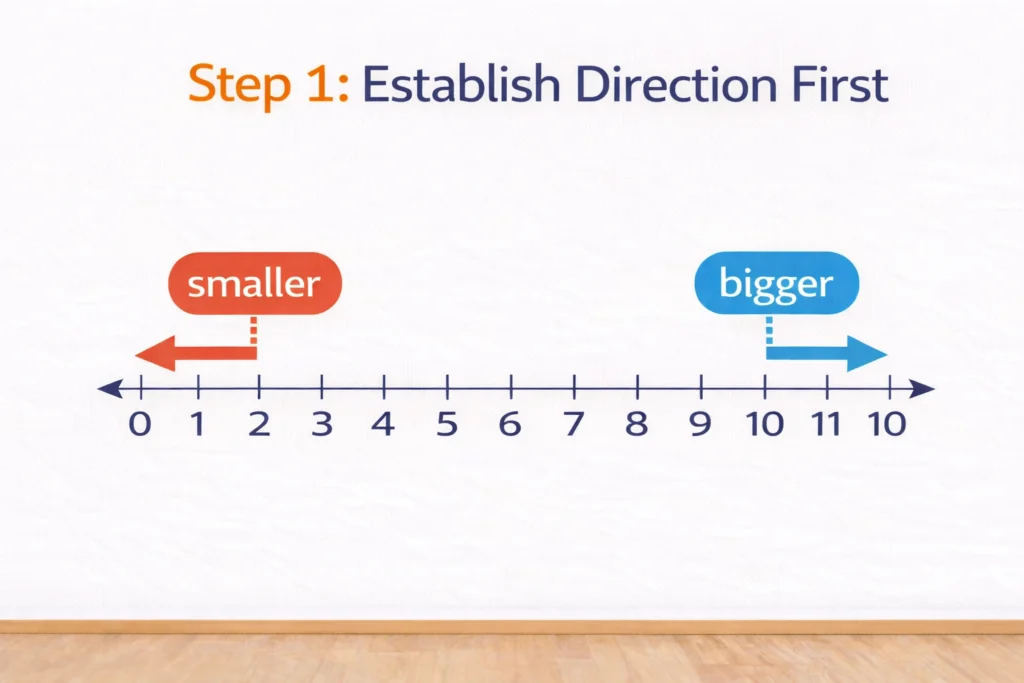
Draw a 0–10 line on the board with an arrow pointing right. Say: “Every step to the right means one more number gets bigger.” Then point left: “Every step to the left means one less numbers get smaller.”
Reinforce with physical movement before any desk work. Have children stand in a line each holding a number card 0–10. Walk from 0 toward 10 together saying “bigger, bigger, bigger,” then walk back saying “smaller, smaller, smaller.”
The physical experience makes the directional convention a body memory, not just a classroom rule.
This direction foundation connects directly to the full teaching approach in how to teach number line maths class 1 — direction must be secure before any positional work begins.
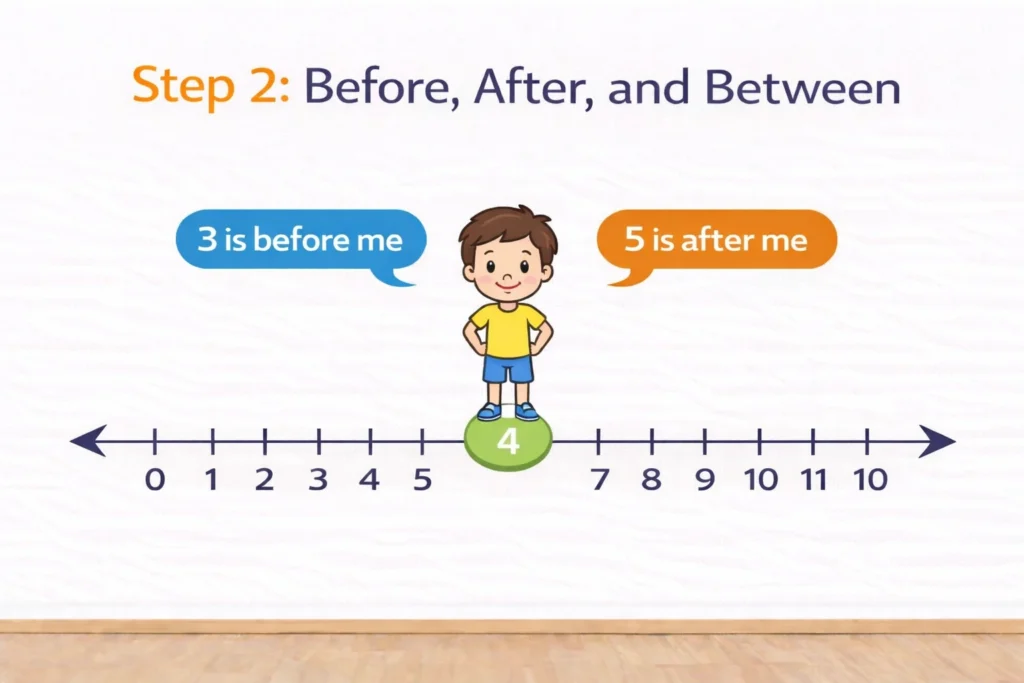
Step 2: Before, After, and Between
These three words are the heart of number position understanding. Children who are fluent with before, after, and between can navigate any number line without counting from zero every time.
Before and After
Every number has exactly one neighbour on each side. Show this clearly:
3 | 4 | 5
- 3 comes before 4
- 5 comes after 4
Ask guiding questions regularly: “What comes just before 7? What comes right after 3? Name both neighbours of 9.”
Building automatic neighbourhood knowledge is one of the highest-value number line skills it directly supports the number sequence fluency in what is the number sequence for class 1 maths.
Between
“Between” extends the idea to three-number relationships:
2 | 3 | 4 — 3 is between 2 and 4.
Start with single-step between questions (“which number is between 6 and 8?”) before moving to wider ranges (“name a number between 3 and 7”).
The wider-range version requires genuine positional understanding the child must know the range, not just count one step.
A common error here is children confusing “between” with “after.” Fix it physically, stand between two children in the classroom, point to the space, and say: “Between means in the middle, not after, not before.”
Then return to the number line with the same language.
Step 3: Greater Than and Less Than as Position
The number line is the most natural and visual way to introduce greater than and less than — far more effective than abstract symbols presented without spatial context.
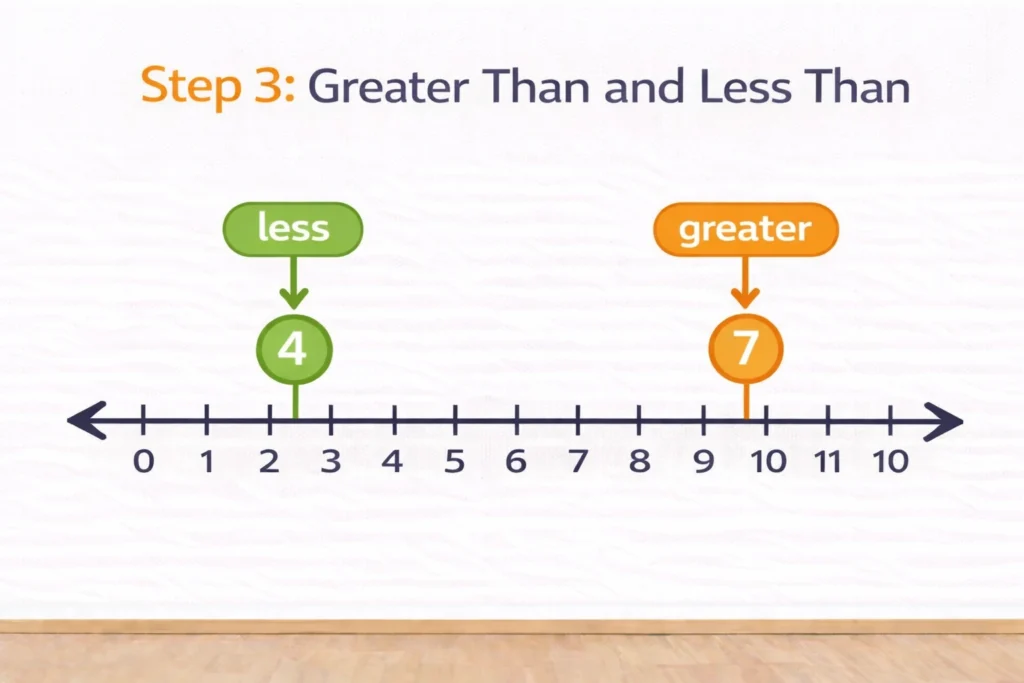
The rule is simple: further right = greater. Further left = less.
Show two numbers — for example, 4 and 7 — on the line. Ask: “Which is further right?” (7.) “So which is greater?” (7.) “Which is further left?” (4.) “So which is less?” (4.)
Repeat with multiple pairs until the spatial reasoning is fluent. Only after children can reliably answer using the number line should the > and < symbols be introduced and always tie them back to position: “7 > 4 means 7 is to the right of 4.”
This visual comparison skill feeds into the ordering work in ascending and descending order in maths for class 1 and builds the number magnitude comparison that underpins all later arithmetic.
Step 4: Equal Spacing
One of the most important structural features of a number line is that every gap between consecutive numbers is exactly the same size. The step from 2 to 3 is identical to the step from 8 to 9.
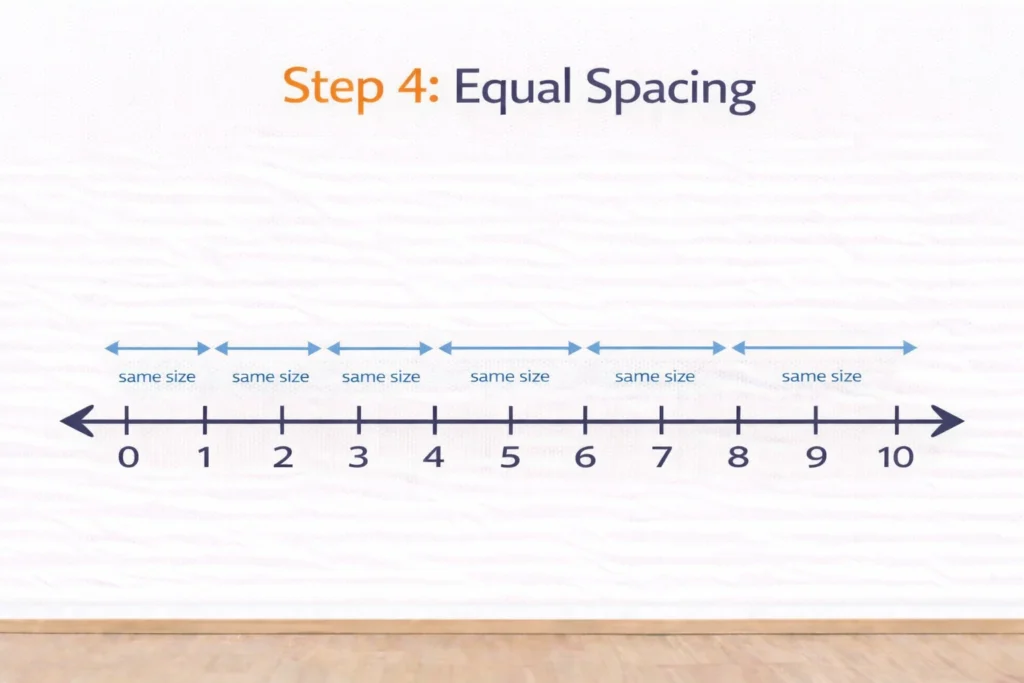
This matters enormously. Equal spacing is what makes the number line a reliable tool; jumps of the same size always produce the same result, regardless of where on the line you start.
It also underpins skip counting: equal repeated jumps of 2 always land on even numbers, equal jumps of 5 always produce multiples of 5.
Teach equal spacing by having children check gaps with a finger: “Is the gap from 3 to 4 the same size as the gap from 7 to 8?”
Use evenly spaced stickers or a ruler to create number lines where equal spacing is visually clear. The pattern regularity that this develops connects to teaching number sequences to class 1 students.
Step 5: Landmark Numbers
Once children are fluent with individual positions, introduce landmark numbers — key reference points that help locate other numbers quickly without counting from zero.
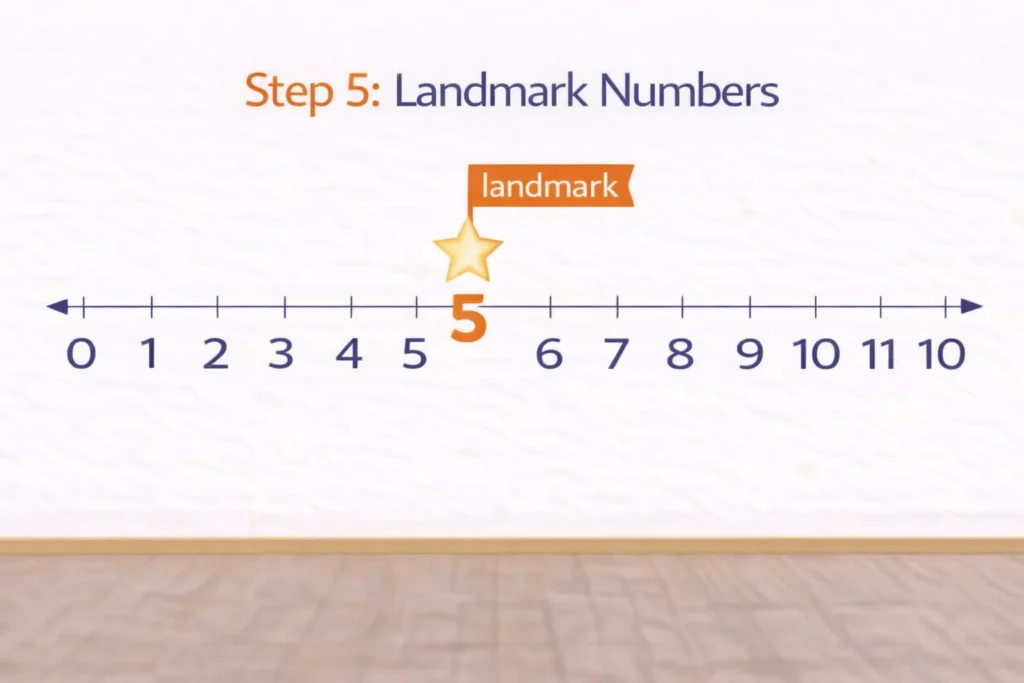
On a 0–10 line, the landmark is 5. On a 0–20 line, the landmarks are 5, 10, and 15. Teach children to always locate the landmark first, then navigate from there rather than from 0.
Ask: “Is 7 closer to 5 or to 10?” This estimation question requires genuine positional understanding and cannot be answered by simple counting.
It builds the spatial number sense connected to spatial understanding for class 1 and prepares children for two-digit number work on a 0–100 line later in the year.
Real-Life Connections
Grounding number positions in real-life contexts makes the abstract concept of “position” concrete and memorable.
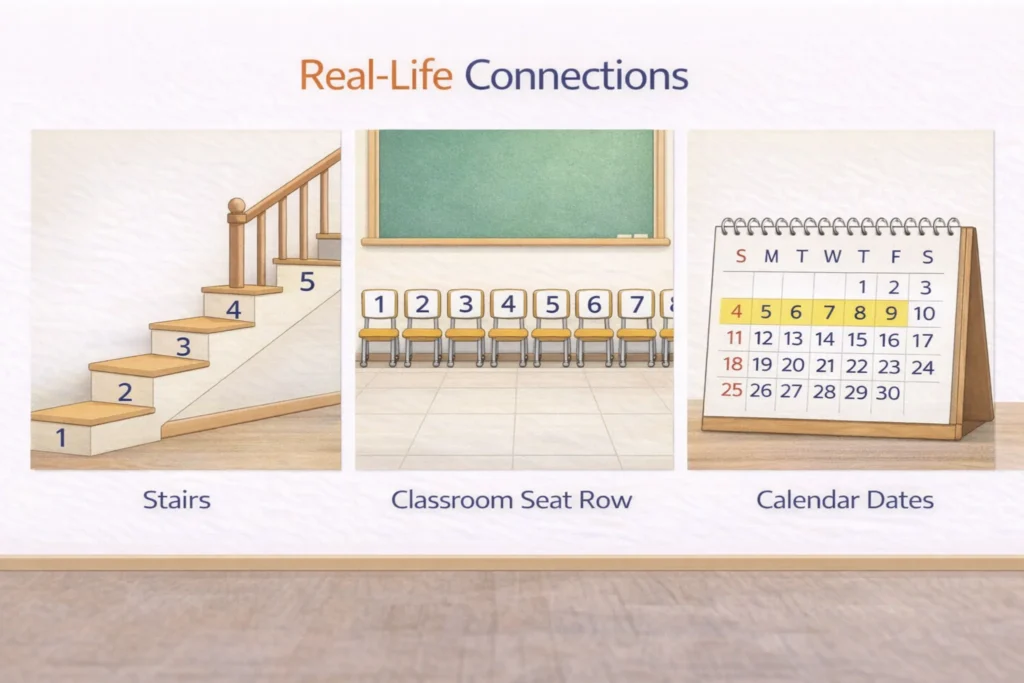
Stairs: Each step is a position on a number line. Moving up one step adds 1; moving down subtracts 1. Equal-size steps reinforce equal spacing. Ask: “You’re on step 4. Go up 3. Which step are you on?”
Seats in a row: Numbered classroom chairs show clear number order. Ask: “Who is before seat 5? Which seat is between 4 and 6?” This makes before/after/between vocabulary feel natural and purposeful.
Calendar dates: A row of calendar dates is a number line in everyday use. Use it to ask position questions and to naturally introduce the ordinal language first, second, third that connects to ordinal numbers for class 1 math.
Key Activities
Fill the Missing Numbers: Give children number lines with gaps — “0, 1, __, 3, __, 5” — and ask them to complete while counting aloud.
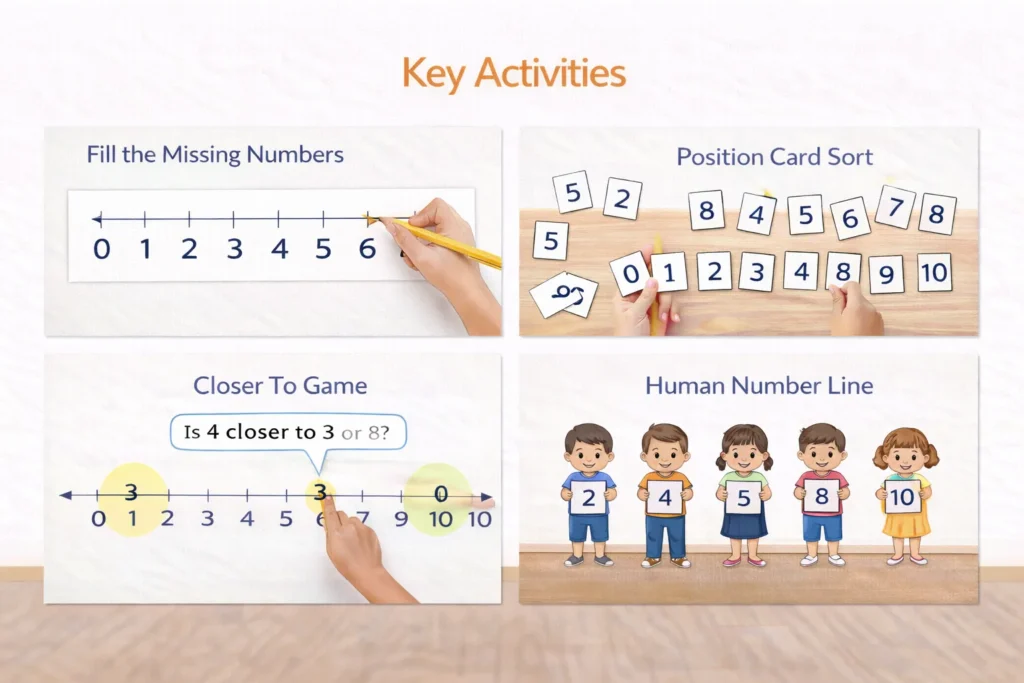
Extend to showing only endpoints (0 and 10) so children place all numbers in between. This demands genuine positional reasoning.
Neighbour Questions: Call out a number and ask children to immediately say both neighbours without looking at the number line. “Neighbours of 6?” (5 and 7.)
Build speed gradually fast neighbour recall is a reliable indicator that positional understanding is truly internalized.
Closer To: Show two landmark numbers. Call out a third and ask: “Is it closer to 3 or to 8?” This estimation activity requires landmark thinking and cannot be answered by counting alone.
It is excellent preparation for the logical reasoning that competition problems at the IMO syllabus for class 1 level reward.
Position Card Sort: Give children number cards 0–10 shuffled. Ask them to arrange in order on a blank line, spacing cards equally.
Discuss relative positions: “Is 7 closer to 5 or 10?” Card sorting builds both ordering and positional magnitude simultaneously.
Common Errors and Fixes
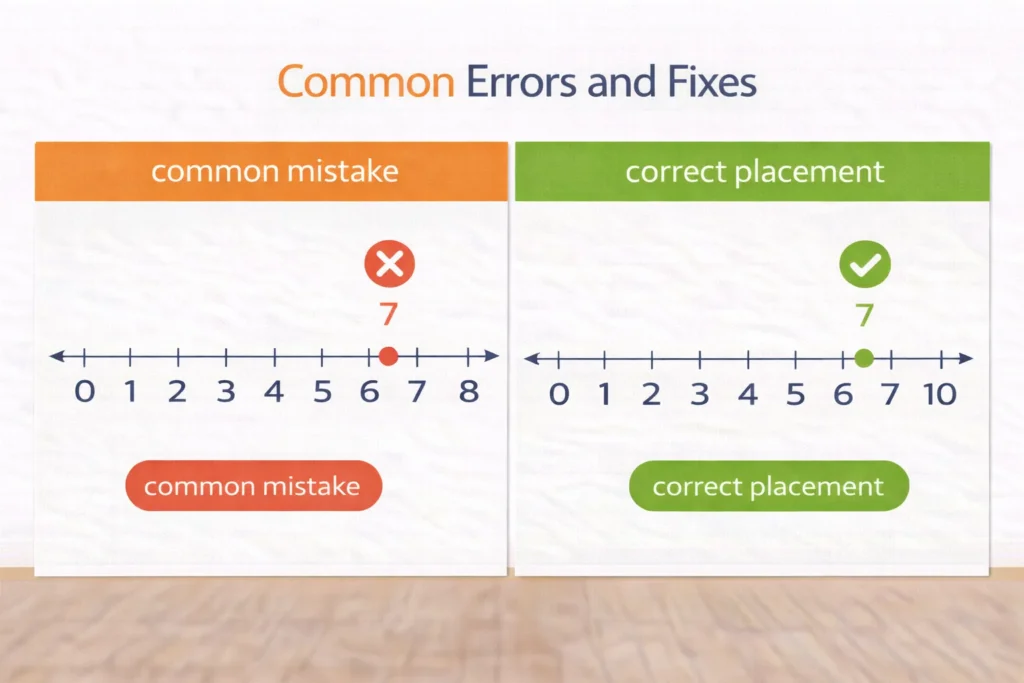
| Error | Fix |
|---|---|
| Confusing “between” with “after” | Stand physically between two students to make the concept spatial before returning to the number line |
| Scanning from zero for every position | Introduce 5 as a midpoint landmark explicitly — “Always start from 5, not 0” |
| Thinking larger numbers have bigger gaps | Check gaps with a finger repeatedly to reinforce equal spacing |
| Misidentifying greater/less than | Always return to the number line — “Which is further right? That one is greater” |
When should I introduce “greater than” and “less than” symbols?
Only after children can reliably identify which of two numbers is further right on the number line and articulate it in plain language. The symbols are shorthand for positional understanding. Introduce them as shorthand, not as the concept itself.
How do I know if a child genuinely understands number positions?
Ask them to place a number on a blank 0–10 line with only the endpoints marked. A child who places 7 correctly, closer to 10 than to 5, with appropriate spacing, has genuine positional understanding. A child who places it randomly or counts from 0 one tick at a time is still at the counting stage.
How does positional understanding connect to olympiad preparation?
Many Class 1 competition problems involve positional reasoning, identifying which number belongs in a given position, finding what sits between two values, or reasoning about relative magnitude. Children with a fluent positional understanding approach these problems naturally. The IMO syllabus for class 1 covers the full range of topics where this foundation applies.
Make Preparing for Math Olympiad Simple!



Conclusion
Number positions on a number line, Class 1 direction, before/after/between, greater/less than, equal spacing, and landmark positions are not separate topics.
They are a connected set of understandings that develop together and reinforce each other.
Teach them progressively, connect them to real-life contexts, and practise them through activities that make the position feel physical and meaningful.
For the full number line teaching methodology, see how to teach number line maths class 1.
For the number sense foundations, see number sense for class 1. For the competition mathematics pathway, see the IMO syllabus for class 1.