 April 3, 2026
 15 min. read

If you’re searching for how to teach word problems Grade 1 students, you’ve already identified one of the trickiest challenges in early math education, and you’re not alone.
Most parents and teachers assume it’s a math problem.
It isn’t. Word problems at the Grade 1 level are a reading and thinking problem. And once you understand that distinction, everything about how to teach math to Grade 1 children changes.
This guide shows how to teach word problems to Grade 1 students using simple strategies, common examples, and an easy 4-step approach for home or classroom learning
For graded word-problem examples your child can practise solving right now, see our guide to word problems for kids, and for the full solving method, how to solve math word problems.
Why Are Word Problems Hard for First Graders?
Children at age 6–7 are what developmental psychologists call concrete thinkers.
They understand the world through things they can see, touch, and physically experience.
Abstract symbols, numbers, operation signs, equations are a second language they’re still learning.
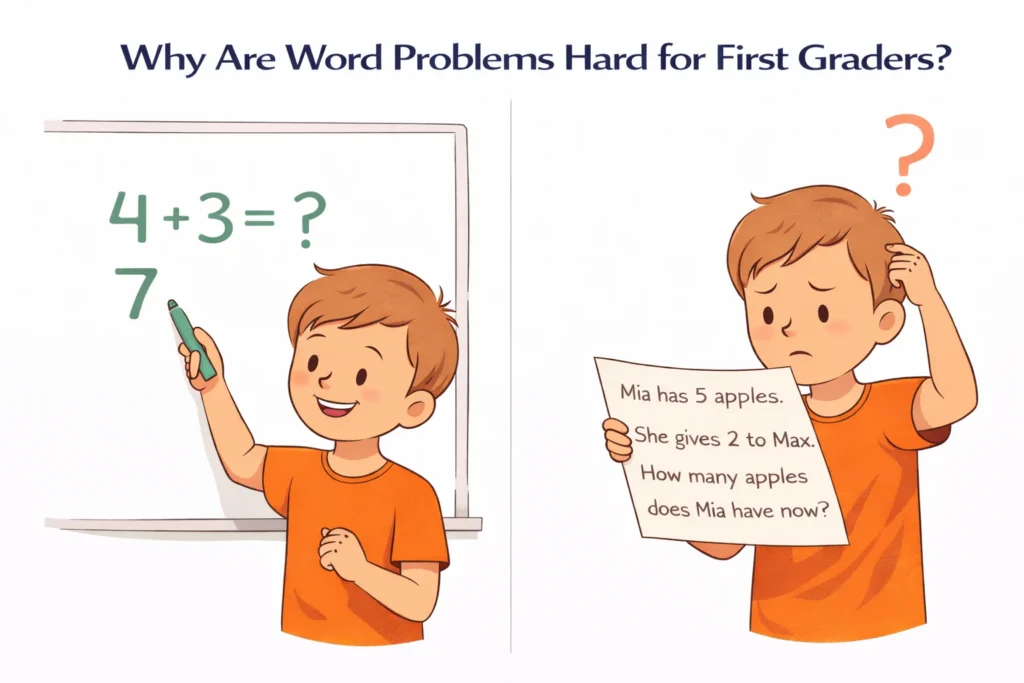
Word problems ask them to do three things at once:
- Read and understand language (decode the story)
- Translate language into math (identify what operation to use)
- Execute the calculation (find the answer)
When a child freezes, it is almost never because they cannot do the arithmetic.
It is because they have not yet built the bridge between the words and the numbers.
This is why reading comprehension matters so much in early maths.
A child who struggles with vocabulary or sentence structure will find word problems harder, even if their number sense for Class 1 is strong.
The reassuring truth: this is entirely normal, and it is entirely teachable.
How Do Children Calculate in First Grade Math?
Before you can teach word problems effectively, it helps to understand how first graders actually calculate because it’s nothing like how adults do it.
At ages 6–7, children calculate through three natural stages:
- Counting all: For 4 + 3, a child counts out 4 fingers or objects, then 3 more, then counts everything from one. This is the earliest stage and it’s completely normal.
- Counting on (and counting back): The child starts from one number and counts forward — “4… 5, 6, 7!” — or counts back to subtract. This is a major milestone, and it builds directly on number sequences. If your child isn’t there yet, our guide on how to teach number sequences to Class 1 covers it step by step.
- Known facts and derived facts: Eventually children just know 4 + 3 = 7, and use known facts to work out new ones (4 + 4 = 8, so 4 + 3 must be one less).
Why this matters for word problems: a child can only solve a story problem using a calculation strategy they already own.
If a child is still “counting all,” asking them to write equations from a word problem is two developmental steps too far. Match the word problem to the calculation stage, not the other way around.
How Can First Graders Solve Word Problems Without Equations?
If your child hasn’t learned equations yet, they don’t need them. Every Grade 1 word problem can be solved with the picture method:
- Read the story aloud together.
- Draw the story — for “Meena had 8 balloons, 3 flew away,” draw 8 balloons and cross out 3.
- Count the picture. What’s left is the answer.
The drawing is the maths. There is no rule that says a 6-year-old must produce “8 − 3 = 5” to have solved the problem correctly. Equations come later, as a record of thinking the child has already done with pictures — which is exactly what the CPA method below formalises.
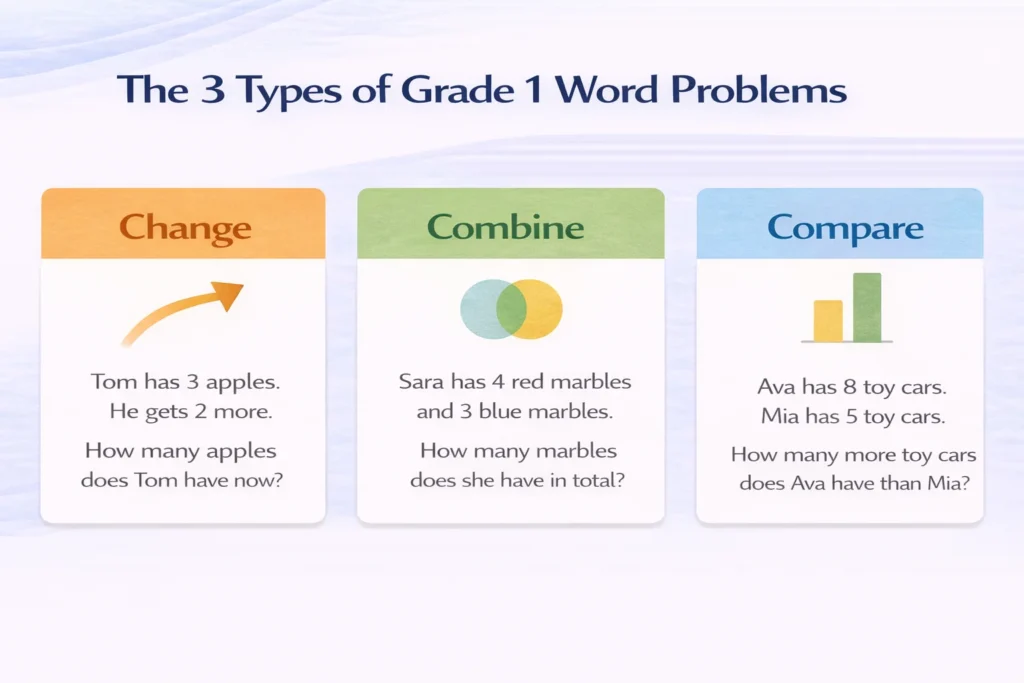
The 3 Types of Grade 1 Word Problems
Most word problems for Grade 1 fall into one of three categories. Teaching children to recognise which type they’re looking at is a skill in itself children don’t naturally categorise problems on their own.
1. Change Problems A quantity goes up or down.
“Riya had 5 apples. She got 3 more. How many does she have now?” “Tom had 9 stickers. He gave away 4. How many does he have left?”
2. Combine Problems Two separate groups are joined together.
“There are 4 cats and 3 dogs in the park. How many animals are there altogether?”
3. Compare Problems Two quantities are compared to find the difference.
“Ana has 8 pencils. Ben has 5. How many more pencils does Ana have than Ben?”
Compare problems are typically the hardest for first graders because the question doesn’t involve any actual joining or removing — it requires reasoning about the gap between two numbers.
When you introduce a new problem, name the type out loud: “This is a combined problem of two groups coming together.”
Over time, children start identifying types independently. That recognition dramatically reduces the cognitive effort needed to solve the problem.
Understanding these types connects directly to number sequences for Class 1 children who understand that numbers follow a predictable order, find it far easier to reason about change and comparison.
The Concrete–Pictorial–Abstract (CPA) Method
The single most important thing to understand about teaching math story problems for kids is this: most teaching skips straight to the abstract. That’s the problem.
The CPA method originally developed by psychologist Jerome Bruner and central to Singapore mathematics education describes how children actually build understanding:
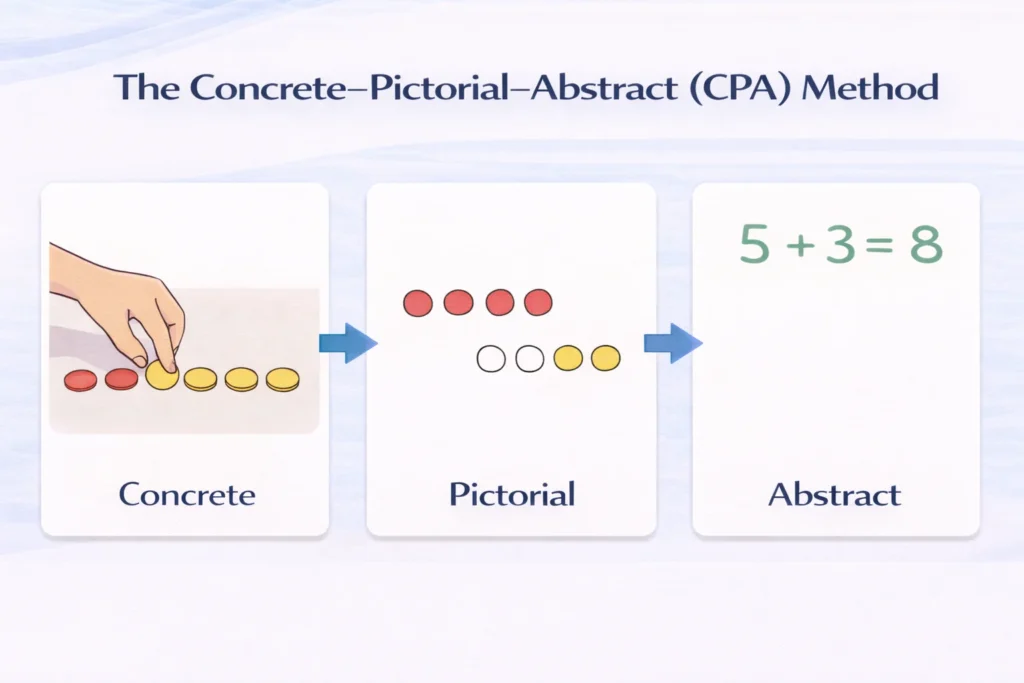
Concrete → Pictorial → Abstract
Concrete
Use physical objects to act out the story. Grapes, blocks, coins, toy cars, fingers. The child moves the objects, counts them, and experiences the problem as a real event.
For “Riya had 5 apples and got 3 more,” place 5 objects on the table, then add 3 more and count them together.
Pictorial
Draw the story. It doesn’t need to be neat — stick figures, circles, tally marks. The drawing bridges the gap between the physical experience and the written number.
Draw 5 circles, add 3 more, count 8.
Drawing pictures is the single most under-used stage. If your child freezes on word problems, more picture-drawing — not more worksheets — is almost always the fix.
Abstract
Only now write the number sentence: 5 + 3 = 8.
The mistake most adults make is starting here. A child who hasn’t gone through the concrete and pictorial stages doesn’t truly understand what 5 + 3 = 8 means in a story; they’re just pattern-matching symbols.
You don’t need to move rigidly through all three stages every time. But whenever a child is stuck or confused, go back. Return to objects. Return to drawing. The abstract will follow.
A Simple 4-Step Teaching Strategy
This step-by-step word problem strategy works for both addition and subtraction word problems at Grade 1. Use it consistently until it becomes a habit.
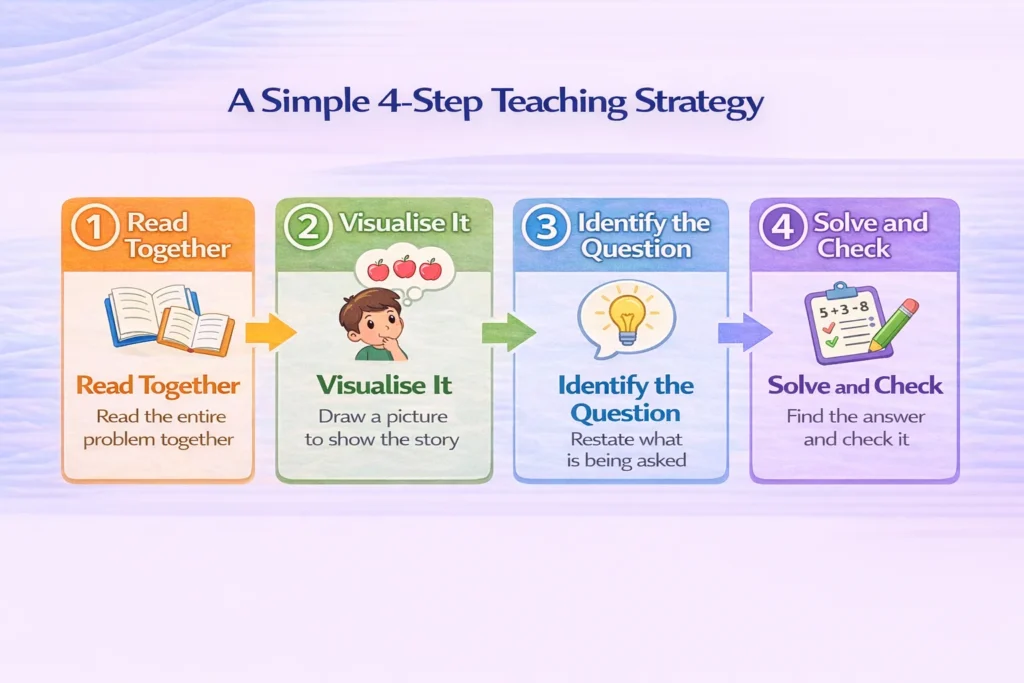
This is also the answer to a question many parents ask: how should children approach problem-solving questions in lower-grade mathematics? T
The same four steps apply to every problem they’ll meet in Grade 1, and they work just as well for addition and subtraction for Class 1 practice generally.
Step 1: Read Together Read the problem aloud, slowly, together. Don’t rush to the numbers. Ask: “What’s the story about?”
Step 2: Visualise It Act it out with objects OR draw it. Don’t skip this step, even when the child thinks they know the answer.
Step 3: Identify the Question Point to the last sentence. Ask: “What is this actually asking us to find?” Many children solve the wrong thing because they never clearly identify the question.
Step 4: Solve and Check Write the number sentence. Then re-read the original problem and ask: “Does this answer make sense in the story?”
Worked Example: Addition Word Problem
Problem: “There are 6 frogs on a log. 3 more frogs jump on. How many frogs are on the log now?”
- Step 1: Read together. “It’s a story about frogs on a log.”
- Step 2: Place 6 counters. Add 3 more. Count: 9.
- Step 3: “It’s asking: how many frogs are on the log now?”
- Step 4: Write 6 + 3 = 9. Re-read: “9 frogs. Does that make sense? Yes — we started with 6 and added more.”
Worked Example: Subtraction Word Problem
Problem: “Meena had 8 balloons. 3 flew away. How many balloons does she have left?”
- Step 1: Read together. “It’s a story about balloons flying away.”
- Step 2: Place 8 objects. Remove 3. Count what’s left: 5.
- Step 3: “It’s asking: how many does she have left?”
- Step 4: Write 8 − 3 = 5. Re-read: “5 balloons. Does that make sense? Yes — some flew away so there should be fewer.”
Parent and Teacher Teaching Scripts
These aren’t robotic scripts; they’re natural conversation starters that guide thinking without answering away.
Use them whenever you work through a problem together.
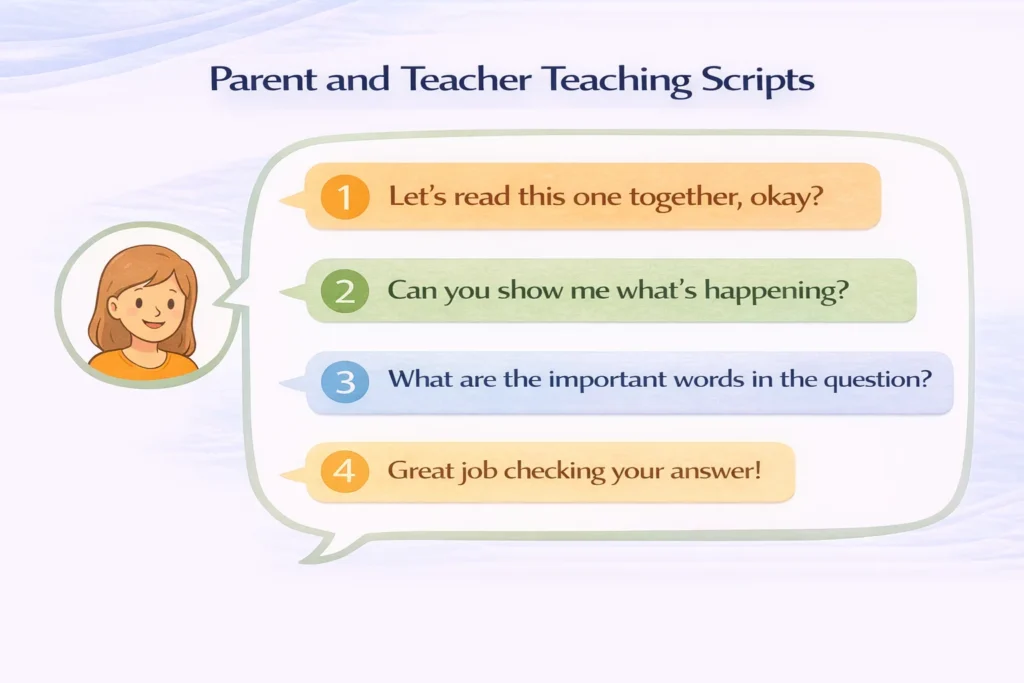
- “Before we solve anything, let’s just read it together. What’s the story about?” (Slows the child down and builds comprehension before calculation.)
- “Can you show me with these counters what’s happening in the problem?” (Activates the concrete stage — moves the child away from guessing.)
- “What does the problem want us to find out? Can you point to the question?” (Ensures the child is solving the right thing.)
- “Does that answer make sense in the story? Let’s check.” (Builds the habit of verification — one of the most valuable math skills.)
- “Let’s draw it first. You don’t have to make it neat.” (Normalises drawing as a thinking tool, not a test of artistic skill.)
- “You’re not stuck — you’re thinking. Take your time.” (Reduces math anxiety and models that pausing is part of the process.)
These scripts work alongside the approach in how to teach forward and backward counting to kindergarten students.
Slowing down and verbalising thinking is consistently the most effective support strategy for young learners.
Common Mistakes and How to Fix Them
The most important diagnostic in teaching word problems to first graders is this: “My child can compute but can’t solve story problems.”
This is not a maths gap. It’s a reading comprehension and visualisation gap and it’s fixable.
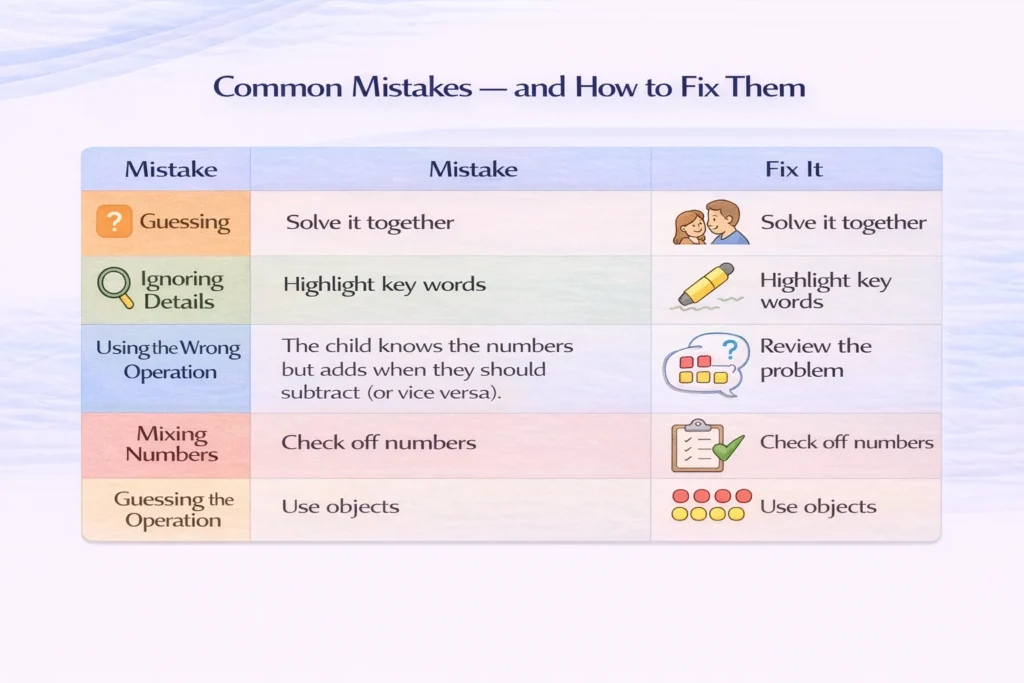
| Common Mistake | What It Means | How to Fix It |
| Grabs the numbers and adds them automatically | Child is pattern-matching, not reading | Return to Step 1. Insist on full read-aloud before touching numbers |
| Solves the wrong thing (e.g. answers a different question) | Didn’t identify the question clearly | Practise Step 3 in isolation — point to the question, repeat it aloud |
| Correct operation, wrong calculation | Maths gap, not a word problem gap | Use concrete objects to verify the arithmetic separately |
| Freezes completely | Overwhelmed by words + numbers simultaneously | Reduce to concrete only: read once, act it out, don’t write anything |
| Solves correctly but can’t explain how | Understands procedurally but not conceptually | Ask “what does this number mean in the story?” after every answer |
How to Use Manipulatives and Drawing
You don’t need special teaching equipment. The best manipulatives for problem solving skills in Grade 1 are already in your home or classroom.
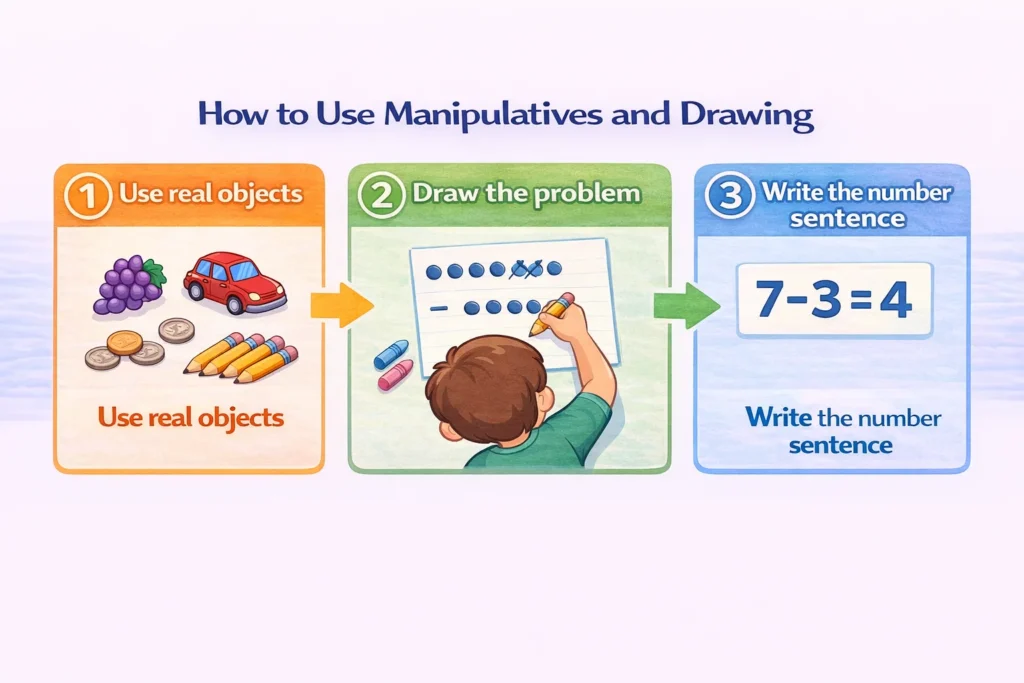
Everyday objects that work:
- Grapes or raisins at snack time (“You have 7 grapes. You eat 3. How many are left?”)
- Toy cars lined up and driven away
- Coins sorted and counted
- Pencils grouped and handed out
- Fingers — always available, always reliable
Why it works: Physical objects give the child a real experience of the mathematical action joining, removing, comparing. Once they’ve experienced it concretely, the abstract number sentence has meaning rather than just being a symbol to memorise.
For drawing: Tell children they don’t need to draw things accurately. A circle is a person, a dot is a sweet, a line is a pencil. The goal is a visual map of the story, not artwork. Drawing activates spatial thinking and helps children see the structure of the problem before they calculate.
When you model drawing, say: “I’m going to draw what’s happening. I’ll use circles for the children.” Draw it aloud, narrating as you go. Children learn to draw problems by watching adults model it without embarrassment.
If you’d like more hands-on reasoning activities in this style, see our critical thinking activities for Grade 1 — they pair naturally with word-problem practice.
A Simple 4-Week Starter Plan
This isn’t a rigid timetable, it’s a flexible rhythm. Aim for 2–3 short sessions per week (10–15 minutes each). If the child needs more time at any stage, stay there.
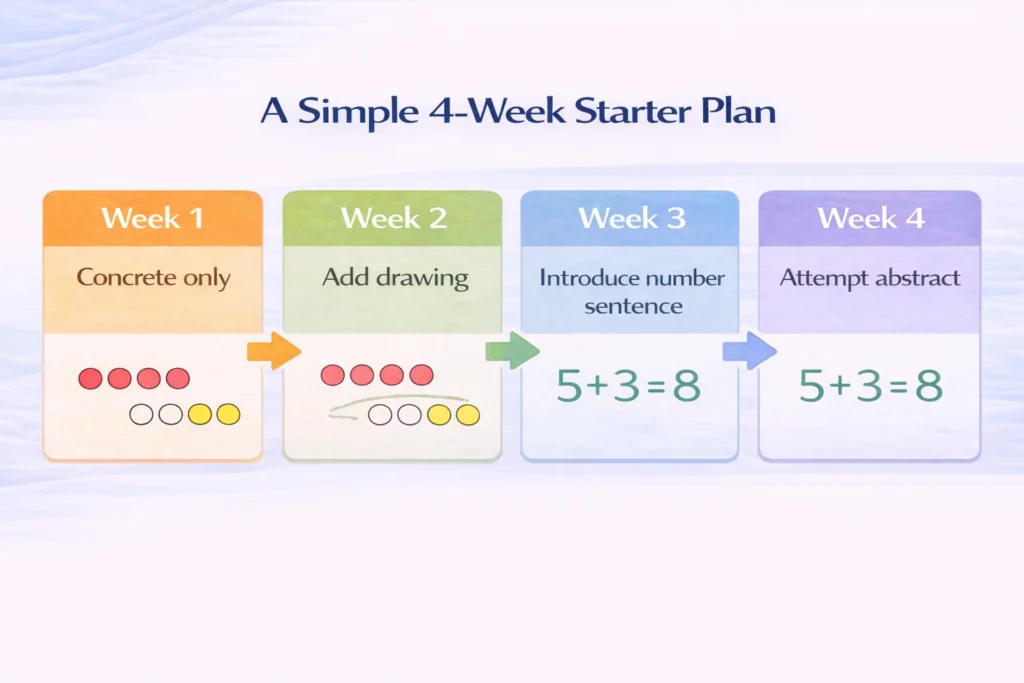
Week 1 — Concrete Only Solve every problem using physical objects. No writing, no equations. Read the problem aloud, act it out, count the answer. The goal is comfort with the story, not speed.
Week 2 — Add Drawing Before touching objects, draw the story first. Then verify with objects if needed. Start with the child watching you draw, then gradually hand the pencil over.
Week 3 — Introduce the Number Sentence After drawing, write the equation alongside the picture. Show the connection explicitly: “These 5 circles are the 5 frogs. This + means more jumped on. The 3 new circles are these 3 frogs.”
Week 4 — Attempt Abstract Problems Try a problem using the number sentence without drawing first. If the child hesitates or gets stuck, say: “Let’s draw it” not as a punishment but as a normal thinking tool. Always return to concrete or pictorial when needed.
Progress isn’t linear. A child might manage abstract problems on Tuesday and need counters again on Friday. That’s completely normal.
If you enjoy working from a structured weekly rhythm, our lesson plan on skip counting for Class 1 follows the same low-pressure format and makes a good companion unit.
Realistic Expectations for a Kid
Here’s what age-appropriate progress actually looks like for first grade word problems:
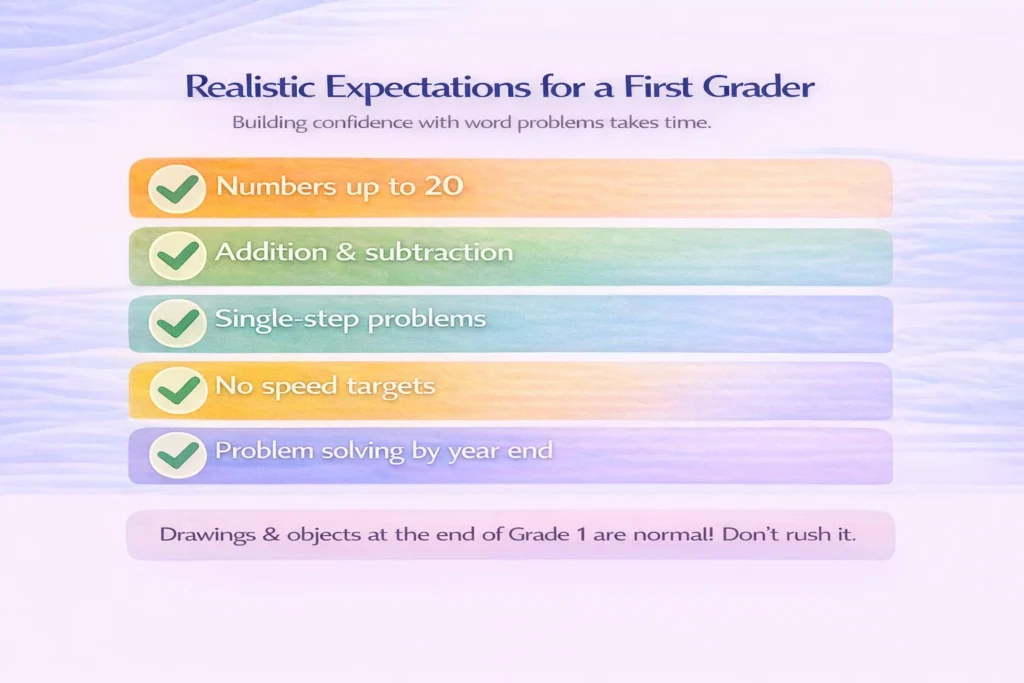
- Numbers: Up to 20. No three-digit numbers, no carrying.
- Operations: Addition and subtraction only. No multiplication or multi-step problems.
- Problem types: Single-step change, combine, and compare problems.
- Speed: There is no target speed. A child who solves one problem correctly using counters and drawing has succeeded.
- Independence: By the end of Grade 1, most children can solve familiar problem types with minimal prompting. That’s the goal.
What counts as progress isn’t a perfect score. It’s a child who reads the whole problem before grabbing numbers. Who draws before calculating.
Who checks whether their answer makes sense. These habits built slowly, without pressure are what create confident, capable mathematical thinkers.
If your child is still relying on objects and drawing at the end of Grade 1, that is fine. Many children need longer in the concrete and pictorial stages.
Pushing too quickly to abstract is the most common teaching mistake at this level.
Why does my child freeze on word problems but not number sums?
Word problems require reading comprehension and maths simultaneously a much heavier cognitive load than a standalone number sentence. When a child freezes, it’s usually a language or visualisation gap, not a maths gap. Slowing down, reading aloud together, and acting the problem out with objects almost always breaks the freeze.
What are the 3 types of Grade 1 word problems?
The three main types are change problems (a quantity increases or decreases), combine problems (two groups are joined together), and compare problems (two quantities are compared to find the difference). Teaching children to name the type before solving makes the problem feel more structured and less overwhelming.
Should I use worksheets or real objects to teach word problems?
Real objects first, always. Worksheets are useful for practice once a child understands the structure, but they’re not a teaching tool. A child who can solve a worksheet problem without understanding what the numbers mean in the story hasn’t truly grasped the concept. Start with grapes, toy cars, or coins. Worksheets come later.
What is the CPA method and does it work for Grade 1?
The Concrete–Pictorial–Abstract (CPA) method is a teaching progression developed by psychologist Jerome Bruner and widely used in Singapore mathematics education. It moves from physical objects (concrete), to drawings (pictorial), to written equations (abstract). Research consistently supports its effectiveness for early learners, and it’s especially well-suited to Grade 1 because it matches how 6–7 year olds naturally develop understanding.
How long does it take for a Grade 1 child to get comfortable with word problems?
Most children need 4–8 weeks of consistent, low-pressure practice to build genuine comfort with familiar word problem types. Progress depends heavily on the amount of concrete and pictorial experience they gain. Children who spend more time with objects and drawings typically become more confident faster than those pushed to abstract equations too soon. Expect uneven progress: some weeks will feel like breakthroughs, others like regression. Both are normal.
How can first graders solve word problems without learning equations?
Use the picture method: read the problem aloud, draw the story (for example, draw 8 balloons and cross out 3), and count the picture to find the answer. For 6–7 year olds, a drawing is a complete and correct solution written equations come later as a record of thinking the child has already done.
How do children calculate in first-grade math?
First graders calculate in three stages: counting all (counting every object from one), counting on or counting back (starting from one number and counting forward or backward), and finally using known number facts. Children can only solve word problems using a calculation stage they’ve already mastered, so match the problem to the child’s stage.
Make Preparing for Math Olympiad Simple!



Final Thought
Word problems aren’t a wall your child has to crash into. They’re a skill built in small steps, with the right support, at the right pace.
The children who become confident problem solvers aren’t the ones who were pushed hardest or practiced the most worksheets.
Start with one problem today. Read it aloud. Grab whatever’s nearby grapes, coins, pencils. Act it out together. Don’t rush to the equation.
And when your child is ready for independent practice, the Gonit app turns these same problem types into daily, game-like practice a natural next step once the teaching foundations from this guide are in place.