May 20, 2026
 20 min. read

Searching for SilverZone Olympiad books? Most parents either buy too many or pick the wrong one books that don’t match the syllabus, the exam pattern, or their child’s level.
There are dozens of SilverZone Olympiad books out there and no clear answer on which ones your child actually needs.
This guide gives you class-wise book picks from Class 1 to 12, official vs reference comparisons, and a preparation strategy so you buy right the first time.
What Are SilverZone Olympiads? A Quick Overview
SilverZone Foundation conducts national and international-level Olympiad exams for students from Class 1 to Class 12 across India.
These are school-level competitive exams designed to test conceptual understanding beyond regular school textbooks.
If you’re wondering how SilverZone compares to other Olympiad bodies, our detailed SOF vs SilverZone comparison breaks it down.
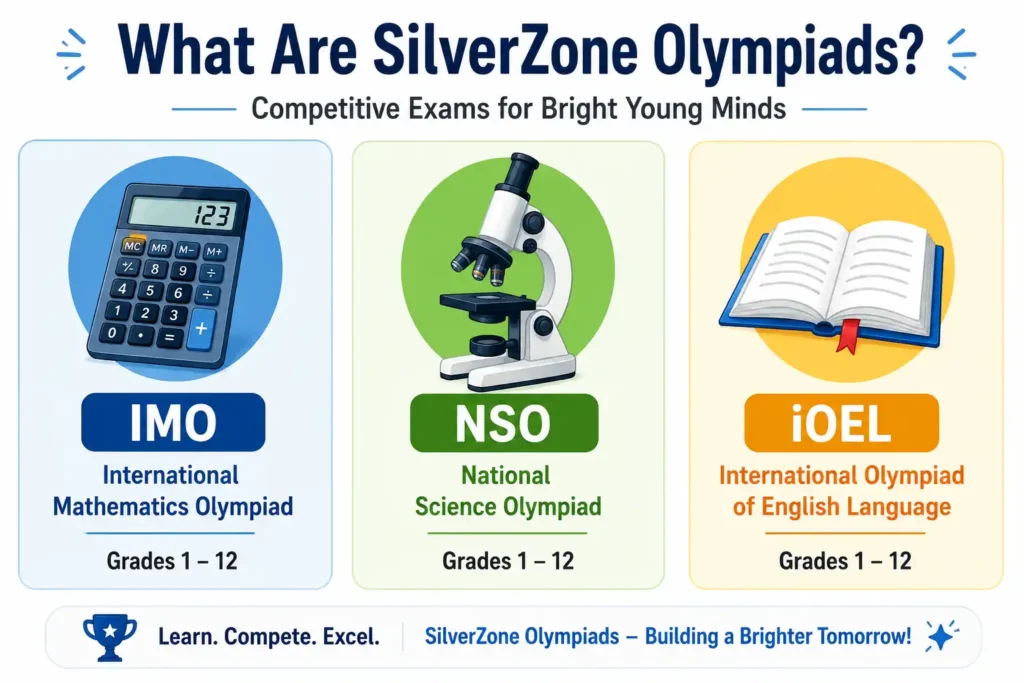
Three major SilverZone Olympiads are:
iOM — International Olympiad of Mathematics
The iOM tests mathematical understanding, logical reasoning, and problem-solving skills.
The syllabus is closely mapped to the CBSE/ICSE/State Board curriculum for each class, with additional sections on analytical reasoning and mental ability.
This is the most popular SilverZone Olympiad, and the best SilverZone Maths Olympiad books focus heavily on higher-order thinking questions beyond the textbook.
For a deeper look at the SilverZone maths exam specifically, read our guide on SilverZone IOM.
iOS — International Olympiad of Science
The iOS evaluates scientific concepts and their application. Questions cover the current academic syllabus plus applied science and reasoning.
SilverZone Science Olympiad books are essential here because the exam tests application-based understanding, not rote memorisation.
iOEL — International Olympiad of English Language
The iOEL assesses vocabulary, grammar, comprehension, and functional English.
It’s based on the CBSE/ICSE syllabus with a mental aptitude section.
SilverZone English Olympiad books help build language skills beyond what school textbooks typically cover.
Exam structure (all three):
| Feature | Details |
| Eligibility | Classes 1–12 (all recognised boards) |
| Format | MCQ, no negative marking |
| Level 1 | All registered students |
| Level 2 | Top 1000 rank holders from Level 1 (min. 50% marks) |
| Level 3 | 1st rank holders from Level 2 (Classes 6–12), held in New Delhi |
| Top prizes | Trip to NASA (iOM/iOS), Trip to London (iOEL) |
How to Choose the Right SilverZone Olympiad Books
Before you add anything to your cart, here are four things to check.
Getting these right saves money and, more importantly, prevents your child from struggling with the wrong material.
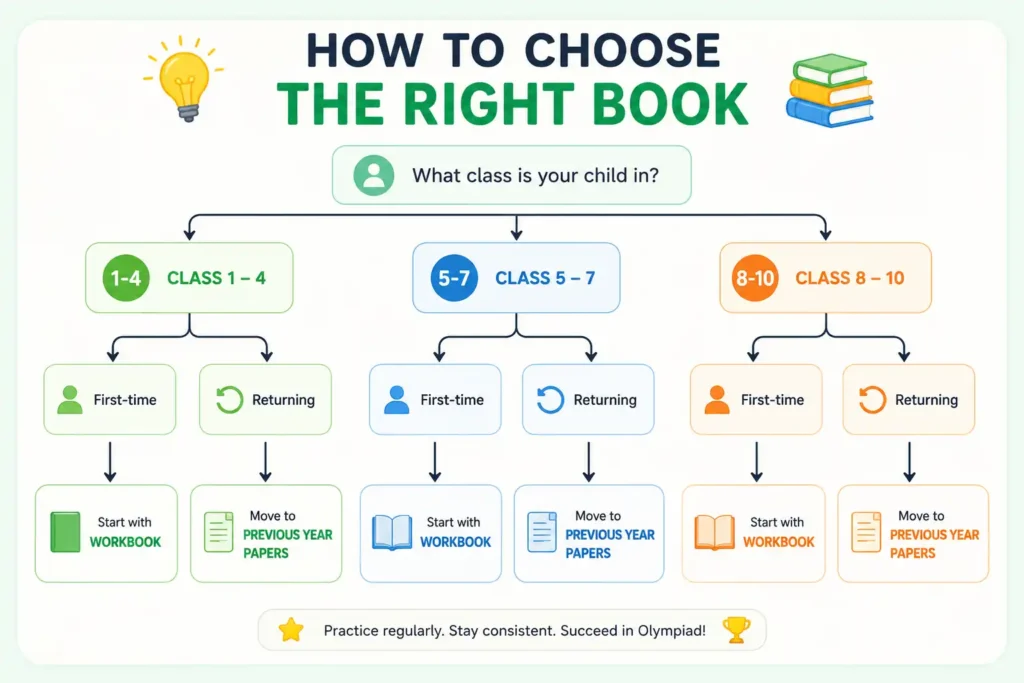
Check Syllabus Alignment First
The single most important factor. SilverZone Olympiad syllabus books should map directly to the topics your child will face in the exam.
SilverZone publishes its syllabus on the official website. Compare the topic list with the table of contents of any book before buying. Official SilverZone workbooks are naturally aligned.
Third-party reference books may cover extra topics or miss some. For reference, you can also check how the SOF IMO syllabus compares, which helps parents understand what’s unique to SilverZone.
For Class 1 parents specifically, our IMO syllabus for class 1 guide covers the topic breakdown in detail.
Match the Difficulty to Your Child’s Level
A Class 4 student attempting their first Olympiad doesn’t need an advanced problem-solving book. Start with books labeled “beginner” or “foundation.”
If your child scored well in a previous attempt or finds school maths easy, move to moderate or advanced-level SilverZone Olympiad preparation books.
Official Books vs Reference Books
Official SilverZone Olympiad study material (workbooks, sample papers) gives you the closest match to actual exam questions.
Reference books from publishers like MTG Learning Media provide broader practice and deeper concept coverage. Most students benefit from one official book + one reference book per subject.
Don’t Forget Previous Year Papers
SilverZone Olympiad previous year papers are one of the most underrated resources. They show exact question patterns, difficulty distribution, and recurring topic areas. Always include at least one previous year paper compilation in your book selection.
If you want to see what Olympiad-level questions look like before buying any book, browse our collection of math olympiad questions.
Best SilverZone Olympiad Books by Class
This is the section most parents are looking for.
Below are class-wise book recommendations organised by class group.
Every recommendation includes the book name, subject, difficulty level, and who it’s best for.
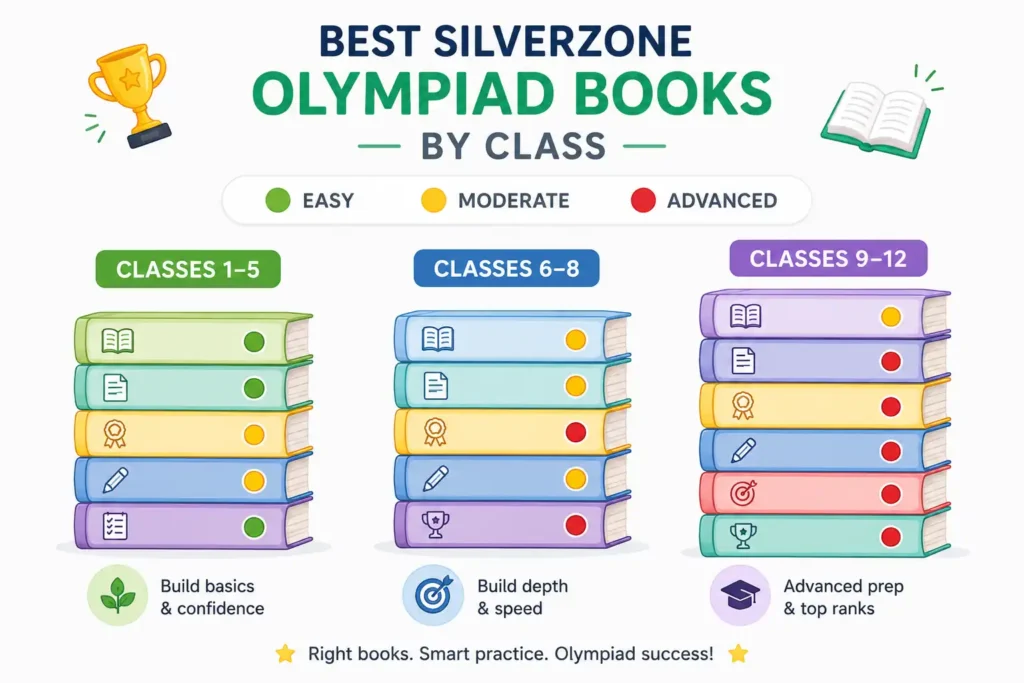
Best Books for Classes 1–5 (Primary)
Young students need books that are visually engaging, age-appropriate, and build confidence. Avoid anything that feels like a “test prep grind” at this stage.
The goal is to develop curiosity and comfort with Olympiad-style questions.
| Book Name | Subject | Difficulty | Best For |
|---|---|---|---|
| SilverZone IMO Official Workbook (Class-wise) | Maths | Easy | First-time Olympiad participants. Covers syllabus topics with practice questions directly aligned to the SilverZone IMO pattern. |
| SilverZone NSO Official Workbook (Class-wise) | Science | Easy | Beginners preparing for the National Science Olympiad. Simple language, colorful layout for younger learners. |
| SilverZone iOEL Official Workbook (Class-wise) | English | Easy | Students preparing for the English Olympiad. Focuses on grammar, vocabulary, and comprehension at age-appropriate difficulty. |
| MTG National Science Olympiad (NSO) Book (Class-wise) | Science | Easy–Moderate | Students who’ve finished the official workbook and want more practice. Broader question bank with concept explanations. |
| MTG International Mathematics Olympiad (IMO) Book (Class-wise) | Maths | Easy–Moderate | Students comfortable with school-level maths who want a step up. Includes topic-wise practice and previous year questions. |
| SilverZone Previous Year Papers (Class-wise) | All Subjects | Moderate | Students in the final month of preparation. Essential for understanding exam pattern and time management. |
SilverZone Olympiad books for Class 1 and Class 2 should focus almost entirely on official workbooks — at this age, familiarity with the question format matters more than advanced practice.
If your child is in Class 1 and you’re unsure about the registration process, check our guide on how to apply for the maths olympiad for class 1.
For SilverZone Olympiad books for Class 3, Class 4, and Class 5, you can start introducing one MTG reference book alongside the official material if your child is showing strong interest.
Tip for parents of primary students: Pair book study with daily Maths practice on the Gonit App.
Short, concept-based practice sessions (10–15 minutes) build the problem-solving habits that help students apply what they’ve learned from books.
Building strong fractions for class 1 skills and comfort with word problems for kids early on makes Olympiad questions feel far less intimidating.
Best Books for Classes 6–8 (Middle School)
This is where Olympiad preparation gets more structured. Students can handle longer practice sessions, and the syllabus depth increases significantly.
SilverZone Olympiad books for Class 6, Class 7, and Class 8 should introduce higher-order thinking and multi-step problems.
| Book Name | Subject | Difficulty | Best For |
|---|---|---|---|
| SilverZone IMO Official Workbook (Class-wise) | Maths | Moderate | Core preparation. Every student should start here for syllabus-aligned practice. |
| SilverZone NSO Official Workbook (Class-wise) | Science | Moderate | Foundation-level science Olympiad prep. Good for understanding the NSO question style. |
| SilverZone iOEL Official Workbook (Class-wise) | English | Moderate | Solid grammar and comprehension practice for the iOEL exam pattern. |
| MTG Maths Olympiad Explorer (Class-wise) | Maths | Moderate–Advanced | Students who find the official workbook too easy. Deeper problem sets with explained solutions. |
| MTG Science Olympiad Explorer (Class-wise) | Science | Moderate–Advanced | Students aiming for top ranks in NSO. Application-based questions beyond textbook level. |
| SilverZone Previous Year Papers (Class-wise) | All Subjects | Moderate | Exam simulation. Time the papers to build speed and accuracy. |
| Pearson IIT Foundation Series (Class-wise) | Maths/Science | Advanced | Students interested in competitive maths beyond Olympiad — bridges Olympiad prep with foundational competitive exam thinking. |
SilverZone Olympiad books for Class 6 should still lean toward official material with one reference book added. By Class 7 and Class 8, students can handle two reference books if they’re serious about ranking well.
Students in this age group who want to sharpen their fundamentals should also work on factorisation in maths class 8 it’s a topic that comes up frequently in Olympiad papers.
Best Books for Classes 9–12 (Senior)
Senior students need resources that challenge them at a higher level.
The SilverZone Olympiad syllabus for these classes closely mirrors CBSE/ICSE board content but tests deeper conceptual understanding and application.
| Book Name | Subject | Difficulty | Best For |
|---|---|---|---|
| SilverZone IMO Official Workbook (Class-wise) | Maths | Moderate | Starting point for SilverZone-specific preparation. Covers the exact syllabus and question pattern. |
| SilverZone NSO Official Workbook (Class-wise) | Science | Moderate | Must-have for understanding NSO-specific question framing at the senior level. |
| MTG Maths Olympiad Challenger (Class-wise) | Maths | Advanced | Students aiming for top 1% scores. Complex multi-concept problems with detailed solutions. |
| MTG Science Olympiad Challenger (Class-wise) | Science | Advanced | Rigorous science problems for high-performing students. Physics and Chemistry focus for senior classes. |
| SilverZone Previous Year Papers (Class-wise) | All Subjects | Moderate–Advanced | Non-negotiable. Senior-level previous year papers reveal exactly how tough the exam gets. |
| RD Sharma / RS Aggarwal (relevant chapters) | Maths | Moderate | Students who need to strengthen school-level fundamentals before attempting Olympiad-level problems. |
| Oswaal Olympiad Sample Papers (Class-wise) | Maths/Science | Moderate | Additional practice for students who want variety in question types beyond official and MTG books. |
Subject-Wise Book Recommendations
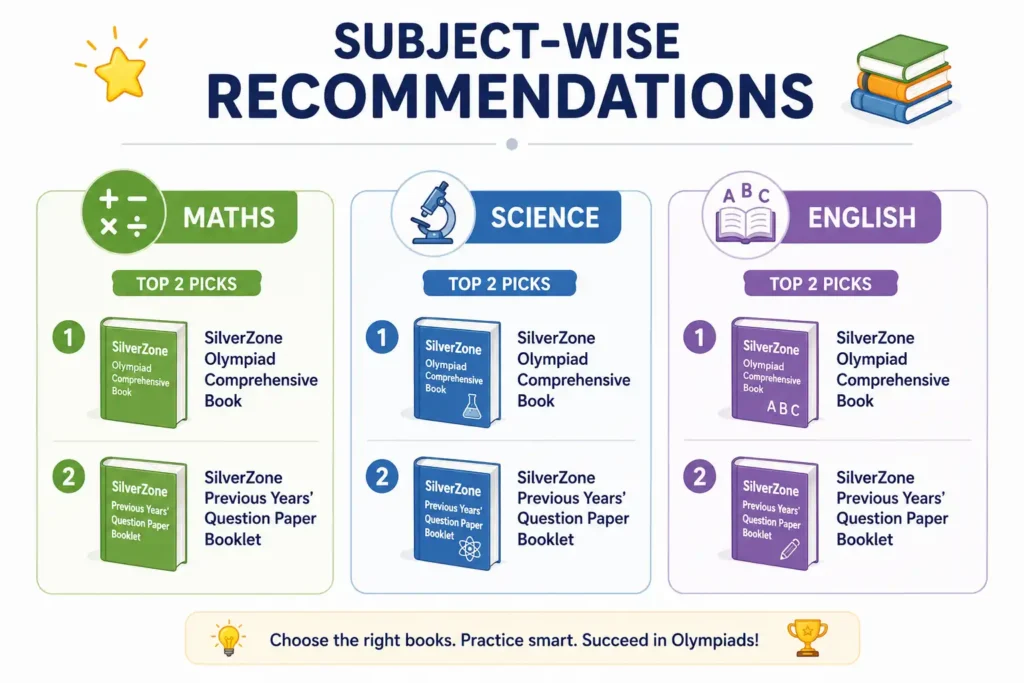
Best SilverZone IMO (Maths) Books
The SilverZone IMO is the most widely attempted exam, and SilverZone IMO books have the broadest selection.
Here’s how to think about Maths Olympiad book selection:
- For conceptual foundations: School textbook (NCERT for CBSE students) + SilverZone IMO Official Workbook. Don’t skip fundamentals. Maths Olympiad books for school students are useless if basic concepts are shaky.
- For extra practice: MTG IMO Explorer (Classes 6–8) or MTG IMO Challenger (Classes 9–12). These are among the best books for SilverZone Olympiad preparation in Maths because they offer graded difficulty within each chapter.
- For exam simulation: SilverZone Previous Year Papers + SilverZone Olympiad mock test books.
- For daily habit-building: Gonit App provides structured, Olympiad-style Maths practice that complements book study. It’s especially useful for students who finish their workbook but need ongoing daily practice to maintain sharpness.
If your child wants to go beyond books and improve their overall approach, our guide on how to get better at solving math olympiad questions covers techniques that work alongside any book.
Best SilverZone NSO (Science) Books
SilverZone Science Olympiad books need to cover both theory and application.
Science Olympiad questions often present familiar concepts in unfamiliar contexts.
- Foundation: SilverZone NSO Official Workbook (class-wise). Aligns exactly with the NSO syllabus.
- Deeper practice: MTG NSO Explorer or Challenger series. Provides concept explanations followed by practice questions at increasing difficulty.
- Exam readiness: SilverZone Previous Year Papers. Science questions change significantly year-to-year, so solving 3–5 years of papers builds real confidence.
Best SilverZone iOEL (English) Books
SilverZone iOEL books are fewer in number but focused.
English Olympiad preparation is less about “drilling” and more about consistent reading and language practice.
- Core prep: SilverZone iOEL Official Workbook (class-wise). Covers grammar, vocabulary, comprehension, and language reasoning in the iOEL pattern.
- Supplementary: MTG English Olympiad books (if available for your class). Otherwise, any strong grammar and vocabulary workbook (like Wren & Martin for senior students) supports iOEL preparation indirectly.
- Practice: SilverZone iOEL Previous Year Papers. The English exam is pattern-heavy previous papers reveal recurring question types.
Official SilverZone Books vs Reference Books: Which Do You Need?
This is one of the most common questions parents ask: Are the official SilverZone books enough, or do I need to buy books from MTG and other publishers too?
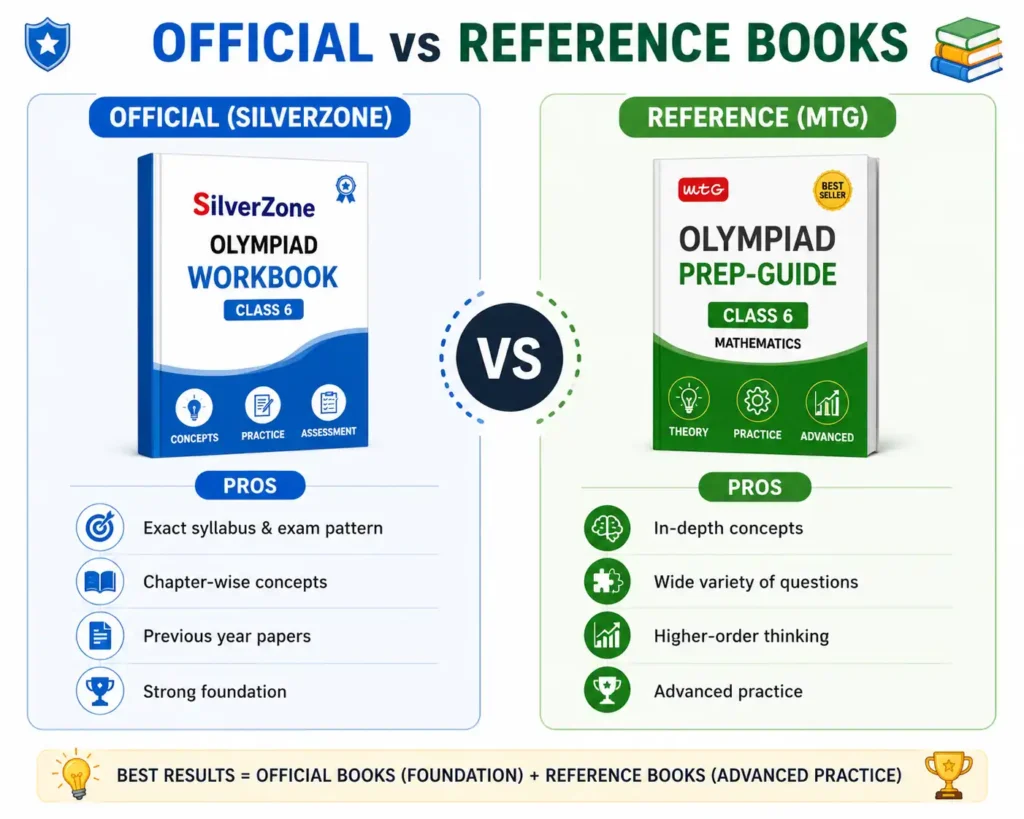
Here’s a clear comparison:
| Feature | Official SilverZone Books | Reference Books (MTG, Pearson, etc.) |
| Syllabus alignment | Perfectly aligned to SilverZone exam pattern | Aligned to general Olympiad patterns (SOF, SilverZone, etc.) |
| Question style | Matches actual SilverZone papers closely | Broader variety of question types from multiple Olympiads |
| Theory depth | Moderate — focused on practice | Detailed includes concept explanations and worked examples |
| Price range | ₹220–₹395 per book | ₹150–₹500+ per book |
| Previous year papers | Available as a separate book | SOF-focused; SilverZone papers may not be included |
| Best for | SilverZone-specific preparation | Building deeper conceptual understanding and cross-Olympiad practice |
When official books are enough: Your child is a first-time participant, in Classes 1–5, or primarily looking for familiarity with the exam pattern rather than intensive preparation.
The official SilverZone Olympiad workbook + previous year papers is a solid, sufficient combination.
When to add reference books: Your child has attempted the Olympiad before and wants to improve, finds the official workbook too easy, or is in Classes 6+, where the competition is tougher and deeper practice helps.
If you’re also considering SOF exams alongside SilverZone, understanding how to prepare for SOF IMO can help you decide whether one set of books covers both or if you need exam-specific resources.
The recommended combo for most students: One official SilverZone workbook + one reference book (MTG series) + previous year papers. That’s three resources, not ten.
Beginner to Advanced: Book Progression Roadmap
One of the biggest mistakes in Olympiad preparation is jumping straight to advanced material.
Here’s a stage-by-stage SilverZone Olympiad preparation roadmap that maps books to your child’s current level.
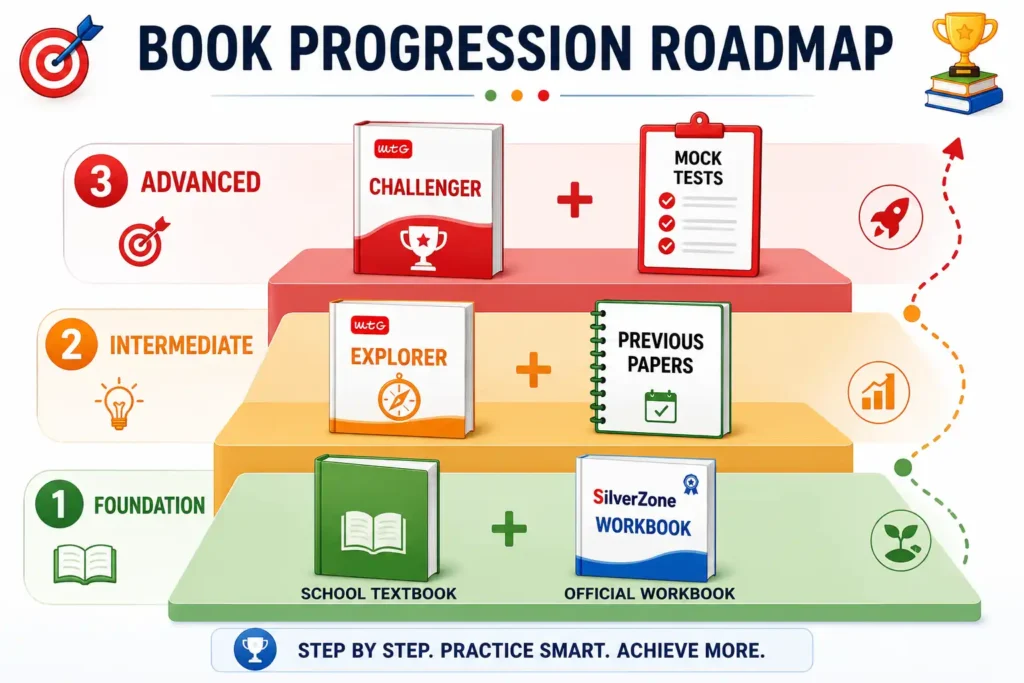
Stage 1 — Foundation (Getting Started)
Books: School textbook (NCERT or equivalent) + SilverZone Official Workbook
Goal: Understand basic concepts and get comfortable with Olympiad-style questions. No pressure for scores, just familiarity.
Duration: 4–6 weeks before the exam.
This is the right starting point for all SilverZone Olympiad books for beginners. Don’t skip this stage even if your child is academically strong.
Olympiad questions are framed differently from school exams. Younger students especially benefit from building strong number sense skills before jumping into Olympiad-level material.
Stage 2 — Intermediate Practice
Books: MTG Explorer series (or equivalent reference book) + SilverZone Previous Year Papers
Goal: Build speed, accuracy, and the ability to handle slightly tricky questions. Start timing practice sessions.
Duration: 2–4 weeks (overlapping with Stage 1 for the second half).
At this stage, students should also work on how to solve math word problems which make up a significant chunk of SilverZone Olympiad papers.
Stage 3 — Advanced Problem Solving
Books: MTG Challenger series + Pearson IIT Foundation (for Maths/Science) + additional mock test compilations
Goal: Tackle difficult, multi-concept problems. Target top ranks. Identify and fix weak areas.
Duration: Ongoing practice for serious Olympiad students.
Important: Most students only need Stages 1 and 2. Stage 3 is for students who are aiming for national-level ranks or who genuinely enjoy competitive problem-solving.
Junior Math OStudents at this level might also want to explore how to prepare for the junior math olympiad for additional challenge.
How to Prepare Using These Books: A Study Strategy
Having the right books is only half the equation.
Here’s a practical, step-by-step SilverZone Olympiad preparation strategy that works for any class.
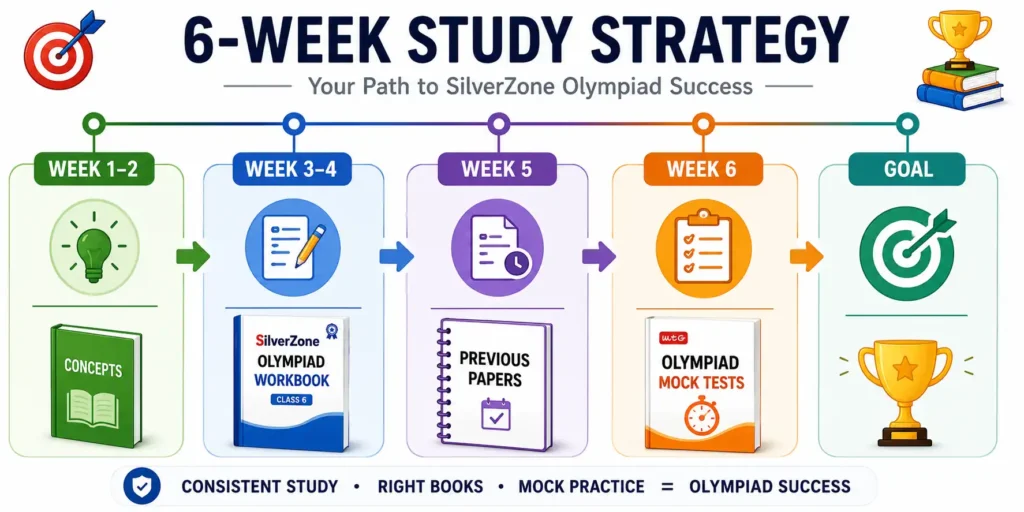
Step 1 — Build Concepts First (Weeks 1–2)
Read the relevant chapters in your school textbook. Make sure your child understands the core concepts before touching any Olympiad book.
Olympiad questions test the application of concepts; if the concepts aren’t solid, practice will feel frustrating rather than productive.
Step 2 — Practice with the Official Workbook (Weeks 2–4)
Work through the SilverZone Official Workbook chapter by chapter. Don’t rush. The goal is to attempt every question, review mistakes, and understand why the correct answer is correct.
Mark questions that felt confusing. These are the weak areas to revisit later.
Step 3 — Solve Previous Year Papers (Weeks 4–5)
Once the workbook is done, move to SilverZone Olympiad previous year papers. Solve them under timed conditions (actual exam duration).
This builds exam stamina and reveals the real difficulty level. To see what SOF-style papers look like for comparison, check our collection of SOF IMO sample paper resources.
Step 4 — Take Mock Tests (Weeks 5–6)
Use SilverZone Olympiad mock test books or online mock tests to simulate the full exam experience. Analyze every mock don’t just check the score, understand which topics cost marks.
For Maths Olympiad preparation specifically, Gonit App offers structured practice that fits naturally between book study sessions. Students can use it for daily 10–15 minute practice to reinforce concepts they’ve studied in books.
It’s particularly effective for building speed on the types of logical reasoning and problem-solving questions that appear in the SilverZone IMO.
Step 5 — Revise Weak Areas (Final Week)
Go back to the questions you marked as confusing in Steps 2 and 3. Re-solve them. If entire topics feel weak, revisit the school textbook for that topic, then redo the Olympiad questions.
Focused revision in the last week yielded the biggest score improvement. For tested revision and scoring techniques, read our guide on how to get full marks in the Maths Olympiad.
Previous Year Papers & Mock Test Resources
Previous year papers are essential preparation material for every SilverZone Olympiad.
Here’s where to find them:
- SilverZone Official Website: Offers sample papers and some previous year papers for download. Check the “Books” section at silverzone.org.
- SilverZone Previous Year Paper Books: Published in compiled format (usually 5 years of papers per book) — available on Amazon and Flipkart.
- MTG Previous Year Paper Compilations: Available for IMO and NSO. Include answer keys and some have explained solutions.
- Online Mock Tests: SilverZone offers online practice tests on their portal. These are useful for getting familiar with the digital test interface if your child’s school uses online mode.
How many papers to solve: Aim for at least 3–5 previous year papers.
If time permits, solve all available years. Each paper takes 45–60 minutes, so this is achievable within two weeks of practice.
Looking for additional free practice beyond books? Our free math olympiad training online guide lists digital resources that supplement paper-based preparation.
Common Mistakes to Avoid When Choosing Olympiad Books
These mistakes waste money and, more importantly, can discourage your child. Avoid them.
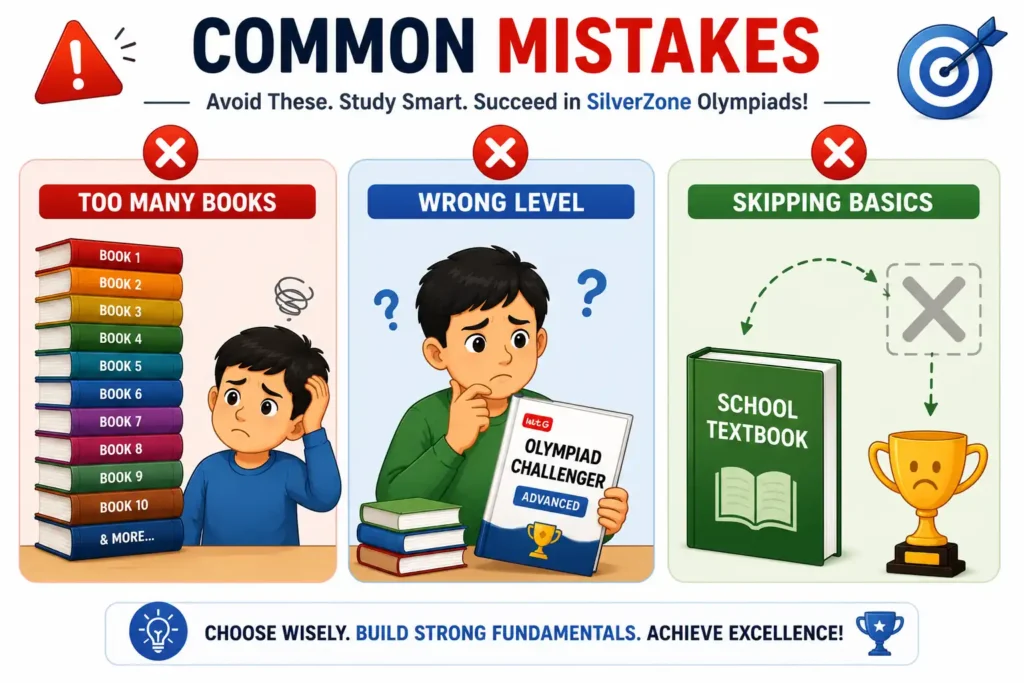
1. Buying Too Many Books: More books ≠ better preparation. Two or three well-chosen, fully completed books are far more effective than six half-finished ones.
For most students, the combination of one official workbook + one reference book + previous year papers is the sweet spot.
2. Choosing the Wrong Difficulty Level: A Class 3 student struggling with a book meant for advanced Class 5 competitors will lose confidence.
Always start one level below where you think your child is. It’s better to build confidence and move up than to start too hard and give up.
3. Ignoring Fundamentals: Some parents jump straight to Olympiad-level books without ensuring school-level concepts are strong.
If your child doesn’t fully grasp fractions, an Olympiad book on fractions will only cause frustration. Ensure the school textbook chapters are clear before opening the Olympiad workbook.
4. Skipping Previous Year Papers: This is the most common mistake among first-time participants.
Previous year papers are the single best predictor of what the actual exam will look like. Skipping them is like preparing for a race without ever seeing the track.
5. Buying Generic “Olympiad” Books Not Aligned to SilverZone: Some books are titled “Olympiad” generically and are designed for SOF or other bodies.
The syllabus and question pattern differ. Always confirm the book is aligned to the SilverZone Olympiad syllabus books, check the publisher’s description or table of contents.
Our SOF vs SilverZone guide explains exactly where the two exams differ, so you don’t accidentally buy the wrong book.
Best Books for Self-Study (Without Coaching)
Many students prepare for SilverZone Olympiads entirely on their own, without coaching classes.
This is absolutely doable especially if you choose the right SilverZone Olympiad preparation books.
For self-study, prioritize books that include:
- Concept explanations (not just questions). MTG Explorer and Challenger series include topic summaries before each chapter’s practice questions ideal for self-learners.
- Detailed answer keys with solutions. The official SilverZone workbooks provide answer keys, but reference books with step-by-step solutions are far more helpful when studying alone.
- Progressive difficulty. Start with the official workbook (easier), move to a reference book (moderate), then tackle previous year papers (exam-level). This self-guided progression replaces the structure a coaching class would provide.
Self-study toolkit for any class:
- School textbook (for concept clarity)
- SilverZone Official Workbook (for exam-pattern familiarity)
- MTG Explorer or Challenger book (for deeper practice with explained solutions)
- Previous year papers (for exam simulation)
- Gonit App (for daily Maths practice between study sessions structured, self-paced, no coaching needed)
That’s five resources. You don’t need anything more for a strong SilverZone Olympiad preparation without coaching.
-Students studying independently will also find our guide on how to improve problem solving skills for IMO useful the techniques apply directly to SilverZone preparation too.
“What Should I Buy First?” — Quick Recommendation Summary
Here’s the table you’ve been looking for. Based on your child’s class and goal, here’s exactly what to buy:
| Class Group | First-Time Participant | Returning / Aiming for Top Ranks |
| Class 1–2 | SilverZone Comprehensive Book (1 subject) | Comprehensive Book + Previous Year Papers |
| Class 3–5 | SilverZone Comprehensive Book + Previous Year Papers | Comprehensive Book + Previous Year Papers + MTG Prep-Guide |
| Class 6–8 | Comprehensive Book + Previous Year Papers | Excellence Guide + Previous Year Papers + MTG Prep-Guide |
| Class 9–10 | Comprehensive Book + Previous Year Papers | Excellence Guide + Previous Year Papers + MTG Prep-Guide + Pathfinder (for iOM) |
| Class 11–12 | Comprehensive Book + Previous Year Papers | Excellence Guide + Previous Year Papers + Advanced reference book (subject-specific) |
Budget guidance: For a first-time participant buying two official SilverZone books (Comprehensive Book + Previous Year Papers) for one subject, expect to spend approximately ₹500–₹520. Adding an MTG Prep-Guide brings the total to around ₹750–₹900 per subject.
Are official SilverZone books enough for Olympiad preparation?
For first-time participants in Classes 1–5, yes, the SilverZone Comprehensive Book and Previous Years’ Question Papers are typically sufficient. For students aiming for top ranks or preparing for Level 2 (usually Class 5 and above), adding a reference book like the MTG Olympiad Prep-Guide provides the extra depth and practice variety needed for competitive performance.
Which book should beginners start with?
The SilverZone Olympiad Comprehensive Book for the relevant subject and class is the best starting point for beginners. It’s affordable (₹220), covers the entire syllabus chapter by chapter, and includes practice papers. Complete this book before buying anything else.
How many books does my child need?
For most students, 2–3 books per subject is the right number: one for syllabus coverage (Comprehensive Book or Excellence Guide), one for exam pattern familiarity (Previous Year Papers), and optionally one for additional practice (MTG Prep-Guide). Buying more than three books per subject is usually unnecessary and counterproductive.
What’s the difference between SilverZone workbooks and reference books?
SilverZone’s own books (Comprehensive Book, Excellence Guide, and Previous Year Papers) are specifically designed for SilverZone Olympiads; they match the exact syllabus, exam pattern, and difficulty level. Reference books from publishers like MTG, Pearson, and Arihant cover Olympiad concepts more broadly, often with detailed theory explanations and questions from multiple Olympiad bodies. SilverZone books ensure exam-specific preparation; reference books build wider conceptual strength.
Can my child prepare for the SilverZone Olympiad without coaching?
Absolutely. SilverZone Level 1 is designed to be accessible, and most students who perform well prepare through self-study with the right books. Use the SilverZone Comprehensive Book for syllabus coverage, the MTG Prep-Guide for detailed explanations, and Previous Year Papers for exam practice. Follow a consistent daily practice routine (20–30 minutes), and your child will be well-prepared without coaching.
Is the SilverZone Olympiad exam hard?
Level 1 is designed to be approachable; it’s based on the current class syllabus with no negative marking. The questions are slightly harder than school exams, but not unreasonably difficult for a well-prepared student. Level 2 is significantly harder and requires deeper preparation with advanced books and extensive past-paper practice.
What is the best book for SilverZone iOM (Maths Olympiad)?
Start with the SilverZone iOM Comprehensive Book for your child’s class, then add the Previous Years’ Question Papers. For Classes 6 and above, the MTG Olympiad Prep-Guide Mathematics is an excellent supplement. For Classes 9–12, Pathfinder for Olympiad Mathematics by Pearson is recommended for students targeting top ranks.
When should my child start preparing?
Ideally, start 3–4 months before the exam date. For first-time participants, even 6–8 weeks of consistent daily practice (20–30 minutes) is often enough for Level 1. For Level 2 aspirants, a 4–6 month preparation window is recommended.
My child is in Class 1. Is it too early for Olympiad preparation?
Not at all. SilverZone Olympiad books for Class 1 are designed to be age-appropriate, fun, and confidence-building. At this age, the goal isn’t intensive preparation; it’s exposure. The official workbook introduces Olympiad-style thinking gently. Think of it as enrichment, not competition. Check our guide on IMO exam eligibility criteria for students of classes 1 to 12 to confirm your child’s eligibility.
Are SilverZone books available online or only in print
SilverZone official books are available in print through the SilverZone website, Amazon, and Flipkart. Some sample papers and resources are available as digital downloads on the SilverZone portal. MTG reference books are available both in print and as e-books on major retail platforms
Make Preparing for Math Olympiad Simple!



Conclusion
Start with the SilverZone Official Workbook for your child’s class and exam, add one MTG reference book if they need deeper practice, and always finish with previous year papers.
Three resources not ten cover the vast majority of students from Class 1 through Class 12.
The biggest prep mistake isn’t choosing the wrong book. It’s buying five books and finishing none.
Pick two or three from the tables above, follow the 6-week study strategy, and your child will walk into the exam confident and prepared.