 June 5, 2026
 17 min. read

Teaching Grade 2 fractions is most effective when you transition from concrete (hands-on) to pictorial (visual) and then to abstract (numbers).
Start by using physical objects like food or blocks to teach the core concept of equal parts, then introduce the vocabulary and simple written fractions.
Teaching fractions to Grade 2 students becomes much easier when learning starts with real-life examples and hands-on activities.
But learning how to teach fractions to Grade 2 students the right way makes all the difference. Second graders can absolutely grasp fractions.
This guide covers what students need to learn, simple ways to introduce fractions, engaging activities, common misconceptions, and easy assessment ideas.
What Fractions Are Grade 2 Students Expected to Learn?
Before planning lessons, it helps to understand the scope of Grade 2 fraction learning. The goal at this stage is conceptual understanding, not calculation.
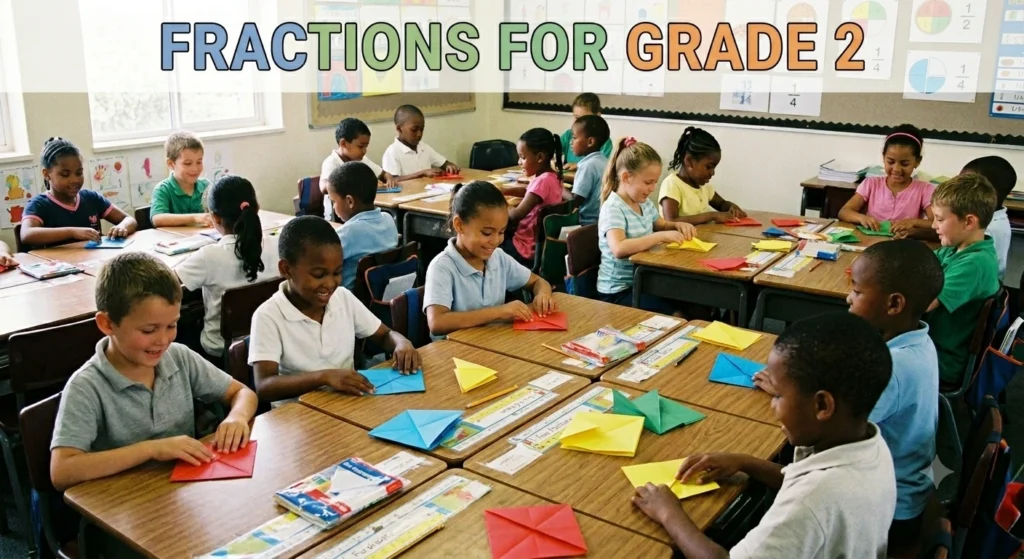
Understanding how to teach fractions to Grade 2 students starts with knowing exactly what the curriculum expects at this level.
Students are not expected to add or subtract fractions that come later.
By the end of Grade 2, students should be able to:
- Understand that a fraction represents equal parts of a whole
- Recognize and use the fractions ½, ⅓, and ¼
- Identify whether a shape has been divided into equal or unequal parts
- Describe parts of a whole using fraction language (“one half,” “one quarter,” “one third”)
- Find half of a small set of objects (e.g., half of 8 counters)
- Understand that equal parts of the same whole must be the same size
- Begin to recognize that fractions can be more than one part (e.g., 2 out of 4 = ½)
Notice what is not on this list: numerators and denominators as formal terms, equivalent fractions, improper fractions, or any arithmetic. Grade 2 is purely about building the right mental picture of what a fraction is.
If your student is coming from Grade 1, they may already have some familiarity with basic sharing ideas.
You can read about fractions for Class 1 to understand what foundation they’re building on and where to start if there are gaps.
How to Introduce the Concept of a Fraction
The best way to introduce fractions to a 7- or 8-year-old is through sharing a situation they already understand emotionally and socially.
Start with a Story Problem
Before touching paper, pose a situation:
“You and your friend want to share one sandwich equally. How do you do it?”
Let students discuss. Most will say “cut it in half.” From here you can ask:
- How many pieces are there? (2)
- Are the pieces the same size? (Yes, that’s important!)
- What do we call each piece? (Introduce: one half)
This grounds the math in something meaningful. The sandwich isn’t a random shape, it’s food they care about sharing fairly.
Building fraction understanding through real-life scenarios also develops the number sense students need to reason flexibly about all areas of mathematics.
Build the Language First
Before introducing written symbols, spend time building fraction vocabulary:
| Word | Meaning in child-friendly terms |
| Whole | The entire thing, before sharing |
| Equal parts | Pieces that are the same size |
| Half | 2 equal parts; you have 1 of them |
| Quarter | 4 equal parts; you have 1 of them |
| Third | 3 equal parts; you have 1 of them |
Use these words constantly in class. “Can you fold this paper into equal parts?” “How many equal pieces is this orange cut into?”
When to Introduce the Written Symbol
Only after students can reliably explain fractions in words should you introduce ½, ¼, and ⅓ as written symbols. Explain that:
- The bottom number tells how many equal pieces the whole is cut into
- The top number tells how many pieces you’re talking about
Keep it simple you do not need to use the words “numerator” and “denominator” in Grade 2. Many curricula save that vocabulary for Grade 3 or 4.
Teaching Equal Parts: The Foundation of Everything
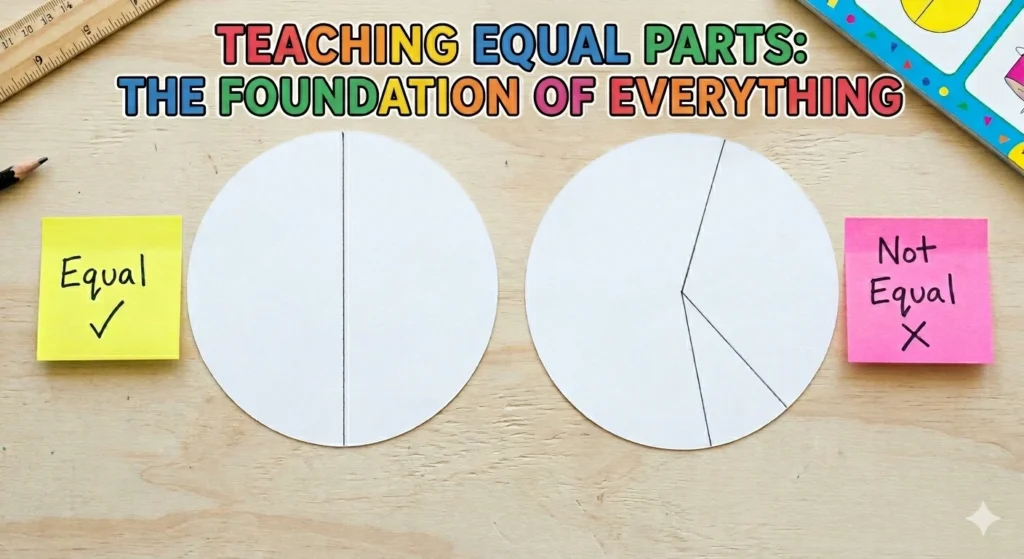
The single most important concept in Grade 2 fractions is equality of parts.
A student who truly understands this is well-prepared for all fraction work ahead.
Why “Equal” Is Everything
A fraction only makes sense when all parts are the same size. If you cut a pizza into 4 pieces but one piece is much bigger than the others, it’s still 4 pieces but it’s not quarters.
Many students think any division into parts creates a fraction. They need repeated, explicit teaching that the parts must be equal.
How to Teach It
Activity 1 — Sort the shapes:
Show students shapes that have been divided in different ways. Some divisions are equal, some are not.
[Circle cut into 2 equal halves] → Equal ✓
[Circle cut unevenly into 2 parts] → Not equal ✗
[Square cut into 4 equal parts] → Equal ✓
[Square cut into 4 unequal parts] → Not equal ✗
Ask students to sort cards into two groups: “equal parts” and “not equal parts.” Discuss each card.
Recognising shapes and how they can be divided also connects to spatial understanding, a skill that underpins both geometry and fraction work in early primary.
Activity 2 — Folding paper:
Give students square pieces of paper. Ask them to fold in half. Then unfold and check are the two parts equal? How do they know? (You can flip one half onto the other to check.)
Try folding in different ways (horizontally, vertically, diagonally). All give equal halves, which shows that shape and orientation don’t matter, only size does.
Key question to ask repeatedly: “Are the parts equal? How do you know?”
Introducing Half (½)
Half is almost always the right place to start. Most students already have an informal understanding of “half” from everyday life. Your job is to formalise that understanding.
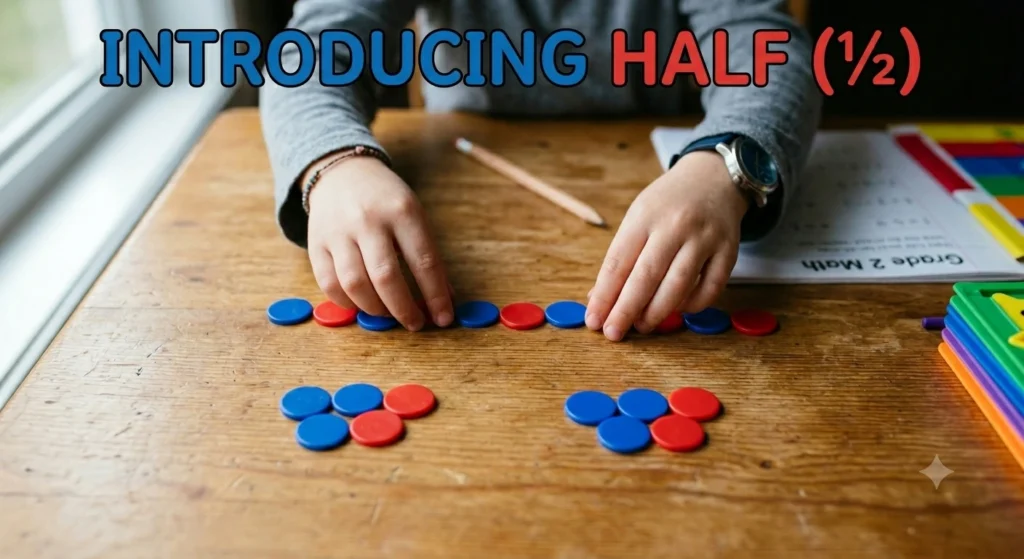
Concrete Stage: Use Real Objects
Start with physical objects before any drawings or symbols:
- Cut a piece of play dough into 2 equal parts
- Fold a piece of paper in half
- Share 10 blocks equally between 2 students
- Cut a paper strip in half
Each time, ask: “How many equal parts? How many do you have? What do we call that?”
Pictorial Stage: Shapes and Diagrams
Once students can explain half with objects, move to pictures. Show a variety of shapes, not just circles and squares divided in half.
A common mistake is showing only standard orientations (rectangle divided horizontally). Show:
- A rectangle divided vertically
- A rectangle divided diagonally
- A triangle divided in half
- An irregular shape divided in half
This prevents students from thinking “half” means a specific position rather than equal size.
Abstract Stage: The Symbol ½
Now introduce the written form. Write ½ and explain:
- The 2 at the bottom means the whole is split into 2 equal parts
- The 1 at the top means we’re talking about 1 of those parts
Practice having students circle half of shapes, colour in half of a grid, and write ½ to describe what they shaded.
Half of a Group
Extend to sets: “Half of 6 counters is ___?”
Have students physically split 6 counters into 2 equal groups. Each group has 3. So half of 6 = 3.
Work with even numbers only at this stage (2, 4, 6, 8, 10, 12). Odd numbers cannot be split into whole halves, which can confuse students if introduced too early.
Introducing Quarters (¼) and Thirds (⅓)
Once half is solid, move to quarters and thirds. The teaching sequence mirrors the approach for halves: concrete → pictorial → abstract.
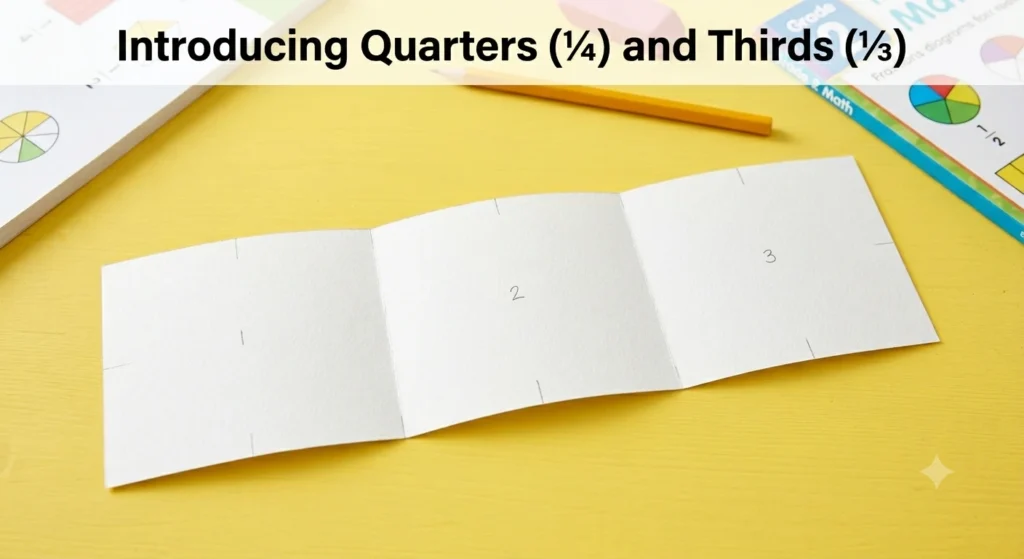
Teaching Quarters (¼)
A “quarter” divides a whole into 4 equal parts. The word “quarter” is meaningful. Students may already know it from money (a quarter = one-fourth of a dollar).
Folding activity: Fold a paper in half, then in half again. Open it up there are 4 equal parts. Each part is one quarter of the whole.
Discuss:
- How many equal parts? (4)
- If you colour one part, what fraction is coloured? (¼ — one quarter)
- If you colour two parts, what fraction is coloured? (2/4 — two quarters, or one half)
That last point is a natural, powerful way to show that 2/4 = ½, without any formal fraction arithmetic.
Teaching Thirds (⅓)
Thirds are harder to visualise than halves or quarters, and folding into thirds accurately is tricky. Use strips of paper or chocolate bar models instead.
Strip activity: Give students a paper strip. Ask them to fold it into 3 equal parts. (Guide them physically if needed.) Unfold there are 3 equal parts. Each part is one third.
Chocolate bar model: Draw a chocolate bar with 3 equal rows. If one row is broken off, what fraction of the bar is that? (⅓)
Ask: “Is ½ bigger or smaller than ⅓?” This is a great discussion prompt. With a fraction strip or folded paper, students can see directly that each half is bigger than each third because the whole is cut into fewer pieces.
Fractions of a Set (Not Just a Shape)
Many students learn fractions only through shapes (circles, squares) and are then confused when they see fractions applied to groups of objects.
It’s important to teach fractions of a set explicitly.
What Is a Fraction of a Set?
When we say “½ of 8,” we mean: divide 8 objects into 2 equal groups. How many in each group? (4)
This connects fractions to the early division thinking students are developing in Grade 2 and lays important groundwork for multiplication concepts they will encounter next.
Teaching Sequence
Step 1 — Concrete: Use counters, blocks, or small toys.
“Here are 6 apples. Share them equally into 2 groups. How many apples is half of 6?”
Step 2 — Pictorial: Draw dot arrays in groups.
“Here are 8 stars in 4 equal groups. Circle one group. What fraction is that?” (¼)
Step 3 — Abstract: Write the number sentence.
“¼ of 8 = ___”
Important Connections to Build
- ½ of 10 = 5 (sharing by 2)
- ¼ of 8 = 2 (sharing by 4)
- ⅓ of 9 = 3 (sharing by 3)
Notice that finding a unit fraction of a number is the same as dividing by the denominator.
While you don’t need to explain this formally, students who experience it repeatedly will develop strong fractions.
Comparing Fractions: Which Is More?
Grade 2 students should begin to develop intuition for the relative size of fractions, even without formal rules.
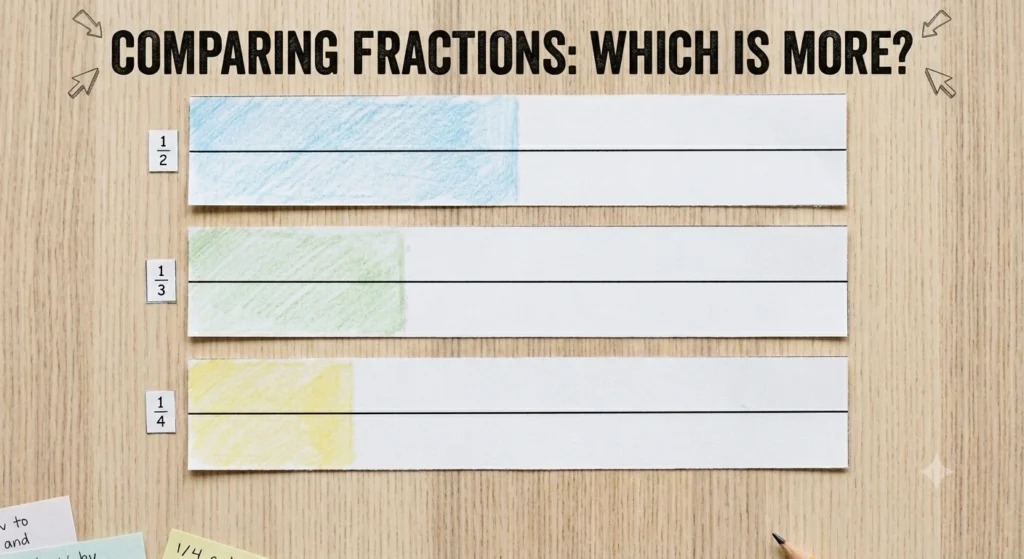
The Key Insight: More Pieces = Smaller Each Piece
When the whole is the same size and you cut it into more pieces, each piece gets smaller.
If you share a chocolate bar between 2 people, each person gets more than if you share it between 4 people.
So: ½ > ¼ > ⅛
This seems obvious when said out loud, but many students need to physically see and hold fraction pieces to believe it.
How to Teach Comparison
Fraction strips are the best tool here. Create (or print) strips of equal length divided into halves, thirds, and quarters. Students can lay them side by side and directly compare.
Ask questions like:
- “Which is bigger: ½ or ⅓?” (Hold up strips and look)
- “Which is smaller: ¼ or ½?” (Compare directly)
- “I ate ⅓ of my sandwich. You ate ¼ of yours. Our sandwiches were the same size. Who ate more?”
Comparing Fractions with the Same Numerator (Same Top Number)
In Grade 2, all comparisons should use unit fractions (fractions with 1 on top). This keeps it conceptually simple and avoids the need for common denominators.
The rule students should understand: when comparing unit fractions, the bigger the denominator, the smaller the fraction.
Hands-On Activities and Games
Grade 2 students learn fractions best through movement, manipulation, and play.
Here are activities that work well in classrooms and at home.
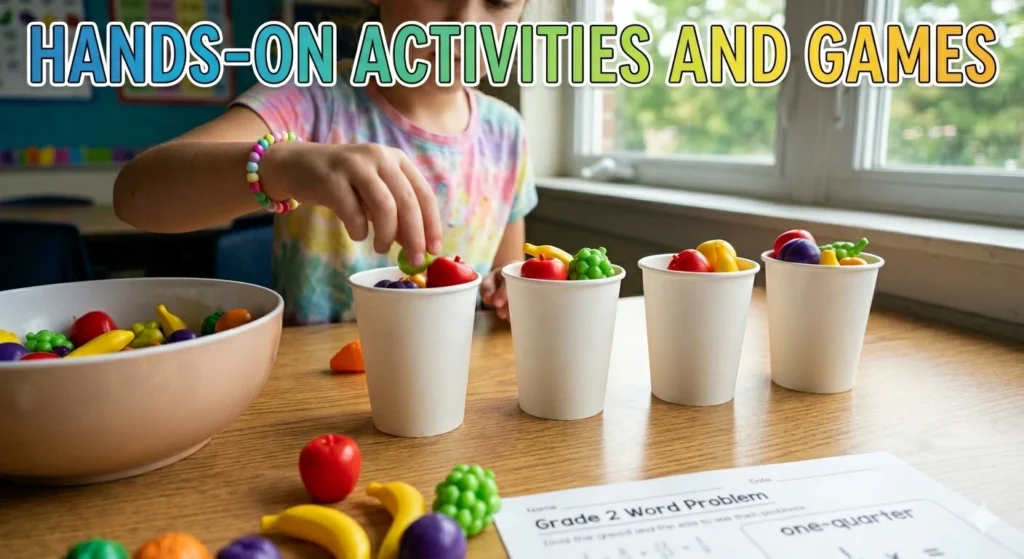
The most effective approach to how to teach fractions to Grade 2 students is through play, movement, and manipulation, not worksheets.
Activity 1: Fraction Folding
Materials: Paper squares and rectangles, crayons
How to play: Give students a shape and ask them to fold it into halves, quarters, or thirds. Open the fold, trace the lines, and colour one part. Label the fraction.
Variation: “Fold and predict” before opening, ask students how many equal parts they think there will be.
Activity 2: Playdough Fractions
Materials: Playdough, plastic knife, paper plates
How to play: Students roll playdough into a “whole” ball or sausage, then cut it into equal parts. They narrate: “I cut my whole into 4 equal parts. Each part is one quarter.”
This is excellent for tactile learners and makes the “equal” requirement very concrete you can visually see if the pieces are equal.
Activity 3: Fraction Pizza
Materials: Paper plates, coloured paper, scissors
How to play: Students create a “pizza” (paper plate) and cut it into halves or quarters. They can add toppings to each section. Ask: “You ate two slices. What fraction of the pizza did you eat?” (2/4 = ½)
Activity 4: Equal Shares Sorting Game
Materials: Cards showing shapes divided in different ways
How to play: Students sort cards into “equal parts” and “not equal parts.” Start simple, then add tricky cases (e.g., a shape divided into unequal-looking parts that are actually equal).
Activity 5: Fraction Number Line Walk
Materials: Tape on the floor, sticky notes
How to play: Create a large number line on the floor from 0 to 1. Ask students to stand at “0” and “1.” Where would ½ be? Have a student walk to the middle. Where is ¼? Etc.
This builds crucial intuition for fractions as numbers, not just parts of shapes. If your students are still developing comfort with number lines, revisit number line concepts for Class 1 before introducing this activity.
Activity 6: “Fair Share” Story Problems
Pose simple story problems and have students solve them with manipulatives.
Story problems are one of the most effective ways to build mathematical reasoning at this age,, and word problems for kids offer a wealth of ideas you can adapt for fraction contexts:
- “4 friends share 1 pizza equally. What fraction does each friend get?”
- “2 children share 8 grapes. How many grapes does each child get? What fraction of the grapes is that?”
- “A farmer has 12 eggs. She puts an equal number in 4 baskets. What fraction of the eggs is in each basket?”
For structured guidance on building this into your lessons, see how to teach word problems in Grade 1; many of the same strategies apply in Grade 2 fraction contexts.
Common Misconceptions and How to Address Them
Knowing where students go wrong helps you address problems before they become habits.
Misconception 1: Any division creates a fraction
What it looks like: A student cuts a shape into 2 parts and calls each part “½,” even if the parts are different sizes.
Why it happens: Students focus on the number of cuts, not the equality of the resulting pieces.
How to address it: Consistently return to “Are the parts equal? How do you know?” Provide deliberate examples of unequal division and ask whether it shows a fraction. Answer: no, fractions require equal parts.
Misconception 2: The fraction ½ always looks like a certain shape
What it looks like: A student correctly identifies a rectangle split horizontally as showing ½, but says a rectangle split diagonally does not show ½.
Why it happens: Over-reliance on standard visual examples.
How to address it: Deliberately show fractions in unusual orientations. Fold paper in multiple ways to produce halves. Use physical folding and comparison (flip one piece onto the other) to confirm equality.
Misconception 3: Bigger numbers mean bigger fractions
What it looks like: A student says ¼ is bigger than ½ because “4 is bigger than 2.”
Why it happens: Students apply whole-number thinking to fractions bigger numbers means more.
How to address it: Use the sharing story explicitly. “Would you rather share a cookie between 2 people or 4 people? Which gives you more?” Then connect this directly to ½ vs. ¼.
Misconception 4: Fractions only apply to shapes
What it looks like: A student can identify ¼ of a square, but is confused by “¼ of 8 pencils.”
Why it happens: Limited exposure to fractions of sets during instruction.
How to address it: Balance your instruction between shape-based and set-based fraction tasks from early on. Use concrete objects before pictures.
Misconception 5: The two numbers in a fraction are separate and unrelated
What it looks like: When asked “What does the 4 mean in ¼?” a student says “I don’t know” or gives a whole-number answer.
Why it happens: Rushing to the symbol before the concept is solid.
How to address it: Always link the symbol back to the story. “The 4 means we cut the whole into 4 equal pieces. The 1 means we have 1 of those pieces.” Repeat this explanation every time the symbol appears.
How to Assess Grade 2 Fraction Understanding
The goal of assessment at this level is to check for conceptual understanding, not just correct answers.
A student can guess “½” on a worksheet without really understanding fractions and a student can deeply understand fractions without being able to write the symbol correctly.
Observation and Discussion
The most valuable assessment tool is listening to students explain their thinking. Ask:
- “How did you know that was half?”
- “Can you show me how to use these blocks?”
- “Is this picture showing a fraction? Why or why not?”
Students who understand will be able to explain; students who are guessing or copying will struggle to articulate their reasoning.
Practical Tasks
Ask students to demonstrate understanding physically:
- Fold a piece of paper into quarters
- Share 10 counters equally between 2 groups and say what fraction each group represents
- Draw a shape and shade one third of it
- Sort picture cards into “equal parts” and “not equal parts”
Written Tasks
Use these question types on written assessments:
- Circle the shape that shows ½ (multiple choice with one correct, some unequal divisions, some showing ¼)
- Shade ¼ of this shape (drawing task)
- Fill in the blank: ½ of 6 = ___
- True or false: This shape shows equal parts (with a picture)
- Which is larger — ½ or ¼? Draw a picture to explain.
What to Watch For
| Sign of Understanding | Sign of Confusion |
| Can explain why parts must be equal | Just counts pieces without checking size |
| Identifies unequal divisions as “not a fraction” | Calls any divided shape a fraction |
| Says ½ is bigger than ¼ with a reason | Says ¼ is bigger because “4 is bigger” |
| Can find ½ of a set using objects | Only recognises ½ in shapes |
| Uses fraction language naturally | Avoids fraction vocabulary |
What fractions should Grade 2 students know?
Grade 2 students should understand and use the unit fractions ½ (one half), ¼ (one quarter), and ⅓ (one third). They should be able to identify these fractions in shapes and in sets of objects, and compare them in terms of size.
Do Grade 2 students need to know the words “numerator” and “denominator”?
Not typically. Most Grade 2 curricula focus on building the concept through language like “the top number” and “the bottom number,” reserving the formal terms numerator and denominator for Grade 3 or later. Check your specific curriculum guidelines.
My child understands ½ but struggles with ⅓. Is that normal?
Yes, very normal. Thirds are harder than halves and quarters because they don’t align with familiar folding patterns, and the number 3 is less intuitive for equal sharing than 2 or 4. Spend extra time with concrete materials like fraction strips and paper folding.
Should I use worksheets to teach fractions in Grade 2?
Worksheets can reinforce understanding, but they should come after hands-on exploration, not before it. If a student is working through worksheets without first manipulating real objects, they are likely memorising patterns rather than building understanding.
My Grade 2 student keeps saying ¼ is bigger than ½ because 4 is bigger than 2. How do I fix this?
This is one of the most common fraction misconceptions. Don’t argue with the number logic; instead, change the context. Ask: “Would you rather share a pizza between 2 friends or 4 friends? Which gives you a bigger slice?” Once they feel the answer, connect it back to ½ and ¼.
Is it too early to show Grade 2 students that ½ = 2/4?
Not necessarily but only if it arises naturally from activities (like folding a paper in quarters and noticing that 2 quarters equals a half). Don’t introduce it as a formal rule. Grade 2 is too early for equivalent fraction procedures; the goal is just to build the intuition.
How much time should be spent on fractions in Grade 2?
Most Grade 2 curricula dedicate 2–4 weeks to fractions, spread across the year. Short, frequent exposure is more effective than one long unit. Revisit fraction concepts through informal activities and story problems throughout the year.
What’s the most important thing a Grade 2 student should understand about fractions?
That fractions represent equal parts of a whole and that the “equal” part is non-negotiable. Everything else in fraction learning (simplifying, comparing, operating) builds on that single idea.
Make Preparing for Math Olympiad Simple!



Conclusion
Teaching fractions in Grade 2 is about helping children understand equal parts through hands-on experiences before introducing symbols.
Start with sharing and real-life examples, then move to pictures and notation.
Focus on common fractions like ½, ¼, and ⅓, and address misconceptions early. A strong foundation now makes future fraction learning much easier.