 March 4, 2026
 10 min. read

How to teach ordinal numbers to Class 1 students is straightforward when you use the right approach.
Most children already use words like first and second in daily life; the challenge is turning that natural understanding into confident, consistent maths knowledge.
Many parents and teachers rely on worksheets too early, before children have a physical feel for position and order.
This guide walks you through exactly that with fun activities, games, and support strategies for children who need extra time.
For the full concept background, start with what ordinal numbers are in Class 1 maths before diving in.
When Are Class 1 Students Ready to Learn Ordinal Numbers?
Most Class 1 students are ready for ordinal numbers once they have basic number sense recognising numbers, counting in order, and understanding simple sequences.
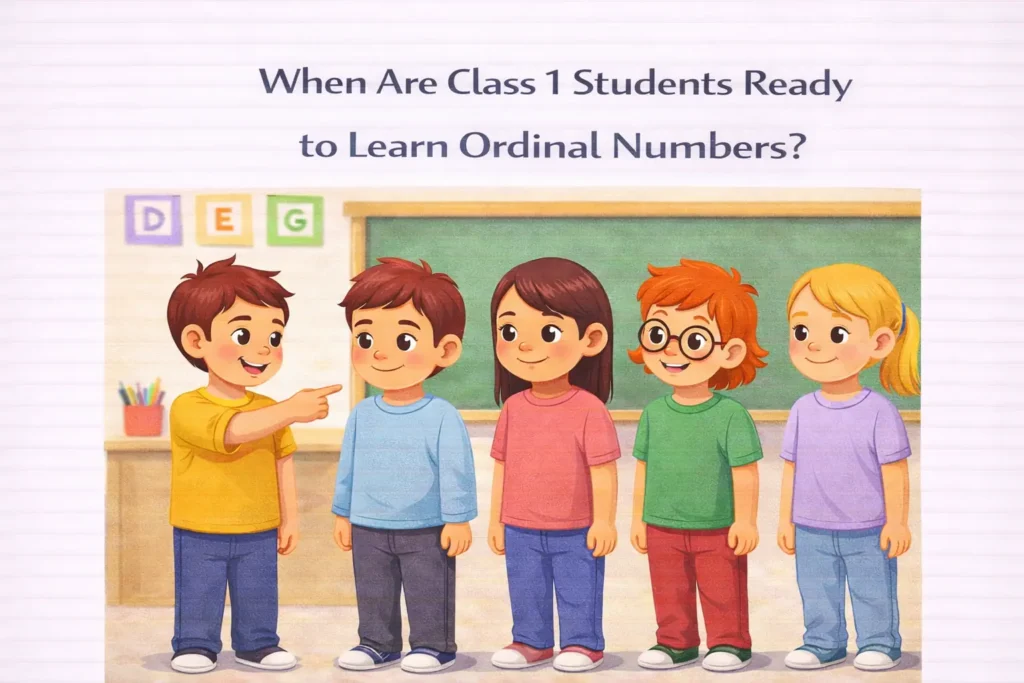
Readiness often shows up naturally in everyday moments before formal teaching begins:
- Pointing to who is first in a game without being prompted
- Following directions like “stand second in line” without confusion
- Retelling a story using first, next, and last in the right order
One common misconception is that children must master counting before learning ordinal numbers. In practice, many children understand position through games and daily routines long before their counting is perfect. Teaching both together strengthens each skill simultaneously.
This mirrors the approach used when teaching number sequences to Class 1 students, where readiness builds gradually through play and repetition rather than waiting for counting fluency.
Step-by-Step Method to Teach Ordinal Numbers
The most effective progression moves from physical objects → visual aids → oral language → written practice. Each stage builds on the last, and no stage should be skipped.
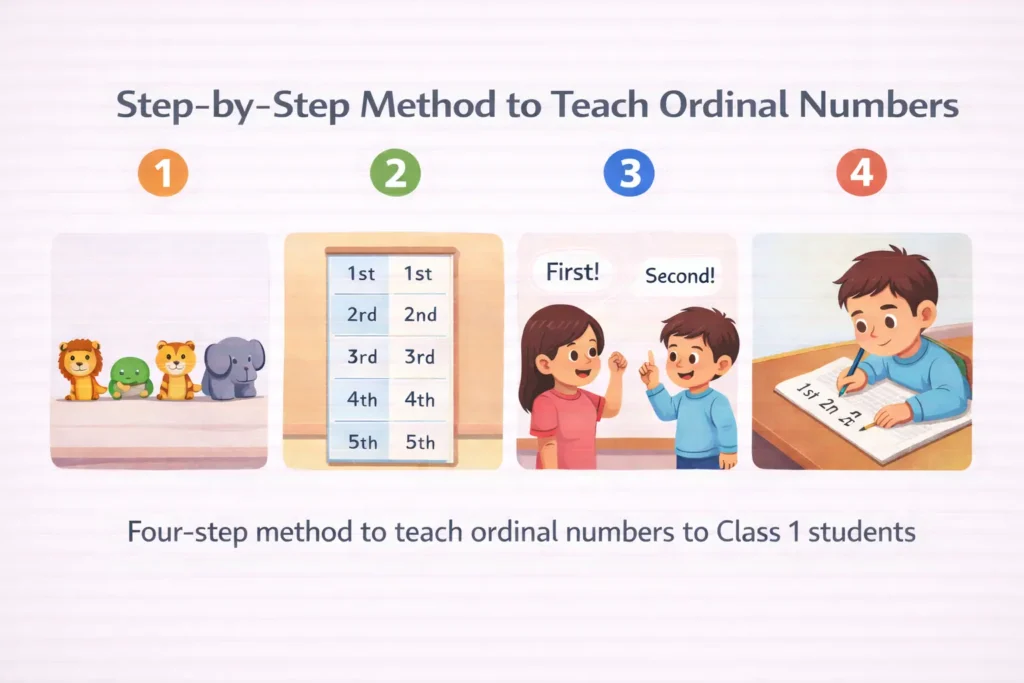
Step 1 — Start With Real Objects
Line up toys, blocks, books, or children and ask about their positions: “Which one is first? Can you touch the fourth block?”
Start with just 3 objects and extend to 5 as confidence grows. Physical interaction — touching, pointing, moving — helps children feel the concept before they are asked to name or write it. This concrete-first approach is the same one recommended when teaching number sequences step by step, where real objects make abstract ideas tangible.
Step 2 — Use Visual Aids
Once children are confident with objects, introduce ordinal number cards, picture sequences, and charts. Story strips — showing what happens first, next, and last work particularly well because children already think in narrative order.
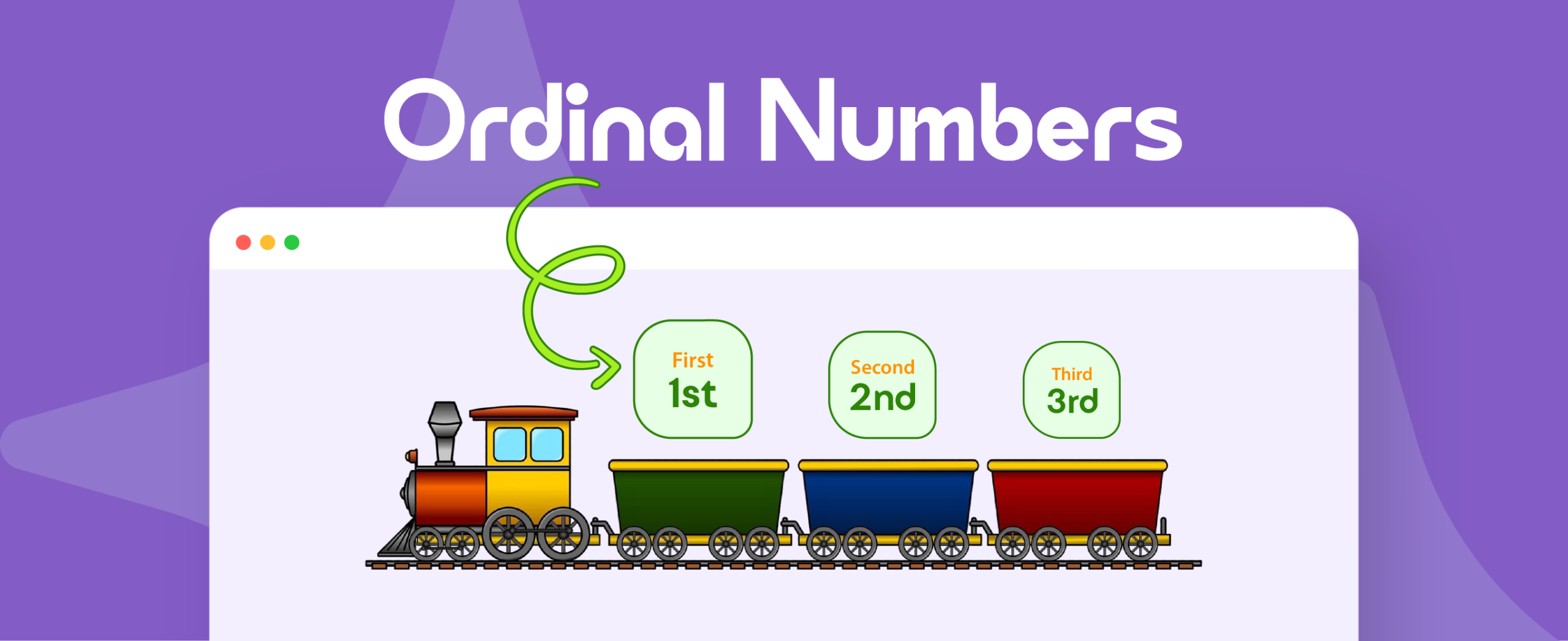
A number line for Class 1 is also highly effective here, giving children a clear visual reference for which position comes before or after another. Train carriages labelled 1st–5th and colour-pattern sequences are other visual tools that make position easy to see.
Step 3 — Practise Oral Language
Embed ordinal language naturally into the school day: “The first group may collect their books,” “The second student can answer.” Play call-and-response games — “After first comes…?” — during transitions and movement breaks.
Oral practice reinforces number ordering skills as children hear and repeat positional language throughout the day, building vocabulary before writing is introduced.
Step 4 — Introduce Writing Gradually
When children are confident with objects, pictures, and spoken language, introduce simple writing tasks:
- Tracing 1st, 2nd, 3rd on dotted lines
- Labelling pictures: “Circle the third star”
- Filling in blanks: “The ___ pig built a house of bricks”
Keep written activities short and paired with something hands-on. Focus on understanding over neatness a child who explains the right answer confidently has grasped the concept, regardless of handwriting.
A structured lesson plan for number patterns in Class 1 is a useful template for planning similarly short, focused written sessions.
What is the Easiest Way to Teach Ordinal Numbers?
The easiest way is hands-on play with familiar objects. Line up 3–5 toy cars, animals, or blocks, label their positions with small cards (1st, 2nd, 3rd), and ask children to point and say the position aloud.
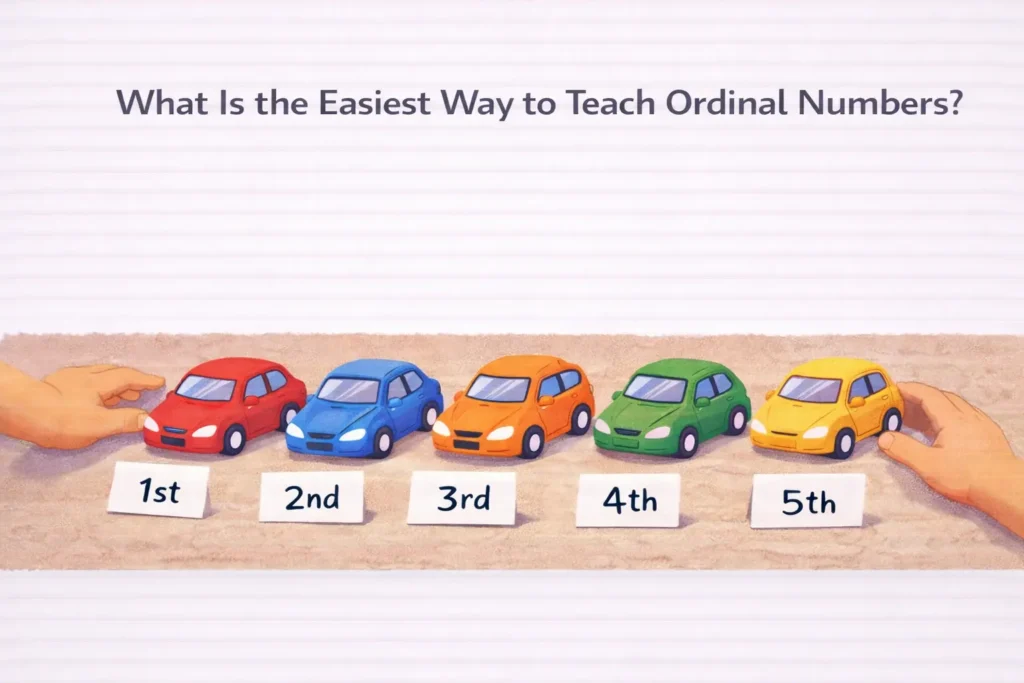
Adding movement makes this even more effective. Tape a number line on the floor and call out positions for children to hop to.
Learning how to explain number positions on a number line gives teachers a clear method for connecting physical movement to the abstract idea of position, making ordinal numbers click much faster.
Short, repeated sessions of 5–10 minutes work better than long, infrequent ones. The goal is for ordinal language to feel automatic, not effortful.
Fun Activities and Games to Teach Ordinal Numbers
Play-based activities make ordinal number practice memorable. These work equally well in the classroom and at home.
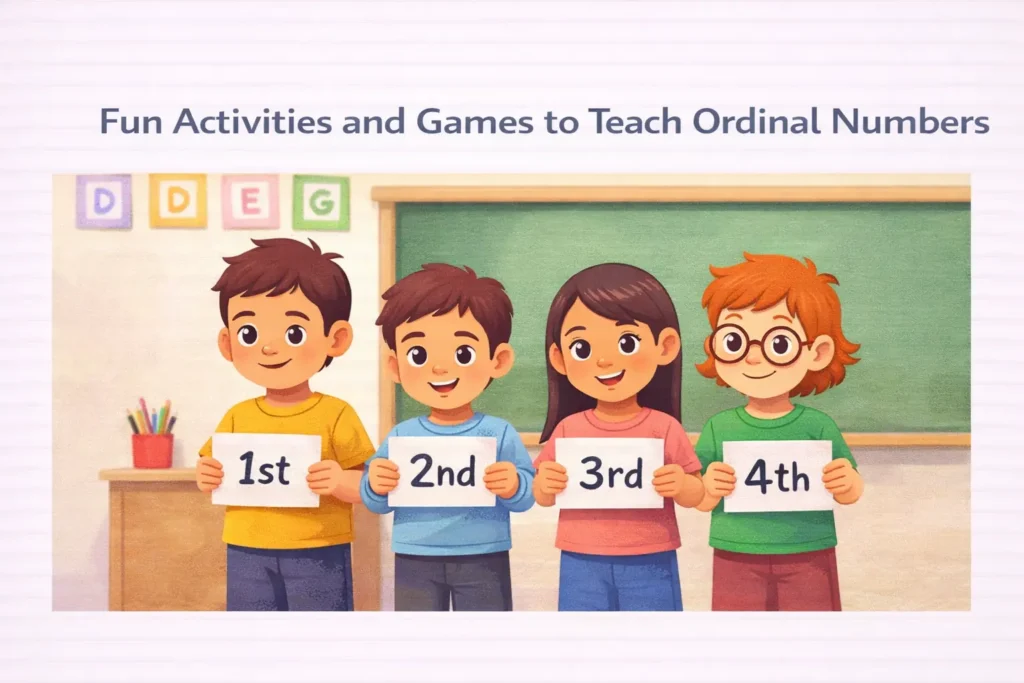
1. Line-Up and Movement Games
Turn everyday transitions into learning moments. Ask children to say their position aloud as they line up: “I am third in line!” Tape a number line on the floor and call out positions for children to hop to, adding a countdown or music makes it even more engaging.
For more active counting routines, teaching forward and backward counting to kindergarten students offers movement-based ideas that transfer directly to ordinal number practice in Class 1.
2. Story Sequencing
Read a familiar story and pause to ask: “What happened first? What came next? What was last?” Children can arrange picture cards from the story in the correct sequence, or act out different roles.
This links ordinal numbers to storytelling and reinforces the same positional thinking children develop when working with number sequences in Class 1 maths.
3. Role-Play Scenarios
Set up imaginative scenarios, a shop queue, a bus stop, and a race finish line. Children take turns being the first customer, second passenger, or third-place finisher.
Role-play gives ordinal language a meaningful context, making it far more memorable than a worksheet alone.
4. Ordinal Number Relay
Divide children into small teams. Each child runs to a board and writes or places the next ordinal position (1st, 2nd, 3rd…) before tagging the next teammate.
Works well for reinforcing the written forms of ordinal numbers alongside the spoken ones.
How to Help Children Who Struggle With Ordinal Numbers
Struggling with ordinal numbers is normal. The key is to adjust the approach, not to increase the pressure.
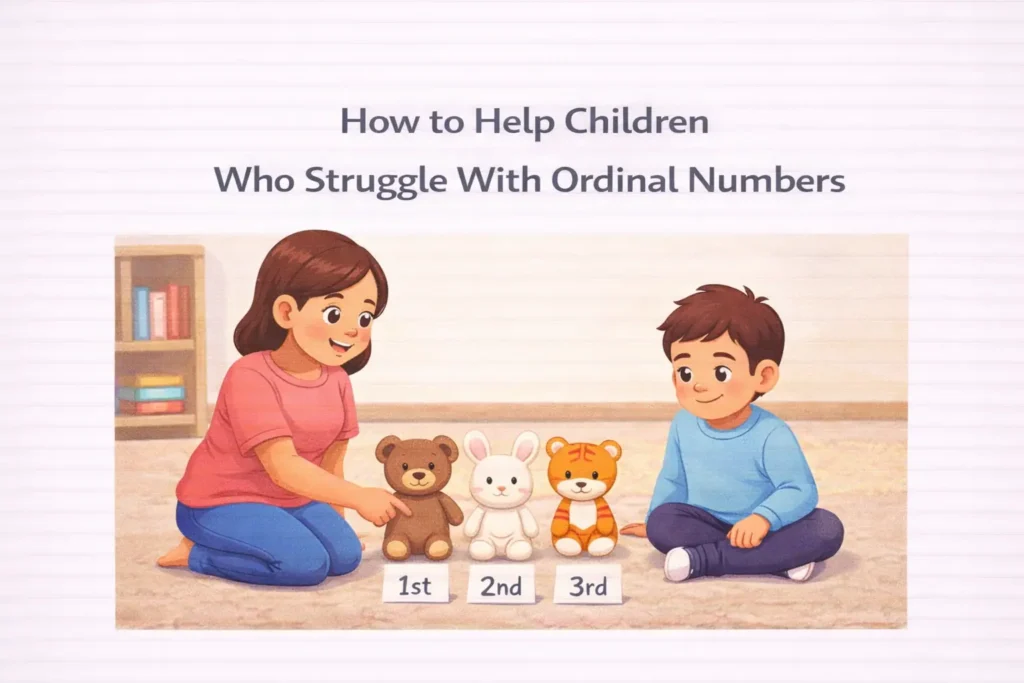
Start smaller. Focus only on first, second, and third until these feel completely natural. The top three positions are the most frequently used in daily life and the easiest to anchor in memory.
Use short, daily practice. Five minutes of a line-up game or a turn-taking activity is far more effective than a long worksheet session.
For children who need structured reinforcement, easy skip-counting activities for Class 1 builds the same sequencing and pattern-recognition skills that underpin ordinal number understanding.
Combine movement, visuals, and speech. Ask children to hop to the second spot, point to the third card, and say “third” aloud — all at the same time.
The multi-sensory combination accelerates learning for children who find the concept abstract.
The same approach is used in teaching skip counting to Class 1 kids, which offers additional multi-sensory strategies that work equally well for struggling ordinal number learners.
Celebrate small wins. A child who correctly identifies first and second consistently is making real progress. Acknowledging that progress builds the confidence that makes the next step possible.
How to Assess Ordinal Number Understanding in Class 1
Formal tests are rarely needed at this stage. The richest assessment information comes from observation during everyday activities.
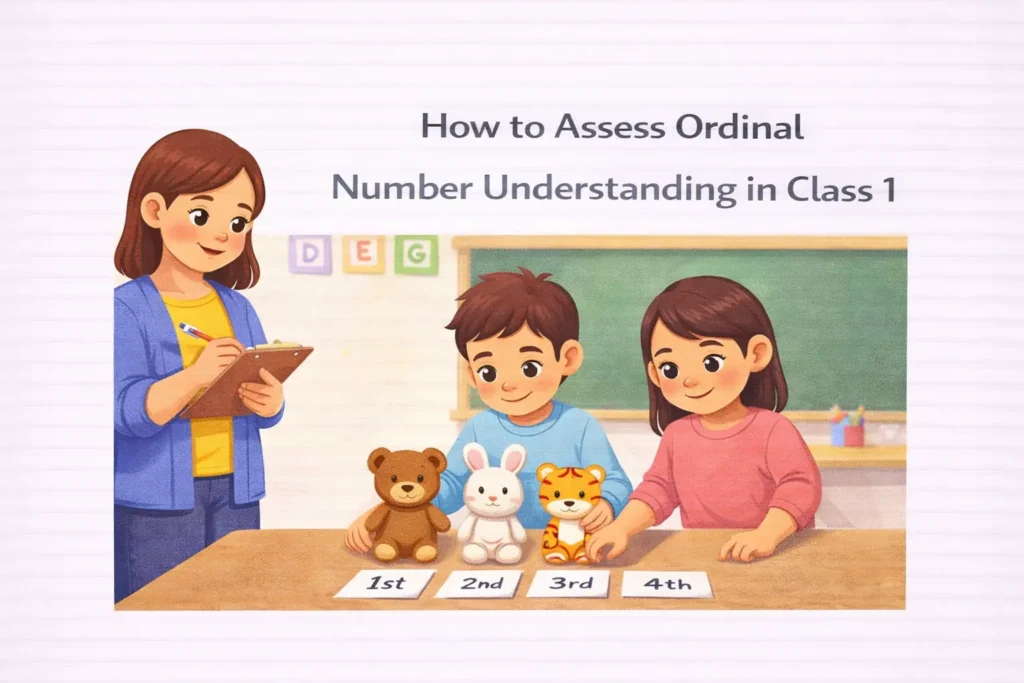
Oral checks (quick and natural):
- “Who is first in our toy line?”
- “What comes after second in the story?”
- “Can you stand in the third spot?”
Look for quick, confident answers without the child needing to count up from first each time.
Activity observation:
- Does the child use ordinal words spontaneously during line-up or games?
- Can they point to the correct position without hesitation?
- Do they self-correct when they make a positional error?
Signs of solid understanding:
- Using ordinal language unprompted in conversation (“I want to be first!”)
- Correctly following multi-step ordinal instructions (“Take the second book from the third shelf”)
- Applying position language accurately in stories and role-play
Reviewing the characteristics of number sense for Class 1 helps teachers identify whether a child has the foundational understanding needed to progress comfortably with ordinal numbers and related concepts.
Why Do Children Confuse Ordinal and Cardinal Numbers?
This is one of the most common early maths confusions, and it makes complete sense once you understand why it happens.
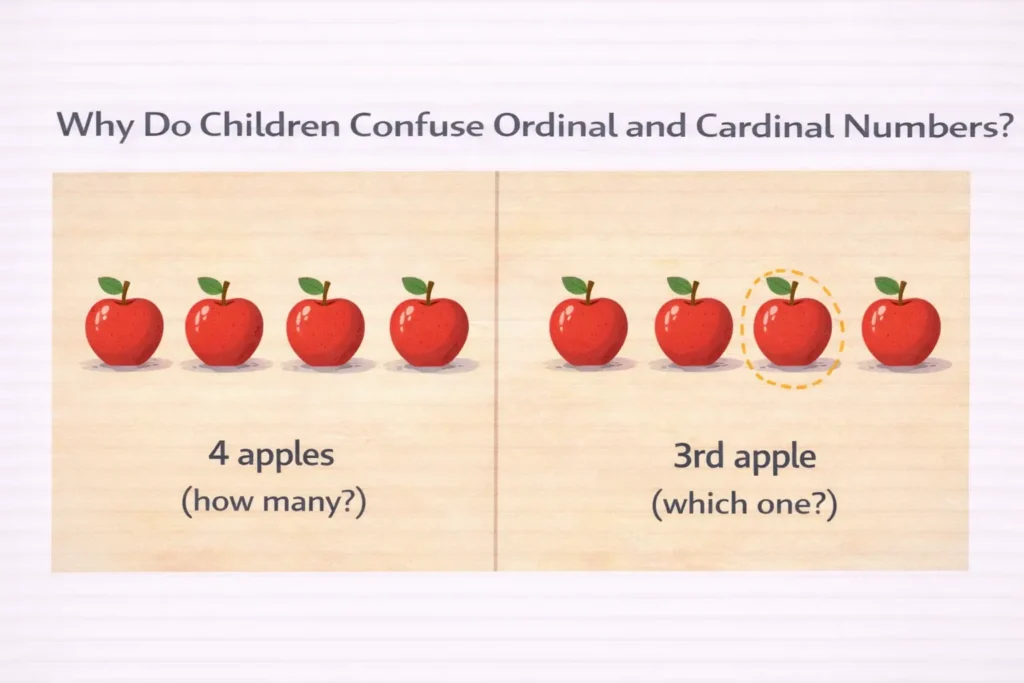
Children first learn numbers as a memorised sequence 1, 2, 3, 4 much like a song. In this context, three and third feel interchangeable because they both involve the number 3.
The distinction between counting quantity and describing position is not obvious until it is explicitly taught.
This confusion is closely connected to the broader challenge of understanding the difference between number sense and arithmetic, where children must learn that numbers serve different purposes in different contexts.
The clearest fix is to consistently ask two different questions about the same situation:
- “How many students are in the line?” → cardinal (quantity)
- “Which position is Riya in?” → ordinal (position)
Contrast, repetition, and real-life examples resolve this confusion naturally over time.
How do you introduce ordinal numbers to Class 1 students?
Start with real objects, line up 3–5 toys, and ask children to identify each position aloud. Once that feels natural, move to visual aids like charts and number cards, then oral practice through games, and finally short written activities like tracing or labelling.
What is the easiest way to teach ordinal numbers to young children?
Hands-on play with familiar objects is the easiest and most effective starting point. Line up toys, label their positions with cards (1st, 2nd, 3rd), and ask children to point and say each position. Adding movement like hopping to positions on a floor number line, makes the concept stick faster.
At what age should children learn ordinal numbers?
Most children are ready to learn ordinal numbers at age 5–6, which corresponds to Class 1 or Grade 1. Many already use positional language naturally before formal teaching words like first and last appear early in play and storytelling.
Why do children confuse ordinal and cardinal numbers?
Children learn numbers as a counting sequence first, which makes three and third feel similar. The distinction between counting quantity (cardinal) and describing position (ordinal) is not obvious until it is explicitly taught using side-by-side examples and contrast questions.
What activities help Class 1 students learn ordinal numbers?
Line-up games, story sequencing, role-play scenarios, and floor number line hopping are the most effective. These combine movement, visual input, and spoken language — a multi-sensory approach that accelerates learning for all children, especially those who find the concept abstract.
How do you help a child who is struggling with ordinal numbers?
Start with just the first, second, and third. Use short daily activities (5–10 minutes) rather than long worksheets. Combine movement, visuals, and speech, ask children to hop to the third spot, point to the second card, and say the position aloud simultaneously.
How do you assess ordinal number understanding without a formal test?
Observe children during everyday activities. Ask casual questions: “Who is first in line?” or “What happened next in the story?” Look for spontaneous use of ordinal language in play and conversation that is the clearest sign of genuine understanding.
How do ordinal numbers connect to number sequences?
Both concepts are built on the same foundation: numbers have a fixed, meaningful order. A child who understands that third comes after second is already thinking sequentially, the same thinking that makes number sequences for Class 1 easier to grasp.
Make Preparing for Math Olympiad Simple!



Conclusion
Teaching ordinal numbers works best when it starts with hands-on play and builds gradually from lining up toys, to reading position charts, to writing 1st, 2nd, and 3rd with confidence.
Short, daily practice beats long, infrequent sessions every time.
Ready to take the next step? Explore what ordinal numbers cover in Class 1 maths for the full concept guide, or download the Gonit app to give your child structured, Olympiad-level maths practice they’ll actually enjoy.
For the full concept overview, visit our guides on number sequences, number ordering, and why number sense matters in Class 1 to keep strengthening your child’s early maths foundation.