


IOQM full form is Indian Olympiad Qualifier in Mathematics, the national-level qualifying exam that opens India’s Mathematical Olympiad pathway for students in Classes 8 to 12.
- What is IOQM? Full Form and Meaning
- IOQM to RMO to INMO to IMOTC to IMO: The Complete Olympiad Pathway
- IOQM 2026 Eligibility Criteria
- IOQM 2026 Registration Process
- IOQM 2026 Exam Date & Schedule
- IOQM 2026 Syllabus: Topic-Wise Breakdown
- Exam Pattern & Marking Scheme
- Previous Year IOQM Cutoff Analysis (2021–2025)
- How to Prepare for IOQM 2026: A Step-by-Step Roadmap
- Best Books & Resources for IOQM Preparation
- How Hard Is IOQM? Difficulty Level Explained
- Time Management & Solving Strategies
- Common Mistakes to Avoid in IOQM
- Conclusion
Based on recent years’ pattern, IOQM 2026 is expected on a Sunday in September 2026, as a single 3-hour, 100-mark, OMR-based paper with no negative marking.
If you’re one of the thousands of students and parents watching for the IOQM 2026 notification;
This guide covers it all: registration, eligibility, syllabus, exam pattern, cutoffs, fees, the MTA portal, and a month-by-month prep plan, including the full IOQM to RMO to INMO to IMOTC to IMO pathway.
What is IOQM? Full Form and Meaning
IOQM full form is Indian Olympiad Qualifier in Mathematics.
In simple terms, the IOQM meaning is a single national-level qualifying exam that acts as the entry gate to India’s Mathematical Olympiad programme.
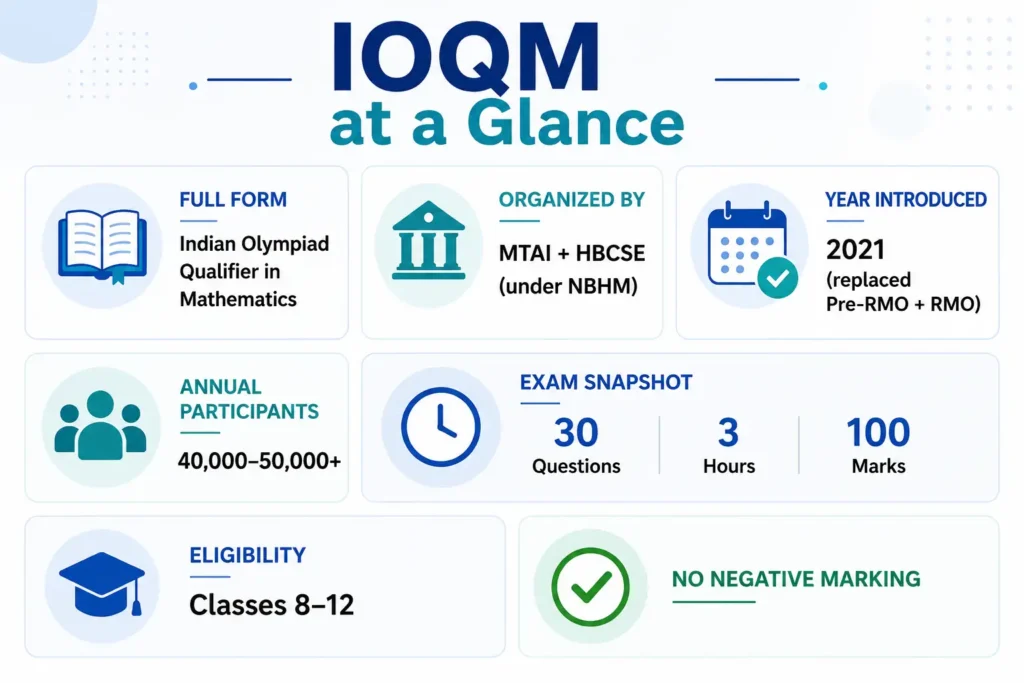
It is the first stage of the Indian Mathematical Olympiad programme.
Conducted jointly by the Mathematics Teachers’ Association of India (MTA/MTAI) and the Homi Bhabha Centre for Science Education (HBCSE), which operates under the Tata Institute of Fundamental Research (TIFR). So when people ask who conducts IOQM, the short answer is MTA(I) in association with HBCSE.
Think of IOQM as the gateway exam. It replaced the earlier two-stage system (Pre-RMO / PRMO and RMO) in 2021, combining them into a single national-level qualifier.
The exam tests mathematical reasoning far beyond what’s covered in school textbooks. It focuses on creative problem-solving in areas like algebra, geometry, number theory, and combinatorics.
If you only need the quick definition and history, our focused explainer on the IOQM full form breaks down what each letter stands for and how the exam evolved from PRMO.
Why Does IOQM Matter?
IOQM matters for three key reasons:
First, it’s the only pathway to represent India at the International Mathematical Olympiad (IMO), the world’s most prestigious mathematics competition for pre-university students. If your goal is IMO, it starts here.
Second, qualifying for IOQM (and the subsequent stages) is a powerful credential for college admissions, particularly for top institutions in India and abroad. Universities recognize Olympiad achievement as evidence of exceptional analytical ability.
Third, the problem-solving skills you develop while preparing for IOQM are genuinely valuable. They sharpen logical thinking, pattern recognition, and structured reasoning in ways that benefit you well beyond this single exam.
How Many Students Appear for IOQM Every Year?
Each year, approximately 30,000 to 50,000 students appear for IOQM across India, and the participation pool has been growing steadily. Of these, roughly 800 to 1,000 students qualify for the next stage (RMO, leading to INMO).
In other words, only about 2-3% of participants clear IOQM. The numbers are competitive, but the preparation journey itself is deeply rewarding.
Is IOQM Conducted Online or Offline?
IOQM is conducted offline, as a pen-and-paper, OMR-sheet based exam at designated school and centre locations. It is not an online or computer-based test, so students should practice with physical OMR sheets and offline mock papers rather than digital ones.
IOQM to RMO to INMO to IMOTC to IMO: The Complete Olympiad Pathway
If you’re new to the Mathematical Olympiad world, the selection pathway and its stages can seem confusing.
Let’s break it down stage by stage so you understand exactly where IOQM fits, what the levels of IOQM lead to, and what comes after.
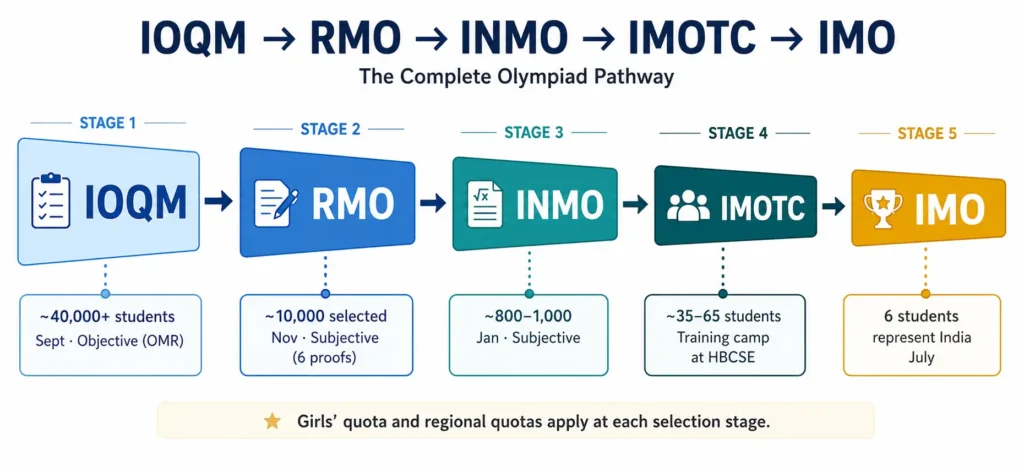
Stage-by-Stage Breakdown
| Stage | Exam Name | Full Form | What Happens |
| Stage 1 | IOQM | Indian Olympiad Qualifier in Mathematics | National-level qualifying exam. ~40,000-50,000+ students appear. Objective format (integer answers on OMR). Top performers from each region advance to RMO. |
| Stage 2 | RMO | Regional Mathematical Olympiad | A 3-hour exam with 6 subjective (proof-based) problems. Conducted region-wise. In 2025, RMO was held on November 16. Top performers advance to INMO. |
| Stage 3 | INMO | Indian National Mathematical Olympiad | Held on the third Sunday of January. Subjective exam. Top ~30 from Category A and top ~6 from Category B are selected for the training camp, plus a girls’ quota. |
| Stage 4 | IMOTC | IMO Training Camp | Intensive training at HBCSE, Mumbai. Multiple selection tests over 8-10 days determine the final team. |
| Stage 5 | IMO | International Mathematical Olympiad | India sends a team of 6 students to compete against 100+ countries at the world’s most prestigious math competition. |
Want the details on the later stages? See our dedicated guides on the Regional Mathematical Olympiad (RMO) and the Indian National Mathematical Olympiad (INMO).
Here’s the key takeaway: IOQM is the widest funnel. It’s the exam with the most participants and the most accessible entry point. If you clear IOQM, you’ve already placed yourself in the top 2-3% of all participants. Each subsequent stage narrows the field dramatically.
How IOQM Qualification Works
The selection from IOQM to RMO follows a specific quota-based system. Here’s exactly how it works, based on the official HBCSE criteria used in the 2025 cycle:
- A student must score at least 10% of the total marks (i.e., at least 10 out of 100) to be considered. This is the minimum qualifying mark, not a guarantee of qualification. Students scoring 10% or more also receive a participation certificate.
- Students in Classes 8-11 are classified as Category A. Students in Class 12 are classified as Category B.
- From each region, the top 200 students from Category A qualify for RMO.
- From each region, the top 40 students from Category B qualify for RMO.
- Girls’ quota: 5 additional girl students from Category A per region are selected. There is no separate girls’ quota for Category B.
- Ties at the cutoff position are broken using IOQM scores.
What Happens After You Qualify IOQM?
If you qualify IOQM, you receive an invitation to appear for RMO (Regional Mathematical Olympiad), typically held in November. This is the next stage after IOQM.
RMO is a very different exam, for it’s subjective, requiring detailed mathematical proofs rather than integer answers.
The transition from IOQM’s objective format to RMO’s proof-writing format is significant, and students who qualify IOQM should begin proof-writing practice immediately.
Students who don’t qualify IOQM in a given year can reattempt the following year, as long as they still meet the eligibility criteria. There’s no limit on the number of attempts (within the age/class window).
If your long-term goal is the International Mathematical Olympiad itself, our detailed guide on how to prepare for the IMO covers the full journey from IOQM through to international selection.
IOQM 2026 Eligibility Criteria
Before you begin the IOQM 2026 registration process, make sure you (or your child) meet the eligibility requirements.
Here’s a clear breakdown of the IOQM eligibility criteria based on the norms used in the 2025 cycle:
| Criterion | Requirement |
| Nationality | Must be eligible to hold an Indian passport. Students with OCI cards are provisionally eligible. Students of Indian origin studying abroad can appear but must travel to India at their own expense; they are treated as enrolled from the Delhi-NCR region. |
| Class/Grade (which class) | Students enrolled in Class 8, 9, 10, 11, or 12 (or equivalent) at a recognized school in India. So IOQM is for classes 8 to 12. Open-school and home-schooled students are also eligible. |
| Age Limit | For the 2025 cycle, students born between August 1, 2006 and July 31, 2013 were eligible. The IOQM 2026 age limit will use an updated date range; expect a similar window shifted by one year, confirmed in the official notification. |
| Board Exam Condition | Must NOT have qualified (or be scheduled to appear for) the Class 12 board examination before the cutoff date specified in the notification. Must not have commenced university studies before June 1 of the relevant year. |
| Residency | Must have been residing and studying in India since a specified date (October 30, 2023 for the 2025 cycle), or studying in an Indian school system since that date. |
| Previous Qualification | No prior Olympiad experience required. First-time aspirants are welcome. However, students who have already qualified for IMOTC or participated in IMO are not eligible. |
| Number of Attempts | No restriction. You can appear every year as long as you meet the class and age criteria. |
A common question from parents: “Can my child in Class 8 really appear for IOQM?”
Yes, absolutely. Class 8 students are eligible, and many do appear. However, the syllabus extends well beyond Class 8 school mathematics, so younger students should plan for a longer preparation timeline.
Younger students (Classes 6-8) may also benefit from starting with junior-level competitions first. See our guide on how to prepare for the Junior Math Olympiad.
Important note: IOQM 2026 eligibility criteria will be confirmed in the official notification, typically released between June and August.
Always verify the latest criteria on the official HBCSE Olympiad page and the MTAI website before registering.
IOQM Eligibility for Class 8, 9, 10, 11 and 12
Since the same syllabus and paper apply across classes, IOQM eligibility for Class 8, Class 9, Class 10, Class 11 and Class 12 students follows one common rule: enrolment in a recognized Indian school within the eligible age window.
There is no separate IOQM eligibility 2026 criteria for individual grades; the only structural difference is the Category A (Classes 8-11) versus Category B (Class 12) qualifying quota described above.
IOQM 2026 Registration Process
The IOQM 2026 registration process is handled through the Mathematics Teachers’ Association of India (MTA), using the official MTA(I) IOQM registration portal.
Here’s a step-by-step walkthrough of how to register for IOQM so you know exactly what to do.
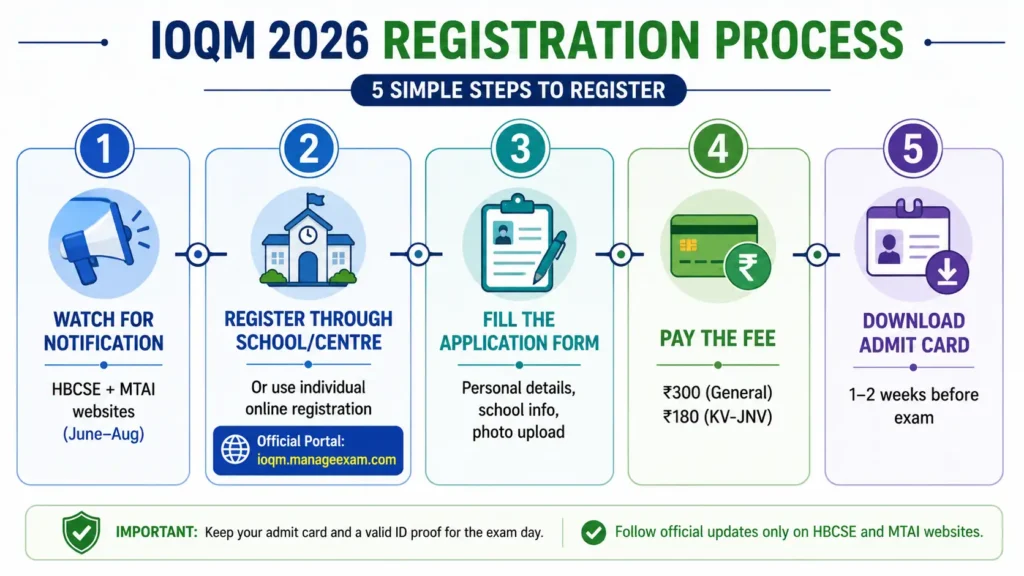
Step-by-Step Registration
Step 1: Watch for the Official Notification. HBCSE and MTA typically release the IOQM notification between June and August each year.
This notification contains the exact registration dates, the registration last date, exam date, fees, and any changes to the eligibility criteria. Monitor the official websites:
HBCSE: https://olympiads.hbcse.tifr.res.in/
Step 2: Register Through Your School (Primary Route). In most cases, school registration is the main route.
Your school’s mathematics teacher or Olympiad coordinator registers eligible students in bulk through the MTA portal. Speak to your school’s math department or principal’s office to confirm they’ll be registering students.
Step 3: Individual Registration (If School Doesn’t Participate). If your school doesn’t participate in IOQM, individual registration is available through the MTA portal, and you can register for IOQM individually.
You’ll need to fill in personal details, school information, and upload the required documents (see the checklist below). This route also applies if you’re searching for IOQM centre registration, since individual registrants are assigned to their nearest exam centre.
Step 4: Pay the Registration Fee. The registration fee for IOQM is typically in the range of ₹250-₹300 (inclusive of GST).
Fee waivers or concessions may be available for students from economically weaker sections (SC/ST). Check the official notification for details.
Step 5: Download Your Admit Card. Once registration is confirmed, admit cards are released approximately 1-2 weeks before the exam date.
Download and print your admit card from the MTA portal. Carry it to the exam centre along with a valid photo ID.
IOQM Registration Portal and Login
There is no separate public IOQM login for students to check ahead of the notification. Registration, the admit card download, and result access all run through the same MTA(I) IOQM registration portal once it opens for the year. Bookmark the HBCSE and MTA(I) pages linked above rather than searching for a standalone login page, since the portal link changes with each year’s notification.
Documents Required for IOQM Registration
Keep these ready before you start the form to avoid last-minute delays:
- A recent passport-size photograph (in the accepted file size and format).
- A valid school ID card or proof of enrolment in an Indian school.
- Date of birth proof (as per the age-limit window).
- A working email ID and mobile number for confirmations and the admit card.
- Category certificate (for SC/ST fee concession, where applicable).
Individual Registration vs School Registration vs Centre Registration
Both routes lead to the same exam, so choose based on your situation. If your school is an IOQM centre, school registration is simplest: the coordinator handles the form and fee, and the exam is often held in your own school.
If your school does not participate, IOQM individual registration on the MTA portal lets you register directly and get assigned to a nearby exam centre through the centre registration process. The per-student fee is the same either way.
Important Dates & Deadlines (Expected for IOQM 2026)
| Event | Expected Timeline |
| Official notification release | June – August 2026 |
| Registration opens | July – August 2026 |
| Registration last date / deadline | August – September 2026 |
| Admit card release | 1-2 weeks before the exam |
| IOQM 2026 exam date | September – October 2026 (typically a Sunday) |
| Results & IOQM cutoff | October – November 2026 |
Note: These dates are based on the pattern followed in recent years (2023, 2024, 2025 cycles). The exact IOQM 2026 exam date and registration date will be confirmed in the official notification. We strongly recommend bookmarking the HBCSE and MTA websites and checking back regularly from June 2026 onward.
IOQM 2026 Registration Fees
The IOQM registration fee is modest and roughly the same across categories, with concessions where applicable:
| Category | Approximate Fee |
| General / OBC | ₹250 – ₹300 |
| SC / ST (where applicable) | Reduced fee or waiver (check notification) |
| School bulk registration | Same per-student fee; coordinated by school |
IOQM 2026 Registration Fees
The IOQM registration fee is modest and roughly the same across categories, with concessions where applicable:
| Category | Approximate Fee |
|---|---|
| General / OBC | ₹250 – ₹300 |
| SC / ST (where applicable) | Reduced fee or waiver (check notification) |
| School bulk registration | Same per-student fee; coordinated by school |
IOQM 2026 Exam Date & Schedule
Based on trends from previous years, here’s what to expect for the IOQM 2026 exam date:
The exam is typically held on a Sunday in September or October. In recent years:
- IOQM 2023 was held on September 3, 2023
- IOQM 2024 was held on September 8, 2024
- IOQM 2025 was held on September 7, 2025 (with a September 28, 2025 session for rescheduled regions)
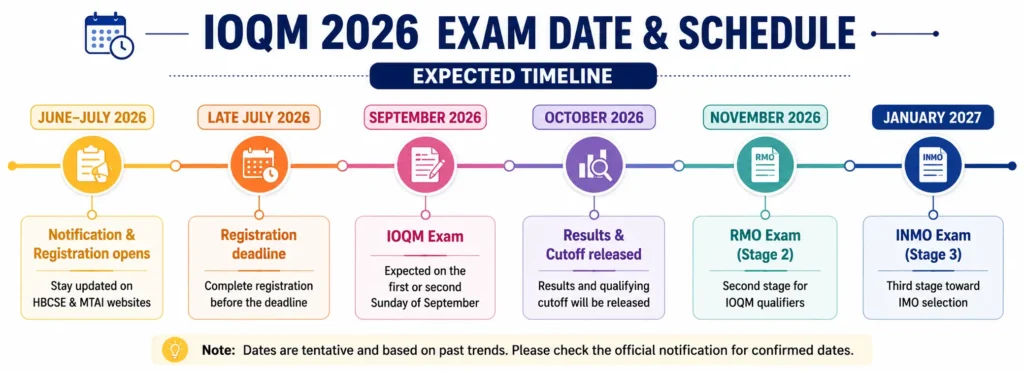
Following this pattern, IOQM 2026 is expected in September 2026, likely on the first or second Sunday of the month. The final date must be confirmed in the official notification.
The exam is conducted in a single session, and the IOQM exam duration is 3 hours, typically from 10:00 AM to 1:00 PM. All centres across India follow the same time slot to maintain uniformity.
Timeline of the Full IOQM 2026 Cycle
| Milestone | Expected Period |
| Notification & registration | June – September 2026 |
| IOQM exam | September – October 2026 |
| Results & IOQM cutoff release | October – November 2026 |
| RMO (next stage) | November 2026 |
| INMO exam | January 2027 |
Looking further ahead, the IOQM 2026-27 cycle (sometimes searched as IOQM 2027) is expected to follow the same rhythm: a notification around mid-year, the exam in the second half of the year, and results a few weeks later.
IOQM 2026 Syllabus: Topic-Wise Breakdown
The IOQM 2026 syllabus covers four major branches of mathematics: Algebra, Geometry, Number Theory, and Combinatorics.
Unlike school math, there’s no prescribed textbook; the syllabus is defined by the types of problems that appear.
Here’s a beginner-friendly breakdown of what each area covers and what sub-topics to focus on:
Complete Syllabus Table
| Branch | Sub-Topics | Beginner-Friendly Explanation |
| Algebra | Polynomials, equations & inequalities, functional equations, sequences & series, algebraic identities, AM-GM-HM inequality, Cauchy-Schwarz inequality, mathematical induction | You’ll work with equations and expressions, but at a deeper level than school algebra. Expect questions on proving inequalities, finding patterns in sequences, and working with functions that satisfy specific conditions. |
| Geometry | Triangles (congruence, similarity, special points), circles (tangent properties, power of a point, cyclic quadrilaterals), coordinate geometry basics, trigonometric identities in geometry, area methods, geometric transformations | Geometry is heavily tested in IOQM. Be comfortable with triangle centres (circumcentre, incentre, orthocentre, centroid), circle theorems, and applying multiple concepts together in a single problem. |
| Number Theory | Divisibility, primes & factorization, GCD & LCM, modular arithmetic, Euler’s totient function, Fermat’s Little Theorem, Chinese Remainder Theorem, Diophantine equations | This is about the properties of whole numbers. You’ll learn to work with divisibility rules at a much deeper level, and modular arithmetic (clock arithmetic) becomes a core tool. |
| Combinatorics | Counting principles (permutations, combinations), Pigeonhole Principle, inclusion-exclusion, graph theory basics, recurrence relations, generating functions (advanced), probability (basic) | Combinatorics is about counting and arrangement. Many students find it unfamiliar because it’s barely covered in school, but it’s one of the most rewarding areas to learn. |
For the official topic list and a deeper class-wise view, see our dedicated IOQM syllabus guide.
If you’re unsure what Olympiad-level problems actually look like, our breakdown of math Olympiad questions shows real examples across difficulty levels.
Is the IOQM Syllabus the Same for All Classes (8 to 12)?
Yes. The IOQM syllabus is the same for every class from 8 to 12; there is no separate syllabus for Class 8, Class 9, Class 10, Class 11, or Class 12. The four branches (algebra, geometry, number theory, combinatorics) apply to everyone.
What changes is your starting point: a Class 12 student has usually seen more of the school-level groundwork, while a Class 8 or Class 9 student may need extra time on topics like modular arithmetic and cyclic quadrilaterals that aren’t in the regular curriculum yet.
Category A (Classes 8-11) and Category B (Class 12) differ only in the qualification quota, not the question paper.
How Topics Are Weighted
While the exact distribution varies year to year, the approximate weightage based on previous IOQM papers is:
| Topic | Approximate Weightage |
| Algebra | 25-30% |
| Geometry | 25-30% |
| Number Theory | 20-25% |
| Combinatorics | 20-25% |
Exam Pattern & Marking Scheme
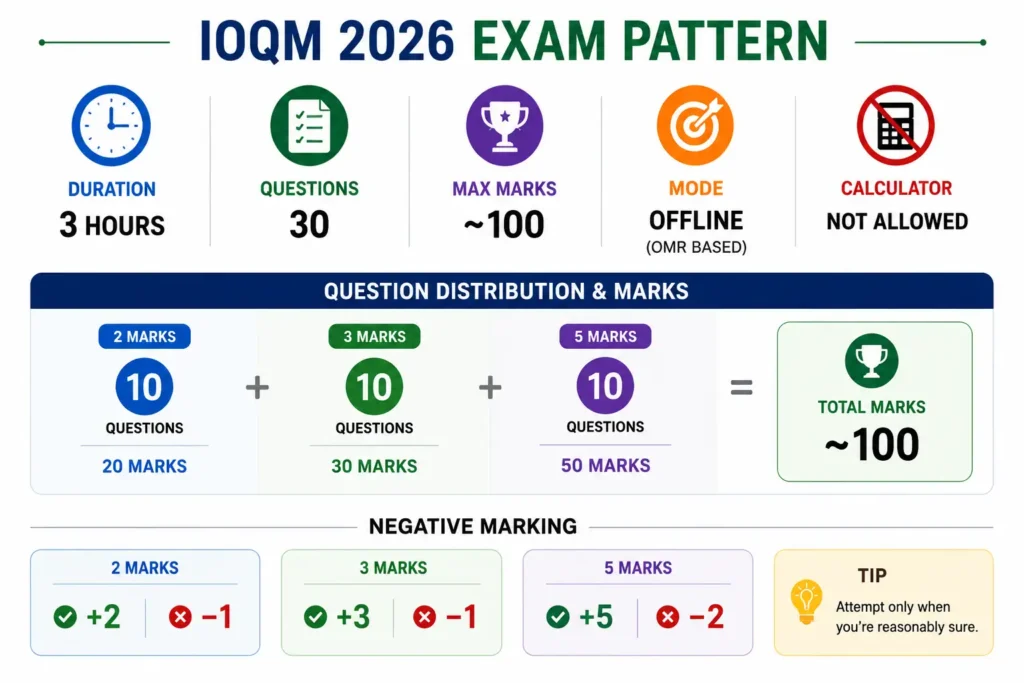
Understanding the IOQM exam pattern is essential for strategy.
Here’s the complete breakdown of the IOQM paper pattern, question format, and marking scheme:
| Parameter | Details |
| Conducting Body | MTA (Mathematics Teachers’ Association of India) in association with HBCSE |
| Mode | Offline (pen-and-paper), OMR-sheet based. IOQM is an offline, OMR-based exam, not online. |
| Duration | 3 hours (180 minutes) |
| Total Questions | 30 questions |
| Question Type | Objective, not subjective. Every answer is an integer (typically between 00 and 99) marked on an OMR sheet. |
| Marks per Question | Questions carry 2, 3, or 5 marks depending on difficulty |
| Total / Maximum Marks | 100 marks. Recent papers used 10 questions x 2 marks + 10 x 3 marks + 10 x 5 marks = 100. (Some years used a 10×2 + 12×5 + 2×10 split; always confirm in the notification.) |
| Qualifying / Passing Marks | A minimum of 10% (10/100) is needed to be considered; actual qualification depends on the region-wise cutoff. |
| Negative Marking | No. IOQM has no negative marking, so you can attempt all 30 questions without any penalty for wrong answers. |
| Language | English and Hindi (regional language options at some centres) |
| Calculators | Not allowed |
| Rough Work | Provided in the question paper itself |
Is IOQM Objective or Subjective?
IOQM is fully objective. You do not write proofs at this stage; you solve each problem and enter a single integer answer (00-99) on a machine-readable OMR sheet.
The subjective, proof-based writing only begins at RMO, the stage after IOQM.
Does IOQM Have Negative Marking?
No. There is no negative marking in IOQM. You earn marks only for correct answers, and nothing is deducted for wrong ones. This is confirmed year after year in the official pattern.
What this means for your strategy: because there is no penalty, you should attempt every question you can make reasonable progress on.
Even a well-reasoned educated attempt has upside and zero downside. That said, don’t fill answers completely at random on questions you haven’t worked on.
Since answers range from 00-99, a blind guess has only about a 1% chance of being right, so your time is better spent solving than gambling. We’ll cover how to use this in the time-management section below.
IOQM Total Marks, Qualifying Marks and Passing Marks
IOQM total marks (maximum marks) is 100, spread across 30 questions worth 2, 3, or 5 marks each. The IOQM passing marks, or minimum qualifying marks, is 10 out of 100 (10%). Scoring 10% or above makes you eligible for the region-wise cutoff list and a participation certificate, but the actual IOQM qualifying marks needed to advance to RMO depend on your region’s cutoff, which typically falls between 36 and 46 out of 100 for the general category, as shown in the cutoff table below.

Key insight:
Many students over-invest in algebra (because it feels closest to school math) and under-prepare for geometry and combinatorics. Don't make that mistake. Geometry and combinatorics together account for roughly half the paper, and they're often where the biggest scoring gaps appear between students.
Previous Year IOQM Cutoff Analysis (2021–2025)
The IOQM 2026 cutoff will depend on the overall difficulty of the paper and the number of participants.
But historical trends give you a realistic benchmark to aim for.
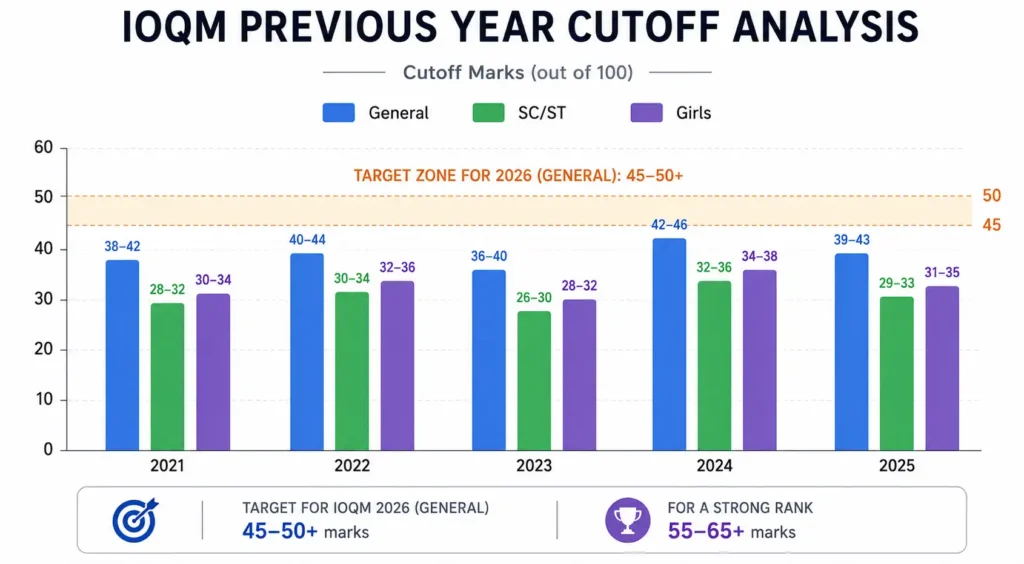
Previous Year Cutoff Trends
| Year | General Cutoff (Approx.) | SC/ST Cutoff (Approx.) | Girls Cutoff (Approx.) | Participants (Approx.) |
| IOQM 2021 | ~38-42 / 100 | ~28-32 | ~30-34 | ~25,000 |
| IOQM 2022 | ~40-44 / 100 | ~30-34 | ~32-36 | ~30,000 |
| IOQM 2023 | ~36-40 / 100 | ~26-30 | ~28-32 | ~35,000 |
| IOQM 2024 | ~42-46 / 100 | ~32-36 | ~34-38 | ~40,000+ |
| IOQM 2025 | ~39-43 / 100 | ~29-33 | ~31-35 | ~45,000+ |
(Note: HBCSE publishes exact cutoffs after each exam. The ranges above are approximate, based on publicly reported data and community discussions. Category-wise cutoffs vary by region; some states have separate quotas.)
What the Cutoff Trends Tell You
The general cutoff hovers around 38-46 out of 100. This means you don’t need to solve every question. You need to solve roughly 40-45% of the paper correctly. That’s the realistic target.
Category-wise relaxation exists. Students in the SC/ST category and female students typically have a lower cutoff by 8-12 marks. This is part of HBCSE’s effort to encourage participation from underrepresented groups.
Difficulty fluctuations cause cutoff swings. In years when the paper is harder (like 2023), cutoffs drop. When the paper is more accessible, cutoffs rise. Don’t fixate on a single number; focus on building strong fundamentals so you can handle variation.
The participation pool is growing. More students take IOQM each year, which generally doesn’t raise the cutoff proportionally (because many new participants are first-timers who score lower). However, the top tier of competition gets more intense.
Realistic target for IOQM 2026: Aim for 45-50+ marks out of 100 to be safely above the general cutoff. If you’re targeting not just qualification but a strong IOQM rank (which helps at INMO), aim for 55-65+.
How to Prepare for IOQM 2026: A Step-by-Step Roadmap
This is the section most students skip to, and for good reason.
Knowing the syllabus is one thing; knowing how to prepare is what actually makes the difference.
Here’s a phased roadmap that works whether you have 3 months or 7 months before the exam. Most motivated students can reach a competitive level with 4–6 months of consistent preparation.
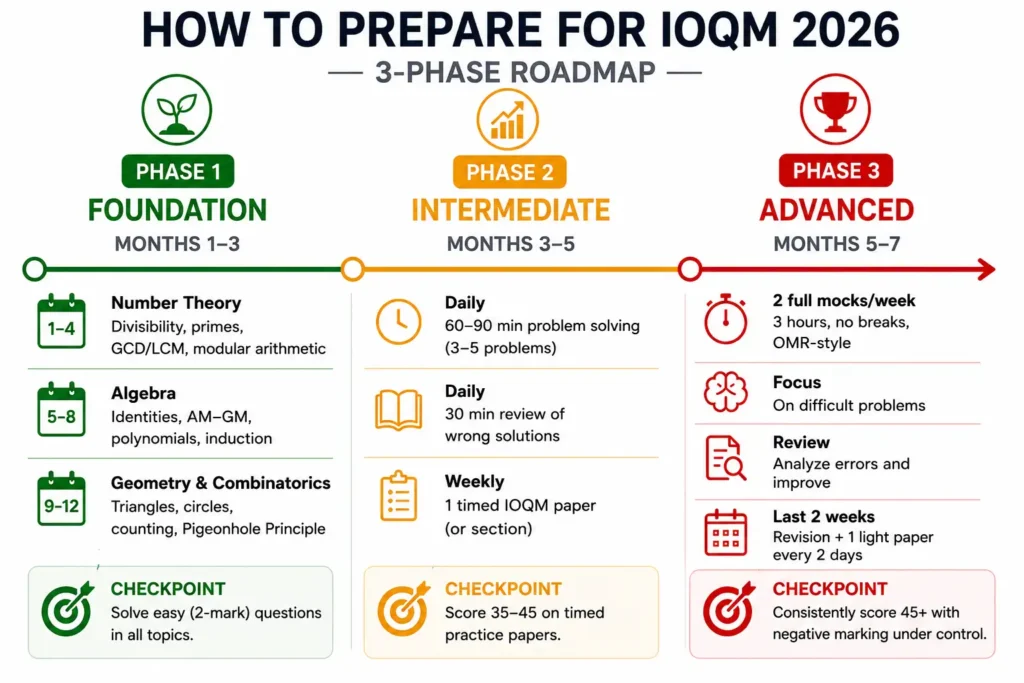
Phase 1: Foundation Building (Months 1-3)
Goal: Build a solid base in all four topics. Don’t try to solve competition-level problems yet. Focus on understanding core concepts.
What to do each day (1.5-2 hours):
Week 1-4: Number Theory Foundations. Start with divisibility, primes, GCD/LCM, and basic modular arithmetic. Number theory is often the most approachable topic for beginners because it doesn’t require advanced school math, just clear logical thinking. Work through introductory chapters in “Challenge and Thrill of Pre-College Mathematics.”
Week 5-8: Algebra Foundations. Cover algebraic identities, AM-GM inequality, basic polynomial theory, and mathematical induction. Practising the manipulation of inequalities is a core skill that shows up across all IOQM problems.
Week 9-12: Geometry & Combinatorics Introduction. Begin with triangle properties, circle theorems, and basic counting principles (permutations, combinations, Pigeonhole Principle). Geometry requires spatial visualization, so draw diagrams for every problem, with no exceptions.
Phase 1 checkpoint: By the end of Month 3, you should be able to solve “easy” level problems from previous IOQM papers (typically the 2-mark questions) in all four topics.
Phase 2: Intermediate Problem Solving (Months 3-5)
Goal: Start solving actual Olympiad-level problems. Develop the ability to combine concepts across topics.
What to do each day (2-2.5 hours):
- Spend 60-90 minutes solving math Olympiad questions from recommended books. Aim for 3-5 problems per session. Don’t just solve; struggle with problems. If you solve every problem in under 3 minutes, you’re not working at the right difficulty level.
- Spend 30 minutes reviewing solutions you got wrong. Don’t just read the answer; understand why you didn’t see the approach. Write down the key insight in a notebook.
- Once a week, attempt a full previous-year IOQM paper (or a section of one) under timed conditions.
Key focus areas in Phase 2:
- Geometry: Master cyclic quadrilaterals, power of a point, and problems involving multiple circle theorems
- Number Theory: Get comfortable with Euler’s Totient, Fermat’s Little Theorem, and solving Diophantine equations
- Combinatorics: Practice inclusion-exclusion problems and basic graph theory
- Algebra: Work on functional equations and inequality proofs
Phase 2 checkpoint: You should be scoring 35-45 on timed practice papers from previous years.
Phase 3: Advanced Practice & Mock Tests (Months 5-7)
Goal: Optimize speed, accuracy, and exam strategy. Focus on the 5-mark questions where qualification is often decided.
What to do each day (2-3 hours):
- Take 2 full-length timed mock tests per week under strict exam conditions (3 hours, no breaks, OMR-style answering)
- Spend significant time on problems you find difficult, and push your comfort zone
- Review every mock test thoroughly. For each question you got wrong, categorize why: concept gap, calculation error, time pressure, or misread question
- In the final 2 weeks, shift focus to revision: redo problems you’ve struggled with, review your error notebook, and do one light practice paper every 2 days
Phase 3 checkpoint: You should consistently score 40+ on practice papers.
For students aiming even higher, our guide on how to get full marks in a maths Olympiad covers advanced strategies for maximising your score.
Best Books & Resources for IOQM Preparation
The right resources make a significant difference.
The right resources make a significant difference. Here’s a curated table of the best books for IOQM preparation, organized by difficulty level:
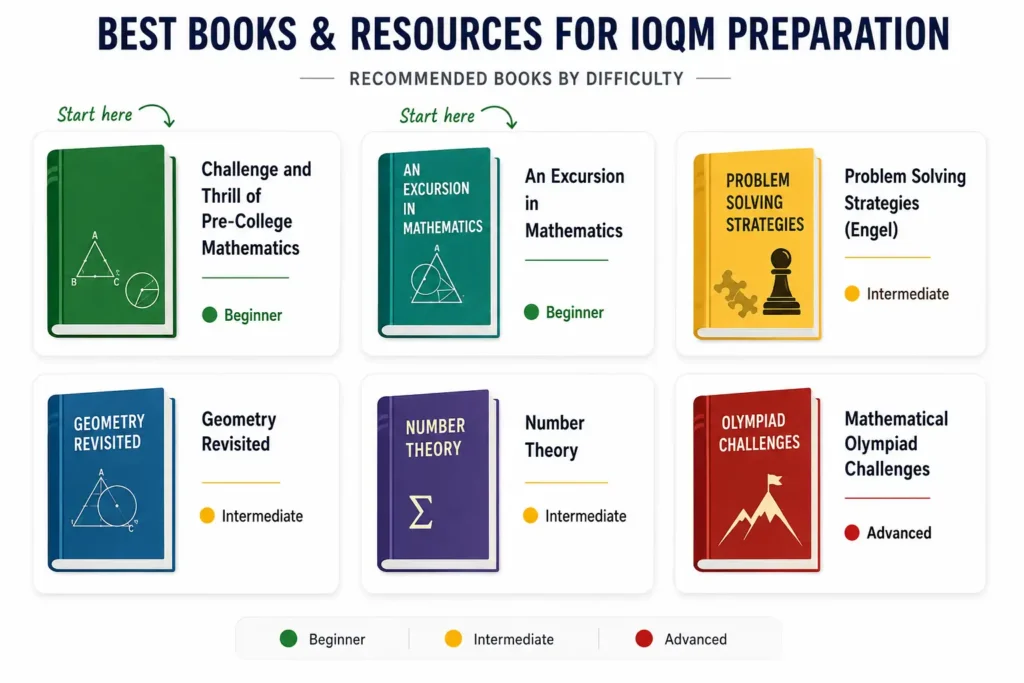
Recommended Books
| Book | Author(s) | Level | What It Covers |
| Challenge and Thrill of Pre-College Mathematics | V. Krishnamurthy, C.R. Pranesachar, K.N. Ranganathan, B.J. Venkatachala | Beginner | Excellent starting point (recommended by HBCSE). Covers all four areas with a gentle introduction to Olympiad thinking. |
| Problem Solving Strategies | Arthur Engel | Beginner-Intermediate | Broad coverage of problem-solving techniques with well-organized chapters by method. |
| An Excursion in Mathematics | M.R. Modak, S.A. Katre, V.V. Acharya, V.M. Sholapurkar | Beginner-Intermediate | Written specifically for Indian Math Olympiad prep (also recommended by HBCSE). Clear explanations with graded problems. |
| Polynomials | E.J. Barbeau | Intermediate | Deep dive into polynomial theory, excellent for strengthening algebra. |
| Geometry Revisited | H.S.M. Coxeter, S.L. Greitzer | Intermediate | The classic geometry book for Olympiad preparation. Covers advanced Euclidean geometry beautifully. |
| Number Theory: Structures, Examples, and Problems | Titu Andreescu, Dorin Andrica | Intermediate | Comprehensive number theory with excellent problem sets organized by difficulty. |
| Principles and Techniques in Combinatorics | Chen Chuan-Chong, Koh Khee-Meng | Intermediate | Clear treatment of counting techniques with many worked examples. |
| The Art and Craft of Problem Solving | Paul Zeitz | Intermediate-Advanced | Teaches how to think about problems. Excellent for developing mathematical maturity. |
| Mathematical Olympiad Challenges | Titu Andreescu, Razvan Gelca | Advanced | For students aiming for a high IOQM score and INMO qualification. Tough problems with elegant solutions. |
Online Resources & Previous Year Papers
Beyond books, these resources are valuable, especially the previous year IOQM papers, which are the single most important practice tool:
- Previous year IOQM papers (available on the HBCSE website and math forums): the single most important resource. Work through at least 3-5 years of past papers.
- AoPS (Art of Problem Solving) forums: the global math Olympiad community. Search for IOQM-specific discussion threads and paper solutions.
- Gonit App: our platform provides structured, topic-wise Olympiad practice problems for Grades 1-12, with difficulty-graded questions that mirror the IOQM style. It’s designed for students who want organized practice without the guesswork of selecting problems from multiple books.
- HBCSE’s official resource list: HBCSE occasionally publishes recommended reading lists on their Olympiad page.
- Free training resources: if budget is a concern, our guide to free math Olympiad training online maps out a complete preparation roadmap using freely available materials.
- YouTube channels: several Indian math educators create IOQM-specific solution walkthroughs. Look for channels that explain the thought process, not just the answer.
How Hard Is IOQM? Difficulty Level Explained
IOQM is significantly harder than school mathematics, but it is very much learnable. The questions test creative problem-solving and mathematical reasoning rather than formula application. Topics like modular arithmetic, combinatorics, and proof-style geometry go well beyond NCERT textbooks.
The encouraging part: the general cutoff sits near 40-45%, so you do not need to solve everything. With 4-6 months of consistent, active practice, most motivated students can reach a competitive level. Difficulty rises sharply at the later stages (RMO and INMO), but IOQM itself rewards steady preparation more than raw talent.
Is IOQM Harder Than JEE?
IOQM and JEE test different skills, so a direct comparison is misleading. JEE rewards speed and applying known formulas across a wide syllabus under time pressure. IOQM rewards creative, proof-oriented thinking on a narrower set of topics (algebra, geometry, number theory, combinatorics), often with fewer standard shortcuts available. Many students who find school-style problem sets manageable still find IOQM’s reasoning-heavy questions unfamiliar at first, which is why dedicated Olympiad preparation, rather than JEE preparation alone, is recommended.
Time Management & Solving Strategies
You have 180 minutes for 30 questions. That’s an average of 6 minutes per question. But you should not spend equal time on every question. Here’s a smarter approach:
The Three-Pass Strategy
Pass 1 (First 45 minutes): Scan and solve the easiest questions. Go through all 30 questions quickly. Solve the ones you can do in under 3 minutes. Mark the rest for later. Your goal: pick up 20-30 “sure” marks with minimal time investment.
Pass 2 (Next 75 minutes): Work on medium-difficulty questions. Return to questions you skipped that seem solvable with some effort. Spend up to 7-8 minutes per question. This is where most of your marks will come from.
Pass 3 (Final 60 minutes): Attempt the hard questions and review. Try the remaining tough questions (usually the 5-mark ones). Spend 10-12 minutes maximum per question. Use any remaining time to double-check your OMR sheet and verify calculations for questions you’ve already answered.
Attempt Everything: There’s No Penalty
Because IOQM has no negative marking, leaving a question completely blank is a wasted opportunity. If you have narrowed a problem down or done meaningful work, put your best integer down. Rules to follow:
- Attempt every question where you’ve done real working, because there is no penalty for a wrong answer
- Never fill the OMR sheet in the last 5 minutes in a rush; fill it as you go, question by question
- For calculation-heavy problems, verify your final answer by substituting it back or checking edge cases
- If you’ve narrowed a question down to 2-3 possible integer answers, pick the most likely one and move on
Common Mistakes to Avoid in IOQM
After analyzing thousands of IOQM attempts, certain patterns emerge. Here are the most common mistakes and how to avoid them:
Mistake 1: Leaving questions blank. Since IOQM has no negative marking, every blank you leave on a question you could have attempted is a lost chance. Students who play too safe can miss 15-20 easy marks. Fix: attempt every question where you’ve done genuine working.
Mistake 2: Ignoring geometry and combinatorics. Many students come from a school background where algebra dominates. They spend 80% of prep time on algebra and number theory, then face a paper where about half the marks are in geometry and combinatorics. Fix: allocate at least 40% of your preparation time to geometry and combinatorics from Day 1.
Mistake 3: Not practicing with previous year papers. Books teach concepts; past papers teach the exam. Students who only read theory are often shocked by the format, difficulty curve, and time pressure on exam day. Fix: start solving previous year papers from Phase 2. Aim for 4-5 full papers under timed conditions before the exam.
Mistake 4: Poor time allocation during the exam. Getting stuck on one question for 20+ minutes is a common trap, especially on geometry problems that “feel” almost solved. Meanwhile, easier questions later in the paper go unattempted. Fix: use the three-pass strategy above and set a hard time limit per question.
Mistake 5: Calculation errors on “easy” questions. The 2-mark questions are designed to be straightforward, but that doesn’t mean error-free. Arithmetic mistakes on simple questions are heartbreaking. Fix: double-check every calculation on questions worth 2-3 marks. These are your safe marks, so protect them.
Mistake 6: Starting preparation too late. IOQM covers topics most schools don’t teach (modular arithmetic, Pigeonhole Principle, cyclic quadrilaterals). These aren’t things you can learn in two weeks. Fix: begin preparation at least 4-6 months before the exam. If you’re reading this early, you have a real advantage.
Mistake 7: Studying passively instead of solving actively. Reading a chapter on number theory is not the same as solving number theory problems. IOQM rewards active problem-solving, not passive knowledge. Fix: for every 20 minutes of reading, spend 40 minutes solving problems. The ratio should always favour practice.
Our step-by-step guide on how to improve your problem-solving skills covers specific techniques for building this active-practice habit.
And if you’re weighing IOQM against school-level Olympiads, our comparison of SOF IMO vs IOQM explains how the two differ. If MOEMS or MATHCOUNTS is also on your radar for younger grades, our guides on MOEMS and MATHCOUNTS break down those formats too.
What is the full form of IOQM?
IOQM stands for Indian Olympiad Qualifier in Mathematics. It is the first stage of the Indian Mathematical Olympiad programme, conducted by the Mathematics Teachers’ Association of India (MTA) in collaboration with HBCSE.
Can Class 8 students appear for IOQM 2026?
Yes. Students from Class 8 through Class 12 are eligible to appear for IOQM. Younger students should be aware that the syllabus includes topics beyond their current school curriculum, so additional preparation time is recommended.
What is the IOQM 2026 exam date?
The exact date hasn’t been announced yet, but based on previous years’ patterns, IOQM 2026 is expected to be held on a Sunday in September 2026. The official date will be confirmed in the HBCSE/MTA notification, typically released between June and August.
Is there negative marking in IOQM?
No. IOQM has no negative marking. You earn marks only for correct answers, and nothing is deducted for a wrong or blank response. This is confirmed year after year in the official exam pattern, so you should attempt every question you’ve made progress on.
How much does IOQM registration cost?
The registration fee is approximately ₹250–₹300. Fee concessions may be available for SC/ST students. Registration is typically handled through schools, though individual registration is also possible via the MTA portal.
Is coaching necessary for IOQM preparation?
Not necessarily. Many IOQM qualifiers are self-taught using the right books and resources. Coaching can help with structured guidance and peer learning, but it’s not a requirement. What matters most is consistent problem-solving practice with quality materials. Platforms like Gonit App can provide structured practice without the need for full coaching.
How difficult is IOQM compared to school math?
IOQM is significantly harder than school mathematics. The questions test creative problem-solving and mathematical reasoning rather than formula application. Topics like modular arithmetic, combinatorics, and proof-based geometry go well beyond NCERT textbooks. However, with 4–6 months of dedicated preparation, most motivated students can reach a competitive level.
What happens after I qualify IOQM?
If you qualify IOQM (score above the cutoff), you’re invited to appear for INMO (Indian National Mathematical Olympiad), typically held in January. INMO is a subjective exam requiring written mathematical proofs. Top INMO performers are selected for the IMO Training Camp, and ultimately, 6 students represent India at the International Mathematical Olympiad.
Can I appear for IOQM multiple times?
Yes. There’s no limit on the number of attempts, as long as you continue to meet the eligibility criteria (class and age requirements) each year.
Where can I find previous year IOQM papers?
Previous-year papers are available on the HBCSE Olympiad website, on various math Olympiad forums (especially AoPS), and on preparation platforms. Solving at least 3–5 years of previous papers is one of the most effective preparation strategies.
Who conducts IOQM?
IOQM is conducted by the Mathematics Teachers’ Association of India (MTA/MTAI) in association with the Homi Bhabha Centre for Science Education (HBCSE), which operates under TIFR.
What is the IOQM total marks and passing marks?
IOQM is out of 100 total marks across 30 questions. The minimum qualifying mark to be considered is 10 out of 100 (10%), though the actual region-wise cutoff to advance to RMO is usually between 36 and 46 out of 100 for the general category.
Is IOQM conducted online or offline?
IOQM is conducted offline as a pen-and-paper, OMR-sheet based exam. It is not held online or as a computer-based test.
Make Preparing for Math Olympiad Simple!



Conclusion
IOQM is the first step toward India’s IMO pathway. It is expected around September 2026 and covers algebra, geometry, number theory, and combinatorics, with no negative marking and answers entered on an OMR sheet.
To prepare well, build foundations first, then move to Olympiad-level problems and timed mocks. Give extra focus to geometry and combinatorics, as many students lose marks there.
Start now: check the IOQM 2026 eligibility, follow official HBCSE and MTA updates for the registration date and exam date, choose a strong starter book, practise daily, and use structured platforms like Gonit App for topic-wise Olympiad practice.

Mikha Piregu is a Content Writer with experience spanning educational content, including math and math olympiad topics, as well as advocacy writing, research-based articles, and SEO-driven web content. He creates high-quality blog content, web copy, and feature articles that support brand visibility, audience engagement, and long-term organic growth through data-informed storytelling. Skilled in WordPress, WooCommerce, and modern digital tools, Mikha adapts content across various platforms, including blogs, websites, campaigns, and advocacy initiatives, with clarity and purpose.




There are no comments posted here yet.
Sign in to leave a comment