


The SilverZone International Olympiad of Mathematics (iOM) 2026-27 is a prestigious competition for students in Classes 1–12, focused on enhancing mathematical aptitude and analytical skills.
- What is SilverZone iOM?
- iOM 2026-27 Important Dates
- Eligibility — Who Can Participate?
- iOM Exam Pattern 2026-27
- SilverZone iOM Syllabus 2026-27
- Awards, Medals & Recognition
- iOM vs SOF IMO — Which Should Your Child Choose?
- How to Register for SilverZone iOM 2026-27
- How to Prepare for iOM — Study Strategy
- Conclusion
Registration for Stage is now open, with a deadline of August 31, 2026, and exams scheduled on 8 October 2026, 18 November 2026, and 7 December 2026.
Your child is ready for a Math Olympiad but between SOF IMO, NSTSE, and SilverZone iOM, you’ve hit a wall of confusing options, outdated websites, and zero straight answers.
In this guide, you’ll get the iOM 2026–27 exam pattern, syllabus, registration steps, and a clear SOF IMO comparison.
What is SilverZone iOM?
The SilverZone International Olympiad of Mathematics (iOM) is a national-level competitive exam organized by SilverZone Foundation.
A New Delhi-based educational organization that has been running Olympiad programs since 2004.
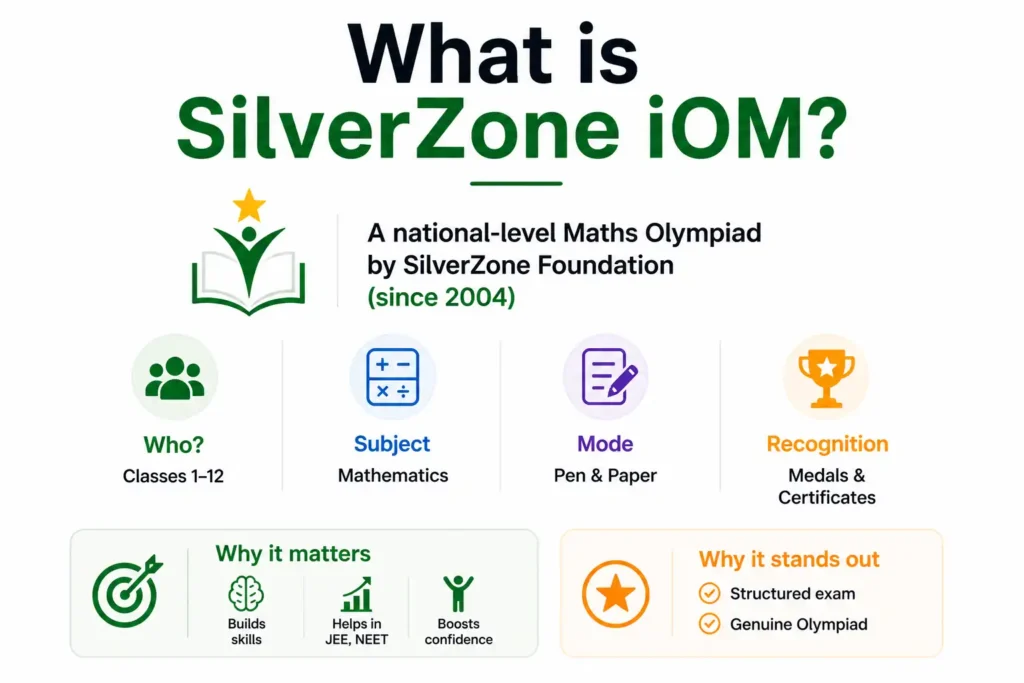
Here’s what makes it stand out:
- Who can participate: Students in Classes 1–12
- Subject: Mathematics pure, logical, and applied problem-solving
- Mode: Pen-and-paper exam, conducted at the school level (or individually more on that below)
- Recognition: Winners receive medals, certificates, and scholarships. High ranks are recognized by schools and competitive exam coaching centers as a credible achievement.
Unlike some Olympiads that are mostly certificate mills, SilverZone iOM has a structured award system and is genuinely competitive.
It’s particularly popular in CBSE schools across metro and Tier 2 cities.
Why does it matter? For students serious about maths, Olympiad experience builds the kind of problem-solving instinct that pays dividends in JEE, NEET, and beyond.
For younger students, it’s an excellent confidence builder and a first taste of competitive maths.
iOM 2026-27 Important Dates
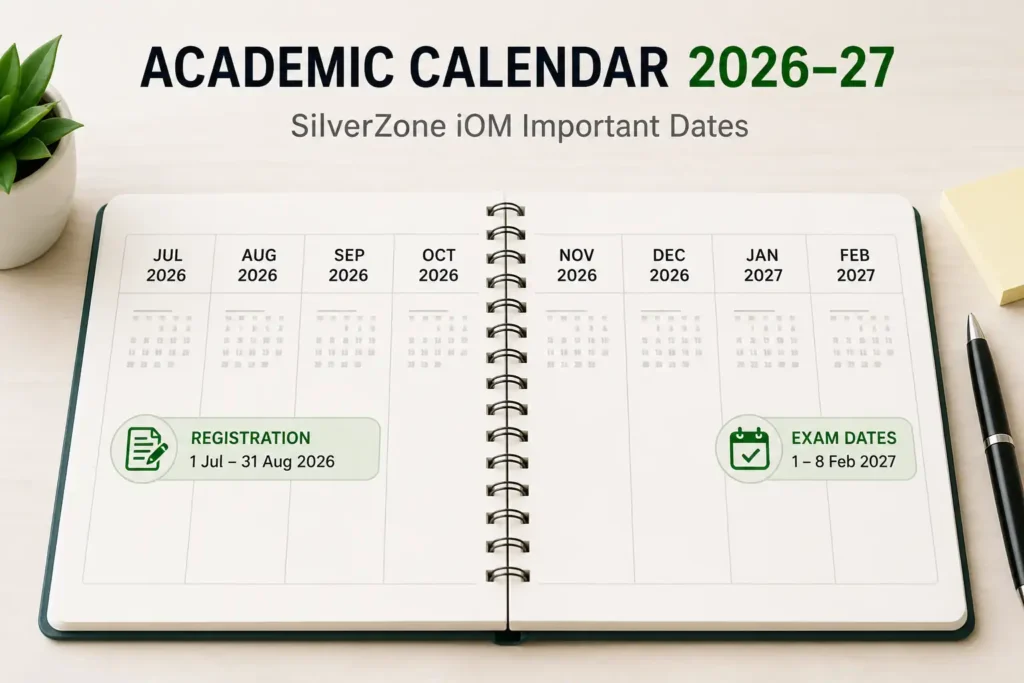
For the 2026–27 session, the International Olympiad of Mathematics is scheduled on 8 October 2026, 18 November 2026, and 7 December 2026.
While the last date of registration is 31 August 2026.
The table below is based on historical SilverZone patterns from 2022–2025:
| Event | Estimated Timeline (Based on Past Years) |
| Registration Opens | July–August 2026 |
| School Registration Deadline | September–October 2026 |
| Individual Registration Deadline | October 2026 |
| Level 1 Exam | November–December 2026 |
| Level 1 Results | January–February 2027 |
| Level 2 Exam (if applicable) | February–March 2027 |
| Final Results / Awards | March–April 2027 |
What to do now: Bookmark the official SilverZone website (silverzone.org) and check back in July 2026 for confirmed dates.
If your child’s school participates, the class teacher or principal will typically notify parents in August–September.
Eligibility — Who Can Participate?
School Registration (Most Common)
Most students participate through their school. If your school is a registered SilverZone centre:
- Any student in Classes 1–12 is eligible
- No minimum marks or prior Olympiad experience required
- School coordinates registration, exam, and result communication
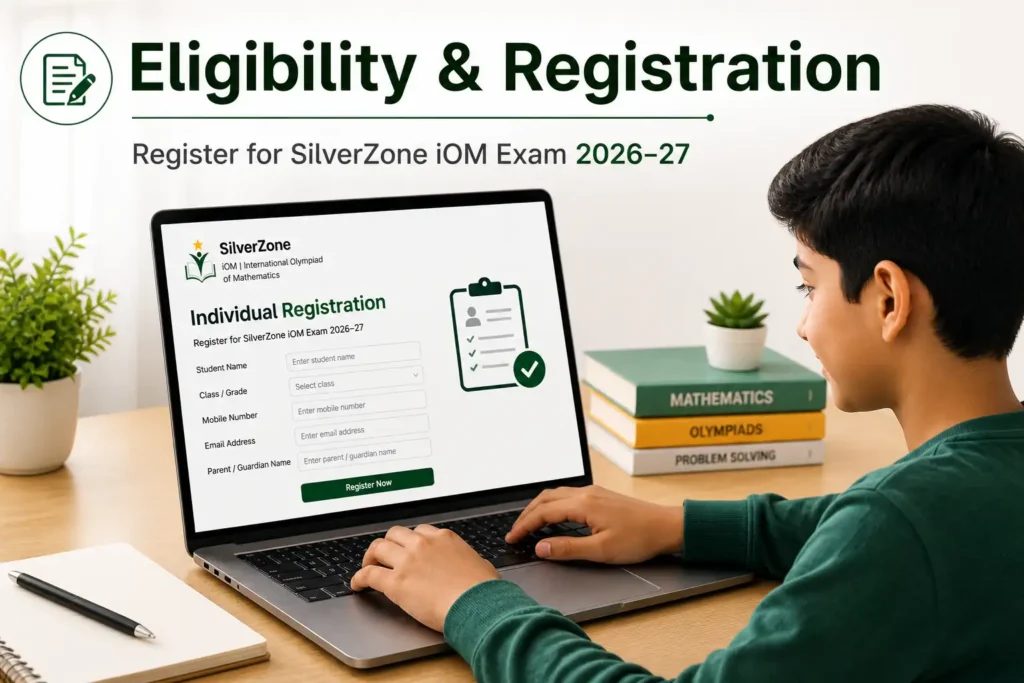
Individual Registration (SilverZone’s Big Advantage)
This is where SilverZone genuinely stands apart from competitors like SOF IMO.
You don’t need your school to participate. SilverZone allows individual registrations meaning:
- Your school doesn’t need to be a registered SilverZone centre
- You can register directly on the SilverZone website
- You’ll be assigned to a nearby exam centre
This is a game-changer for students in smaller cities, unrecognized schools, or families who are proactive about Olympiad prep before their school gets involved.
Home-Schoolers and Private Candidates
Home-schooled students and private candidates can register individually. You’ll need:
- Proof of the student’s class/grade level
- Valid contact information for centre assignment
There is no board-specific restriction CBSE, ICSE, state board, and international curriculum students are all welcome.
iOM Exam Pattern 2026-27
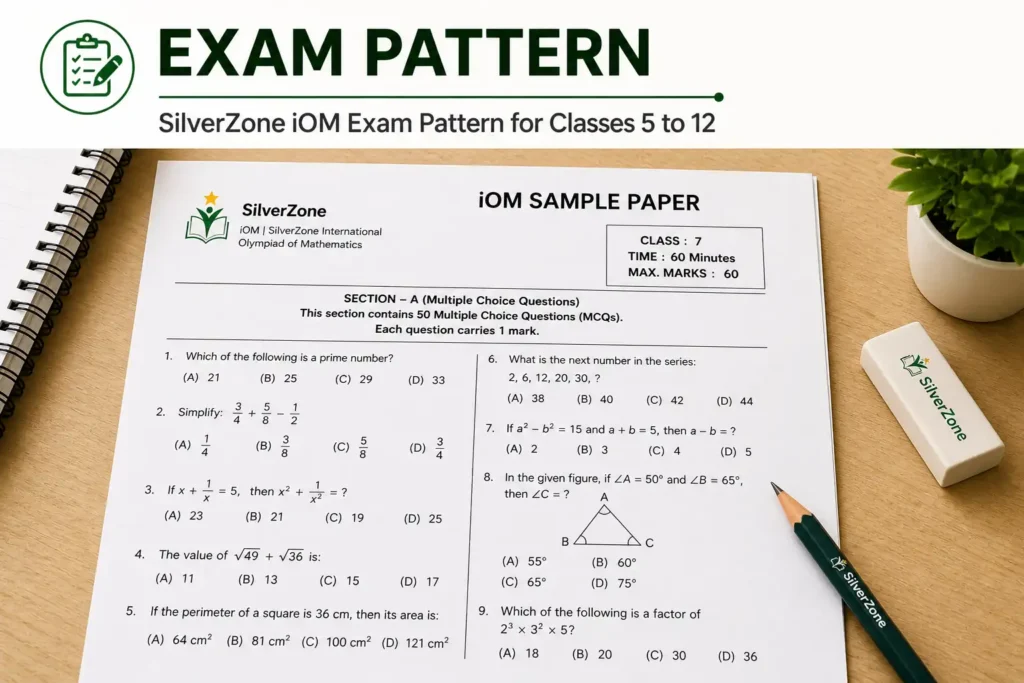
The iOM exam is structured to test three types of mathematical thinking:
| Question Type | What It Tests |
| Conceptual | Core syllabus knowledge (formulas, theorems, definitions) |
| Logical Reasoning | Pattern recognition, spatial thinking, number series |
| Applied / Word Problems | Real-world application of math concepts |
Exam Structure (General Pattern)
| Parameter | Details |
| Duration | 60 minutes |
| Total Questions | 35 questions (Classes 1–4: 30 questions) |
| Total Marks | 40 marks |
| Question Type | Multiple Choice Questions (MCQs) only |
| Negative Marking | None (no penalty for wrong answers) |
| Medium | English |
Section Breakdown (Classes 5–12)
| Section | Questions | Marks |
| Mathematical Reasoning | 15 | 15 |
| Everyday Mathematics | 10 | 10 |
| Achiever’s Section (Higher Order) | 10 | 20 |
| Total | 35 | 45 |
⚠️ Note: The Achiever’s Section carries 2 marks per question which significantly rewards students who prepare beyond the basic syllabus. Don’t ignore it.
No negative marking means guessing is always worth attempting. This makes time management a more important skill than loss-aversion strategy.
Curious how this stacks up against the competition? See the full SOF IMO exam pattern for a direct side-by-side read.
SilverZone iOM Syllabus 2026-27
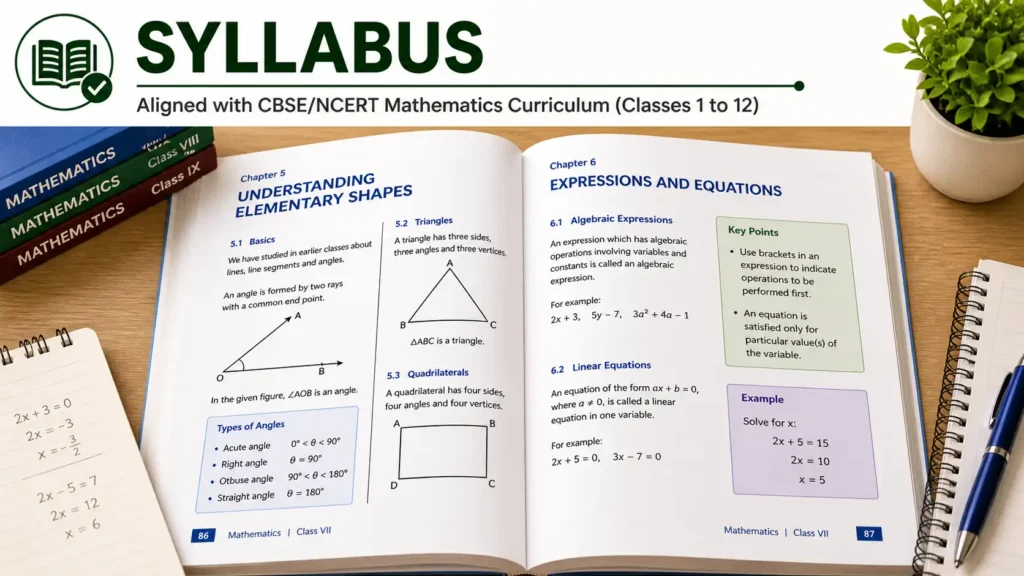
The iOM syllabus closely follows CBSE guidelines, making it accessible for CBSE students without extra effort.
ICSE and state board students will find 85–90% overlap in core topics.
Class-Wise Focus Areas
| Class Group | Core Topics |
| 1–2 | Numbers (up to 100/1000), basic addition/subtraction, shapes, patterns |
| 3–4 | Multiplication, division, fractions, measurement, basic geometry |
| 5–6 | Decimals, percentages, ratio, integers, basic algebra, data handling |
| 7–8 | Linear equations, geometry, mensuration, exponents, statistics |
| 9–10 | Polynomials, coordinate geometry, triangles, circles, probability |
| 11–12 | Calculus basics, probability, permutation-combination, vectors |
Most Frequently Tested Topics (Based on Past Papers)
- Number systems and operations (all classes)
- Mensuration (area, perimeter, volume) — especially Classes 5–8
- Algebra and equations — Classes 7–10
- Geometry proofs and properties — Classes 8–10
- Ratio, proportion, and percentages — Classes 5–7
- Statistics and data interpretation — Classes 8–12
- Logical and pattern-based questions (always appear in the Achiever’s Section)
Alignment with School Boards
| Board | Syllabus Match |
| CBSE | Near-perfect alignment |
| ICSE | High overlap (~85%) |
| State Boards | Moderate overlap (~75–80%) |
| International (IB/Cambridge) | Partial — some topics may differ |
Practical implication: If your child already studies CBSE maths sincerely, they have a solid foundation for iOM without needing to learn an entirely new curriculum.
If you’re also considering SOF IMO, we’ve put together a class-wise SOF IMO syllabus breakdown so you can compare topic overlap before committing.
Awards, Medals & Recognition
SilverZone iOM has one of the more generous award structures among school Olympiads.
Here’s what students can win:

Award Structure
| Rank/Performance | Award |
| International Rank 1–3 | Gold Medal + Certificate of Merit + Cash Prize |
| International Rank 4–10 | Silver Medal + Certificate |
| International Rank 11–25 | Bronze Medal + Certificate |
| Top 10% in class (national) | Certificate of Distinction |
| All participants | Participation Certificate |
| School achievers | School Excellence Award (for top performers from the school) |
💡 Exact scholarship amounts vary by year and haven’t been confirmed for 2026-27. Check silverzone.org for the latest prize structure once it’s published. To see how this compares, here’s the full SOF IMO awards and prizes breakdown for 2026-27.
How It Looks on a Student Profile
- Medals and certificates are recognized by schools and noted in academic records
- Useful for Class 9–12 students building competitive portfolios for scholarships and college admissions
- International rank certificates carry more weight than participation certificates in competitive environments
iOM vs SOF IMO — Which Should Your Child Choose?
This is the most common question parents ask. Here’s an honest comparison:
Side-by-Side Comparison
| Parameter | SilverZone iOM | SOF IMO |
| Organizer | SilverZone Foundation | Science Olympiad Foundation |
| Established | 2004 | 1996 |
| Eligibility | Classes 1–12 | Classes 1–12 |
| Individual Registration | ✅ Yes | ❌ School-only |
| Exam Mode | School/Centre | School only |
| Negative Marking | No | No |
| Difficulty Level | Moderate | Moderate–High |
| Award Structure | Medals + Certificates + Cash | Medals + Certificates |
| Brand Recognition | Good (growing) | Excellent (established) |
| Participation Scale | Large | Largest in India |
Scenario-Based Recommendations
→ Beginner student (first Olympiad): Choose iOM. The question difficulty is accessible without being discouraging, and no negative marking means less anxiety. It’s a confidence-builder.
→ No school support / individual registration needed: Choose iOM. SOF IMO doesn’t offer individual registration SilverZone’s individual registration option is a genuine differentiator.
→ Rank-focused student wanting maximum peer comparison: Consider SOF IMO. The larger participant base means competition is stiffer, and the brand recognition is higher among schools and coaching institutes.
→ Advanced student wanting a real challenge: Do both. Treat iOM as a structured practice ground and SOF IMO as the main event.
They’re complementary, not mutually exclusive. Start with SOF IMO sample papers to gauge the difficulty gap before deciding how to split your prep time.
The honest answer: Neither is objectively better. It depends on your child’s situation and goals. For most families reading this, iOM is an excellent starting point especially if school-level registration is uncertain.
How to Register for SilverZone iOM 2026-27
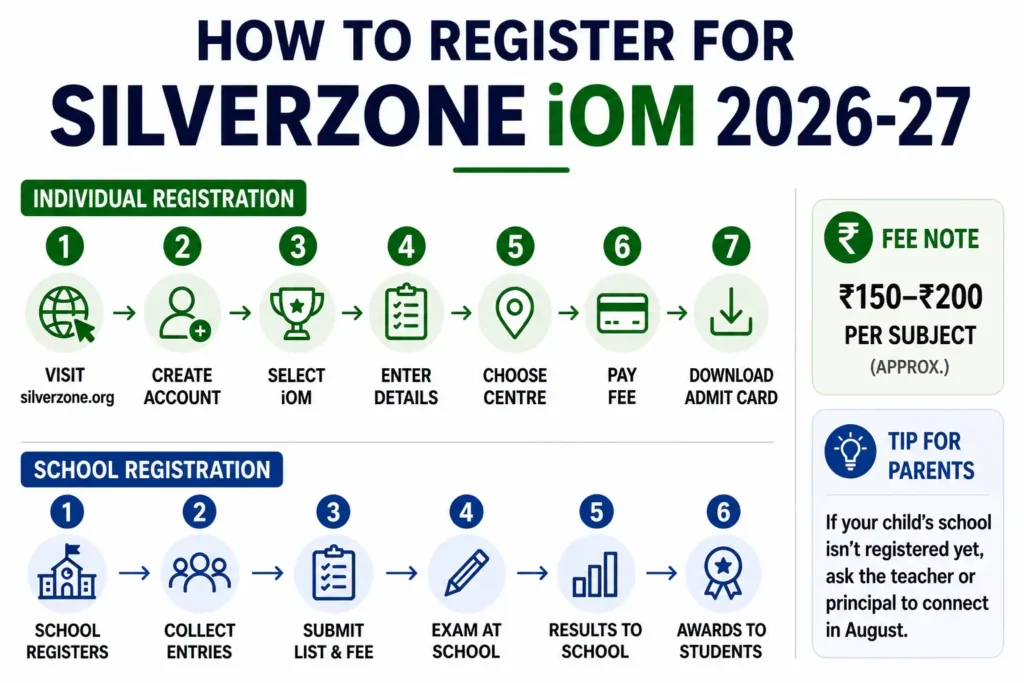
Individual Registration (Step-by-Step)
- Visit silverzone.org and navigate to “Olympiad Registration” or “Individual Registration”
- Create a parent/student account with your email ID
- Select the Olympiad: iOM (International Olympiad of Mathematics)
- Enter student details: name, class, board, school name
- Select your preferred exam centre (from available centres near your PIN code)
- Pay the registration fee online (UPI, net banking, debit/credit card accepted)
- Download and save the registration confirmation and admit card
📌 Fee note: Registration fees as of 2024–25 were approximately ₹150–₹200 per subject per student. Exact 2026-27 fees are not confirmed yet check the official website at the time of registration.
School Registration (Step-by-Step)
- The school coordinator (usually a teacher) registers the school as a SilverZone centre if not already registered
- Coordinator collects student registrations from interested students
- School submits the list and fee to SilverZone by the school deadline
- Exam is conducted at the school premises on the scheduled date
- Results and awards are dispatched to the school
Tip for parents: If your child’s school hasn’t registered yet, ask the class teacher or principal to connect with SilverZone in August.
Schools get a small monetary incentive per registered student, which makes most schools willing to participate.
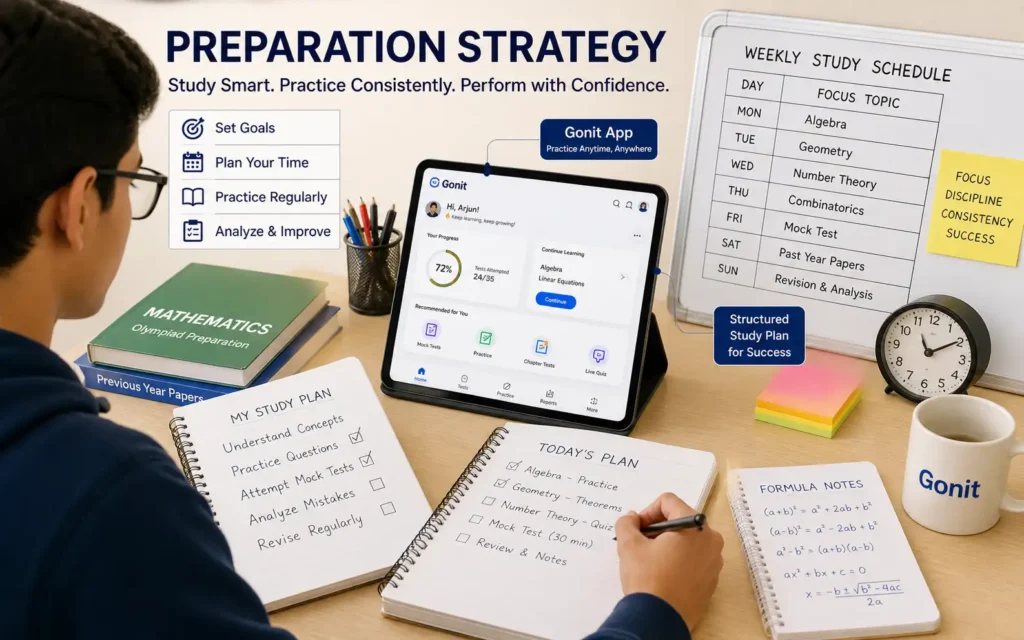
How to Prepare for iOM — Study Strategy
Beginner Track (First-time Olympiad, Classes 1–6)
- Start with school textbook mastery — 70% of iOM questions are curriculum-based. Don’t overlook this.
- Introduce logical reasoning puzzles — 15–20 minutes daily using apps or workbooks
- Attempt 1 mock test in the month before the exam under timed conditions
- Review mistakes — don’t just practice, understand where thinking went wrong
Experienced Track (Classes 7–12, or returning Olympiad students)
- Focus on the Achiever’s Section these 2-mark questions decide ranks
- Practice with past SilverZone papers look for 3–5 years of prior papers
- Build speed at 60 minutes for 35 questions; you have ~100 seconds per question. Slow students lose marks on easy questions
- Work on weak chapters specifically rather than re-covering everything
If your child is preparing for both exams simultaneously, our 60-day SOF IMO preparation strategy maps well onto iOM prep too.
The topic overlap is high enough that a shared study plan works.
Recommended Resources
- SilverZone’s own workbooks — available on their website, mapped to the syllabus
- R.D. Sharma / NCERT — foundational curriculum practice (especially Classes 6–10)
- Previous year papers — the best indicator of actual question style
- Gonit App — if you want structured, Olympiad-style math practice organized by class and topic, Gonit is worth exploring. It’s designed for exactly this kind of competition prep, with problems calibrated to the difficulty level of iOM and similar exams.
Common Mistakes to Avoid
- Skipping the Achiever’s Section in practice most students don’t realize it carries double marks
- Only studying new topics iOM tests depth in standard topics, not exotic content
- Starting too late two weeks of prep isn’t enough; six to eight weeks is ideal
- Not timing practice sessions exam anxiety often comes from unfamiliarity with time pressure, not lack of knowledge
- Ignoring Level 2 requirements, if your child qualifies, the jump in difficulty is significant. Our SOF IMO Level 2 advanced strategy guide covers what changes and how to adjust.
Is SilverZone iOM worth it?
Yes — especially for students who want structured competitive math exposure. The exam is well-organized, the award structure is genuine, and participation builds problem-solving habits that benefit students in board exams and beyond. Don’t sign up just for the certificate, though, commit to the preparation.
Can I give an Olympiad without my school’s help?
Yes, SilverZone iOM explicitly allows individual registration. You don’t need school support. Visit silverzone.org to register directly and get assigned to a nearby exam centre.
Which Olympiad is best for maths?
For beginners and students without school support: SilverZone iOM. For students wanting maximum competitive exposure: consider both iOM and SOF IMO. For the highest national prestige: IOQM (formerly RMO) is the gold standard, but it’s significantly harder.
Is iOM good for beginners?
Yes. No negative marking, a balanced difficulty level, and a structured syllabus make it one of the better first Olympiads for students in Classes 3–8. Students in Classes 1–2 may find it harder to prepare independently and may benefit from a parent’s involvement.
What is the iOM Achiever’s Section?
It’s a higher-order thinking section at the end of the exam. Questions are harder than the rest and carry 2 marks each (vs 1 mark for standard questions). It’s the main differentiator between mid-rank and top-rank students don’t skip it in your prep.
Is SilverZone recognized by schools and colleges?
SilverZone medals and international rank certificates are recognized by many CBSE schools and are often noted in school records. For college admissions, Olympiad recognition is more meaningful at Class 11–12 level and for scholarships. A SilverZone medal isn’t equivalent to an IMO selection, but it’s a credible, tangible achievement.
When do the 2026-27 results come out?
Based on historical patterns, Level 1 results are typically declared within 6–8 weeks of the exam, placing them around January–February 2027. Official timelines will be published on silverzone.org after the exam is conducted. If you’re tracking SOF IMO results on the same cycle, see our guides on SOF IMO result dates and how to check SOF IMO results for a comparison of how both exams handle result declarations.
Make Preparing for Math Olympiad Simple!



Conclusion
SilverZone iOM is a well-structured, accessible Math Olympiad that works for beginners, students without school support, and serious competitors alike.
The no-negative-marking format, individual registration option, and CBSE-aligned syllabus make it one of the easiest Olympiads to enter.
Here’s your action plan:
- Classes 1–8, first Olympiad: Register for iOM. It’s the right starting point.
- No school support: Use individual registration on silverzone.org. Problem solved.
- Classes 9–12 or experienced students: Do both iOM and SOF IMO they complement each other.
- Ready to start prepping now? Work through past papers, cover the Achiever’s Section deliberately, and use Gonit App for Olympiad-calibrated practice problems organized by class and topic.

Mikha Piregu is a Content Writer with experience spanning educational content, including math and math olympiad topics, as well as advocacy writing, research-based articles, and SEO-driven web content. He creates high-quality blog content, web copy, and feature articles that support brand visibility, audience engagement, and long-term organic growth through data-informed storytelling. Skilled in WordPress, WooCommerce, and modern digital tools, Mikha adapts content across various platforms, including blogs, websites, campaigns, and advocacy initiatives, with clarity and purpose.




There are no comments posted here yet.
Sign in to leave a comment