December 23, 2025
 5 min. read

Number Ordering for Class 1 means arranging numbers in a specific sequence, either from the smallest to the biggest or the biggest to the smallest.
This forms the base of number sense, helping students understand how numbers grow and change.
If your child is starting, it also helps to understand ascending and descending order in math before going deeper.
This guide explains number ordering for Class 1 in depth, why it matters so much at this age, and how you can support your child step by step.
What Exactly is Number Ordering?
Number ordering means arranging numbers in a meaningful sequence so that they follow a clear order.
Number ordering is a key part of building strong number sense in early grades.
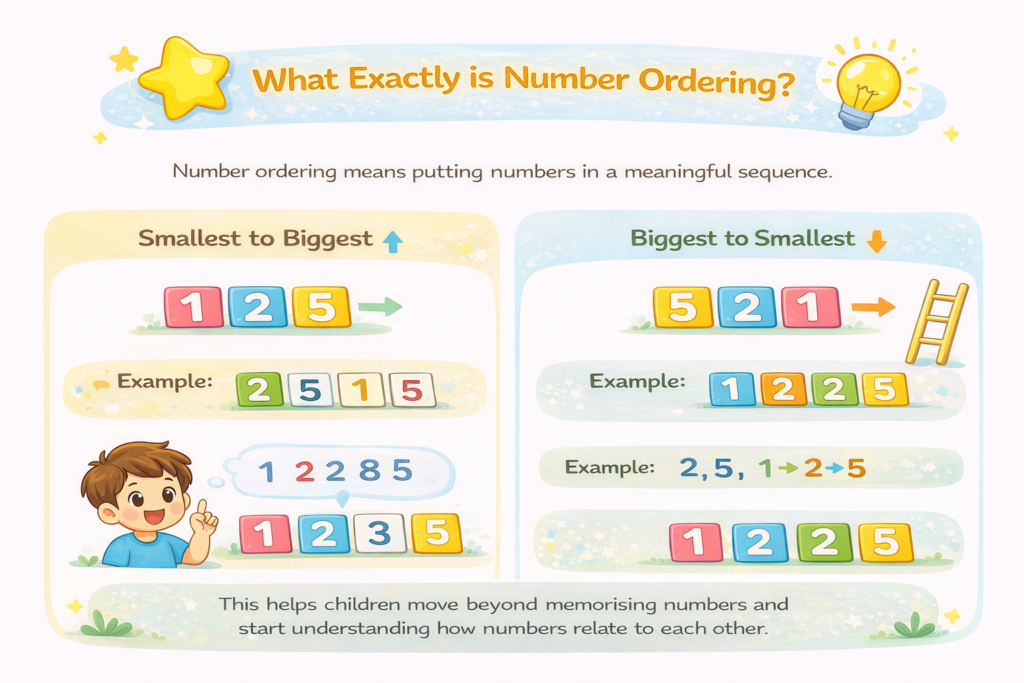
For young children, this usually means:
- putting numbers from smallest to biggest, or
- putting numbers from biggest to smallest
In very simple words, number ordering answers questions like:
- Which number comes first?
- Which number comes after?
- Which number comes before?
Example:
If the numbers are 2, 5, 1, the correct order is 1, 2, 5.
This helps children move beyond memorising numbers and start understanding how numbers relate to each other.
These ideas are taught step by step using simple rules for ordering numbers in Class 1.
Why Number Ordering Is So Important in Class 1
Class 1 is a critical stage because children move from basic counting to thinking with numbers. Number ordering plays a key role in this transition.
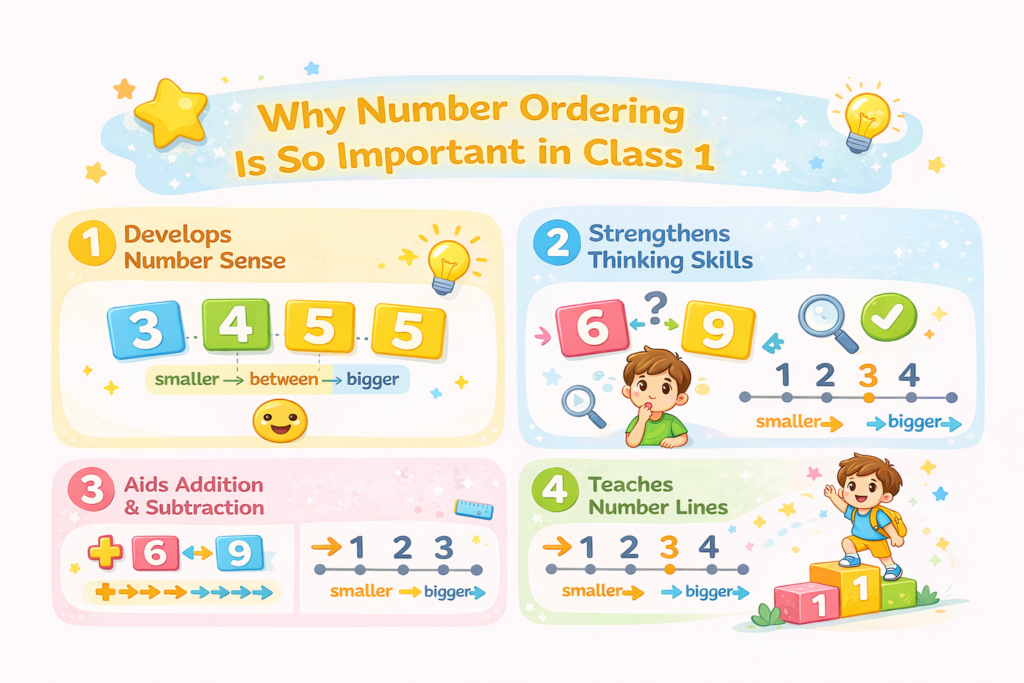
1. It Develops True Number Sense
Number sense means understanding what numbers really mean, not just saying them out loud.
Practising ordering through clear examples for Class 1 helps children understand these relationships naturally.
When children practice number ordering, they learn:
- that 5 is bigger than 4
- that 3 comes between 2 and 4
- that numbers follow a logical pattern
This understanding helps children feel comfortable with numbers instead of feeling scared or confused.
2. It Strengthens Thinking and Reasoning Skills
Ordering numbers requires children to:
- compare values
- make decisions
- check their answers
These small actions build logical thinking, which supports learning not just in maths, but also in reading and problem-solving.
3. It Makes Addition and Subtraction Easier
Children who understand number order find addition and subtraction much easier.
For example:
- When adding, children count forward
- When subtracting, children count backward
If a child knows the order of numbers well, they don’t have to guess—they can see the answer through counting.
4. It Prepares Children for Number Lines
Number lines are an important maths tool, and number ordering is their foundation.
This is why number ordering is always taught before introducing number line maths in Class 1.
Children learn that:
- numbers increase as we move to the right
- numbers decrease as we move to the left
Without number ordering, number lines can feel confusing. With it, number lines become clear and helpful.
Types of Number Ordering
In Class 1, children learn two types of number ordering.
Children understand this better when they already know the difference between ascending and descending order.
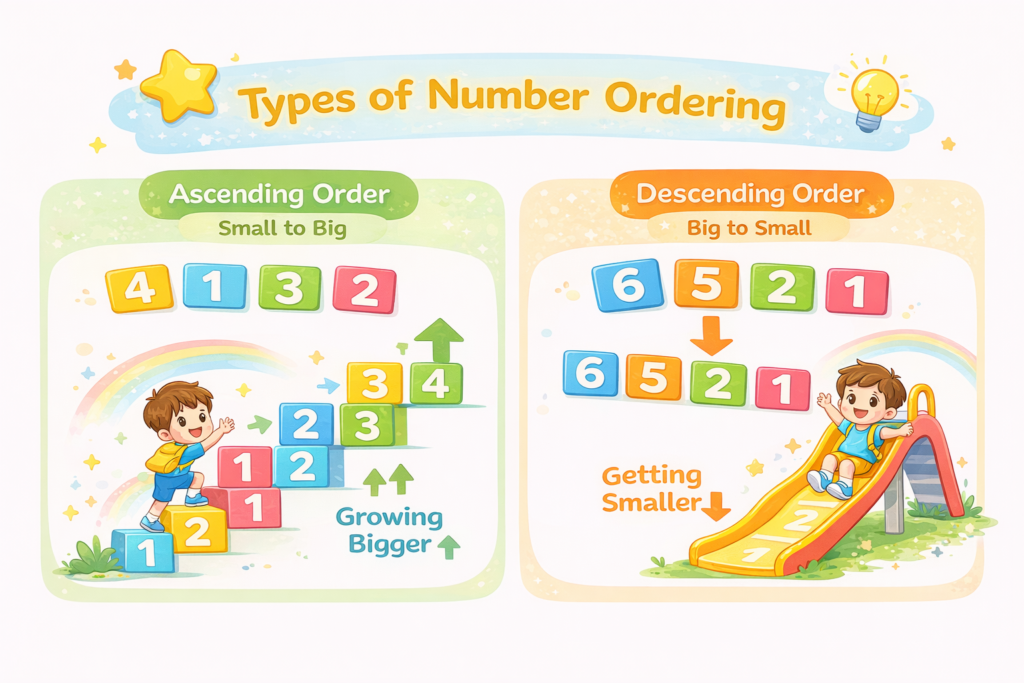
Ascending Order (Small to Big)
Ascending order means arranging numbers from the smallest to the biggest.
You can explain it as:
- “numbers going up”
- “numbers growing bigger”
Example:
4, 1, 3, 2 → 1, 2, 3, 4
Helpful memory trick:
- Think of climbing stairs or going up a slide
Descending Order (Big to Small)
Descending order means arranging numbers from the biggest to the smallest.
You can explain it as:
- “numbers going down”
- “numbers getting smaller”
Example:
6, 2, 5, 1 → 6, 5, 2, 1
Helpful memory trick:
- Think of sliding down a hill or counting down before a jump
Simple Number Ordering Examples for Class 1
Start with small numbers to build confidence.
Numbers from 1 to 10
Ascending:
- 7, 2, 9 → 2, 7, 9
Descending:
- 5, 10, 3 → 10, 5, 3
Once children are confident, you can slowly increase the number range.
Learning Number Ordering Using Real-Life Objects
Children learn faster when they can see and touch.
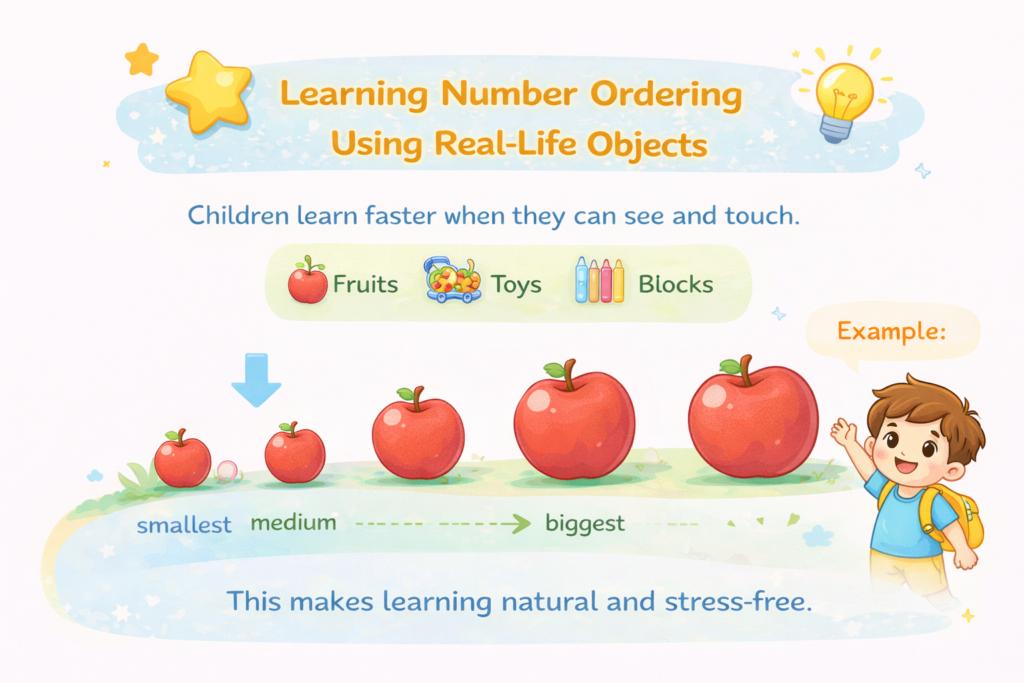
Try using:
- fruits
- toys
- blocks
- pencils
Example:
- 1 apple, 3 apples, 5 apples
Ask your child to arrange them from smallest to biggest.
This makes learning natural and stress-free.
Fun and Effective Ways to Practice Number Ordering
Practice does not need to feel like homework.
Hands-on practice works best before moving on to worksheets or structured ordering rules.
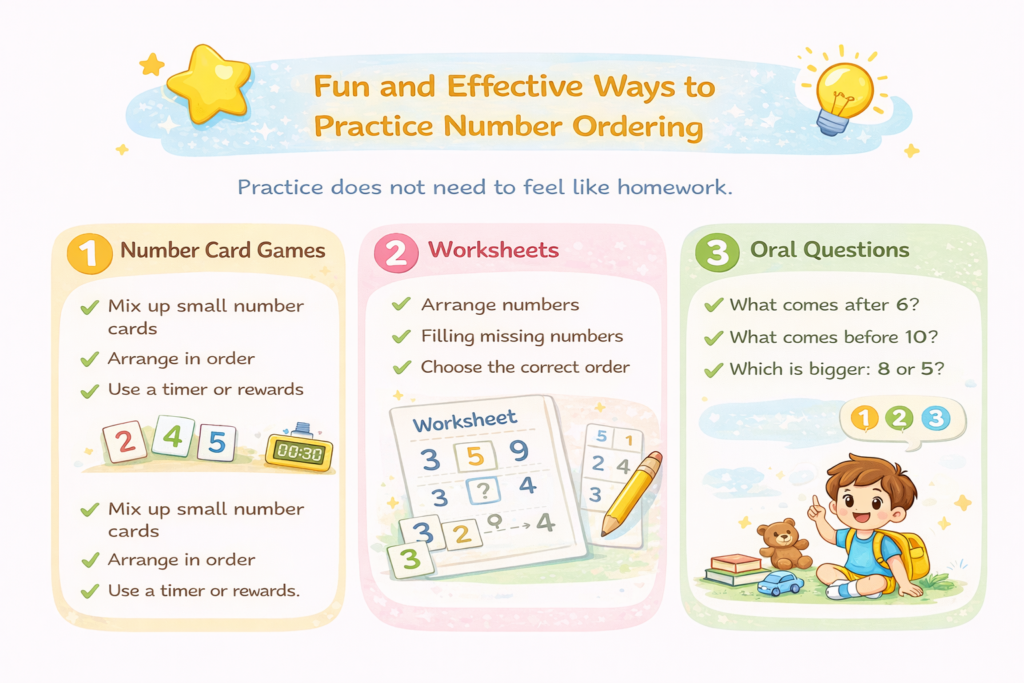
Number Card Games
Write numbers on small cards and mix them.
Ask your child to:
- arrange them in ascending order
- arrange them in descending order
Turn it into a game with a timer or rewards.
Worksheets (In Small Amounts)
Worksheets help reinforce learning, but keep them short.
Good worksheet activities include:
- arranging numbers
- filling missing numbers
- choosing the correct order
Oral and Everyday Practice
Ask questions during daily activities:
- What comes after 6?
- What comes before 10?
- Which number is bigger: 8 or 5?
These small moments add up.
Common Problems Children Face in Number Ordering
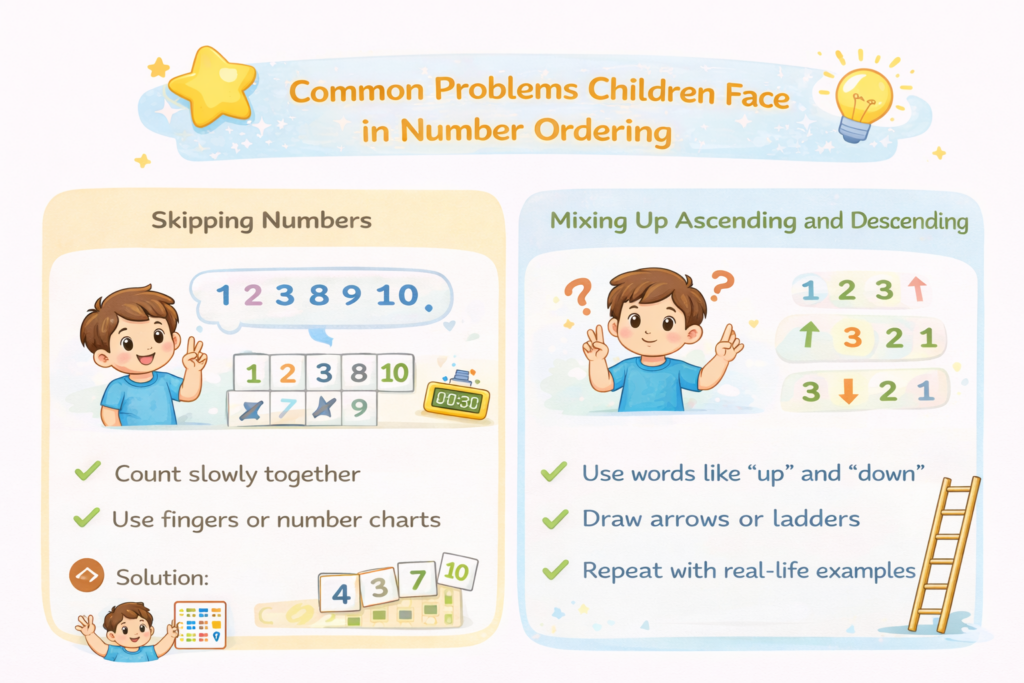
Skipping Numbers
Children may skip numbers when ordering.
Solution:
- Count slowly together
- Use fingers or number charts
Mixing Up Ascending and Descending
Children may confuse directions.
Solution:
- Use words like “up” and “down”
- Draw arrows or ladders
- Repeat with real-life examples
Strong basics like number ordering are the first step toward Math Olympiad preparation.
Make Preparing for Math Olympiad Simple!



Final Thoughts
Number ordering is much more than arranging numbers; it is a foundation skill that supports everything a child learns in maths later.
With patience, playful practice, and everyday examples, children can master number ordering with confidence and joy.
When children understand number order, maths becomes less about fear and more about fun and that is the best start any learner can have.