

Grade 2 addition follows a clear three-stage progression: basic single-digit sums first, then two-digit addition without regrouping, then two-digit addition with regrouping (carrying).
- The Three Stages of Grade 2 Addition, at a Glance
- Stage 1: Basic Single-Digit Sums
- Stage 2: Two-Digit Addition Without Regrouping
- Stage 3: Two-Digit Addition With Regrouping
- Common Mistakes and How to Fix Them
- How Much Addition Practice Does a Grade 2 Student Need?
- From Addition Fluency to Competition Math
- Conclusion
Most Grade 2 students move through all three stages during the school year, and by the end of the year they’re expected to add two-digit numbers within 100 fluently, including problems that require regrouping.
If your child is stuck at any point along the way, that’s a normal part of the process, and there’s a specific fix for each stage.
This guide walks through each stage with a simple visual model, sample problems you can use right now, and a rundown of the mistakes that trip up most kids (and how to fix them).
The Three Stages of Grade 2 Addition, at a Glance
Before diving into each stage, here’s the big picture.
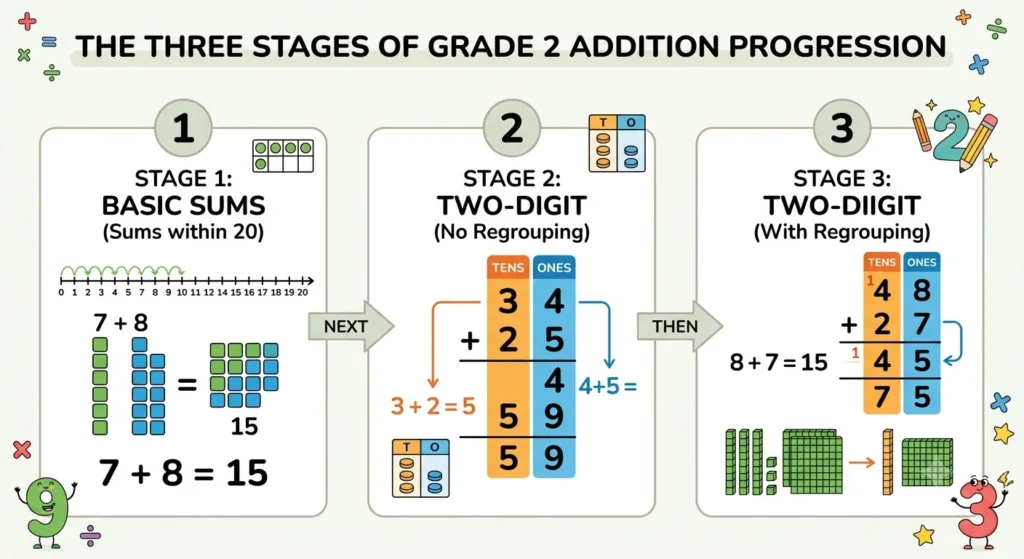
Grade 2 math standards build addition skill in this order, and each stage depends on the one before it:
| Stage | What it covers | Example |
| 1. Basic sums | Single-digit numbers, sums within 20 | 7 + 8 = 15 |
| 2. Two-digit, no regrouping | Two-digit + two-digit, no carrying needed | 34 + 25 = 59 |
| 3. Two-digit, with regrouping | Two-digit + two-digit, carrying required | 48 + 27 = 75 |
Keeping these three stages separate matters. Mixing them together in practice sets is one of the most common reasons kids get confused, because they end up guessing whether a problem needs regrouping instead of checking.
Stage 1: Basic Single-Digit Sums
This is the foundation: adding two single-digit numbers, with sums up to 20.
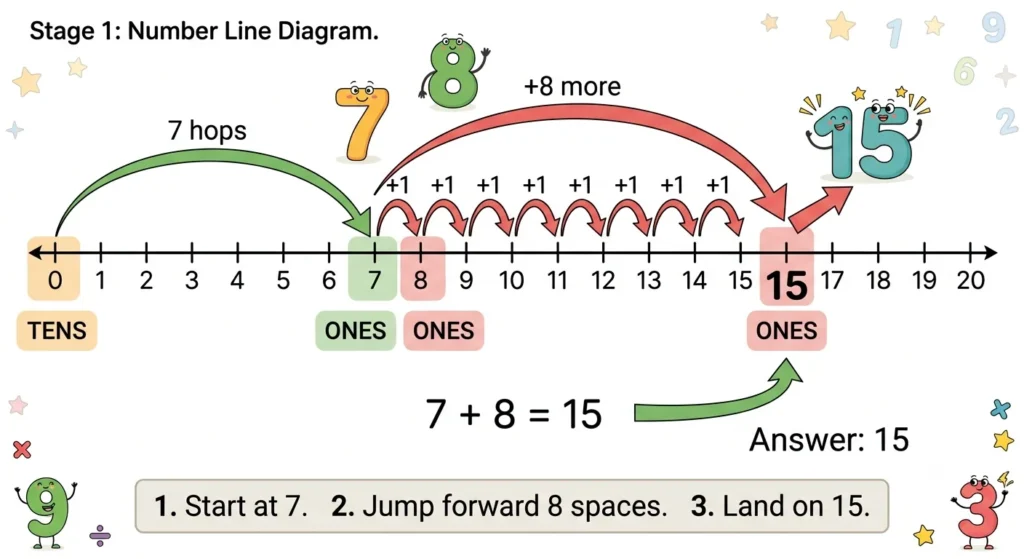
By Grade 2, most kids are moving from counting on their fingers to recalling these facts automatically, which teachers call “math fact fluency.”
A number line is the easiest visual model here.
For 7 + 8, your child starts at 7 and hops forward 8 spaces to land on 15. Ten-frames (a simple 2-by-5 grid) also work well, since they help kids see “make a ten” strategies, like turning 7 + 8 into 7 + 3 + 5 to hit 10 first.
This stage builds directly on skip counting, so if your child hasn’t fully settled into counting by 1s, 2s, 5s, and 10s yet, it’s worth reviewing that first since it makes number-line hops and “make a ten” strategies click faster.
Practice problems (Stage 1):
- 4 + 5 =
- 9 + 6 =
- 7 + 7 =
- 8 + 9 =
- 6 + 6 =
Stage 2: Two-Digit Addition Without Regrouping
Once single-digit sums feel automatic, the next stage is adding two two-digit numbers where no column adds up to 10 or more. This is where place value enters the picture.
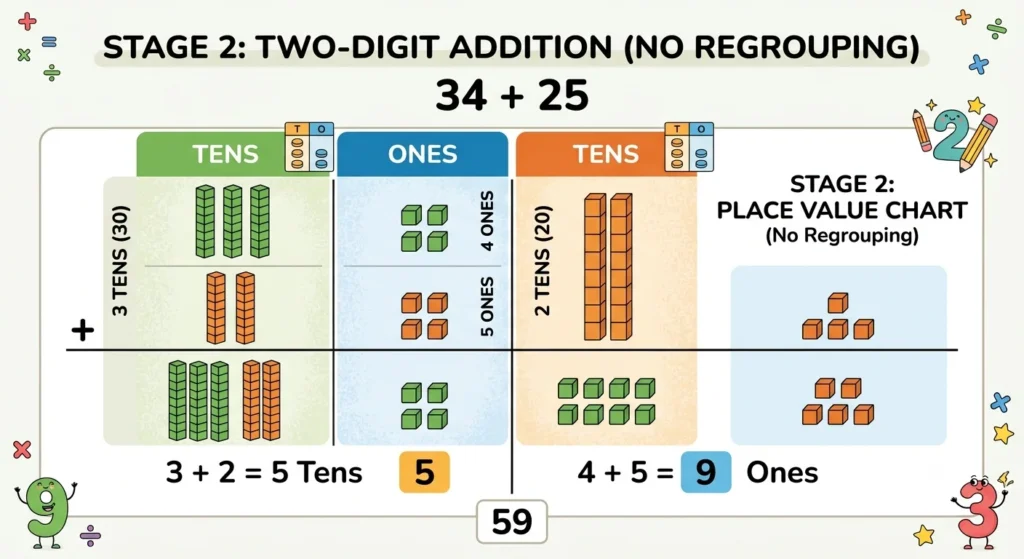
Place value means the value a digit holds based on its position, so in 34, the 3 is worth 3 tens (30) and the 4 is worth 4 ones.
The rule for this stage is simple: add ones to ones, and tens to tens, and stop there.
Example: 34 + 25
- Ones: 4 + 5 = 9
- Tens: 3 + 2 = 5
- Answer: 59
A place value chart, two columns labeled “tens” and “ones,” makes this visible. Writing each number in its own column keeps kids from accidentally adding a tens digit to a ones digit, which is one of the most common setup errors at this stage.
If your child mixes up which column is which, it usually means place value itself needs a quick refresher rather than the addition steps. Gonit’s place value guide covers the tens-and-ones concept this stage relies on.
Practice problems (Stage 2):
- 23 + 15 =
- 42 + 31 =
- 56 + 22 =
- 64 + 13 =
- 38 + 40 =
Stage 3: Two-Digit Addition With Regrouping
This is the stage that usually needs the most support, and it’s also the one most competitor resources skip explaining clearly.
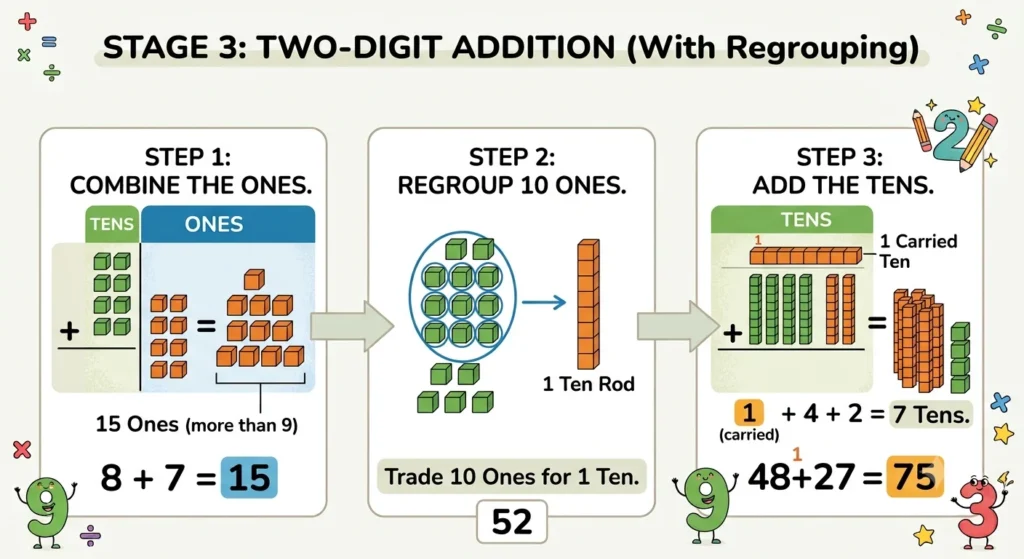
Regrouping means exchanging 10 ones for 1 ten (or, later, 10 tens for 1 hundred) when a column adds up to 10 or more. It’s the same idea as “carrying,” just described in terms of place value instead of a shortcut trick.
The base-10 block model
Base-10 blocks use small cubes for ones and long rods for tens. To add 48 + 27:
- Lay out 4 tens rods and 8 ones cubes for 48, and 2 tens rods and 7 ones cubes for 27.
- Combine the ones cubes first: 8 + 7 = 15 ones cubes.
- 15 ones cubes is more than a full group of 10, so trade 10 of those cubes for 1 new tens rod. That’s regrouping: 15 ones becomes 1 ten and 5 ones.
- Now combine the tens rods: the original 4 and 2, plus the 1 new one from the trade, makes 7 tens rods.
- Read off the answer: 7 tens and 5 ones is 75.
Once your child can physically (or mentally) picture that trade of 10 ones for 1 ten, the standard vertical written method makes a lot more sense, because the small “1” written above the tens column is just a shorthand for that same trade.
Written method, side by side with the blocks:
- Ones column: 8 + 7 = 15. Write the 5, carry the 1 ten to the tens column.
- Tens column: 4 + 2 + 1 (carried) = 7.
- Answer: 75.
Practice problems (Stage 3):
- 29 + 16 =
- 37 + 45 =
- 58 + 34 =
- 26 + 59 =
- 47 + 38 =
Common Mistakes and How to Fix Them
Regrouping errors are extremely common at this age, and they usually fall into a few predictable patterns rather than being random.
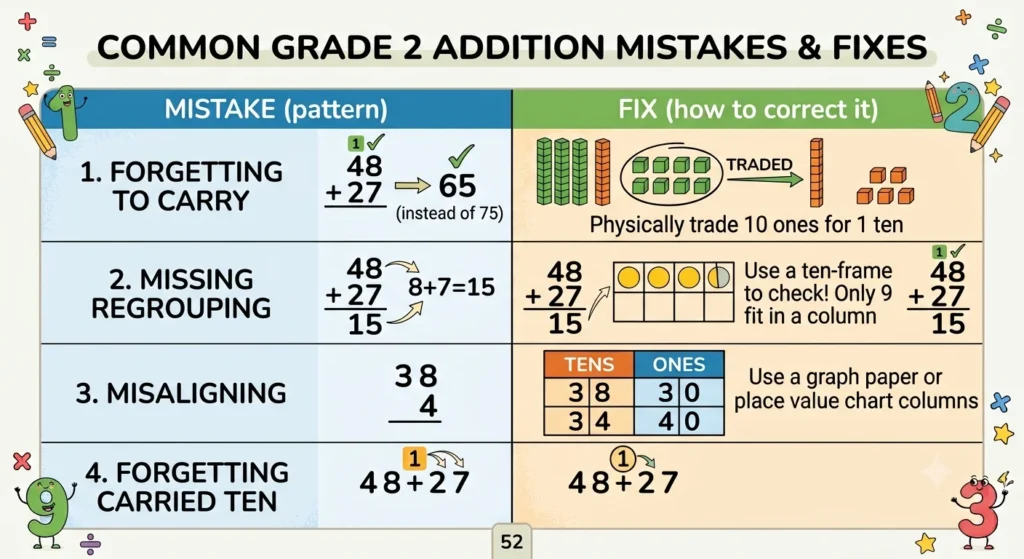
Recognizing the pattern is often enough to fix it.
| Mistake | What it looks like | How to fix it |
| Forgetting to carry the ten | 48 + 27 answered as 65 instead of 75 | Go back to base-10 blocks and physically trade 10 ones cubes for 1 tens rod so the missing ten becomes visible |
| Not realizing regrouping is needed | Adding 8 + 7 in the ones column and writing 15 straight across | Ask “can more than 9 ones fit in one column?” before starting, as a quick check-in |
| Misaligning place value when writing the problem | Lining up digits by the left edge instead of the ones place | Use graph paper or a place value chart so each digit has its own column |
| Forgetting to add the carried ten to the tens column | Carrying the 1 correctly but not including it in the tens total | Circle the carried digit and count it out loud as part of the tens sum |
If one of these patterns keeps showing up across several problems, that’s a signal to slow down and rebuild the concept with blocks rather than pushing through more worksheet repetition.
How Much Addition Practice Does a Grade 2 Student Need?
A short, consistent routine works better than long, infrequent sessions. Ten to fifteen minutes a day, four or five days a week, is generally enough to build fluency without causing fatigue.
Mixing in a few review problems from earlier stages keeps basic facts sharp while newer regrouping skills are still developing.
It’s also worth rotating between the three stages rather than only drilling the hardest one. A student who is shaky on regrouping often benefits from a quick warm-up of basic sums first, since slow recall of single-digit facts is frequently the real bottleneck in a two-digit problem, not the regrouping step itself.
From Addition Fluency to Competition Math
Solid addition fluency isn’t just a Grade 2 checkbox. It’s the foundation for early competition math.
Programs like MOEMS and Math Kangaroo include early-round questions built on quick, accurate mental arithmetic rather than advanced formulas, so a student who’s genuinely comfortable with regrouping has one less thing to think about when a competition problem introduces a new twist.
Gonit’s Grade 2 series is built with that in mind: skip counting, place value, and addition each feed into the next skill, and eventually into structured Olympiad-style practice.
What is regrouping in addition?
Regrouping is exchanging 10 of a smaller place value for 1 of the next larger place value, such as trading 10 ones for 1 ten. It happens whenever a column in an addition problem adds up to 10 or more.
When should regrouping be taught?
Most Grade 2 classrooms introduce regrouping after students are already comfortable with two-digit addition that doesn’t require it, typically in the middle of the school year, once place value understanding is solid.
How many addition problems should a Grade 2 student do per day?
A focused set of 8 to 12 problems a day, mixed across stages, is generally plenty. Consistency matters more than volume.
Why does my child understand two-digit addition but struggle only when regrouping is involved?
This is extremely common and usually means the concept of trading 10 ones for 1 ten hasn’t fully clicked yet, even if the written steps have been memorized. Returning to base-10 blocks for a few problems usually closes that gap.
Is it normal for a Grade 2 student to still count on fingers?
Yes, especially early in the year. Finger counting is a normal step on the way to fluent recall, and it fades naturally with regular practice.
Once two-digit addition with regrouping feels steady, the next natural step is subtraction with regrouping, which uses the same place value thinking in reverse. In the meantime, Gonit’s addition and subtraction basics page is a good place to revisit foundational concepts, and our Grade 2 fractions guide is a natural next stop in the Grade 2 series if you want to keep building from here.
Make Preparing for Math Olympiad Simple!



Conclusion
Grade 2 addition comes down to three stages: basic sums, two-digit addition without regrouping, and two-digit addition with regrouping.
Each builds on the one before it, so if your child slows down at the regrouping stage, that’s normal, not a sign of falling behind. A quick return to base-10 blocks usually fixes it faster than more worksheets.
Work through the practice problems at your child’s own pace, keep the stages separate, and use the mistakes table whenever something doesn’t click. That’s really all it takes.

Mikha Piregu is a Content Writer with experience spanning educational content, including math and math olympiad topics, as well as advocacy writing, research-based articles, and SEO-driven web content. He creates high-quality blog content, web copy, and feature articles that support brand visibility, audience engagement, and long-term organic growth through data-informed storytelling. Skilled in WordPress, WooCommerce, and modern digital tools, Mikha adapts content across various platforms, including blogs, websites, campaigns, and advocacy initiatives, with clarity and purpose.


There are no comments posted here yet.
Sign in to leave a comment