


Fun math activities for 2nd graders are hands-on tasks that use ordinary household items, like dice, coins, and measuring cups, to reinforce core Grade 2 skills without feeling like worksheets.
- Addition and Subtraction Activities
- Multiplication and Skip Counting Activities
- Counting Money Activities
- Measurement Activities (Length, Weight, and Time)
- Geometry and Spatial Reasoning Activities
- Word Problems and Real-Life Math Activities
- Why These Fun Math Activities for 2nd Graders Work
- Getting Started
Unlike printables or apps, these activities ask kids to touch, sort, measure, and count real objects, which builds number sense in a way that flat paper can’t.
This article includes:
- Dice and card games for addition and subtraction
- Egg carton and pasta activities for multiplication and arrays
- Coin sorting and role-play for counting money
- Measuring cup, scale, and clock activities for measurement
- Shape hunts and paper folding for geometry
- Grocery list and journal activities for word problems
Every activity below lists the exact Grade 2 skill it builds, a realistic time estimate, whether your child needs supervision, what setup is involved, and a pro tip for adjusting the difficulty.
You won’t find vague “practice math” instructions here. If an activity says 10 minutes, it takes about 10 minutes for a typical Grade 2 child with normal parent guidance.
Addition and Subtraction Activities
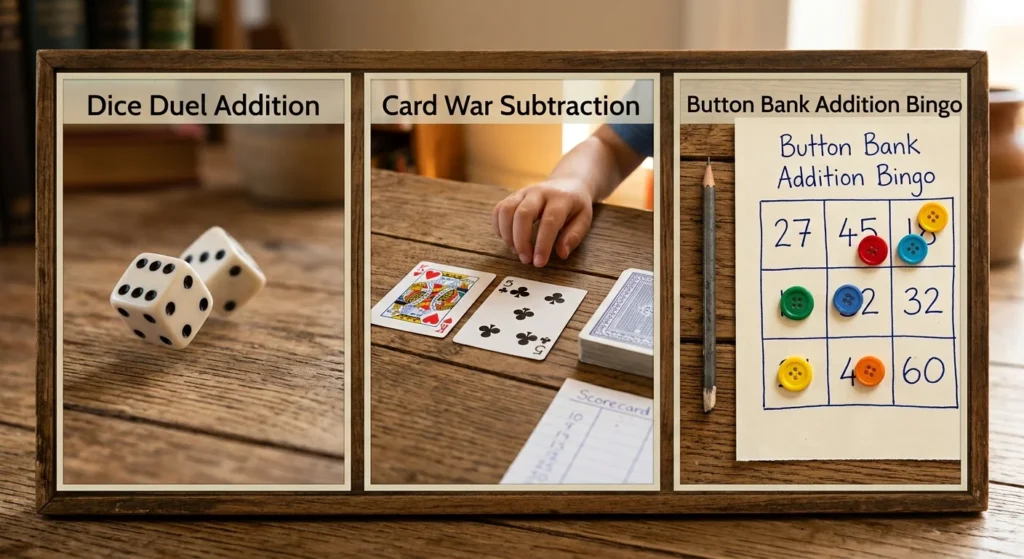
1. Dice Duel Addition
Skill Reinforced: Addition facts to 20, mental math strategies
Time Estimate: 10 minutes
Supervision: Mostly independent
Materials Needed: 2 dice (or 4 for a challenge), paper and pencil
Setup Complexity: Quick setup
Steps:
- Each player rolls two dice and adds the numbers together.
- Whoever calls out the correct sum first gets a point.
- Write down each sum so your child sees a running list of addition facts.
- Play to 10 points.
- Swap to subtraction by rolling and finding the difference instead.
Learning Outcome: Builds fluency with addition facts to 20 and speeds up mental math recall.
Pro Tip: Add a third die once your child is winning consistently. Three-dice addition pushes sums past 20 and introduces regrouping.
2. Card War Subtraction
Skill Reinforced: Subtraction within 20, number comparison
Time Estimate: 15 minutes
Supervision: Independent (siblings) or adult-supervised (one-on-one)
Materials Needed: A standard deck of playing cards (face cards removed)
Setup Complexity: Quick setup
Steps:
- Split the deck evenly between two players.
- Each player flips one card at the same time.
- Subtract the smaller number from the larger one and say the answer out loud.
- Whoever answers first keeps both cards.
- Play until the deck runs out; whoever has more cards wins.
Learning Outcome: Reinforces subtraction fact fluency and reduces hesitation with mental subtraction.
Pro Tip: Flip three cards instead of two and have your child find the difference between the highest and lowest.
3. Button Bank Addition Bingo
Skill Reinforced: Addition with regrouping, number recognition
Time Estimate: 15–20 minutes
Supervision: Adult-supervised
Materials Needed: A handful of buttons, dried beans, or pasta pieces; paper; pencil
Setup Complexity: Medium setup (draw a 3×3 grid in advance)
Steps:
- Draw a 3×3 grid on paper and write a two-digit number in each square.
- Call out two numbers from the grid and have your child add them.
- If they land on a sum that matches a number on the grid, they cover it with a button.
- Continue until your child covers three squares in a row.
- Reset the grid with new numbers for another round.
Learning Outcome: Practices two-digit addition with regrouping in a low-pressure, game-like format.
Pro Tip: Use sums that require carrying (like 27 + 15) to specifically target regrouping practice.
Ready for more structured practice after the games wind down? Explore more addition activities for Grade 2 or work through Grade 2 subtraction step by step.
Multiplication and Skip Counting Activities
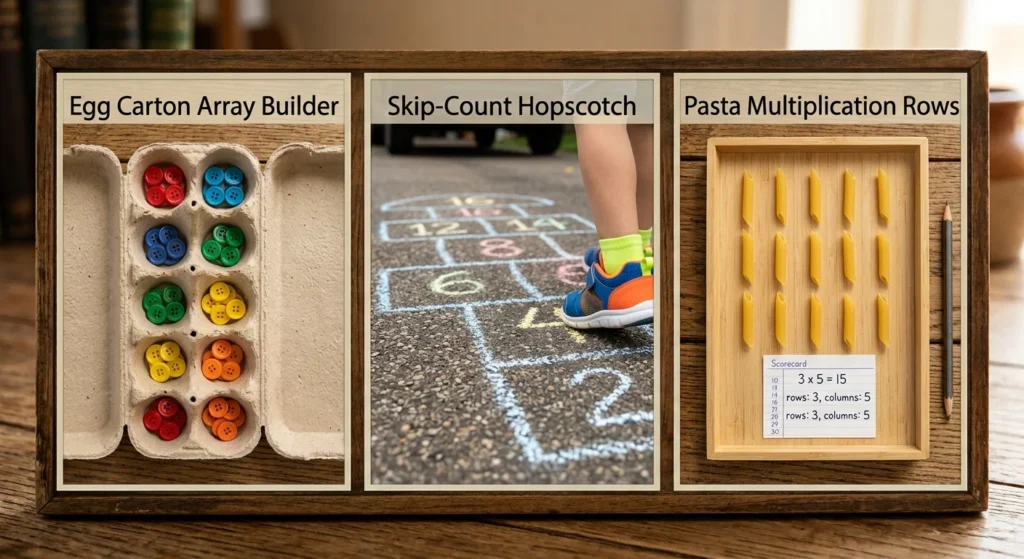
4. Egg Carton Array Builder
Skill Reinforced: Multiplication as repeated addition, arrays
Time Estimate: 10–15 minutes
Supervision: Mostly independent
Materials Needed: An empty egg carton (or muffin tin), small objects like buttons or dried beans
Setup Complexity: Quick setup
Steps:
- Have your child drop the same number of buttons into each cup of the carton, such as 2 per cup.
- Count how many cups they filled, then count the total number of buttons.
- Write the multiplication sentence that matches (e.g., 6 cups x 2 buttons = 12).
- Repeat with a different number of buttons per cup.
- Ask your child to predict the total before counting, then check their guess.
Learning Outcome: Builds a concrete understanding of multiplication as equal groups, which is the foundation for multiplication fluency.
Pro Tip: Leave one cup empty on purpose and ask your child what happens to the total. It’s a gentle, hands-on way to introduce the idea of multiplying by zero.
5. Skip-Count Hopscotch
Skill Reinforced: Skip counting by 2s, 5s, and 10s
Time Estimate: 10 minutes
Supervision: Independent
Materials Needed: Sidewalk chalk (or masking tape indoors), index cards with numbers written on them
Setup Complexity: Medium setup (draw the hopscotch grid first)
Steps:
- Draw a hopscotch grid, but instead of 1 through 10, label the squares by skip counting (2, 4, 6, 8…).
- Have your child hop and call out each number as they land.
- Time how fast they can get through the whole sequence.
- Switch to counting by 5s or 10s for a new grid.
- Try counting backward from the top square for an extra challenge.
Learning Outcome: Strengthens skip counting fluency, which supports both multiplication and telling time to the nearest five minutes.
Pro Tip: Mix in one wrong number on the grid and see if your child catches the error while hopping.
6. Pasta Multiplication Rows
Skill Reinforced: Multiplication facts, arrays, even and odd numbers
Time Estimate: 15 minutes
Supervision: Mostly independent
Materials Needed: Dry pasta or dried beans, a placemat or tray
Setup Complexity: Quick setup
Steps:
- Call out a multiplication fact, such as 3 x 4.
- Have your child arrange the pasta into 3 rows of 4 pieces each.
- Count the total together to check the answer.
- Ask them to rearrange the same pasta into 4 rows of 3 to show the facts are related.
- Repeat with new facts, increasing the numbers as your child gets faster.
Learning Outcome: Connects the visual layout of an array to the abstract multiplication fact, reinforcing that multiplication can be arranged more than one way.
Pro Tip: Ask “what if we had one more row?” to preview how multiplication facts build on each other.
Want a companion resource for these skills? Dive deeper into Grade 2 multiplication or build skip counting fluency further.
Counting Money Activities
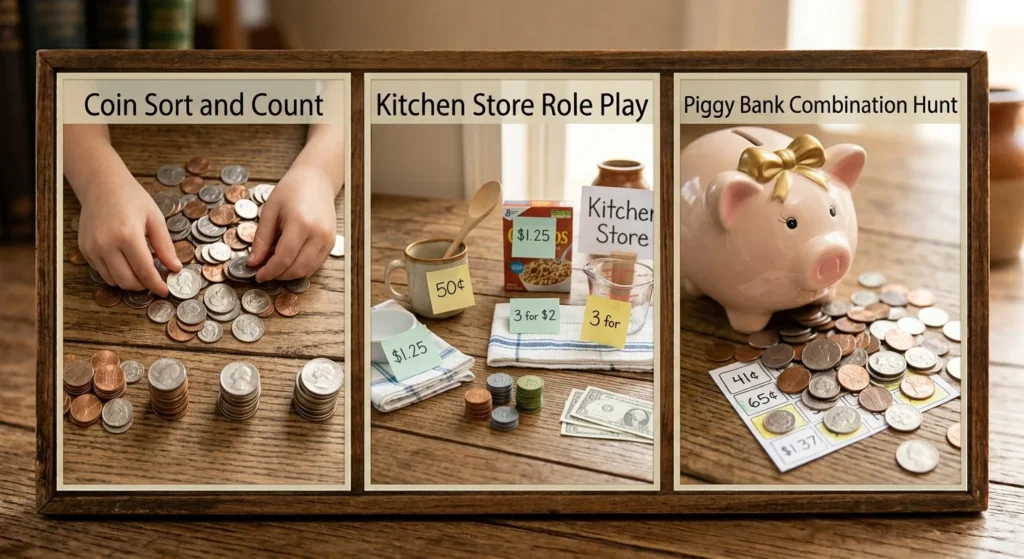
7. Coin Sort and Count
Skill Reinforced: Coin identification, counting money, place value
Time Estimate: 10–15 minutes
Supervision: Independent
Materials Needed: A mixed handful of pennies, nickels, dimes, and quarters
Setup Complexity: Quick setup
Steps:
- Dump the coins onto a table and have your child sort them by type.
- Count each pile separately and write down the totals.
- Add all the piles together for a grand total.
- Ask your child to find two different coin combinations that equal the same amount, like a quarter versus five nickels.
- Repeat with a new handful of coins for more practice.
Learning Outcome: Builds fluency in identifying coin values and adding mixed denominations, a core Grade 2 money skill.
Pro Tip: Hide one “trick” coin, like a foreign coin or a token, and see if your child notices it doesn’t belong in the count.
8. Kitchen Store Role Play
Skill Reinforced: Making change, counting money, real-world application
Time Estimate: 20–30 minutes
Supervision: Adult-supervised
Materials Needed: Play coins or real coins, a few household items with price tags written on sticky notes
Setup Complexity: Medium setup (write price tags in advance)
Steps:
- Set up a few household items with price tags between 5 and 50 cents.
- Give your child a set amount of coins to “shop” with.
- Have them count out the exact amount to pay for each item.
- Play the cashier role and give them change, then ask them to check it’s correct.
- Switch roles so your child practices being the cashier too.
Learning Outcome: Applies coin counting and simple change-making to a real-life context, which builds confidence with money math.
Pro Tip: Set a “budget” of exactly one dollar and see how many items your child can buy without going over.
9. Piggy Bank Combination Hunt
Skill Reinforced: Coin combinations, addition, problem solving
Time Estimate: 10 minutes
Supervision: Mostly independent
Materials Needed: A small jar or piggy bank with mixed coins
Setup Complexity: Quick setup
Steps:
- Name a target amount, such as 35 cents.
- Have your child dig through the coins to find a combination that adds up to exactly that amount.
- Once they find one combination, challenge them to find a second, different one.
- Increase the target amount as they succeed.
- Keep a tally of how many different combinations they can find for one amount.
Learning Outcome: Reinforces flexible thinking about coin values and strengthens mental addition with money.
Pro Tip: Set a target that can be made at least three different ways (like 30 cents) to stretch their problem-solving further.
For structured lessons on this exact skill, learn more about counting money in Grade 2.
Measurement Activities (Length, Weight, and Time)
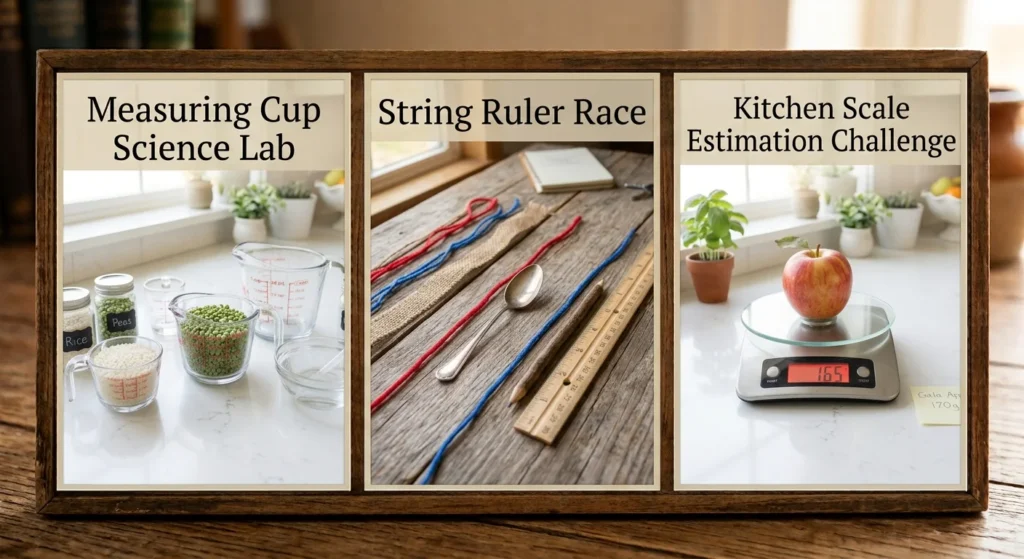
10. Measuring Cup Science Lab
Skill Reinforced: Volume and capacity, comparing measurements
Time Estimate: 15–20 minutes
Supervision: Adult-supervised (near water)
Materials Needed: Measuring cups of different sizes, a bowl of water or dry rice
Setup Complexity: Quick setup
Steps:
- Line up a 1/4 cup, 1/2 cup, and 1 cup measuring tool.
- Ask your child to guess how many 1/4 cups it takes to fill the 1 cup measure.
- Have them fill and pour to test their guess.
- Repeat with the 1/2 cup measure.
- Write down the results together (4 quarters = 1 cup, 2 halves = 1 cup).
Learning Outcome: Builds an intuitive sense of volume and how smaller units combine into larger ones.
Pro Tip: Use rice or dry beans instead of water for a mess-free version that works on any table.
This activity also doubles as an early introduction to fractions since quarters and halves come up naturally while measuring. See how Gonit teaches fractions in Grade 2 for a more structured follow-up.
11. String Ruler Race
Skill Reinforced: Measuring length, comparing lengths
Time Estimate: 15 minutes
Supervision: Independent
Materials Needed: A ball of string or yarn, scissors, a ruler
Setup Complexity: Quick setup
Steps:
- Pick five household objects, like a book, a spoon, and a shoe.
- Have your child cut a piece of string to match the length of each object.
- Line up all five strings side by side from shortest to longest.
- Measure each string with a ruler and write down the length in centimeters.
- Ask your child to predict which object is longest before measuring, then check.
Learning Outcome: Connects estimating and measuring length, plus practices ordering measurements from shortest to longest.
Pro Tip: Compare two objects that look similar in length, like a fork and a pencil, to sharpen careful measuring habits.
12. Kitchen Scale Estimation Challenge
Skill Reinforced: Weight and mass, estimation
Time Estimate: 10–15 minutes
Supervision: Mostly independent
Materials Needed: A kitchen scale, five to six small household objects
Setup Complexity: Quick setup
Steps:
- Pick a few objects, such as an apple, a spoon, and a small toy.
- Ask your child to guess which object is heaviest and lightest just by holding them.
- Weigh each object on the kitchen scale in grams.
- Line the objects up in order from lightest to heaviest based on the actual weights.
- Compare the final order to their original guess.
Learning Outcome: Builds estimation skills for weight and introduces reading a scale, both part of Grade 2 measurement standards.
Pro Tip: Weigh a full water bottle versus an empty one to show how the same object can have very different weights.
13. Clock-Watching Chore Timer
Skill Reinforced: Telling time, elapsed time
Time Estimate: 5 minutes to set up, ongoing throughout the day
Supervision: Independent
Materials Needed: An analog wall clock or clock face printout, a simple chore or task
Setup Complexity: Quick setup
Steps:
- Before starting a task, like tidying a room, look at the clock together and note the start time.
- Set a goal, such as finishing before the minute hand reaches a certain number.
- Check the clock again once the task is done.
- Talk through how many minutes passed between start and finish.
- Repeat with different daily tasks to build a feel for elapsed time.
Learning Outcome: Builds real-world fluency with reading an analog clock and understanding elapsed time, a skill many kids find abstract on worksheets alone.
Pro Tip: Use tasks that naturally take 5, 10, or 15 minutes so the math stays simple and the clock reading stays realistic.
For more structured lessons across length, weight, and time, explore Grade 2 measurement skills.
Geometry and Spatial Reasoning Activities
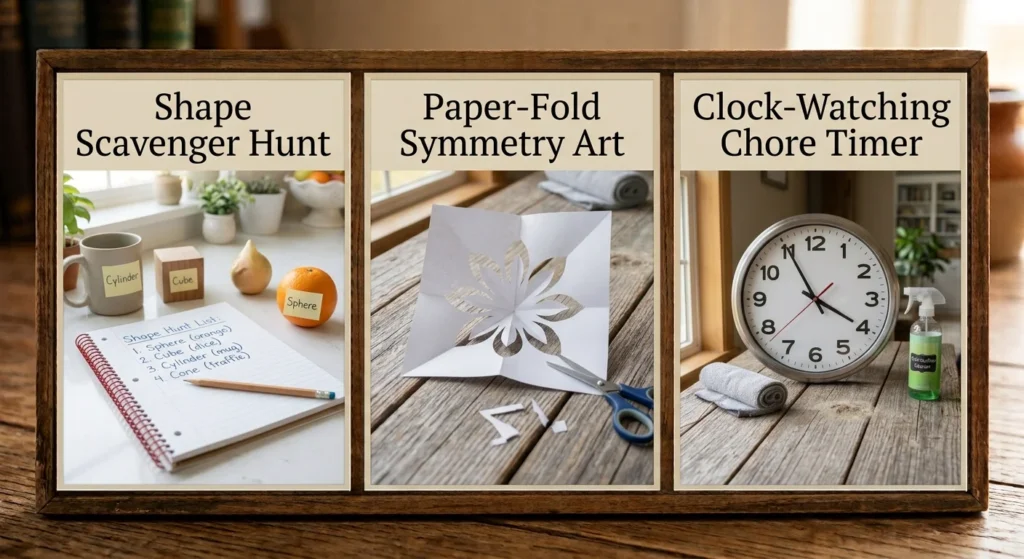
14. Shape Scavenger Hunt
Skill Reinforced: Identifying 2D and 3D shapes, shape attributes
Time Estimate: 15 minutes
Supervision: Independent
Materials Needed: A notepad and pencil (no other materials needed)
Setup Complexity: Quick setup
Steps:
- Give your child a list of shapes to find around the house: a cube, a cylinder, a rectangle, a triangle.
- Have them search the house and write down what object they found for each shape.
- Ask them to explain why each object counts as that shape (number of sides, corners, or faces).
- Compare notes and see who found the most unusual match.
- Repeat with a new list focusing on shapes they struggled with.
Learning Outcome: Reinforces shape recognition and the vocabulary needed to describe 2D and 3D shape attributes.
Pro Tip: Ask “what shape is this made of two shapes?” using something like a house-shaped object (a square plus a triangle) to introduce composite shapes.
15. Paper-Fold Symmetry Art
Skill Reinforced: Symmetry, spatial reasoning
Time Estimate: 15–20 minutes
Supervision: Mostly independent
Materials Needed: Paper, scissors, crayons or markers
Setup Complexity: Quick setup
Steps:
- Fold a piece of paper in half.
- Draw half of a shape or design along the fold line.
- Cut it out (while still folded) or color it in, then unfold to reveal a symmetrical design.
- Ask your child to point out the line of symmetry.
- Try folding the paper a different way to create a design with two lines of symmetry.
Learning Outcome: Builds a hands-on understanding of symmetry that’s harder to grasp from a flat worksheet image alone.
Pro Tip: Use a mirror held along the fold line before cutting so your child can preview what the finished symmetrical shape will look like.
For more on this topic, explore Grade 2 geometry concepts, or start with the basics in Gonit’s general geometry guide for kids if your child needs a refresher on shape vocabulary first.
Word Problems and Real-Life Math Activities
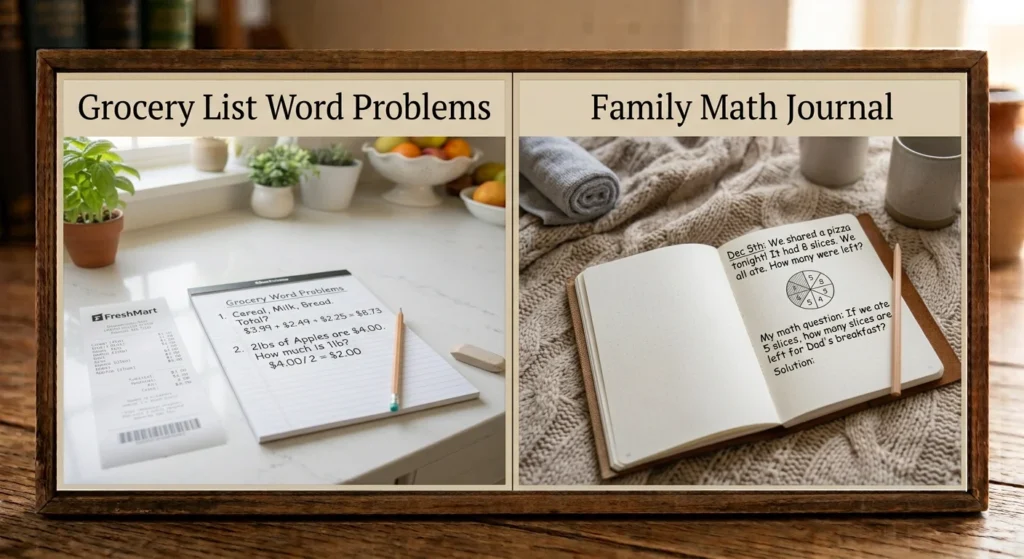
16. Grocery List Word Problems
Skill Reinforced: Word problems, addition and subtraction application
Time Estimate: 10–15 minutes
Supervision: Adult-supervised
Materials Needed: A grocery receipt or a simple shopping list with prices
Setup Complexity: Quick setup
Steps:
- Pick three or four items from a recent grocery receipt.
- Ask your child a question like, “If we bought apples for $3 and bread for $2, how much did we spend?”
- Have them solve it using paper, mental math, or objects.
- Ask a follow-up question that requires subtraction, like how much change from $10.
- Let your child make up their own grocery word problem for you to solve.
Learning Outcome: Connects abstract word problems to real spending your child has seen firsthand, which builds relevance and confidence.
Pro Tip: Let your child create the “answer key” for a problem they write themselves. Explaining their own reasoning deepens understanding.
17. Family Math Journal
Skill Reinforced: Word problems, number sense, writing about math
Time Estimate: 10 minutes daily
Supervision: Mostly independent
Materials Needed: A notebook or a few sheets of paper stapled together
Setup Complexity: Quick setup
Steps:
- Each day, have your child notice one math moment from daily life (splitting a snack, counting stairs, comparing ages).
- Have them write one sentence describing what happened and one math question about it.
- Solve the question together or let them try solving it alone first.
- Review the journal weekly to see how their questions have grown more complex.
- Celebrate the variety of real-life math they’ve noticed.
Learning Outcome: Builds number sense by connecting math to everyday experiences and strengthens the ability to write and interpret word problems.
Pro Tip: If your child struggles to start, ask “what did we count, measure, or split today?” as a daily prompt.
For structured word problem practice, practice more Grade 2 word problems.
Why These Fun Math Activities for 2nd Graders Work
Worksheets ask kids to recognize a math fact on paper. Hands-on activities ask them to build, sort, measure, or count a real object, which gives the brain a second, physical way to store the same information.
For Grade 2 learners, who are still developing abstract number sense, this concrete practice matters more than it does for older kids.
These activities also sidestep the “feels like homework” problem. A worksheet signals “this is schoolwork.” A dice game or a coin hunt signals “this is something we’re doing together.” The math content is identical, but the framing changes how a child approaches it.
Developmentally, Grade 2 students are ready for two-digit addition and subtraction, the early stages of multiplication, coin combinations, and measurement using standard units.
Every activity above stays within that range, so you’re not accidentally pushing a skill your child hasn’t been introduced to yet or wasting time on something they’ve already mastered.
How much time should math activities take each day?
Ten to twenty minutes a day is plenty for Grade 2. Most of the activities above fit that window. Longer isn’t automatically better. A short, focused activity your child finishes with confidence beats a long one that ends in frustration.
Do these activities replace worksheets or homework?
No. Think of them as a supplement, not a substitute. If your child’s teacher has assigned specific worksheets, those still matter for tracking classroom progress. These activities reinforce the same skills in a different format, which helps ideas stick.
Can my child do these activities independently?
Some, yes. Activities marked “Independent” or “Mostly independent” above need little to no adult involvement once explained. Activities marked “Adult-supervised” usually involve counting money, using a kitchen scale, or a task where checking accuracy matters.
What if my child finds an activity too easy or too hard?
Every activity includes a Pro Tip with a way to adjust difficulty, usually by changing the numbers involved (more dice, bigger coin targets, harder multiplication facts). Start where your child is comfortable and adjust from there.
Do I need to buy anything special?
No. Every activity uses items most households already have: dice, playing cards, coins, measuring cups, pasta, paper, and string. If you don’t have one specific item, most activities can substitute a similar object without changing the skill being practiced.
How do I know if an activity is right for Grade 2, not too advanced or too basic?
Each activity lists the exact skill it targets, matched to typical Grade 2 curriculum: addition and subtraction to 20 with regrouping, early multiplication concepts, coin combinations, measurement with standard units, basic geometry, and simple word problems.
Can these help if my child has math anxiety or resists practice time?
Many parents find that removing the word “practice” helps. Framing it as a game or a joint activity, rather than an assignment, lowers resistance for kids who associate math with pressure. Start with a low-stakes activity like the dice game before moving to ones involving money or measurement.
Can I do these activities with kids at different grade levels?
Yes. Most activities scale up or down easily. A kindergartner can sort coins by size while a Grade 2 sibling counts totals, and a Grade 4 sibling can extend the addition dice game to three or four dice.
Are these activities screen-free?
Yes, every activity above uses physical household items with no screens involved. That’s intentional. Screen-free math practice gives kids a break from digital learning tools while still building the same skills.
Make Preparing for Math Olympiad Simple!



Getting Started
Hands-on activities and structured lessons work best together. The activities above build number sense and comfort with math in daily life, while a structured resource helps fill in gaps and track progress over time.
Explore Gonit’s full Grade 2 math practice hub for lessons that pair naturally with what you’ve just tried at home, or check out Gonit’s Grade 2 math games for a screen-based option on days when you want something quick.
You don’t need to try all seventeen activities this week. Pick one that matches a skill your child is currently working on in school, set a timer for ten minutes, and see how it goes. Most families find one or two activities become regular favorites, and that consistency matters more than variety.

Mikha Piregu is a Content Writer with experience spanning educational content, including math and math olympiad topics, as well as advocacy writing, research-based articles, and SEO-driven web content. He creates high-quality blog content, web copy, and feature articles that support brand visibility, audience engagement, and long-term organic growth through data-informed storytelling. Skilled in WordPress, WooCommerce, and modern digital tools, Mikha adapts content across various platforms, including blogs, websites, campaigns, and advocacy initiatives, with clarity and purpose.

There are no comments posted here yet.
Sign in to leave a comment