


This guide is designed for parents and teachers who need quick, practical help during homework time.
- How Much 2nd Grade Math Homework is Reasonable?
- Addition: Building Blocks with Regrouping
- Subtraction: Regrouping and Strategy
- Place Value: Understanding Tens and Ones
- Multiplication Introduction: Arrays, Repeated Addition, and Skip Counting
- Measurement: Length and Time
- Counting Money: Indian Rupees
- Geometry: Shapes, Position, and Patterns
- Word Problems: A Strategy for Success
- Next Steps: More Practice on Gonit
Most 2nd grade math homework sessions should take between 20 and 45 minutes, depending on the topic and your child’s familiarity with the concept.
If homework is consistently taking longer than an hour, that’s a sign your child might benefit from breaking the session into smaller chunks or reaching out to their teacher for extra support.
How Much 2nd Grade Math Homework is Reasonable?
Before diving into topics, let’s talk about homework expectations.
A typical 2nd-grade homework session on a single topic should take about 5 to 10 minutes per problem type, with the full session landing somewhere between 20 and 45 minutes. This varies based on whether your child is reviewing a familiar topic or learning something new.
Signs of productive struggle: Your child pauses to think, tries different approaches, and gets frustrated occasionally but keeps working. This is healthy learning.
Signs of unproductive struggle: Your child is crying, asking for answers without attempting, or shutting down after 15 minutes. This means it’s time to step in, break the work into smaller pieces, or reach out to the teacher.
Red flags that warrant teacher contact: Homework consistently takes over an hour, your child is showing signs of math anxiety (avoiding it entirely, physical stress), or they can’t grasp a concept after you’ve explained it in a few different ways. Teachers have tools and strategies you might not, and they want to help.
When to let them struggle and when to help: If your child tries a problem, gets stuck, and asks for help immediately, encourage them to try one more time or use a different strategy. If they’ve genuinely tried and still can’t figure it out after a few minutes, step in with a gentle explanation. The goal is building confidence, not getting through the homework sheet.
Addition: Building Blocks with Regrouping
Addition in 2nd grade moves beyond simple number bonds to include regrouping, which is when the ones place adds up to 10 or more and we need to “carry” a group of 10 to the tens place.
This is one of the most common homework trouble spots for parents, especially if you learned the old “carrying” method without understanding the place value behind it.
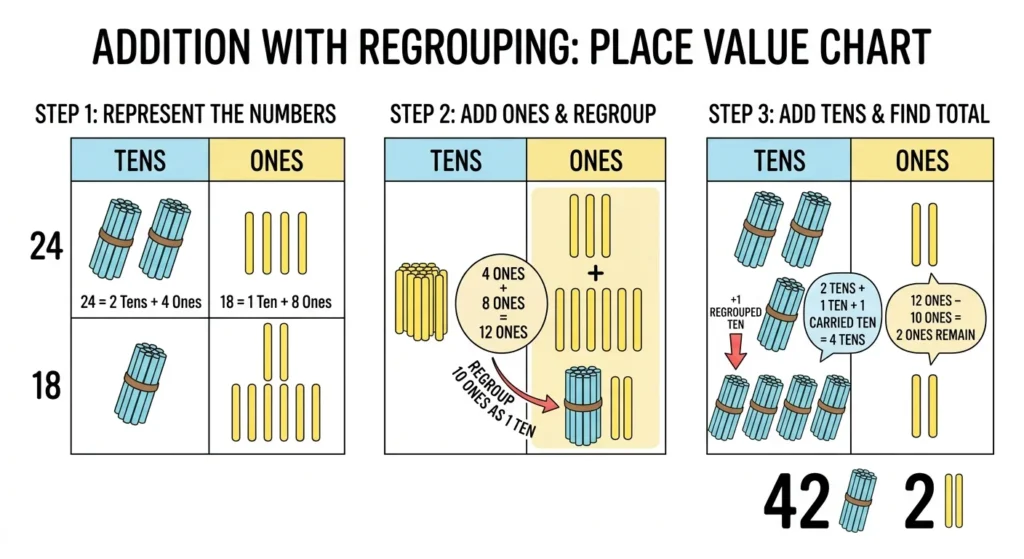
The key concept: When you add two numbers and the ones place equals 10 or more, you group those 10 ones into 1 ten and move it to the tens column. This is regrouping.
Worked Example 1: Addition Without Regrouping
Let’s add 21 + 14:
Step 1: Write the numbers in columns, with ones below ones and tens below tens.
21
+ 14
—-
Step 2: Add the ones first: 1 + 4 = 5. Write 5 in the ones place.
Step 3: Add the tens: 2 + 1 = 3. Write 3 in the tens place.
Answer: 21 + 14 = 35
Worked Example 2: Addition With Regrouping
Let’s add 24 + 18:
Step 1: Set up the columns:
24
+ 18
—-
Step 2: Add the ones: 4 + 8 = 12. Since 12 is more than 10, we have 1 ten and 2 ones. Write 2 in the ones place and carry 1 ten to the tens column (you can write a small 1 above the tens).
Step 3: Add the tens: 2 + 1 (carried) + 1 = 4. Write 4 in the tens place.
Answer: 24 + 18 = 42
Practice Problems:
- 23 + 15 = ?
- 31 + 19 = ?
- 27 + 14 = ?
- 16 + 25 = ?
- 35 + 17 = ?
Answers: 1) 38 (no regrouping needed), 2) 50 (regrouping ones to tens), 3) 41 (regrouping needed), 4) 41 (regrouping needed), 5) 52 (regrouping needed)
For more practice on addition, visit Grade 2 Addition practice problems on Gonit
Subtraction: Regrouping and Strategy
Subtraction in 2nd grade introduces regrouping from the tens place (sometimes called “borrowing”).
However, modern methods also teach “counting up” or “making 10” strategies, which help children understand subtraction conceptually rather than just mechanically. You may have learned “borrowing,” but your child might use a different method that works just as well.
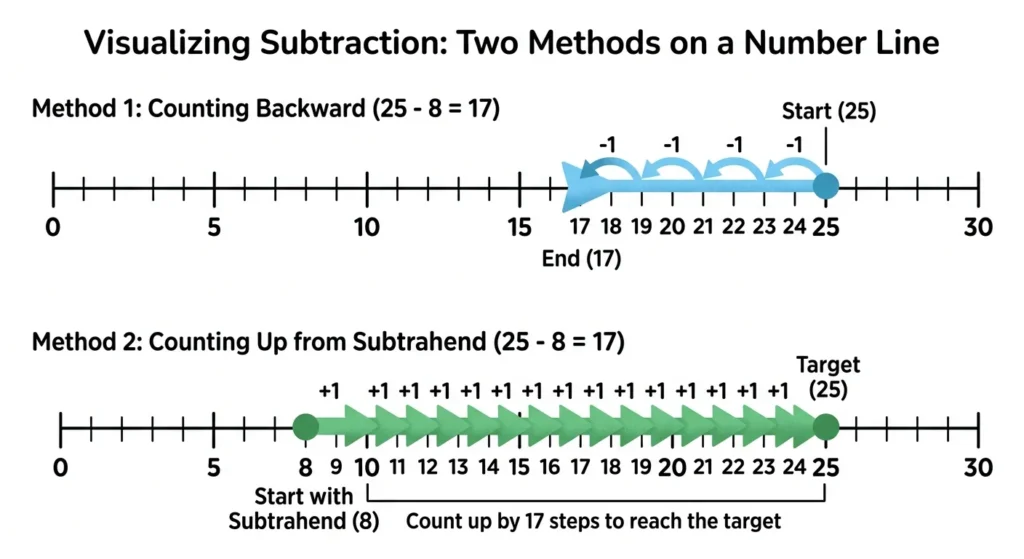
The key concept: When the ones digit on top is smaller than the ones digit on the bottom, we break one ten from the tens place into 10 ones so we have enough to subtract. OR, we can count up from the smaller number to the larger number to find the difference.
Worked Example 1: Subtraction Without Regrouping
Let’s subtract 28 − 14:
Step 1: Set up the columns:
28
– 14
—-
Step 2: Subtract the ones: 8 − 4 = 4. Write 4 in the ones place.
Step 3: Subtract the tens: 2 − 1 = 1. Write 1 in the tens place.
Answer: 28 − 14 = 14
Worked Example 2: Subtraction With Regrouping
Let’s subtract 25 − 8:
Step 1: Set up the columns:
25
– 8
—-
Step 2: Look at the ones place. We need to subtract 8 from 5, but 5 is smaller. So we borrow 1 ten from the tens place. Now the tens place has 1 (instead of 2), and the ones place has 15 (5 + 10).
Step 3: Subtract the ones: 15 − 8 = 7. Write 7 in the ones place.
Step 4: Subtract the tens: 1 − 0 = 1. Write 1 in the tens place.
Answer: 25 − 8 = 17
Alternative Strategy: Counting Up
Some children find it easier to count up from 8 to 25 using a number line. Start at 8, count up by ones or tens until you reach 25, and count how many steps you took. That’s your answer.
Practice Problems:
- 32 − 11 = ?
- 24 − 7 = ?
- 30 − 15 = ?
- 23 − 9 = ?
- 35 − 18 = ?
Answers: 1) 21 (no regrouping), 2) 17 (regrouping from tens), 3) 15 (no regrouping), 4) 14 (regrouping needed), 5) 17 (regrouping needed)
For more practice on subtraction, visit Grade 2 Subtraction practice problems on Gonit
Place Value: Understanding Tens and Ones
Place value is the foundation for addition and subtraction with regrouping. If your child understands that 37 means 3 tens and 7 ones (not just “thirty-seven”), the concept of regrouping makes so much more sense.
Many parents skip this section thinking it’s too basic, but it’s absolutely critical.
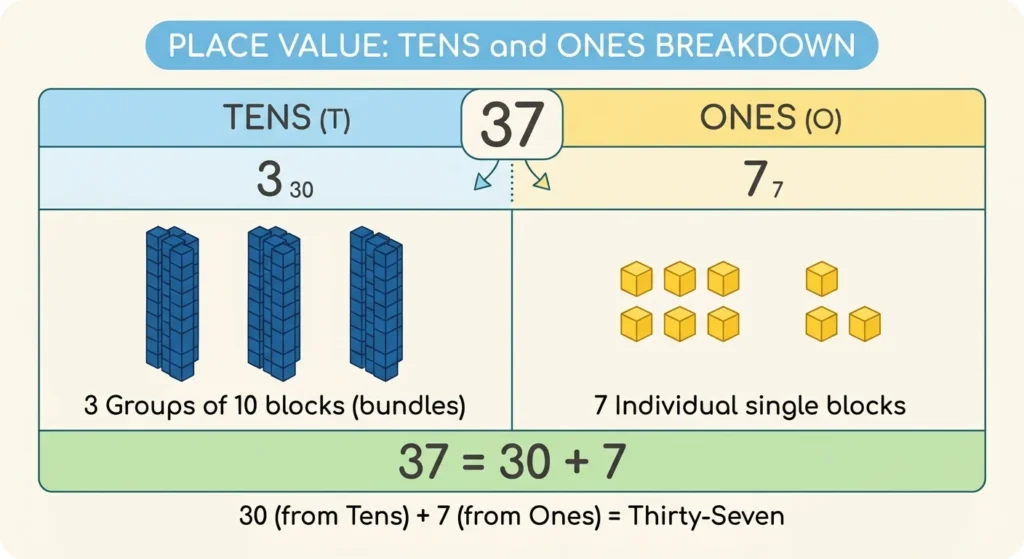
The key concept: Every two-digit number is made of groups of 10 (tens) and single units (ones). For example, 42 = 4 tens + 2 ones = 40 + 2.
Worked Example: Breaking Apart Numbers
Let’s break down the number 56:
How many tens? 5 tens (which equals 50) How many ones? 6 ones
So 56 = 5 tens + 6 ones, or 56 = 50 + 6
Worked Example: Building Numbers
If I have 3 tens and 8 ones, what number do I make?
3 tens = 30 8 ones = 8 30 + 8 = 38
So 3 tens and 8 ones make 38.
Practice Problems:
- Break apart 23. How many tens? How many ones?
- Build the number: 4 tens and 5 ones = ?
- Break apart 60. How many tens? How many ones?
- Build the number: 7 tens and 2 ones = ?
- Which number is greater: 42 or 24? Why?
Answers: 1) 2 tens and 3 ones (23 = 20 + 3), 2) 45, 3) 6 tens and 0 ones (60 = 60 + 0), 4) 72, 5) 42 is greater because it has more tens (4 tens vs. 2 tens)
For more practice on place value, explore Grade 2 Addition resources on Gonit
Multiplication Introduction: Arrays, Repeated Addition, and Skip Counting
Multiplication in 2nd grade is an introduction, not fluency. Your child isn’t expected to memorize facts yet.
Instead, they’re learning that multiplication is a shorthand for repeated addition and that arrays (arranging objects in rows and columns) show what multiplication looks like visually.
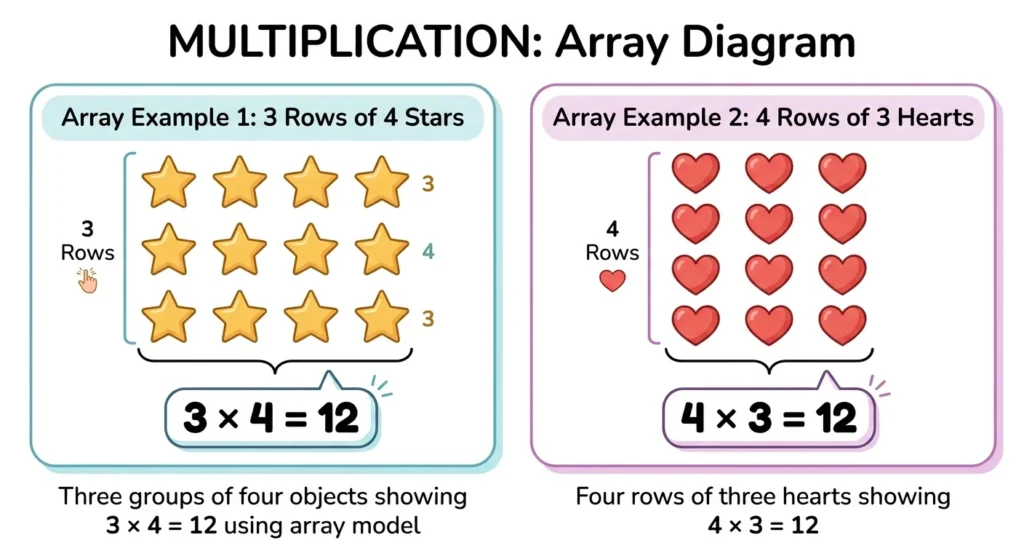
The key concept: Multiplication means groups of equal size. 3 groups of 4 is the same as 4 + 4 + 4, which we can write as 3 × 4.
Worked Example 1: Using Arrays
Imagine 3 rows of 4 stars each. How many stars total?
* * * *
* * * *
* * * *
Count them: 4 + 4 + 4 = 12
We can write this as 3 × 4 = 12 (read as “3 groups of 4 equals 12”)
Worked Example 2: Skip Counting
Skip counting is another way to think about multiplication. To find 4 × 2, count by 2s four times:
2, 4, 6, 8
So 4 × 2 = 8
Practice Problems:
- Draw an array with 2 rows of 5 stars. How many stars total? Write as a multiplication sentence: 2 × 5 = ?
- Use repeated addition: 3 + 3 + 3 = ? Write as multiplication: 3 × 3 = ?
- Count by 5s three times and write the answer: 5, __, __, so 3 × 5 = ?
- Draw an array with 4 rows of 3 hearts. How many hearts? 4 × 3 = ?
- What’s 2 groups of 6? Write as multiplication: 2 × 6 = ?
Answers: 1) 10 stars; 2 × 5 = 10, 2) 9; 3 × 3 = 9, 3) 5, 10, 15; so 3 × 5 = 15, 4) 12 hearts; 4 × 3 = 12, 5) 12; 2 × 6 = 12
For more practice on multiplication, visit Grade 2 Multiplication practice problems on Gonit
Measurement: Length and Time
Measurement in 2nd grade involves using rulers to measure length, reading analog clocks to tell time (usually to the nearest 5 or 15 minutes), and comparing lengths or amounts.
These are practical, hands-on skills that connect math to the real world.
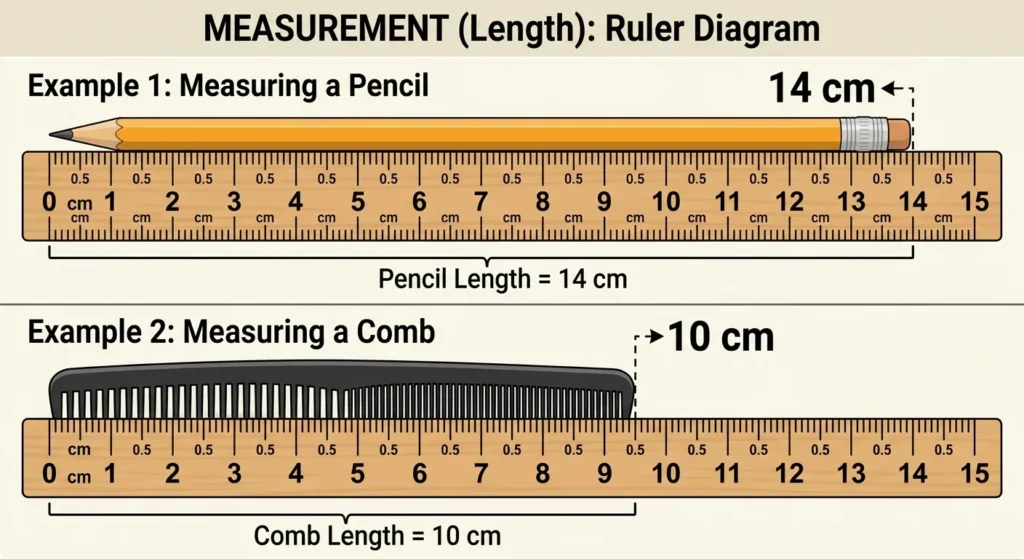
The key concept: A unit of measurement (like a centimeter or an hour) is a standard way to describe how long or how much something is.
Worked Example 1: Measuring Length
If I measure a pencil with a ruler and it goes from 0 to 14, the pencil is 14 centimeters long.
When measuring: Step 1: Place the 0 mark of the ruler at the start of the object. Step 2: See where the end of the object lines up on the ruler. Step 3: That number is the length.
Worked Example 2: Telling Time
An analog clock has an hour hand (shorter) and a minute hand (longer). The hour hand points to the hour, and the minute hand tells you how many minutes past the hour.
If the hour hand is between 3 and 4, and the minute hand points to 3, then:
- The hour hand being between 3 and 4 means it’s in the 3 o’clock hour.
- The minute hand pointing to 3 means it’s 15 minutes past the hour (each number represents 5 minutes: 1=5, 2=10, 3=15, etc.).
- So the time is 3:15.
Practice Problems:
- Measure this object with a ruler. It starts at 0 and ends at 8. How long is it? ___ cm
- What time is shown on the clock if the hour hand is just past 2 and the minute hand points to 12? (Hint: the minute hand pointing to 12 means 0 minutes, so it’s exactly 2 o’clock)
- If a stick is 12 cm long and another stick is 8 cm long, which is longer and by how much?
- What time is it if the hour hand is between 7 and 8, and the minute hand points to 6?
- A rope is 20 cm long. You cut off 7 cm. How much rope is left? ___ cm
Answers: 1) 8 cm, 2) 2:00, 3) The first stick is longer by 4 cm (12 − 8 = 4), 4) 7:30, 5) 13 cm (20 − 7 = 13)
For more practice on measurement, visit Grade 2 Measurement practice on Gonit
Counting Money: Indian Rupees
Counting money is a practical application of addition skills. In 2nd grade, children learn to recognize coin and bill denominations, count combinations of coins, and figure out if they have enough to buy something.
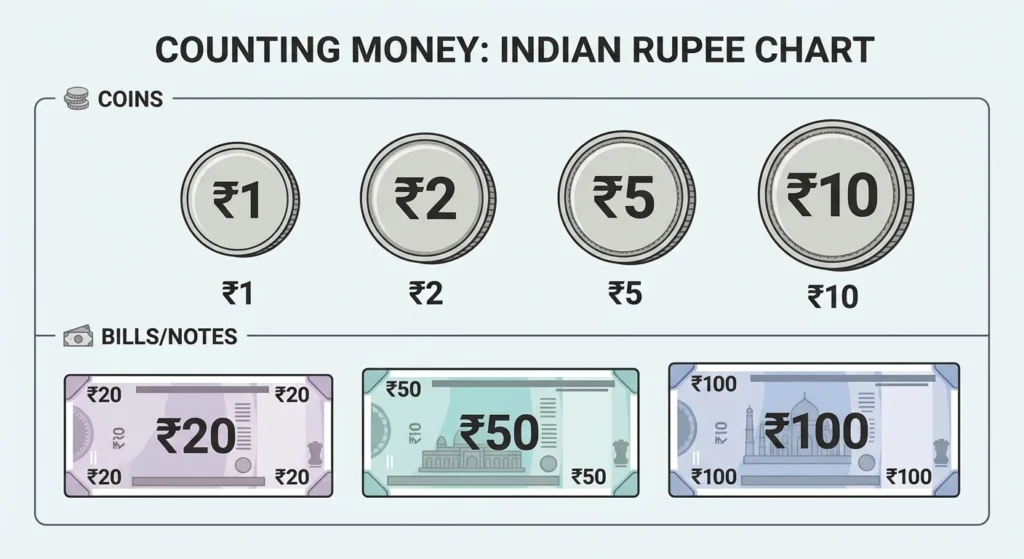
The key concept: Different coins and bills represent different values. Adding them together tells you the total amount of money you have.
Indian Rupee Denominations:
Coins: ₹1, ₹2, ₹5, ₹10 Bills (notes): ₹20, ₹50, ₹100
Worked Example 1: Counting Coins
If I have three ₹5 coins and two ₹1 coins, how much money do I have?
Step 1: Count the ₹5 coins: 5 + 5 + 5 = 15 Step 2: Count the ₹1 coins: 1 + 1 = 2 Step 3: Add them together: 15 + 2 = 17
I have ₹17 total.
Worked Example 2: Making an Amount
How can I make ₹23 using ₹10 bills and ₹1 coins?
One way: Two ₹10 bills and three ₹1 coins = 20 + 3 = 23
Another way: Two ₹10 bills, one ₹2 coin, and one ₹1 coin = 20 + 2 + 1 = 23
Practice Problems:
- I have two ₹10 coins and four ₹5 coins. How much money do I have? ₹___
- I want to buy something for ₹30. I have two ₹10 bills and three ₹5 coins. Do I have enough? Yes / No
- Make ₹18 using ₹10 bills and ₹1 coins. What coins do you use?
- Count the money: three ₹5 coins, one ₹10 coin, and two ₹2 coins. ₹___
- If I have ₹25, how much more money do I need to have ₹40?
Answers: 1) ₹40 (20 + 20 = 40), 2) Yes (20 + 15 = 35, which is more than 30), 3) One ₹10 bill and eight ₹1 coins (or other combinations that equal 18), 4) ₹29 (15 + 10 + 4 = 29), 5) ₹15 (40 − 25 = 15)
For more practice on counting money, visit Grade 2 Counting Money practice on Gonit
Geometry: Shapes, Position, and Patterns
Geometry in 2nd grade focuses on identifying and naming 2D shapes, describing positions and directions, and recognizing simple patterns. This builds spatial reasoning skills that are important for later math.
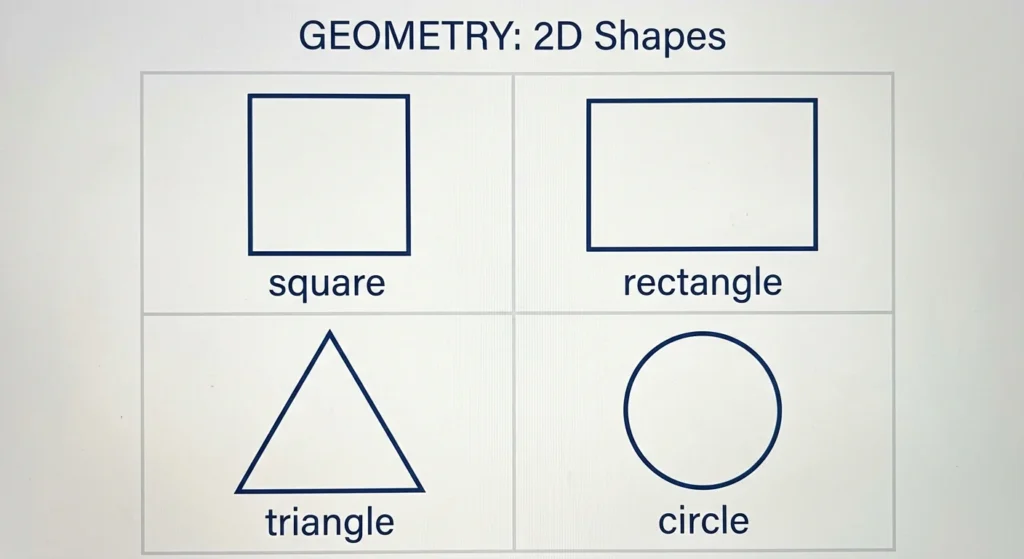
The key concept: Shapes have defining features (number of sides, angles, curves) that help us identify them. Position words help us describe where things are relative to each other.
Worked Example 1: Identifying Shapes
A square has 4 equal sides and 4 corners. A rectangle has 4 sides and 4 corners, but opposite sides are equal (not all sides are the same). A triangle has 3 sides and 3 corners. A circle has no sides and no corners; it’s round.
Worked Example 2: Describing Position
Look at this picture:
- The star is above the house.
- The tree is to the right of the house.
- The flower is below the house.
- The cloud is to the left of the tree.
Practice Problems:
- How many sides does a triangle have? ___
- Which shape is this? It has 4 equal sides and 4 corners. _______
- Look at the picture. Is the cat above or below the table?
- If I draw a rectangle, how many corners does it have? ___
- Complete the pattern: square, triangle, square, triangle, _____, _____
Answers: 1) 3 sides, 2) Square, 3) Above (or below, depending on the diagram provided), 4) 4 corners, 5) Square, triangle (continuing the alternating pattern)
For more practice on geometry, visit Grade 2 Geometry practice on Gonit
Word Problems: A Strategy for Success
Word problems can feel overwhelming, but they’re just stories with math inside them.
If your child learns a simple strategy for breaking down word problems, they’ll gain confidence and independence.
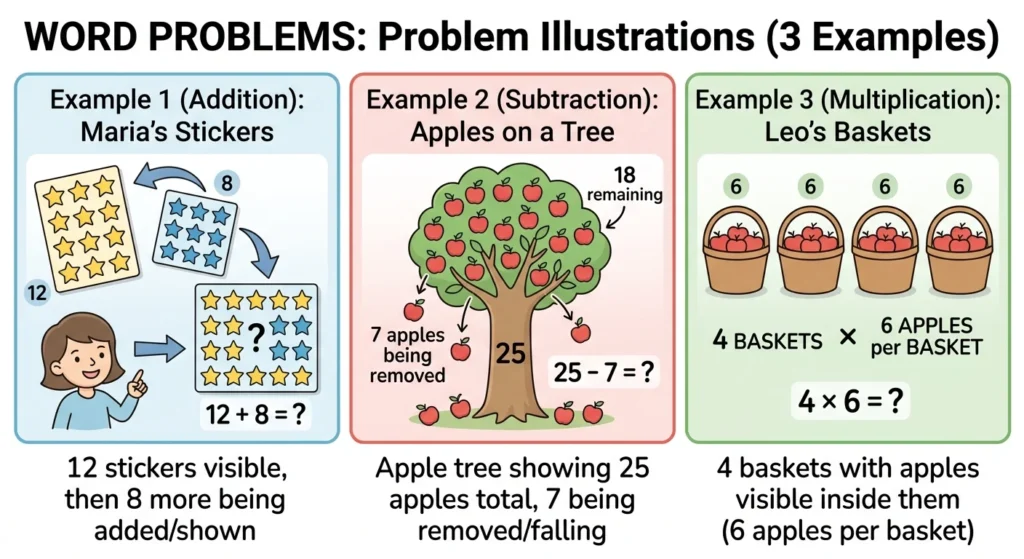
The Key Strategy:
Step 1: Read the whole problem without stopping. Step 2: Identify what you know (the numbers and facts given). Step 3: Identify what you’re looking for (the question). Step 4: Choose an operation: Do I need to add, subtract, multiply, or divide? Step 5: Solve the problem. Step 6: Check: Does my answer make sense?
Worked Example 1: Addition Word Problem
Maria has 12 stickers. Her friend gives her 8 more stickers. How many stickers does Maria have now?
Step 1: Read it all the way through. (Done.) Step 2: What do I know? Maria starts with 12 stickers. She gets 8 more. Step 3: What am I looking for? The total number of stickers Maria has. Step 4: What operation? I’m combining groups, so I add. Step 5: 12 + 8 = 20 Step 6: Does it make sense? Yes, if Maria started with 12 and got 8 more, she should have more than 12. 20 is more than 12, so this works.
Answer: Maria has 20 stickers.
Worked Example 2: Subtraction Word Problem
There were 25 apples on a tree. Birds ate 7 of them. How many apples are left on the tree?
Step 1: Read it all the way through. Step 2: What do I know? Started with 25 apples. 7 apples are gone. Step 3: What am I looking for? How many apples remain. Step 4: What operation? I’m taking away, so I subtract. Step 5: 25 − 7 = 18 Step 6: Does it make sense? Yes, if 7 apples are gone, there should be fewer than 25. 18 is fewer, so this works.
Answer: There are 18 apples left on the tree.
Worked Example 3: Multiplication Word Problem
Leo has 4 baskets. Each basket has 6 apples. How many apples does Leo have altogether?
Step 1: Read it all the way through. Step 2: What do I know? There are 4 baskets. Each has 6 apples. Step 3: What am I looking for? Total apples. Step 4: What operation? I have groups of equal size, so I multiply. Step 5: 4 × 6 = 24 Step 6: Does it make sense? Yes, 4 groups of 6 should be more than 6, and 24 is.
Answer: Leo has 24 apples altogether.
Practice Problems:
- Ben has 14 pencils. He buys 9 more pencils. How many pencils does he have now?
- There are 30 cookies in a jar. The children eat 12 cookies. How many are left?
- A toy costs ₹15. Ravi has ₹20. Does he have enough money? How much change will he get?
- Amy has 3 bags of marbles. Each bag has 5 marbles. How many marbles does she have total?
- Sam read 8 pages yesterday and 12 pages today. How many pages did he read in total?
Answers: 1) 23 pencils (14 + 9 = 23), 2) 18 cookies (30 − 12 = 18), 3) Yes, he has enough (20 is more than 15). He gets ₹5 change (20 − 15 = 5), 4) 15 marbles (3 × 5 = 15), 5) 20 pages (8 + 12 = 20)
For more practice on word problems, visit Grade 2 Word Problems practice on Gonit
How much math homework is too much for a 2nd grader?
Most 2nd grade homework should take 20 to 45 minutes per session, depending on the topic. If your child is regularly spending more than an hour on math homework, or if they’re showing signs of stress or anxiety, reach out to the teacher. It’s possible the work is too advanced, or your child may benefit from breaking it into smaller pieces or having additional support.
My child learned a different method than I remember. Should I correct them or teach them the way I learned?
No, stick with what the teacher is teaching. Modern methods like regrouping (understanding place value) and counting up (for subtraction) are actually more conceptual and help children understand the “why” behind the math, not just the “how.” If you teach a different method, it can confuse your child. If you’re curious, ask the teacher to explain the method they’re using, and you’ll likely understand your child’s homework much better.
What if my child can’t do a problem after I explain it once?
Try explaining it a different way or using manipulatives (blocks, counters, draw a picture). If they still can’t grasp it after a few minutes, move on and make a note for the teacher. Sometimes children need to sleep on a concept or have the teacher explain it in yet another way. There’s no shame in this; all children learn at different paces.
Should I let my child use fingers or manipulatives to count?
Absolutely. Using fingers or objects to count is a normal part of development. As children practice, they’ll naturally start to count without touching, but there’s no rush. Manipulatives help children understand what the numbers actually mean, so they’re very helpful.
How do I know if my child needs a tutor?
Most 2nd graders don’t need a tutor yet. However, if your child is consistently frustrated, falling behind despite your efforts, or showing signs of math anxiety (avoiding homework, physical stress), it might be worth talking to the teacher first. Sometimes a brief intervention or a small group session at school is all that’s needed. A tutor can be helpful if the teacher recommends it or if your child needs one-on-one attention for a specific concept.
Make Preparing for Math Olympiad Simple!



Next Steps: More Practice on Gonit
You now have worked examples and practice problems for every major 2nd grade math topic. The best way to support your child is to work through these problems during homework time, celebrate progress, and reach out to the teacher if something isn’t clicking after a few attempts.
Gonit offers deeper practice and interactive tools for each of these topics, organized by skill and difficulty level. Explore the full Grade 2 curriculum through the links in each section above, or check out additional resources like math games and puzzles designed specifically for 2nd graders. The more practice and exposure your child gets in a low-pressure setting, the more confident they’ll become.
You’re doing great by being here and seeking support. Math confidence starts at home with a caring adult who’s willing to try.

Mikha Piregu is a Content Writer with experience spanning educational content, including math and math olympiad topics, as well as advocacy writing, research-based articles, and SEO-driven web content. He creates high-quality blog content, web copy, and feature articles that support brand visibility, audience engagement, and long-term organic growth through data-informed storytelling. Skilled in WordPress, WooCommerce, and modern digital tools, Mikha adapts content across various platforms, including blogs, websites, campaigns, and advocacy initiatives, with clarity and purpose.

There are no comments posted here yet.
Sign in to leave a comment