

Grade 2 geometry teaches kids to identify and name 2D and 3D shapes, count their sides, corners (vertices), and faces, split shapes into equal parts, and recognize basic symmetry.
- What Is Geometry in Grade 2?
- The Attribute Framework: Sides, Corners, Edges, and Faces
- 2D Shapes: Flat Shapes and Their Sides
- 3D Shapes: Solid Shapes and Their Faces
- Splitting Shapes into Equal Parts
- Basic Symmetry in Shapes
- Confusing Shape Pairs, Explained
- Common Mistakes Kids Make with Shapes
- Simple Practice Activities to Try at Home
- Why This Matters Beyond Grade 2
- Conclusion
A shape is a triangle because it has 3 sides and 3 corners, not because of its color or size.
That one idea, that shapes are classified by countable, comparable attributes- is the foundation for everything else in this article.
Whether we’re talking about a flat square on paper, a solid cube you can hold in your hand, or a shape split into two equal halves.
What Is Geometry in Grade 2?
At this grade level, geometry is not about formulas or angle measurements. It’s about noticing and describing shapes using a small, consistent set of terms.
A Grade 2 student is expected to recognize common 2D shapes like triangles, squares, rectangles, pentagons, and hexagons, and common 3D shapes like cubes, spheres, cones, and cylinders.
They’re also expected to describe those shapes using attributes: how many sides they have, how many corners, and for solid shapes, how many faces. Beyond naming and counting,
Grade 2 also introduces two related ideas covered later in this article: splitting a shape into equal parts, and recognizing symmetry.
The reason this matters is that once your child understands attributes, they can identify a shape they’ve never seen labeled before, just by counting. That’s a much stronger skill than memorizing a list of shape names.
The Attribute Framework: Sides, Corners, Edges, and Faces
Before looking at individual shapes, it helps to define the four words that describe every shape in this article. Once your child knows these terms, the rest of geometry becomes a matter of counting and comparing.
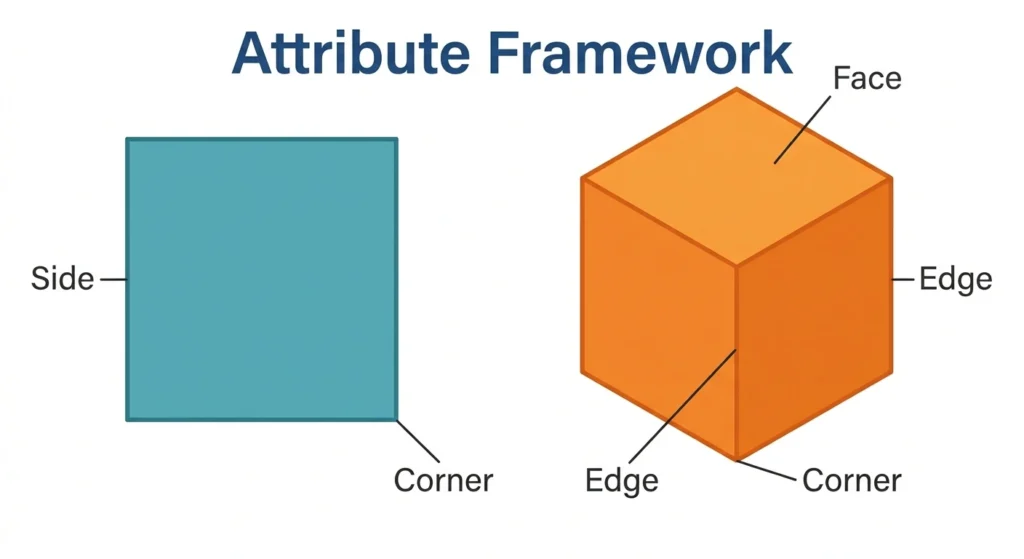
- Side: A straight line that forms part of the outer edge of a flat shape. A triangle has 3 sides.
- Corner (also called a vertex): The point where two sides meet. A square has 4 corners.
- Edge: The line where two faces of a solid shape meet. A cube has 12 edges.
- Face: A flat surface on a solid shape. A cube has 6 faces.
Here’s a simple way to remember which terms apply to which kind of shape:
| Term | What it describes | Used for |
|---|---|---|
| Side | A straight outer line | 2D (flat) shapes |
| Corner / Vertex | Where two sides or edges meet | 2D and 3D shapes |
| Edge | Where two faces meet | 3D (solid) shapes |
| Face | A flat surface | 3D (solid) shapes |
This table is worth returning to. Every shape we cover below gets described using these same four words, so the framework doesn’t change, only the shape does.
2D Shapes: Flat Shapes and Their Sides
A 2D shape is flat. It has length and width but no thickness, which is why it can be drawn on a piece of paper. We describe 2D shapes by counting sides and corners.
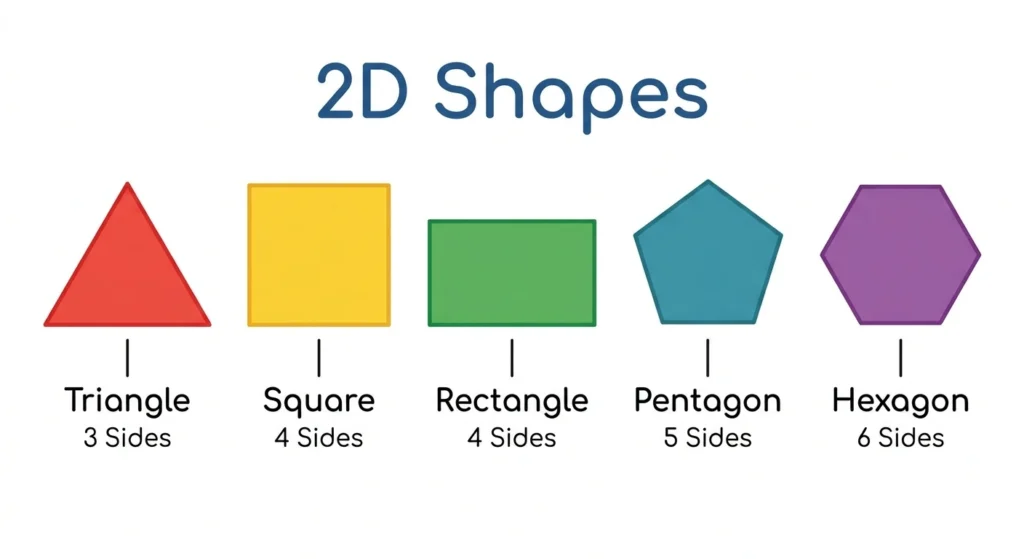
- Triangle: 3 sides, 3 corners. Real-world example: a slice of pizza or a road sign warning of a curve ahead.
- Square: 4 sides of equal length, 4 corners. Real-world example: a chessboard tile or a napkin.
- Rectangle: 4 sides, with opposite sides equal in length, 4 corners. Real-world example: a book cover or a door.
- Pentagon: 5 sides, 5 corners. Real-world example: a home plate on a baseball field (roughly) or the outline of a simple house drawing with a peaked roof.
- Hexagon: 6 sides, 6 corners. Real-world example: a honeycomb cell or the end view of a hex nut.
Here’s a quick reference table for the 2D shapes covered here:
| Shape | Sides | Corners |
|---|---|---|
| Triangle | 3 | 3 |
| Square | 4 | 4 |
| Rectangle | 4 | 4 |
| Pentagon | 5 | 5 |
| Hexagon | 6 | 6 |
Notice the pattern: for every 2D shape in this list, the number of sides equals the number of corners. That’s true for any polygon, which is the general word for a flat shape made of straight sides.
3D Shapes: Solid Shapes and Their Faces
A 3D shape is solid. It has length, width, and depth, so you can pick it up and turn it around. We use the same idea as before, counting attributes, except now we count faces and edges instead of sides.
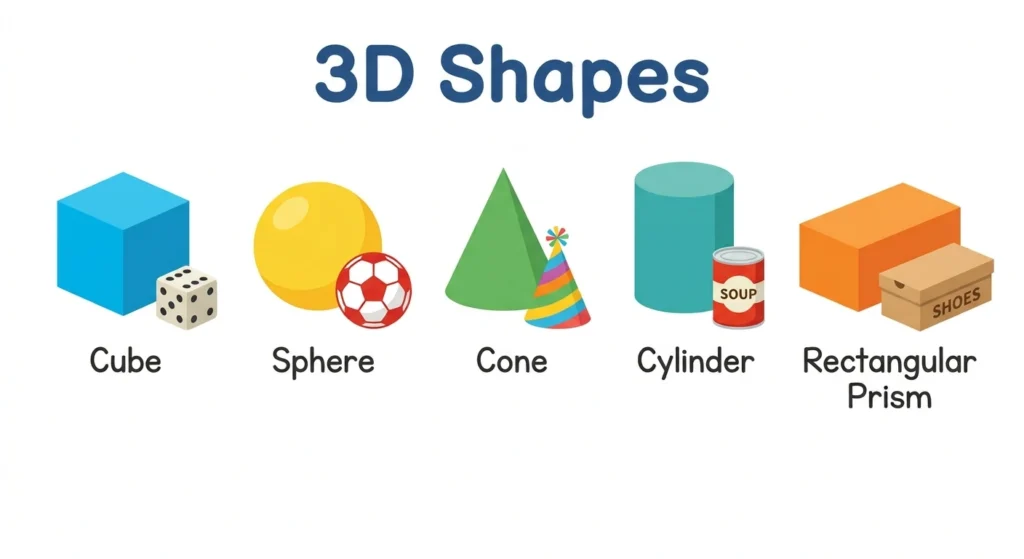
- Cube: 6 faces (all squares), 12 edges, 8 corners. Real-world example: a dice or a sugar cube.
- Sphere: 0 flat faces (it’s fully curved), 0 edges, 0 corners. Real-world example: a ball or a marble.
- Cone: 1 flat face (a circle), 1 curved surface, 1 corner at the tip. Real-world example: an ice cream cone or a party hat.
- Cylinder: 2 flat faces (circles), 1 curved surface, 0 corners. Real-world example: a can of soup or a paper towel roll.
- Rectangular prism: 6 faces (rectangles), 12 edges, 8 corners. Real-world example: a shoebox or a cereal box.
| Shape | Faces | Edges | Corners |
|---|---|---|---|
| Cube | 6 | 12 | 8 |
| Sphere | 0 | 0 | 0 |
| Cone | 1 flat + 1 curved | 1 | 1 |
| Cylinder | 2 flat + 1 curved | 2 | 0 |
| Rectangular prism | 6 | 12 | 8 |
The framework hasn’t changed. We’re still counting attributes, just with one more dimension added. A cube is a “3D square” in the sense that both are built from equal-length straight parts, and a rectangular prism relates to a rectangle the same way.
Once your child sees this connection, 3D shapes stop feeling like a whole new topic and start feeling like an extension of what they already know.
Splitting Shapes into Equal Parts
A shape can be divided into equal parts, called equal shares. If you split a rectangle into 2 same-size pieces, each piece is called a half.
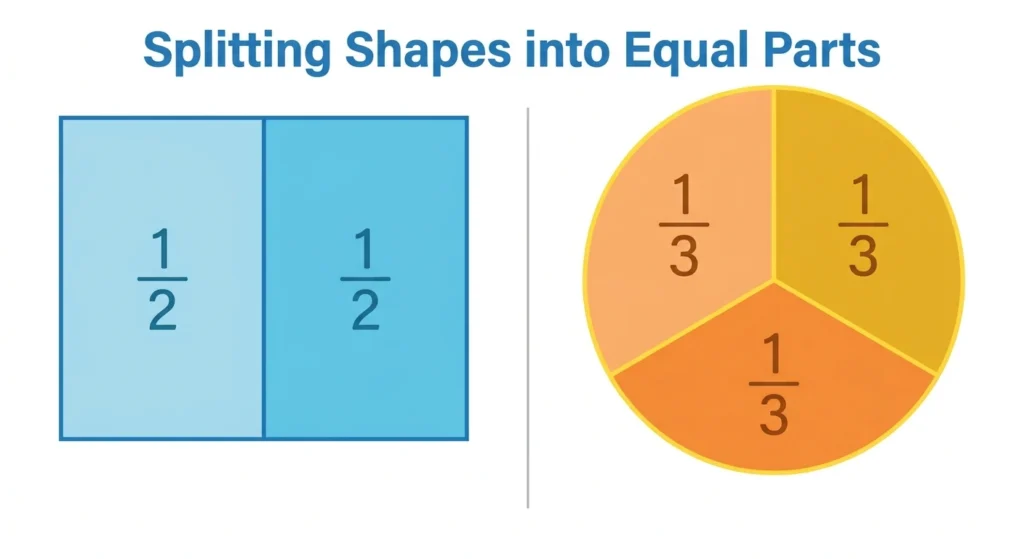
Split it into 3 same-size pieces, and each is a third. Split it into 4 same-size pieces, and each is a fourth (also called a quarter).
The word to hold onto is equal. A shape cut into two pieces of different sizes is not split into halves, even though there are 2 pieces. Both parts have to be the same size and shape for the word half, third, or fourth to apply.
This is also the first place fractions and geometry overlap, since a half of a shape and the fraction 1/2 describe the same idea.
A single shape can be split into equal parts in more than one way. A square can be cut into 2 halves with a line straight down the middle, or with a line corner to corner, and both are still valid halves as long as the two pieces match in size and shape.
Basic Symmetry in Shapes
A shape has symmetry when it can be folded along a line so that both halves match up exactly. That fold line is called a line of symmetry.
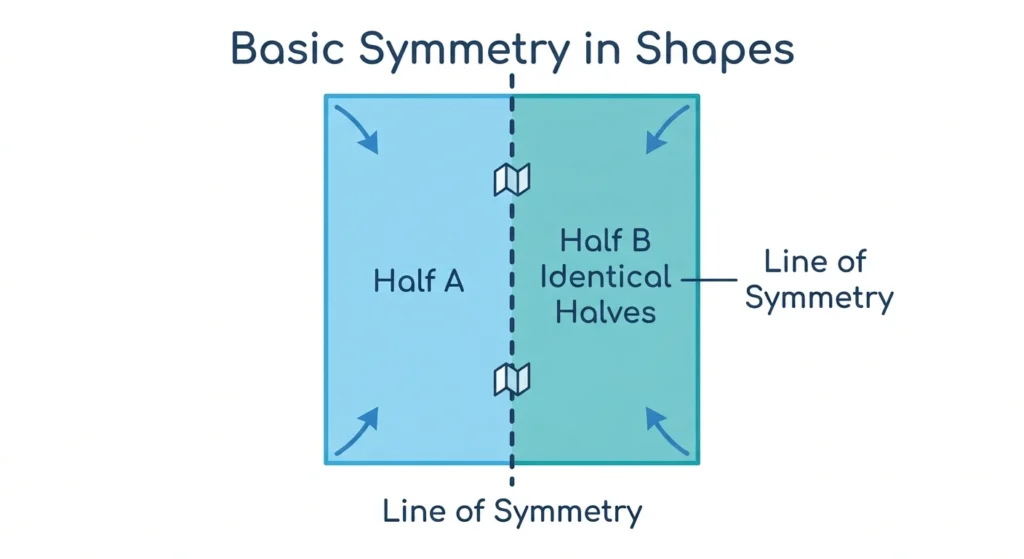
- Square: has 4 lines of symmetry.
- Rectangle: has 2 lines of symmetry.
- Regular hexagon: has 6 lines of symmetry.
- A scalene triangle (one with all different side lengths): has 0 lines of symmetry.
An easy way to test for symmetry at home: fold a paper cutout of the shape. If the two halves line up edge to edge with no overlap or gap, that fold line is a line of symmetry. Some shapes have more than one, and some, like an irregular pentagon, may have none at all.
Confusing Shape Pairs, Explained
A few shape pairs cause real confusion at this age, usually because they look similar at a glance but differ in one specific attribute.
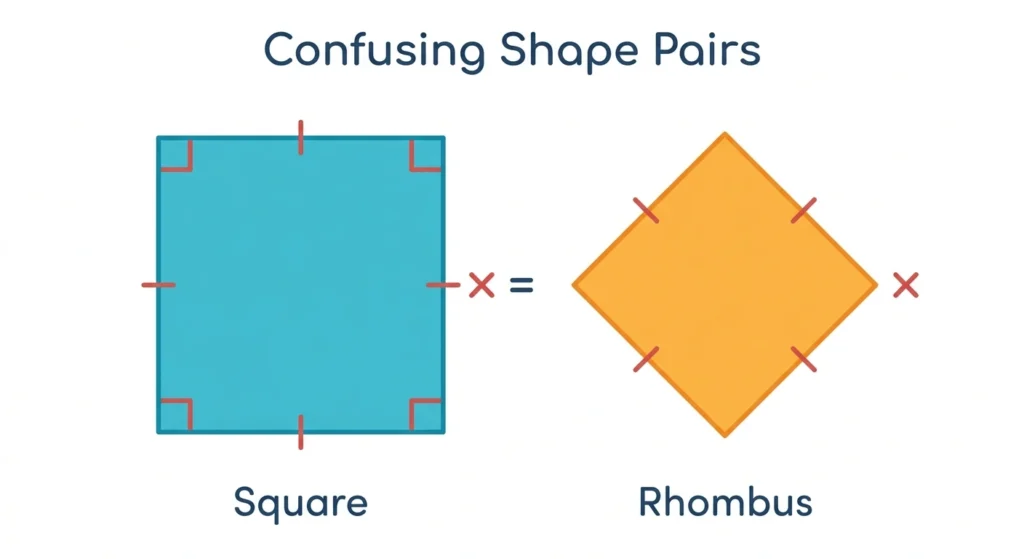
Rhombus vs. square
A rhombus has 4 equal sides, just like a square. The difference is the corners. A square’s corners are all right angles (like the corner of a piece of paper), while a rhombus’s corners can be tilted, making it look like a leaning square or a diamond shape. Every square is technically a rhombus, but not every rhombus is a square.
Pentagon vs. hexagon
These get mixed up simply because they’re both many-sided shapes that don’t look like a triangle or square. The reliable fix is counting: pentagon has 5 sides, hexagon has 6. A memory trick that works well: “penta” sounds like “five” (think pentathlon, five events), and hexagon has one more side to notice.
Square vs. rectangle
This one trips up even adults. A square is actually a special type of rectangle, one where all 4 sides happen to be equal. Every square is a rectangle, but not every rectangle is a square, because a rectangle only requires opposite sides to match, not all four.
Common Mistakes Kids Make with Shapes
A few patterns show up again and again when children are learning to identify shapes.
Thinking a rotated shape is a different shape
If a square is turned so it looks like a diamond, some children will say it’s no longer a square. It’s still a square. Rotating a shape never changes its number of sides or corners, and that’s the actual test.
Miscounting sides on irregular shapes
When a pentagon or hexagon isn’t perfectly symmetrical, kids sometimes lose track while counting. Encourage your child to physically point to each side, one at a time, and count out loud rather than guessing from the overall look of the shape.
Mixing up 2D and 3D names
It’s common to hear a circle called a sphere, or a square called a cube. The fix is to ask a follow-up question: “Can you pick it up and see all sides of it, or is it flat on the page?” If it’s flat, it’s a 2D shape. If it has thickness, it’s 3D.
Simple Practice Activities to Try at Home
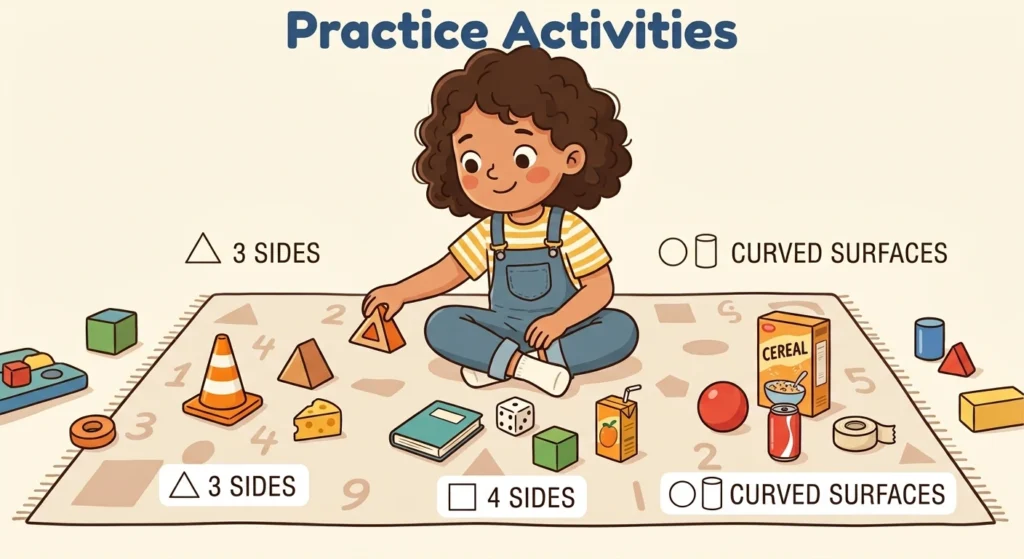
Shape hunt
Walk around the house together and find one real object for each shape covered above. A cereal box for a rectangular prism, a ball for a sphere, a book for a rectangle.
This turns the real-world associations from earlier sections into something your child discovers themselves.
Sort by attribute
Gather a mixed pile of small household objects or shape cutouts and ask your child to sort them by number of sides, or by number of faces for 3D objects.
Sample identification problems
- A shape has 4 equal sides and all right-angle corners. What is it? (Answer: a square)
- A solid shape has 2 flat circular faces and a curved surface. What is it? (Answer: a cylinder)
- A shape has 6 sides and 6 corners. What is it? (Answer: a hexagon)
Working through a few of these together, out loud, reinforces the counting habit more effectively than a worksheet alone.
Why This Matters Beyond Grade 2
Attribute-based thinking about shapes is what later supports understanding perimeter and area, since both start with knowing how many sides a shape has and how they relate to each other.
If your child is also working through Gonit’s Grade 2 measurement guide covering length, weight, and time, the same habit of counting and comparing attributes carries directly into measuring shapes.
Shape and attribute questions also show up early in competition math. Math Kangaroo’s earlier levels regularly include questions asking students to count sides, corners, or identify a shape from a description rather than a picture, and MOEMS practice problems include similar attribute-based reasoning, which rewards exactly the kind of attribute-first thinking built in this article.
Counting sides and corners accurately is also a form of visual reasoning, and it overlaps with the critical thinking skills your child is building across other Grade 1 and Grade 2 topics.
If your child is working through the rest of the Grade 2 series, fractions is another topic where the same habit of breaking a whole into countable, comparable parts comes up again.
What’s the difference between a rhombus and a square?
Both have 4 equal sides. A square’s corners are all right angles, while a rhombus’s corners can be slanted, giving it a tilted or diamond-like look.
When do kids learn 3D shape names?
Grade 2 is when most children formally learn to name and describe common 3D shapes like cubes, spheres, cones, and cylinders using faces, edges, and corners.
Is a square a rectangle?
Yes. A square meets all the requirements of a rectangle (4 sides, opposite sides equal, right-angle corners) and additionally has all 4 sides equal in length.
How many sides does a hexagon have?
A hexagon has 6 sides and 6 corners.
What’s the difference between a 2D shape and a 3D shape?
A 2D shape is flat, with length and width only, like a square drawn on paper. A 3D shape is solid, with length, width, and depth, like a cube you can hold.
What is a line of symmetry?
A line of symmetry is a fold line that divides a shape into two halves that match exactly. A square has 4, a rectangle has 2, and some shapes have none.
How do you split a shape into equal parts?
Divide the shape into pieces that are the same size and shape as each other. Two equal pieces are called halves, three are thirds, and four are fourths, and this is the same idea as the fractions 1/2, 1/3, and 1/4.
Make Preparing for Math Olympiad Simple!



Conclusion
Grade 2 geometry comes down to one repeatable skill: looking at a shape and counting what makes it that shape, its sides, its corners, and for solid shapes, its faces.
That same counting habit extends naturally into splitting shapes fairly and spotting symmetry, both of which show up again in later math and in early competition problems.
The confusion pairs and common mistakes covered here are the exact spots where kids usually stall, so revisiting them with a quick shape hunt or sorting activity at home is often enough to make the ideas stick.

Mikha Piregu is a Content Writer with experience spanning educational content, including math and math olympiad topics, as well as advocacy writing, research-based articles, and SEO-driven web content. He creates high-quality blog content, web copy, and feature articles that support brand visibility, audience engagement, and long-term organic growth through data-informed storytelling. Skilled in WordPress, WooCommerce, and modern digital tools, Mikha adapts content across various platforms, including blogs, websites, campaigns, and advocacy initiatives, with clarity and purpose.

There are no comments posted here yet.
Sign in to leave a comment