

Grade 2 multiplication is the introduction to multiplication as repeated addition, meaning your child learns to combine equal groups of objects before ever seeing a times table.
- What Multiplication Really Means
- The Teaching Sequence That Works: From Repeated Addition to Times Tables
- Is My Child Ready for Multiplication?
- Common Mistakes to Watch For
- Practice Problems at Each Stage
- How Grade 2 Multiplication Connects to Skip Counting, Addition, and Subtraction
- Grade 2 Multiplication and the Path to Competition Math
- Practice Grade 2 Multiplication with Gonit
- Conclusion
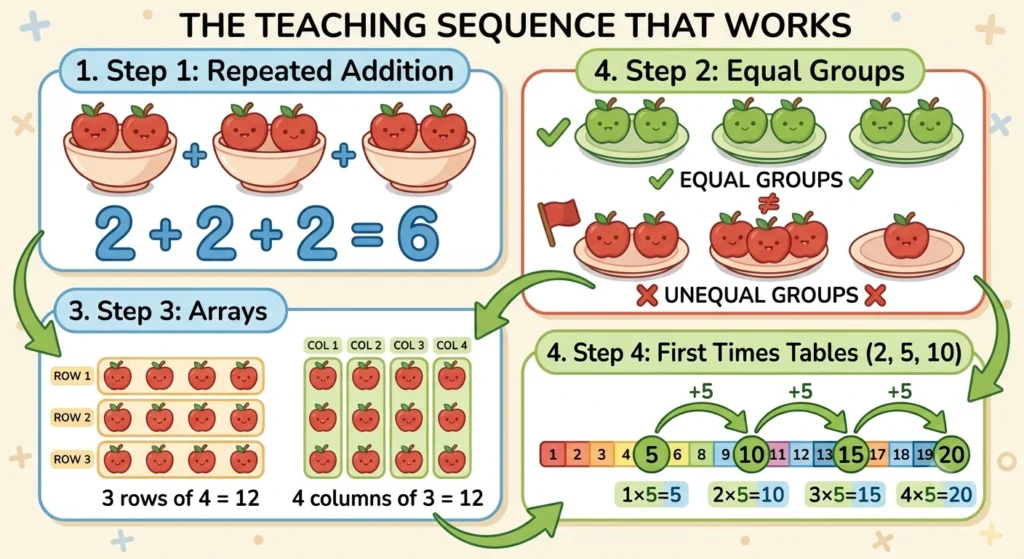
The teaching sequence that works best moves through four stages in order: repeated addition, equal groups, arrays, and finally the first times tables for 2, 5, and 10.
Skipping straight to memorized facts before your child understands what multiplication represents tends to create confusion later, so the goal at this stage is understanding, not speed.
If your child is bringing home multiplication problems for the first time, that’s a genuine milestone. It means they’ve built enough number sense through addition, subtraction, and skip counting to take on a new kind of thinking: seeing groups of things instead of just single numbers.
This guide walks through exactly how that thinking develops, what a healthy introduction looks like at home, and where parents commonly get tripped up.
What Multiplication Really Means
Multiplication is a faster way to add the same number repeatedly. When your child sees 4 x 3, that’s shorthand for 3 + 3 + 3 + 3.
Mathematicians call the numbers being multiplied factors, and the answer the product. So in 4 x 3 = 12, four and three are the factors, and twelve is the product.
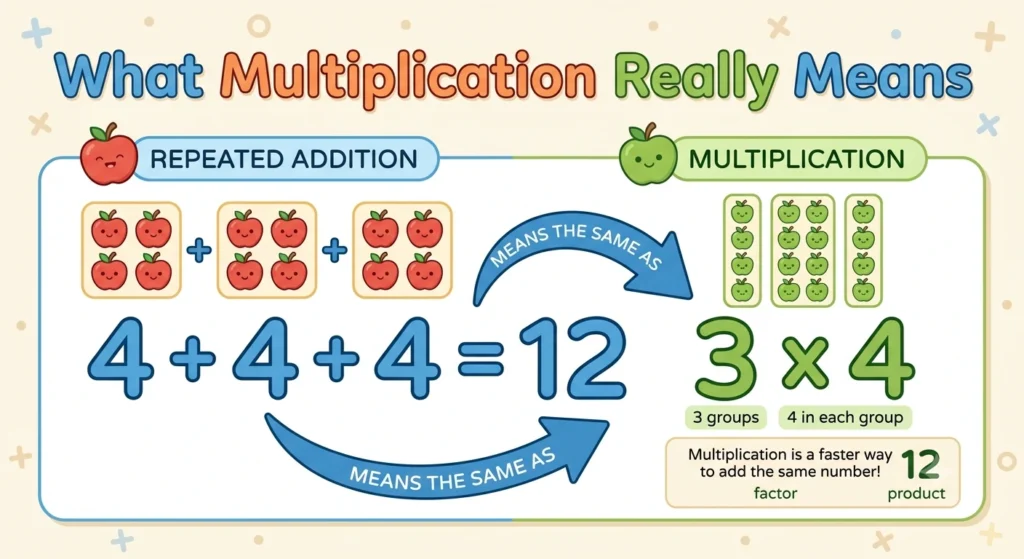
There’s no need to introduce those terms right away. In fact, most Grade 2 classrooms don’t even use the word ‘multiplication’ at first. Instead, children work with equal groups, meaning collections of objects that all have the same amount, and practice describing them as addition before the multiplication symbol ever appears.
This matters because multiplication is a bigger conceptual leap than addition or subtraction. Addition and subtraction describe changes to a single quantity: more or less.
Multiplication describes a relationship between two different quantities, the number of groups and the size of each group, and asks a child to hold both in mind at once. That’s genuinely harder, and it’s why the introduction deserves a slower, more visual approach than addition did.
The Teaching Sequence That Works: From Repeated Addition to Times Tables
Every strong introduction to multiplication follows roughly the same four steps.
Rushing ahead to memorization before your child is solid at an earlier step is the single most common reason multiplication feels confusing later on.
Step 1: Repeated Addition
Start with addition your child already knows. If there are 3 bags with 2 apples in each bag, ask your child to add: 2 + 2 + 2 = 6. At this stage, don’t mention multiplication at all. The goal is simply for your child to notice that they’re adding the same number again and again.
A good home activity: use small objects like coins, buttons, or cereal pieces. Make several small piles of the same size and have your child write out the addition sentence for the total.
Step 2: Equal Groups
Once repeated addition feels natural, introduce the language of groups. An equal group is a set where every group has the same number of items. Show your child 3 groups of 2 apples and ask: how many groups do we have, and how many are in each group? Then connect it back to the addition sentence they already wrote.
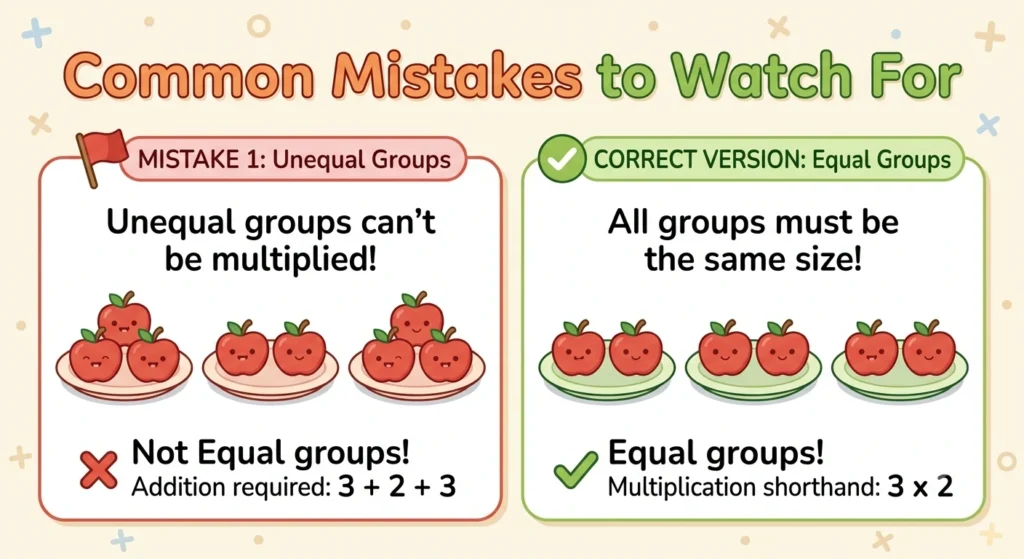
This is also the stage to point out unequal groups so your child can tell the difference. If one bag has 2 apples and another has 3, that can still be added, but it can’t be multiplied, because multiplication only works with equal groups.
Step 3: Arrays
An array arranges objects into neat rows and columns, like a grid. Arrays are useful because they let your child see multiplication from two directions at once: as rows added together, or as columns added together. A 3 by 4 array of dots can be read as 3 groups of 4, or 4 groups of 3, both giving 12.
Try building an array with square tiles, LEGO bricks, or even egg cartons. Ask your child to count it two different ways: by rows, then by columns. Seeing that both methods give the same total is a quiet but powerful introduction to the idea that 3 x 4 and 4 x 3 give the same answer.
Step 4: First Times Tables (2, 5, 10)
Only after your child is comfortable with repeated addition, equal groups, and arrays should times tables enter the picture, and even then, start small. The 2, 5, and 10 times tables come first because they build directly on skip counting, which most Grade 2 students have already practiced. Counting by 2s, 5s, and 10s is essentially multiplying by 2, 5, and 10 one step at a time.
Keep early times table practice connected to the visual models. When your child says ‘3 x 5 = 15,’ ask them to show it as 3 groups of 5 or as an array. That connection is what keeps the facts meaningful instead of becoming disconnected numbers to memorize.
Is My Child Ready for Multiplication?
Most children are introduced to multiplication concepts partway through Grade 2, but readiness depends more on specific skills than on age or grade level.
Your child is likely ready to begin this sequence if they can:
- Add single-digit numbers fairly fluently, without needing to count on fingers for every problem
- Skip count by 2s, 5s, and 10s, at least up to 20 or 50
- Recognize and describe a group of objects, such as counting how many are in a set
- Sit with a slightly harder problem for a minute or two without giving up
If any of those feel shaky, that’s not a sign of falling behind. It just means a bit more time on addition fluency and skip counting will make the multiplication introduction smoother. There’s no rush here, and starting with solid groundwork beats starting early with a shaky foundation.
It also helps to reframe this stage positively. Grade 2 multiplication is an early start, not a race. A child who takes an extra few weeks on equal groups before moving to arrays isn’t behind; they’re building the kind of understanding that makes every later math topic easier.
If your child needs an even gentler on-ramp before this sequence, Multiplication for Class 1 covers the very first steps with equal groups in a slower, earlier-grade pace.
Common Mistakes to Watch For
A few mix-ups show up again and again at this stage, and knowing what to look for helps you catch them early.
- Confusing group size with number of groups: a child might say ‘3 x 5’ when they mean 5 groups of 3, mixing up which number tells you how many groups there are and which tells you how many are in each group. Ask your child to point to the groups and count them out loud to sort this out.
- Skip-counting errors: if your child skip counts by 5s as ‘5, 10, 15, 25,’ the multiplication answer built on that count will be wrong even if their multiplication thinking is correct. It’s worth double-checking the skip count itself when an answer looks off.
- Treating unequal groups as multiplication: children sometimes try to multiply groups that aren’t actually equal in size. Remind them that multiplication is a shortcut specifically for equal groups; anything else needs regular addition.
- Rushing to memorize facts before the concept is solid: a child who has memorized that ‘2 x 6 = 12’ without understanding why can get stuck the moment a word problem asks them to apply it in an unfamiliar way.
Practice Problems at Each Stage
Working through a few problems at each stage of the sequence helps confirm your child is ready to move forward.
Repeated addition practice
- Write the addition sentence for 4 groups of 3.
- Write the addition sentence for 5 groups of 2.
Equal groups practice
- There are 3 plates with 4 cookies on each plate. How many cookies in total?
- Draw 5 groups of 2 stars and write the total.
Array practice
- Build an array with 3 rows and 5 columns. What is the total, and how do you know?
- Look at a 4 by 4 array. Write two different addition sentences that describe it.
Times tables practice (2, 5, 10)
- Skip count by 5s to find 6 x 5.
- What is 10 x 4? Show it as an array or as repeated addition.
How Grade 2 Multiplication Connects to Skip Counting, Addition, and Subtraction
Multiplication doesn’t appear out of nowhere in Grade 2. It builds directly on three skills your child has likely already been practicing.
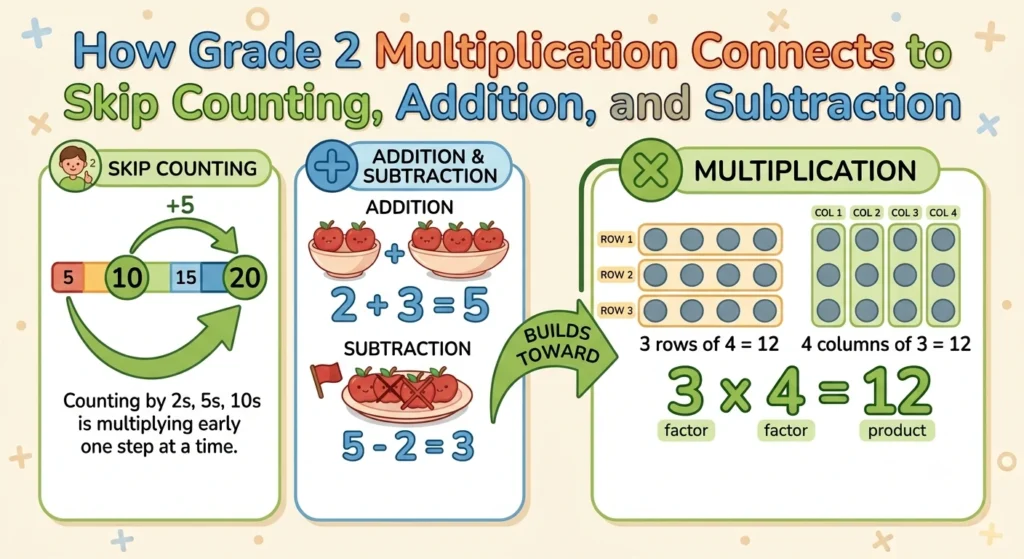
Skip Counting for Class 1 is the most direct prerequisite. Counting by 2s, 5s, and 10s is the same mental motion as multiplying by those numbers, just done one step at a time instead of all at once. A child who is confident skip counting has a real head start on the first times tables.
Addition and Subtraction for Class 1 covers the raw addition skill that repeated addition depends on, along with the subtraction fluency that rounds out a child’s number sense. Every multiplication fact at this stage is really an addition problem in disguise, so fluency in both directly determines how smoothly multiplication clicks, especially once word problems start mixing all three operations.
If your child is still building speed in any of these three areas, it’s worth circling back to them alongside multiplication rather than treating multiplication as a separate, later topic.
Grade 2 Multiplication and the Path to Competition Math
Early rounds of competitions like Math Kangaroo, MOEMS, and CML for younger grades don’t test formal multiplication facts, but they do reward exactly the kind of thinking this sequence builds: recognizing patterns in groups, working flexibly between addition and multiplication, and reasoning about arrays and visual arrangements.
A child who genuinely understands equal groups and arrays, rather than one who has only memorized a few facts, tends to handle these pattern-based problems more comfortably.
There’s no need to rush toward competition preparation in Grade 2. But building multiplication understanding the right way now sets up a much smoother transition into the more formal competition math that typically starts in Grade 3 and beyond.
Is Grade 2 too early to learn multiplication?
No. Most curricula introduce the foundations of multiplication, equal groups and arrays, during Grade 2, with formal times table memorization typically following in Grade 3. Grade 2 is meant to build the conceptual groundwork, not full fluency.
How do I explain multiplication without just having my child memorize times tables?
Use physical objects to build equal groups and arrays before introducing any times table. Ask your child to show a fact like 3 x 4 with objects or drawings before writing it as a memorized number sentence. The physical model should always come first.
Why do 2, 5, and 10 come first in times tables?
Because they connect directly to skip counting, which most Grade 2 students already practice. Counting by 2s, 5s, and 10s is functionally the same skill as multiplying by those numbers, so they’re the most natural starting point.
My child can recite times tables but seems confused in word problems. What’s going on?
This usually means the facts were memorized before the concept was solid. Go back to equal groups and arrays with physical objects, and have your child connect each memorized fact to a picture or a group of objects before moving forward.
How long should we spend on each stage of the sequence?
There’s no fixed timeline. Move to the next stage only once your child can explain the current one in their own words and solve a few problems independently, whether that takes a few days or a few weeks.
Make Preparing for Math Olympiad Simple!



Practice Grade 2 Multiplication with Gonit
Building real understanding of multiplication takes consistent, well-sequenced practice, and that’s exactly what Gonit is designed to support. Explore Gonit’s Grade 2 practice problems to help your child move confidently from equal groups and arrays to their first times tables, with the kind of structured, concept-based practice that carries forward into competition math down the road.
Conclusion
Grade 2 multiplication doesn’t need to start with times tables, and it shouldn’t.
When your child moves through repeated addition, equal groups, and arrays before ever memorizing a fact, the numbers actually mean something. That foundation is what makes 2, 5, and 10 click quickly, and it’s what keeps multiplication from feeling like a wall of memorization later on.
There’s no need to rush this. A child who takes their time with equal groups is doing exactly what they should be doing at this stage. Keep the practice visual, keep it connected to skip counting and addition, and the times tables will follow naturally.

Mikha Piregu is a Content Writer with experience spanning educational content, including math and math olympiad topics, as well as advocacy writing, research-based articles, and SEO-driven web content. He creates high-quality blog content, web copy, and feature articles that support brand visibility, audience engagement, and long-term organic growth through data-informed storytelling. Skilled in WordPress, WooCommerce, and modern digital tools, Mikha adapts content across various platforms, including blogs, websites, campaigns, and advocacy initiatives, with clarity and purpose.

There are no comments posted here yet.
Sign in to leave a comment