

Grade 2 subtraction follows three stages: basic single-digit subtraction facts, two-digit subtraction without regrouping, and two-digit subtraction with regrouping (also called borrowing).
- Why Grade 2 Subtraction Feels Harder Than Addition
- The Three-Stage Path Through Grade 2 Subtraction
- Stage 1: Basic Single-Digit Subtraction (Within 20)
- Stage 2: Two-Digit Subtraction Without Regrouping
- Stage 3: Two-Digit Subtraction With Regrouping (Borrowing)
- Common Mistakes in Grade 2 Subtraction (And How to Fix Them)
- Why Subtraction Fluency Matters Beyond the Classroom
- Keep Building With Related Gonit Grade 2 Guides
- Build Confidence With Daily Practice on Gonit
- The Bottom Line
Most Grade 2 students move through these stages in order over the course of the school year, and the vast majority of struggles happen at the third stage, when a child has to “borrow” a ten to subtract in the ones column.
Once you know which stage your child is working on and how to explain regrouping in plain terms, subtraction stops feeling like a mystery and starts feeling like a skill they can build one step at a time.
This guide walks through all three stages with simple visual models, points out the specific mistakes that trip up most Grade 2 students, and gives you practice problems for each stage so you can work through subtraction with your child today, not just download a worksheet and hope for the best.
Why Grade 2 Subtraction Feels Harder Than Addition
Subtraction in Grade 2 asks a child to do more mental juggling than addition does. Addition only ever adds value, so a child never has to “take apart” a number to make a problem work.
Subtraction sometimes does. When the top number’s ones digit is smaller than the bottom number’s ones digit, your child has to reorganize the numbers before subtracting, which is exactly what regrouping means.
This is completely normal. It is not a sign that your child is behind or that something is wrong with how they think about numbers. It is simply a new kind of thinking, and like any new skill, it clicks with the right explanation and enough low-pressure practice.
The Three-Stage Path Through Grade 2 Subtraction
Grade 2 math standards build subtraction skill in a specific order, moving from subtraction facts your child already half-knows from Grade 1, up to two-digit subtraction with regrouping by the end of the year.
Here is the path, stage by stage.
Stage 1: Basic Single-Digit Subtraction (Within 20)
This stage covers subtraction facts like 9 – 4 or 15 – 8, all within 20. By Grade 2, your child should be able to solve these quickly, ideally from memory, without needing to count on fingers every time.
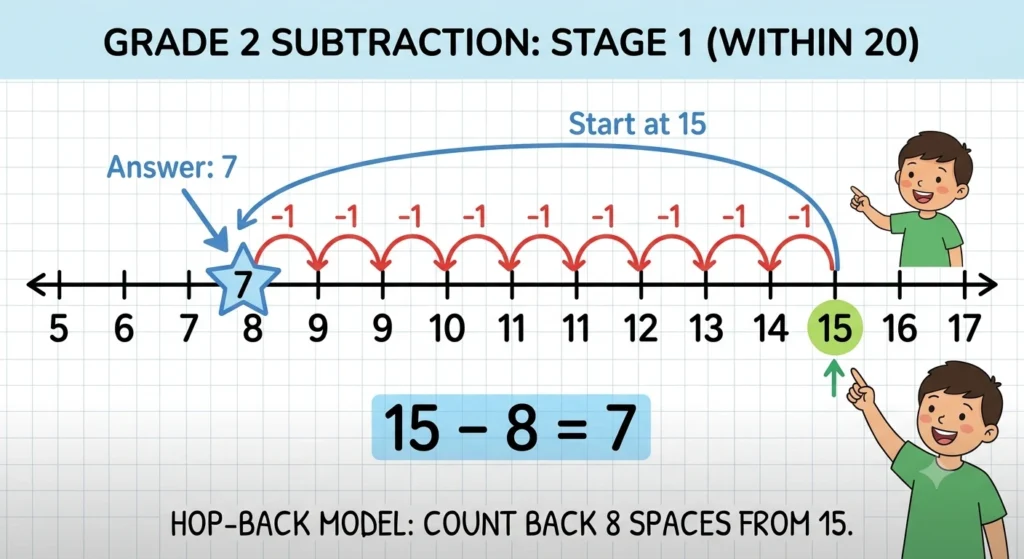
A helpful visual model here is the number line. Your child starts at the larger number and counts backward the number of spaces shown by the smaller number. For 15 – 8, they start at 15 and hop back 8 spaces, landing on 7.
Encouragement note: If your child is still counting on fingers at this stage, that is fine. Fluency comes from repetition, not from rushing. A few minutes of daily practice will get them there faster than one long, frustrating session.
Practice problems, Stage 1:
- 9 – 3 = ___
- 14 – 6 = ___
- 17 – 9 = ___
- 12 – 5 = ___
Stage 2: Two-Digit Subtraction Without Regrouping
This stage covers problems like 58 – 23, where the ones digit on top (8) is larger than the ones digit on the bottom (3), and the tens digit on top (5) is larger than the tens digit on the bottom (2). No borrowing is needed. Your child simply subtracts each column separately, ones first, then tens.
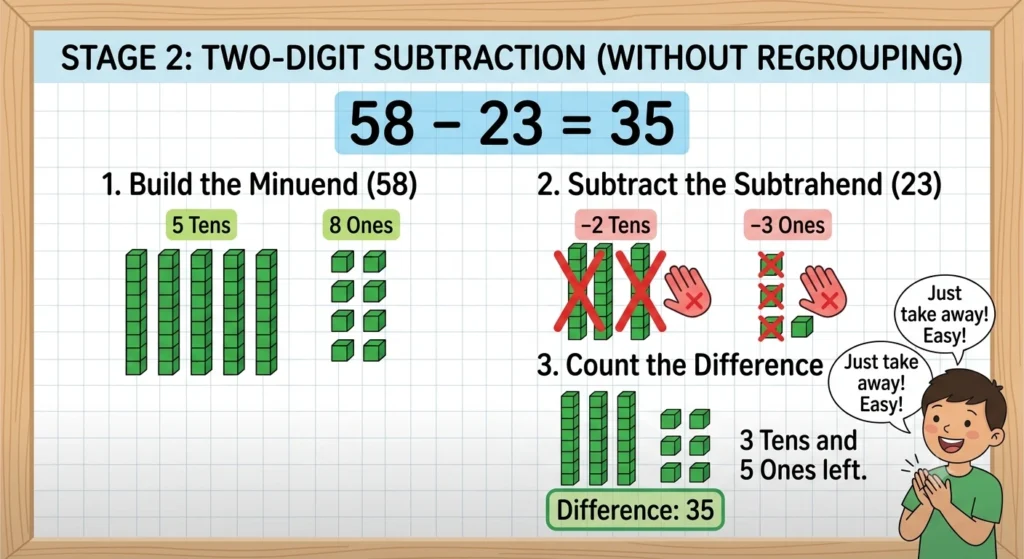
A base-10 block model works well here. Base-10 blocks are a hands-on tool where a single small cube stands for one, and a long rod of ten cubes stands for a group of ten. To solve 58 – 23, your child lays out 5 tens rods and 8 ones cubes, then physically removes 2 tens rods and 3 ones cubes, counting what’s left.
Encouragement note: This stage builds the habit of working column by column, which is the exact habit they will lean on once regrouping enters the picture. Praise the process, not just the answer.
Practice problems, Stage 2:
- 58 – 23 = ___
- 76 – 45 = ___
- 89 – 34 = ___
- 64 – 12 = ___
Stage 3: Two-Digit Subtraction With Regrouping (Borrowing)
This stage covers problems like 52 – 27, where the ones digit on top (2) is smaller than the ones digit on the bottom (7). Since you cannot subtract 7 from 2 directly, your child needs to regroup.
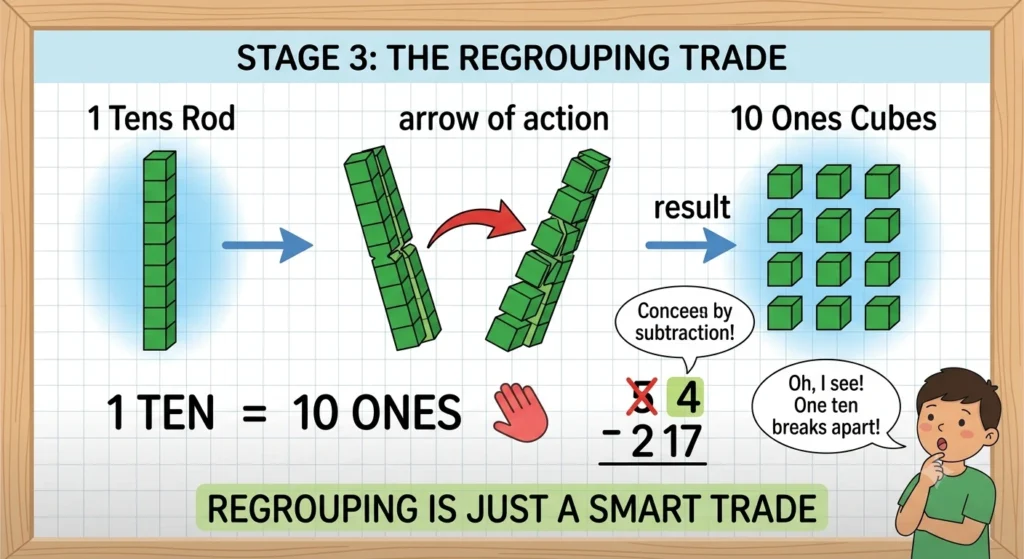
Regrouping means taking one group of ten from the tens column and breaking it into ten ones, then adding those ten ones to the ones column so there’s enough to subtract. This is also commonly called borrowing.
Here is the base-10 block model for 52 – 27, step by step:
- Lay out 5 tens rods and 2 ones cubes to represent 52.
- Look at the ones column. You need to subtract 7, but you only have 2 ones cubes.
- Take one tens rod and trade it for 10 ones cubes. Now you have 4 tens rods and 12 ones cubes, which is still equal to 52, just organized differently.
- Subtract 7 ones cubes from the 12 ones cubes, leaving 5 ones cubes.
- Subtract 2 tens rods from the 4 tens rods, leaving 2 tens rods.
- The remaining 2 tens rods and 5 ones cubes show the answer: 25.
On paper, this same process is written as crossing out the tens digit, writing one less above it, and writing a small 1 in front of the ones digit before subtracting. The base-10 blocks show your child why that crossing-out step works, instead of asking them to memorize it as an arbitrary rule.
Encouragement note: Regrouping is the single biggest jump in Grade 2 subtraction. If your child needs to slow down and use blocks or drawings for a while, that’s expected and healthy. Speed comes after understanding, not before.
Practice problems, Stage 3:
- 52 – 27 = ___
- 83 – 46 = ___
- 71 – 38 = ___
- 90 – 24 = ___
Common Mistakes in Grade 2 Subtraction (And How to Fix Them)
Most subtraction struggles in Grade 2 trace back to one of a few specific habits. Here’s what to look for and how to correct each one.
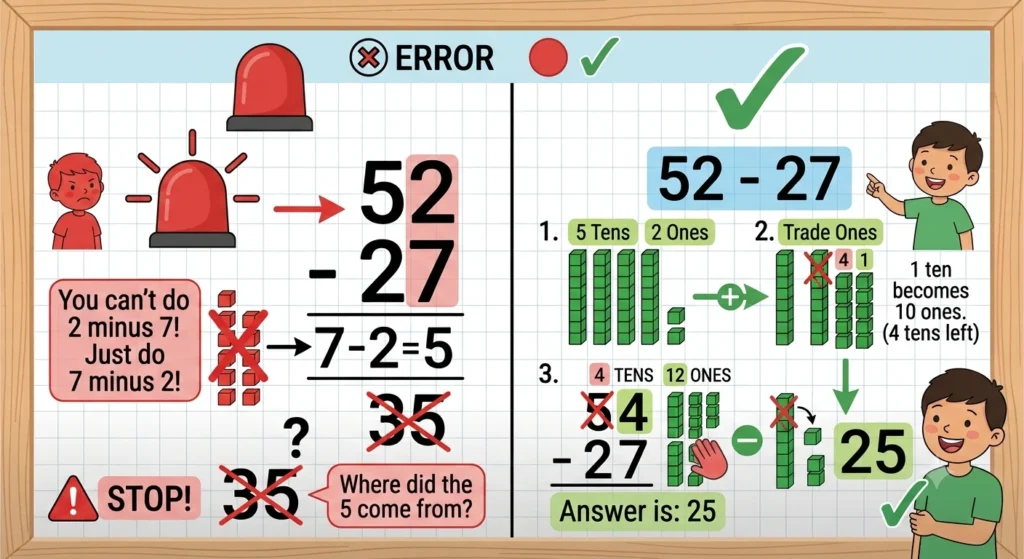
Mistake 1: Subtracting the Smaller Digit From the Larger Digit, Regardless of Position
For a problem like 52 – 27, a child makes this mistake by looking at the ones column (2 and 7), deciding 7 is bigger, and simply flipping the subtraction to get 7 – 2 = 5, instead of regrouping. The result looks like a real answer, which makes this mistake easy to miss.
The fix: Ask your child, “Which number is on top?” before every subtraction. Reinforce that the top number always has to give up value through regrouping. It cannot borrow value from the bottom number.
Mistake 2: Forgetting to Reduce the Tens Digit After Borrowing
After correctly borrowing a ten for the ones column, a child sometimes forgets to also lower the tens digit by one before subtracting the tens column. This leads to an answer that’s exactly 10 too high.
The fix: Physically cross out the original tens digit and write the new, smaller number directly above it every time, rather than trying to do it mentally. Base-10 blocks help here too, since the trade of a tens rod for ten ones cubes is visible and impossible to skip.
Mistake 3: Miscounting While Regrouping Across a Zero
Problems like 90 – 24 give many Grade 2 students trouble because there are no tens to “see” borrowing from directly; the tens digit is a 0. A child needs to understand that 90 is the same as 8 tens and 10 ones before they can regroup.
The fix: Rewrite the top number in expanded or block form first (90 = 8 tens, 10 ones) before subtracting, so the regrouping step happens on paper instead of purely in their head.
How Much Practice Does a Grade 2 Child Need?
Short, frequent practice beats long, infrequent sessions. Ten to fifteen minutes a day, five days a week, is enough to build real fluency over a school year. Mix all three stages into practice sessions rather than drilling only the hardest stage, since easier facts keep confidence high while your child works through the harder regrouping problems.
Why does my child cross out the wrong number when borrowing?
This usually means your child is copying the mechanical steps of regrouping without yet connecting them to what a ten actually represents. Go back to base-10 blocks for a few sessions so they can see the value being traded, rather than just crossing out digits on paper.
How many subtraction problems should a Grade 2 student practice per day?
Around 8 to 12 mixed problems a day, spanning all three stages, is a reasonable target. Quality of understanding matters more than quantity of problems.
Is it normal for my child to still use their fingers or blocks in Grade 2?
Yes. Many Grade 2 students still lean on visual or physical tools while building fluency, especially for regrouping problems. This fades naturally with consistent practice and does not need to be rushed.
What comes after Grade 2 subtraction with regrouping?
Grade 3 extends the same regrouping idea to three-digit numbers, and subtraction fluency becomes a building block for multiplication and early word problems. Strong subtraction habits built now carry directly into that next step.
Make Preparing for Math Olympiad Simple!



Why Subtraction Fluency Matters Beyond the Classroom
Subtraction fluency isn’t only a report-card skill. Early competition math programs for young learners, including Math Kangaroo and MOEMS at the elementary level, regularly include subtraction-based word problems and number puzzles that assume quick, confident subtraction as a baseline skill. A child who has moved past counting on fingers and can regroup confidently has more mental space left over to actually think through a tricky word problem instead of getting stuck on the arithmetic itself. Building this fluency now, even informally at home, sets up a smoother path if your child later explores Olympiad-style math.
Keep Building With Related Gonit Grade 2 Guides
Subtraction fluency builds on a few other early math skills. If your child needs a refresher, explore our guides on addition and subtraction for Class 1, place value for Grade 1, and skip counting for Class 1, each of which reinforces the number sense that makes regrouping click faster. If your child is ready to move beyond subtraction, our guide on teaching fractions to Grade 2 students is a natural next step.
Build Confidence With Daily Practice on Gonit
Grade 2 subtraction is a skill that grows one small win at a time. With the Gonit app, your child gets structured, bite-sized subtraction practice across all three stages, with instant feedback that keeps confidence building instead of frustration setting in. Sign up for Gonit today and turn a few minutes a day into steady, visible progress.
The Bottom Line
Grade 2 subtraction is not one skill; it’s three stages building on each other: basic facts, two-digit subtraction without regrouping, and two-digit subtraction with regrouping.
Most of the frustration parents and kids feel comes down to that third stage, and it clears up quickly once your child can see, not just memorize, what borrowing a ten actually means.
Slow down at Stage 3, lean on base-10 blocks or drawings for as long as your child needs them, and watch for the three common mistakes covered above. Confidence builds the same way the skill does: one stage, one correct problem, one small win at a time.

Mikha Piregu is a Content Writer with experience spanning educational content, including math and math olympiad topics, as well as advocacy writing, research-based articles, and SEO-driven web content. He creates high-quality blog content, web copy, and feature articles that support brand visibility, audience engagement, and long-term organic growth through data-informed storytelling. Skilled in WordPress, WooCommerce, and modern digital tools, Mikha adapts content across various platforms, including blogs, websites, campaigns, and advocacy initiatives, with clarity and purpose.


There are no comments posted here yet.
Sign in to leave a comment