


IMO past papers are the six-problem question papers set at each International Mathematical Olympiad, the yearly world championship in mathematics for school students.
Access complete official past papers, problem sets, and solutions for the International Mathematical Olympiad (IMO). Every paper since 1959 is free to download from the official IMO website. This page lists the IMO past papers from 2016 to 2026, with the answer, a key-idea solution outline and a link to a full written solution for all 66 problems.
This page is about the International Mathematical Olympiad, the competition for national teams of up to six students. For the school-level SOF International Mathematics Olympiad held in India, use the SOF IMO sample papers and previous year papers instead. The two competitions share the letters IMO and nothing else.
What an IMO Past Paper Looks Like
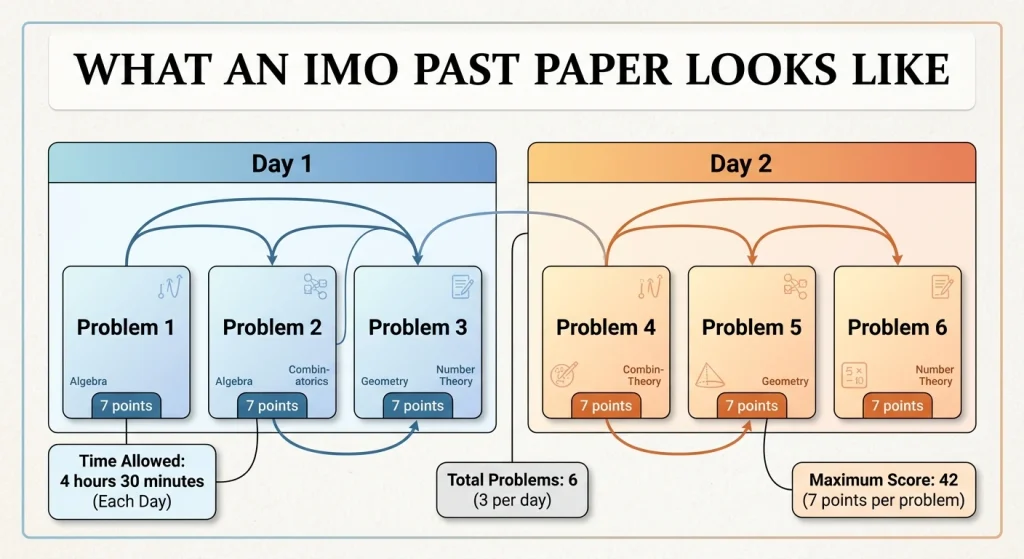
An IMO past paper has six problems, sat over two consecutive days. Each day has three problems and lasts four and a half hours. Every problem is marked out of 7, so a perfect score is 42. No calculators are allowed, and every answer must come with a complete proof.
| Part of the paper | Day 1 | Day 2 | What it means for practice |
|---|---|---|---|
| Problems | 1, 2, 3 | 4, 5, 6 | Sit one day at a time, never all six together |
| Time allowed | 4 hours 30 minutes | 4 hours 30 minutes | About 90 minutes per problem on average |
| Marks | 7 per problem | 7 per problem | Partial progress earns partial marks |
| Planned difficulty | Problem 1 easiest, Problem 3 hardest | Problem 4 easiest, Problem 6 hardest | Start with Problems 1 and 4 |
| Topics | Algebra, combinatorics, geometry, number theory | Same four areas | No calculus is needed |
The IMO describes the planned order of difficulty as 1, 4, 2, 5, 3, 6. Problems 1 and 4 are the entry points. Problems 3 and 6 are the ones that decide gold medals, and in some years only a handful of the 600 or more contestants solve them.
A student aiming to reach the competition should read how IMO preparation works alongside the papers, because the papers show the target and the preparation guide shows the route.
IMO Past Papers by Year: 2016 to 2026
The table lists every IMO paper from 2016 to 2026 with its host, the topic of each problem and two downloads. The official paper is the original question sheet from the IMO website.
The Gonit PDF restates the six problems in plain words and adds the answer, a key-idea outline and a link to a full written solution for each one.
Topic letters: A = algebra, C = combinatorics, G = geometry, N = number theory. The six letters follow Problems 1 to 6.
| Year | Host | Topics, Problems 1 to 6 | Official paper | Gonit PDF with solution outlines |
|---|---|---|---|---|
| 2026 | Shanghai, China | N G C C A N | IMO 2026 paper | IMO 2026 solution outlines (PDF) |
| 2025 | Sunshine Coast, Australia | C G N N A C | IMO 2025 paper | IMO 2025 solution outlines (PDF) |
| 2024 | Bath, United Kingdom | A N C G C A | IMO 2024 paper | IMO 2024 solution outlines (PDF) |
| 2023 | Chiba, Japan | N G A A C G | IMO 2023 paper | IMO 2023 solution outlines (PDF) |
| 2022 | Oslo, Norway | C A N G N C | IMO 2022 paper | IMO 2022 solution outlines (PDF) |
| 2021 | St Petersburg, Russia (held remotely) | N A G G C A | IMO 2021 paper | IMO 2021 solution outlines (PDF) |
| 2020 | St Petersburg, Russia (held remotely) | G A C C N G | IMO 2020 paper | IMO 2020 solution outlines (PDF) |
| 2019 | Bath, United Kingdom | A G C N C G | IMO 2019 paper | IMO 2019 solution outlines (PDF) |
| 2018 | Cluj-Napoca, Romania | G A C C N G | IMO 2018 paper | IMO 2018 solution outlines (PDF) |
| 2017 | Rio de Janeiro, Brazil | N A C G C N | IMO 2017 paper | IMO 2017 solution outlines (PDF) |
| 2016 | Hong Kong | G C N N A C | IMO 2016 paper | IMO 2016 solution outlines (PDF) |
The topic letters for 2016 to 2025 follow the official IMO Shortlist. The 2026 letters are Gonit’s own reading, because the 2026 shortlist is published after IMO 2027.
Papers older than 2016, back to the first IMO in 1959, are on the official IMO problems page. No IMO was held in 1980.
What the Last Ten IMO Papers Test
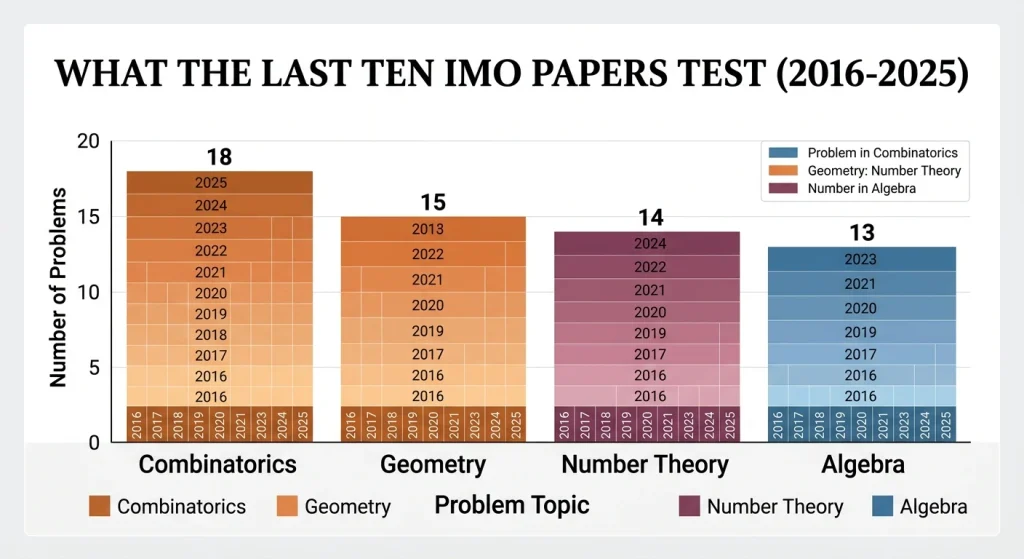
The 60 problems set from 2016 to 2025 split almost evenly across four areas: 18 combinatorics, 15 geometry, 14 number theory and 13 algebra. All four areas appeared in every one of those ten papers. Half of the 60 problems ask the student to find an answer and prove it; the other half are pure proofs.
| Topic | Problems out of 60 | Where the topic usually sits | What to practise first |
|---|---|---|---|
| Combinatorics | 18 | Problem 3 or Problem 5 (five times each) | Games, invariants, counting in two ways, the pigeonhole principle |
| Geometry | 15 | Problem 4 or Problem 6 (four times each); never Problem 5 | Angle chasing, cyclic quadrilaterals, power of a point |
| Number theory | 14 | Problems 1, 3, 4 and 5 (three times each) | Divisibility, greatest common divisors, exponents of primes |
| Algebra | 13 | Problem 2 (five times) | Functional equations, inequalities, sequences |
Two patterns matter for planning practice. Problem 2 was algebra in five of the ten years and geometry in three more. Problem 5 was combinatorics in five years and was never geometry.
Many combinatorics problems in these papers rest on one elementary tool. The 2021 Problem 1 and the 2026 Problem 3 both turn on the pigeonhole principle, the fact that more objects than boxes forces two objects into one box.
Two IMO Problems Solved Step by Step
The two problems below are both Problem 1 on their papers, the planned easiest slot. They show what a complete IMO solution has to contain: every case covered and every claim justified.
IMO 2019 Problem 1 (algebra)
Problem, restated. Find all functions f from the integers to the integers such that f(2a) + 2f(b) = f(f(a + b)) for all integers a and b. Proposed by Liam Baker, South Africa.
Solution.
- Put a = 0. The equation becomes f(0) + 2f(b) = f(f(b)). So f(f(b)) = 2f(b) + f(0) for every integer b.
- Put b = 0. The equation becomes f(2a) + 2f(0) = f(f(a)). By step 1, f(f(a)) = 2f(a) + f(0). So f(2a) = 2f(a) minus f(0).
- Go back to the original equation. Replace f(2a) using step 2 and f(f(a + b)) using step 1. The result is 2f(a) minus f(0) + 2f(b) = 2f(a + b) + f(0). Divide by 2: f(a) + f(b) = f(a + b) + f(0).
- Write g(n) = f(n) minus f(0). Step 3 says g(a) + g(b) = g(a + b). A function on the integers with this property is g(n) = kn, where k = g(1). So f(n) = kn + c, with c = f(0).
- Check which k and c work. The left side is 2ka + c + 2kb + 2c, which is 2k(a + b) + 3c. The right side is k(k(a + b) + c) + c, which is k²(a + b) + kc + c. These agree for all a and b only if k² = 2k and 3c = kc + c.
- From k² = 2k, k is 0 or 2. If k = 0, then 3c = c, so c = 0. If k = 2, then 3c = 3c, which holds for every c.
Answer: f(n) = 0 for all n, or f(n) = 2n + c for any fixed integer c. Both families satisfy the original equation, which step 5 has already checked.
IMO 2026 Problem 1 (number theory)
Problem, restated. 2026 integers greater than 1 are written on a board. In one move, two of the numbers that are greater than 1, say m and n, are replaced by gcd(m, n) and lcm(m, n) divided by gcd(m, n). Moves continue for as long as possible. Prove that (a) the process always ends with exactly one number M greater than 1, and (b) M is the same whatever moves are chosen. Proposed by Giancarlo Kerg, Luxembourg.
Here gcd is the greatest common divisor and lcm is the least common multiple. Since lcm(m, n) = mn divided by gcd(m, n), the second new number is mn divided by gcd(m, n) squared.
Try it with two numbers. Start with 12 and 18. Their gcd is 6 and their lcm is 36, so the move gives 6 and 36 divided by 6, which is 6. The next move on 6 and 6 gives gcd 6 and 6 divided by 6, which is 1. The board now reads 6 and 1, and no move is possible. Here M = 6.
Solution to part (a).
- If gcd(m, n) = 1, the move writes a 1 and the number mn. A 1 can never be chosen again, so the count of 1s goes up for good. This can happen at most 2025 times.
- If gcd(m, n) = d with d greater than 1, the product of the two numbers changes from mn to mn divided by d. The product of all numbers on the board gets smaller. A positive whole number cannot get smaller for ever.
- So only finitely many moves are possible. The process stops when fewer than two numbers exceed 1.
- A move never destroys both numbers. If d = 1, the number mn is greater than 1. If d is greater than 1, d itself stays on the board. So at least one number greater than 1 always remains, and the process ends with exactly one.
Solution to part (b).
- Fix a prime p. Suppose p divides m exactly x times and divides n exactly y times, with x at most y.
- Then p divides gcd(m, n) exactly x times, and divides lcm(m, n) divided by gcd(m, n) exactly y minus x times. The move replaces the pair of exponents (x, y) by (x, y minus x).
- Replacing (x, y) by (x, y minus x) is one step of the Euclidean algorithm. The step does not change the greatest common divisor of the two exponents, so the greatest common divisor of all 2026 exponents of p stays fixed through every move.
- At the end, 2025 of the numbers are 1, with exponent 0. The greatest common divisor of the exponents is then the exponent of p in M.
- So the exponent of p in M equals the greatest common divisor of the exponents of p in the starting numbers. The same holds for every prime, and M is fixed before the first move is made.
Check with the example. 12 = 2² × 3 and 18 = 2 × 3². The exponents of 2 are 2 and 1, with greatest common divisor 1. The exponents of 3 are 1 and 2, with greatest common divisor 1. So M = 2 × 3 = 6, which matches.
The same idea, following the exponent of one prime at a time, also drives IMO 2018 Problem 5 and IMO 2016 Problem 3. A student who is unsure about factors and multiples should settle the divisibility rules and prime factorisation before attempting the number theory problems.
How to Practise with IMO Past Papers
To practise with IMO past papers, sit one day of one paper at a time under the real limit of four and a half hours, write full proofs, and only then read a solution. The steps below turn that into a routine.
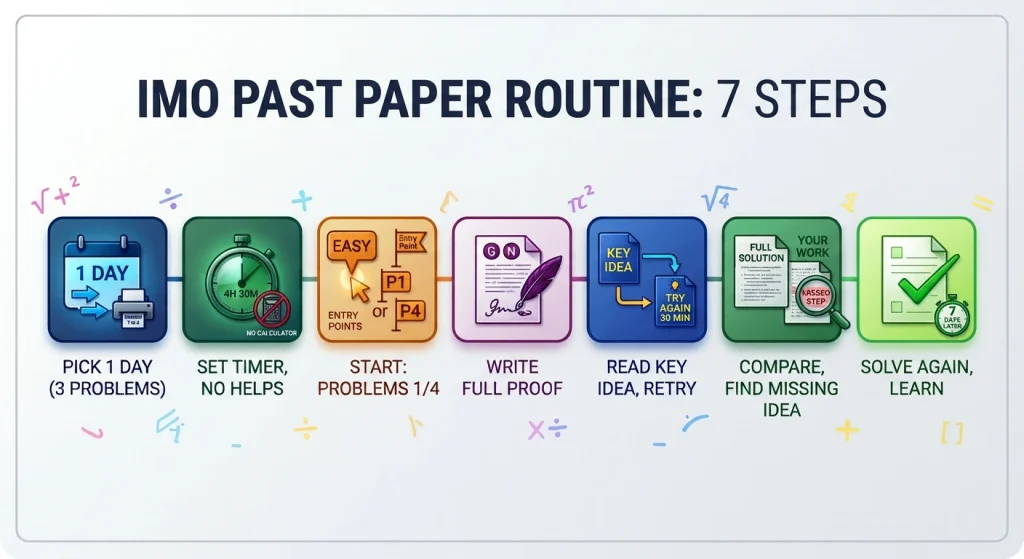
- Pick one day, not one paper. Print Problems 1 to 3 or Problems 4 to 6 of a single year. Six problems in one sitting is not how the competition runs.
- Set a timer for 4 hours 30 minutes. Work without a calculator, notes or the internet, as contestants do.
- Start with Problem 1 or Problem 4. These are the planned easiest problems. A student new to the IMO can spend the whole session on that one problem.
- Write the proof in full. Marks are given for complete arguments. A correct answer with no proof earns very little.
- Read the key idea before the full solution. If you are stuck after an honest attempt, read only the key idea in the Gonit PDF and try again for 30 minutes.
- Compare with a full written solution. Look for the step you missed and write down, in one sentence, the idea you did not have.
- Return to the problem a week later. Solve it again from a blank page. A problem is learned when it can be solved without help.
The habits behind these steps are covered in more depth in Gonit’s guide to building problem-solving skills for the IMO.
Which IMO past papers to start with
Students below national-team level should begin with Problems 1 and 4 from 2016 to 2026, which gives 22 problems. Problems 2 and 5 come next. Problems 3 and 6 are for students who already solve most Problems 2 and 5.
| Student level | Start with | Good first choices from 2016 to 2026 |
|---|---|---|
| New to proof-based olympiads | Problem 1 of each year | 2019 Problem 1, 2023 Problem 1, 2026 Problem 1 |
| Comfortable with national olympiad problems | Problems 1 and 4, then Problem 2 | 2016 Problem 4, 2020 Problem 1, 2018 Problem 2 |
| Training for a national team | Full days under timed conditions | Any complete paper, most recent first |
A student who finds Problem 1 out of reach is not behind. National olympiads are the usual step before IMO papers: USAMO problems for students in the United States and the INMO for students in India are closer in level and written in the same proof style.
Common mistakes when using IMO past papers
Mistake 1: Reading the solution after ten minutes. Fix: give every problem at least one full hour before opening any hint.
Mistake 2: Stopping at the answer. Fix: for a “find all” problem, prove two things: the answers you found work, and no other answer exists.
Mistake 3: Practising only one favourite topic. Fix: every paper contains algebra, combinatorics, geometry and number theory, so rotate through all four each month.
Mistake 4: Collecting PDFs instead of solving problems. Fix: one paper worked properly teaches more than eleven papers downloaded.
Mistake 5: Confusing the IMO with school olympiads. Fix: check the paper is from the International Mathematical Olympiad before you start; SOF IMO papers are multiple choice and test different skills.
Where to find full IMO solutions
Full written solutions to IMO problems are published free in three places. The IMO itself publishes the problems and, a year later, the shortlist with official solutions on imo-official.org. The Art of Problem Solving wiki keeps a page of contributed solutions for every problem of every year.
Evan Chen, a former contestant and coach, publishes a set of solution notes for each recent year. The Gonit PDFs in the table above link each problem to its wiki solution page.
Make Preparing for Math Olympiad Simple!


Frequently Asked Questions
Where can I download IMO past papers?
IMO past papers can be downloaded free from the problems page of the official IMO website, imo-official.org. The site holds every paper from 1959 to the present, in English and in dozens of other languages. Each year’s paper is a short PDF with three problems per day.
Do IMO past papers come with official solutions?
The IMO question paper does not include solutions. Official solutions appear in the IMO Shortlist, which the IMO publishes after the following year’s competition. Until then, full solutions written by coaches and former contestants are available on the Art of Problem Solving wiki.
How many questions are in an IMO paper?
An IMO paper has six questions, called problems. Three are set on the first day and three on the second day, with four and a half hours allowed each day. Each problem is worth 7 points, for a maximum of 42.
Is the IMO the same as the SOF IMO?
No. The International Mathematical Olympiad is a proof-based competition for national teams of up to six students, held in a different country each year. The SOF International Mathematics Olympiad is a multiple-choice school olympiad run by the Science Olympiad Foundation for Classes 1 to 12. The two papers are different in format, level and purpose.
Which IMO problems are the easiest?
Problems 1 and 4 are planned as the easiest problems on each IMO paper. The intended order of difficulty is 1, 4, 2, 5, 3, 6. Easiest is relative: Problems 1 and 4 still need a complete written proof.
Do IMO problems need calculus?
No. IMO problems are drawn from algebra, combinatorics, geometry and number theory at secondary school level. Calculators are not allowed, and the difficulty comes from finding the idea and proving it, not from advanced topics.
Who is allowed to sit the IMO?
An IMO contestant must be under 20 years old and must not be enrolled in post-secondary education. Each country sends a team of up to six students, chosen through its own national selection. The routes differ by country; Gonit has guides to qualifying for the IMO in the USA and qualifying for the IMO from Bangladesh.
Can a younger student use IMO past papers?
Yes, with the right expectations. A student in Class 8 or 9 who already solves national olympiad problems can attempt Problem 1 of recent papers. A student who has not yet written proofs will learn more from graded math olympiad questions first.
Conclusion
IMO past papers are short: six problems, two days, nine hours. All of them are free, and the last eleven are listed above with answers and key ideas.
The habit that makes the papers useful is slow work on one problem at a time, with the proof written out before any solution is opened. One problem understood fully is worth more than a folder of unread PDFs.
Start with Problem 1 from 2019, 2023 or 2026. When Problem 1 feels manageable, move to Problem 4, and let the harder problems wait until the easier ones are routine.

Mikha Piregu is a Content Writer with experience spanning educational content, including math and math olympiad topics, as well as advocacy writing, research-based articles, and SEO-driven web content. He creates high-quality blog content, web copy, and feature articles that support brand visibility, audience engagement, and long-term organic growth through data-informed storytelling. Skilled in WordPress, WooCommerce, and modern digital tools, Mikha adapts content across various platforms, including blogs, websites, campaigns, and advocacy initiatives, with clarity and purpose.


There are no comments posted here yet.
Sign in to leave a comment