

The note comes home tucked inside a library book. Your first grader is on the list for the OLSAT test next month, part of the school’s gifted screening, and the last line says families needn’t do anything. While the pasta water heats, you open three practice sites on your phone. They don’t agree on how many kinds of questions there are or which level has which. Every one of them sells a pack with a grade printed on the cover.
- Should You Just Buy the Practice Book for Your Child's Grade?
- What Is the OLSAT Test Actually Measuring?
- Which Level Will Your Child Take, and What's on It?
- Can You Try a Few Number Questions at Home?
- How Much OLSAT Practice Is Enough?
- Which Four Questions Should You Email the School?
- What You'll Have Sorted Before the OLSAT Test
- FAQ
- Related guides
The OLSAT has seven levels, each marked with a letter, and Pearson’s chart gives each level its own mix of question types. So the level letter decides what your child will see, and it’s the first thing to ask the school.
Key Takeaways
- Ask the school which OLSAT level letter your child will take. Pearson’s chart pairs each level with a usual grade, and the school makes the final choice.
- Practice each question type on that level once or twice, then spend one short session on marking answers in the right place.
- Ask the school four plain questions before test day.
Should You Just Buy the Practice Book for Your Child’s Grade?
The pack marked “Grade 1” is the natural one to buy. Your child is in first grade, and a few pages after dinner on school nights would finish it by test day.
Pearson’s chart names 21 question types in three areas. Each level uses its own mix of them, anywhere from 9 to 15 question types per level. A first grader usually takes Level B, which has 9 of them.
That’s how a grade-labeled pack drifts from the real test. Number Series doesn’t appear until Level D, yet a pack for second graders can be full of it, while skipping Following Directions, which Level C includes. A third grader’s pack can keep drilling Picture Analogies, a type Pearson’s chart stops after Level C.
The cost is a few evenings, plus a child who meets an unfamiliar kind of question on test morning and spends the first minutes working out what it wants. Neither cost is large, and both are easy to avoid once you know the level letter.
Familiarity does help, and Pearson agrees: it makes a practice test that schools can give before the real one. So some practice makes sense, on the question types your child’s level includes.
What Is the OLSAT Test Actually Measuring?
The OLSAT, or Otis-Lennon School Ability Test, is a Pearson test of verbal, nonverbal and quantitative reasoning. The current edition, OLSAT 8, has seven levels from kindergarten to grade 12, and each level uses a mix of question types chosen for it.
In Pearson’s own words, the OLSAT 8 “offers insights into how well a student learns, not what has been learned.” The tasks include following directions, classifying and spotting likenesses and differences. Others ask a child to put things in order, solve arithmetic problems or complete analogies.
Pearson lists it as untimed, finishing within 75 minutes at most, and the time varies by level. Young children take it on paper; from around second or third grade a school may give it online.
Which Level Will Your Child Take, and What’s on It?
Here is Pearson’s own level chart, condensed into one table.
| Level | Usual grade | Question types on this level | How many |
|---|---|---|---|
| A | Kindergarten | Following Directions; Aural Reasoning; Arithmetic Reasoning; Picture Classification; Picture Analogies; Picture Series; Figural Classification; Figural Analogies; Pattern Matrix; Figural Series | 10 |
| B | Grade 1 | Level A’s list without Picture Series | 9 |
| C | Grade 2 | The same 9 as Level B | 9 |
| D | Grade 3 | Antonyms; Sentence Completion; Sentence Arrangement; Arithmetic Reasoning; Logical Selection; Word/Letter Matrix; Verbal Analogies; Verbal Classification; Figural Classification; Figural Analogies; Pattern Matrix; Figural Series; Number Series; Numeric Inference; Number Matrix | 15 |
| E | Grades 4–5 | Level D’s list without Figural Classification, plus Inference | 15 |
| F | Grades 6–8 | The same 15 as Level E | 15 |
| G | Grades 9–12 | The same 15 as Level E | 15 |
The big switch sits between Levels C and D. Following Directions, Aural Reasoning, Picture Classification and Picture Analogies stop after Level C. At Level D the word types arrive (Antonyms and Verbal Analogies among them), along with all three number types. Four types run at every level: Arithmetic Reasoning, Figural Analogies, Pattern Matrix and Figural Series.
The chart pairs levels with grades, but the school picks the letter, usually the one that matches the grade. So ask which letter your child will take.
Can You Try a Few Number Questions at Home?
We wrote every question and game below ourselves, so none of them is a real OLSAT item. The three number types start at Level D. Under each one sits a kitchen-table game for a younger child, based on types Pearson lists for Levels A–C.
Number Series
Which number comes next?
20 · 18 · 21 · 19 · 22 · 20 · ?
(a) 18 (b) 21 (c) 23 (d) 24 (e) 25
Show answer
Answer: 23. The rule takes away 2, then adds 3, and repeats. After 20 comes the “add 3” step, so the next number is 23. A child who looks only at the last step, 22 down to 20, will pick 18. How to see it: write the change under each gap (−2, +3, −2, +3) before choosing.
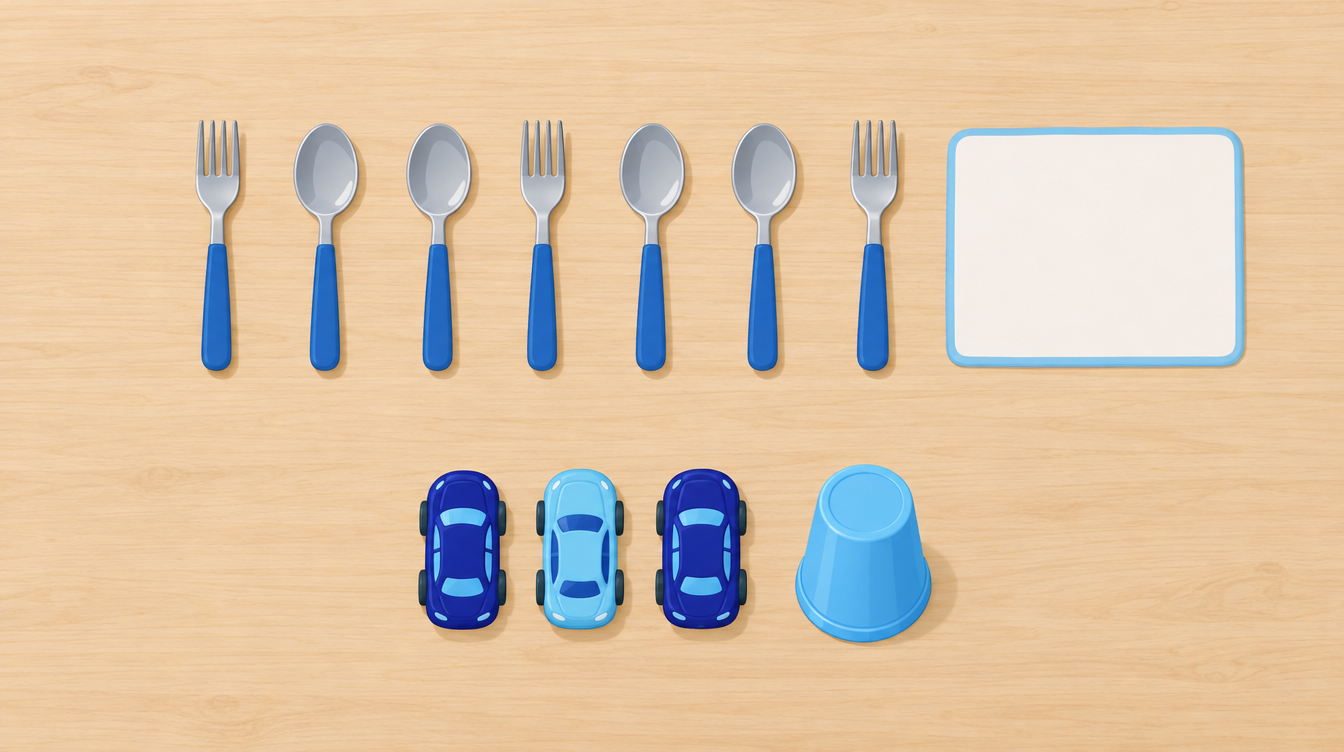
For a younger child (K–2). Lay out one fork and two spoons, repeat that once, then add one more fork. Ask what comes next. The answer is a spoon. Pearson’s chart has Picture Series at Level A and Figural Series at every level, so a row of cutlery is a fair warm-up.
Numeric Inference
The same rule turns 3 into 7 and turns 5 into 11. What does it turn 8 into?
(a) 12 (b) 15 (c) 16 (d) 17 (e) 19
Show answer
Answer: 17. The rule is “double it, then add 1”: 3 becomes 7, 5 becomes 11 and 8 becomes 17. “Add 4” fits the first pair but turns 5 into 9, so 12 is the trap. Test any rule on both pairs before choosing.
For a younger child (K–2). Arithmetic Reasoning runs at every level. Say this once, without repeating it: “A girl has 3 toy cars. Her brother gives her 2 more. Then she gives 1 to a friend. How many does she have now?” The answer is 4.
Number Matrix
Each row follows the same rule. What goes in the empty space?
Row 1: 2 · 3 · 6
Row 2: 4 · 5 · 20
Row 3: 3 · 7 · ?
(a) 10 (b) 14 (c) 21 (d) 24 (e) 37
Show answer
Answer: 21. In each row, the first number times the second gives the third, and 3 times 7 is 21. Adding works nowhere (2 plus 3 is 5, and the row says 6), so 10 is the trap.
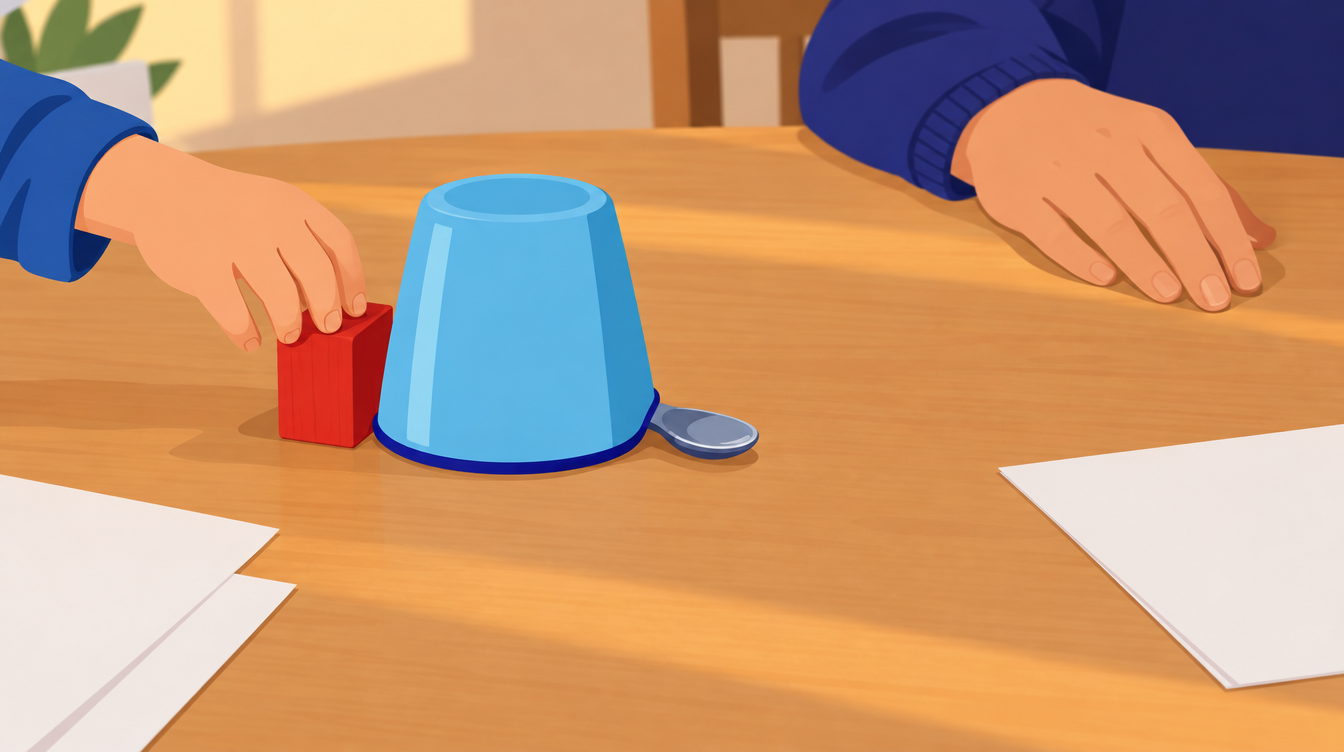
For a younger child (K–2). Following Directions appears on Levels A–C. Say once: “Put the spoon under the cup, then put the red block next to the cup.” Watch whether your child does both steps, in order, after hearing them once.
If the number puzzles were the fun part, keep going with math analogy examples for grades 1–3, with a free worksheet.
How Much OLSAT Practice Is Enough?
Pearson’s practice test packs aim to help students know what to expect “by familiarizing them with test directions, types of items, and answer coding.” At home we’d cover the same three things, starting from the level letter.
- Find out the level letter from the school.
- Give each cluster on that level one session of about 15 minutes, with one or two of your own examples per question type.
- Use the figural session from step 2 for shapes, with ideas for building the eye for shape patterns and matrices.
- For K–2, play one round of the listen-once games above.
- Spend one session on marking the answer in the right place.
- Stop once your child has the idea of each type.
Pearson’s chart sorts the types into clusters such as Verbal Comprehension, Pictorial Reasoning and Quantitative Reasoning. By our count every level draws on four of them, so step 2 comes to four short sessions, and the Figural Reasoning one is step 3. At the younger levels children usually mark answers in the test booklet itself; Pearson even sells place markers to help young children keep their place.
If your district also gives the CogAT, the same idea carries over: how we’d handle a CogAT practice test.
Which Four Questions Should You Email the School?
They fit in one short email. Keep the reply with the note.
- Which level will my child take? The letter decides the question types.
- Will it be on paper or online? Pearson offers both, with paper for the youngest grades.
- Will the class take Pearson’s practice test first, and are questions read aloud at my child’s level? Pearson makes a practice test schools can give.
- How will the score be used, with what else, and can a child retest? Scores compare your child with children of the same age. One California district, for example, uses the OLSAT as one of several measures, according to its parent FAQ.
What You’ll Have Sorted Before the OLSAT Test
The night before, the note sits in a kitchen drawer with the school’s reply clipped to it. You know the level letter and which question types sit on that level. Your child has tried each of those types once or twice in short sessions and knows where to mark her answers. Otherwise the weeks looked like any others, plus a couple of games with forks and spoons.
Once the score arrives, our enrichment guide walks through what to do next, whatever the result.
Gonit is a math practice app with no link to Pearson, and it isn’t OLSAT preparation. If your child asked for another number question after the ones above, Gonit has 10,000+ original Olympiad-style questions for grades 1–12. You choose by grade, and the topics include number sense and logical reasoning. Hints and step-by-step explanations are Premium. Premium is a paid, auto-renewing subscription; eligible accounts get a 7-day free trial.
Make Preparing for Math Olympiad Simple!


OLSAT is a trademark of Pearson. Gonit is not affiliated with or endorsed by Pearson, and the sample questions in this post are our own.
FAQ
What does OLSAT stand for?
OLSAT stands for the Otis-Lennon School Ability Test. The current edition, OLSAT 8, is published by Pearson and has seven levels. They run from Level A for kindergarten to Level G for grades 9–12.
Is the OLSAT an IQ test?
Pearson describes the OLSAT 8 as a test of verbal, nonverbal and quantitative reasoning for kindergarten to grade 12. It calls it a general academic ability indicator that is not content specific.
How long is the OLSAT test?
Pearson lists it as untimed, finishing within 75 minutes at most, and the time varies by level. Ask the school how the session will run for your child’s level.
What is a good OLSAT score?
Scores compare your child with children of the same age, as a School Ability Index, a percentile rank and a stanine. Pearson’s public pages set no gifted cutoff, so ask your district how it uses the score. One California district uses it as one of several measures.
Related guides
- Why Your Child Flies Through One Logic Puzzle and Stalls on the Next
- Critical Thinking for Kids: The Complete Parent & Teacher Guide
- Odd One Out for Class 1: Complete Guide with Examples

Bianca R. Samuels holds a Bachelor's degree in Mathematics and writes about building strong problem-solving foundations for young learners. Based in the United States, she focuses on making early math concepts clear, practical, and genuinely engaging for students and parents alike.



There are no comments posted here yet.
Sign in to leave a comment