

What are the last two digits of 43 to the power 2026? The number has 3,310 digits, so a calculator can’t show it and long multiplication would run past midnight. Still, the answer is two digits, and four small powers of 43 will find it.
A search for hard math questions turns up famous unsolved problems, a birthday riddle and test questions that are hard mostly because they’re long. You pick one that looks doable, give it two minutes and scroll down to the answer.
Key takeaways
| Your question | Short answer |
|---|---|
| What makes a math question hard? | You can’t see the first step. After that, the rest is usually math you’ve done before. |
| What do you try first? | One of six first moves. Small cases and working backwards are the usual openers. |
| When do you read the answer? | After 15 minutes and three different moves. Then two hints with 5 minutes each. |
Why Do Lists of Hard Math Questions Leave You Stuck?
The lists call those problems hard, so the longest or most famous one looks like the real thing. Reading the answer seems useful too, since you can follow every line of the solution.
The most famous hard problems are unsolved. The Clay Mathematics Institute’s seven Millennium Prize Problems carry $1 million each; since 2000 only one, the Poincaré Conjecture, is listed as solved. There is nothing there to finish tonight. A long test question mostly trains care with routine steps, which you likely have already.
In our view, reading the answer after two minutes shows you how that one problem ends. You never had to find the first move yourself. On the next hard problem, you are stuck at the start again.
So spend your practice time on problems you can’t start yet, and keep the answer closed while you try.
What Actually Makes a Math Question Hard?
A hard math question is one where you can’t see the first step, even though every step is within reach once you find it. Long questions (many routine steps) and tricky ones (a trap in the wording) feel hard too, but they need care and rereading. A hard-to-start question needs a first move.
That’s the working definition we use, and it splits “hard” three ways.
| Kind of hard | What it feels like | What fixes it | Example from the set below |
|---|---|---|---|
| Long | Many routine steps where one slip ruins the answer | Care and checking | Multiplying out all 30 fractions in Problem 8 (it works, slowly) |
| Tricky | A trap in the wording or a riddle | Rereading slowly | Reading Problem 4 as “exactly one 8” when it says “at least one” |
| Hard to start | You can’t see where to begin | A first move | Problem 1 and its 3,310-digit number |
Only the third row builds a skill you carry to the next problem.
What Do You Try When You Can’t See the First Step?
George Pólya’s How to Solve It, first published in 1945, splits solving into four phases: understand the problem, make a plan, carry out the plan, look back. When you can’t start, you’re stuck in phase two. Don’t compute yet. Pick a move.
Strategies taught with Pólya’s method include drawing a picture or diagram, solving smaller versions of the problem and looking for a pattern, decomposing the problem and using variables to write an equation. Our six first moves borrow three of those and add three more, and each opens a problem below.
- Try small cases and look for a pattern. Problems 1 and 8.
- Work backwards from the end. Problem 3.
- Draw it, or redraw it with easy numbers. Problem 5.
- Name the unknown and write one equation. Problem 6.
- Count the opposite. Problem 4.
- Look for what doesn’t change. Problem 7.
Problem 2 needs a fourth strategy from that list: decompose the problem into pieces. For the whole method, see a longer framework for working through Olympiad problems.
Can You Crack These Eight?
We wrote these eight problems for this page. None comes from a contest paper or the SAT, though a few use classic ideas. The answers sit together after Problem 8. Start a 15-minute timer and scroll only as far as the hints.
Grades 6–8
Problem 1. What are the last two digits of 432026?
- Where it gets stuck: the number is far too big to work out.
- Hint 1: only the last two digits of each power matter for the next one. Find the last two digits of 431, 432, 433, 434 and 435.
- Hint 2: they repeat every 4 (43, 49, 07, 01). Where does 2026 land in a cycle of 4?
Problem 2. The pages of a book are numbered 1, 2, 3 and so on. Printing all the page numbers uses 270 digits. How many pages does the book have?
- Where it gets stuck: guessing a page count and checking it takes forever.
- Hint 1: how many digits do pages 1–9 use? Pages 10–99?
- Hint 2: 9 + 180 = 189 digits are used before page 100. Every page after that uses 3.
Problem 3. Ana gives Ben half of her marbles plus 1 more. Then she gives Cara half of the marbles she has left plus 1 more. Now she has 5 marbles. How many did she start with?
- Where it gets stuck: you don’t know the starting number, and an equation with two halvings gets messy.
- Hint 1: start from the end. Before Cara got her share, what number leaves 5 after you take away half of it plus 1?
- Hint 2: undo each step in reverse order: add 1, then double.
Grades 7–10
Problem 4. A raffle uses tickets numbered 1000 to 4999. A ticket is lucky if at least one of its digits is an 8. How many lucky tickets are there?
- Where it gets stuck: “at least one” means one 8, two 8s or three 8s, and those cases overlap.
- Hint 1: count the tickets with no 8 at all.
- Hint 2: the first digit has 4 choices (1, 2, 3 or 4). The other three have 9 each.
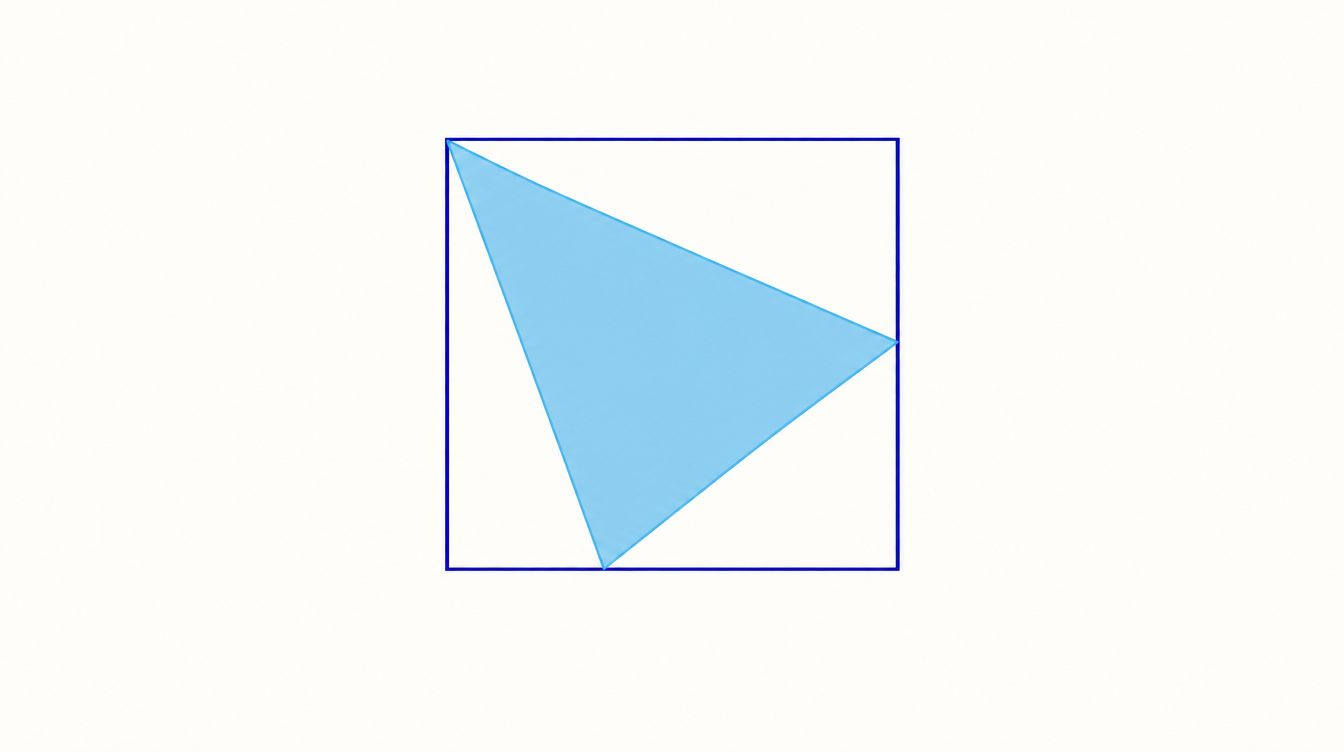
Problem 5. Draw a square. Mark the point one third of the way along the bottom side from the bottom-left corner, and the midpoint of the right side. Join these two points to each other and to the top-left corner. What fraction of the square does the triangle cover?
- Where it gets stuck: no lengths are given, and no side of the triangle lies along the square.
- Hint 1: pick a size that thirds and halves both divide. Let the square have side 6.
- Hint 2: the triangle is what’s left after you cut three right triangles off the square’s other corners.
Problem 6. A rectangular garden takes 30 m of fence to go all the way around. A straight path from one corner to the opposite corner is 12 m long. What is the garden’s area?
- Where it gets stuck: the length and width come out as (15 ± √63)/2, which is ugly to multiply.
- Hint 1: you don’t need the length and width. Call them a and b. What do the fence and the path tell you about a + b and a² + b²?
- Hint 2: (a + b)² = a² + 2ab + b², and the area is ab.
Grades 9–12
Problem 7. A game starts with the number 5. On each move you may add 9, subtract 6 or multiply by 4. Can you ever reach 2026?
- Where it gets stuck: there are far too many ways to play to try them all.
- Hint 1: play a few moves and write down where you land. What do all those numbers have in common?
- Hint 2: look at the remainder when each one is divided by 3.
Problem 8. A jug is full of water. On day 1 you pour out a quarter of it. On day 2 you pour out a ninth of what is left, on day 3 a sixteenth, and so on: on day n it’s 1/(n + 1)² of what is left. What fraction of the water is left after day 30?
- Where it gets stuck: 30 fractions to multiply, each with a bigger square underneath.
- Hint 1: work out what is left after days 1, 2 and 3. If day 2 gives 2/3, write it as 4/6. What’s the pattern?
- Hint 2: 1 − 1/k² = (k − 1)(k + 1)/k². Write the first few factors this way and look for what cancels.
Answers (After Your 15 Minutes)
Show answers
- 49. The last two digits of 43, 432, 433 and 434 are 43, 49, 07 and 01, then they repeat. Since 2026 = 4 × 506 + 2, the power lands 2nd in the cycle. Move: small cases, then the pattern.
- 126 pages. Pages 1–99 use 9 + 180 = 189 digits. That leaves 81, and 81 ÷ 3 = 27 three-digit pages: 100 to 126. Move: split the count by number of digits.
- 26 marbles. Undo the last step: (5 + 1) × 2 = 12. Undo the first: (12 + 1) × 2 = 26. Check it forward: 26 − 14 = 12, then 12 − 7 = 5. Move: work backwards.
- 1,084. There are 4,000 tickets, and 4 × 9 × 9 × 9 = 2,916 of them have no 8. So 4,000 − 2,916 = 1,084 have at least one. Move: count the opposite.
- 5/12. With side 6 the marked points sit 2 along the bottom and 3 up the right side. The three corner triangles cover 6 + 6 + 9 = 21, so the triangle is 36 − 21 = 15, and 15/36 = 5/12. Move: draw it and choose a convenient size.
- 40.5 square meters. The fence gives a + b = 15 and the path gives a² + b² = 144. Squaring the first gives 225 = 144 + 2ab, so ab = 40.5. You never find a or b. Move: name what you want and write one equation that contains it.
- No. Adding 9 or subtracting 6 changes the number by a multiple of 3, and 4n = n + 3n, so the remainder after dividing by 3 never changes. The game starts at 5 (remainder 2), but 2026 = 3 × 675 + 1 leaves remainder 1. Move: look for what doesn’t change.
- 16/31. After days 1, 2 and 3 you have 3/4, 4/6 and 5/8 left, so after day n it’s (n + 2)/(2n + 2). Writing each factor as (k − 1)(k + 1)/k² shows why: almost everything cancels. After day 30 that’s 32/62 = 16/31. Move: small cases first, then split each factor.
Problem 7’s move has a cousin in pigeonhole principle problems, where finding the boxes is the hard part. For another round, try more Olympiad-style problems sorted by grade.
How Long Should You Stay Stuck Before Reading the Answer?
When you practice, this is the rule we’d use.
- Give the problem 15 minutes and at least three different first moves before you read Hint 1.
- Read Hint 1, then give it 5 more minutes.
- Read Hint 2, then 5 more.
- Read the answer, and write one line on which move opened it.
SAT prep guides tell you that if you’ve spent more than about two minutes on a question with no progress, you should make your best guess, flag it and move on. On test day that’s right, because a test is about points and a stuck question spends time that belongs to the others. At your desk the trade runs the other way: being stuck is the exercise, and the timer only tells you when to stop.
Pólya’s last phase is to look back at the solution, and the line you write in step 4 is a short way to do it. If you have a test coming up, try a three-night plan for studying for a math test. It keeps a log of every miss, and your step 4 lines can go in it.
What Changes the Next Time a Problem Won’t Open?
Think back to 43 to the power 2026. The 3,310 digits never mattered. Four small powers and a repeating pattern did.
The next problem that won’t open will still feel shut at first. What’s different is the next step. You can name which kind of hard it is, and you have six moves to try and a timer that says when a hint is allowed. When it opens, you write down which move did it, so the one after that starts with a better guess.
If you’re in grades 10–12 and the last three problems went well, look at what AIME problems look like when you want the next step up.
When you want more problems to be stuck on, Gonit has 10,000+ original questions for grades 1–12. You practice by topic, such as combinatorics and logical reasoning or algebra, and the app shows your accuracy for each topic, so you can see which kind of problem still stops you. It won’t sit through the 15 minutes with you; that part stays yours. The app’s hints and step-by-step explanations are Premium. Premium is a paid, auto-renewing subscription; eligible accounts get a 7-day free trial.
Make Preparing for Math Olympiad Simple!


FAQ
What is a hard math question?
In our view, it’s one where you can’t see how to start, even though each step is within reach once you find the first move. Long questions and tricky ones feel hard too, but they need care and rereading.
How do you solve a hard math problem?
Understand it, then choose a plan before you compute: try small cases, work backwards, draw it or write one equation. Give it 15 minutes before reading the answer, then look back at which move worked.
What is the hardest math problem in the world?
The famous candidates are unsolved. The Clay Mathematics Institute’s seven Millennium Prize Problems carry $1 million each; since 2000 only one, the Poincaré Conjecture, is listed as solved. For practice, pick hard math problems you can finish.
Related guides
- 48 × 25 Without a Pencil: Mental Math Strategies for Contest Rounds
- USAMO Problems You Can Finish Before You Open the Archive

Donald A. Kroll holds a Master's degree in Mathematics and has spent years helping students prepare for competition-level problem solving. Based in the United States, he writes about study strategy, test readiness, and the habits that turn steady practice into real results.

There are no comments posted here yet.
Sign in to leave a comment