October 31, 2025
 12 min. read

Your child is signed up for Math Kangaroo or you’re thinking about it and now you’re searching for a real preparation plan.
Not another list of websites. Not “just practice regularly.” A structured, grade-specific roadmap that tells you exactly what to study, how many hours to put in, and what to realistically expect.
That’s what this guide is. Whether your child is in Grade 1 or Grade 8, you’ll leave with a clear Math Kangaroo preparation guide tailored to their level, a realistic timeline, and the confidence to start today.
If you’re still comparing competitions, you may also want to read what Kangaroo Math is and the difference between the math olympiad and Kangaroo Math before diving in.
Knowing how to prepare for Math Kangaroo effectively starts with understanding exactly what the competition is and what it isn’t.
What Is Math Kangaroo?
Math Kangaroo is one of the largest math competitions in the world, held annually in 90+ countries.
If you’re wondering how it compares to other contests, see:
👉 What is the best math competition in the world
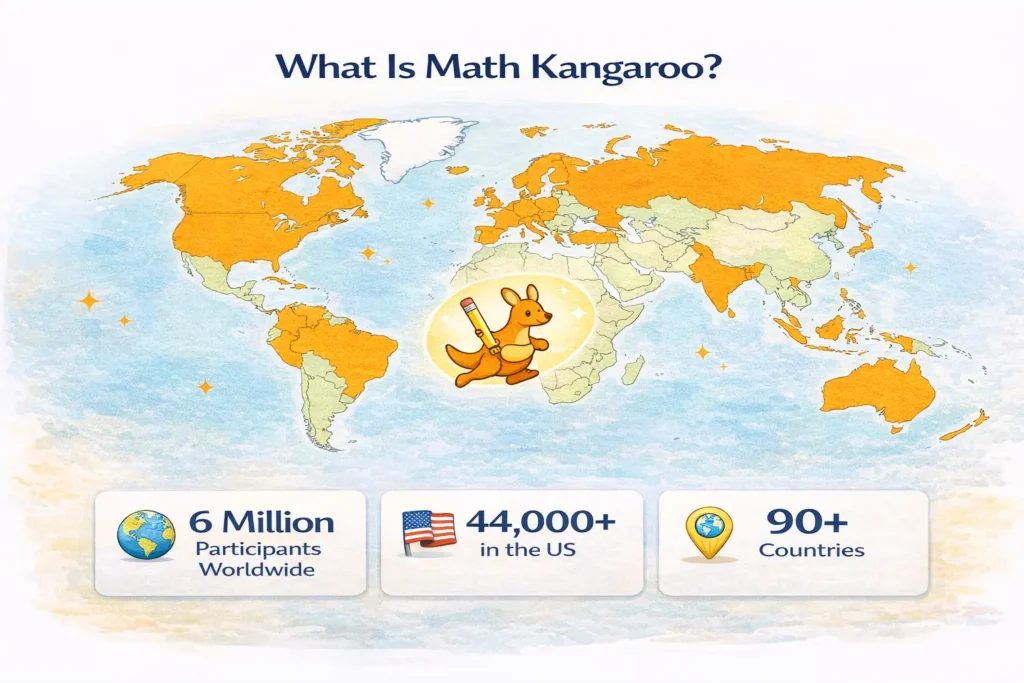
In the US, the 2024 competition drew over 44,000 participants with more than 75% of those students in Grades 1 through 5, making it the most beginner-friendly major math competition available.
The exam is a single 75-minute multiple-choice test, held every year on the third Thursday of March. Questions come in three difficulty tiers: easy (3 points), medium (4 points), and hard (5 points) with equal numbers of each type.
Here’s how the grade bands and question counts break down:
| Grade Band | Level Name | Questions | Max Score | Time |
|---|---|---|---|---|
| Grades 1–2 | Pre-Ecolier | 24 | 96 | 75 min |
| Grades 3–4 | Ecolier | 24 | 96 | 75 min |
| Grades 5–6 | Benjamin | 30 | 120 | 75 min |
| Grades 7–8 | Junior | 30 | 120 | 75 min |
| Grades 9–10 | Cadet | 30 | 120 | 75 min |
| Grades 11–12 | Student | 30 | 120 | 75 min |
No calculators, rulers, or other aids are permitted. Students may use scratch paper only.
Rankings and awards are calculated separately for each individual grade level so a Grade 3 student competes only against other Grade 3 students, not Grade 4.
The Math Kangaroo Scoring System
Most Math Kangaroo preparation articles skip this entirely. That’s a mistake, because understanding the scoring system changes how you approach the exam.
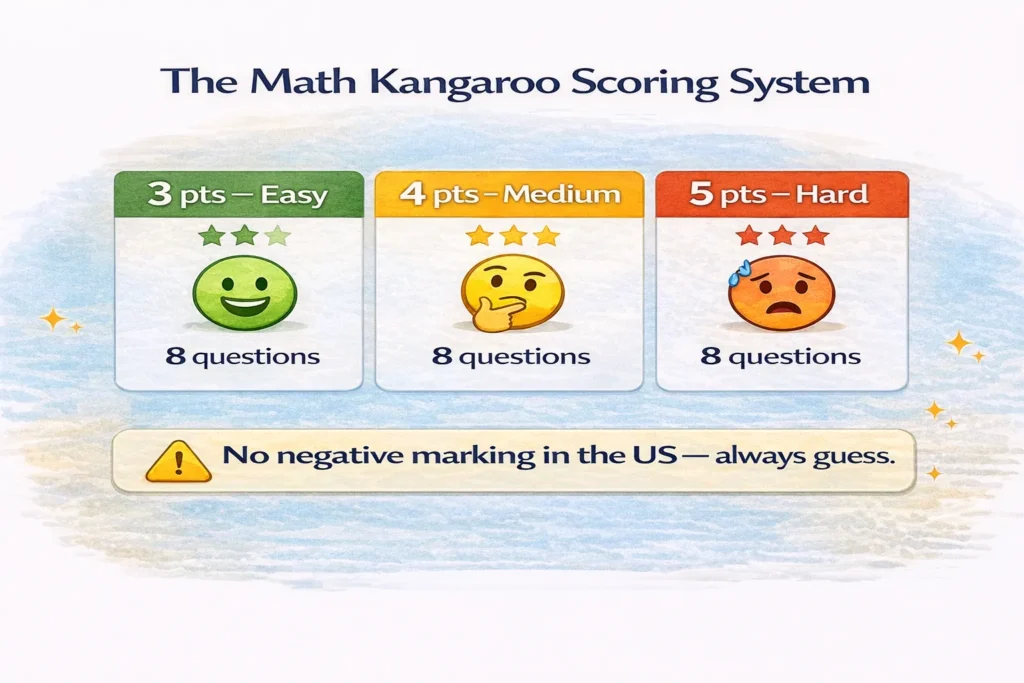
The US scoring rule (confirmed by mathkangaroo.org): there is no negative marking for wrong answers.
Unanswered and incorrect answers both earn zero points. This means there is no penalty for guessing which is a significant strategic advantage.
Here’s what that means in practice:
- Never leave a question blank. Since wrong answers cost nothing, always make your best guess on every question, even if you’re uncertain.
- Use the process of elimination. With 5 multiple-choice options and no penalty, eliminating even 1–2 wrong answers meaningfully improves your odds.
- Manage time for the hard questions. The 5-point questions are where scores separate but not at the cost of skipping the 3-point and 4-point questions you could answer correctly.
Important note for international participants: Some regional versions of Math Kangaroo (including the Indian and certain other national editions) do apply a negative marking penalty of 1 point per wrong answer.
If you’re preparing outside the US, verify your country’s specific rules at your national Math Kangaroo website before applying the strategy above.
The maximum possible score is 96 points for Grades 1–4, and 120 points for Grades 5–12.
Grade-by-Grade Math Kangaroo Preparation Roadmap
This is the section that no competitor article provides. Here’s a structured progression system by grade band.
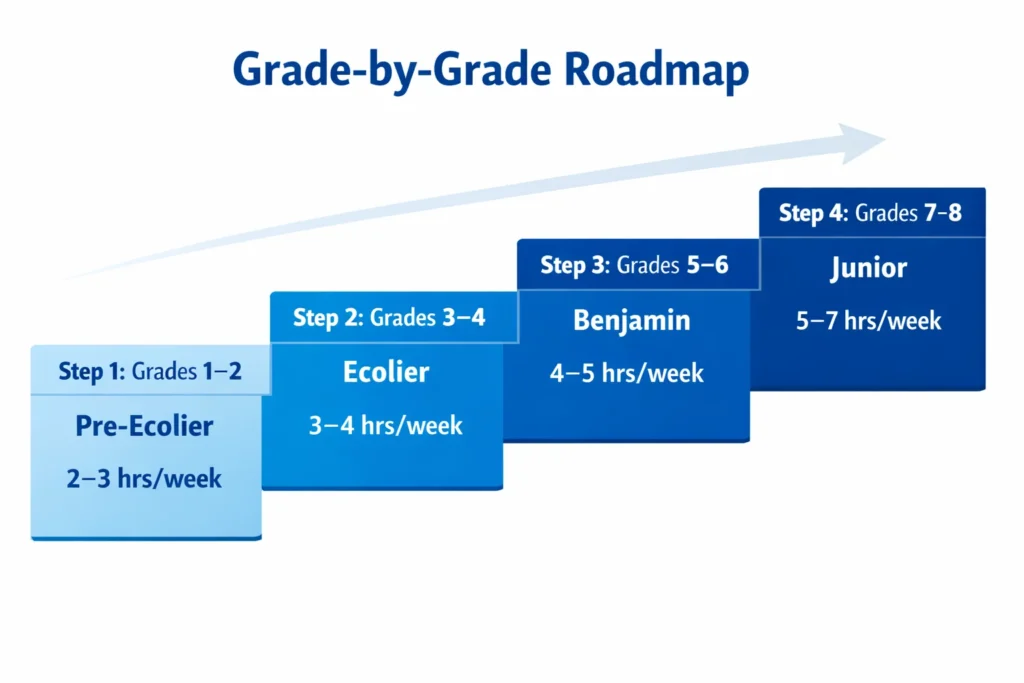
Grades 1–2 (Pre-Ecolier)
Key topics: Counting and number sense, basic addition and subtraction, simple patterns, visual and spatial puzzles, shape recognition
What the 2024 exam emphasized: Geometry and spatial reasoning dominated Levels 1–2, with logical reasoning questions increasing in proportion. Expect more “which shape completes the pattern?” than “what is 7 + 8?”
Weekly time: 2–3 hours.
Problem volume target: 100–200 problems before exam day.
If your child needs stronger arithmetic foundations, review:
👉 addition and subtraction for class 1
👉 geometrical shapes for grade 1
Primary goal: Familiarity and enjoyment. Pressure-free participation builds mathematical confidence that pays dividends for years.
Free resources: Past papers on mathkangaroo.org (free), Gonit App structured problem sets for early grades.
Realistic timeline: 2–3 months of light, consistent practice is ideal
Grades 3–4 (Ecolier)
Key topics: Multi-step arithmetic, basic geometry (area, perimeter, angles), logic puzzles, word problems requiring multi-step reasoning
What the 2024 exam emphasized: Word problems made up 43% of the Level 3–4 exam, with logical reasoning accounting for 30%. Rote calculation is less important than reading comprehension and step-by-step thinking.
If your child wants to build stronger problem-solving skills beyond Kangaroo, read:
👉 how to improve problem solving skills for IMO
Weekly time: 3–4 hours.
Problem volume target: 200–350 problems
Timeline: 3–4 months of consistent preparation for a comfortable performance; 5–6 months for top-20 national ranking aspirations
Free resources: Official past papers (mathkangaroo.org), AoPS Math Kangaroo archive, Gonit App.
Grades 5–6 (Benjamin)
Key topics: Fractions and decimals, introductory geometry, combinatorics and counting, number patterns, multi-step word problems
Students at this level often begin exploring competition math more seriously. If interested in extending beyond Kangaroo:
👉 free math olympiad training online
👉 how to prepare for AMC Math Competition
Weekly time: 4–5 hours
Problem volume target: 300–500 problems, with topic-focused drilling before switching to mixed practice in the final 4–6 weeks
Timeline: 4–6 months for competitive performance; 3 months for solid participation
Free resources: mathkangaroo.org past papers, AoPS problem archive, for students wanting to extend their preparation toward AMC 8
Grades 7–8 (Junior)
Key topics: Algebra, advanced geometry, combinatorics and probability, number theory, multi-step logical reasoning
Weekly time: 5–7 hours
Problem volume target: 400–600 problems.
Students in this band are often ready to explore AMC-level competitions:
👉 What is a good AMC math competition score
👉 average AMC math scores
Timeline: 6 months for a strong performance targeting top rankings; 3 months for above-average scores
Free resources: mathkangaroo.org past papers, AoPS Math Kangaroo section, AoPS Wiki for topic-specific study
If long-term goals include Olympiad pathways:
👉 how to qualify for the IMO in the USA
Note: Students at this level preparing for Math Kangaroo Junior are also well-positioned to begin AMC 8 and AMC 10 preparation.
3-Month vs 6-Month Study Plans — Which Do You Need?
| Factor | 3-Month Plan | 6-Month Plan |
|---|---|---|
| Weekly hours | 3–5 hours | 4–7 hours |
| Problem volume | 150–300 problems | 350–600 problems |
| Mock tests | 2–3 timed past papers | 5–8 timed past papers |
| Realistic goal | Comfortable participation, top 40% | Top 20% nationally, medal targeting |
| Best for | First-time participants, younger grades | Returning participants, Grade 5–8 |
How to choose: If your child has never taken Math Kangaroo before and is in Grades 1–4, the 3-month plan is the right starting point. Familiarity with the format is the first goal scores improve naturally in subsequent years.
If your child has participated before, knows their grade band topics, and is targeting a national or state ranking, the 6-month plan gives the problem volume and mock test repetition needed to perform under time pressure.
Time Management Strategy for the 75-Minute Exam
Most students don’t underperform in Math Kangaroo because they don’t know the math. They underperform because they don’t pace themselves.
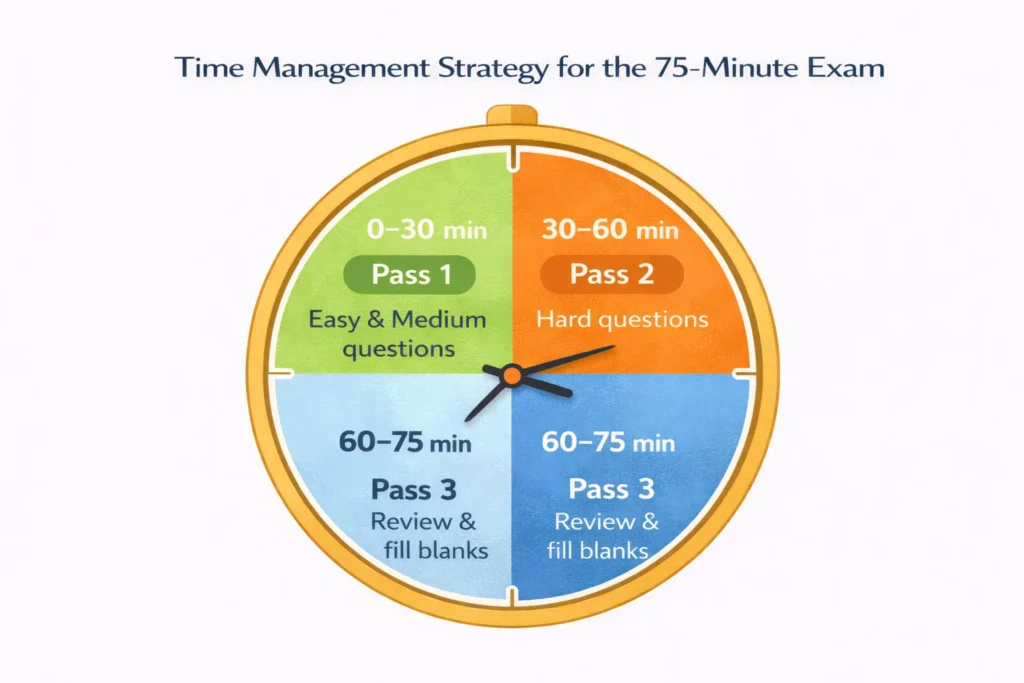
The 3-pass strategy:
Pass 1 (first 30 minutes): Work through all questions in order, answering every 3-point and 4-point question you can solve confidently in under 2 minutes. Mark any question you’re unsure about and move on immediately.
Pass 2 (next 30 minutes): Return to the questions you marked. Spend up to 4–5 minutes on each 5-point question. Use process of elimination. Since there’s no penalty for wrong answers in the US competition, commit to a best guess before moving on.
Pass 3 (final 15 minutes): Review all answers. Change any answer only if you have a specific reason — not just a feeling of doubt. Fill in any remaining blanks with your best guess.
For younger students (Grades 1–4): The 3-pass strategy is too complex. A simpler rule works well: spend no more than 3 minutes per question and always write something, even if you’re guessing.
Common Mistakes — And How to Avoid Them
Skipping questions unnecessarily. With no US penalty for wrong answers, leaving blanks is always a mistake. Even random guessing on 5-choice questions gives 20% odds better than zero.
Spending the first 20 minutes on hard questions. The 5-point questions appear last in each section. Students who burn time here often rush through easier questions they could have answered correctly.
Preparing without grade-specific resources. A Grade 3 student practicing Junior-level problems, or a Grade 7 student doing only elementary past papers, both are wasting preparation time. Match your resources to your exact grade band.
Skipping mock tests. Knowing the material and performing under timed conditions are different skills. At minimum, attempt 2 timed past papers before exam day one untimed for analysis, one fully timed for simulation.
Reviewing answers without understanding the error. Checking which answer was wrong is worthless. Understanding why you made the error misread the question, calculation mistake, didn’t know the concept is what drives improvement.
Starting preparation with under 4 weeks to go. Cramming doesn’t work for Math Kangaroo. The competition rewards pattern recognition and problem-solving instinct built over months, not memorized formulas reviewed overnight.
If comparing competition difficulty levels, revisit:
👉 difference between math olympiad and kangaroo math
Best Free Resources for Math Kangaroo Preparation
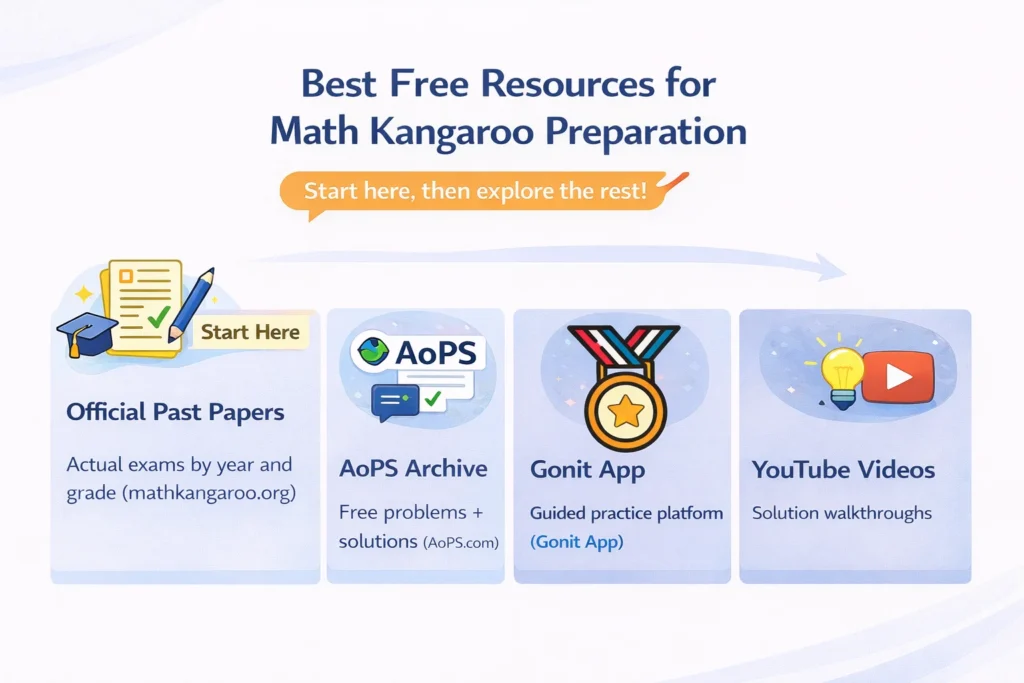
Official past papers (mathkangaroo.org): The single best preparation tool available free, organized by year and grade level, and directly representative of the actual exam. Start here.
AoPS Math Kangaroo problem archive: Art of Problem Solving maintains a free archive of Math Kangaroo problems with community-written solutions. Useful for Grades 5–8 students who want detailed explanations.
Gonit App: Structured problem sets designed for Grades 1–8, aligned with competition math topics. Useful for students who want guided practice rather than unsorted past papers.
YouTube solution walkthroughs: Multiple channels post full Math Kangaroo solutions by year and grade. Use these after attempting problems yourself, watching solutions before attempting builds passive understanding, not problem-solving skill.
One honest note: Free resources exist and are genuinely sufficient for preparation. What most students lack isn’t access to problems, it’s a structured sequence to work through them. That’s where platforms like Gonit App add the most value.
If your child is leaning toward Olympiad-style math after Kangaroo, explore:
👉 What type of questions are asked in math olympiads
For Parents — What You Actually Need to Know
Math Kangaroo is not an elite-only competition. With over 44,000 US participants in 2024, the vast majority of students are participating for the experience of mathematical challenge, not chasing national rankings. Both goals are completely valid.
You don’t need to understand math to support your child effectively. Your role is simpler: maintain a consistent weekly schedule, celebrate effort over results, and resist the urge to push too hard in the weeks before the exam.
If you’re evaluating long-term competition benefits, read:
👉 What are the benefits of the math AMC
Signs your child is ready to aim for a top ranking:
- Scoring above 80% on past papers consistently
- Finishing timed papers with 10+ minutes to spare
- Asking for harder problems on their own initiative
Signs your child needs more time before targeting a medal:
- Struggling to complete all questions in 75 minutes
- Getting frustrated by the hard (5-point) questions
- Less than 3 months of preparation remaining
The most important thing: Regardless of score, consistent preparation for Math Kangaroo builds genuine mathematical thinking logical reasoning, multi-step problem solving, pattern recognition that benefits your child in every area of their education, competition or not.
Your Math Kangaroo Preparation Starts Today
Structured preparation always beats frantic preparation. Here’s your 30-day starter plan — no prior preparation required:
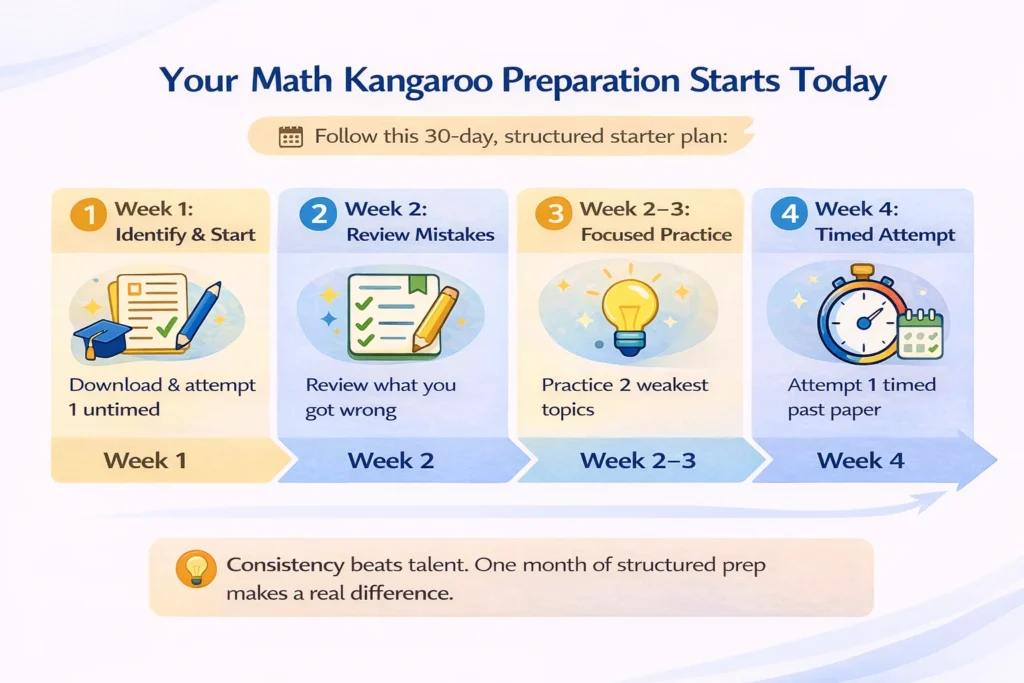
- Week 1: Identify your grade band (1–2, 3–4, 5–6, or 7–8) and download two past papers from mathkangaroo.org
- Week 1: Attempt one paper completely untimed. Don’t worry about the score — focus on understanding every question
- Week 2: Review every question you got wrong or skipped. Write down what you didn’t understand. These are your study topics for the next 4 weeks
- Week 2–3: Begin topic-focused practice on your two weakest areas from the review
- Week 4: Attempt your second past paper fully timed (75 minutes). Apply the 3-pass strategy. Compare your score to Week 1
- Ongoing: Set a fixed weekly schedule — 3 sessions per week, 45–60 minutes each. Consistency over the next 3–6 months is what moves the needle
The gap between students who score well and students who don’t is almost never talent. It’s almost always structured.
Is Math Kangaroo hard?
It’s challenging but accessible. The easy and medium questions (worth 3 and 4 points) are designed to be within reach of students who have strong foundational skills at their grade level. The hard questions (5 points) are genuinely difficult and designed to separate top performers. Most students find the competition rewarding even without a perfect score.
When should I start preparing for Math Kangaroo?
Ideally, 4–6 months before the March exam date — so September or October for the following year’s competition. Returning participants who have already taken past papers can begin focused preparation 3 months out.
How is Math Kangaroo scored?
Each correct answer earns either 3, 4, or 5 points depending on the question’s difficulty tier. Wrong answers and blank answers both earn zero. Maximum score is 96 for Grades 1–4 and 120 for Grades 5–12.
How many students get awards at Math Kangaroo?
In 2024, 4,801 students placed in the top 20 nationally across all grade levels, and 1,761 achieved a top-3 state ranking. Awards are given separately for each individual grade, so the pool of winners is larger than it might seem.
Can a student improve their Math Kangaroo score year over year?
Yes — and this is one of the most compelling reasons to start early. Students who participate from Grade 1 or Grade 2 and build their skills consistently over multiple years regularly place in national rankings by Grades 4–6.
Make Preparing for Math Olympiad Simple!



Final Thought
Success in Math Kangaroo isn’t just about solving every question; it’s about how you think, learn, and grow through the process.
By understanding the exam format, practicing strategically with past papers, and sharpening your problem-solving skills, you’ll build the mindset and confidence needed to perform your best.
Every challenge you tackle strengthens your reasoning skills and helps you think more creatively, skills that go far beyond any exam.