 January 26, 2026
 9 min. read

The number sequence for Class 1 math is simply knowing numbers in their correct order, understanding what comes next and what comes before, like 1, 2, 3, 4, 5.
This sounds simple, but it’s foundational. When children understand order, they begin to grasp that numbers represent more or less, which is the heart of number sense for Class 1.
Children use number sequences every single day, counting toys, climbing stairs, reading a calendar, or playing games that use words like first, second, and third (which connects directly to ordinal numbers for Class 1).
Mastering number sequences in Class 1 lays a strong foundation for everything that follows in maths.
What is a Number Sequence in Simple Terms?
A number sequence is a group of numbers that appear one after another in a fixed, correct order. Every number has its own place.
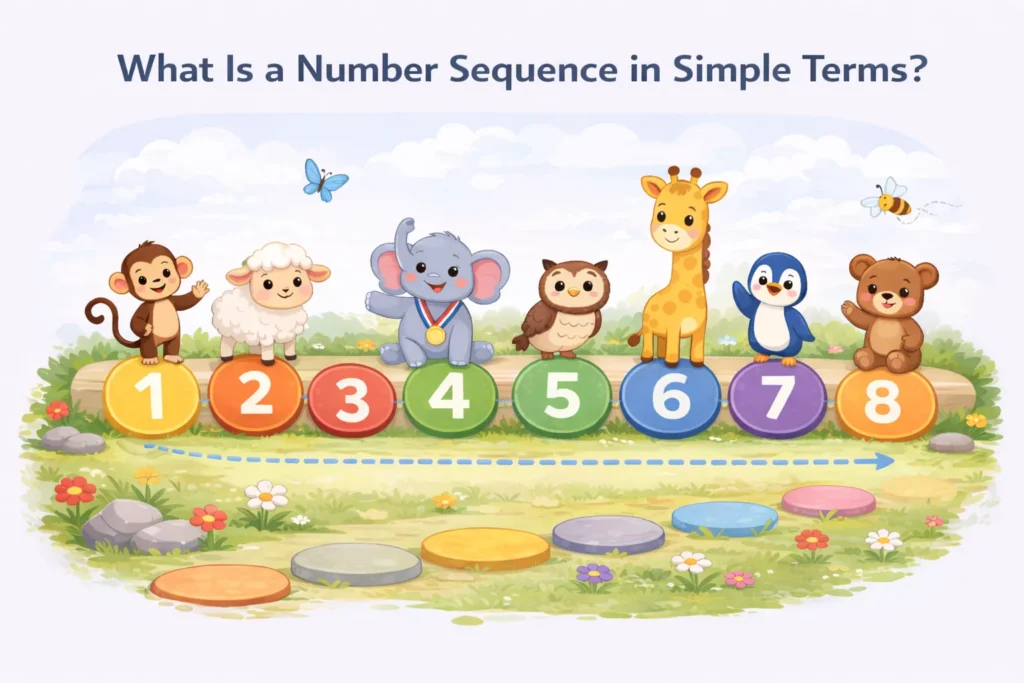
Think of it this way: “Numbers are like kids standing in a queue: 1 is first, then 2, then 3.”
If the order changes, say 1, 3, 2, the sequence breaks down. In Class 1, children focus on two directions:
- Forward sequences (counting up): 1, 2, 3, 4, 5
- Backward sequences (counting down): 5, 4, 3, 2, 1
Simple examples to use with children:
- “Let’s count the pencils — 1, 2, 3, 4, 5.” (forward)
- “Rocket countdown — 5, 4, 3, 2, 1… blast off!” (backward)
Both are equally important. Understanding them gives children a mental map of where every number sits.
Types of Number Sequences in Class 1 Maths
Class 1 covers four main types of number sequences. Together, they build a complete picture of how numbers relate to each other.
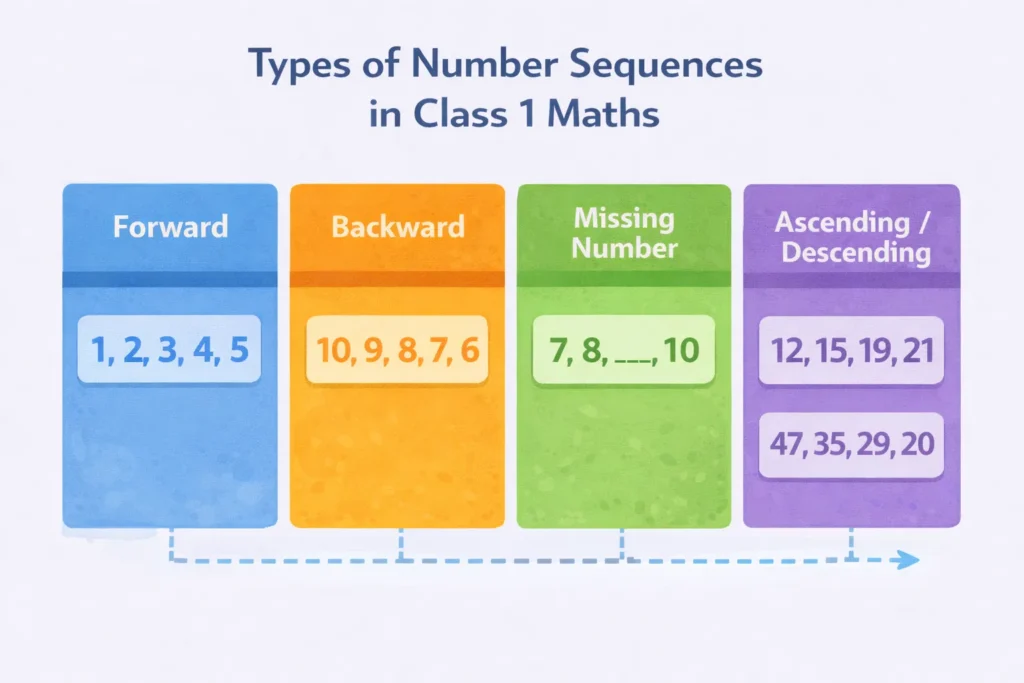
1. Forward Number Sequence
Counting up, where each number is one more than the one before: 1, 2, 3, 4, 5.
In Class 1, children typically start with 1–20, then extend to 1–50 and 1–100. A key skill is learning to start from any point — for example: 23, 24, 25, 26 — not just from 1.
2. Backward Number Sequence
Counting in reverse: 10, 9, 8, 7, 6. This is a critical concept: understanding the backward number sequence for Class 1 directly prepares children for subtraction.
Short countdowns (10 to 1, or 20 to 1) are a great starting point. Learning why backward counting matters helps parents and teachers appreciate just how much groundwork it lays.
3. Missing Number Sequence
One or more numbers are hidden, and children must figure out what belongs in the gap:
- 7, 8, __, 10 → 9
- 10, 9, __, 7 → 8
This type builds logical thinking. It also connects closely to skip counting for Class 1, where children learn to spot patterns by jumping in equal steps.
4. Ascending and Descending Order
- Ascending (smallest to largest): 12, 15, 19, 21
- Descending (largest to smallest): 47, 35, 29, 20
You can explore ascending and descending order for Class 1 in depth, or look at practical examples of ascending and descending order to see how it’s taught.
This also ties into number ordering for Class 1, a closely related skill children develop alongside sequences.
Why Are Number Sequences Important for Class 1 Students?
Number sequences aren’t just about counting they underpin almost every maths concept that follows.
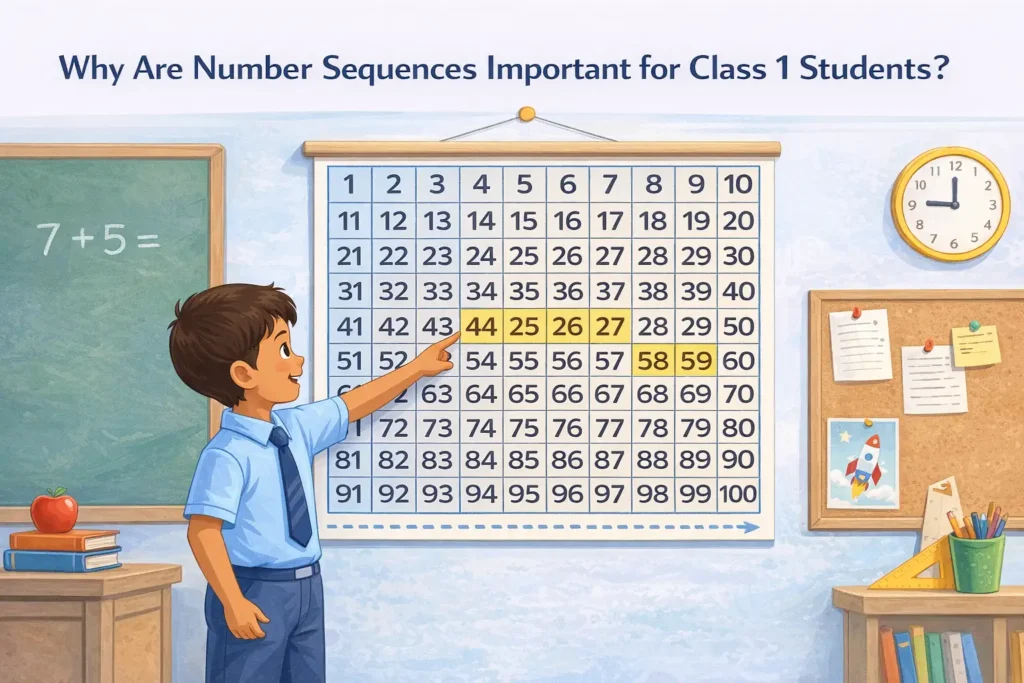
They Build Number Sense
Lining numbers from small to big or big to small helps children spot patterns of increase and decrease. Understanding before, after, and between teaches comparison: why 18 is greater than 12, for instance.
Discover why number sense is so important for Class 1 and how sequences feed directly into it.
They Support Addition and Subtraction
A strong grasp of sequences lets children use a mental number line for Class 1 to count on and count back. For example:
- 7 + 1 → move one step forward → 8
- 9 − 1 → move one step backward → 8
These are the first steps toward mental arithmetic.
They Develop Logical Thinking
Finding missing numbers, identifying mistakes in sequences, and arranging numbers in order all teach children to recognise rules and verify whether their answers make sense, habits of mind that serve them well far beyond Class 1.
Number Sequence Examples for Class 1
Using a mix of written, oral, and visual examples is the most effective approach for young learners.
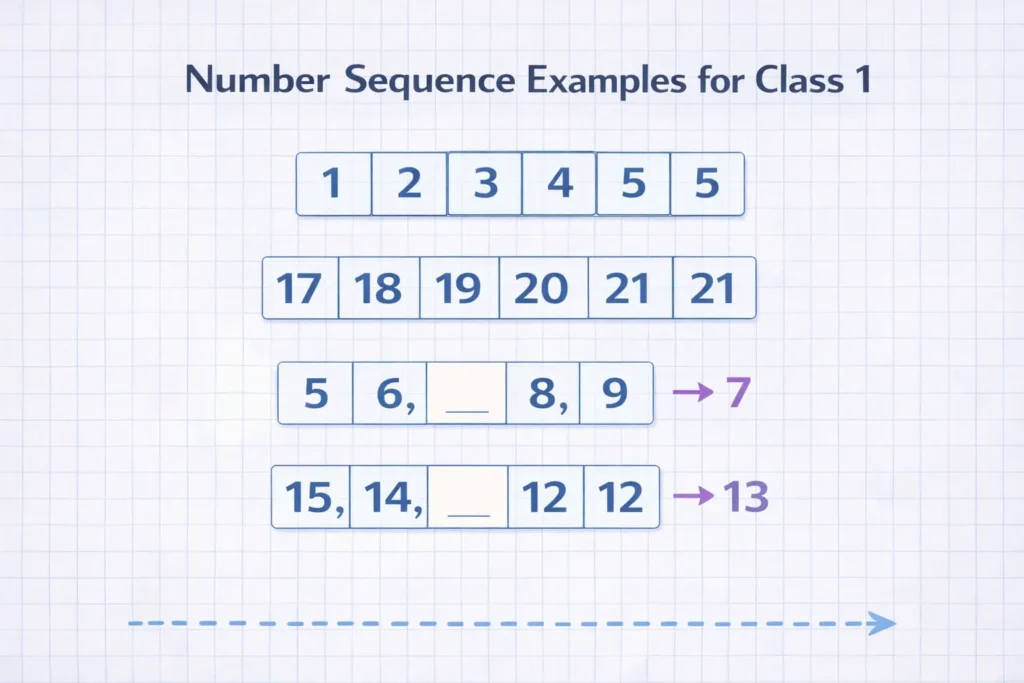
Written Examples
| Type | Example |
|---|---|
| Forward | 1, 2, 3, 4, 5 / 17, 18, 19, 20, 21 |
| Backward | 10, 9, 8, 7, 6 / 20, 19, 18, 17, 16 |
| Missing | 5, 6, __, 8, 9 → 7 |
| Missing (backward) | 15, 14, __, 12 → 13 |
Oral Practice
Spoken counting builds fluency and is easy to do anywhere:
- Choral counting: “Let’s count from 1 to 20 together — now backwards from 10!”
- Start in the middle: “Start at 9 and count up to 15.”
- Quick-fire questions: “What comes after 29?” / “What comes before 50?” / “What’s between 17 and 19?”
Visual Practice with Number Charts
- Colour squares 11 to 15 on a 1–50 chart and read them aloud
- Cover one number: “24, 25, __, 27 — what’s missing?”
- Trace a full row (1–10) forwards, then backwards
Fun Activities to Learn Number Sequences
Play-based activities make number sequences memorable. Children learn best when they are moving, talking, and playing.
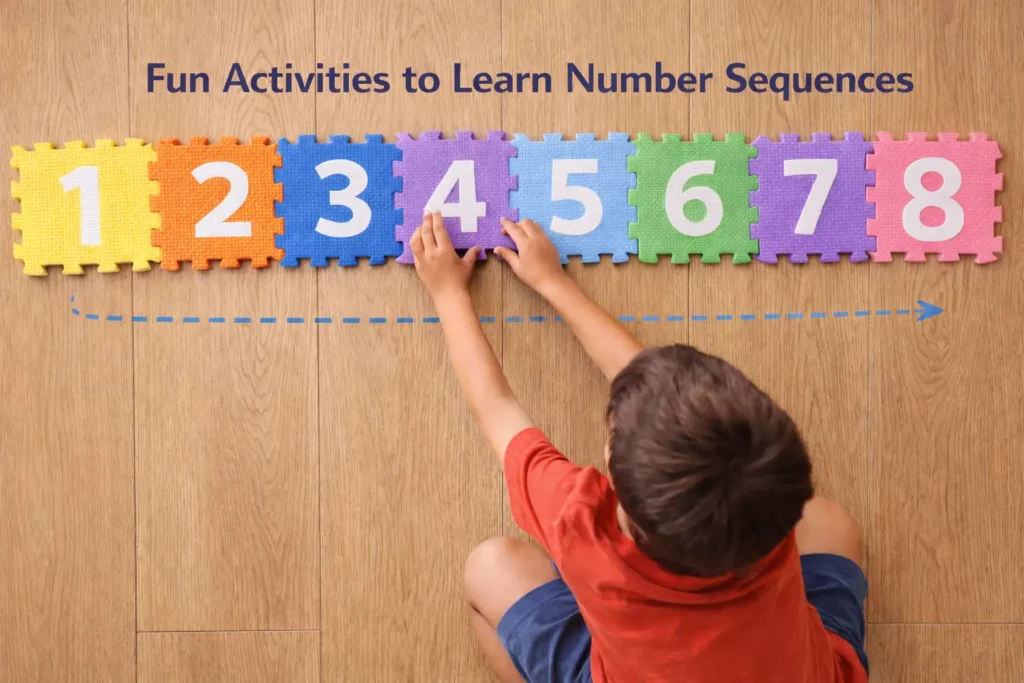
Number Line Games
Lay a number line on the floor using tape or cards. Children:
- Start at a number (e.g. 7) and jump to another (e.g. 12), counting aloud as they go
- Jump backward for reverse sequences
- Find the “missing stop” when one number is covered
Classroom and Home Games
- Pass-the-Count: One child says a number; the next continues. Try starting from different points or going backwards.
- Stand–Sit: Children stand only when a number from a specific range is called.
- Number card ordering: Shuffle cards and arrange from smallest to biggest.
- Fill the chart: Complete blank sections of a 1–50 or 1–100 number chart.
For home use, try easy skip counting activities for Class 1.
Parents will also find teaching forward and backward counting to kindergarten, a practical guide for at-home practice.
Learning Through Play
- Connect blocks while counting up or down
- Count stairs going up (forward) and down (backward)
- Use meal times: “Can you get me 5 spoons? Count them out loud!”
Common Mistakes Children Make with Number Sequences
These mistakes are normal; they signal that a child is actively building number understanding. With consistent practice, they fade.
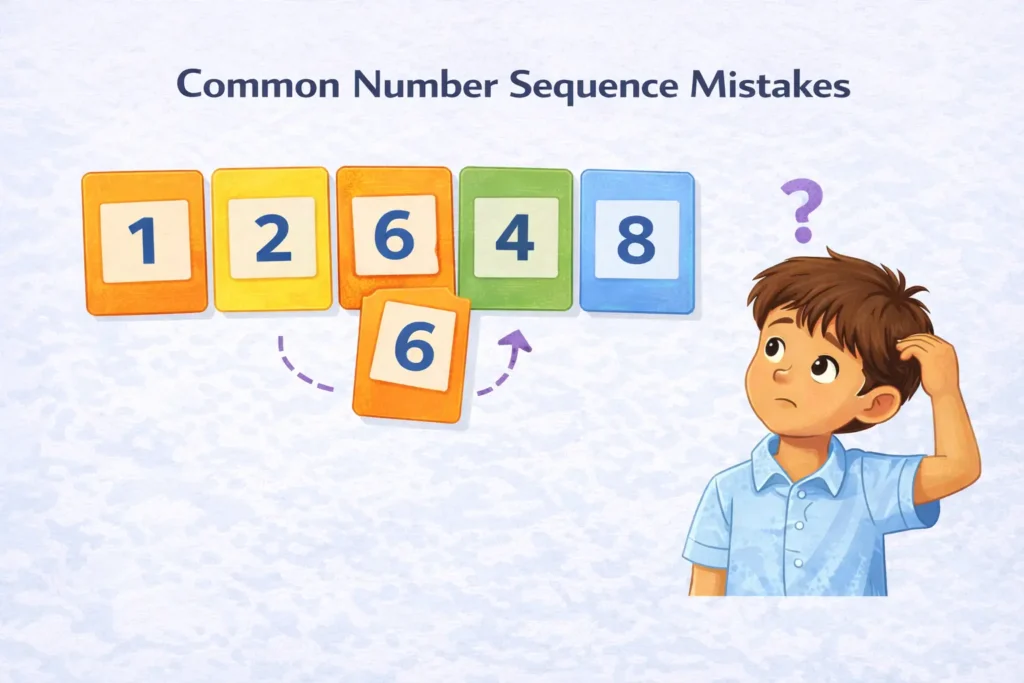
Skipping Numbers
Writing 1, 2, 4, 5 instead of 1, 2, 3, 4, 5. Usually caused by rushing. Slowing down and counting with physical objects (one touch per number) helps reinforce each step.
Mixing Up the Order
Placing numbers out of position (e.g. 3 before 2). This is especially common with backward or mixed sequences. Regular practice with number lines, spoken aloud, helps anchor position.
Confusing “Before” and “After”
Mixing up “What comes before 7?” with “What comes after 7?” Visual aids, such as a number line, can point to and everyday language reinforce the difference naturally.
Tips for Parents: Practise Number Sequences at Home
You don’t need worksheets or special materials. A few minutes of relaxed, regular practice makes an enormous difference.
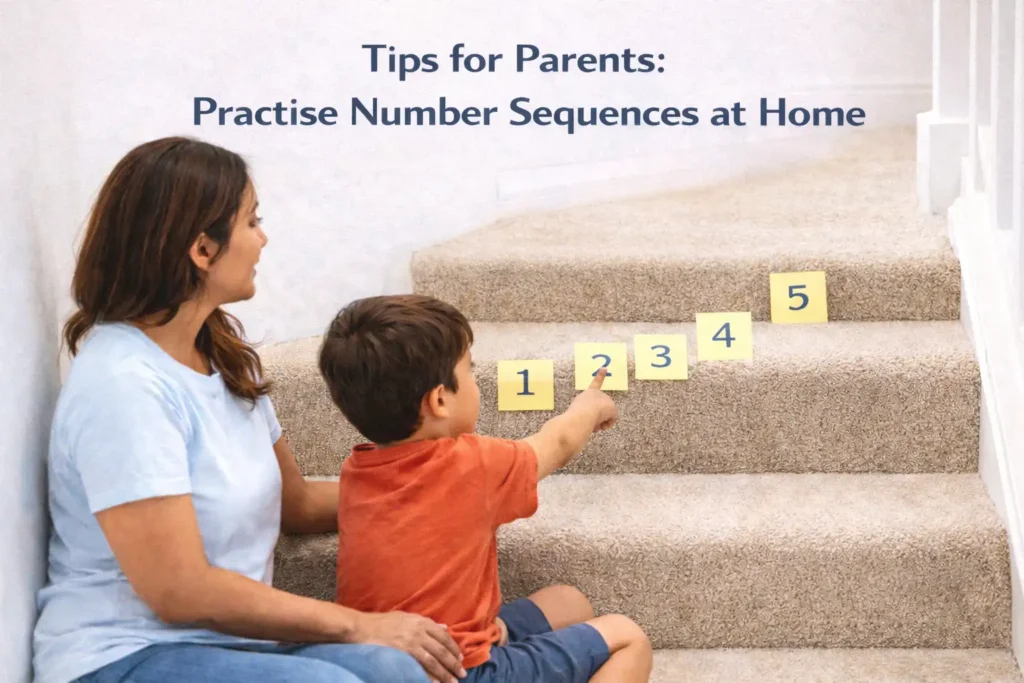
Build It Into Daily Routines
- Stairs: Count forward going up (1, 2, 3…), backward coming down (10, 9, 8…)
- Calendar: Point to today’s date and ask, “What comes after 15?” or “What comes before 10?”
- Meals: Count fruit, spoons, or bites and say the sequence out loud
Use Toys and Objects
- Arrange toy cars or blocks from smallest group to biggest
- Lay out 10 objects and remove one “What number is missing?”
- Play card games where children arrange numbers in order
Turning everyday moments into number games keeps practice light, fun, and stress-free.
Simple Worksheets and Practice Ideas
Short, focused worksheet tasks reinforce number sequences without overwhelming young learners.
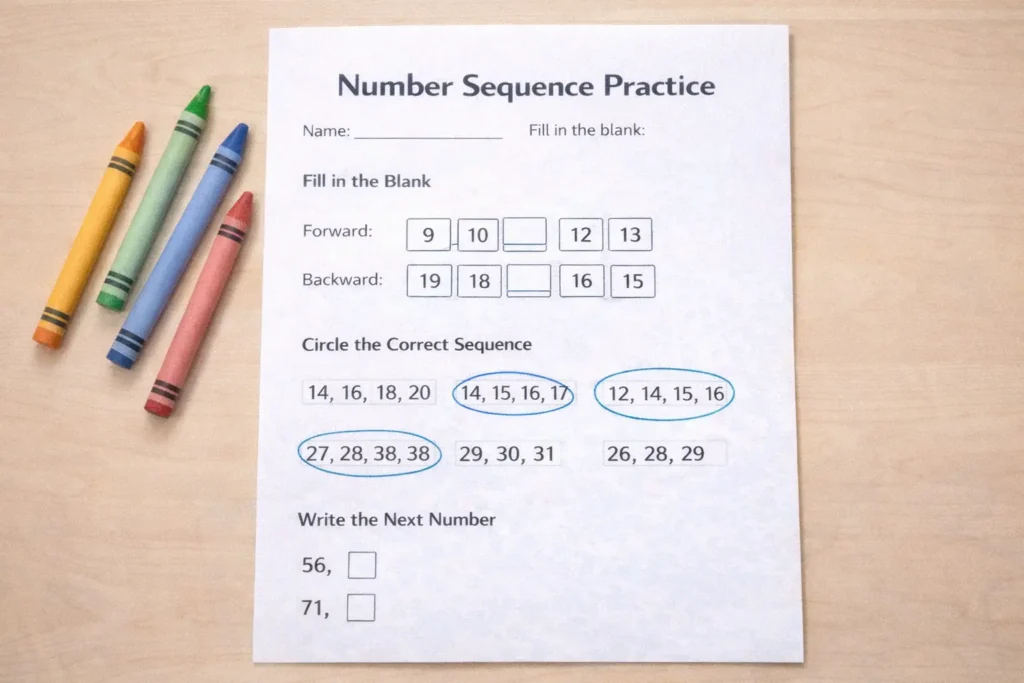
Complete the Sequence
Fill in the missing number:
- 3, 4, __, 6, 7 → 5
- 10, 9, __, 7 → 8
- 15, 14, 13, __, 11 → 12
Circle the Correct Order
Which sequence is correct?
- 1, 3, 2, 4 → ❌ incorrect
- 5, 4, 3, 2 → ✅ correct (backward counting)
- What comes next after 8, 9, 10? → a) 9 b) 11 ✅
Write the Next Number
- What comes after 12? → 13
- Count back: 20, 19, 18, __ → 17
- Pattern: 2, 4, 6 → next is 8
For a more structured approach, a lesson plan for skip counting in Class 1 gives teachers and parents a ready-made framework.
You can also explore how to teach number sequences step by step to Class 1 kids using patterns and visual tools.
What is a number sequence for Class 1?
A number sequence is a group of numbers arranged in a fixed order, where each number has its own place. In Class 1, children learn to count forward (1, 2, 3…), backward (10, 9, 8…), and find missing numbers in a sequence.
What are the types of number sequences taught in Class 1 maths?
Class 1 covers four main types: forward sequences (counting up), backward sequences (counting down), missing number sequences (finding the gap), and ascending/descending order (arranging numbers from smallest to largest or largest to smallest).
What is an example of a number sequence for Class 1?
Some simple examples are:
Forward: 5, 6, 7, 8, 9
Backward: 10, 9, 8, 7, 6
Missing number: 12, 13, __, 15 → 14
Ascending: 11, 14, 17, 20
Why is learning number sequences important for Class 1 students?
Number sequences build number sense, help children understand the relationship between numbers, and lay the groundwork for addition and subtraction. They also develop logical thinking and pattern recognition skills.
How can parents help their child practise number sequences at home?
Parents can use everyday moments, counting stairs, reading a calendar, or arranging toys — to practise sequences. Short 2–3 minute sessions daily are more effective than long, infrequent practice.
What is a missing number sequence in Class 1 maths?
A missing number sequence is when one or more numbers are left out and the child must identify what belongs in the gap. For example: 7, 8, __, 10 — the missing number is 9. This activity builds logical thinking and counting fluency.
How is a number sequence different from skip counting?
A standard number sequence goes up or down by 1 each time (1, 2, 3 or 10, 9, 8). Skip counting jumps by a fixed number greater than 1, like counting by 2s (2, 4, 6, 8) or by 5s (5, 10, 15). Skip counting is an extension of number sequences introduced after basic sequencing is mastered.
At what age do children learn number sequences?
Children typically begin learning number sequences around age 5–6, which corresponds to Class 1 or Grade 1. They start with sequences within 1–20, then gradually extend to 1–50 and 1–100 as their confidence grows.
What common mistakes do Class 1 students make with number sequences?
The three most common mistakes are: skipping numbers (writing 1, 2, 4 instead of 1, 2, 3), mixing up the order of numbers, and confusing “what comes before” with “what comes after.” All of these improve naturally with regular, guided practice.
How do number sequences help with addition and subtraction?
When children know the order of numbers, they can count on (for addition) and count back (for subtraction) using a mental number line. For example, solving 6 + 2 becomes “start at 6, count forward 2 steps → 8.” This is one of the first mental maths strategies children develop.
Make Preparing for Math Olympiad Simple!



Conclusion
Number sequences are one of the most important concepts in Class 1 maths and one of the most accessible.
Through simple daily practice, children learn where every number belongs, what comes before and after, and how numbers grow or shrink.
This builds the number sense that underpins addition, subtraction, and all the maths to come. The key is consistency: short, playful practice every day is far more effective than long, infrequent sessions.
To take this further, explore how to teach number sequences to Class 1 students with proven classroom strategies.
For related topics, also check out our guides on ordinal numbers, the number line, and skip counting to continue building your child’s maths confidence.