December 23, 2025
 7 min. read

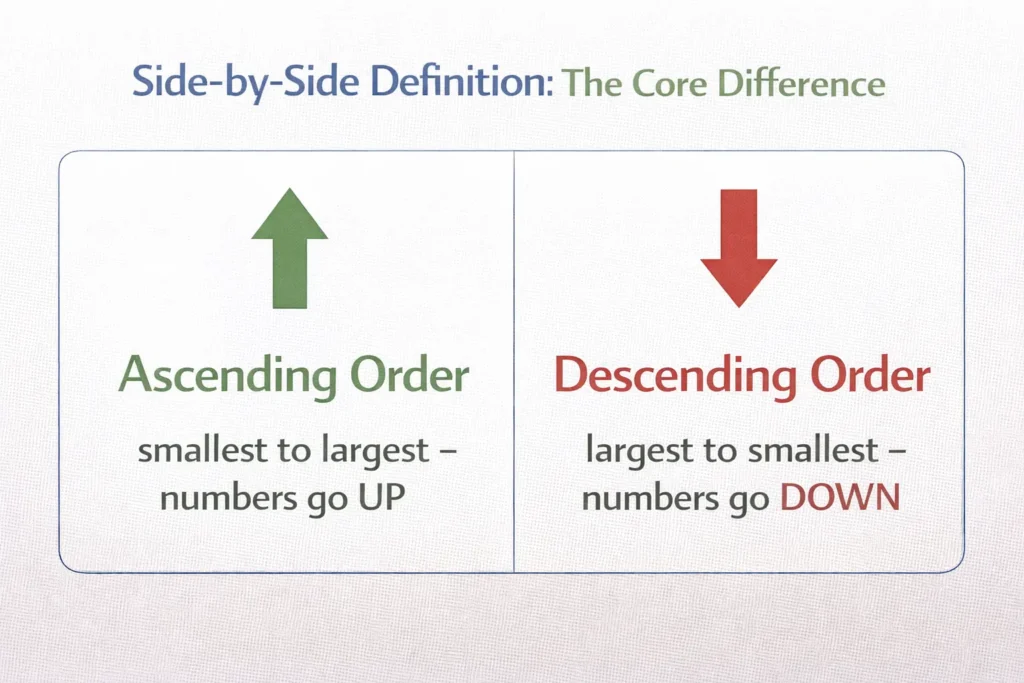
The difference between ascending and descending order is simple: ascending arranges numbers from smallest to largest (1, 2, 3), while descending arranges them from largest to smallest (3, 2, 1).
Many Class 1 children hear both terms but struggle to tell them apart when it counts. That confusion is common and fixable. Both orders look similar on paper they are just sequences of numbers.
The only difference is direction. Without a clear picture of which direction is which, children mix them up under pressure, even after practising both.
In this guide, we explain both orders clearly, show exactly where children go wrong, and give parents and teachers simple strategies to make the difference impossible to forget.
Side-by-Side Definition: The Core Difference
| Ascending Order | Descending Order | |
|---|---|---|
| Meaning | Smallest to largest | Largest to smallest |
| Direction | Numbers go UP | Numbers go DOWN |
| Start with | The smallest number | The largest number |
| Counting style | Forward counting (1, 2, 3…) | Backward counting (10, 9, 8…) |
| Number line | Moves left to right → | Moves right to left ← |
| Real-life | Climbing stairs, growing taller | Sliding down, counting down |
| Example | 2, 5, 8, 11 | 11, 8, 5, 2 |
| Symbol direction | Each number > the one before | Each number < the one before |
This single table captures every meaningful dimension of the difference between ascending and descending order.
Return to it whenever a child is unsure which direction to use. The “Start with” row alone resolves most confusion immediately.
Ascending Order: Definition and Worked Example
Ascending order means arranging numbers from the smallest to the largest. Each number in the sequence is bigger than the one before it.
Numbers go up like climbing stairs, like growing taller each year, like counting forward.
Worked example: Set: 7, 2, 9, 4
- Find smallest: 2 → place first
- Find smallest of remaining (7, 9, 4): 4 → place second
- Find smallest of remaining (7, 9): 7 → place third
- Last number: 9 → place fourth
Answer: 2, 4, 7, 9 ✅
Double-check: Is each number bigger than the one before it? 2 < 4 ✅ → 4 < 7 ✅ → 7 < 9 ✅ → Correct.
For the complete step-by-step rules that produce this result every time, see rules for ordering numbers class 1.
Descending Order: Definition and Worked Example
Descending order means arranging numbers from the largest to the smallest. Each number in the sequence is smaller than the one before it.
Numbers go down like sliding down a slide, like counting down before a race, like arranging objects from biggest to smallest.
Worked example: Set: 7, 2, 9, 4
- Find largest: 9 → place first
- Find largest of remaining (7, 2, 4): 7 → place second
- Find largest of remaining (2, 4): 4 → place third
- Last number: 2 → place fourth
Answer: 9, 7, 4, 2 ✅
Double-check: Is each number smaller than the one before it? 9 > 7 ✅ → 7 > 4 ✅ → 4 > 2 ✅ → Correct.
Notice that both worked examples use the same set of numbers (7, 2, 9, 4); the only difference is the direction. This is the clearest way to show children the contrast: same numbers, opposite arrangements.
For more graduated examples at every difficulty level, see examples of ascending and descending order class 1.
The Number Line: Seeing the Difference Visually
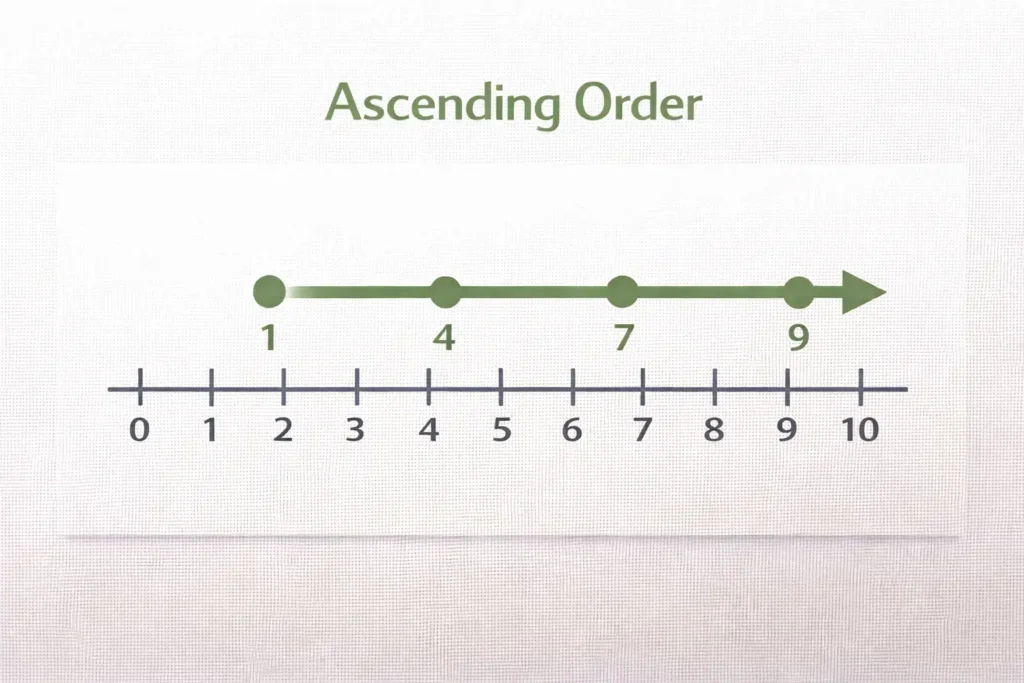
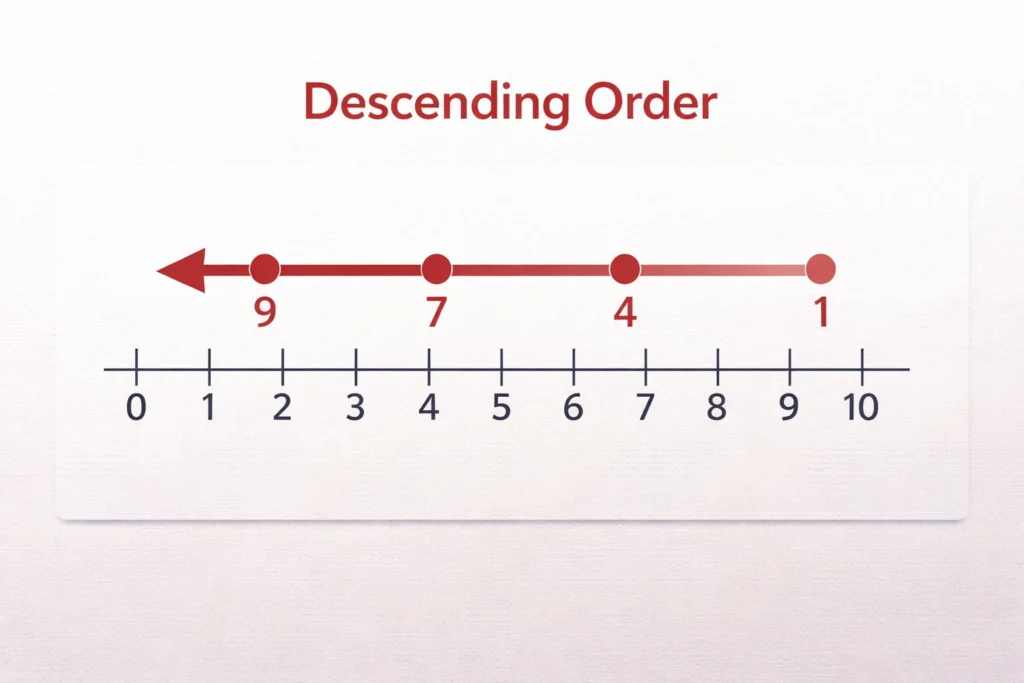
The number line makes the difference between ascending and descending order visually obvious and permanent. On any number line:
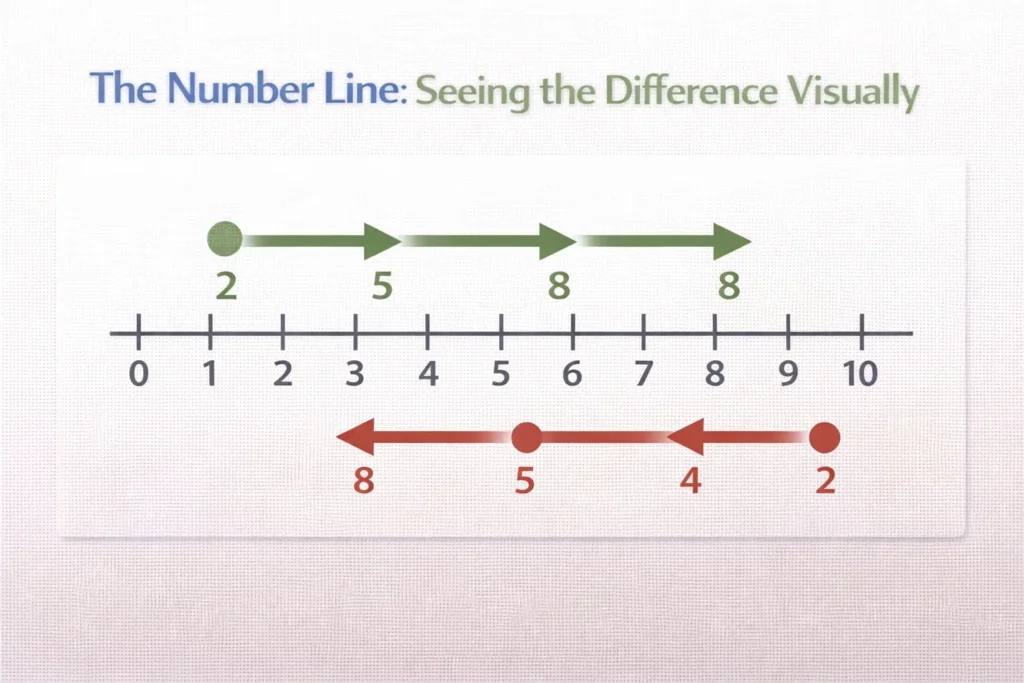
- Numbers increase as you move right → this is ascending order
- Numbers decrease as you move left → this is descending order
Ascending order on a number line means moving in the direction of the arrow, left to right. Descending order means moving against the arrow, from right to left.
This visual grounding is the most reliable long-term fix for children who confuse the two directions.
Every time a child is unsure whether a sequence is ascending or descending, they can locate the first and last numbers on the number line and ask: “Did I move right (ascending) or left (descending)?” The answer is always visually clear.
The positional understanding that makes this work is covered in number positions on a number line class 1 and the complete number line teaching methodology in how to teach number line maths class 1.
Real-Life Connections for Both Directions
Connecting the difference between ascending and descending order to real-life contexts makes both concepts memorable and natural.
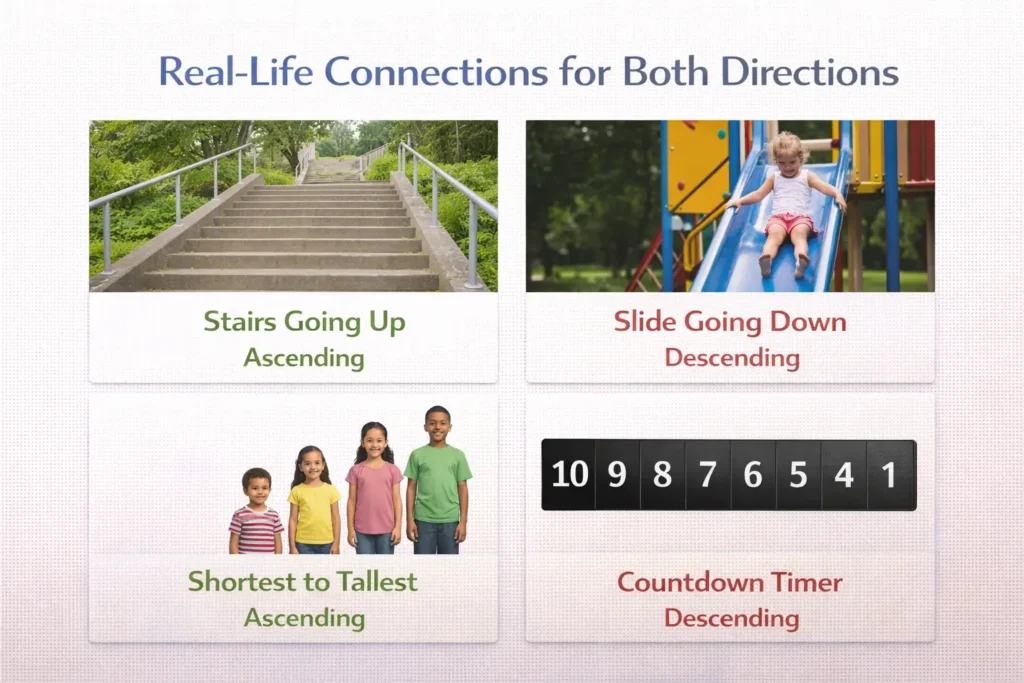
Ascending order in real life:
- Climbing stairs — each step takes you higher, just as ascending order takes you to a bigger number
- Growing taller — each birthday you are taller than before
- Lining up from shortest to tallest — the sequence goes up
- Forward counting: 1, 2, 3, 4, 5…
Descending order in real life:
- Sliding down a playground slide — each position is lower than the one before
- Countdown before a race: 5, 4, 3, 2, 1, Go!
- Lining up from tallest to shortest — the sequence goes down
- Backward counting: 10, 9, 8, 7, 6…
The counting connection is particularly powerful for children who already count forward fluently, essentially already know ascending order.
Building backward counting fluency through the sequence work in teaching number sequences to class 1 students directly strengthens descending order ability.
Common Confusion and How to Fix It
The most common source of confusion between ascending and descending order is not forgetting the definitions but failing to decide the direction before starting.
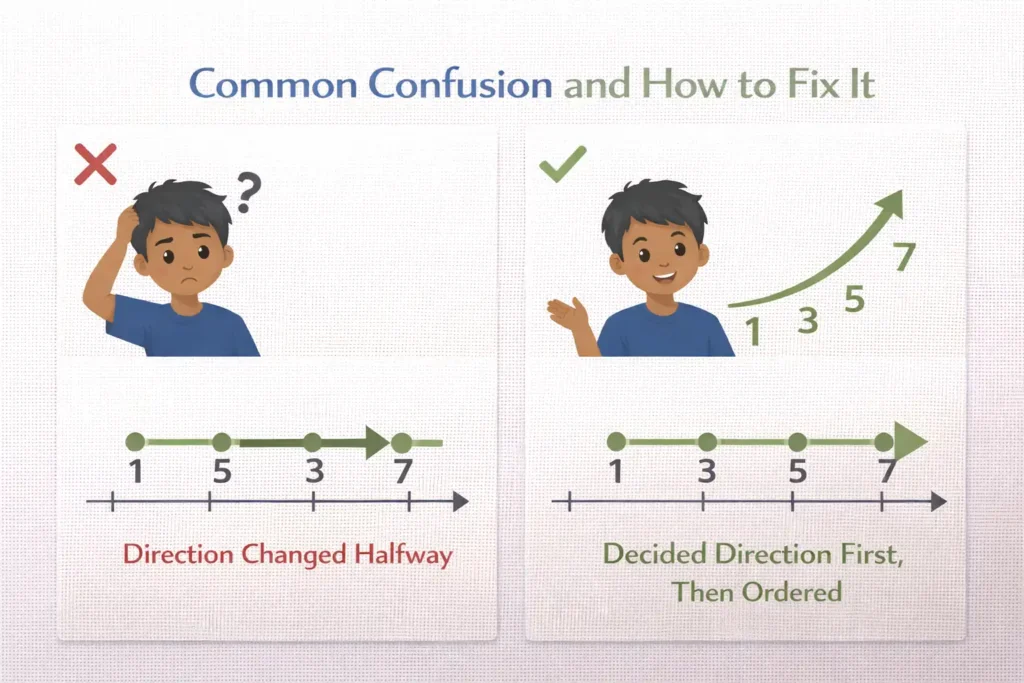
Children who begin ordering without explicitly choosing “up” or “down” often start correctly and then change direction partway through.
The fix: Before touching a single number, ask: “Are we going up or down?” Make the child state the direction aloud “We are going up, so we start with the smallest,” or “We are going down, so we start with the largest.”
This deliberate direction-setting step, done every time, prevents mid-sequence direction changes.
| Confusion Type | What It Looks Like | Fix |
|---|---|---|
| Direction changed halfway | 1, 5, 3, 7 for ascending | State direction aloud before starting “going up” |
| Wrong starting number | Started with 5 instead of 1 for ascending | Ask: “For going up, which number is smallest? Start there.” |
| Ascending and descending mixed up | Called ascending order “descending” | Return to staircase/slide analogy ascending = up like stairs |
| Correct order, wrong label | Ordered 9, 6, 3 but called it “ascending” | Check: “Is each number bigger than before? No, this is descending.” |
The number sense foundations that prevent this confusion are covered in number sense for class 1 children.
With strong number magnitude understanding rarely confusing the two directions because they have an intuitive feel for which numbers are larger.
Memory Tricks to Keep the Difference Clear
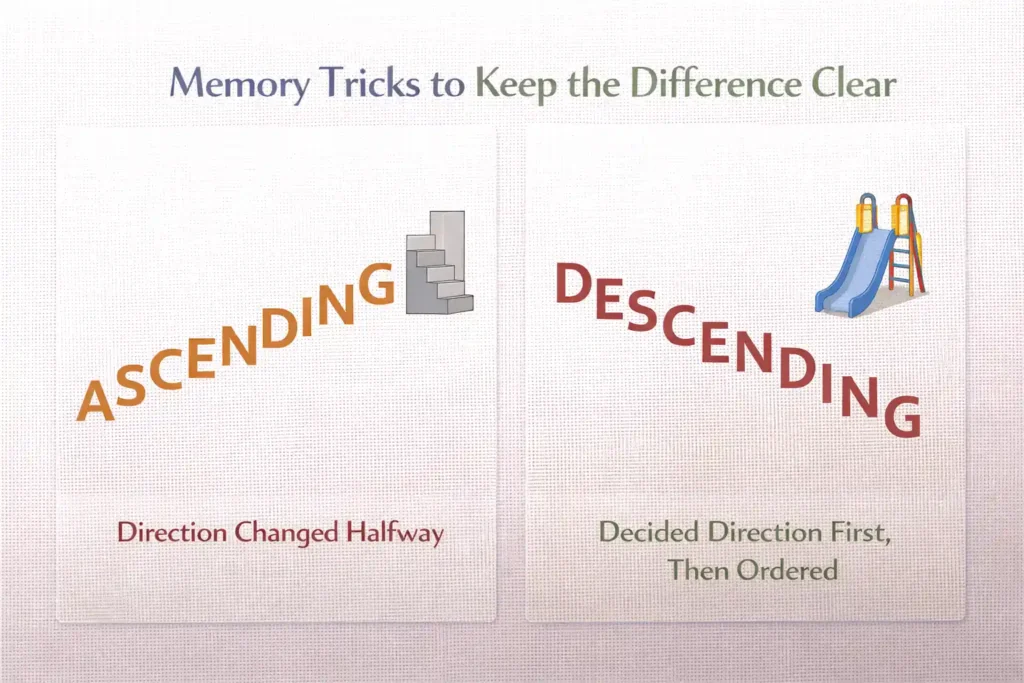
Trick 1 — Staircase and Slide: Ascending = climbing stairs (going UP, getting bigger). Descending = sliding down (going DOWN, getting smaller).
This is the most universal and effective memory aid for Class 1 children; return to it every time confusion occurs.
Trick 2 — The Words Themselves: Ascend means to rise or climb. Astronauts ascend to space. Descend means to fall or come down; planes descend to land.
For older children who can hold these word meanings, this linguistic connection is reliable and lasting.
Trick 3 — Arrow Habit: Before ordering, draw a small arrow above the answer space ↑ for ascending, ↓ for descending.
The physical arrow keeps the direction visible throughout the entire ordering process and prevents mid-sequence direction changes.
Trick 4 — Counting Connection: Ascending = forward counting (1, 2, 3, 4…). Children already know this. Descending = backward counting (10, 9, 8, 7…) — practise this daily.
The more fluent backward counting becomes, the more natural descending order feels.
Is ascending order always used before descending in Class 1?
Yes — ascending order is typically taught first because it is directly connected to forward counting, which children already know. Descending order follows once ascending is secure, usually 2–3 weeks later. Teaching both simultaneously before either is fluent often creates the confusion this guide addresses.
What is the quickest way to tell ascending from descending apart?
Look at the first and last numbers. If the last number is bigger than the first, it is ascending. If the last number is smaller than the first, it is descending. This two-second check works for any sequence and requires no counting or comparison of middle numbers.
How does the difference between ascending and descending order connect to competition mathematics?
Both directions appear in Class 1 competition problems, arranging sets of numbers, completing sequences in a specified direction, and identifying whether a given sequence is correctly ordered. Children who have a clear, automatic understanding of the difference approach these problems immediately and confidently. The IMO syllabus for class 1 covers all number topics assessed at this level.
Make Preparing for Math Olympiad Simple!



Conclusion
The difference between ascending and descending order comes down to one thing: direction. Ascending climbs from smallest to largest; descending falls from largest to smallest.
Once children anchor that contrast clearly not just as two separate definitions but as true opposites they can apply both confidently to any set of numbers.
For worked examples of both directions at every difficulty level, see examples of ascending and descending order class 1.
For the full definitions and real-life connections, see ascending and descending order in Maths Class 1.
For the step-by-step ordering rules, see the rules for ordering numbers class 1.