


A lesson plan on skip counting for Class 1 gives every Class 1 teacher what good intentions alone cannot: a clear structure that turns skip counting sessions into genuine learning outcomes.
Without a plan, lessons drift too long on warm-up, too little guided practice, and no clear moment to check whether children have truly understood or are simply chanting along.
With one, every minute serves a purpose, and every child gets the right level of challenge.
This guide provides a complete, ready-to-use lesson plan for skip counting in Class 1, including SMART objectives.
Before using it, make sure foundations are in place: skip counting for Class 1 covers what skip counting is and why it matters, and how to teach skip counting to Class 1 kids explains the concrete-to-abstract progression this plan applies.
Lesson Overview
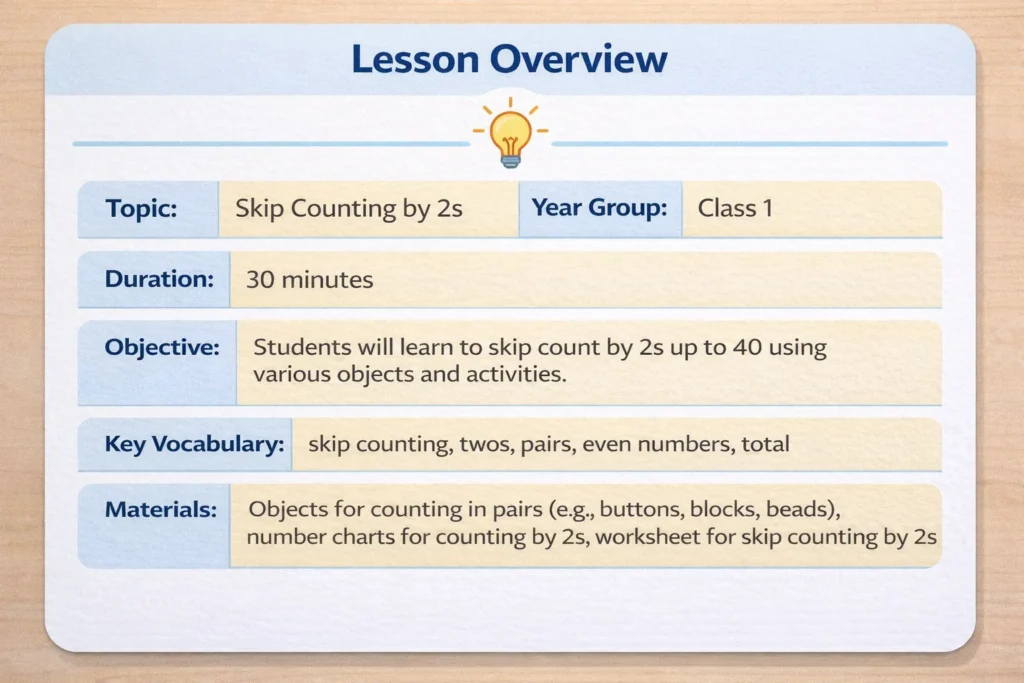
| Field | Detail |
|---|---|
| Topic | Skip Counting by 2s (Lesson 1 of 3) |
| Year Group | Class 1 (Ages 5–7) |
| Duration | 45 minutes |
| Focus Sequence | Skip counting by 2s to 20 |
| Key Vocabulary | skip count, jump, pattern, equal groups, twice, even |
| Prior Knowledge Required | Forward counting to 20 fluently from any starting point |
| Curriculum Link | Number sequences, counting fluency, early multiplication foundations |
Note on the three-lesson sequence: This plan covers Lesson 1 (skip counting by 2s). Follow with Lesson 2 (skip counting by 5s) once by-2s fluency is confirmed, and Lesson 3 (skip counting by 10s) thereafter.
Teaching all three sequences simultaneously is the most common skip-counting teaching mistake one sequence at a time produces far stronger fluency.
SMART Learning Objectives
By the end of this lesson, students will be able to:
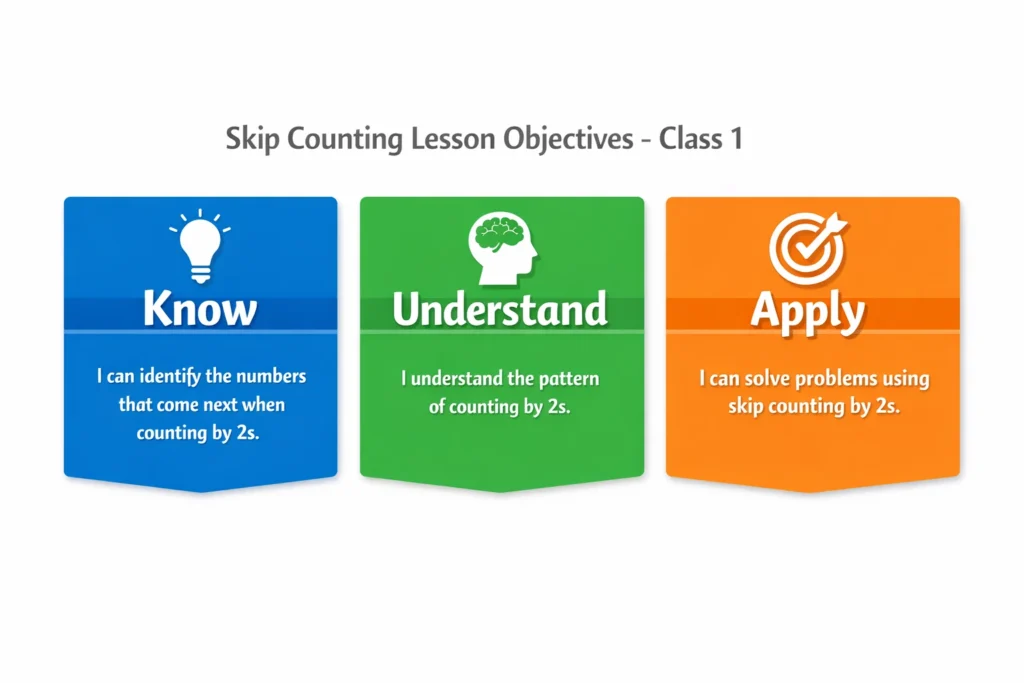
1. KNOW — Identify skip counting by 2s as counting in equal jumps of 2, and recognize the sequence 2, 4, 6, 8, 10, 12, 14, 16, 18, 20 by sight and sound.
2. UNDERSTAND — Explain that skip counting by 2s means adding 2 each time, and connect the sequence to pairs of real objects (2 buttons, 4 buttons, 6 buttons…).
3. APPLY — Skip count by 2s independently from 0 to 20 using objects, a number line, and orally in response to a call-and-response prompt — without reverting to counting by ones.
These objectives cover the three levels of understanding that genuine number sense requires.
The number sense foundations these objectives build toward are covered in Number Sense for class 1 and the five characteristics in the characteristics of number sense class 1.
Materials Checklist
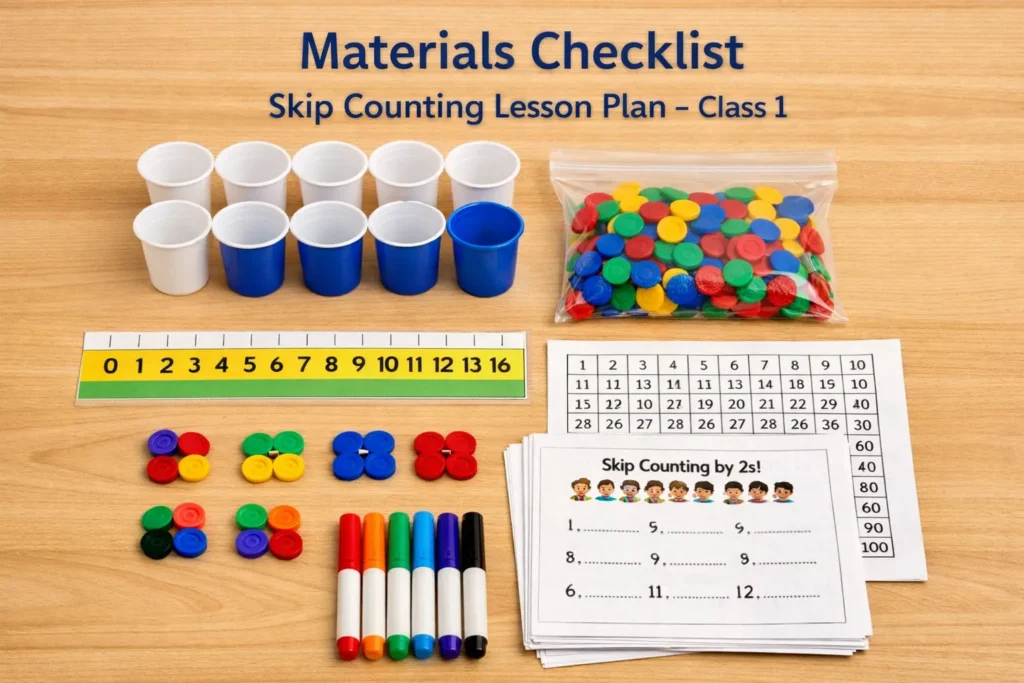
Per student (or pair):
- 10 small cups or sections of an egg carton
- 20 small counters, buttons, or dried beans
- A printed 0–20 number line (desk size)
- Coloured pencil (one colour per student for chart work)
For teacher / class display:
- Large 1–100 chart (displayed at child-visible height)
- Large floor number line (0–20, made with tape or chalk)
- Whiteboard and marker for demonstration
Optional extension:
- Connect-the-dots worksheet (dots labelled 2, 4, 6… 20)
- Blank open number line for advanced students
Timed Lesson Structure
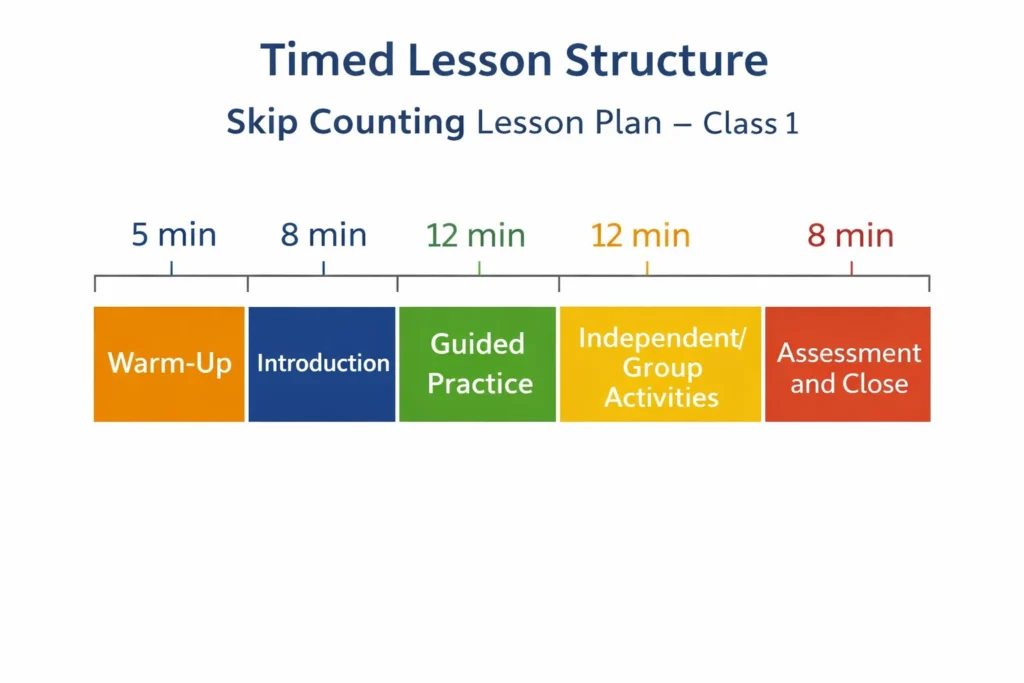
Phase 1: Warm-Up — Counting Fluency Review (5 minutes)
Purpose: Activate prior counting knowledge and focus attention before the new concept is introduced.
Activity: Count forward together from 0 to 20, then backward from 20 to 0. Use a clapping rhythm — one clap per number. Then call-and-response: teacher says a number, class says the next. “7?” — “8!” “14?” — “15!”
Why this matters: Children who cannot yet count forward fluently from any starting point are not ready for skip counting.
If the warm-up reveals counting gaps, note which children need additional support before or during the guided practice phase.
The counting fluency foundations this warm-up assesses are covered in detail in what is the number sequence for class 1 maths.
Phase 2: Introduction — Grouping With Objects (8 minutes)
Purpose: Build the conceptual understanding that skip counting means counting groups, not individual items.
Teacher script: “We know how to count every single object. Today we are going to learn a faster way — counting groups.”
Place 5 cups on the demonstration table. Put exactly 2 counters in each cup, one at a time, making the grouping visible. “Every cup has 2. Let’s count only the cups, not the counters.”
Touch cup 1: “2.” Touch cup 2: “4.” Touch cup 3: “6.” Touch cup 4: “8.” Touch cup 5: “10.”
“We jumped by 2 each time. We called it skip counting by 2s. Now you try.”
Give each student/pair their cups and counters. Ask them to fill each cup with exactly 2 counters, then touch each cup and say the running total aloud.
This grouping activity is the most important conceptual step in the entire lesson. The number of research-supported minutes spent here directly predicts the depth of understanding students carry into all subsequent skip-counting work.
The full rationale is in how to teach skip counting to class 1 kids.
Phase 3: Guided Practice — Number Line Jumps (12 minutes)
Purpose: Move from physical object grouping to visual number line representation, making the equal-jump structure permanent.
Part A — Class number line (5 minutes): Draw a 0–20 number line on the board. Starting at 0, draw curved arcs to 2, 4, 6, 8, 10, labelling each arc “+2.”
Circle each landing number. Ask: “What do you notice about the arcs?” (Same size.) “What do you notice about the landing numbers?” (All even, gap of 2 between each.)
Part B — Student number lines (7 minutes): Students use their desk number line. Ask them to draw arcs and circle landing numbers for skip counting by 2s from 0 to 20, saying each landing number aloud as they draw.
Circulate check arc size consistency and whether students are saying the numbers as they draw.
The number line teaching approach this phase applies is covered in how to teach number line maths class 1, and the positional understanding of landing positions is in number positions on a number line class 1.
Phase 4: Differentiated Activities (12 minutes)
Set up three activity options and direct children to the most appropriate level. This differentiation ensures every child is working at the right level of challenge.
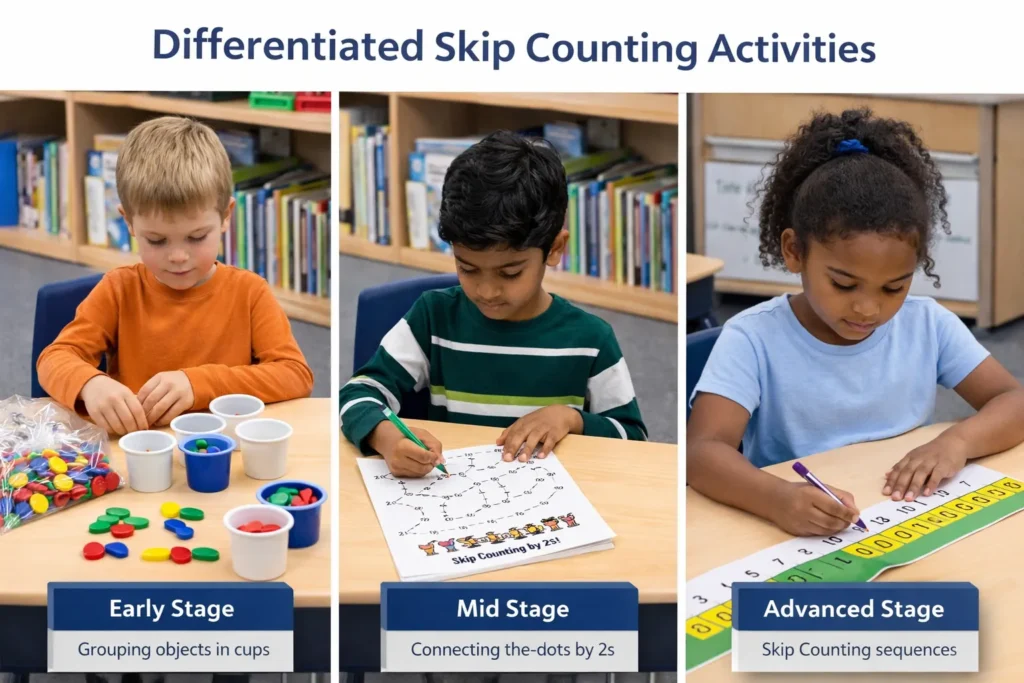
Early stage (still building conceptual understanding): Continue with the cup grouping activity extend to 10 cups (counting to 20). Students touch each cup and say the total.
The teacher works with this group to confirm the connection between “one more cup of 2” and “add 2 to the total.”
Expected level (concept understood, building fluency): Connect-the-dots worksheet with dots numbered 2, 4, 6, 8… 20. Students connect in sequence to reveal a picture.
The activity is self-checking an incorrect sequence produces a meaningless image. After completing, students write the full sequence in their book.
Advanced level (fluent with by-2s, ready for extension): Open number line (blank line, only 0 and 20 marked). Students place the skip counting by 2s sequence themselves, deciding where each number belongs.
Extend: “Can you start at 1 and skip count by 2s? What sequence do you get?” (Odd numbers — 1, 3, 5, 7…) This extension builds the number relationship understanding detailed in number sense teaching strategies for first graders.
Phase 5: Assessment and Close (8 minutes)
Purpose: Check individual understanding, consolidate learning, and preview the next lesson.
Individual oral assessment (3 minutes): Call-and-response individually with 4–5 children while others complete their activity: “Start at 0 and skip count by 2s to 10.”
Note who can do this independently and who still needs support. This 30-second check per child provides more reliable assessment information than any worksheet.
Class consolidation (3 minutes): Gather the class. Ask: “What did we learn to do today?” Take 3–4 responses. Summarise: “We learned to skip count by 2s — counting in equal jumps of 2. What are the numbers we landed on?” Class chants: “2, 4, 6, 8, 10, 12, 14, 16, 18, 20.”
Preview (2 minutes): “Next time, we are going to count groups of 5. How is that different from groups of 2?” Leave the question open, do not answer. The cognitive anticipation of the answer prepares children for the next lesson.
Assessment Rubric
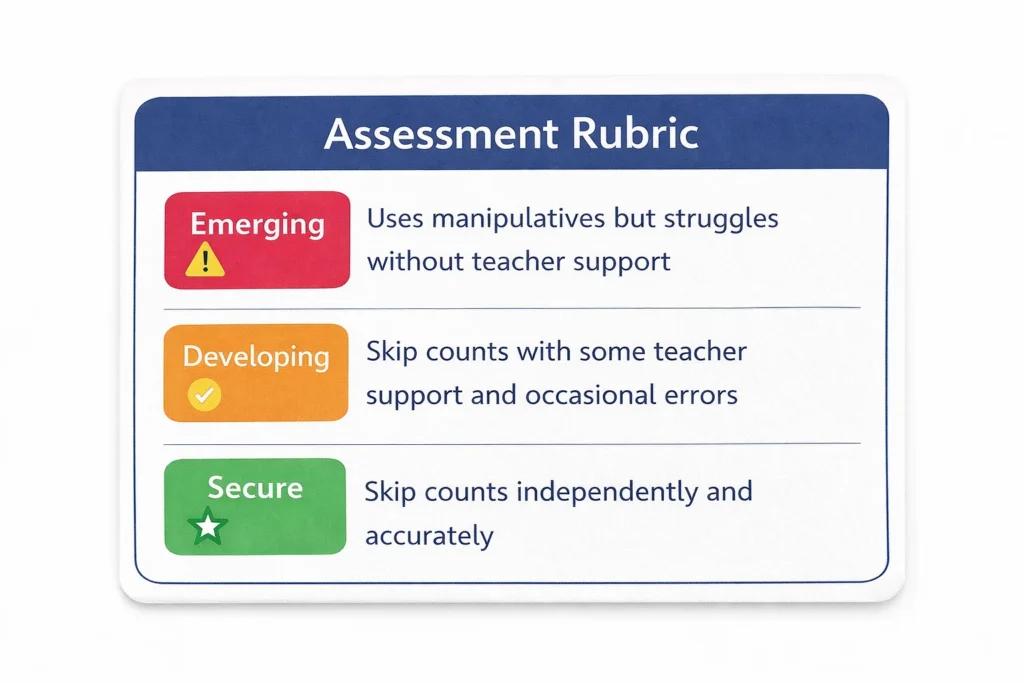
| Level | Observable Indicator |
|---|---|
| Emerging | Can recite 2, 4, 6, 8 as a chant but cannot continue from a non-zero starting point or explain the pattern |
| Developing | Skip counts by 2s to 20 from 0 with occasional errors; can connect sequence to grouped objects with support |
| Secure | Skip counts by 2s to 20 fluently from any starting point; explains “adding 2 each time”; connects sequence to groups independently |
Children at Emerging level need more time with Phase 2 (cup grouping) before number line work. Children at Developing level are ready for Phase 3 number line work.
Children at the Secure level are ready to begin skip counting by 5s. This differentiation connects directly to the skip counting teaching methodology in how to teach skip counting to class 1 kids.
How many lessons does it take to achieve fluency in skip counting by 2s?
Most Class 1 children need 5–8 short lessons (10–15 minutes each) plus daily 5-minute warm-up practice to achieve genuine fluency in skip counting by 2s. The first lesson (this plan) builds conceptual understanding. Subsequent lessons build oral fluency through varied activities. Written fluency comes last. Do not advance to skip counting by 5s until by-2s is fully secure in a call-and-response format.
Can this lesson plan be adapted for skip counting by 5s and 10s?
Yes — the structure remains identical. Replace the cup contents (5 counters per cup for by-5s, 10 for by-10s), adjust the number line range (0–50 for by-5s, 0–100 for by-10s), and update the worksheets. The five-phase timed structure and assessment rubric apply unchanged. Teaching one sequence per lesson cycle is far more effective than trying to teach all three sequences simultaneously.
How does this lesson plan connect to early competition mathematics?
Skip counting fluency directly supports the number sequence and pattern recognition problems that appear in Class 1 mathematical competitions, such as completing sequences, identifying missing numbers, and extending patterns. Children who have been through the concrete-to-abstract progression in this plan approach these problems with natural pattern-recognition instincts. The IMO syllabus for class 1 maps the full range of topics assessed at this level.
Make Preparing for Math Olympiad Simple!



Conclusion
A well-structured skip counting lesson plan does more than organise a single session.
It builds a coherent progression that develops genuine understanding, ensures every child works at the right challenge level, and produces reliable assessment information at every stage.
Use this plan for Lesson 1 with skip counting by 2s, then adapt it for 5s and 10s once fluency is confirmed.
The 45-minute structure, SMART objectives, and three-level assessment rubric stay constant; only the materials and real-life connections change.
For deeper support, explore skip counting for Class 1
for the full conceptual background, how to teach skip counting to Class 1 kids,
for the teaching methodology, and number sense for Class 1, for the foundations this lesson builds toward.

Mikha Piregu is a Content Writer with experience spanning educational content, including math and math olympiad topics, as well as advocacy writing, research-based articles, and SEO-driven web content. He creates high-quality blog content, web copy, and feature articles that support brand visibility, audience engagement, and long-term organic growth through data-informed storytelling. Skilled in WordPress, WooCommerce, and modern digital tools, Mikha adapts content across various platforms, including blogs, websites, campaigns, and advocacy initiatives, with clarity and purpose.

There are no comments posted here yet.
Sign in to leave a comment