


SOF IMO and IOQM are not the same exam and choosing the wrong one can cost your child months of misdirected preparation.
- What is SOF IMO?
- What is IOQM?
- SOF IMO vs IOQM: Complete Comparison Table
- SOF IMO vs IOQM Difficulty: How Big Is the Gap?
- SOF IMO vs IOQM Syllabus: What Topics Does Each Cover?
- SOF IMO vs IOQM Exam Pattern: Structure, Duration, and Marking
- How Much Preparation Does Each Exam Need?
- Which Olympiad Should You Prepare For?
- Can SOF IMO Help in IOQM Preparation?
- Olympiad Pathways: SOF IMO vs the National Olympiad Route
- Common Mistakes to Avoid
- Final Verdict
SOF IMO is a school-level Olympiad for building maths confidence. IOQM is the first stage of India’s national Olympiad pathway that leads to the International Mathematical Olympiad (IMO).
Most parents and students confuse these two because both involve “competitive maths.” But the difficulty gap is massive.
A student who tops SOF IMO at school may still struggle to clear IOQM without months of additional, targeted preparation.
This guide compares SOF IMO vs IOQM clearly and helps you decide which Olympiad your child should prepare for first.
What is SOF IMO?
The SOF International Mathematics Olympiad is a school-level competitive exam conducted by the Science Olympiad Foundation (SOF) for students from Class 1 to Class 12.
Its purpose is to expose students to competitive mathematics early, build problem-solving confidence, and encourage thinking beyond the school curriculum.
It’s not designed to select students for international-level competition.
How it works: Level 1 is conducted at the school level with MCQs based on the class syllabus plus logical reasoning.
Top performers qualify for SOF IMO Level 2, which is a national-level exam with slightly greater difficulty. Outstanding Level 2 performers may reach the international level organised by SOF.
Key features: Open to Classes 1–12, MCQ-based, aligned to school syllabus, awards medals, certificates, and scholarships, no prior qualification needed, any student can participate through their school.
Check the latest SOF IMO 2026–27 registration dates to plan ahead.
SOF IMO is an excellent starting point for students new to Olympiads. Read our detailed guide on how to prepare for SOF IMO if you’re getting started.
What is IOQM?
The Indian Olympiad Qualifier in Mathematics (IOQM) is the first stage of India’s national Mathematical Olympiad programme.
Conducted by the Mathematics Teachers’ Association (MTA) with the Homi Bhabha Centre for Science Education (HBCSE).
Here’s what IOQM stands for if you need background.
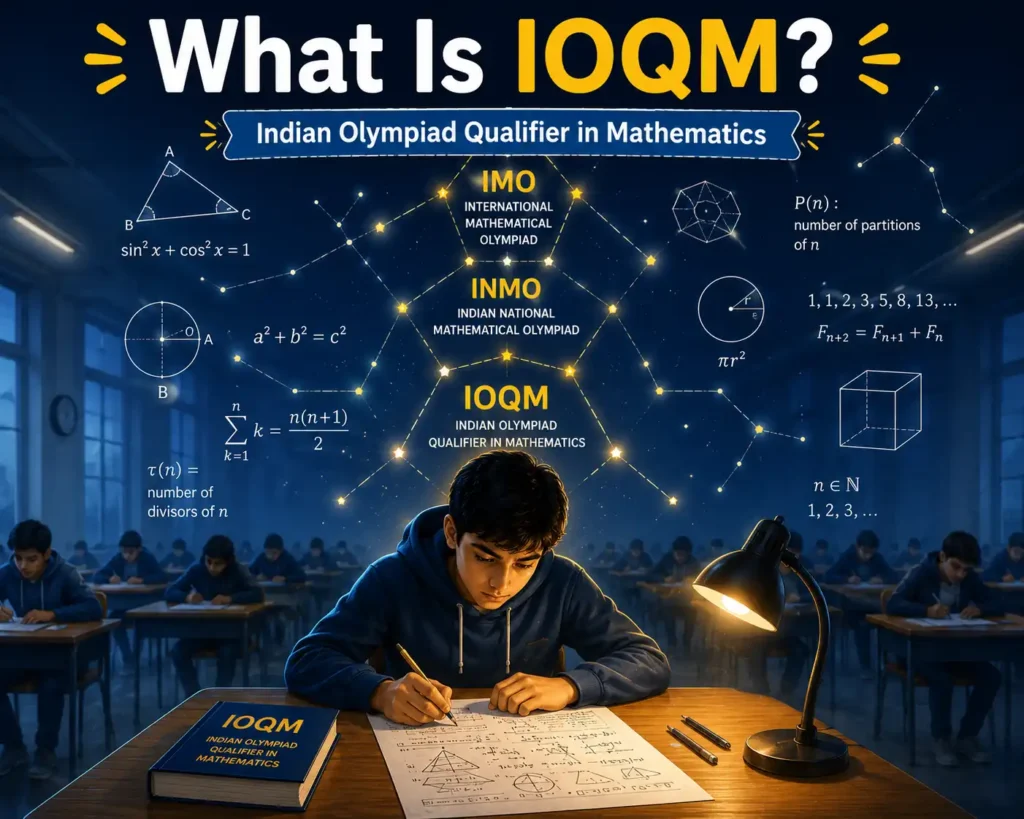
Students who clear IOQM progress to RMO → INMO → IMO Training Camp → Indian team selection for the International Mathematical Olympiad.
The purpose is fundamentally different from SOF IMO. IOQM is a competitive screening exam designed to identify students with exceptional mathematical talent.
Key features: Primarily Classes 8–12, conducted at designated centres (not schools), integer-answer problems well beyond the school curriculum, tests number theory/combinatorics/geometry/algebra at Olympiad level, no awards; the outcome is qualification to RMO.
IOQM is not a participation-based Olympiad. It’s the starting line of a serious, multi-stage national selection process.
SOF IMO vs IOQM: Complete Comparison Table
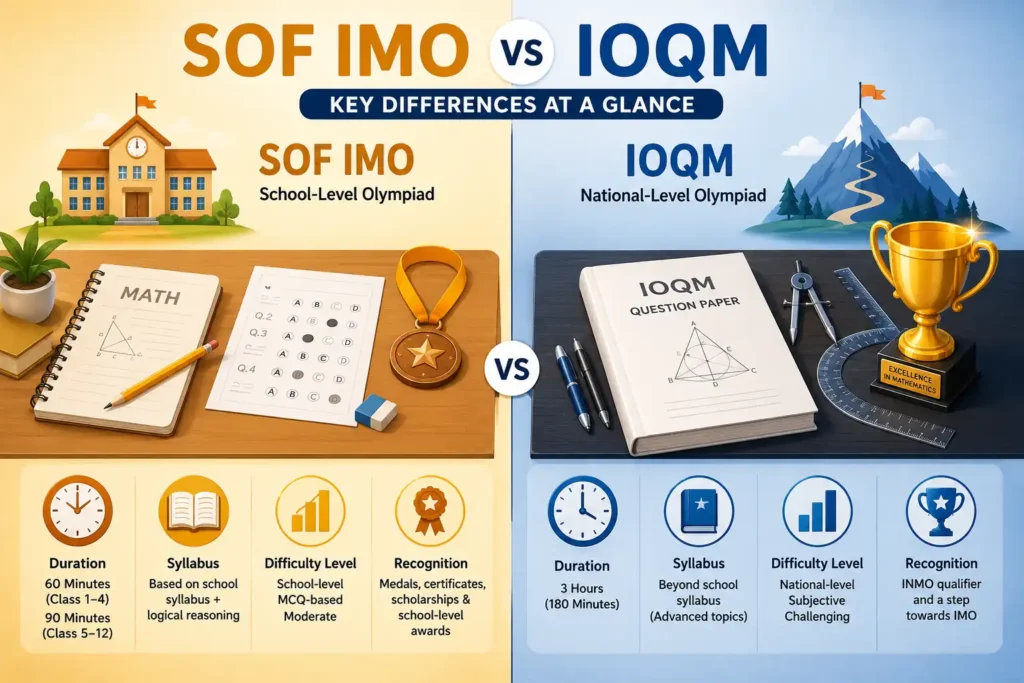
| Parameter | SOF IMO | IOQM |
| Conducting Body | Science Olympiad Foundation (SOF) | MTA with HBCSE |
| Purpose | Build maths interest at school level | National Olympiad pathway to IMO |
| Target Students | Classes 1–12 | Primarily Classes 8–12 |
| Eligibility | Any student; school registers with SOF | Indian school students; HBCSE age/class criteria |
| Difficulty | Moderate — school syllabus + logical reasoning | High — advanced problem-solving beyond school |
| Question Type | MCQs (4 options) | Integer-answer (no options) |
| Syllabus | Class-wise school curriculum + mental ability | Number theory, combinatorics, algebra, geometry at Olympiad level |
| Duration | 60 minutes | 3 hours |
| Questions | 35 (Level 1) | ~30 (varies by year) |
| Stages | Level 1 → Level 2 → International | IOQM → RMO → INMO → IMO Camp → IMO |
| Outcome | Medals, certificates, scholarships | Qualification to RMO |
| Preparation | Weeks of focused practice | Months of dedicated Olympiad training |
| Exam Setting | Student’s own school | Designated exam centres |
SOF IMO is designed for broad participation and encouragement. IOQM is designed for competitive selection.
SOF IMO vs IOQM Difficulty: How Big Is the Gap?
IOQM is significantly harder than SOF IMO.
This isn’t a small step up; it’s a different category of exam altogether.
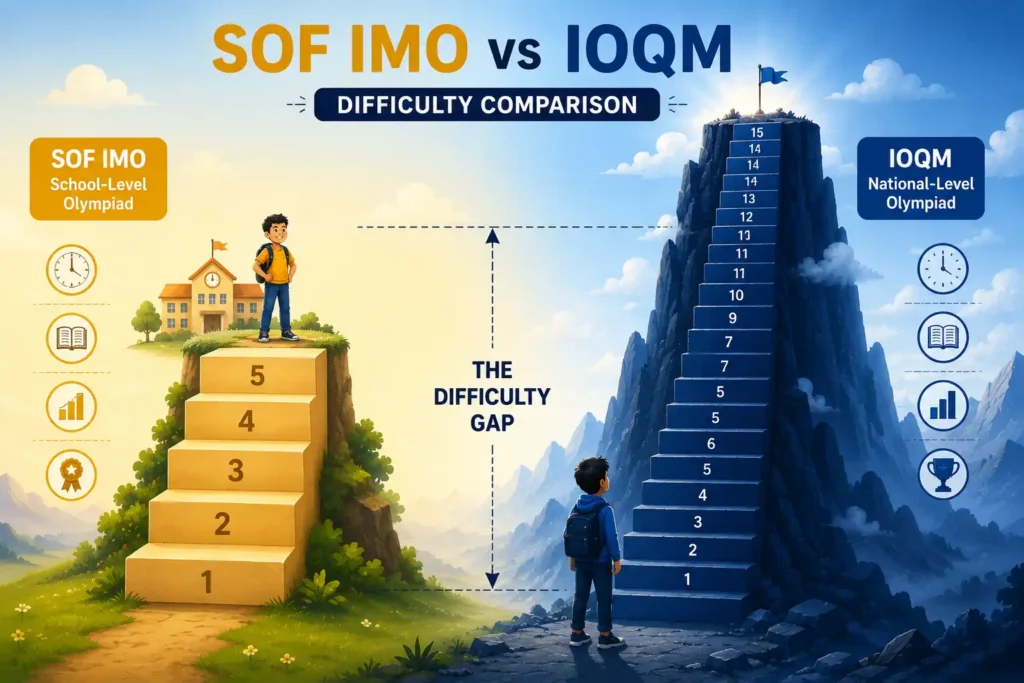
SOF IMO questions are based on school curriculum with logical reasoning emphasis. A strong student can prepare in 3–6 weeks.
Questions test concept application, pattern recognition, and mental maths within grade-level difficulty.
IOQM problems test mathematical maturity, multi-step problems demanding creative thinking, logical arguments, and concepts (number theory, combinatorics, geometry) rarely taught in school.
No answer choices; you must arrive at the correct integer independently.
A typical IOQM problem might ask you to find the number of integers satisfying a specific set of divisibility conditions, or to determine a geometric property using non-standard techniques.
These aren’t problems you solve by memorising formulas they require deep conceptual understanding and the ability to connect ideas across topics.
The real gap: SOF IMO tests whether you can use school maths cleverly. IOQM tests whether you can do mathematics that your school hasn’t taught you, using reasoning your school hasn’t trained you for.
The SOF IMO vs IOQM difficulty gap is comparable to the difference between a school-level quiz and a state-level entrance exam.
Students who excel at SOF IMO may still find IOQM overwhelming without months of Olympiad-specific preparation in entirely new topics and problem-solving techniques.
SOF IMO vs IOQM Syllabus: What Topics Does Each Cover?
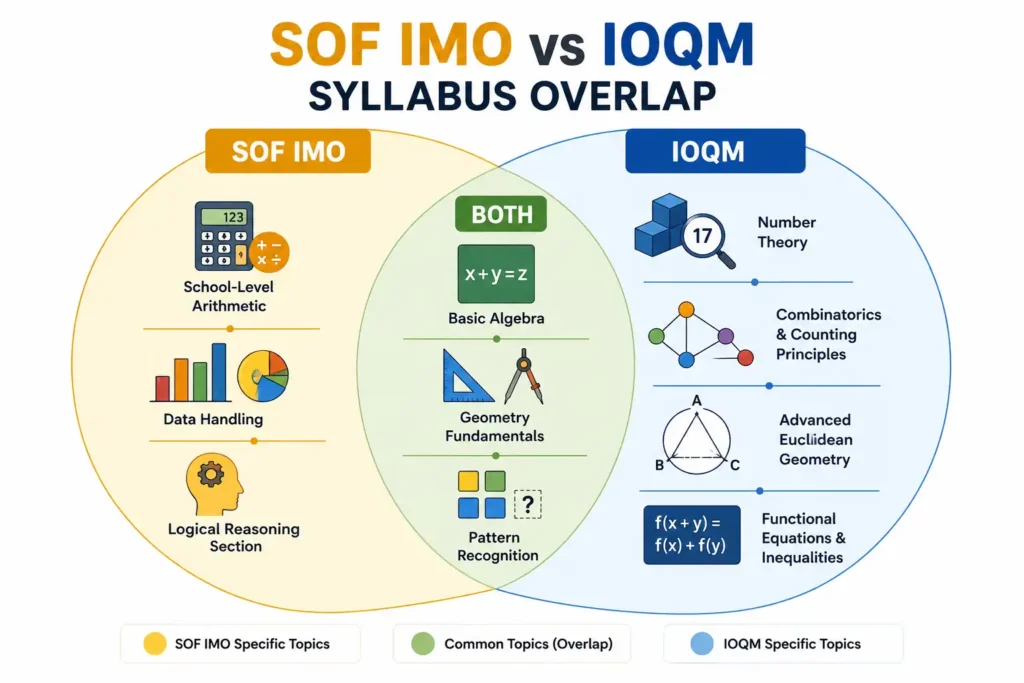
| Topic Area | SOF IMO | IOQM |
| Arithmetic & Numbers | Class-level (fractions, decimals, operations) | Advanced number theory (modular arithmetic, Diophantine equations) |
| Algebra | Class-level (expressions, equations) | Olympiad-level (inequalities, polynomials, functional equations) |
| Geometry | Class-level (shapes, mensuration, basic proofs) | Olympiad-level (Euclidean geometry, circle theorems, constructions) |
| Combinatorics | Basic patterns and logical reasoning | Formal counting, pigeonhole principle, graph theory |
| Logical Reasoning | Dedicated section | Not separate — reasoning embedded in every problem |
| Data Handling | Included per syllabus | Not typically tested |
For a class-wise breakdown of what SOF covers, see our complete SOF IMO syllabus guide.
The key takeaway: SOF IMO syllabus matches school learning; IOQM introduces entirely new mathematical territories requiring independent study.
SOF IMO vs IOQM Exam Pattern: Structure, Duration, and Marking
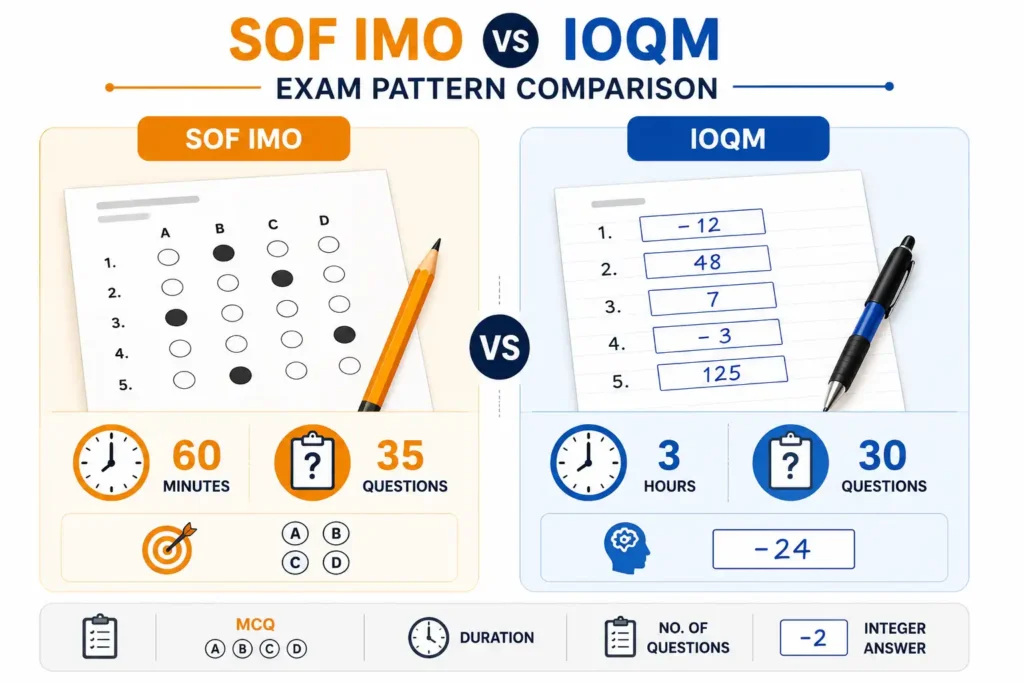
| Feature | SOF IMO (Level 1) | IOQM |
| Format | MCQs — 4 options | Integer-answer (no options) |
| Questions | 35 | ~30 |
| Duration | 60 minutes | 3 hours |
| Sections | Logical Reasoning, Mathematical Reasoning, Everyday Maths | Single paper, no sections |
| Marking | +1 per correct; no negative marking in most formats | Varies by question; typically no negative marking |
| Centre | Student’s school | Designated external centres |
The biggest difference: SOF IMO’s MCQ format allows elimination and estimation. IOQM demands exact integer answers with no safety net.
The 3-hour duration reflects how each IOQM problem requires extended thought. For a deeper look at the SOF side, read our SOF IMO exam pattern breakdown.
How Much Preparation Does Each Exam Need?
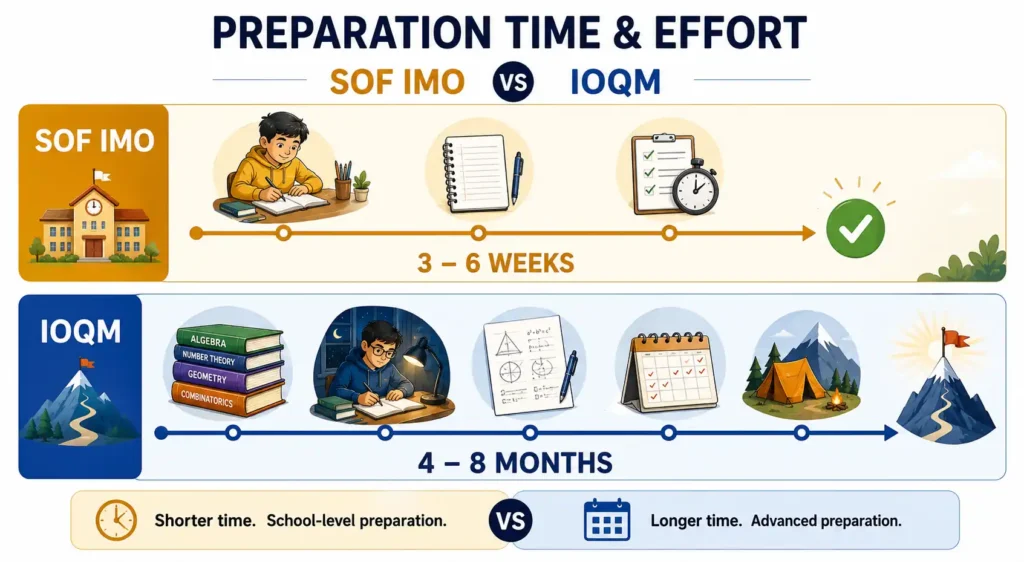
SOF IMO: Manageable alongside schoolwork. 3–6 weeks of focused practice (30–45 min/day) revise school concepts, practice SOF IMO sample papers, and work on logical reasoning.
For Level 2, add 2–4 more weeks.
IOQM: 4–8 months of consistent effort. Students must learn new concepts from scratch (number theory, combinatorics, Olympiad geometry) using Olympiad textbooks.
Expect 1–2 hours of daily practice focused exclusively on Olympiad maths.
SOF IMO is a sprint alongside school studies. IOQM is a marathon requiring dedicated training.
Which Olympiad Should You Prepare For?
Classes 1–5: Start with SOF IMO
IOQM isn’t designed for this age group. SOF IMO gives young learners their first taste of competitive maths in a supportive, school-based environment.
Focus on building confidence and enjoying the process.
Classes 6–8: SOF IMO First, Then Explore IOQM
Continue SOF IMO while gradually building Olympiad foundations. If your child consistently excels (qualifying for Level 2), introduce basic number theory and combinatorics.
Class 8 is often the earliest realistic IOQM entry point, though most students benefit from starting formal IOQM prep in Class 9 after building a stronger base.
The SOF IMO vs IOQM decision for Class 8 students usually comes down to this: if you’re among the strongest maths students in your school and enjoy challenging problems, start exploring IOQM alongside SOF IMO.
Otherwise, strengthen your SOF IMO performance first.
Classes 9–12: Choose Based on Goals
By Class 9, the paths diverge clearly.
For mathematical exposure, recognition, and enrichment → continue with SOF IMO. It provides awards, certificates, and competitive satisfaction without requiring a major time investment.
For serious competitive maths, national recognition, or representing India at IMO → IOQM should be your primary focus.
SOF IMO can remain a secondary activity, but your preparation energy should shift to Olympiad-level problem-solving.
Already Strong in Maths?
If school maths feels too easy and you enjoy challenging problems, attempt IOQM directly.
Mathematical readiness matters more than Olympiad history.
Can SOF IMO Help in IOQM Preparation?
Yes but with caveats. SOF IMO builds the ground floor; IOQM requires several more storeys.
How it helps: SOF IMO develops speed, accuracy, logical reasoning, and comfort with competitive formats.
The logical reasoning section trains pattern recognition and analytical thinking skills that underpin all Olympiad problem-solving.
Where SOF IMO stops: It doesn’t teach number theory, combinatorics, or advanced geometry. It doesn’t require constructing mathematical arguments or working without MCQ options.
The transition requires learning new topics and a new style of mathematical thinking.
The bridge: Pick up an introductory Olympiad textbook, start with basic number theory and combinatorics, and work through math Olympiad questions at increasing difficulty.
Our guide on how to get better at solving math Olympiad questions covers the skill-building approach you’ll need.l.
SOF IMO and IOQM aren’t competing paths; they’re sequential stages for students who want to progress in competitive mathematics.
Olympiad Pathways: SOF IMO vs the National Olympiad Route
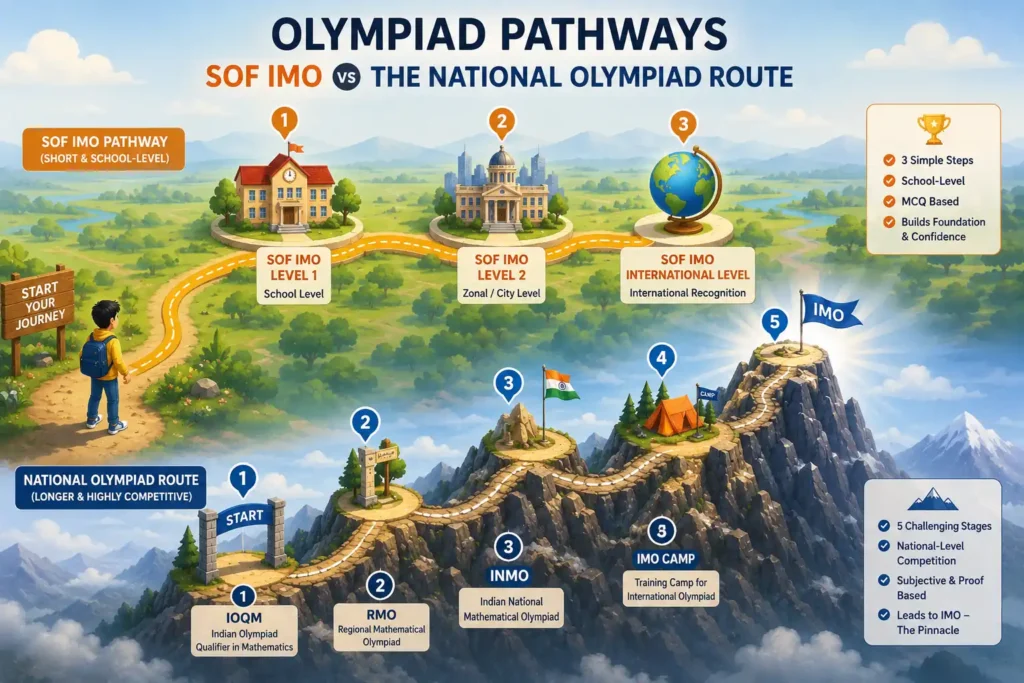
SOF IMO Pathway
Level 1 (School) → Level 2 (National) → International Level
Self-contained within the SOF ecosystem. Awards include medals, certificates, and scholarships.
Important: SOF’s “International” level is not the same as the IMO completely different competitions run by different bodies.
National Olympiad Pathway
IOQM → RMO → INMO → IMO Training Camp → Team Selection → IMO
India’s official pathway coordinated by HBCSE. Each stage is harder; qualifying students shrink dramatically.
IOQM sees lakhs of registrations; only 6 students represent India at IMO.
Many students do both SOF IMO for experience and recognition, while simultaneously preparing for the national pathway.
Common Mistakes to Avoid
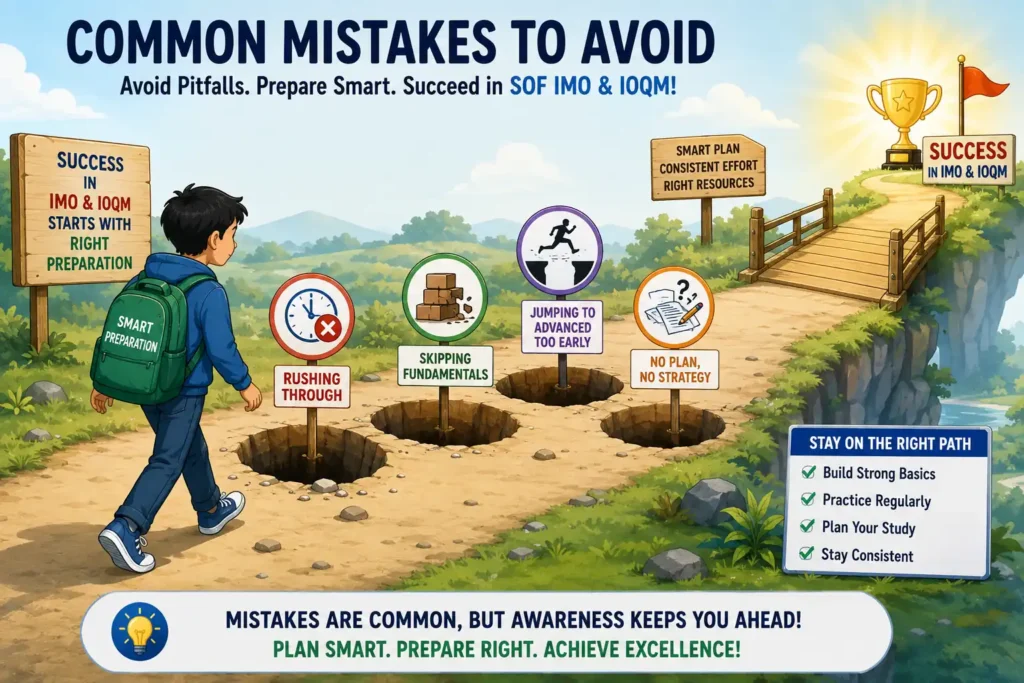
Jumping into IOQM too early. Without adequate preparation, it leads to discouragement.
If a student isn’t comfortable with basic Olympiad concepts yet, starting with SOF IMO and building up is smarter than diving into IOQM and struggling.
Assuming SOF IMO success means IOQM readiness. Topping SOF IMO at the school level is a great achievement but it doesn’t automatically mean you’re ready for IOQM.
The difficulty gap is real, and bridging it takes deliberate, focused preparation in Olympiad-specific topics.
Ignoring fundamentals. Both exams reward strong problem-solving habits, such as reading carefully, exploring multiple approaches, and checking answers.
Students who rush to advanced problems without mastering the basics often plateau. Our guide on how to improve problem-solving skills for Olympiads can help.
Underestimating IOQM time commitment. This isn’t a few-weekend exam. Planning and starting months before the exam date is essential.
No structured plan. Random problem-solving leads to scattered knowledge. Whether preparing for SOF IMO or IOQM, follow a structured, topic-by-topic progression with increasing difficulty.
Treating SOF IMO as “not worth it.” Even serious IOQM aspirants benefit from the competitive experience, confidence, and fundamental skills that SOF IMO builds in earlier years.
Which is harder, SOF IMO or IOQM?
IOQM is significantly harder. SOF IMO covers school curriculum with logical reasoning; IOQM tests advanced number theory, combinatorics, and Olympiad geometry with integer-answer format (no MCQs).
Can I attempt both?
Yes. They have different exam dates. Many students participate in SOF IMO for experience while preparing for IOQM separately.
Which should I start with first?
SOF IMO for most students. It builds foundational skills in a familiar environment. Students in Classes 9–12 with strong maths ability can start IOQM directly.
Is SOF IMO enough for competitive maths?
It’s an excellent introduction but not sufficient for national/international level. IOQM → RMO → INMO is the pathway for serious competitive maths.
What class should I start preparing for IOQM preparation?
Most students benefit from starting in Class 8 or 9. Build a strong foundation through SOF IMO and school maths in earlier classes.
Does SOF IMO help with IOQM?
Indirectly, it builds reasoning, speed, and competitive exam comfort. But IOQM-specific topics (number theory, combinatorics, Olympiad geometry) require additional dedicated preparation.
Is SOF IMO the same as the International Mathematical Olympiad?
No. SOF IMO is a school-level exam by the Science Olympiad Foundation. The IMO is the world’s most prestigious maths competition; India’s team is selected through IOQM → RMO → INMO managed by HBCSE.
Can SOF IMO awards help in college admissions?
They strengthen a student’s profile. However, achievements in the national Olympiad pathway (IOQM/RMO/INMO) carry significantly more weight for top-tier admissions. Learn more about SOF IMO awards and recognition.
Make Preparing for Math Olympiad Simple!



Final Verdict
SOF IMO is the right starting point if you’re in Classes 1–8, new to competitive maths, or want a structured school-level Olympiad experience with awards and recognition.
IOQM is the right choice if you’re in Classes 8–12, have a strong maths foundation, and want to pursue the national Olympiad pathway leading to RMO, INMO, and ultimately the IMO.
Many students do both and that’s a smart strategy. SOF IMO builds your foundation; IOQM tests whether that foundation can hold advanced problem-solving weight.

Mikha Piregu is a Content Writer with experience spanning educational content, including math and math olympiad topics, as well as advocacy writing, research-based articles, and SEO-driven web content. He creates high-quality blog content, web copy, and feature articles that support brand visibility, audience engagement, and long-term organic growth through data-informed storytelling. Skilled in WordPress, WooCommerce, and modern digital tools, Mikha adapts content across various platforms, including blogs, websites, campaigns, and advocacy initiatives, with clarity and purpose.




There are no comments posted here yet.
Sign in to leave a comment