 August 20, 2025
 14 min. read

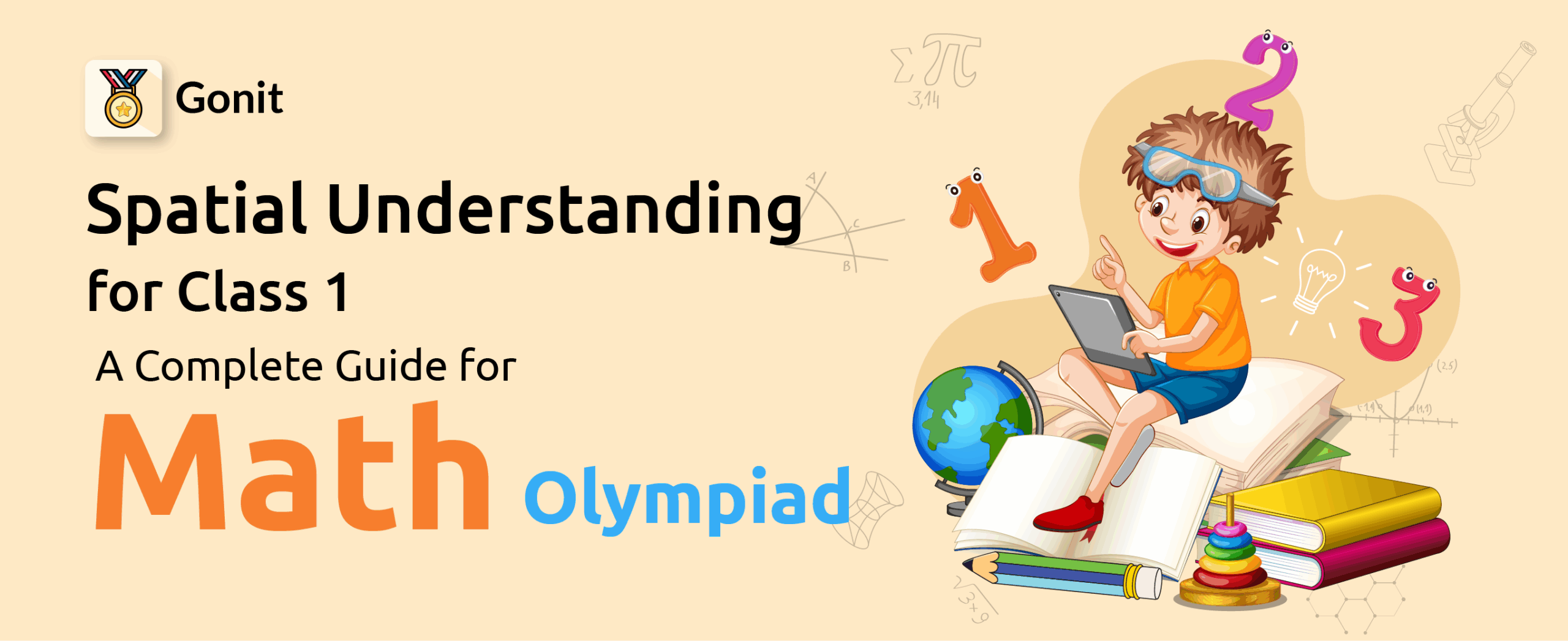
Spatial Understanding for Class 1 means helping children recognize where objects are placed and how they move in relation to each other.
It includes learning position words like above, below, beside, inside, and between. These early spatial skills build the foundation for geometrical shapes for Grade 1, problem-solving, and logical thinking in later grades.
In simple terms, spatial understanding in maths refers to the ability to perceive, describe, and reason about space; where things are, how far they are, and in which direction they face or move.
It is one of the most foundational concepts in early childhood mathematics.
Expert Insights

“Spatial understanding is the first step for children to see, sense, and shape the world around them.”
What is Spatial Understanding?
Spatial understanding definition: It is the ability to recognize positions, directions, and locations of objects in space using simple words like above, below, beside, near, and far.
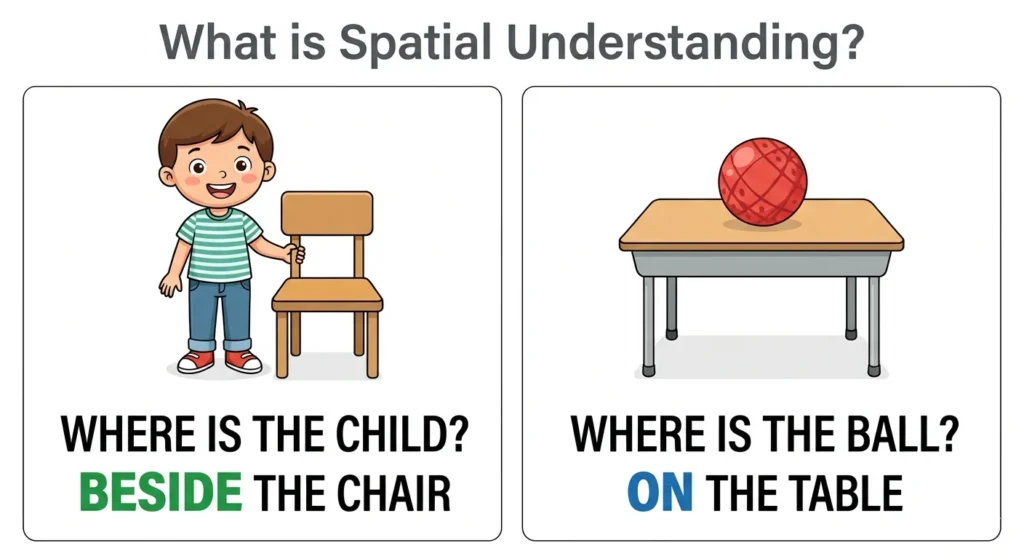
In everyday language, spatial meaning in maths is understanding where something is and how it relates to other things around it.
If your child can describe where a book is placed (“The book is under the table”) or follow directions like “Stand behind the chair,” they are already developing spatial awareness.
Spatial understanding meaning can also be described as:
- Knowing where your body is in space
- Using words to describe object placement
- Following directional instructions accurately
- Identifying spatial relationships between objects
Let’s break this down in a simple and practical way.
What is Spatial Understanding for Kids?
Spatial understanding is the ability to:
- Recognize positions of objects
- Understand direction and movement
- Describe locations using words
- Compare distances (near, far)
- Identify relative positions (left, right, between)
In Grade 1, children don’t study formal geometry. Instead, they learn spatial concepts for grade 1 through everyday experiences and simple classroom activities.
This also connects closely to critical thinking activities for Grade 1, where children begin reasoning about the world around them.
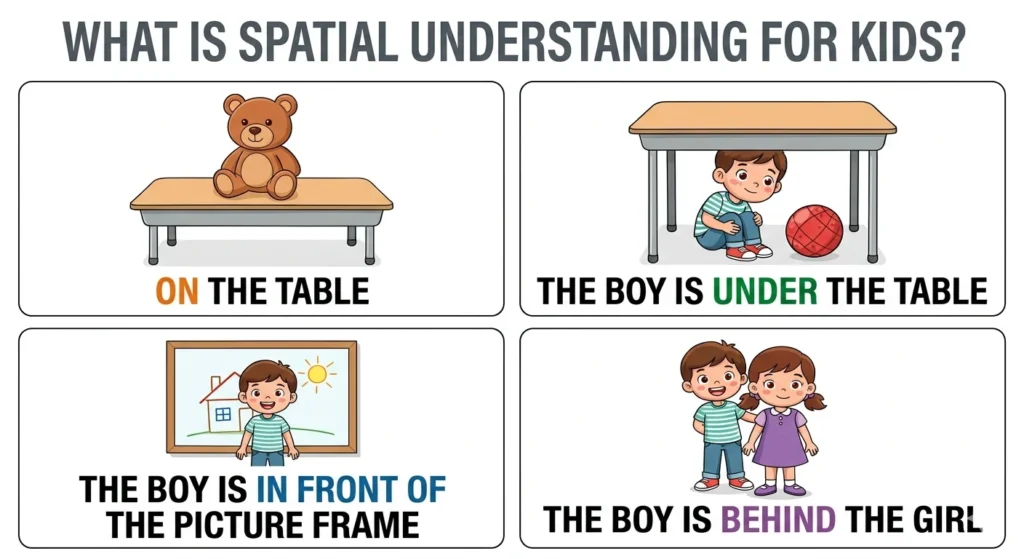
Here’s a simple description of common position examples:
- On – A teddy bear is placed on the table.
- Under – A boy is sitting under the table with a ball.
- In front – A boy is standing in front of a picture frame.
- Behind – A boy is standing behind a girl.
Why Spatial Skills Matter in Early Childhood
Spatial skills are not just about position words. They help children:
- Improve reading and writing direction (left to right)
- Understand number lines for Class 1
- Follow instructions correctly
- Develop problem-solving skills
- Build strong math foundations
Research shows that strong spatial reasoning for class 1 improves later math performance. When children understand space, they understand patterns, shapes, and logical relationships better.
Spatial awareness in math also connects to:
- Reading coordinates and graphs (later grades)
- Understanding symmetry and reflection
- Geometry and shape recognition
In simple words, spatial awareness helps children make sense of the world around them.
Spatial Understanding Meaning in Maths: Quick Reference
Understanding the difference between related terms helps teachers and parents teach more effectively.
| Term | Meaning |
|---|---|
| Spatial understanding | Knowing where things are and how they relate to each other |
| Spatial sense | The intuitive ability to understand space and position |
| Spatial reasoning | Thinking logically about objects in space |
| Spatial awareness | Being conscious of your own body position in relation to surroundings |
| Positional language | Words that describe where something is (on, under, beside) |
| Directional concepts | Words describing movement or facing direction (left, right, forward) |
Key Spatial Vocabulary for Grade 1
Teaching positional words for Class 1 is the first step. Here is a helpful spatial vocabulary table you can use:
| Position Word | Meaning | Example Sentence |
|---|---|---|
| Above | Higher than | The fan is above the table. |
| Below | Lower than | The bag is below the desk. |
| Beside | Next to | The chair is beside the table. |
| Between | In the middle of two things | The cat is between two boxes. |
| Near | Close to | The park is near my house. |
| Far | Not close | The school is far from the lake. |
| Inside | Within something | The toys are inside the box. |
| Outside | Not inside | The dog is outside the house. |
| Left | Direction opposite of right | Raise your left hand. |
| Right | Opposite of left | Turn right at the corner. |
You can turn this into a position words worksheet for grade 1 by asking children to fill in blanks or match pictures with words.
💡 Tip for Parents: These positional words for kindergarten also apply to Class 1. Start introducing them during play and daily routines before formal schooling begins. You can also explore odd one out activities for Class 1 to build early visual and positional reasoning together.
Key Concepts in Spatial Understanding for Class 1
Spatial understanding is a key early learning skill.
For Class 1 students, it means using position and direction words, building spatial reasoning, and developing awareness of their body in space; skills that support math, problem-solving, and everyday activities.
1. Position (Placement and Location)
Position words describe where one object is compared to another. These are often taught through picture-based activities and classroom worksheets.
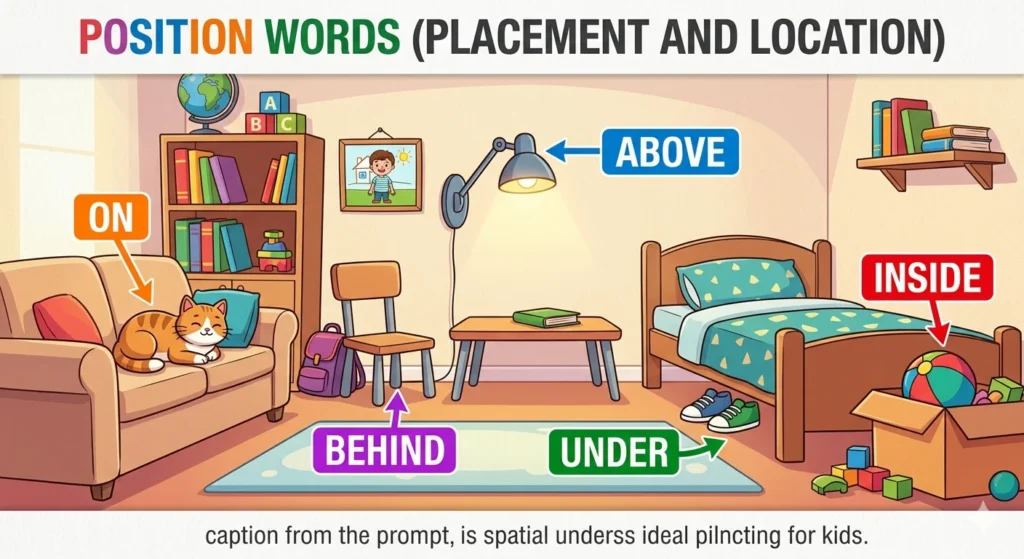
- On and Under: “The cat is on the sofa.” / “The shoes are under the bed.”
- In Front and Behind: “Stand in front of the board.” / “The bag is behind the chair.”
- Next to and Between: “Sit next to your friend.” / “Sita is between two classmates.”
- Near and Far: “The rabbit is near the tree.” / “The squirrel is far from the tree.”
- Above and Below: “The fan is above the table.” / “The mat is below the chair.”
- Inside and Outside: “The ball is inside the box.” / “The dog is outside the house.”
- Before and After: Understanding sequence in time or space, like brushing teeth before sleeping.
These position words are essential building blocks in early childhood education. They also form the language base children need for data handling for Class 1, where sorting and classifying objects by position is a key skill.
2. Direction (Movement and Orientation)
Direction tells us the way something moves or is placed. It supports spatial awareness, following instructions, and safe navigation.
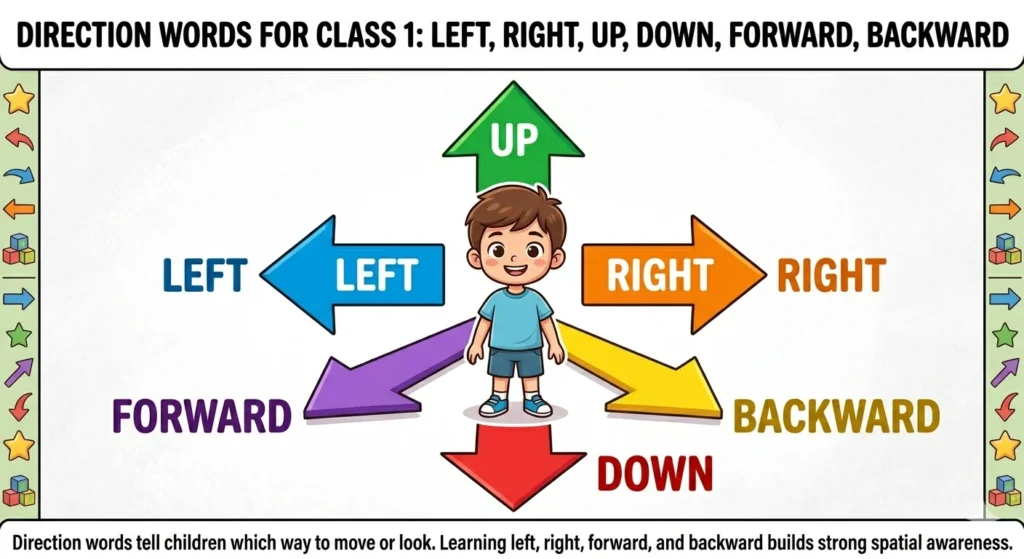
Types of basic directions taught in Class 1:
- Left and Right: “Raise your right hand.” / “The ball is on your left side.”
- Forward and Backward: “Step forward two times.” / “Move backward slowly.”
- Up and Down: “Look up at the sky.” / “Sit down on the chair.”
- Front and Back: “Stand in front of the board.” / “The bag is at the back of the chair.”
By practicing direction words (orientation, movement, path), children develop confidence in both classroom and real-life settings.
3. Spatial Reasoning (Thinking with Objects)
Spatial reasoning is the ability to imagine how objects look, move, or fit together.
It is sometimes called visual reasoning or arrangement thinking, and it strengthens problem-solving skills.
Examples for kids:
- Jigsaw puzzles: Thinking about which piece fits where.
- Building blocks: Figuring out how to stack blocks without falling.
- Tangrams or shape puzzles: Visualizing how shapes combine to make pictures.
These activities support cognitive development, logical thinking, and creative play.
Spatial reasoning also reinforces alphabet patterns for Class 1, where children use visual sequencing and positional logic to recognize letter forms and arrangements.
4. Spatial Awareness (Body in Space)
Spatial awareness means knowing where your own body is in relation to objects and people. It’s about understanding personal space, avoiding collisions, and moving confidently.
Examples:
- Standing behind a desk
- Sitting between two friends
- Running in the playground without bumping into others
- Stretching arms without hitting someone nearby
This skill links to body awareness, orientation skills, and safe movement; important in both classroom learning and everyday life.
Spatial Vocabulary and Core Concepts for Class 1
Spatial understanding in Class 1 builds the foundation for awareness, reasoning, and problem-solving.
By learning position and direction words, children describe where things are and how they move. Worksheets, pictures, and games make this skill fun, meaningful, and useful for math and everyday life.
Positional Words: Making Sense of Where Things Are
Positional words (also called placement words or prepositions for kids) are key to describing the location of objects. They help children express spatial relationships in a clear way.
- On → Describes when something rests upon another. Example: “The cat is on the mat.”
- Under → Refers to being below. Example: “The shoes are under the bed.”
- Inside → Indicates something is enclosed. Example: “The cookies are inside the jar.”
- Outside → The opposite of inside. Example: “We played outside the house.”
- Above → Higher but not touching. Example: “The bird is flying above the tree.”
- Below → Lower than something else. Example: “The river flows below the bridge.”
- Near → Close in distance. Example: “The school is near the park.”
- Far → Opposite of near. Example: “The mountain is far from our town.”
These position words appear frequently in classroom instructions (sit behind, stand next to, place your book on the desk) and in home practice activities with toys and objects.
Directional Words: Navigating Space and Movement
Direction words are essential for orientation and navigation. They help students follow instructions, understand movement, and develop spatial reasoning.
- Up / Down → Moving vertically. “Climb up the stairs, walk down the hill.”
- Forward / Backward → Moving ahead or behind. “Step forward two spaces, move backward one step.”
- Left / Right → Core to navigation and awareness. “Hold the ball in your left hand.”
- Front / Behind → Orientation in space. “The dog is hiding behind the curtain.”
Teachers often use picture-based worksheets for spatial reasoning to reinforce these terms, making learning visual and engaging.
Size and Measurement: Comparing the World Around Us
Spatial concepts also include comparing size, length, and height; early math skills that children use daily.
- Bigger / Smaller → “An elephant is bigger than a dog.”
- Longer / Shorter → “This pencil is longer than that one.”
- Taller / Shorter → “The tree is taller than the house.”
These early learning skills strengthen visual learning and prepare kids for math worksheets in higher grades.
They also connect directly to measurement for Class 1, where children begin comparing lengths, weights, and heights using simple tools and language.
Temporal Positioning: Sequencing in Time
Spatial awareness also links with temporal words that describe sequence and order.
- Before → “We brush our teeth before bed.”
- After → “We eat lunch after school.”
Such spatial awareness activities connect location, direction, and sequence, creating a complete foundation for cognitive development in early childhood.
Difference Between Position and Direction for Class 1
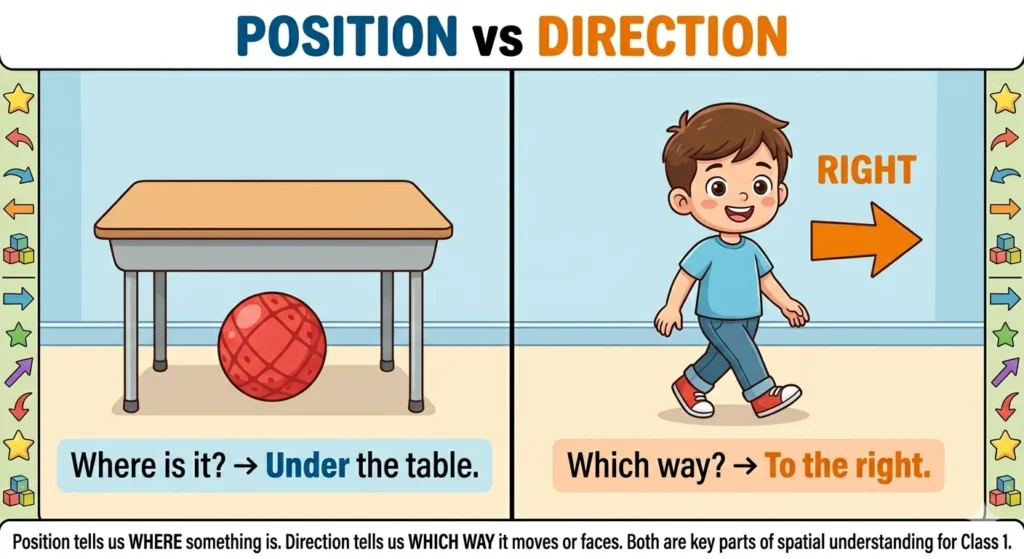
| Aspect | Position | Direction |
|---|---|---|
| Meaning | Where an object is located | The way an object is moving or facing |
| Examples of Words | On, under, above, below, next to, between | Left, right, forward, backward, up, down |
| Question it answers | Where is it? | Which way to go? |
| Example Sentence | “The ball is under the table.” | “The boy walked to the right.” |
| Focus | Placement / location | Movement / orientation |
What is Spatial Relationship for Class 1?
A spatial relationship describes how one object is positioned in relation to another.
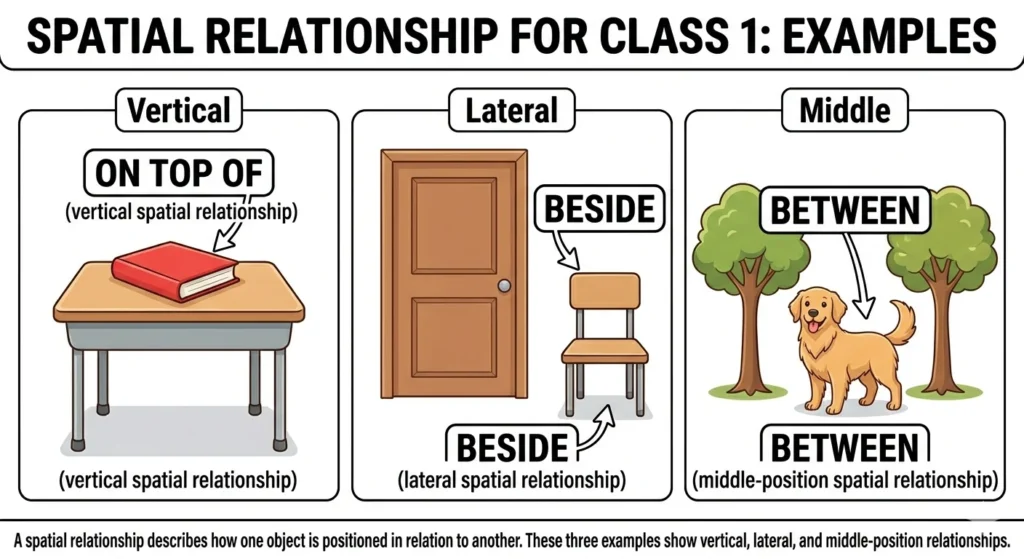
For example:
- “The book is on top of the table.” → The book and table share a vertical spatial relationship.
- “The chair is beside the door.” → A lateral spatial relationship.
- “The dog is between the two trees.” → A middle-position spatial relationship.
Understanding spatial relationships in math helps Class 1 students:
- Describe scenes accurately
- Follow map-like instructions
- Build early geometry skills
Common locational words used to describe spatial relationships include: on, under, over, beside, between, near, far, inside, outside, above, below, in front of, behind.
This understanding also supports geometrical shapes for Grade 1, where children begin identifying how shapes relate to one another in space.
Real-Life Examples Children Understand
Children learn best from daily life. Here are simple examples:
- “Your shoes are under the bed.”
- “The clock is above the door.”
- “Stand between your friends.”
- “Put your bottle inside the bag.”
- “Walk straight and turn left.”
These everyday instructions build spatial awareness for kids naturally. When children hear and use these words in real settings, the learning sticks far better than worksheets alone.
Real Classroom Activities for Teaching Positional Words
Teachers can use these easy activities:
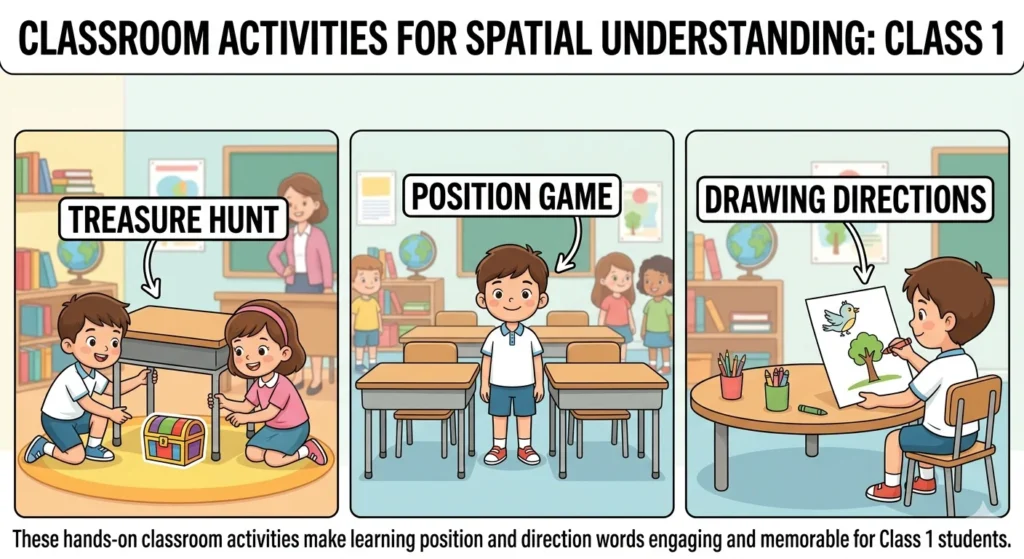
1. Classroom Treasure Hunt
Give clues using direction words:
- “Look under the teacher’s table.”
- “Check beside the window.”
2. Human Position Game
Ask students to:
- Stand behind a chair.
- Sit beside a friend.
- Stand between two desks.
3. Object Arrangement Activity
Place three objects on a table. Ask:
- Which object is in the middle?
- Which one is on the left?
4. Drawing Directions
Give instructions:
- Draw a tree.
- Draw a bird above the tree.
- Draw a dog below the tree.
5. Following Direction Sentences
Give verbal instructions for kids to act out:
- “Move forward three steps, then turn right.”
- “Place the pencil inside the box, then beside the box.”
This develops both following directions with spatial concepts and listening comprehension simultaneously.
You can extend this activity by incorporating critical thinking activities for Grade 1 where children must reason about multiple positional steps at once.
These hands-on activities make spatial sense for class 1, engaging and clear.
At-Home Spatial Awareness Activities for Parents
You don’t need special materials. Try these:
1. Toy Placement Game
Ask your child:
- Put the teddy inside the box.
- Place the ball under the chair.
2. Cooking Helper
- “Keep the spoon beside the plate.”
- “Put the vegetables inside the bowl.”
3. Walking Directions
While walking:
- “Turn left.”
- “Stand near the gate.”
4. Puzzle and Block Play
Building blocks improve spatial reasoning for class 1 because children understand height, balance, and placement.
5. Near and Far Distance Game
While in the park or at home:
- Ask: “Is the tree near or far from us?”
- Point to objects: “Is the car near or far from the gate?”
This simple game builds near and far concept understanding naturally through real-life observation.
Simple daily practice builds strong spatial concepts.
Spatial Understanding Worksheets for Class 1
Worksheets are one of the most effective tools for reinforcing spatial understanding. Here is a printable practice set.
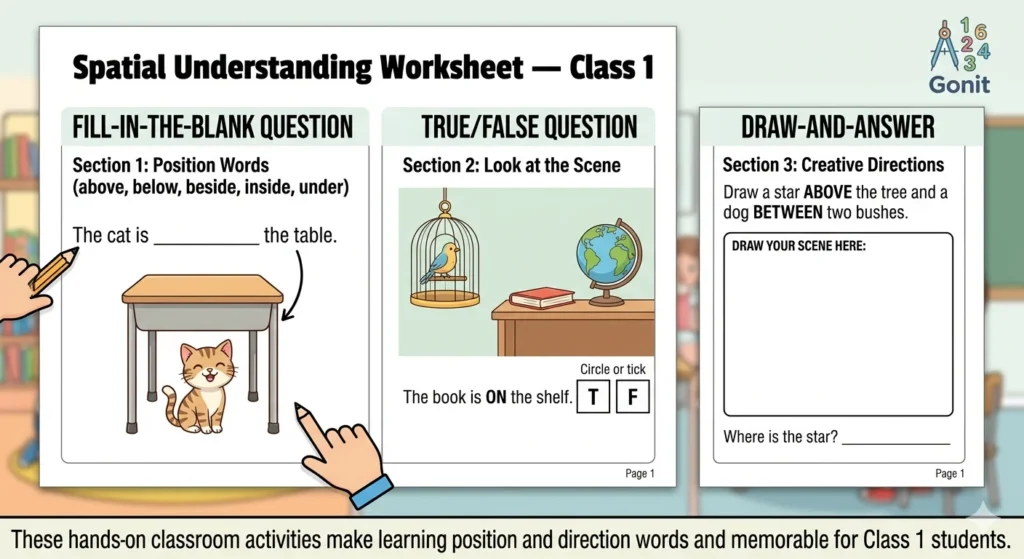
Part A: Fill in the Blanks
- The cat is ______ the table. (under / above)
- The ball is ______ the box. (inside / between)
- The tree is ______ the house. (beside / far)
- The shoes are ______ the bed.
- The park is ______ my school. (near / inside)
Part B: Answer the Questions
- What is between two chairs?
- Draw a star above a circle.
- Draw a square below a triangle.
- Stand beside your desk.
- Raise your left hand.
Part C: True or False
- “Inside” means outside something. (False)
- “Near” means far away. (False)
- “Between” means in the middle. (True)
Part D: Position Words Exercise
Look at the picture and answer:
- Where is the cat? (on / under / beside the mat)
- Where is the dog? (inside / outside / above the house)
- Where is the bird? (above / below / behind the tree)
💡 Teacher Tip: For additional spatial understanding worksheets for grade 1, extend Part D with picture-observation tasks where children circle the correct positional word. These worksheets pair well with measurement for Class 1 activities, where size-comparison words like bigger, smaller, taller, and shorter reinforce the same positional vocabulary in a new context.
Common Mistakes Children Make
- Confusing left and right
- Mixing up inside and outside
- Forgetting that “between” needs two objects
- Struggling with direction words like forward and backward
- Answering without visualizing the scene
- Confusing “near” and “beside”; near means close to, beside means directly next to
The solution? Always use real objects and demonstrations. Children learn positional language through physical experience, not just reading.
1. What is spatial understanding for Class 1?
It is the ability to understand positions, directions, and locations of objects using simple words like above, below, and beside.
2. Why is spatial awareness important for kids?
It helps improve problem-solving, reading direction, and early math skills.
3. How do I teach positional words at home?
Use daily instructions like “Put the book under the table” or “Stand beside the chair.”
4. What are examples of direction words for Class 1?
Left, right, forward, backward, near, and far.
5. Is spatial understanding part of geometry?
Yes, it is an early stage of geometry learning focused on position rather than shapes.
6. What activities improve spatial reasoning?
Block building, treasure hunts, drawing instructions, and puzzle games.
7. How can teachers assess spatial skills?
By giving practical tasks like placing objects or drawing according to directions.
8. What is the difference between near and beside?
“Near” means close to. “Beside” means directly next to.
9. What is spatial understanding meaning in maths?
In maths, spatial understanding means the ability to recognize, describe, and reason about the position, direction, and relationships of objects in space.
10. What are spatial concepts in math?
Spatial concepts in math include positional words (above, below, beside), directional words (left, right, forward), and measurement comparisons (bigger, smaller, taller, shorter). These form the basis of early geometry learning and are closely connected to measurement for Class 1.
Make Preparing for Math Olympiad Simple!



Final Thoughts
Spatial understanding may seem simple, but it builds the foundation for future math learning.
When children clearly understand location words for kids and basic spatial relationships, they feel more confident in math and everyday tasks.
The spatial understanding meaning goes beyond just knowing where things are; it shapes how children think, navigate, and solve problems throughout their academic journey.
Start small. Use real objects. Practice daily.
As children grow more confident with position and direction words, they are ready to explore connected topics like geometrical shapes for Grade 1, measurement for Class 1, and number lines for Class 1; each of which builds on the spatial foundation laid right here.