

The Continental Mathematics League (CML) is a school-based math competition for students in grades 2 through 9 plus an AP-level Calculus League. It runs 3 to 5 meets per school year with several word problems in each.
- What Is the Continental Math League?
- What Grades Can Take Part in CML?
- How the CML Contest Works
- How Team Scoring Works
- How CML Scoring, Awards and Certificates Work
- What Do Continental Math League Questions Look Like?
- How to Register Your Child for the Continental Math League
- Continental Math League Cost and Fees
- How to Prepare Your Child for CML
- Where to Find CML Practice Problems and Past Papers
- How CML Compares to Other Math Competitions
- FAQ
- Conclusion
- Related guides
Schools register as teams, so your child takes part through their school instead of signing up alone. CML has run since 1980.
By the end you’ll know which division fits your child, when the 2026–27 meets fall and what a season costs.
Quick Takeaways
- What it is: a school-based math contest for grades 2 through 9, plus an AP-level Calculus League, run since 1980.
- Grades and divisions: grades 2-3 run their own contest; grades 4-9 split into Euclidean and Pythagorean divisions; high school students can take the AP-level Calculus League.
- Format: about 6 problems in 30 minutes per meet, with 3 to 5 meets spread across the school year.
- 2026–27 dates: grades 4–9 meet Nov 5 and Dec 3 in 2026 and Jan 7, Feb 4 and Mar 4 in 2027; grades 2–3 meet Jan 7, Feb 4 and Mar 4 in 2027.
- How to prep: short timed practice by grade, one topic at a time, plus grade-matched reps in an app like Gonit between meets.
What Is the Continental Math League?
The Continental Math League is a math contest that schools run for their own students, usually as an enrichment or math-club activity.
Instead of traveling to a testing center, students take timed problem sets right in their classroom on set dates, and a teacher scores them and reports the results.
It’s designed to feel like a game more than a high-stakes exam. That makes it a gentle on-ramp to competition math for elementary and middle-school kids, and a popular pick among school math club and math league programs.
If competition math is new to your family, it helps to see where CML sits in the wider landscape first. Our parent’s guide to junior math olympiads walks through what these contests are and how to tell if your child is ready.
Who Runs CML and How Long It’s Been Around
CML is run by the Continental Mathematics League, which has offered the contest since 1980. Per its official About page, the group is now in its 46th year, so this is a long-established program and no new startup.
It was created by educators who wanted a classroom-friendly way to bring competition problems to younger students, and it has since grown into a family of Leagues that also covers science, geography, social studies and language arts alongside its math contests.
Is CML a National Competition?
CML is offered to public and private schools across the United States, so it has national reach, but it is not a single centralized event like a national championship.
Each participating school signs up its own team and administers the meets locally within the scheduled windows. So the day-to-day experience can look a little different from school to school, but the problem sets and scoring rules are the same everywhere.
In short, it’s national in coverage but school-organized in practice, and results feed into National and Regional rankings once scores are reported.
What Grades Can Take Part in CML?
Which contest your child takes depends on their grade:
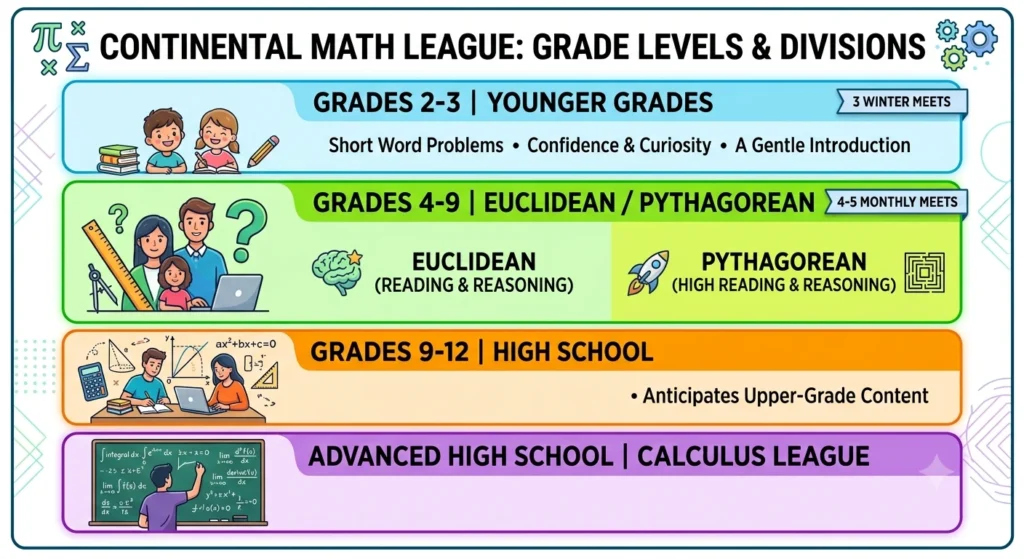
| Level | Who it’s for | What’s different |
|---|---|---|
| Younger grades | Grades 2–3 | Their own separate contest with short word problems |
| Euclidean / Pythagorean | Grades 4–9 | Two divisions split by reading and reasoning level, not by topic |
| Calculus League | High school (AP level) | 4 meets of 8 questions, 40 minutes each |
The Younger Grades (2-3)
Students in grades 2 and 3 have their own contest built for their age.
A meet at this level is a short set of word problems solved in about 30 minutes. The season is shorter too: 3 meets, all between January and March.
For many kids, this is their first timed math contest. Praise the effort after each meet and leave the score talk for later.
Euclidean vs Pythagorean Divisions (Grades 4-9)
From grade 4 through grade 9, CML math is offered in two divisions: Euclidean and Pythagorean. Both cover the same math. According to the official CML FAQ, the difference is the level of reading comprehension and analytical reasoning the questions demand.
The Euclidean division uses questions that call for average reading comprehension and analytical reasoning, while the Pythagorean division uses questions that call for above-average reading comprehension and analytical reasoning.
Schools decide which division fits their students, and a student competes in only one division per season, so recognition stays clear within each group.
The Calculus League for High School Students
For high school students, CML offers one math league: the Calculus League, listed at the Advanced Placement level.
It runs 4 meets of 8 questions, with 40 minutes per meet. The questions are written to prepare students for the AB level of the AP Calculus exam, and calculators approved by ETS may be used.
How the CML Contest Works
The mechanics of a CML meet are refreshingly simple, which is part of the appeal. Here’s what happens on contest day.
How Many Meets There Are and When
CML runs as a series of meets across the school year (typically 3 to 5, depending on the grade level and league), and scores build up from one meet to the next.
The official CML site notes that each contest is given within a designated window instead of on one fixed day nationwide.
Grades 4–9 get five meets in 2026–27 and grades 2–3 get three:
| Grades | 2026–27 meet dates |
|---|---|
| 4–9 (Euclidean and Pythagorean) | Nov 5 and Dec 3 (2026); Jan 7, Feb 4 and Mar 4 (2027) |
| 2–3 | Jan 7, Feb 4 and Mar 4 (2027) |
Your school may run each meet on a nearby day inside its window, so confirm the exact dates with your school coordinator.
Problems Per Meet and the Time Limit
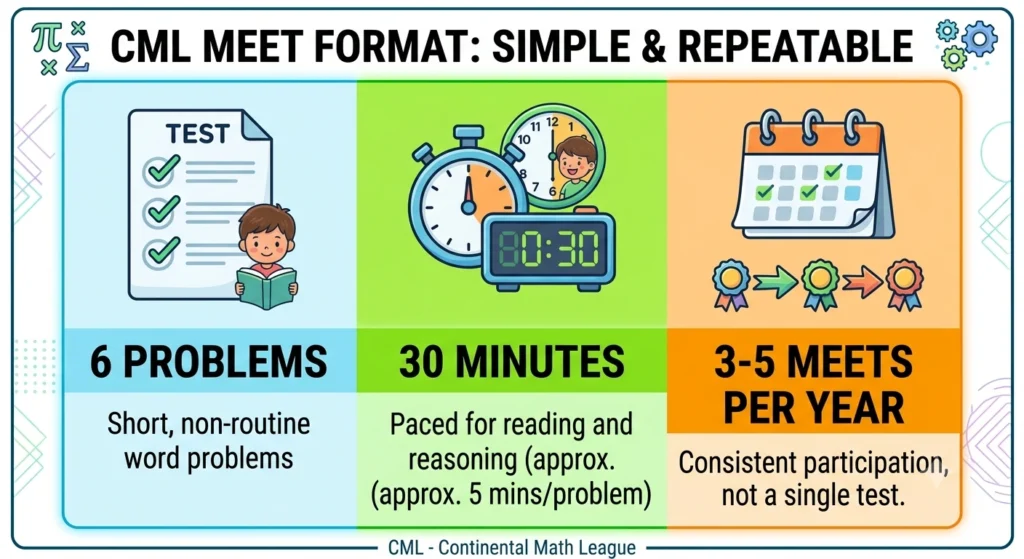
A typical CML meet is short: around 6 problems to solve in 30 minutes, roughly five minutes per problem. That’s enough time to read carefully and check your work without rushing.
The exact count and time limit can vary by league. The Calculus League, for example, allows more time for more problems. Still, the “a handful of problems in half an hour” shape holds across the younger levels, and it’s one reason CML feels approachable for elementary students who might find a longer exam intimidating.
How Team Scoring Works
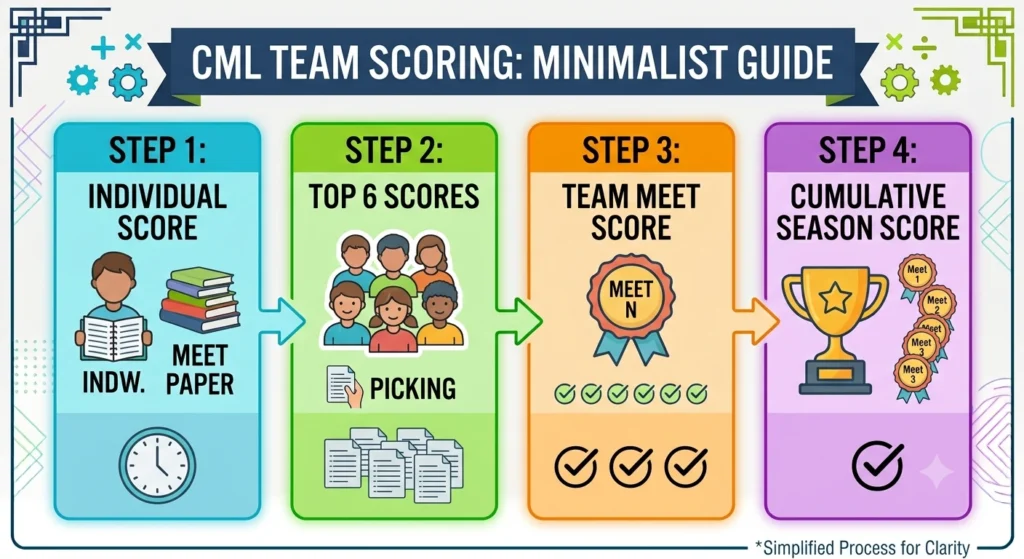
CML rewards the whole team as well as individual stars. When a school enters a team, the official CML FAQ explains that the team’s math score for each meet is the sum of its top 6 individual student scores, while other subject leagues use the top 10.
Those meet scores then add up into a cumulative score across the season. So a child doesn’t have to be the single best mathematician in the school to matter to the result, which encourages a whole group to practice together.
Individual students still earn their own recognition, and the roster of top scorers can even change from meet to meet, but the team framing makes CML a nice fit for math clubs and classrooms.
Is the Continental Math League Hard?
This is one of the most common questions parents search for, and the short answer is that CML is designed to be challenging without being overwhelming.
The questions are intentionally non-routine word problems that lean on reading comprehension and multi-step logic instead of memorized formulas. A child who is strong in school math can still be tripped up by tricky wording if they rush.
The Pythagorean division is noticeably harder than the Euclidean division for the same grade, and problems get harder as students move from the youngest grades toward grade 9 and the Calculus League.
That said, CML is generally considered gentler than a single high-stakes exam. Because scores accumulate across several meets, one rough day doesn’t sink a student’s season, and the low-pressure classroom setting keeps the experience feeling more like practice than a final exam.
Most families find that a bit of regular timed practice beats last-minute cramming when it comes to making CML problems feel manageable.
How CML Scoring, Awards and Certificates Work
Beyond the basic team-score math, parents often want to know what recognition their child can earn.
Each participating team receives a set of certificates and medals to distribute to its own top contributors, and CML also runs National and Regional recognition on top of that.
Individual students can be named National Student Winners by grade and division for standout performances, such as a perfect score across all of a season’s meets, and top teams can earn National Team Championship honors based on their cumulative scores.
For a family just starting out, the practical takeaway is simpler. A child’s individual score is the total number of problems they solve correctly across every meet they take. Consistent participation, more than a single perfect round, is usually what earns recognition.
That structure is part of why CML doubles as a confidence-builder as much as a competition.
What Do Continental Math League Questions Look Like?
Parents naturally want to know what their child will face. CML problems are word problems that reward clear reading and logical steps. Memorized formulas and calculator tricks won’t carry a child far.
If you’d like a broader sense of the style, our overview of the kinds of questions math olympiads ask is a useful companion, and our guide to how to solve math word problems breaks down a reusable step-by-step approach.
The examples below are original, written in the same spirit as CML problems to show the flavor. They are not copied from any official CML paper.
Sample Problems for Grades 2-3
At the youngest level, expect short, concrete word problems a second or third grader can picture. For example:
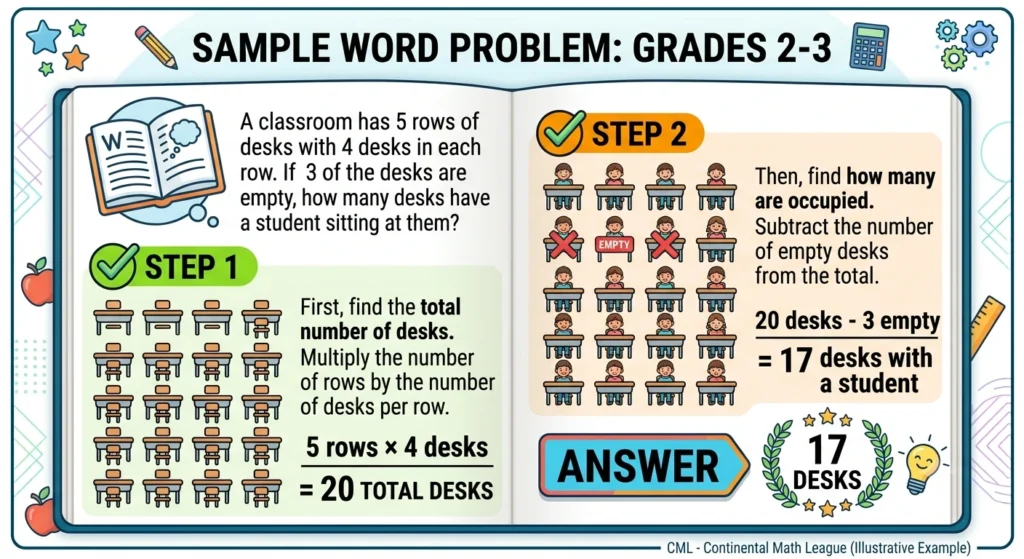
A classroom has 5 rows of desks with 4 desks in each row. If 3 of the desks are empty, how many desks have a student sitting at them?
To solve it, a child multiplies 5 by 4 to get 20 desks, then subtracts the 3 empty ones to reach 17. The math is simple, but the child has to read carefully and do two steps in the right order, which is exactly the skill CML is building. This kind of two-step word problem for second graders makes a good daily warm-up before the first meet.
What Changes in Grades 4-6 and Up
From grade 4 onward, the problems add more steps. They also start touching light number theory, geometry and early algebraic thinking. Here’s an example in that style:
What is the smallest whole number greater than 1 that leaves a remainder of 1 when you divide it by 2, by 3 and by 4?
A student reasons that the number must be one more than a number that 2, 3 and 4 all divide evenly. The smallest number divisible by all three is 12, so the answer is 13. Problems like this reward students who can spot a pattern and reason it through instead of just crunching numbers.
How to Register Your Child for the Continental Math League
Here’s the part that trips up a lot of parents: in most cases, you don’t register your child directly. CML is organized around school teams, so the usual path is that a teacher or coordinator signs the school up and enters its students.
If your child’s school already participates, the simplest step is to ask their teacher how to join the team.
If your child’s school doesn’t offer CML, there is still an option.
The official CML FAQ lists a homeschool and individual route priced at $25 per child for each league or contest, registered under a “Home School” team name instead of as part of a school roster.
Because fees can change between seasons, treat that figure as a guide and confirm the current pricing and sign-up steps on the official CML site before you enroll.
Continental Math League Cost and Fees
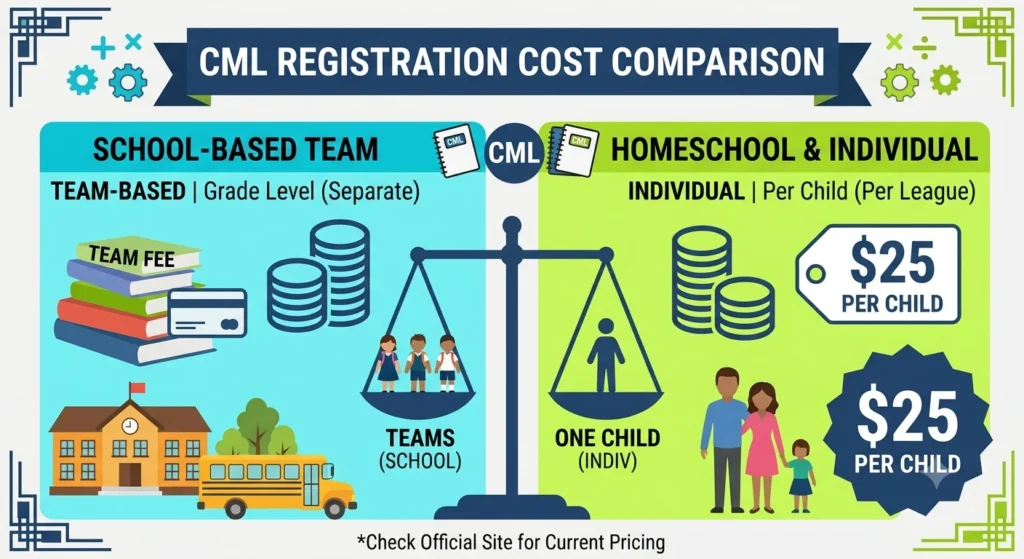
Schools pay a registration fee per league and per team for the season. Students joining outside a school use the Home School option.
| Who | Fee (2026–27) | Notes |
|---|---|---|
| Grades 2–3 school team | $90 per team | Same price for every team |
| Grades 4–9 school team (Euclidean or Pythagorean) | $100 for the first team, $85 for each additional team | Each team after the first |
| Home School | $25 per child per league | For students joining outside a school |
The fees cover the full season, not each meet.
CML also sells practice books, priced separately from registration. Fee schedules are updated by season, so the official CML pricing page is the source to check before you budget for the year.
How to Prepare Your Child for CML
Good news: preparing for CML doesn’t require a tutor or hours of drilling. Because meets are short and reward careful reasoning, a little focused practice goes a long way. Here’s a simple approach.

- Practice with a timer. Since a meet is roughly 6 problems in 30 minutes, have your child try small timed sets so the clock starts to feel familiar.
- Work through past-style problems by grade. Steady exposure to word problems at your child’s level builds the reading-and-reasoning muscle CML tests. Focus on understanding each solution as well as getting the answer.
- Target topics one at a time. Spend a week on number sense, then a week on simple geometry or logic, so each skill gets its own focus.
- Keep it light. Celebrate effort and clever thinking. This age group responds far better to encouragement than pressure.
Gonit is built specifically for math-competition practice, with grade-wise, Olympiad-style questions for grades 1-12. Hints before answering and step-by-step explanations after a wrong answer are Premium features. They help a child see where a solution went off track.
It’s one option among many for giving your child structured, low-pressure reps between meets, and it fits the reading-and-reasoning style CML uses.
Where to Find CML Practice Problems and Past Papers
Many parents look for Continental Math League past papers or sample tests, hoping for a library like some other competitions publish.
CML posts a free sample test for every grade, and you can download it from that grade’s page on the official site. It doesn’t publish a large public archive of full past contests the way some competitions do, so a home practice routine usually has to be built from a mix of sources.
Build home practice from timed word problems at your child’s grade level, and add contest-style sets as they get older.
If your child is heading toward the AMC 8 down the road, our roundup of the best free AMC practice resources and our Math Kangaroo past papers guide are both useful next steps, since the reading-heavy, multi-step style overlaps closely with what CML expects. Gonit’s own grade-wise question sets are built in that same spirit for daily reps between CML meets.
How CML Compares to Other Math Competitions
CML is often a child’s first competition, so it helps to see how it sits next to the better-known names.
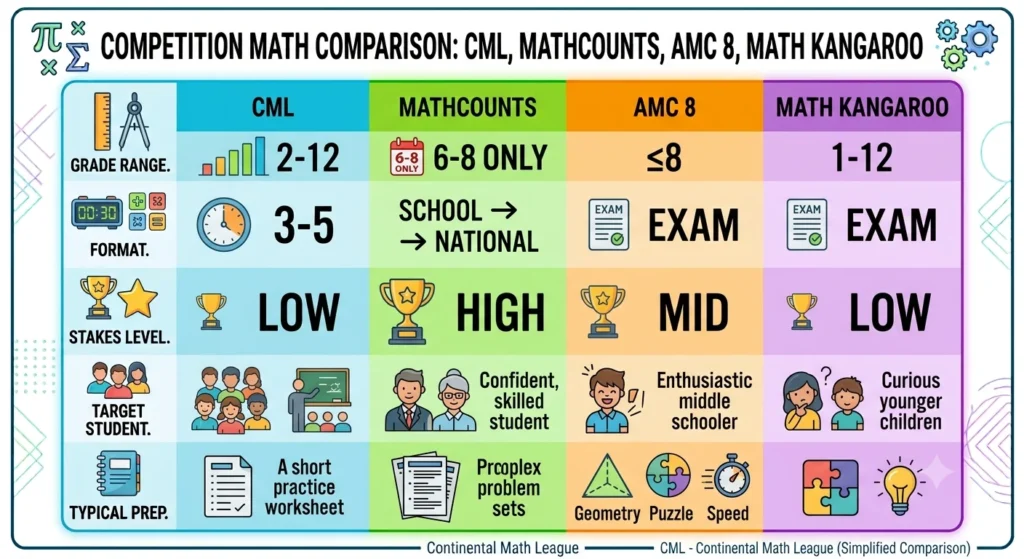
The AMC 8 is a single national exam for middle schoolers. Compared with it, CML is gentler and starts younger, and it spreads its scoring across several short meets instead of one high-stakes sitting.
Compared with Math Kangaroo, another popular elementary contest, CML leans toward classroom team participation, while Math Kangaroo is a single multiple-choice event a child enters individually.
Neither is “better”; they just suit different families and goals.
Continental Math League vs MATHCOUNTS
MATHCOUNTS is another name parents ask about, and it’s a different animal from CML. MATHCOUNTS is aimed only at middle schoolers in grades 6 through 8. It moves through school, chapter, state and national rounds and ends in a fast, head-to-head Countdown Round for top finishers.
CML, by contrast, spans grades 2 through 9 plus a Calculus League and keeps everything at the school-meet level, with no in-person regional or national rounds. It builds its results from several low-stakes meets instead of one elimination-style event.
Families who want a taste of that faster, buzzer-style format alongside CML’s steady meets can start with our MATHCOUNTS parent’s guide, and our look at the benefits of AMC-style math practice covers why families often layer more than one competition over a school year.
If you want to place CML in the full field alongside AMC, Math Kangaroo and others, see our roundup of how the top math competitions compare.
For most young students, CML is a great starting rung, and the skills it builds carry directly into those next competitions, including Math Kangaroo participation and beyond.
FAQ
What is the Continental Math League?
The Continental Math League (CML) is a school-based math competition for students in grades 2 through 9, plus an AP-level Calculus League, that has run since 1980. Schools enter teams and students take short timed problem sets in their own classrooms on scheduled dates, making it a low-pressure introduction to competition math.
What grades can participate in CML?
CML math covers grades 2 through 9. Grades 2–3 have their own contest and grades 4–9 compete in the Euclidean or Pythagorean division. High school students can take the AP-level Calculus League.
What’s the difference between the Euclidean and Pythagorean divisions?
For grades 4–9, both divisions test similar math. Per the official CML FAQ, the difference is reading and reasoning level: Euclidean questions call for average reading comprehension and analytical reasoning, while Pythagorean questions call for above-average reading comprehension and analytical reasoning.
How many problems are on a CML meet and how long is it?
A typical meet is about 6 problems in 30 minutes, roughly five minutes per problem. The exact count can vary by league, and students take part in several meets across the school year instead of one single test.
Is CML a national competition?
CML is offered to schools across the United States, so it has national reach, but it isn’t one centralized event. Each school signs up its own team and administers the meets locally within the scheduled windows.
How do I register my child for CML?
Usually a teacher or school registers a team, so the first step is to ask your child’s teacher whether the school participates. If it doesn’t, the official CML FAQ lists a homeschool and individual option at $25 per child per league; confirm current pricing on the official site before enrolling.
How can my child practice for the Continental Math League?
Short timed practice, grade-level word problems and topic-by-topic review work best, since CML rewards careful reading and reasoning. A dedicated app like Gonit offers grade-wise, Olympiad-style practice to build those skills between meets, with hints and step-by-step explanations as Premium features.
Which CML division should my child be in?
In grades 4–9, the Euclidean and Pythagorean divisions test similar math; Pythagorean questions ask for stronger reading and reasoning. Your child’s school chooses the division, and a student competes in only one division per season, so ask the CML coordinator which team your child is on.
Conclusion
The Continental Math League is a well-established way to get a child started with competition math, without the pressure of a single high-stakes exam.
Between the clear grade divisions, the manageable meet format and steady scoring across the season, CML gives kids room to build confidence one meet at a time.
A little consistent practice at home, paired with what your child’s school already offers, is usually all it takes to help them get the most out of it.
Related guides
- Math Kangaroo vs AMC: Which Math Competition Should Your Child Start With?
- Math Kangaroo Past Papers & Practice: A Parent’s Guide
- The Best Free AMC Practice Resources

Louise R. Fox holds a Ph.D. in Mathematics and brings a researcher's perspective to how students actually learn the subject. Based in the United States, she writes about olympiad-level problem solving and the deeper thinking skills that carry students well beyond the classroom.




There are no comments posted here yet.
Sign in to leave a comment