

Grade 2 word problems combine two skills at once: reading comprehension and math. A child reads a short story, finds the math question hidden inside it, decides whether to add or subtract, writes the equation, and solves.
- Why Word Problems Are Harder Than They Look
- The 5-Step Strategy for Solving Any Word Problem
- Why Keyword Spotting Isn't Enough
- “My Child Knows the Math But Can't Solve Word Problems,” What's Really Going On
- Common Mistakes Grade 2 Students Make With Word Problems
- Practice Word Problems by Difficulty Level
- How This Skill Connects to Competition Math
- Tips for Parents Helping at Home
- Conclusion
The step that trips kids up almost always comes first, picking out what the story is actually asking, not the calculation itself. A child can know addition and subtraction cold and still freeze here.
Once a child has this process, word problems stop being a mystery and become a routine they can apply to any topic, and their reading and math skills grow together instead of feeling like two separate subjects.
This guide walks through that process step by step, explains why keyword tricks only work part of the time, and gives sample problems at increasing difficulty using topics your child is already learning on Gonit: addition, subtraction, counting money, and measurement.
If you’d rather start with the basics of word problems for kids or a general overview of how to solve math word problems, those guides pair well with this one.
Why Word Problems Are Harder Than They Look
A bare equation like 14 + 9 only asks for one skill: computation. A word problem asks for several skills layered on top of each other:
- Reading the sentence and understanding the vocabulary
- Picturing the situation described
- Sorting out which numbers matter and which details are just context
- Translating the situation into an equation
- Doing the calculation
- Checking that the answer actually answers the question that was asked
A Grade 2 student can be strong at the last two steps and still get stuck on the first four. That’s why a child can correctly compute 14 + 9 = 23 on a worksheet, then look at a word problem that requires the exact same equation and not know where to start. The math was never the problem. The translation from words to numbers was.
This is also exactly why Grade 2 math standards treat word problems as their own skill rather than folding them into basic computation. Grade 2 students are expected to solve one- and two-step word problems within 100 involving adding to, taking from, putting together, taking apart, and comparing situations, using addition and subtraction. Comparing situations (“how many more,” “how many fewer”) tend to be the hardest of these, because the language doesn’t map onto an operation as directly as “in all” or “left.”
The 5-Step Strategy for Solving Any Word Problem
This process works for any word problem, regardless of the topic. Encourage your child to say each step out loud the first several times, until it becomes automatic.
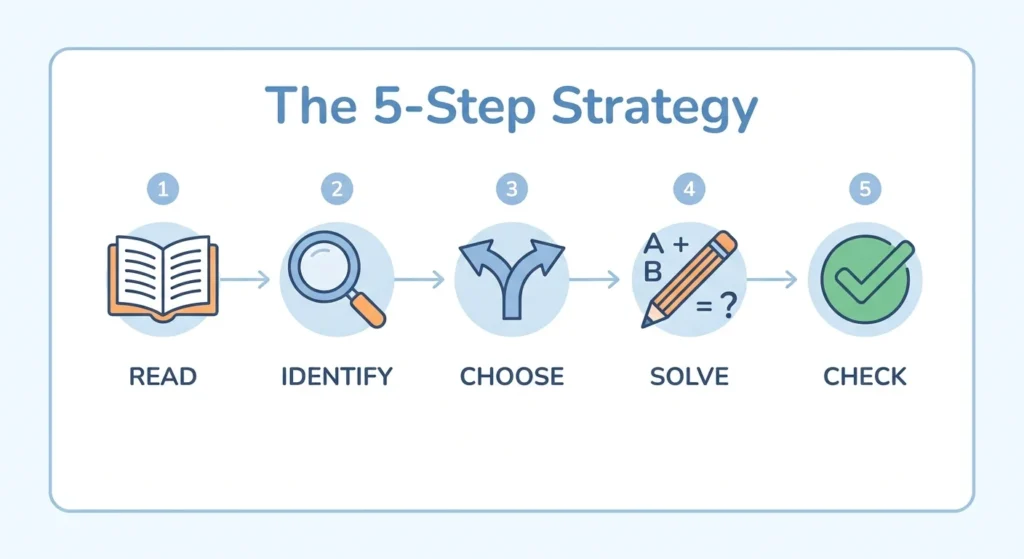
- Read the problem twice. The first read is for the general picture: what is happening in the story? The second read is for details: what numbers are given, and what question is actually being asked? Many mistakes happen when a child solves after only one read and misses a detail.
- Identify what’s known and what’s unknown. Have your child underline or circle every number in the problem, then put a box around the question sentence. The known numbers are the information given. The unknown is whatever the question is asking for.
- Choose the operation. Based on the situation, decide whether the problem is asking to combine amounts (addition), find a difference or what’s left (subtraction), or compare two amounts. This step should come from understanding the situation, not from spotting a single word.
- Solve. Write the equation and calculate. This is usually the easiest step for a child who already knows their addition and subtraction facts.
- Check the answer against the question. Reread the question sentence and ask: does this answer make sense, and does it actually answer what was asked? A common error is calculating correctly but answering a different question than the one that was posed.
For visual learners, drawing a quick picture or a simple bar (a rectangle split into the known and unknown parts) between steps 2 and 3 can make the relationship between the numbers clearer before choosing an operation.
This isn’t required for every problem, but it helps on any problem where your child is stuck deciding between adding and subtracting.
Why Keyword Spotting Isn’t Enough
Many worksheets and apps teach children to scan for a single word and match it to an operation: “altogether” or “in all” means add, “left” or “fewer” means subtract. This shortcut can work, but it breaks down often enough that it shouldn’t be the main strategy.
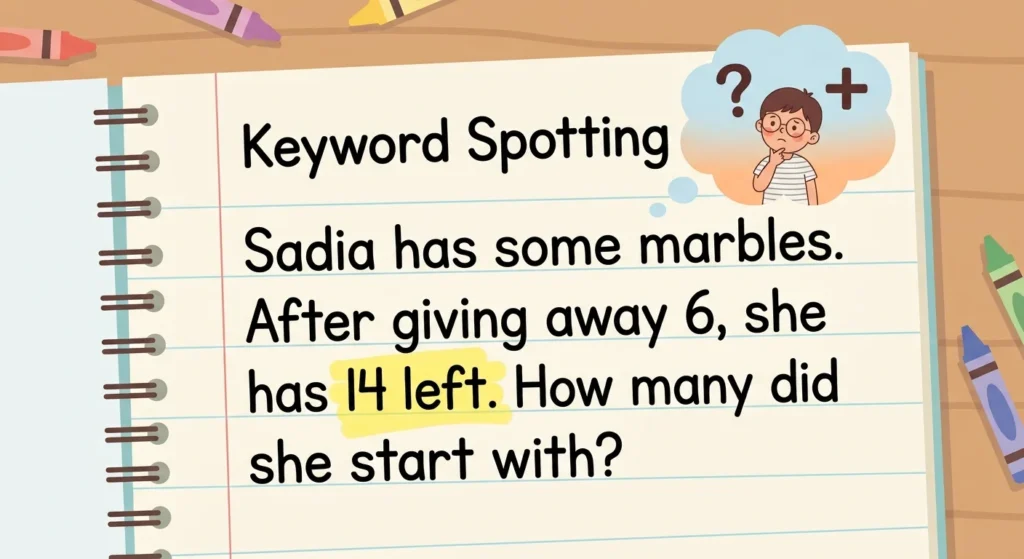
Here’s why it fails: word problems can use the word “left” and still require addition, or use “more” and still require subtraction, depending on what’s actually happening in the story. For example, “Sadia has some marbles.
After giving away 6, she has 14 left. How many did she start with?” contains the word “left,” but the problem requires addition to find the starting amount, not subtraction. A child trained purely on keyword spotting will subtract and get the wrong answer, even though they understand addition and subtraction perfectly well.
Keyword spotting works best as a secondary check, not a first move. After your child has read the problem and pictured the situation, keywords can confirm a choice they’ve already reasoned through.
Used this way, they save time. Used as the only strategy, they create errors that look like “careless mistakes” but are really a sign the child skipped straight to pattern-matching instead of understanding the situation.
“My Child Knows the Math But Can’t Solve Word Problems,” What’s Really Going On
This is one of the most common concerns parents raise, and it makes sense once you separate the two skills involved. A child’s word problem performance depends on their reading level as much as their math level.
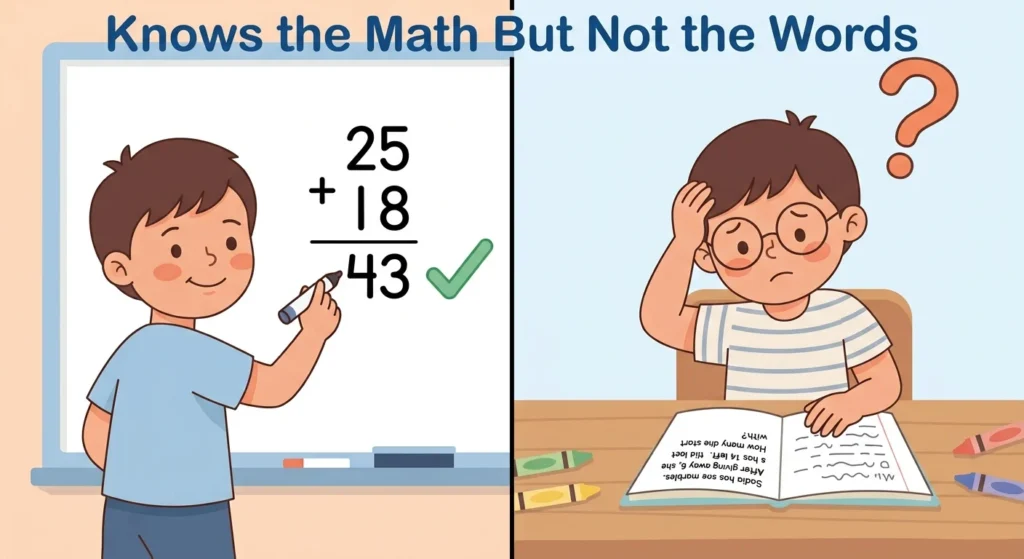
If a child is still working on reading comprehension (understanding sequence, identifying the main question in a sentence, or holding several pieces of information in mind at once), that will show up as a math struggle, even though the math facts themselves are solid.
A few signs this is what’s happening:
- Your child gets the right answer when you read the problem aloud, but not when reading it independently
- Your child can solve the same problem correctly when it’s rewritten as a bare equation
- Your child answers a different question than the one asked, showing they misread rather than miscalculated
- Your child solves the first sentence’s math but misses that a second sentence changes the question
If any of these sound familiar, the fix isn’t more computation practice. It’s reading the problem more slowly, out loud if needed, and practicing the “identify what’s known and unknown” step deliberately, separate from solving.
Some children benefit from underlining the question sentence in a different color before they touch any numbers, so the goal of the problem is locked in before the math starts.
Common Mistakes Grade 2 Students Make With Word Problems
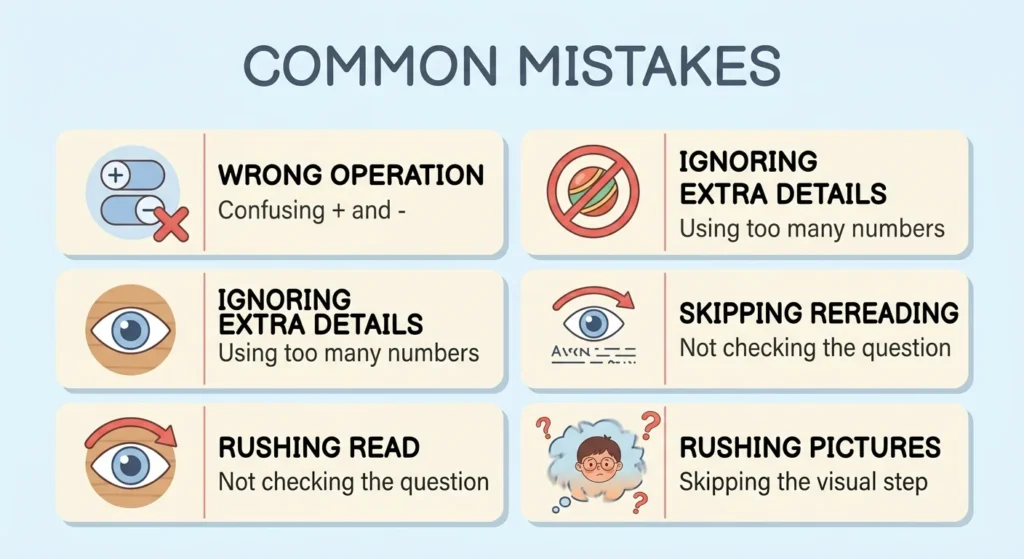
Watching for these patterns helps you know exactly where to focus practice, instead of just assigning more problems.
Misidentifying the operation.
This usually comes from relying on a keyword instead of understanding the situation, as described above. The fix is to ask your child to explain the story in their own words before choosing an operation.
Ignoring extra or irrelevant information.
Some word problems include a detail that isn’t needed for the calculation, such as a character’s age or the color of an object. Children who haven’t practiced this get thrown off, assuming every number in the problem must be used. Practicing a few problems with a deliberately unnecessary detail helps build this skill.
Not rereading before answering.
A child solves the first calculation they can find and stops, without checking it against the actual question. This is especially common in two-step problems, where the first calculation is only part of the answer. Building in a habit of rereading the question after solving catches this every time.
Rushing past the picture-building step.
Children eager to get to the numbers sometimes skip picturing the situation entirely, going straight from reading to calculating. Slowing down for even five seconds to describe what’s happening in the story prevents a lot of downstream errors.
Practice Word Problems by Difficulty Level
These problems use topics from Gonit’s Grade 2 series: addition, subtraction, counting money, and measurement. Have your child apply the 5-step strategy to each one, saying each step out loud.
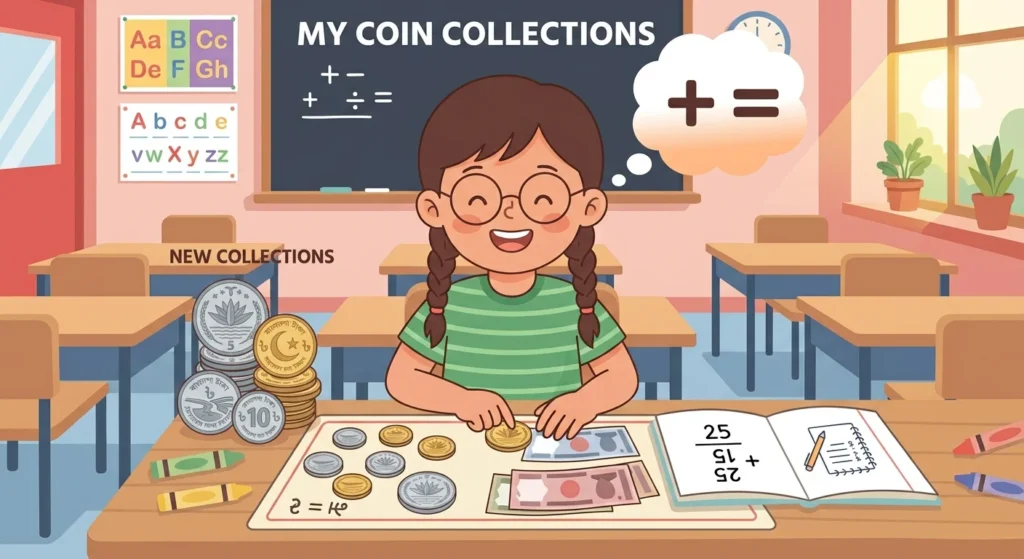
Easy (one-step addition or subtraction)
- Rafiq had 8 marbles. His friend gave him 5 more. How many marbles does Rafiq have now?
- There were 17 birds on a tree. 6 flew away. How many birds are left on the tree?
Medium (one-step, comparing, or money)
- Nadia has 45 taka. Her sister has 30 taka. How many more taka does Nadia have than her sister?
- A pencil costs 12 taka and an eraser costs 8 taka. How much do both items cost together?
Harder (two-step or measurement)
- A ribbon is 60 centimeters long. Farah cuts off 15 centimeters to use for a project, then cuts off another 10 centimeters for a bow. How many centimeters of ribbon does she have left?
- Tanvir buys a notebook for 25 taka and a pen for 15 taka. He pays with a 50 taka note. How much change should he get back?
Problem 5 is a good example of a two-step problem: your child needs to subtract twice, or add the two amounts cut and subtract that total once, either approach works, but they need to recognize that one subtraction alone won’t finish the problem.
Problem 6 combines two operations (addition to find the total cost, then subtraction to find the change) inside a single money-themed story, which mirrors how real Math Olympiad and competition problems are usually built: several small, familiar steps combined into one question.
If your child needs more practice with the coin and note side of these problems before tackling the word-problem versions, counting money for Grade 1 and counting pennies, nickels, and dimes are good places to build that foundation first.
How This Skill Connects to Competition Math
If your child is working toward Math Kangaroo, MOEMS, or early rounds of other competitions, word problems aren’t a side skill, they’re close to the main event.
Nearly all early-round competition questions are presented as short word problems rather than bare equations, specifically to test whether a student can translate a situation into math, not just calculate quickly.
A student who has practiced the read, identify, choose, solve, check process on everyday word problems is already practicing the core skill that competition problems test, just at a smaller scale. Building this habit now in Grade 2 pays off directly as problems get longer and more layered in later grades.
Tips for Parents Helping at Home
- Read the problem aloud together the first few times, then step back so your child reads independently once the process feels familiar
- Ask “what is the question asking” before asking “what’s the answer,” to keep the focus on understanding before calculating
- Resist giving the operation away. Instead ask “what’s happening in this story” and let your child reason toward the operation
- Mix in one problem with an unnecessary detail every so often, so your child doesn’t assume every number must be used
- Praise the process (rereading, checking the answer against the question) as much as the correct answer, since that process is what transfers to harder problems later
Why does my child understand addition and subtraction but still struggle with word problems?
Word problems combine reading comprehension with math. A child can be strong in computation and still struggle if they’re still developing the reading skills needed to identify what a problem is actually asking. The fix is slowing down on reading and identifying the question, not more computation practice.
Is keyword spotting (like “altogether” means add) a reliable strategy?
It can help as a quick double-check after your child has already understood the situation, but it isn’t reliable on its own. Some problems use words like “left” or “more” in ways that don’t match the usual operation, which can lead to a confident wrong answer.
What is the best method for teaching word problems in Grade 2?
A simple, repeatable process works best at this age: read the problem twice, identify what’s known and unknown, choose the operation based on the situation, solve, and check the answer against the question. This transfers across every topic, rather than requiring a new trick for every problem type.
How many steps should a Grade 2 word problem have?
Grade 2 standards focus on one- and two-step addition and subtraction word problems within 100. One-step problems are appropriate for building the core process; two-step problems are a good stretch once that process feels comfortable.
How can I tell if my child’s struggle is reading-related or math-related?
Try reading the problem aloud to your child and see if they can solve it correctly. If they can solve it when it’s read to them but not when reading independently, the struggle is likely tied to reading rather than the math itself.
Do word problems matter for Math Olympiad preparation?
Yes. Most early competition rounds, including Math Kangaroo and MOEMS, present problems as short word problems rather than bare equations. Practicing the translation from story to equation now builds a skill that competition problems rely on directly.
Make Preparing for Math Olympiad Simple!



Conclusion
Word problems are not a separate, harder kind of math. They are the same addition and subtraction your child already knows, wearing a short story.
Once a child has a repeatable way to find the hidden question, sort known from unknown, and choose an operation, that skill carries over to every topic, whether the story is about marbles, taka, or centimeters of ribbon, and to every grade ahead of it.
With consistent practice, this same read, identify, choose, solve, check process is what carries a student from everyday homework problems all the way to Olympiad-style questions in competitions like Math Kangaroo and MOEMS.

Mikha Piregu is a Content Writer with experience spanning educational content, including math and math olympiad topics, as well as advocacy writing, research-based articles, and SEO-driven web content. He creates high-quality blog content, web copy, and feature articles that support brand visibility, audience engagement, and long-term organic growth through data-informed storytelling. Skilled in WordPress, WooCommerce, and modern digital tools, Mikha adapts content across various platforms, including blogs, websites, campaigns, and advocacy initiatives, with clarity and purpose.

There are no comments posted here yet.
Sign in to leave a comment