

Fractions for Class 3 are simply equal parts of a whole, and the fastest way to teach them is through activities your child can touch, fold, cut, and share.
- What Are Fractions for Class 3?
- Equal Parts: The Idea That Makes Fractions Work
- Numerator and Denominator in Plain Language
- Types of Fractions Class 3 Students Learn
- Fractions in Real Life
- How to Teach Fractions to Class 3 Students
- Hands-On Fraction Activities for Class 3
- Fraction Games for Kids with Minimal Materials
- Fractions on a Number Line
- Comparing and Ordering Fractions
- Worked Examples
- Common Mistakes with Fractions for Class 3 and How to Correct Them
- Tips for Parents Teaching Fractions at Home
- Tips for Teachers Delivering Fraction Lessons
- From Fraction Activities to Olympiad Reasoning
- Practice Questions on Fractions for Class 3 with Answers
- Conclusion
A chapati split into two equal pieces, a chocolate bar broken into four, a group of eight marbles divided among four friends: these are fractions.
Children who have already met fractions in Class 1 will recognise the idea instantly, and children aged 7 to 9 understand fair sharing long before they understand notation, so the activities below start from that instinct and build toward reading, writing, comparing, and reasoning with fractions.
This guide gives you a complete teaching sequence, more than ten hands-on activities, games that need almost no materials, worked examples, practice questions with answers, and fixes for the mistakes Class 3 students make most often. Everything works at the kitchen table and in a classroom of forty.
What Are Fractions for Class 3?
A fraction is a number that names one or more equal parts of a whole. If you cut a roti into 4 equal pieces and take 1 piece, you have taken one-fourth, written as 1/4.
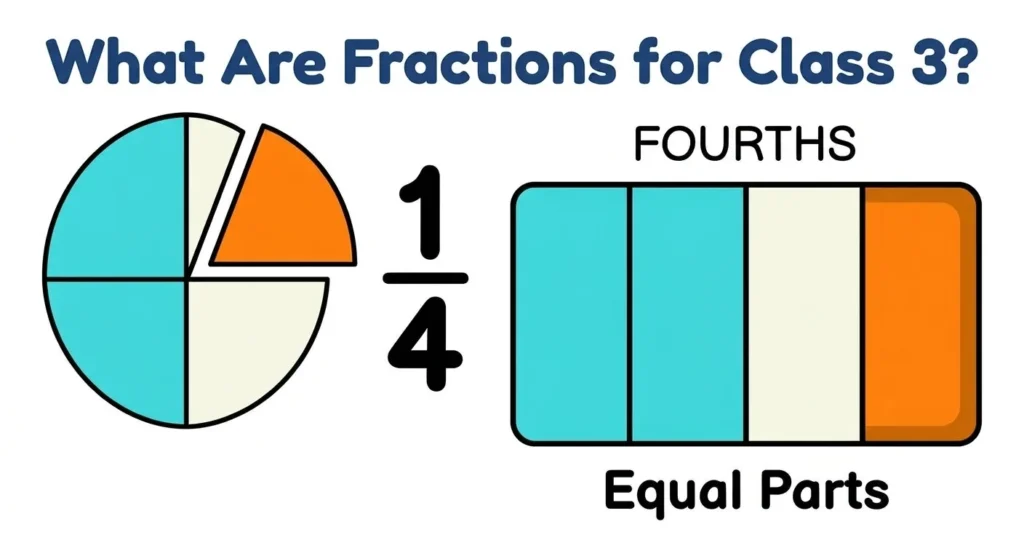
If you take 3 pieces, you have taken three-fourths, written as 3/4.
Two conditions must be true before something counts as a fraction:
- The whole must be divided into parts.
- Those parts must be equal in size.
Four unequal pieces of a roti are still four pieces, but they are not fourths. This single rule causes more confusion in Class 3 than anything else, so it deserves more attention than notation does in the first week of teaching.
A helpful way to say it to a child: a fraction answers two questions at once. How many equal parts is the whole broken into, and how many of those parts are we talking about?
Equal Parts: The Idea That Makes Fractions Work
Start every fraction lesson with sorting, not with symbols. Draw or print six shapes. Divide some into equal parts and some into deliberately unequal parts. Ask one question: has this shape been shared fairly?
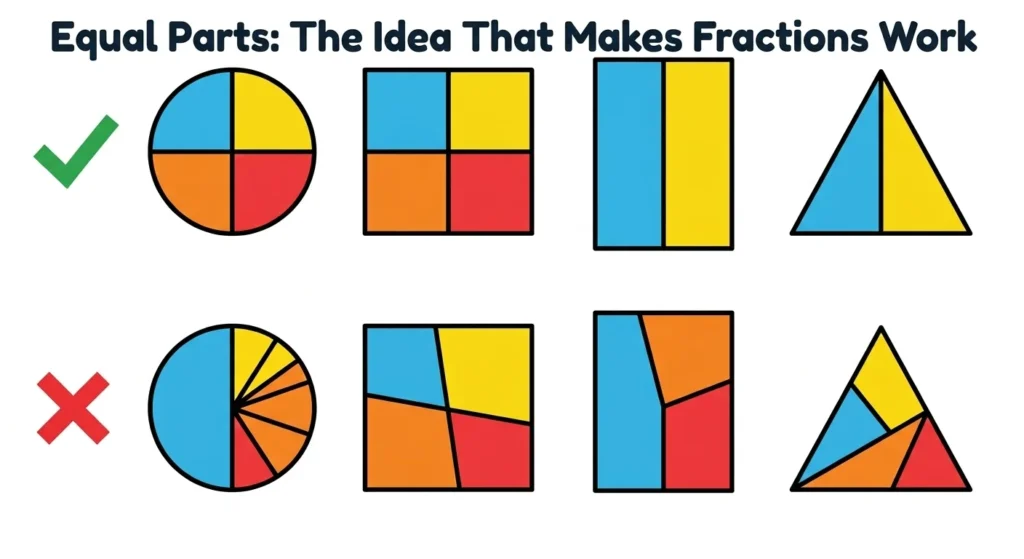
Children can answer that question at age 7 with no mathematical vocabulary at all. Once they can sort fairly-shared shapes from unfairly-shared ones with confidence, the words halves, thirds, and quarters attach easily.
Three things to build during this stage:
- Equal means equal in amount, not equal in shape. A square cut corner to corner gives two triangles, and a square cut down the middle gives two rectangles. Both are halves. Different shapes, same amount. Children who can already name geometrical shapes find this easier to accept.
- More parts means smaller parts. Fold the same paper strip into 2, then 4, then 8. Children can see that the pieces shrink as the number grows. This one observation prevents the most common comparison error later.
- The whole must stay the same. Half of a small chapati and half of a large chapati are both halves, but they are not the same amount of food. Compare fractions only when the wholes match.
Numerator and Denominator in Plain Language
Write 3/4 on paper and point to the two numbers.
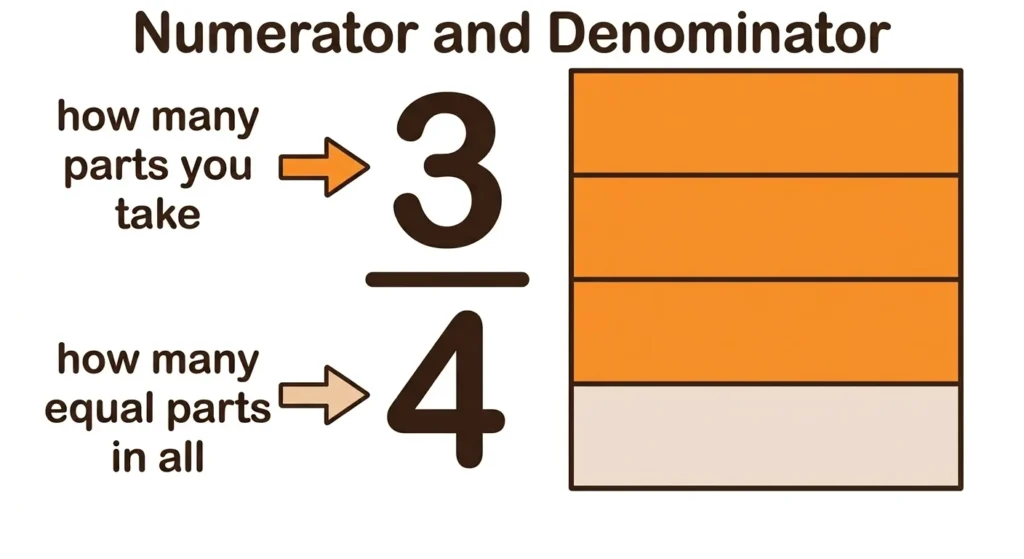
- The bottom number is the denominator. It tells you how many equal parts the whole was divided into. Think of the “d” in denominator and the “d” in divided.
- The top number is the numerator. It tells you how many of those parts you are taking, counting, or colouring.
Say the whole thing out loud as one idea: “three of the four equal parts.” Avoid reading it as “three, four,” because that encourages children to treat a fraction as two separate numbers rather than one quantity. This habit is the root cause of the later mistake where a child thinks 1/8 is bigger than 1/2 because 8 is bigger than 2.
If your child needs a slower walkthrough of these two numbers on their own, our guide to what the numerator and denominator of a fraction mean covers them in detail.
A quick check you can use any day of the week: hold up a paper strip folded into six parts with two coloured. Ask for the denominator first, then the numerator. Denominator first matches how a child actually looks at the object, because they see the total parts before they count the shaded ones.
Types of Fractions Class 3 Students Learn
Class 3 keeps the list short. These four ideas cover almost every question at this level.
Fractions of a whole. One object is divided into equal parts. A cake in 8 slices, a pizza in 6 slices, a paper strip in 4 folds. Take some of those parts and name them: 2/8, 5/6, 3/4.
Unit fractions. Any fraction with 1 as the numerator: 1/2, 1/3, 1/4, 1/5, 1/8. These are the building blocks. Once a child knows that 1/4 is one piece when the whole is cut into four, they can see 3/4 as three of those pieces stacked together.
Proper fractions. The numerator is smaller than the denominator, so the amount is less than one whole: 2/5, 3/7, 5/6. Everything a Class 3 student meets is usually of this type.
Fractions of a collection. The whole is a group of objects rather than one object. Twelve pencils shared into 3 equal groups gives 4 pencils in each group, so 1/3 of 12 is 4. Many children handle shapes comfortably and then stumble here, because the “whole” is now a set. Treat this as a separate skill with its own activities.
Two supporting ideas appear in many Class 3 textbooks and are worth touching lightly:
- Like fractions share the same denominator, such as 1/5, 2/5, and 4/5. These are easy to compare.
- Equivalent fractions are different names for the same amount, such as 1/2 and 2/4. Show this by folding, not by multiplying. The multiplication rule belongs to Class 4 and beyond.
Fractions in Real Life
Children learn faster when the maths is already in the room. Point at fractions during the day rather than saving them for homework time.
- Food: half a banana, a quarter of a watermelon, one of six slices of pizza, two of eight pieces of chocolate.
- Time: half an hour, quarter past four, half the school day gone by lunch. If telling time is still new, the clock face doubles as a fraction model.
- Shapes and objects: half a glass of water, a window pane divided into four squares, a floor tile split by its diagonal.
- Sharing groups: ten laddoos shared between five children, a box of twelve crayons split between two friends.
- Sport and play: half time in a football match, a quarter of a cricket over bowled, one of four rounds finished.
- Money: fifty paise as half a rupee, twenty-five paise as a quarter.
Ask the fraction question out loud each time, then move on. Thirty seconds of noticing beats twenty minutes of drilling.
How to Teach Fractions to Class 3 Students
Follow this sequence. Each step depends on the one before it, and skipping ahead is what produces confusion later.
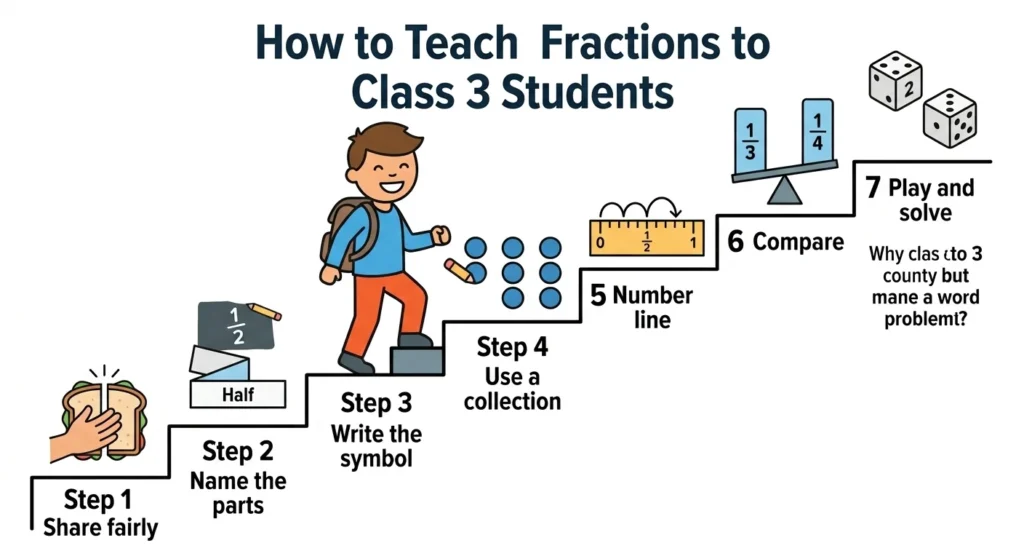
Step 1: Share objects fairly. Give your child a real object and ask them to share it equally between two people, then four. Do not use any symbols. The goal is the idea of fairness.
Step 2: Name the parts in words. Introduce half, third, quarter, fifth. Keep using objects. Ask questions like “how many quarters make the whole?” until the answer is instant.
Step 3: Write the symbol. Now connect the folded paper to 1/4 on the page. Write the denominator first while pointing at the total parts, then the numerator while pointing at the shaded parts.
Step 4: Move from one object to a collection. Share 8 buttons into 4 equal groups and name one group as 1/4 of 8. Repeat with different totals so the child sees that the whole can change.
Step 5: Place fractions on a number line. Draw 0 to 1, split it into equal steps, and label them. Children who have practised the number line in Class 1 will pick this up in one session. This is where a fraction stops being a picture and starts being a number.
Step 6: Compare fractions. Start with like denominators, then with unit fractions. Use strips side by side so the comparison is visible before any rule is stated.
Step 7: Solve problems and play games. Only now bring in word problems, puzzles, and Olympiad-style reasoning questions. By this point the child is reasoning, not guessing.
If your child covered fractions in Grade 2, steps 1 and 2 will move quickly. Spend roughly a week on steps 1 to 3 combined, and do not rush step 5. A child who can place 3/4 correctly on a number line has understood fractions as numbers, which is the single best predictor of comfort with decimals and ratios later.
10 Hands-On Fraction Activities for Class 3
Every activity below uses materials you already have and slots neatly alongside other fun math activities you may already be doing at home. Each takes 10 to 20 minutes and works at home or in a classroom.
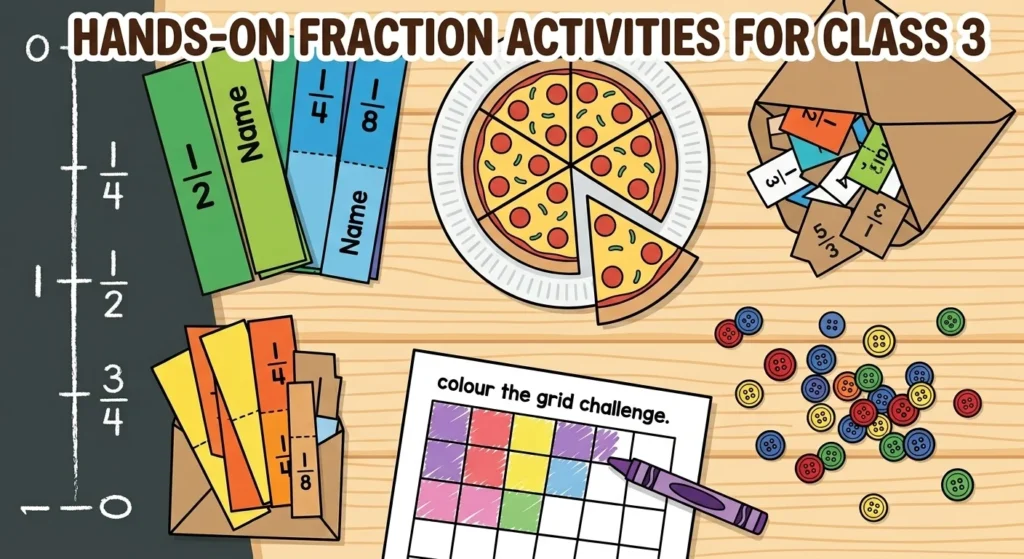
1. Paper Folding Strips
Give each child four identical paper strips. Fold the first into 2 equal parts, the second into 4, the third into 8, and leave the fourth whole. Colour and label each section. Lay the strips one above the other.
What it teaches: equal parts, unit fractions, and the crucial observation that more parts means smaller parts. Keep these strips. They become the reference tool for comparing fractions all term.
2. The Fair Share Snack
Take a real chapati, sandwich, or fruit and ask the child to share it among a changing number of people: 2, then 3, then 4. Let them cut it themselves, even imperfectly. Then ask which share was biggest and why.
What it teaches: fractions of a whole, and the inverse relationship between the denominator and the size of the piece.
3. Fraction Pizza Craft
Cut circles from old cardboard or paper plates. Children decorate them as pizzas, then cut them into halves, thirds, quarters, sixths, and eighths. Store the pieces in envelopes labelled with the fraction.
What it teaches: naming fractions, building a whole from parts, and early equivalence when a child discovers that two quarters cover the same space as one half.
4. Button and Bottle Cap Sorting
Place 12 buttons on the table. Ask the child to make 2 equal groups, then 3, then 4, then 6. Name each group: 1/2 of 12 is 6, 1/3 of 12 is 4, and so on. Change the total to 8, 10, and 20 so the answers change.
What it teaches: fractions of a collection, and flexibility about what counts as the whole.
5. Colour the Shape Challenge
Draw grids of squares, rectangles divided into strips, and circles divided into sectors. Call out a fraction and let the child colour that amount. Then reverse it: you colour, and the child names the fraction.
What it teaches: reading and writing fraction notation from a picture, in both directions.
6. Fraction Wall Build
On a large sheet, draw a row of equal-length bars. Divide the first into 1 part, the next into 2, the next into 3, and continue to 8. Label every section. Hang it on the wall.
What it teaches: equivalence and comparison at a glance. Children start noticing patterns without being told, such as 2/6 lining up exactly with 1/3.
7. Human Fraction Line
Mark 0 and 1 on the floor with tape or chalk. Ask children to stand where 1/2, 1/4, and 3/4 belong. Let the class judge whether each position is fair, then measure to check. Our guide to number positions on a number line pairs well with this one.
What it teaches: fractions as positions on a number line, using the whole body. This works beautifully with a large class and needs no printing.
8. Recipe Halving
Take a simple recipe and halve every quantity together. One cup becomes half a cup, four spoons become two, six biscuits become three.
What it teaches: fractions of a collection applied to real numbers, and early multiplicative thinking.
9. Fraction Hunt Around the House
Give the child five minutes to find and photograph or draw five things divided into equal parts: a window, a tile, a clock face, a chocolate bar, a ludo board.
What it teaches: recognition of fractions outside maths class, which is what makes the concept stick.
10. Build the Whole Back
Hand over a mixed envelope of fraction pieces from the pizza craft and ask the child to build exactly one whole in as many different ways as they can: four quarters, two halves, one half plus two quarters, three thirds.
What it teaches: that fractions add up to a whole, and that the same amount has many names. This is the foundation of equivalence, reached through discovery rather than a rule.
Fraction Games for Kids with Minimal Materials
Games make repetition painless. These need paper, a pencil, and sometimes a dice. For more ideas, see our collection of math games and math puzzles for this age group.
Roll and Colour. Roll a dice to get a numerator, roll again for a denominator. If the fraction is proper, colour that much of a shape on your sheet. First to fill three shapes wins.
Fraction Snap. Make cards with pictures on half of them and fraction symbols on the other half. Play snap, matching each picture to its symbol.
Bigger or Smaller. Each player flips a fraction card. The larger fraction wins the round. Start with like denominators only, then add unit fractions once the group is confident.
Guess My Fraction. One player thinks of a fraction between 0 and 1. The other asks yes-or-no questions: is the denominator even? Is it more than a half? Is it a unit fraction?
Fraction Bingo. Fill a 3 by 3 grid with fractions. The caller holds up shaded shapes instead of saying numbers, so children must translate the picture before marking the square.
Pass the Whole. Sit in a circle. The first child names a unit fraction, and each child after adds another piece of the same size, saying the running total: one-fifth, two-fifths, three-fifths. The child who reaches exactly one whole wins the round.
Fractions on a Number Line
Placing fractions on a number line is the step most often skipped and most worth keeping. It teaches that 3/4 is a single number with a fixed position, not a picture of a pie.
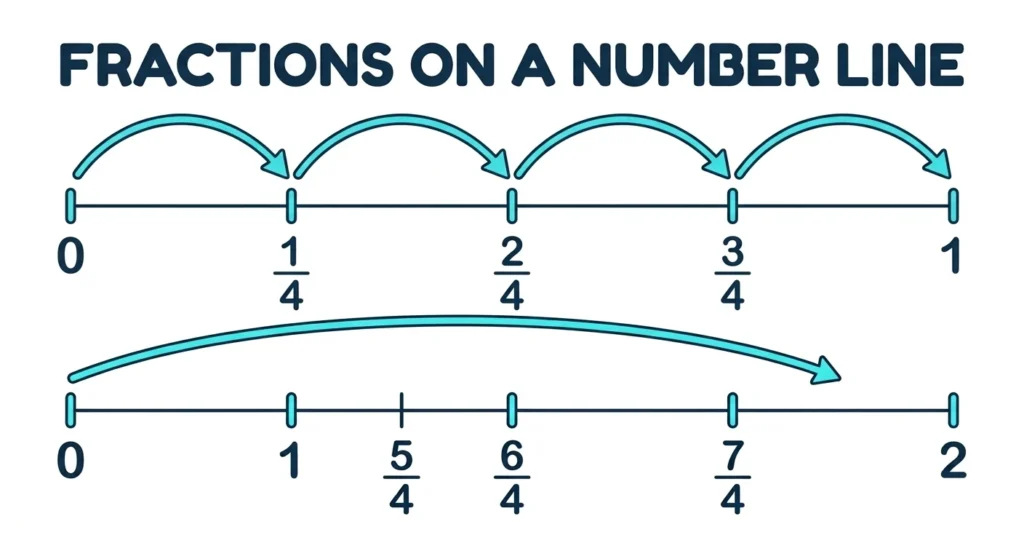
How to do it:
- Draw a straight line and mark 0 at one end and 1 at the other.
- Decide the denominator. For quarters, the gap between 0 and 1 must be split into 4 equal jumps.
- Make the jumps equal. Fold the paper or measure with a ruler rather than eyeballing them.
- Label each mark in order: 1/4, 2/4, 3/4, and then 1 itself.
- Ask questions that move along the line: which is nearer to 1, 1/4 or 3/4? Which fraction sits exactly in the middle?
Our step-by-step guide to teaching number line maths covers the drawing technique in more detail. Two variations that deepen understanding: hide some labels and ask the child to work out the missing one, and extend the line past 1 so children see that fractions keep going and do not stop at the whole.
Comparing and Ordering Fractions
Class 3 handles two comparison cases. Teach them separately and with strips in hand.
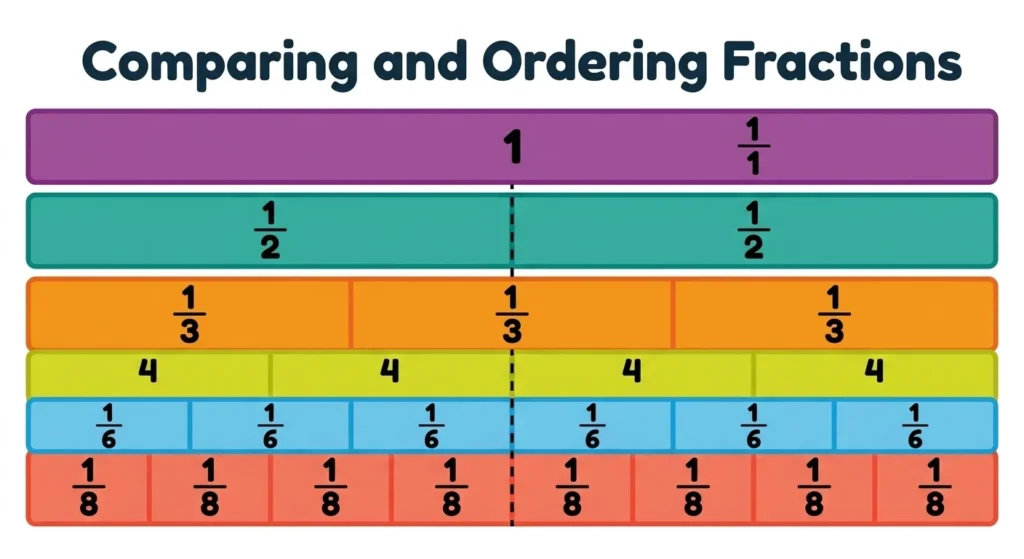
Case 1: same denominator. Compare the numerators. Since the pieces are the same size, more pieces means more amount. So 3/7 is greater than 2/7, and 5/8 is greater than 1/8.
Case 2: same numerator, usually unit fractions. Compare the denominators, and the larger denominator gives the smaller fraction. So 1/3 is greater than 1/5, because cutting into three pieces gives bigger pieces than cutting into five.
Ordering follows directly. To arrange 1/6, 1/2, and 1/4 from smallest to largest, note that all are unit fractions, so the biggest denominator comes first: 1/6, 1/4, 1/2.
Say the reason out loud every time, not just the answer. A child who says “1/3 is bigger because thirds are bigger pieces than fifths” has a rule that will keep working. A child who says “3 is smaller than 5” has a rule that will break next year.
Worked Examples
Example 1: Name the shaded part. A rectangle is divided into 5 equal strips and 2 are shaded. The denominator is 5 because there are 5 equal parts. The numerator is 2 because 2 are shaded. The answer is 2/5.
Example 2: Find a fraction of a collection. What is 1/4 of 16 marbles? The denominator 4 tells you to make 4 equal groups. 16 divided by 4 is 4, so each group has 4 marbles. The answer is 4.
Example 3: Find three parts of a collection. What is 3/4 of 16 marbles? First find 1/4, which is 4. Then take 3 of those groups: 4 plus 4 plus 4 equals 12. The answer is 12.
Example 4: Compare two fractions. Which is greater, 2/9 or 5/9? The denominators match, so compare 2 and 5. The answer is 5/9.
Example 5: Compare unit fractions. Which is greater, 1/6 or 1/10? Both take one piece, but sixths are bigger pieces than tenths. The answer is 1/6.
Example 6: Complete the whole. A cake is cut into 8 equal slices and 3 are eaten. What fraction is left? 8 minus 3 leaves 5 slices out of 8. The answer is 5/8.
Common Mistakes with Fractions for Class 3 and How to Correct Them
Counting parts that are not equal. A child sees a shape cut into three uneven pieces and calls each one a third. Fix it by going back to the fair share test: measure or fold the parts and ask whether anyone would complain about the sharing.
Reading a fraction as two separate numbers. A child says 1/8 is bigger than 1/2 because 8 is bigger than 2. Fix it with paper strips laid on top of each other. Seeing the eighth disappear under the half settles the argument permanently.
Counting only the shaded parts. Asked about a circle with 6 sections and 2 shaded, the child writes 2/4 by counting the unshaded ones as the denominator. Fix it by making them trace the whole shape with a finger and count every part first, before looking at shading.
Assuming the whole is always the same. A child insists half of a small glass equals half of a large glass. Fix it by pouring both into identical containers and looking.
Thinking fractions only look like pizzas. If every example is circular, children fail to recognise fractions in rectangles, sets, and number lines. Fix it by rotating between at least three models in every lesson.
Forgetting that the parts must add back to one whole. Fix it with the build-the-whole activity, asking each time how many more pieces are needed to complete the whole.
Tips for Parents Teaching Fractions at Home
- Use food, laundry, and playtime rather than a worksheet after a long school day.
- Let the child do the cutting and folding, even when it is messy. The hands do the learning.
- Ask “how do you know?” more often than “is that right?” Explanations reveal misunderstandings that correct answers hide.
- Keep sessions to 15 minutes. Fraction understanding grows from frequency, not from length.
- Allow wrong answers to stand for a moment. Ask the child to test the answer with paper before you correct it.
- Praise the reasoning, not the speed. A child who reasons slowly this year will be fast next year, while a child who guesses fast will stay stuck.
- Revisit halves and quarters even after moving to sixths and eighths. Confidence with simple cases is what makes harder cases feel manageable.
Tips for Teachers Delivering Fraction Lessons
- Open every lesson with a concrete object in hand, even in the fourth week of the chapter.
- Use at least three representations across the unit: area models such as shapes, set models such as counters, and linear models such as number lines and strips.
- Insist on precise language. Say “three of the four equal parts,” not “three over four,” until the meaning is secure.
- Build a class fraction wall in week one and refer to it whenever a comparison question comes up.
- Use quick diagnostic questions rather than long tests. Showing a shape with unequal parts and asking whether it shows quarters reveals more in ten seconds than a page of sums.
- Group children deliberately so that a child who explains well sits with a child who is still sorting equal from unequal.
- Delay written notation for children who are still unsure about fair sharing. Notation without the concept produces reliable-looking answers built on nothing.
- Keep decimals, percentages, and mixed numbers out of Class 3 lessons entirely. They crowd out the foundation and create confusion that takes months to undo.
From Fraction Activities to Olympiad Reasoning
Olympiad fraction questions at the primary level rarely ask a child to calculate. Browse a set of math olympiad questions and the pattern becomes obvious. They ask a child to think about parts and wholes in an unfamiliar arrangement. Children who learned fractions through folding, sharing, and number lines handle these far better than children who memorised procedures.
Three kinds of questions show the connection:
Reverse questions. Instead of “what is 1/3 of 12,” ask “if 1/3 of my sweets is 4, how many sweets do I have?” The child must work backwards from a part to a whole. Any child who has built a whole from fraction pieces can do this.
Equal-part puzzles. Ask for three different ways to divide a 4 by 4 grid of squares into two equal halves. There are many valid answers, and the reasoning is about area rather than shape.
Comparison without calculation. Ask which is larger, 3/7 or 4/9, and require an argument rather than a computation. A Class 3 child can reason that 3/7 is less than half while 4/9 is also less than half, then compare each to the half mark. This benchmark strategy is genuine Olympiad thinking and it grows directly out of number line work.
Our walkthrough of how to solve math olympiad problems applies the same reasoning habits to harder questions. The route to competition maths is the same route as the route to confidence: understand the parts, understand the whole, and be able to explain the relationship between them.
Practice Questions on Fractions for Class 3 with Answers
Work through these with paper and pencil. For longer questions in words, see our guide to solving math word problems.
- A pizza is cut into 6 equal slices. Riya eats 2 slices. What fraction did she eat?
- What fraction of the day is 12 hours?
- Which is greater, 4/9 or 7/9?
- Which is smaller, 1/4 or 1/7?
- What is 1/5 of 20 pencils?
- What is 2/3 of 9 apples?
- A chocolate bar has 8 equal pieces and 5 are eaten. What fraction is left?
- Arrange from smallest to largest: 1/8, 1/2, 1/3.
- How many quarters make one whole?
- A shape is divided into 4 parts, but the parts are not equal. Can one part be called a quarter?
Answers: 1. 2/6. 2. 1/2. 3. 7/9. 4. 1/7. 5. 4 pencils. 6. 6 apples. 7. 3/8. 8. 1/8, 1/3, 1/2. 9. Four. 10. No, because fractions need equal parts.
Make Preparing for Math Olympiad Simple!



What are fractions for class 3 in simple words?
A fraction is a number that names equal parts of a whole. If something is divided into 4 equal parts and you take 1, you have 1/4. The bottom number shows the total equal parts and the top number shows how many parts you took.
At what age should a child learn fractions?
Informal fraction ideas such as halves and quarters appear from age 5 through fair sharing. Formal fraction notation is usually introduced around ages 7 to 9, which matches Class 3.
What fraction topics are covered in Class 3?
Equal parts, fractions of a whole, unit fractions, proper fractions, fractions of a collection, like fractions, simple equivalent fractions, fractions on a number line, and comparing fractions with the same numerator or the same denominator.
How do I explain numerator and denominator to a child?
Point at the bottom number and say it tells how many equal parts the whole was divided into. Point at the top number and say it tells how many of those parts you are taking. Then read the whole fraction as one phrase, such as “three of the four equal parts.”
Why does my child think 1/8 is bigger than 1/2?
Because they are comparing 8 and 2 as whole numbers instead of seeing the fraction as one quantity. Lay a strip folded into halves on top of a strip folded into eighths. Seeing the sizes side by side corrects this faster than any explanation.
How do I teach fractions of a collection?
Use countable objects. To find 1/4 of 12 buttons, make 4 equal groups and count one group. Change the total often so the child learns that the whole can be any size.
Should Class 3 students learn adding and subtracting fractions?
Only with like denominators, and only after the meaning of a fraction is secure. Adding 1/5 and 2/5 makes sense to a child holding fifths. Unlike denominators belong to later grades.
How much time should we spend on fractions each day?
Ten to fifteen minutes daily works better than an hour once a week. Short, frequent, hands-on practice builds the intuition that fraction problems depend on.
Are worksheets useful for learning fractions?
They are useful for practice after understanding exists, not for building it. Start with objects and activities, then use worksheets to consolidate.
How do fraction activities help with Math Olympiad preparation?
Olympiad questions test reasoning about parts and wholes rather than calculation. Children who folded, shared, and placed fractions on number lines can work backwards from a part to a whole and compare fractions using benchmarks, which is exactly what those questions ask for.
Conclusion
Fractions for class 3 become easy when children handle them before they write them. Fold the strips, share the snack, group the buttons, then mark the number line. Notation makes sense once the idea of equal parts is already in the child’s hands.
Pick two activities from this guide and run them this week for fifteen minutes a day. Keep asking “how do you know?” and let the paper settle every disagreement. That habit is what carries a child from naming halves and quarters to reasoning about parts and wholes in Olympiad questions later on.

Mikha Piregu is a Content Writer with experience spanning educational content, including math and math olympiad topics, as well as advocacy writing, research-based articles, and SEO-driven web content. He creates high-quality blog content, web copy, and feature articles that support brand visibility, audience engagement, and long-term organic growth through data-informed storytelling. Skilled in WordPress, WooCommerce, and modern digital tools, Mikha adapts content across various platforms, including blogs, websites, campaigns, and advocacy initiatives, with clarity and purpose.

There are no comments posted here yet.
Sign in to leave a comment