


The global eligibility criteria for the International Mathematical Olympiad (IMO) require contestants to be under 20 years old, enrolled in secondary school, and selected through their country’s national mathematical organization.
The official IMO exam eligibility criteria set an exact cut-off: for an IMO in year x, contestants must be born on or after 1 July in year x-20. For IMO 2027 in Budapest, that is 1 July 2007. T
here is no registration either, since each country picks up to six contestants through its own selection rounds.
IMO Eligibility Criteria at a Glance
These are the conditions the Jury verifies before the contest. All of them come from the IMO General Regulations, last updated in July 2025.
| Requirement | Rule |
|---|---|
| Age limit | Born on or after 1 July in the year x-20, where x is the year of the IMO |
| Education status | Not enrolled at a university or equivalent post-secondary institution |
| School enrolment | Normally enrolled in full-time primary or secondary education on or after 1 December in the year before the IMO |
| Home-schooled students | Must not hold a high school diploma or equivalent, and must be working toward one on 1 December |
| Nationality | Normally a citizen of the country they represent, with a residency exception |
| Selection | Chosen through the country’s national Mathematical Olympiad or equivalent programme |
| Team size | Up to 6 contestants per country |
| Number of attempts | No limit, as long as you still meet the age and education rules |
There is no minimum age. Several contestants have competed at 12 or 13. The floor is set by difficulty, not by regulation.
IMO Age Limit: The Exact Rule
The IMO age limit is often quoted as “under 20,” which is correct in spirit but imprecise in practice. The regulations use a fixed birth date cut-off so that every contestant in a given year is measured against the same line, regardless of when the contest falls on the calendar.
Regulation 2.2 states that contestants must have been born on or after 1 July in the year x-20, where x is the year of participation. Because the contest is held in July, this works out to roughly “you must not turn 20 before the competition,” but the birth date version is the one that decides disputes.
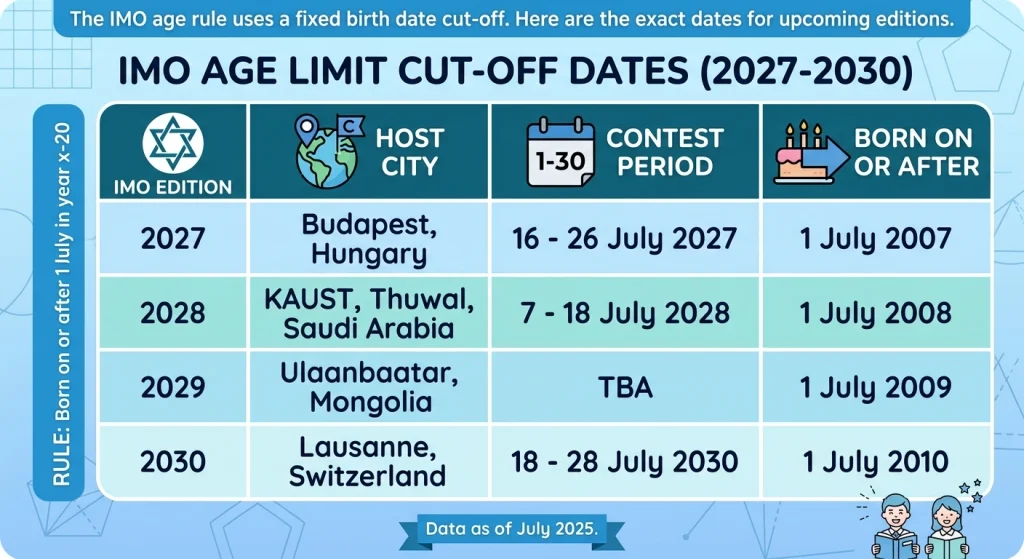
Age Cut-Off Dates for Upcoming Editions
The cut-off moves forward by one year with each edition. Here are the next four, with host cities as published by the IMO Board.
| Edition | Host city | Contest period | Born on or after |
|---|---|---|---|
| IMO 2027 | Budapest, Hungary | 16 to 26 July 2027 | 1 July 2007 |
| IMO 2028 | KAUST, Thuwal, Saudi Arabia | 7 to 18 July 2028 | 1 July 2008 |
| IMO 2029 | Ulaanbaatar, Mongolia | To be announced | 1 July 2009 |
| IMO 2030 | Lausanne, Switzerland | 18 to 28 July 2030 | 1 July 2010 |
For reference, IMO 2026 was held in Shanghai, China from 10 to 21 July, with 117 countries and 666 contestants.
Common Age Limit Questions
The age rule raises the same handful of edge cases every year. Here is how each one lands.
- Age 18 or 19: Eligible, provided your birth date falls on or after the cut-off for that edition and you have not started post-secondary study.
- Turning 20 during the IMO year: Eligible if you were born on or after 1 July in year x-20. Someone born in August 2007 can still compete at IMO 2027 even though they turn 20 that August.
- Finished school but not started university: Eligible on the age rule, but you must have been normally enrolled in full-time secondary education on or after 1 December in the previous year. A gap year after that date does not automatically disqualify you, though your national programme may have its own stricter rules.
- University students: Not eligible. Once you have formally enrolled and started studies at a university or equivalent institution, the door closes even if you are still 18.
- Adults looking for a maths olympiad: The IMO is closed. Open competitions for adults exist, but the IMO is strictly a pre-university event.
- Very young students: No lower age limit exists. Younger contestants simply have to beat everyone else in their national selection.
Education and School Status Requirements
The age limit is only half the eligibility test. The second half is about where you study, and it rules out a group of people who would otherwise pass on age alone.
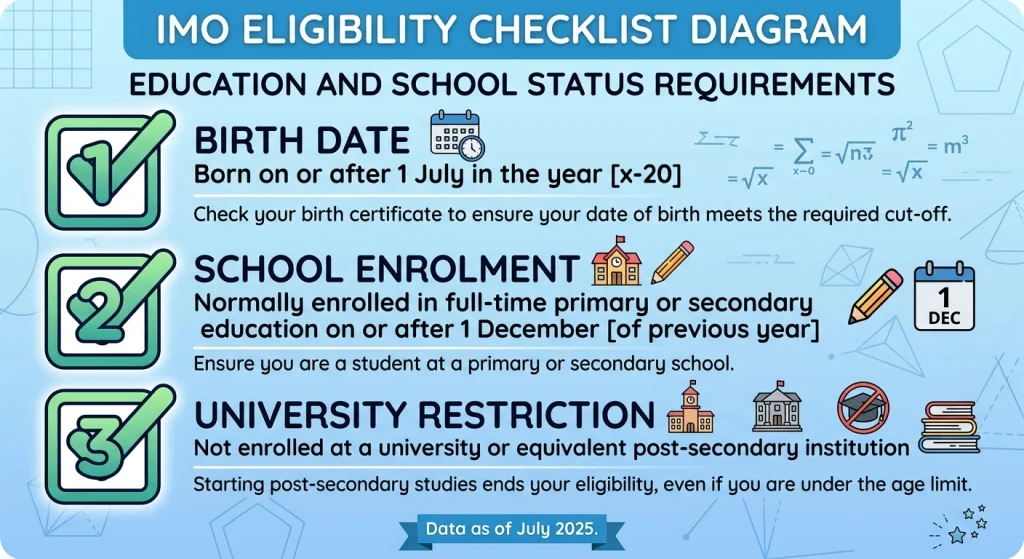
Contestants must not have formally enrolled and commenced studies at a university or at any equivalent post-secondary institution. Accepting an offer is not the issue. Starting the course is.
Contestants must also have been normally enrolled in full-time primary or secondary education on or after 1 December in the year before the IMO. Home-schooled students are covered by a parallel rule: they must not have received a high school diploma or equivalent, and must be working toward that credential on 1 December.
In practice, almost every contestant is in the final two or three years of secondary school. Students in Grades 9 to 12, or Classes 9 to 12, make up the bulk of every national team.
Nationality and Residency Rules
Contestants represent one country, and the regulations are specific about which one. This matters more than people expect, because selection camps in different countries run on different calendars.
A contestant of Country X should normally be a citizen of Country X. Genuine long-term foreign residents can represent the country where they are being educated, provided they have already completed at least one full academic year of education there and will complete at least two years of full-time education there before leaving secondary school. The move must be for a real family reason.
The regulations also block what they call IMO tourism. A student may not attempt the final selection examinations of more than one country in the same IMO year. You pick one national programme and compete through it.
How to Qualify for the IMO
Qualifying means earning one of your country’s six places through national selection. No individual registration exists, and no entry fee is payable by students, because the host country covers the costs of each official team.
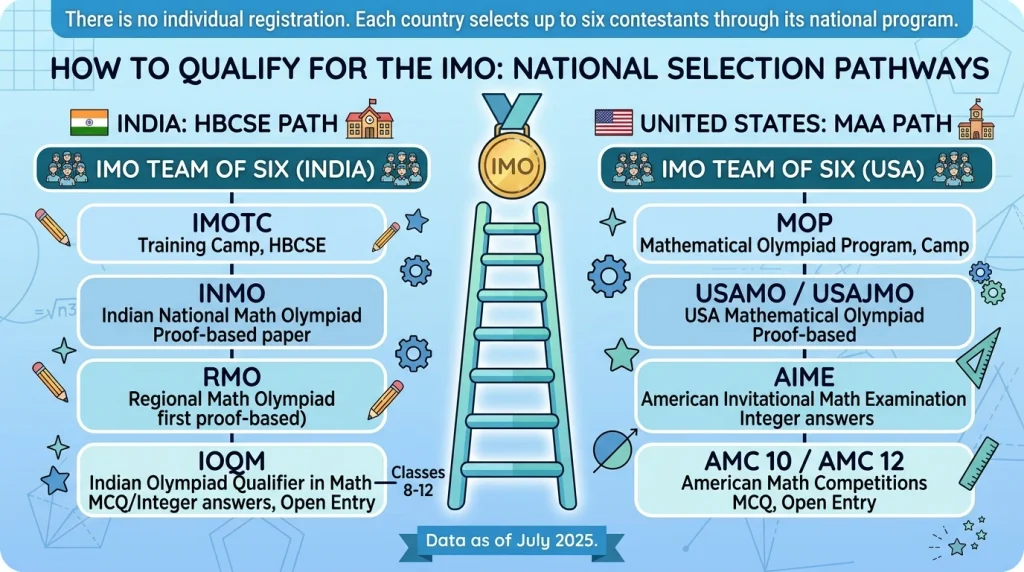
Every participating country runs its own ladder, usually a sequence of open rounds that narrows to a training camp. The exam that leads to the IMO is almost never called the IMO.
India: IOQM to INMO to the Training Camp
India runs a four-stage selection process managed by HBCSE, open to students in Classes 8 to 12.
- IOQM: The Indian Olympiad Qualifier in Mathematics, the open entry round. Our IOQM syllabus guide covers what to study, and IOQM full form explains the exam itself.
- RMO: The Regional Mathematical Olympiad, the first proof-based paper.
- INMO: The Indian National Mathematical Olympiad, which selects a national shortlist.
- IMOTC: The training camp, from which six students are chosen for the Indian team.
United States, Bangladesh and Other Countries
The structure repeats with different names elsewhere. In the United States the route runs through the AMC, the AIME and the USAMO, then the Mathematical Olympiad Program, which we cover in how to qualify for the IMO in the USA.
Bangladesh selects through its national Mathematical Olympiad, explained in how to qualify for IMO from Bangladesh. The United Kingdom, Australia, Pakistan, the UAE and most other participating countries each run an equivalent programme, so the first step anywhere is to find your national olympiad body and enter its open round.
If you are starting from zero, how to prepare for the IMO and how to solve math olympiad problems are the right places to begin.
IMO Exam Pattern, Marks and Medals
Knowing the format helps you judge whether you are preparing for the right thing. The IMO looks nothing like a school olympiad paper, and no multiple-choice questions appear anywhere in it.
The contest runs over two consecutive days. On each day, contestants attempt three problems in four and a half hours. There are six problems in total, each marked out of 7, for a maximum score of 42.
| Element | Detail |
|---|---|
| Duration | 2 days, 4.5 hours per day |
| Problems | 3 per day, 6 in total |
| Marks per problem | 0 to 7 |
| Maximum score | 42 |
| Question type | Full written proofs, no multiple choice |
| Topics | Algebra, combinatorics, geometry, number theory |
| Allowed equipment | Writing and drawing instruments only |
| Banned | Calculators, computers, protractors, books, tables, communication devices |
Medals go to approximately half the contestants, with gold, silver and bronze awarded in a ratio of roughly 1:2:3. Anyone who misses a medal but scores a full 7 on at least one problem receives an Honourable Mention. The Mirzakhani Prize is awarded each year to the best female contestant in each of five regions.
There is no published syllabus. Problems are drawn from secondary school mathematics, but they demand proof technique rather than curriculum coverage. Working through math olympiad questions is more useful than revising a syllabus.
SOF IMO Eligibility Criteria for Classes 1 to 12
A second exam uses the same abbreviation, and most searches for “IMO eligibility” in India are about this one. The SOF International Mathematics Olympiad is a school-level competition run by the Science Olympiad Foundation, and its eligibility rules are the opposite of strict.
| Criteria | SOF IMO | International Mathematical Olympiad |
|---|---|---|
| Conducted by | Science Olympiad Foundation, India | IMO Board, hosted by a different country each year |
| Who can take it | All students in Classes 1 to 12 | Six contestants per country, selected nationally |
| Age limit | None | Born on or after 1 July in year x-20 |
| How you enter | Through your school | National selection rounds |
| Format | 35 or 50 MCQs in 60 minutes | 6 proof problems over 2 days |
| When | Level 1 from October to December, Level 2 in February | July |
The two are not connected. A strong SOF IMO rank is a good sign, but it is not a step on the path to the international team, as SOF IMO vs IOQM explains.
SOF IMO Level 1 Eligibility
Level 1 is open to every student from Classes 1 to 12 whose school is registered with SOF. No age limit, no minimum marks and no qualifying test applies.
Registration runs through schools, which receive forms in advance, pick one of the published exam dates and submit forms 30 days beforehand. SOF does not currently accept individual student registrations, so a student at an unregistered school needs the school to request a prospectus first. The paper is in English and is held during school hours. Full details sit in our SOF IMO exam pattern and SOF IMO syllabus guides.
| Level | Class group | Questions | Total marks | Duration |
|---|---|---|---|---|
| Level 1 | 1 to 4 | 35 MCQs | 40 | 60 minutes |
| Level 1 | 5 to 12 | 50 MCQs | 60 | 60 minutes |
| Level 2 | 3 and 4 | 35 MCQs | 40 | 60 minutes |
| Level 2 | 5 to 12 | 50 MCQs | 60 | 60 minutes |
SOF IMO Level 2 Eligibility
Level 2 is held for Classes 3 to 12 only, roughly two months after Level 1. Classes 1 and 2 take a single paper, and their Level 1 result is final.
Three routes lead into Level 2:
- National merit: The top 5% of candidates in each class at the international level.
- Zonal merit: The top 25 rank holders from each state or zone.
- School topper: Students who score at least 50% of the highest marks in their class, where at least 10 students from the school took part.
When two students finish on the same total, the tie is broken section by section in a fixed order: Achievers Section, then Mathematical Reasoning, then Everyday Mathematics, then Logical Reasoning. Our SOF IMO Level 2 guide covers the harder paper, and SOF IMO awards lists what qualifying is worth.
Make Preparing for Math Olympiad Simple!


Frequently Asked Questions
What is the age limit for the IMO?
Contestants must have been born on or after 1 July in the year 20 years before the competition. For IMO 2027 that means born on or after 1 July 2007. The rule is usually summarised as “under 20,” and it comes with a second condition: you must not have enrolled at a university or any equivalent post-secondary institution.
Is there an age limit for the SOF IMO?
No. The SOF International Mathematics Olympiad goes by class, not age, and is open to every student from Classes 1 to 12 in a registered school. Two students of different ages in the same class sit the same paper.
Can university students or adults take part in the IMO?
No. Enrolling at a university or equivalent post-secondary institution ends your eligibility, even if you are still under 20. There is no adult or open category at the IMO.
Can you take the IMO after finishing Class 12?
Only if you still meet both rules: born on or after the cut-off date, and not yet started at a university. You must also have been normally enrolled in full-time secondary education on or after 1 December of the previous year. National selection programmes often apply stricter class-based limits of their own.
How many times can you compete at the IMO?
There is no limit on attempts. Students who qualify young can represent their country several years in a row, and a few have competed five or six times.
How long is the IMO exam?
Two days, four and a half hours each day, with three problems per day. That is nine hours of exam time for six problems.
Where is the IMO held?
In a different country every year. IMO 2026 was held in Shanghai, China. IMO 2027 goes to Budapest, Hungary, followed by Saudi Arabia in 2028, Mongolia in 2029 and Switzerland in 2030.
Conclusion
The IMO exam eligibility criteria are easy to check and hard to act on. If you were born on or after 1 July in the year x-20, are still in secondary education and have not started university, you are eligible.
The real barrier is national selection, where six places are decided among thousands of strong students. Work backwards from your country’s open round, start on proof writing early, and treat each year as one of a fixed number of attempts the age limit allows you.

Contributor at Gonit Worksheets, writing about math learning that works for real kids.


There are no comments posted here yet.
Sign in to leave a comment