March 3, 2026
 9 min. read

Ordinal numbers for Class 1 maths teach children that counting alone cannot position and order.
While counting numbers (1, 2, 3) answer “How many?”, ordinal numbers (1st, 2nd, 3rd) answer “Which one?” and “In what order?”.
This is a subtle but important shift in thinking that children encounter every day, who finished first in a race, which step comes next in a story, or who is standing third in a line.
Understanding ordinal numbers connects directly to what number sequences are in Class 1 maths, since both concepts rest on the same idea: numbers have a specific order, and that order matters.
It also reinforces the broader number sense for Class 1 that children need before moving on to more complex maths.
What Are Ordinal Numbers in Simple Words?
Ordinal numbers tell us the position of something in a sequence not how many there are, but where something stands.
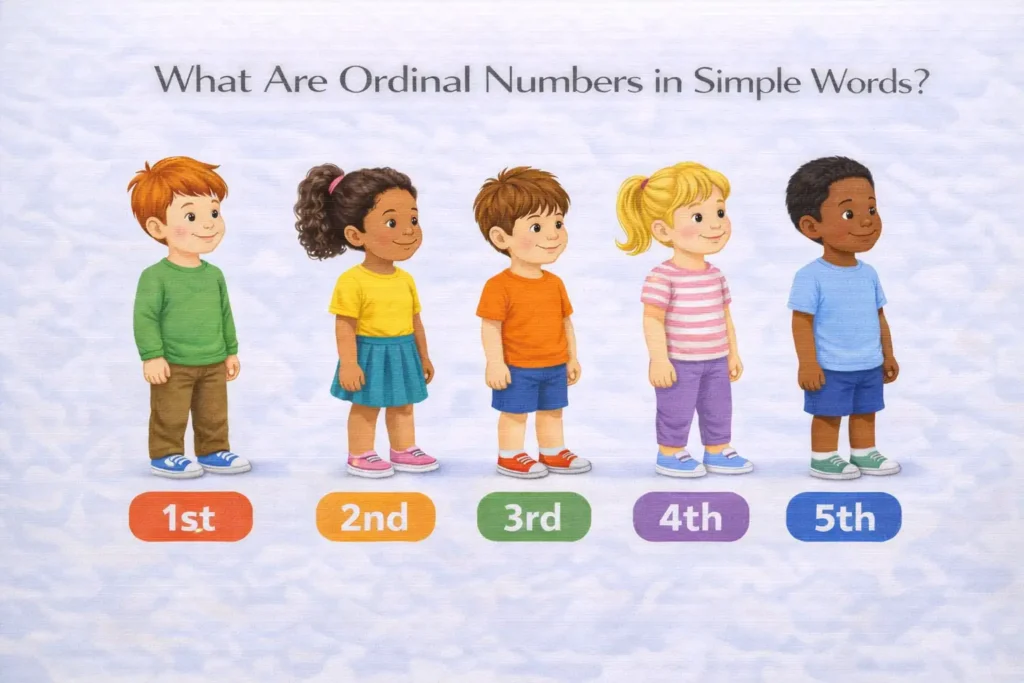
The easiest way to explain this to a Class 1 child:
“In a race, ordinal numbers tell us who came first, second, or third, not how many people ran.”
The key distinction children need to understand:
| Question | Type of Number | Example |
|---|---|---|
| How many? | Cardinal (counting) | Three apples |
| Which one? / What position? | Ordinal | The third apple |
This distinction also strengthens their overall number sense by helping them see that numbers describe the world in more than one way.
Ordinal Numbers Taught in Class 1: A Full List
Class 1 students begin with the first three ordinal numbers 1st, 2nd, and 3rd, which are the most frequently used in daily life. From there, they extend to the tenth position.
| Numeral | Ordinal Word | Suffix |
|---|---|---|
| 1 | First | 1st |
| 2 | Second | 2nd |
| 3 | Third | 3rd |
| 4 | Fourth | 4th |
| 5 | Fifth | 5th |
| 6 | Sixth | 6th |
| 7 | Seventh | 7th |
| 8 | Eighth | 8th |
| 9 | Ninth | 9th |
| 10 | Tenth | 10th |
Children also learn the suffix rules: st (1st), nd (2nd), rd (3rd), and th (4th onwards).
Teachers typically introduce these through classroom routines: “Stand second in line,” “Turn to the third page,” “What happened first in the story?”
These examples connect naturally to ascending and descending order in Class 1, where children arrange numbers by value the same positional thinking applied to quantity.
Why Are Ordinal Numbers Important in Class 1?
Ordinal numbers do more than teach children to say first and second.
They build a set of skills that support language, logic, and future maths learning.
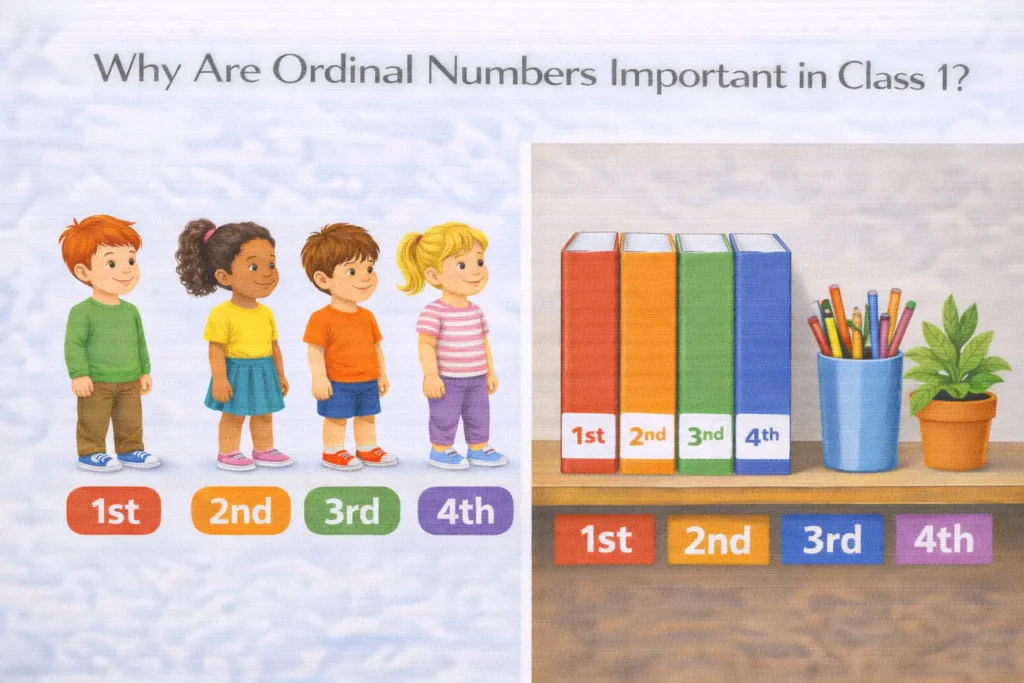
They Build Number Sense
Ordinal words like first, second, and third help children internalise the idea that numbers have a fixed sequence.
This is closely tied to why number sense is important for Class 1. Understanding position deepens a child’s overall grasp of how numbers relate to one another.
They Connect Maths to Daily Life
Children use ordinal language constantly, lining up, taking turns, following instructions, and listening to stories. Recognising this in context makes maths feel natural rather than abstract.
They Prepare Children for Future Maths
The positional thinking behind ordinal numbers is the same thinking children apply to number sequences for Class 1 and backward number sequences.
A child who understands that third comes after second is already thinking sequentially.
They Improve Language and Listening Skills
Following instructions like “stand second in line” or “open the third page” requires children to listen carefully and process positional language accurately a skill that transfers well beyond maths.
They Build Confidence in Class
Children who understand ordinal numbers can participate confidently in classroom routines, games, and group activities all of which frequently rely on positional language.
Cardinal vs. Ordinal Numbers: What’s the Difference?
Class 1 students learn two distinct types of numbers, and understanding the difference is important.
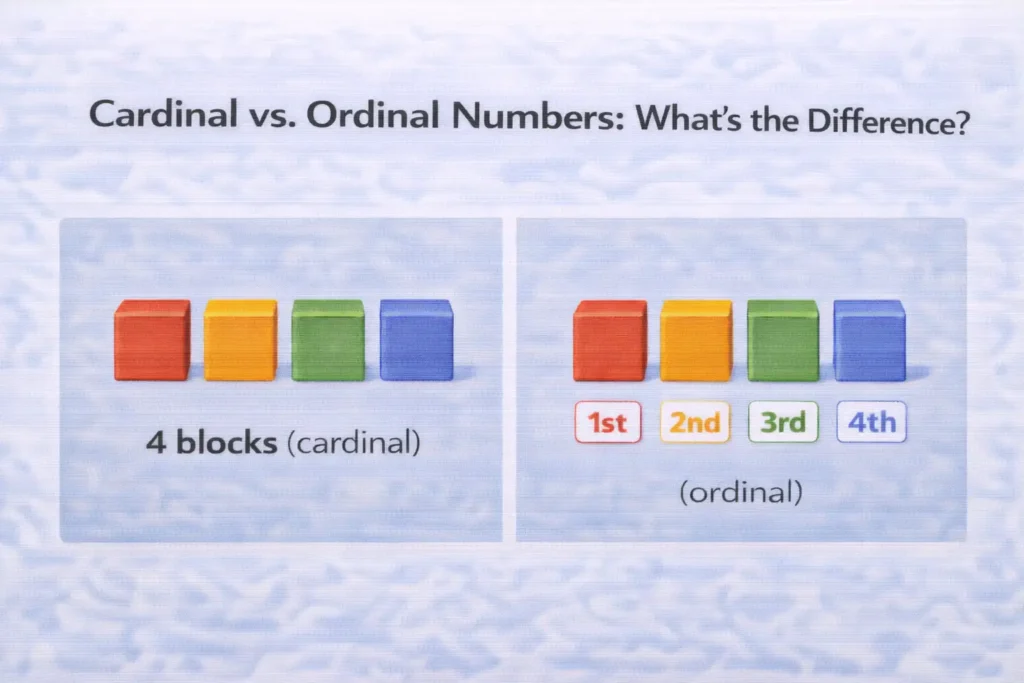
- Cardinal numbers count quantity: three apples, five students
- Ordinal numbers describe position: the first apple, the second student
| Scenario | Cardinal (How Many?) | Ordinal (Which Position?) |
|---|---|---|
| Race finishers | 3 runners | 1st, 2nd, 3rd |
| Books on a shelf | 4 books | 1st, 2nd, 3rd, 4th |
| Students in a line | 6 students | 1st to 6th in line |
This distinction also supports number ordering for Class 1, where arranging numbers by value builds the same positional logic that ordinal numbers require, just applied to quantity rather than rank.
Real-Life Examples of Ordinal Numbers for Class 1
Ordinal numbers appear so frequently in everyday life that children often encounter them before they are formally taught. Drawing attention to these moments is one of the most effective teaching strategies.
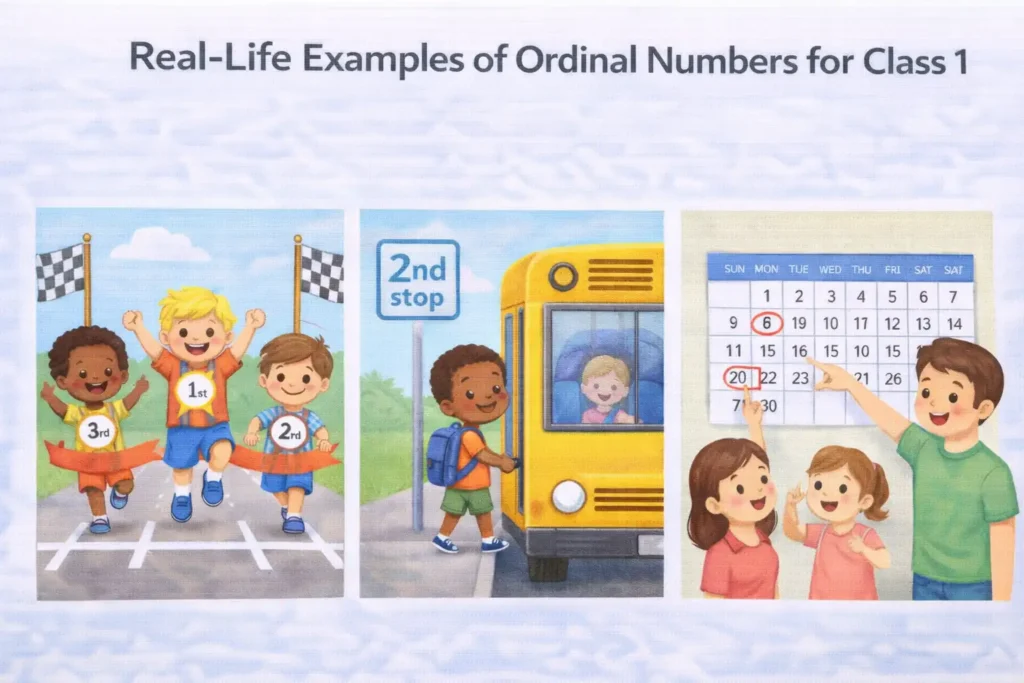
In the classroom: Teachers naturally use ordinal language: “Stand first in line,” “Move to the second position,” “The third student may enter.”
This positional language also echoes the vocabulary children use in spatial understanding for Class 1, where words like first, next, and last describe location and sequence.
In games and races: Who came first, second, or third in a race? Who is the fourth player to take a turn? These are immediate, motivating contexts for ordinal number practice.
In daily routines at home: The first day of the week, the third day of school, the second week of the month parents can use calendars, routines, and everyday conversation to reinforce ordinal language naturally.
The same approach works well alongside the strategies in how to teach forward and backward counting to kindergarten students, which translate equally well to Class 1.
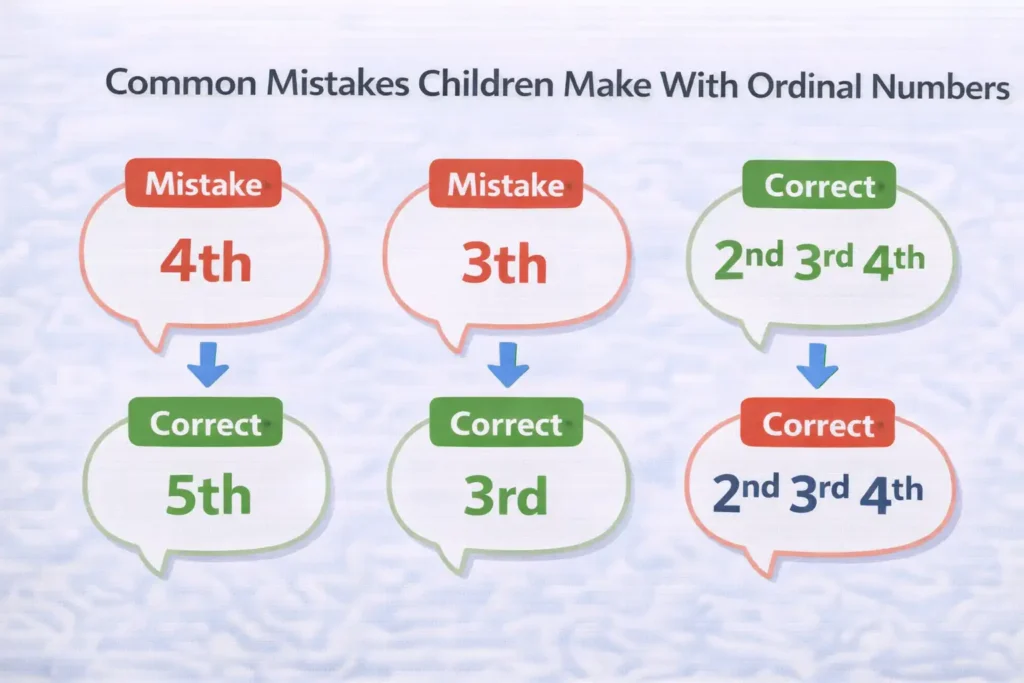
Common Mistakes Children Make With Ordinal Numbers
These errors are normal. They signal that a child is actively constructing their understanding, and they respond well to consistent, gentle correction.
1. Mixing Counting Numbers With Ordinal Numbers
Saying “I am one in line” instead of “I am first in line.”
Fix: Use side-by-side examples. “One tells how many. First tells which position.” Point to a group of objects: “There are three, but this one is first.”
2. Writing Ordinal Suffixes Incorrectly
Writing 1th instead of 1st, or 2th instead of 2nd.
Fix: A suffix chart displayed in the classroom helps children self-check. Flashcards with 1st–10th practised regularly make the correct forms automatic.
3. Confusing Order With Quantity
Saying “three place” instead of “third place.”
Fix: Ask two different questions about the same situation: “How many students ran?” (cardinal) and “Which position did Amir finish in?” (ordinal). The contrast makes the distinction clear.
These mistakes are similar to errors children make when learning ascending and descending order, where confusing position with quantity is also a frequent stumbling block.
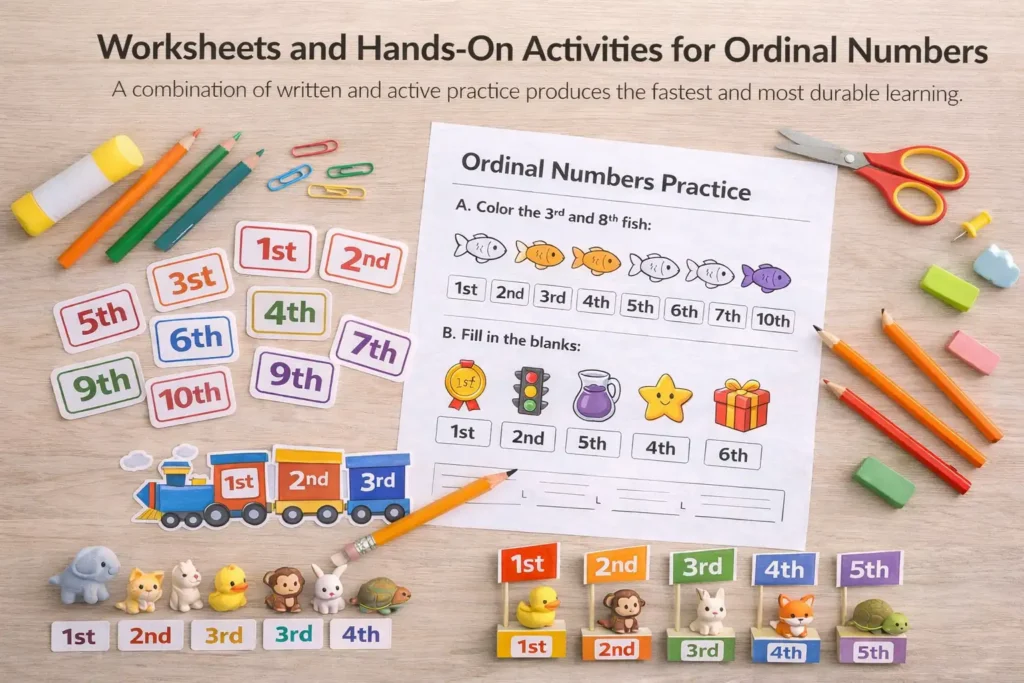
Worksheets and Hands-On Activities for Ordinal Numbers
A combination of written and active practice produces the fastest and most durable learning. Worksheets build accuracy; movement activities build understanding.
Worksheet Activities
Start with 1st–5th before extending to 10th. Effective worksheet tasks include:
- Circle the position: “Circle the 3rd animal in the row.”
- Match and label: Draw a line from each object to its ordinal position.
- Cut and paste ordering: Rearrange pictures into the correct sequence.
- Colour by ordinal instruction: “Colour the 2nd balloon red. Colour the 4th balloon blue.”
Hands-On Activities
- Paper train: Make a train with carriages labelled 1st to 5th. Place animal cards in the correct carriage.
- Number position cards: Shuffle cards 1st–10th and ask children to arrange them in order. This is a natural extension of number ordering activities for Class 1, applying positional logic to rank instead of value.
- Line-up game: Ask five children to stand in a line, then ask questions: “Who is third? Can the second person sit down?”
- Spinner activities: A spinner divided into positions (1st–6th) paired with a board game reinforces ordinal language in a play context.
For a structured teaching framework, a lesson plan on number patterns and sequences for Class 1 can be adapted easily for ordinal number practice sessions.
Always pair worksheets with at least one active or hands-on task. Praise effort and focus on progress — accuracy builds naturally with practice.
What are ordinal numbers for Class 1 maths?
Ordinal numbers describe the position or rank of something in a sequence: first, second, third, and so on. In Class 1, children learn ordinal numbers from 1st to 10th. Unlike counting numbers, which tell how many, ordinal numbers tell which position something occupies.
What is the difference between cardinal and ordinal numbers?
Cardinal numbers count quantity (e.g., three cats), while ordinal numbers describe position (e.g., the third cat). Both are taught in Class 1, and the key question to ask is: “How many?” for cardinal, and “Which one?” for ordinal.
What ordinal numbers do Class 1 students learn?
Class 1 students typically learn ordinal numbers from first (1st) to tenth (10th). They also learn the suffix rules: st for 1st, nd for 2nd, rd for 3rd, and th for 4th onwards.
How do you explain ordinal numbers to a young child?
Use a familiar context like a race or a queue. “In a race, the person who finishes first gets 1st place. The next person gets 2nd place.” Avoid abstract explanations, real scenarios make the concept immediate and memorable.
What are some real-life examples of ordinal numbers for Class 1?
Ordinal numbers appear in races (1st, 2nd, 3rd place), classroom lines (who is standing first or third), calendars (the first day of the week, the third week of the month), and stories (what happened first, second, next).
What common mistakes do Class 1 students make with ordinal numbers?
The three most common errors are: using a counting number instead of an ordinal (saying “one” instead of “first”), writing wrong suffixes (1th instead of 1st), and confusing order with quantity (saying “three place” instead of “third place”). All improve with consistent, game-based practice.
How can parents practise ordinal numbers at home?
Use everyday moments to ask who is first in the family to finish breakfast, which day of the week is the third, or which step in getting ready for school comes second. Even 2–3 minutes of casual ordinary language each day builds familiarity quickly.
How do ordinal numbers connect to number sequences?
Both concepts are built on the idea that numbers have a fixed, meaningful order. A child who understands that third comes after second is already thinking in sequences. This is why ordinal numbers and number sequences for Class 1 are often taught alongside each other.
Make Preparing for Math Olympiad Simple!



Conclusion
Ordinal numbers teach Class 1 children to think beyond counting understanding position and order is a skill they will use across maths and daily life.
That shift in thinking is more significant than it first appears: it underpins sequencing, spatial reasoning, story comprehension, and early problem-solving.
Small mistakes are normal and improve quickly with regular, relaxed practice.
To continue building on this foundation, explore how to teach number sequences to Class 1 students, or visit our guides on number ordering, ascending and descending order, and skip counting for Class 1.