


Ascending and descending order for Class 1 is one of the first ideas that teaches children numbers have direction.
- What Does Ordering Numbers Mean?
- What is Ascending Order?
- What is Descending Order?
- The Symbols: Less Than and Greater Than
- How to Remember Ascending and Descending Order
- Why Ordering Matters: The Connections It Builds
- How to Teach Ascending and Descending Order: 5-Step Method
- Activities to Practise Ordering
- Common Mistakes and How to Fix Them
- Conclusion
Numbers are not just labels to recite. They have size, sequence, and relationship and ordering is where that understanding begins.
Ascending order means arranging numbers from the smallest to the largest. Descending order means arranging numbers from the largest to the smallest.
These two definitions are simple, but they represent a shift in how children think about numbers.
This guide explains both concepts clearly, covers the symbols, gives memory techniques that actually work, and provides a step-by-step teaching method for parents and teachers.
For worked examples and practice questions at every difficulty level, see examples of ascending and descending order for Class 1.
What Does Ordering Numbers Mean?
Ordering numbers means arranging a set of numbers into a sequence that follows a clear rule either from smallest to largest or from largest to smallest.
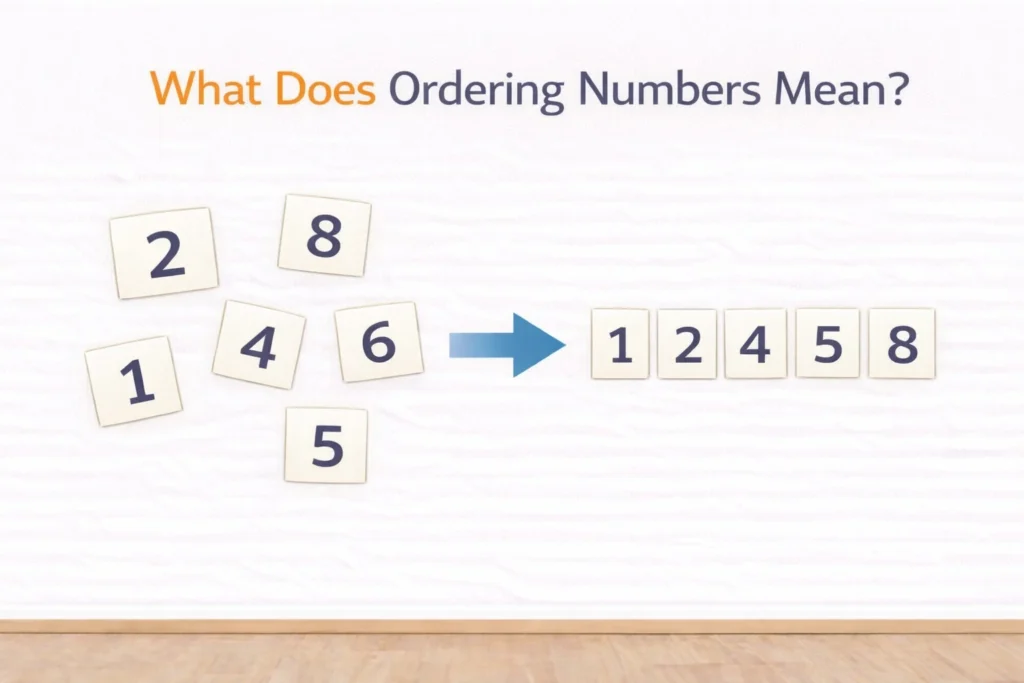
Instead of placing numbers randomly, children compare each number, decide which is greater or smaller, and arrange them accordingly.
There are exactly two directions:
- Ascending order: smallest to largest (also called increasing order)
- Descending order: largest to smallest (also called decreasing order)
Both directions appear throughout the Class 1 curriculum: in counting, number lines, comparison, and real-life measurement.
Children who understand both directions can navigate numbers flexibly a key marker of genuine number sense.
What is Ascending Order?
Ascending order means arranging numbers from the smallest to the largest.
The word “ascend” means to rise or go up. Think of climbing stairs: each step takes you higher, just as each number in ascending order is bigger than the one before it.
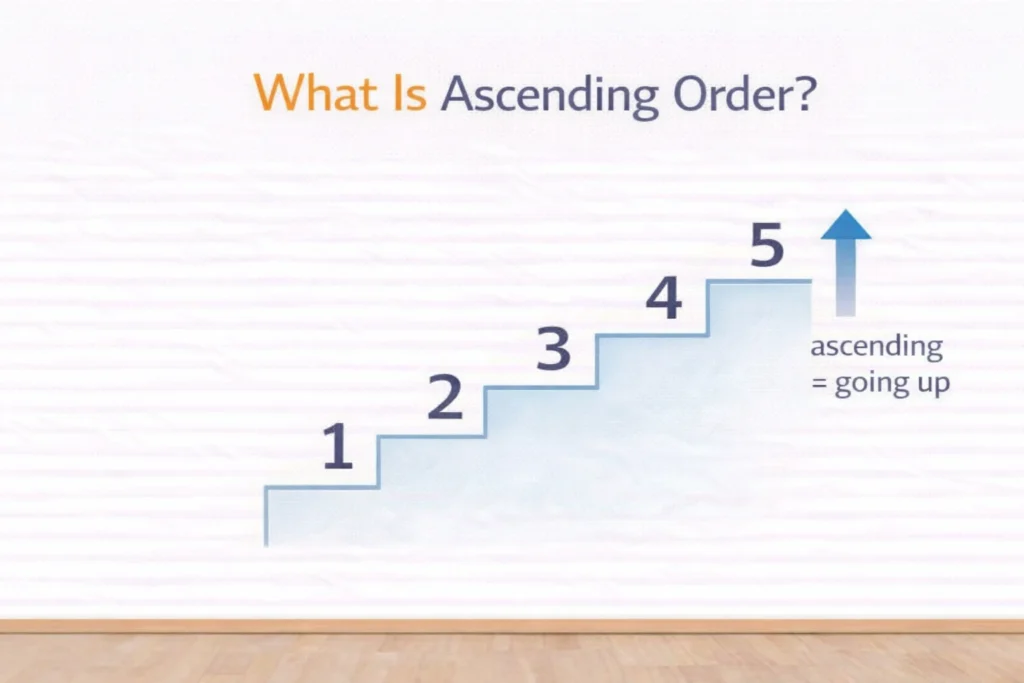
Simple examples:
- 1, 2, 3, 4, 5
- 3, 6, 9, 12
Mixed sets arranged in ascending order:
- 4, 1, 3 → 1, 3, 4
- 9, 2, 6 → 2, 6, 9
- 7, 3, 5, 1 → 1, 3, 5, 7
When teaching this concept, encourage children to say aloud: “This number is smaller, so it comes first.” Verbalising the reasoning builds the comparative thinking that ordering requires.
Ascending Order Definition for Kids
In simple words, ascending order means putting numbers from small to big like lining up from the shortest person to the tallest.
The ascending order symbol used between numbers is the less-than sign (<), because each number is smaller than the one that follows it.
Example: 2 < 5 < 8 shows numbers arranged in ascending order using the correct sign.
The counting sequence children already know 1, 2, 3, 4… is ascending order applied to every whole number. Ordering is simply that same idea applied to any set of numbers.
What is Descending Order?
Descending order means arranging numbers from the largest to the smallest.
The word “descend” means to fall or go down. Think of sliding down a slide: each moment takes you lower, just as each number in descending order is smaller than the one before it.
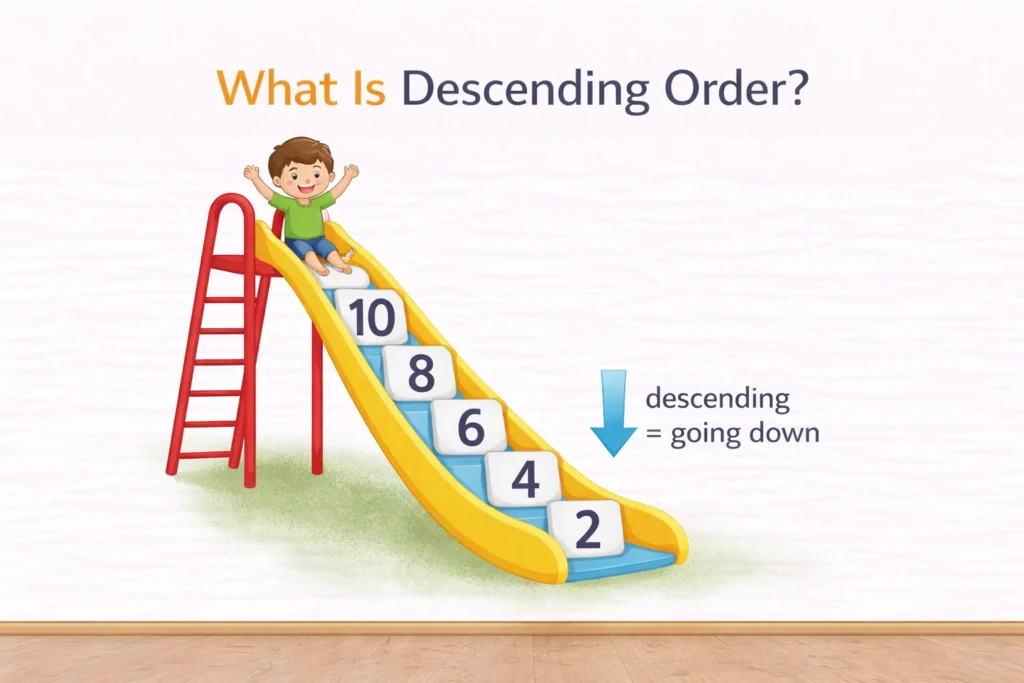
Simple examples:
- 5, 4, 3, 2, 1
- 10, 7, 4, 1
Mixed sets arranged in descending order:
- 6, 2, 5 → 6, 5, 2
- 15, 9, 12 → 15, 12, 9
- 8, 3, 6, 1 → 8, 6, 3, 1
Counting down “10, 9, 8, 7…” before a race starts is a form of descending order in everyday life. Children already do this without realising it.
Descending Order Definition for Kids
Descending order means putting numbers from big to small the exact opposite of ascending order.
The descending order symbol used between numbers is the greater-than sign (>), because each number is bigger than the one that follows it.
Example: 9 > 6 > 3 shows numbers arranged in descending order.
The Symbols: Less Than and Greater Than
When children order numbers, they also begin using comparison symbols, the ascending and descending order signs that describe relationships precisely.
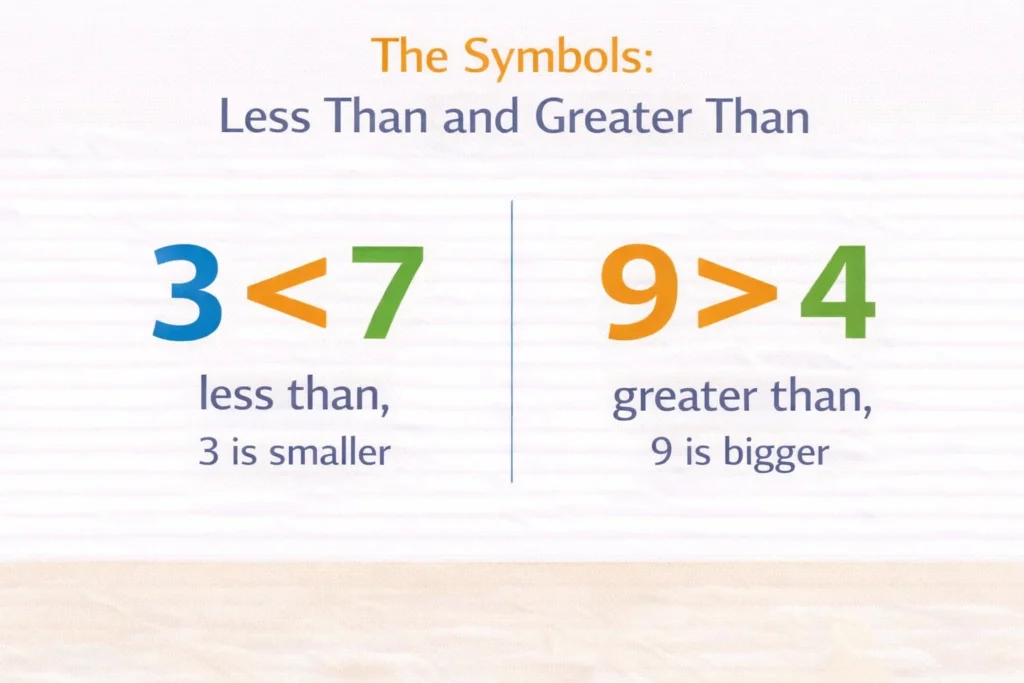
Less than (<): The symbol < means one number is smaller than another.
- 3 < 7 means 3 is smaller than 7.
Greater than (>): The symbol > means one number is larger than another.
- 9 > 4 means 9 is bigger than 4.
The open mouth trick: The symbol always opens toward — “eats” — the bigger number. This child-friendly memory aid is reliable and helps children apply the symbols correctly from the very first introduction.
These symbols directly describe the result of ordering:
- In ascending order, every number is greater than the one before it: 2 < 5 < 8
- In descending order, every number is less than the one before it: 8 > 5 > 2
Understanding the connection between ordering and the symbol deepens both concepts simultaneously.
The number line makes these comparisons visually obvious: numbers to the right are always greater, numbers to the left are always less. This visual grounding is covered in number positions on a number line, Class 1.
Ascending and Descending Order Symbols — Quick Reference
- Ascending order sign: < (less than), also called the increasing order sign
- Descending order sign: > (greater than), also called the decreasing order sign
- Equal sign: = (when two numbers are the same)
Children should learn to read these signs aloud: “3 is less than 7” and “9 is greater than 4.” This verbal practice builds confidence before written exercises.
How to Remember Ascending and Descending Order
The most common question parents ask is how to remember which direction is which. Here are four techniques that work reliably with Class 1 children.
1. The Staircase and Slide Method
Ascending goes up like climbing stairs. Descending goes down like a slide. Draw a staircase labelled 1, 2, 3, 4, 5 going up, and a slide labelled 5, 4, 3, 2, 1 going down. This visual sticks because children interact with both objects every day.
2. The Alphabet Clue
“A” for ascending comes before “D” for descending in the alphabet just as ascending starts from the smaller number. “A” is also for “add”: ascending adds, going higher. “D” is for “drop”: descending drops, going lower.
3. The Counting Connection
Forward counting (1, 2, 3…) is ascending order. Backward counting (10, 9, 8…) is descending order. Children already know both — they simply need to connect the vocabulary to the action they already perform.
4. The Word Itself
“Ascend” means to rise, as in ascending a mountain. “Descend” means to fall, as in descending from a plane. The words carry their own meaning. Once a child hears the etymology, it rarely needs repeating.
Practise both directions for five minutes daily for one week, and the meaning of ascending and descending order becomes automatic.
Why Ordering Matters: The Connections It Builds
Understanding ascending and descending order is not a standalone skill. It connects to several other mathematical concepts that Class 1 children encounter throughout the year.
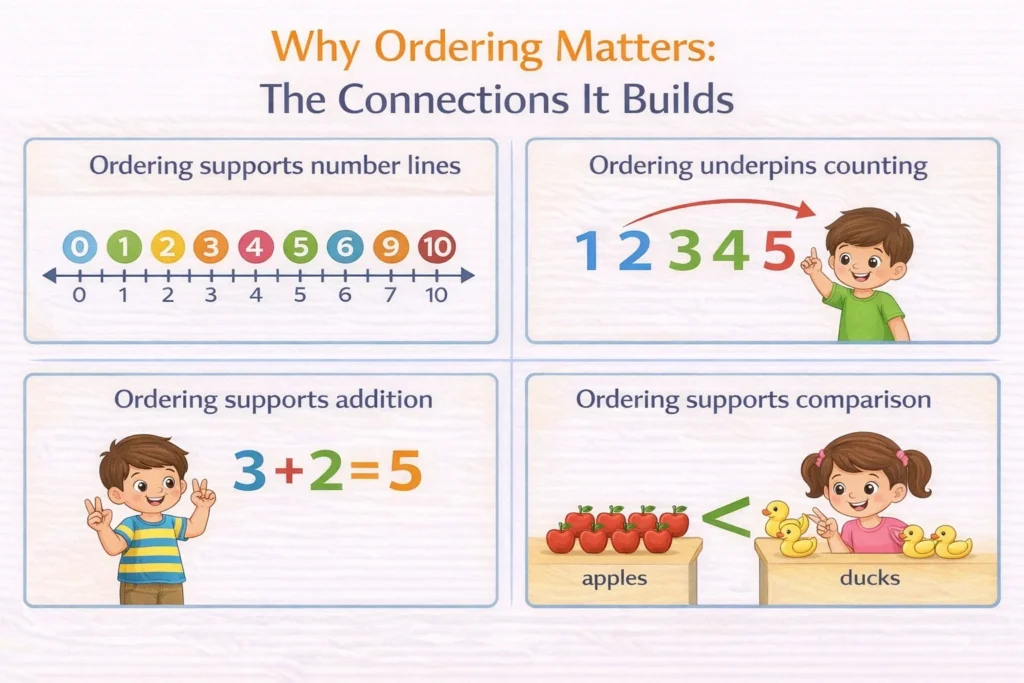
Number lines: A number line is an ascending order of visual numbers increasing consistently from left to right. Children who understand ordering find number line navigation immediately intuitive.
The full picture is in how to teach number line Maths Class 1.
Counting forward is in ascending order. Backward counting is descending order. Every time a child counts, they are using ordering, making ordering practice and counting practice mutually reinforcing.
Addition and subtraction. Adding moves you forward along the number line in the ascending direction. Subtracting moves you backward in the descending direction.
Children who internalise ordering direction find the meaning of these operations clearer and more intuitive.
Comparison Ordering requires comparing each number to decide its position. This comparison habit “is this one bigger or smaller?” is the same skill that less-than and greater-than symbols use, and that all number magnitude work requires.
The ordinal thinking that connects to position and sequence is explored in ordinal numbers for Class 1 Math.
How to Teach Ascending and Descending Order: 5-Step Method
Teaching ordering works best when you move from concrete objects to abstract numbers. Here is the sequence for parents and teachers.
Step 1 — Start with physical objects
Line up toys, bottles, or books from smallest to biggest. Ask the child to describe what they see. Then reverse the order. Use the words “ascending” and “descending” as they arrange. Concrete experience before abstract symbols is non-negotiable at Class 1 level.
Step 2 — Move to number cards
Write numbers 1–10 on individual cards. Let the child arrange them from small to big (ascending), then big to small (descending). Repeat until the arrangement feels easy and requires no pausing.
Step 3 — Introduce the symbols
Once the child is comfortable with verbal ordering, show the less-than (<) and greater-than (>) signs. Use the “hungry mouth” trick — the mouth always opens toward the bigger number. Connect the symbol to the direction: < means going up (ascending), > means going down (descending).
Step 4 — Practice with written exercises
Give sets of mixed numbers and ask the child to write them in ascending order, then in descending order. Start with three numbers, then increase to five. For ready-to-use exercises at five difficulty levels, see examples of ascending and descending order for Class 1.
Step 5 — Play ordering games
Use the activities below to make practice varied and enjoyable. Short daily practice (5 minutes) beats long occasional sessions. Fluency is built through repetition across many days, not in a single sitting.
The key throughout is understanding why numbers go in a certain order, not just how. Children who understand the logic develop a stronger number sense for every topic that follows.
Activities to Practise Ordering
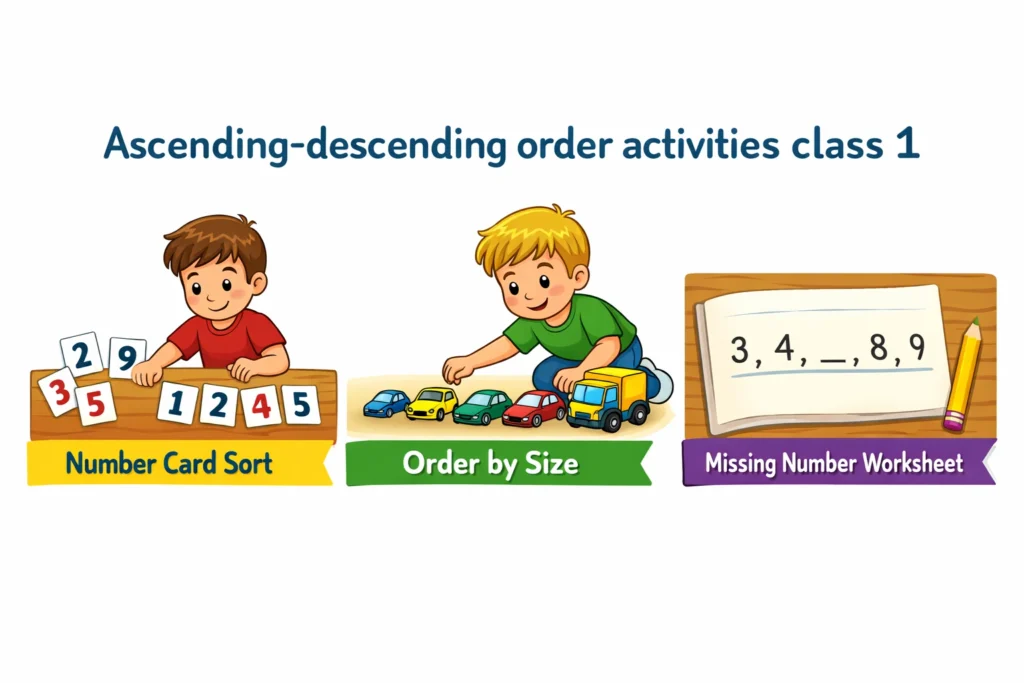
Number Card Sort Write numbers 1–10 on cards, shuffle them, and ask your child to arrange them in ascending order. Shuffle again and arrange in descending order. Time them children love beating their own records.
Object Ordering Gather five household objects of clearly different sizes: spoons, bottles, books, toy cars. Ask your child to arrange them from smallest to largest (ascending), then largest to smallest (descending). Connecting ordering to physical objects makes the concept concrete and memorable.
Human Number Line Give children number cards and ask them to stand in ascending order. Then call “descending!” and have them reverse their positions. The physical, social element makes the direction switch memorable and enjoyable.
Missing Sequence Game Write a partial sequence with gaps “2, __, 6, 8, __” and ask children to fill in the missing numbers. Extend to descending sequences: “10, __, 6, __, 2.” This activity develops both ordering fluency and sequence understanding.
Backward Counting Practice: Ask children to count down from varied starting points “Count down from 15, now from 12, now from 20.” Children who practise backward counting regularly find descending order exercises significantly easier.
Common Mistakes and How to Fix Them
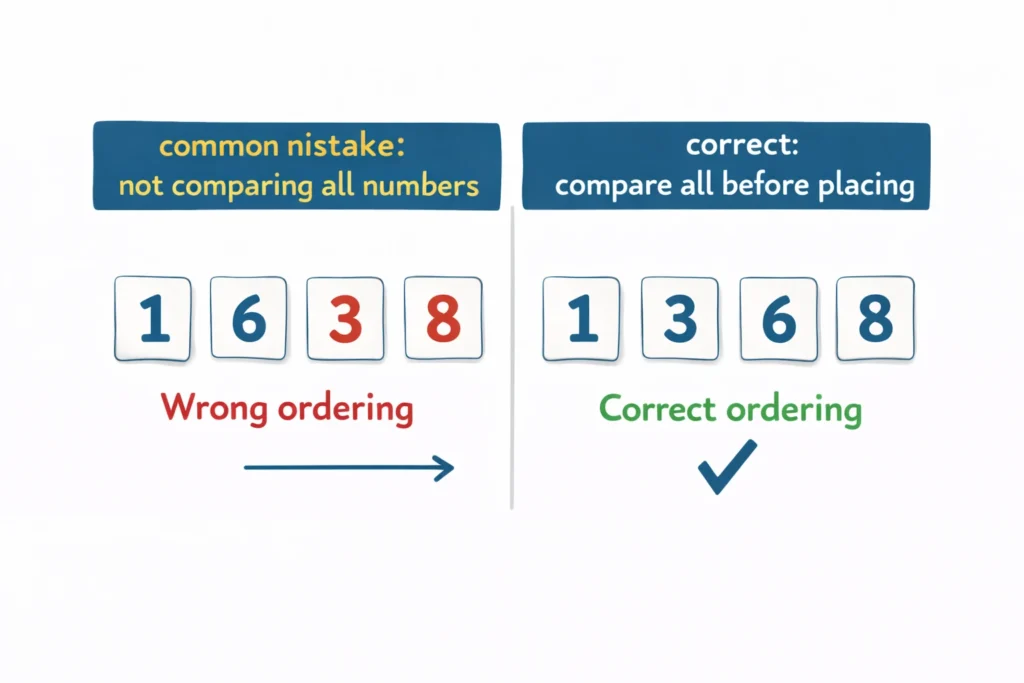
Ordering only the first and last number correctly Children identify the smallest and largest correctly but place middle numbers randomly. Fix this by teaching a systematic approach: find the smallest first, set it aside mentally, then find the smallest of what remains, and repeat.
Confusing ascending with descending The most reliable fix is the staircase/slide analogy: “Ascending goes up like stairs. Descending goes down like a slide.” Return to this language every time confusion occurs, rather than correcting abstractly.
Mixing up the symbols Children sometimes write < when they mean > or vice versa. The “hungry mouth” trick solves this consistently the open side always faces the bigger number.
Stopping after partial ordering Some children correctly order part of a set and then lose track. Fix by having children cross off or physically remove each number after placing it, so they only consider unplaced numbers at each step.
Thinking ascending means big to small This reversal is common. Remind children: ascending means small to big (going up). Descending means big to small (going down). The staircase and slide analogy resolves it faster than any verbal correction.
What is the easiest way to remember ascending vs descending?
Ascending = going up (like climbing stairs, counting up). Descending = going down (like sliding down, counting down). The words themselves contain the clue “ascend” means to rise, “descend” means to fall.
Should Class 1 children use the < and > symbols?
Introduction to the symbols is appropriate in Class 1, but only after the verbal concept of “greater than” and “less than” is secure. Symbols are shorthand; they should follow understanding, not replace it. Start with words, add symbols once the child uses comparison language confidently.
How does ordering connect to the maths olympiad for Class 1?
Ordering and comparison problems appear regularly in early competition mathematics, such as arranging sets of numbers, identifying the largest or smallest value, and reasoning about which number belongs in a given position. Children with fluent ordering ability approach these problems quickly and confidently. The IMO syllabus for class 1 maps all the number topics assessed at this level.
What does ascending mean in maths?
In maths, ascending means going from the smallest value to the largest. When numbers are in ascending order, each number is bigger than the one before it. For example, 2, 5, 8, 11 is in ascending order.
What does descending mean in maths?
Descending in maths means going from the largest value to the smallest. When numbers are in descending order, each number is smaller than the one before it. For example, 11, 8, 5, 2 is in descending order.
Is ascending order smallest to largest?
Yes. Ascending order always means arranging numbers from the smallest to the largest. It is also called increasing order. The ascending order sign is < (less than).
Is descending order largest to smallest?
Yes. Descending order always means arranging numbers from the largest to the smallest. It is also called decreasing order. The descending order sign is > (greater than).
What is the ascending and descending order sign?
What is the easiest way to remember ascending vs descending?
Ascending = going up (like climbing stairs, counting up). Descending = going down (like sliding down, counting down). The words themselves contain the clue “ascend” means to rise, “descend” means to fall.
Make Preparing for Math Olympiad Simple!



Conclusion
Worked examples at graduated difficulty levels with step-by-step solutions, missing number challenges, and real-life contexts turn a familiar concept into an independently applied skill.
Work through each level until it feels effortless before moving to the next. Return to earlier levels whenever needed — fluency at the previous level is always the right foundation first.
For the complete conceptual framework behind these examples, including definitions, symbols, and the full teaching method, see ascending and descending order in Maths Class 1.
For the step-by-step rules each example applies, see rules for ordering numbers Class 1.

Mikha Piregu is a Content Writer with experience spanning educational content, including math and math olympiad topics, as well as advocacy writing, research-based articles, and SEO-driven web content. He creates high-quality blog content, web copy, and feature articles that support brand visibility, audience engagement, and long-term organic growth through data-informed storytelling. Skilled in WordPress, WooCommerce, and modern digital tools, Mikha adapts content across various platforms, including blogs, websites, campaigns, and advocacy initiatives, with clarity and purpose.

There are no comments posted here yet.
Sign in to leave a comment