 February 27, 2026
 10 min. read

How to teach number sequences to Class 1 students is one of the most important steps in early maths, because before children can add or subtract, they need to know that numbers follow a specific, predictable order.
Counting forward, backward, and in patterns like skip counting builds a mental map of numbers that makes number sense for Class 1 and early arithmetic possible.
If you’re new to the topic, start with what number sequences are in Class 1 maths first.
This guide gives parents and teachers a clear, step-by-step framework from recognising readiness signs to fun activities and support strategies.
When Are Class 1 Students Ready to Learn Number Sequences?
Most Class 1 students are ready to learn number sequences once they can recognise numbers from 1 to 20 and count forward to at least 20 without prompting.
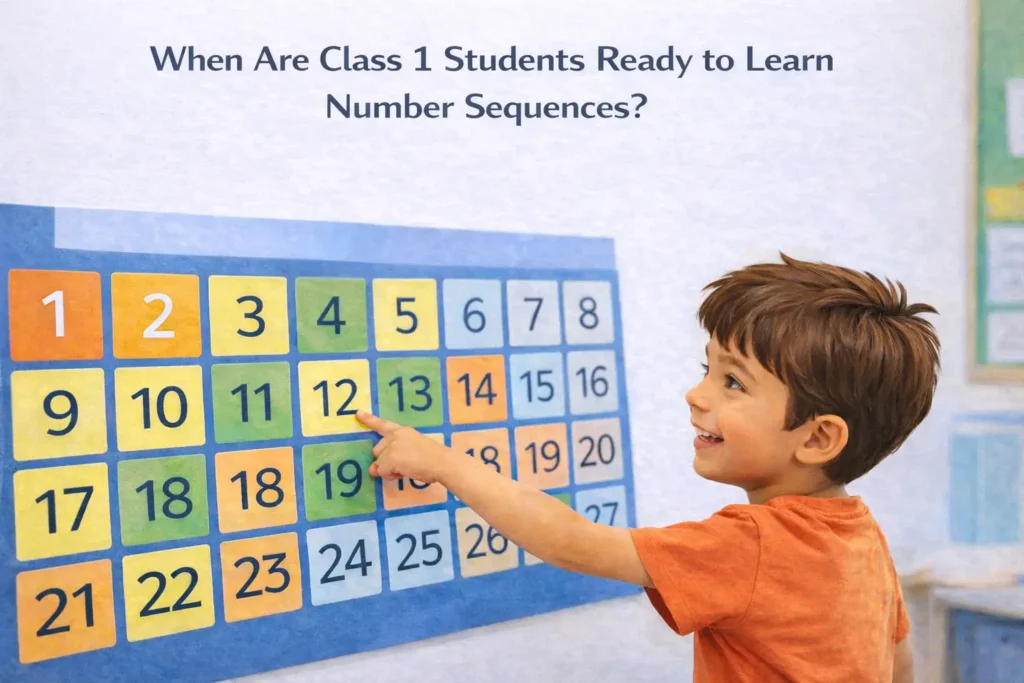
Key readiness signs to look for:
- Recites numbers in the correct order without help
- Answers questions like “What comes after 17?” or “What comes before 10?”
- Can count backward from 10 during songs or games
One common misconception is that children must count perfectly before starting sequence activities. In reality, many children improve their counting through sequence games, songs, and hands-on practice.
Starting early, even with small ranges like 1 to 5, builds confidence alongside skill.
Types of Number Sequences Taught in Class 1
Class 1 covers three main types of number sequences.
Each one builds on the last, and together they give children a well-rounded understanding of number order and pattern.
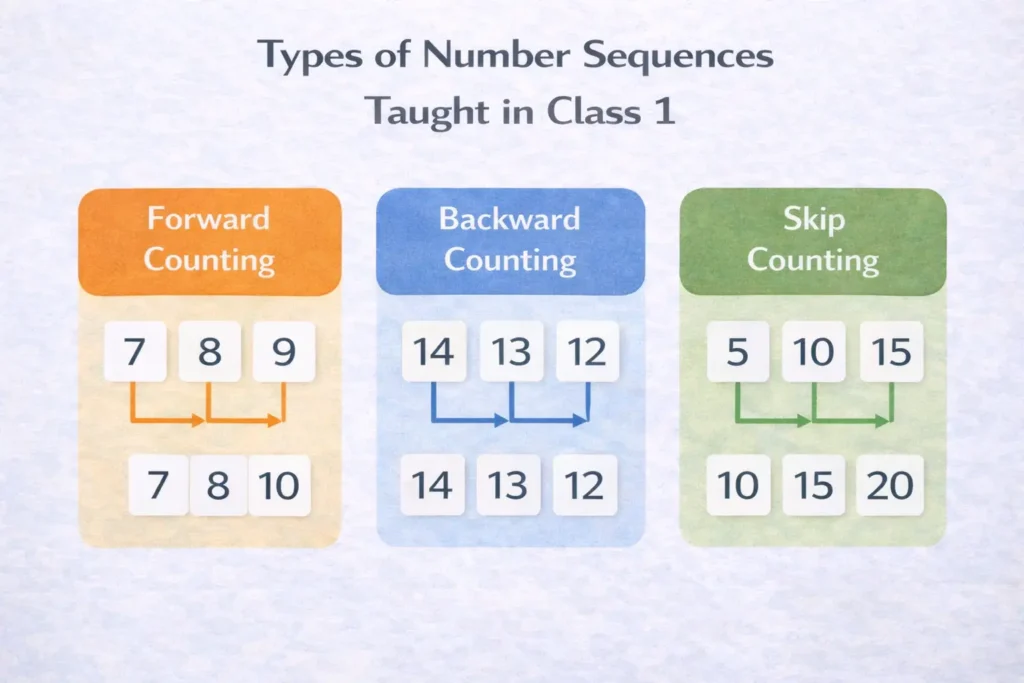
1. Forward Number Sequences
Counting up from smaller to larger numbers, like 1 to 10 or 1 to 20, is the most fundamental sequence type. Think of it as climbing steps one by one: each number is one higher than the one before.
Number line activities for Class 1 and oral counting routines are the most effective tools here. Children first count within a small range, then gradually extend to 1–50 and 1–100.
2. Backward Number Sequences
Counting from larger to smaller, such as 10 to 1 or 20 to 10, teaches children to think in reverse.
Understanding the backward number sequence for Class 1 directly prepares them for subtraction, making it one of the most important early maths skills to develop.
Learning why backward counting matters helps teachers and parents appreciate the full value of this skill.
In daily life, backward counting appears in game countdowns, bedtime routines, and timed activities, which makes it easy to practise naturally.
3. Skip-Counting Sequences
Skip counting means jumping by a fixed number: counting by 2s (2, 4, 6, 8), 5s (5, 10, 15, 20), or 10s (10, 20, 30).
Understanding what skip counting is for Class 1 shows how it bridges basic number sequences and early multiplication.
Real-life examples make this tangible: counting pairs of shoes (by 2s), fingers on hands (by 5s), or ten-pence coins (by 10s).
Step-by-Step Method to Teach Number Sequences
The most effective approach moves children from physical objects → visual tools → spoken practice → written work.
This gradual progression ensures understanding at each stage before moving on.
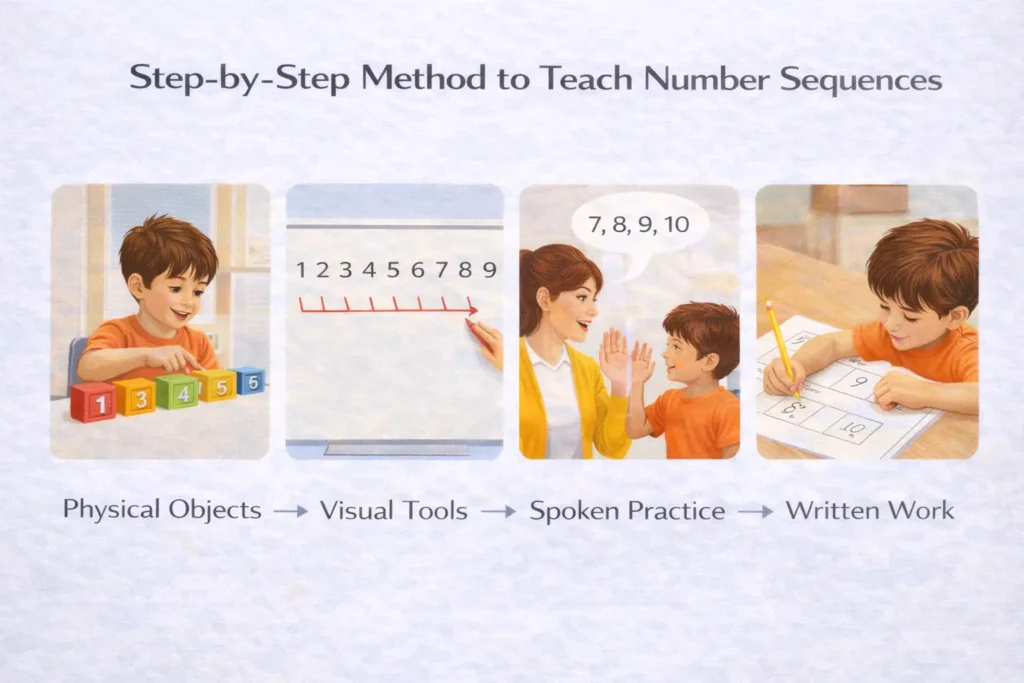
Step 1 — Start With Concrete Objects
Use tangible items children can touch and move: blocks, toys, beads, or counters.
- Line up 10 blocks and count forward as you point to each one
- Remove one block at a time and count backward
- Group objects into pairs or fives to introduce skip counting
Handling objects helps children feel how numbers increase or decrease, making the abstract concrete.
Step 2 — Move to Visual Tools
Once children are comfortable with objects, introduce visual representations. Learning how to teach number line maths to Class 1 students gives a practical framework for this.
You can also teach children the steps to draw a number line themselves, making their own tool deepens understanding.
Other useful visual aids include 1–100 number charts, flashcard sequences, and missing-number strips.
Step 3 — Practise Oral Counting
Spoken practice builds fluency and makes sequences memorable. Use:
- Counting songs and chants — “Count by 2s: 2, 4, 6, 8…”
- Countdown games — “10, 9, 8… blast off!”
- Call-and-response — teacher says “5,” child says “6”
Oral practice is also easy to embed into transitions, meal times, and movement breaks.
Step 4 — Introduce Written Practice
Written activities should come last and stay short. Good starting tasks include:
- Filling in missing numbers: 2, 4, __, 8 → 6
- Completing forward and backward sequences on a strip
- Tracing number patterns or circling the correct next number
Prioritise understanding over neatness. A child who explains the correct answer confidently has grasped the concept, even if their handwriting is still developing.
Fun Activities to Teach Number Sequences to Class 1 Students
Play-based activities are the most effective way to make number sequences stick.
These ideas work equally well in the classroom and at home.
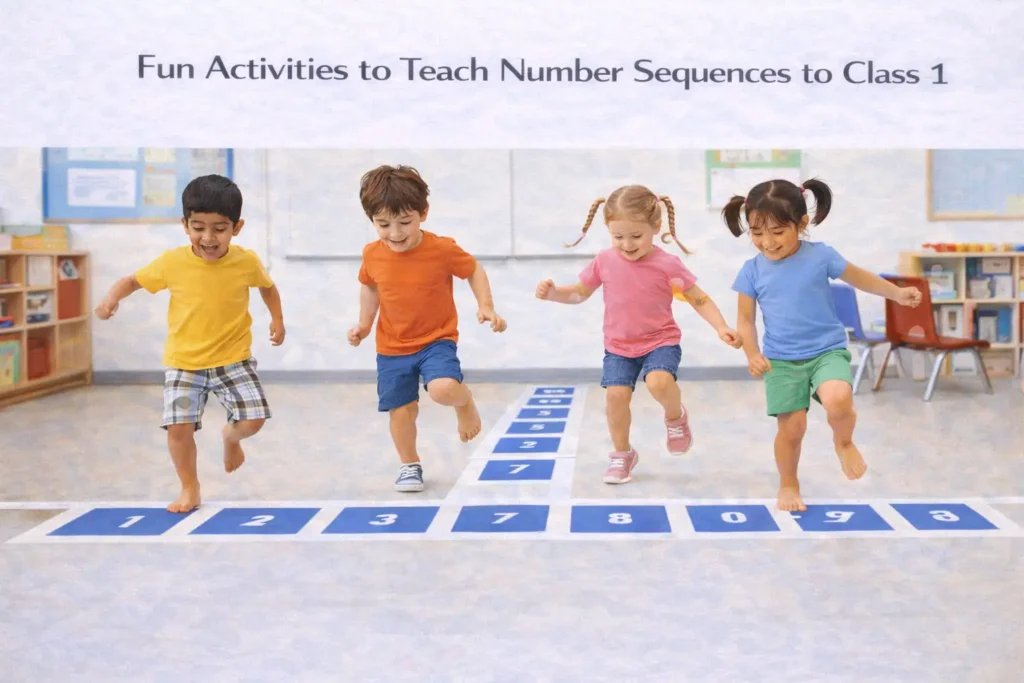
1. Number Line Hopping
Tape or draw a large number line on the floor (1–10 or 1–20). Children hop forward counting aloud, then hop backward, or skip-count by 2s or 5s. Adding music, clapping, or a countdown makes this a favourite.
To make this activity even richer, explore how to explain number positions on a number line so children understand why each number sits where it does, not just what comes next.
2. Missing Number Games
Write sequences on cards or a whiteboard with one or more numbers hidden:
- 3, 4, __, 6 → 5
- 15, __, 13, 12 → 14
Turn it into a class game: pass a ball around the circle, whoever catches it fills in the next missing number.
For individual practice, a lesson plan for skip counting in Class 1 offers structured missing-number activities ready to use.
3. Classroom Sequencing Relay
Divide children into teams. Each child runs to a whiteboard and writes the next number in the sequence before tagging the next teammate.
Works for forward, backward, and skip-counting sequences.
For more ready-to-use ideas, easy skip-counting activities for Class 1 offers a range of simple games that keep children engaged while reinforcing number patterns.
4. Everyday Home Sequencing
Parents can build sequence practice into daily routines without any materials:
- Stairs — count forward going up, backward coming down
- Snacks — group raisins or grapes into pairs to practise counting by 2s
- Calendar — “What date comes after the 14th? What came before the 10th?”
For a structured at-home approach, how to teach forward and backward counting to kindergarten includes simple routines that work equally well for Class 1 children.
How to Help Children Who Struggle With Number Sequences
Struggling with sequences is normal and temporary.
The key is adjusting the pace and approach rather than repeating the same method more frequently.
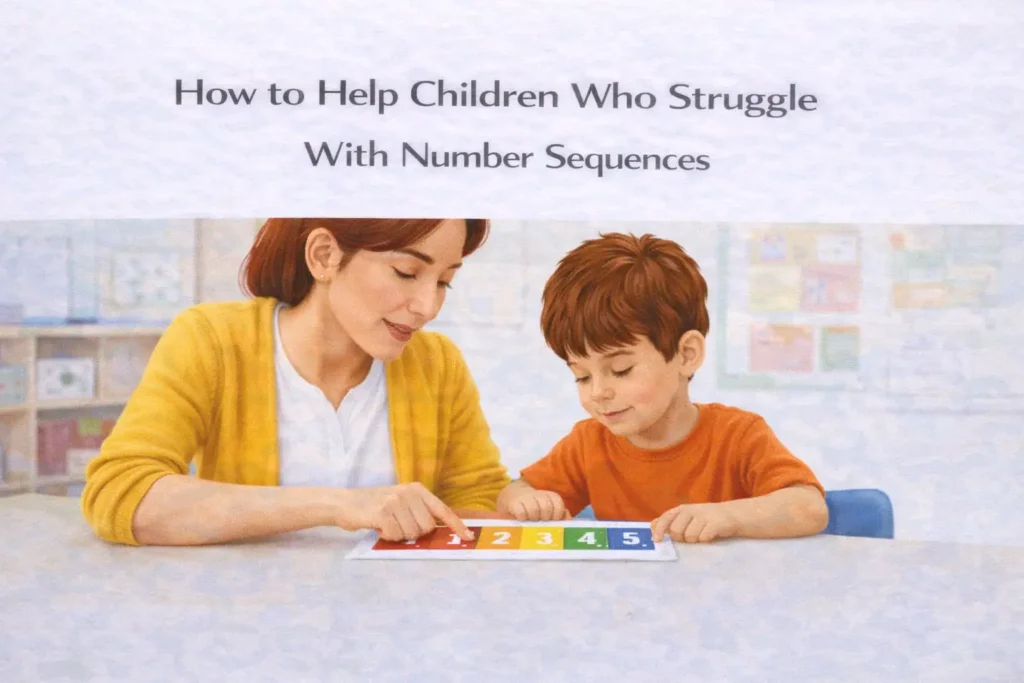
Start smaller than you think necessary. If a child is struggling with 1–10, work with 1–5 until that feels solid. Confidence at a small scale transfers quickly to larger ranges.
Use repetition through games, not drills. Short, playful activities like songs and card games reinforce learning without pressure or anxiety.
Following how to teach skip counting to Class 1 kids step by step is particularly useful for children who need a structured, low-pressure routine.
Add movement. Hopping on a number line, clapping out a sequence, or tapping on a drum as they count engages children who find sitting and listening difficult.
Track progress informally. Notice when a child can now do something they couldn’t do a week ago and point it out to them. Knowing they are improving is a powerful motivator.
Patience and encouragement are the most important tools of all.
How to Assess Number Sequence Understanding in Class 1
Formal tests are rarely needed at this age.
Observation and conversation give far richer information about what a child actually understands.
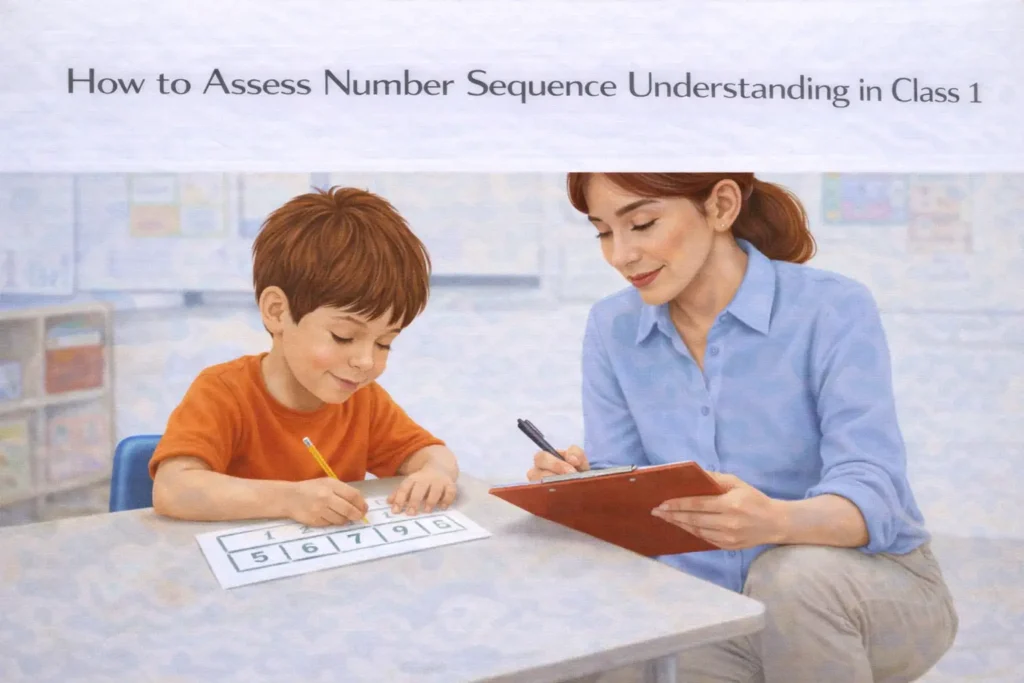
Oral checks (quick and easy):
- “What comes after 15?”
- “Can you count backward from 12?”
- “What number is between 7 and 9?”
Activity observation:
- Does the child hop to the correct position on the number line?
- Can they fill in missing numbers without looking at a chart?
- Do they self-correct when they make a mistake?
Signs of solid understanding:
- Predicting the next number before they reach it
- Skip counting smoothly within a familiar range
- Applying number order naturally in daily activities (e.g., “I’m 6 and my sister is 8, so she’s older”)
For a deeper picture of what to look for, exploring the characteristics of number sense in Class 1 helps teachers and parents identify exactly where a child is on their learning journey.
Understanding why number sense is important for Class 1 also clarifies what these assessments are ultimately building toward.
Printable and Hands-On Materials for Number Sequences
The right materials make practice easier for both children and the adults supporting them.
You don’t need expensive resources; simple, homemade tools work just as well.
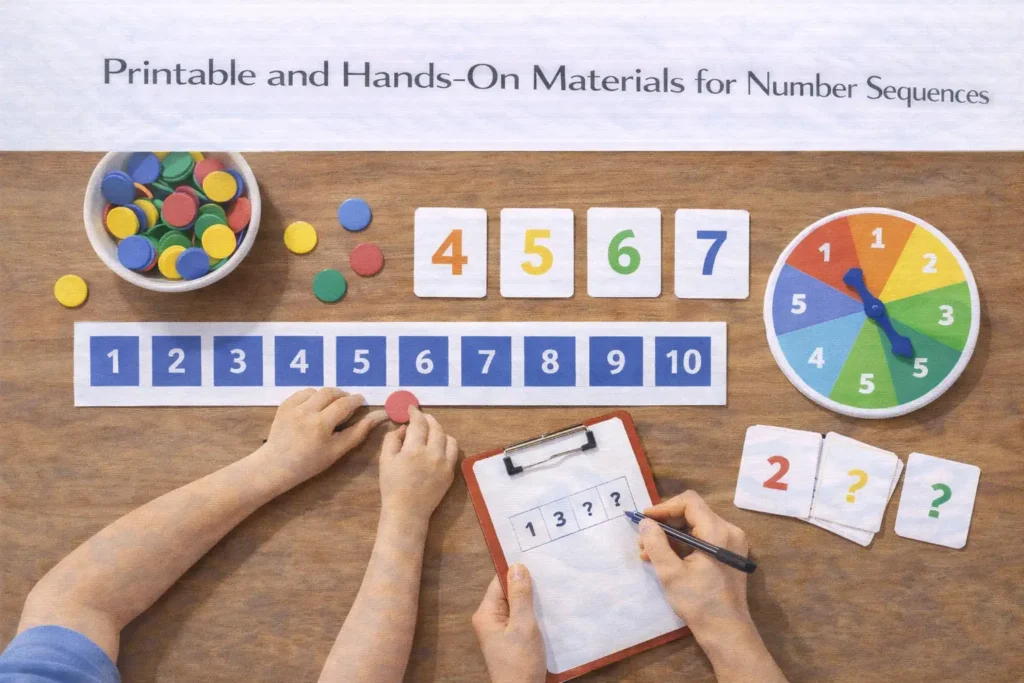
Printable materials:
- Fill-in-the-blank sequence worksheets (forward, backward, and missing number)
- 1–50 and 1–100 number charts for circling or colouring sequences
- Number strips that children can cut out and rearrange
DIY tools:
- Floor number line — tape numbers on a hallway floor or draw on card
- Number wheel — a circular chart with numbers that children spin to practice what comes before and after
- Sequence cards — write numbers on index cards and shuffle them for ordering activities
Everyday objects:
- Beads, bottle caps, or counters for building physical sequences
- Dot stickers on a ruler or cardboard strip to create a quick number line
Learning the steps to draw a number line for Class 1 maths is a great starting point for making your own visual aids.
Always pair worksheets with hands-on activities; written practice alone is rarely enough at this age.
How do you introduce number sequences to Class 1 students?
Start with concrete objects like blocks or counters to show how numbers increase or decrease. Then move to visual tools like number lines and charts, add oral counting practice through songs and games, and finally introduce short written tasks like filling in missing numbers.
At what age should children start learning number sequences?
Most children begin learning number sequences at age 5–6, which corresponds to Class 1 or Grade 1. They typically start with sequences within 1–20 and gradually extend to 1–50 and 1–100 as confidence grows.
What is the best activity for teaching number sequences to young children?
Number line hopping where children physically jump along a floor number line while counting aloud is one of the most effective activities. It combines movement, visual learning, and oral practice, making sequences memorable and enjoyable.
How do you teach backward number sequences to Class 1 students?
Start with short ranges like 5 to 1 or 10 to 1. Use countdown games (“10, 9, 8… blast off!”), remove objects one by one while counting backward, and practise on a number line by moving left instead of right. Songs and rhymes with backward counts are also very effective.
How do you help a child who keeps skipping numbers in a sequence?
Slow the pace down and use physical objects, one touch per number, so the child can feel each step. Reduce the range (e.g., count only 1 to 5) until the child is consistent, then gradually extend. Short, repeated practice across several days works better than one long session.
What is skip counting and how does it relate to number sequences?
Skip counting means counting by a fixed number greater than 1, such as by 2s (2, 4, 6, 8) or by 5s (5, 10, 15). It is an extension of standard number sequences and is introduced once children are comfortable counting forward by 1s. It also prepares children for multiplication later on.
How can parents support number sequence learning at home?
Use everyday moments: count stairs forward and backward, group snacks to practise skip counting, and ask “what comes next?” questions during calendar or bedtime routines. Just 2–3 minutes of relaxed practice each day makes a significant difference.
How do you know if a Class 1 student has mastered number sequences?
Look for these signs: the child can count forward and backward within the expected range without prompting, can identify missing numbers in a sequence, and starts applying number order naturally in daily situations, for example, knowing which number is larger without needing to count up from 1.
Make Preparing for Math Olympiad Simple!



Conclusion
Teaching number sequences in Class 1 works best when it’s gradual, playful, and rooted in everyday life.
Moving from concrete objects to visual tools to spoken and then written practice gives children the time and variety they need to build genuine understanding not just memorisation.
The most important things are consistency and encouragement. Short, regular practice, whether counting stairs at home or hopping on a number line at school, compounds quickly.
To deepen your understanding of the topic itself, revisit what number sequences cover in Class 1 maths.
For related skills, explore our guides on ascending and descending order, number ordering, and ordinal numbers for Class 1 to continue building your child’s maths confidence.