

Math games for 2nd grade work best when they are matched to a specific skill, such as two-digit addition and subtraction, place value, multiplication introduction, counting money, measurement and time-telling, shapes and geometry, or word problems.
- How Much Game-Based Practice Is Enough
- Addition and Subtraction Fluency Games
- Multiplication Introduction Games
- Counting Money Games
- Measurement Games
- Shapes and Geometry Games
- Word Problem Games
- Common Misconceptions About Game-Based Math Learning
- Where Math Kangaroo and MOEMS Fit In
- Top Digital Platforms for Grade 2 Games
- Bring the Games Back to a Structured Plan
This guide groups games by each of those skills and mixes in digital platforms, printable and board games, and screen-free activities, so you get hands-on variety alongside classroom-tested favorites.
How Much Game-Based Practice Is Enough
There is no single official number for how many minutes of math games a second grader should play.
The American Academy of Pediatrics’ updated 2026 guidance moves away from strict screen-time caps and instead asks parents to focus on the quality of what a child is doing on a screen, not just the clock.
A well-designed math game that requires thinking and responding is a different experience than passive video watching, even at the same length of time.
A practical rule that works for most families and classrooms is 10 to 20 minutes of game-based practice, three to five times a week, aimed at one or two specific skills rather than a scattered mix.
That is enough to reinforce a skill without crowding out structured practice, reading, or outdoor play.
For screen-free games, there is more room to stretch the time, since a shopping role-play game or a measurement scavenger hunt around the house does not carry the same balance concerns as a tablet game.
Addition and Subtraction Fluency Games
Fluency means a child can recall basic addition and subtraction facts accurately, quickly, and without counting on fingers for every problem.
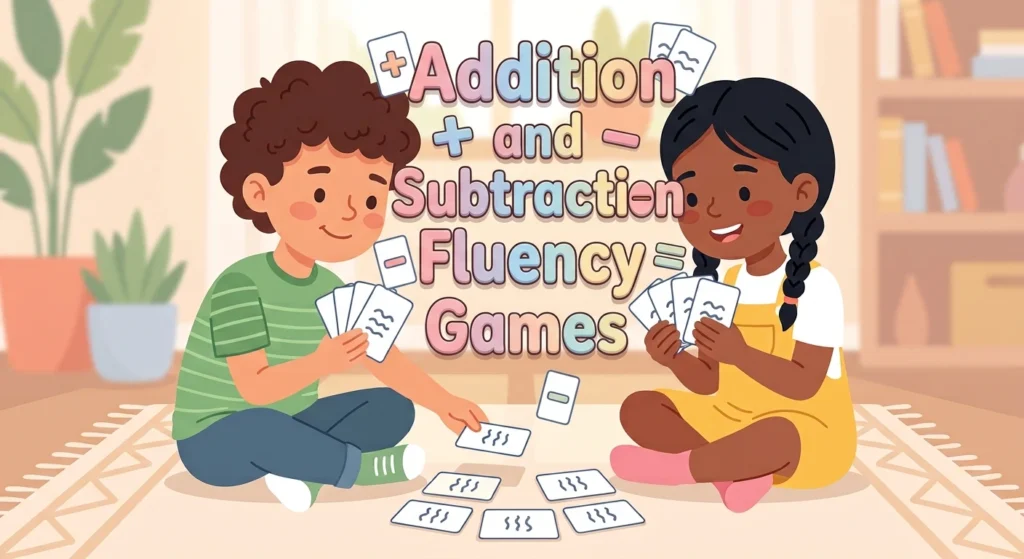
Automatic recall matters because it frees up working memory for harder tasks later, like multi-step word problems.
Games are a well-supported way to build this kind of fluency because children play them repeatedly and willingly, which naturally produces more practice reps than a worksheet of the same length.
Digital games
Prodigy Math Game is a free, adaptive role-playing game where players answer addition and subtraction questions to move through quests, and the difficulty adjusts to the child’s level.
Sumdog offers short, game-based addition and subtraction challenges with a light competitive element that many kids find motivating.
Printable and board games
“Race to 20” or “Race to Zero” is a simple dice game: players roll two dice, add or subtract the numbers, and move a token toward the target. It needs only a printable board, dice, and small counters.
Bump, a classic classroom math game, has students roll dice, solve the resulting addition or subtraction fact, and cover the matching number on a printable board, bumping an opponent’s marker off the space.
Screen-free games
Math War, played with a regular deck of playing cards, has two players flip two cards each and either add them together for addition practice or find the difference for subtraction practice, with the highest or lowest result winning the round.
It requires no setup beyond a deck of cards and works well in a car or waiting room.
For a deeper look at how these skills build across the year, see Gonit’s guides on Grade 2 addition and Grade 2 subtraction.
Multiplication Introduction Games
Second grade typically introduces multiplication as repeated addition and equal groups, often building on the skip counting a child already knows.
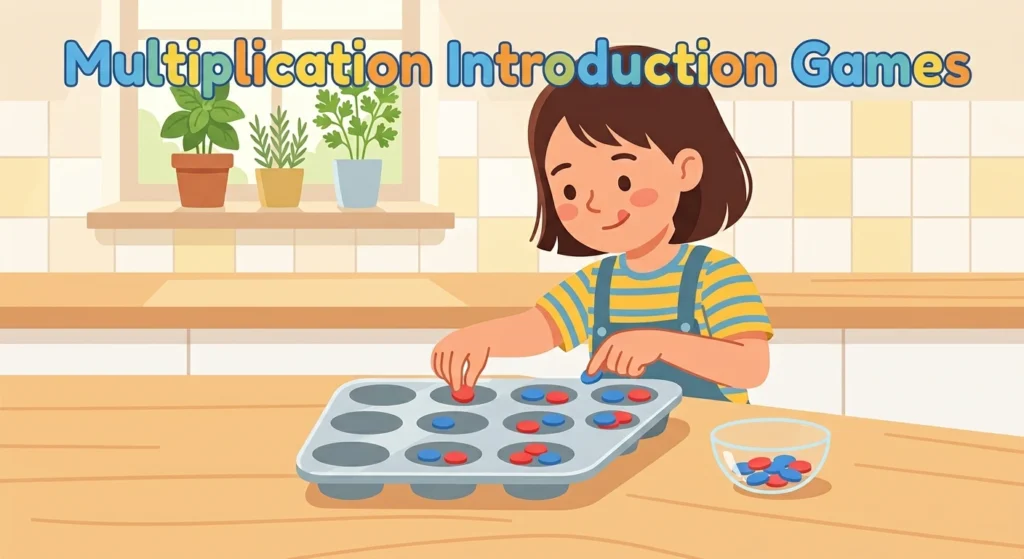
Games at this stage work best when they keep the connection between multiplication and grouping visible, rather than jumping straight to abstract fact memorization.
Digital games
Reflex, from ExploreLearning, is a subscription-based adaptive game platform built specifically for math fact fluency, including early multiplication, and is commonly used by classrooms starting in Grade 2.
Sumdog also includes early multiplication challenges pitched at this level.
Printable and board games
Multiplication War adapts the same playing-card format used for addition: each player flips two cards and multiplies them, with the higher product winning the round.
A printable array grid game, where children roll dice to build rows and columns and then count the total, makes the connection between arrays and multiplication concrete.
Screen-free games
Skip counting hopscotch, where a child hops along a chalk or tape number line calling out multiples of two, five, or ten, ties movement to the same skip counting pattern that underlies multiplication.
Everyday objects like an egg carton or a muffin tin make natural array models: filling three rows of four cups is a hands-on way to see 3 times 4.
To see how Gonit sequences this skill, visit the Grade 2 multiplication guide.
Counting Money Games
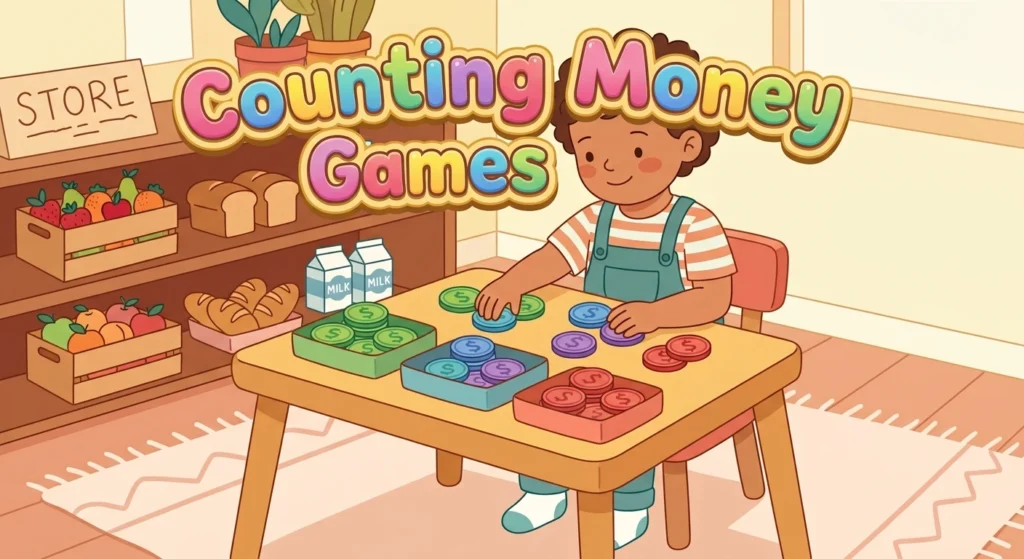
Counting money combines number sense with a real-world skill children can practice almost anywhere, which makes it a natural fit for game-based learning.
Digital games
Toy Theater offers free, browser-based coin counting and money-matching games designed for early elementary students.
ABCya has grade-filtered money games that focus on counting coins and making change.
Printable and board games
Money bingo, where children match a printed coin combination to the correct total on their card, works well for small groups or classroom centers. A printable shopping list worksheet game, where kids add up prices for a short list of items using play money, mimics a real transaction.
Screen-free games
A pretend store, set up with household items and price tags, lets a child act as both shopper and cashier using real or play coins.
This kind of role play is especially useful for South Asian households where children may already be exposed to handling small cash amounts during family errands, giving the game a natural, familiar context.
Gonit’s Grade 2 counting money guide covers the coin and bill combinations this skill builds toward.
Measurement Games
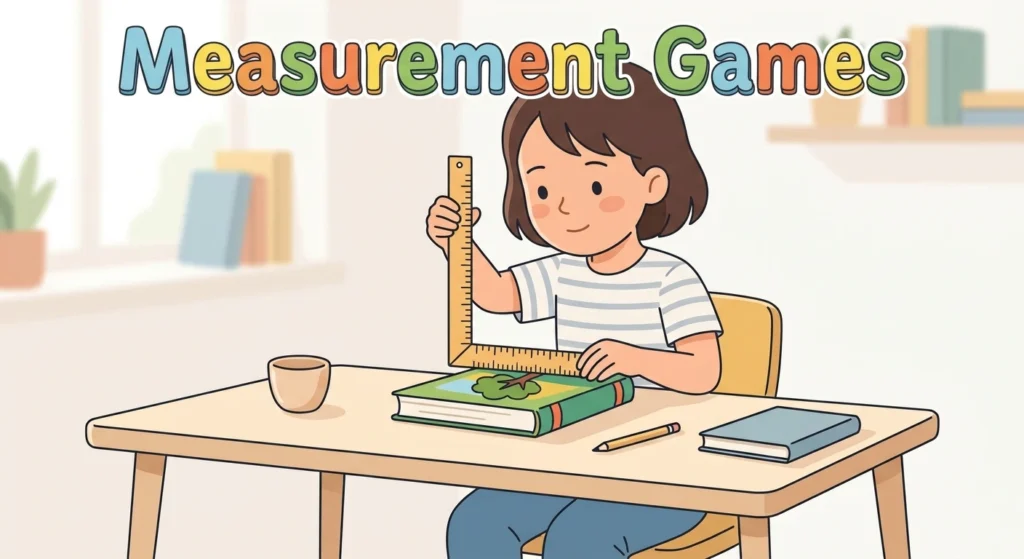
Measurement in Grade 2 usually covers length, weight, and time, and it is one of the easiest skills to practice without any screen at all, since the tools such as rulers, scales, and clocks are already at home.
Digital games
Math Playground hosts several free measurement games, including estimation and unit-comparison activities, that let children practice reading measurement tools in a low-stakes digital format.
Printable and board games
A measurement scavenger hunt sheet, where a child records the length of five household objects using a printable ruler cutout, turns measuring into a mini quest.
A guess-and-check estimation game, where kids write down a guess before measuring an object, builds estimation skills alongside accuracy.
Screen-free games
Baking or cooking together is one of the most effective screen-free measurement games, since it naturally involves reading cups, spoons, and sometimes a kitchen scale.
A simple stopwatch game, where a child estimates how long a task will take and then times it, builds an intuitive sense of time.
Gonit’s full breakdown of this topic is in the Grade 2 measurement guide.
Shapes and Geometry Games
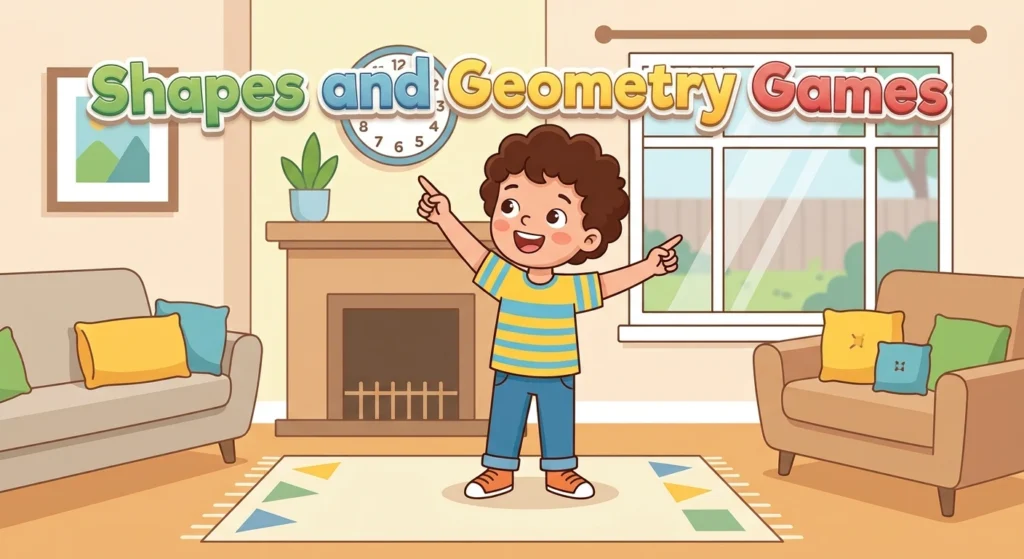
Geometry at this age focuses on identifying and describing shapes by their attributes, such as the number of sides or angles, rather than formal proofs or formulas.
Digital games
Kangaroo Hop, hosted on Math Playground and Arcademics, is a free multiplayer game where children identify shapes to advance, and it can be played head to head with classmates or friends for a light competitive element.
Printable and board games
Shape bingo, using printed cards with 2D and 3D shapes instead of numbers, reinforces shape names and attributes in a familiar game format.
Tangram puzzles, which use seven flat pieces to build larger shapes and pictures, build spatial reasoning alongside shape recognition.
Screen-free games
A shape scavenger hunt around the house or classroom, where children hunt for real-world examples of triangles, rectangles, and circles, connects shape vocabulary to everyday objects.
A simple geoboard, made with a pegboard and rubber bands, lets kids build and compare shapes by hand.
Gonit’s Grade 2 geometry guide goes deeper into the shape vocabulary and attributes covered at this level.
Word Problem Games
Word problems ask a child to translate a real situation into a math operation, which is often harder than the calculation itself.
Games that keep word problems tied to relatable, everyday situations tend to work better than abstract story problems.
Digital games
Many adaptive platforms, including Prodigy Math Game and Sumdog, weave short word-problem style questions into their regular gameplay, so children practice translating text into operations without a separate worksheet.
Printable and board games
Word problem task cards, where each card presents a short scenario and children solve it and move a token forward on a board, work well for small groups.
A roll-and-solve dice game, where the number rolled determines which pre-written word problem a child answers, adds a game layer to a normally text-heavy skill.
Screen-free games
Turning everyday moments into word problems on the spot, such as asking how many crackers are left after sharing a snack between three people, gives children low-stakes practice with real stakes attached.
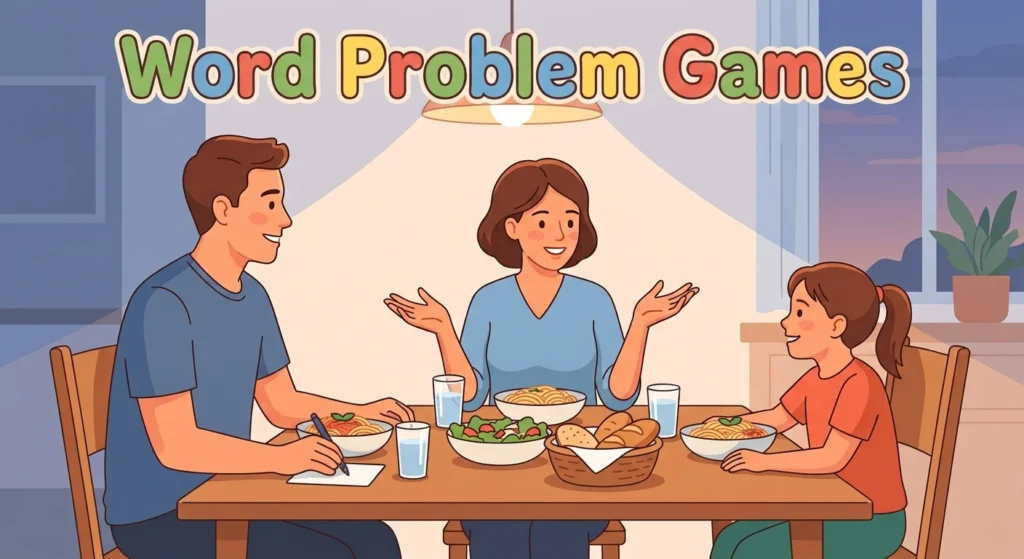
A family problem-of-the-day routine, where one person poses a short word problem at dinner, builds this skill without any materials at all.
Gonit’s Grade 2 word problems guide breaks down the problem types most common at this level.
Common Misconceptions About Game-Based Math Learning
Games can replace structured practice entirely. Games are a strong complement to structured learning, not a substitute for it. A child still needs explicit instruction and guided practice to learn a new concept; games are most effective for reinforcing and building fluency in a skill that has already been introduced.
More time on a math app automatically means more learning. Not all game time is equal. A game that keeps a child guessing at answers without any feedback or strategy teaches very little, no matter how long it is played. Look for games that show why an answer is right or wrong, not just whether it was correct.
Any game labeled math will target the skill your child needs. Many game directories mix basic fact games with much harder concepts under one grade label. Matching the game to the specific skill gap, using the skill-based sections above, is more useful than picking games at random from a big list.
Where Math Kangaroo and MOEMS Fit In
Math Kangaroo and MOEMS, two well-known math competitions open to young students, focus their preparation guidance on logical reasoning, past papers, and puzzle-style problem solving rather than officially endorsing specific games.
That said, the underlying skills these competitions test, including quick fact recall, number sense, and comfort translating a scenario into math, are exactly what fluency and word-problem games at home build over time.
Game-based practice will not replace competition-style preparation, but it lays useful groundwork for a child who may take on Math Kangaroo or MOEMS in later grades.
Here’s the section with all platforms linked:
Top Digital Platforms for Grade 2 Games
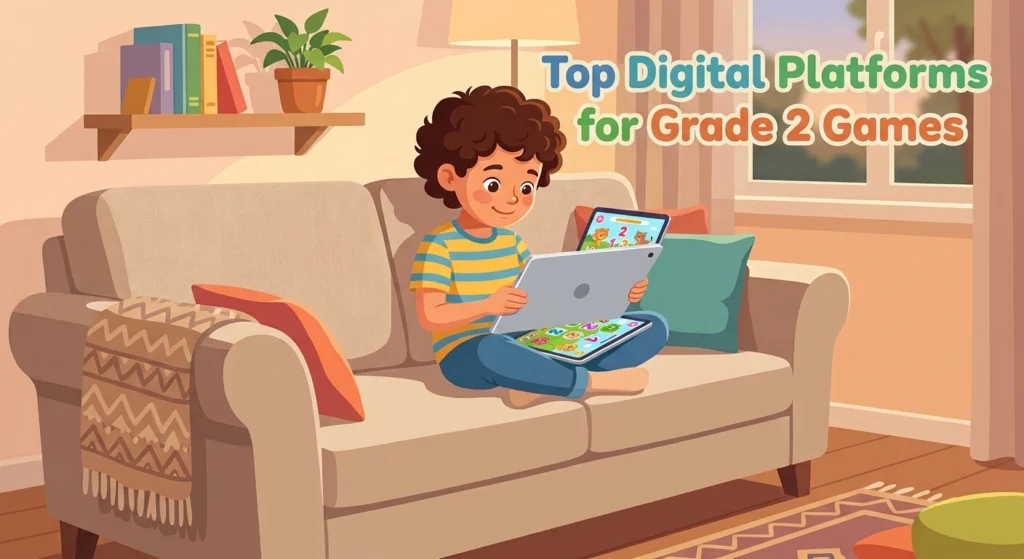
If you want one place to start browsing rather than jumping between the skill-based sections above, these platforms cover the widest range of Grade 2 topics in a single spot.
Gonit takes a different approach from the platforms above. Instead of a browsable game library, it’s a structured Grade 1 to 12 math practice and Math Olympiad prep app, with guided lessons that match each of the skill sections in this guide directly. It’s the natural next step once a game has built interest in a skill, rather than another place to browse for one.
Prodigy Math Game is a free, adaptive role-playing game that adjusts question difficulty as a child plays, covering addition, subtraction, and early multiplication inside its quest format.
Sumdog offers short, game-based challenges across most Grade 2 operations, with a light competitive element and teacher or parent progress reports.
Math Playground is a free, browser-based library with grade-filtered games spanning measurement, shapes, and fact fluency, useful for quick, no-login practice.
SplashLearn is a subscription platform organized by individual skill, with adaptive difficulty and progress tracking, a good fit for families who want a single paid app rather than piecing together free tools.
Toy Theater and ABCya are both free and browser-based, strongest for younger, simpler game formats like money counting and shape matching rather than multi-step problems.
None of these replace matching a game to the specific skill your child needs, which is why the sections above group games by skill first.
Think of this list as a shortcut for browsing, not a substitute for that approach.
How long should my child play math games each day?
Around 10 to 20 minutes of focused, skill-specific gameplay, three to five times a week, is a reasonable target for most second graders. Screen-free games have more flexibility since they do not carry the same screen-time considerations.
Are math games actually effective for learning math?
Yes, when they are matched to a specific skill and paired with feedback. Games are most effective for reinforcing fluency with a concept a child has already been taught, rather than introducing a brand-new topic from scratch.
What is the difference between free and paid math game apps?
Free apps and browser games, like Toy Theater or Math Playground, are useful for quick, casual practice and do not require an account. Paid, subscription-based platforms often add adaptive difficulty, progress tracking, and teacher or parent reporting, which matters more for consistent, structured practice over time.
What age should kids start playing math games?
Simple counting and shape games can start as early as preschool, but games built around addition, subtraction, and early multiplication fluency are best suited to a child who has already been taught the underlying concepts, which for most kids aligns with Grades 1 and 2.
Can math games replace homework or structured curriculum practice?
No. Games work best as a complement to structured practice, not a replacement for it. Use them to reinforce a skill your child is already learning, and rely on a structured curriculum for introducing new concepts and tracking progress over time.
Make Preparing for Math Olympiad Simple!



Bring the Games Back to a Structured Plan
Games work best when they point back to something specific your child is trying to build, not when they replace that plan altogether.
Use the skill-based sections above to match a game to the exact area your child needs, whether that is addition fluency, money counting, or word problems, and treat platforms like Prodigy or Sumdog as a supplement to that plan rather than the plan itself.
Gonit’s Grade 2 series covers each of these skills in a structured, concept-based format, so a quick game session and a focused practice session can reinforce the same idea from two different angles.

Mikha Piregu is a Content Writer with experience spanning educational content, including math and math olympiad topics, as well as advocacy writing, research-based articles, and SEO-driven web content. He creates high-quality blog content, web copy, and feature articles that support brand visibility, audience engagement, and long-term organic growth through data-informed storytelling. Skilled in WordPress, WooCommerce, and modern digital tools, Mikha adapts content across various platforms, including blogs, websites, campaigns, and advocacy initiatives, with clarity and purpose.

There are no comments posted here yet.
Sign in to leave a comment