

3 digit addition and subtraction works exactly like the 2-digit arithmetic your child already knows, with one extra column added on the left. If a child can confidently add 47 and 28, the jump to 347 plus 128 is small.
- What Your Child Needs Before Starting
- How to Do 3 Digit Addition and Subtraction
- 3-Digit Addition Without Regrouping
- 3-Digit Addition With Regrouping
- 3-Digit Subtraction Without Borrowing
- How to Teach 3 Digit Subtraction With Regrouping
- Visual Models That Make Regrouping Make Sense
- Hands-On Activities and Games
- Digit Word Problems From Real Life
- Mental Math and Estimation Strategies
- Common Mistakes and How to Fix Them
- Tips for Parents Teaching at Home
- Tips for Teachers in the Classroom
- From Column Arithmetic to Olympiad Reasoning
- Practice Questions With Answers
- Putting It All Together
What makes it feel hard is not the size of the numbers. It is regrouping and a shaky sense of what the hundreds, tens, and ones columns actually mean.
This guide walks you through the full learning progression in order: place value first, then addition without regrouping, addition with carrying, subtraction without borrowing, subtraction with borrowing, and finally checking, applying and extending the skill.
You get step-by-step methods with worked examples, ten hands-on activities for home and classroom, real-life word problems, mental math strategies, a list of the mistakes Grade 3 students make most often, and practice questions with answers.
What Your Child Needs Before Starting
Three things need to be solid before any column work begins: place value up to 999, addition and subtraction facts to 20, and the idea that ten of one unit can be traded for one of the next.
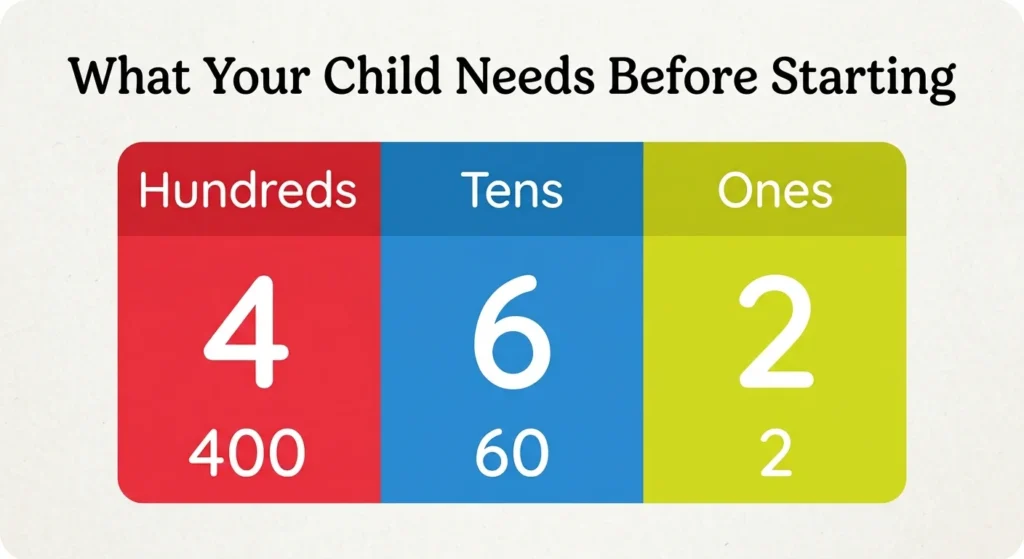
Place value: hundreds, tens and ones
Every 3-digit number is built from three parts. In 462, the 4 is not four. It is four hundreds. The 6 is six tens, and the 2 is two ones.
| Hundreds | Tens | Ones |
|---|---|---|
| 4 | 6 | 2 |
| 400 | 60 | 2 |
If this is shaky, spend a few days rebuilding the foundation with our guide to place value for Grade 1 before returning here. Ask your child to say numbers the long way for a week: “462 is 400 and 60 and 2.” This habit does most of the work for place value addition and subtraction later, because regrouping is just trading between these three columns.
Number facts to 20
Column arithmetic asks a child to add single digits over and over while holding a carried digit in their head. If 8 plus 7 takes ten seconds of finger counting, the carried 1 gets forgotten. Five minutes of fact practice a day for two weeks before starting 3 digit math problems saves a great deal of frustration later. If your child is still counting on fingers for basic sums, go back to addition and subtraction for Class 1 for a fortnight first.
The trading rule
Ten ones make one ten. Ten tens make one hundred. That single rule is the whole of carrying and borrowing. Children who have physically traded ten small cubes for one rod understand regrouping. Children who have only been told “carry the 1” are memorising a ritual they cannot check.
A quick readiness check
Ask these four questions. If your child answers all four without hesitation, they are ready.
- What does the 5 mean in 253?
- How many tens are in 180?
- What is 9 plus 6?
- If I have 10 ones, what can I trade them for?
How to Do 3 Digit Addition and Subtraction
To add or subtract 3-digit numbers, line the numbers up by place value so ones sit under ones, tens under tens and hundreds under hundreds. Then work from right to left: ones column first, then tens, then hundreds.
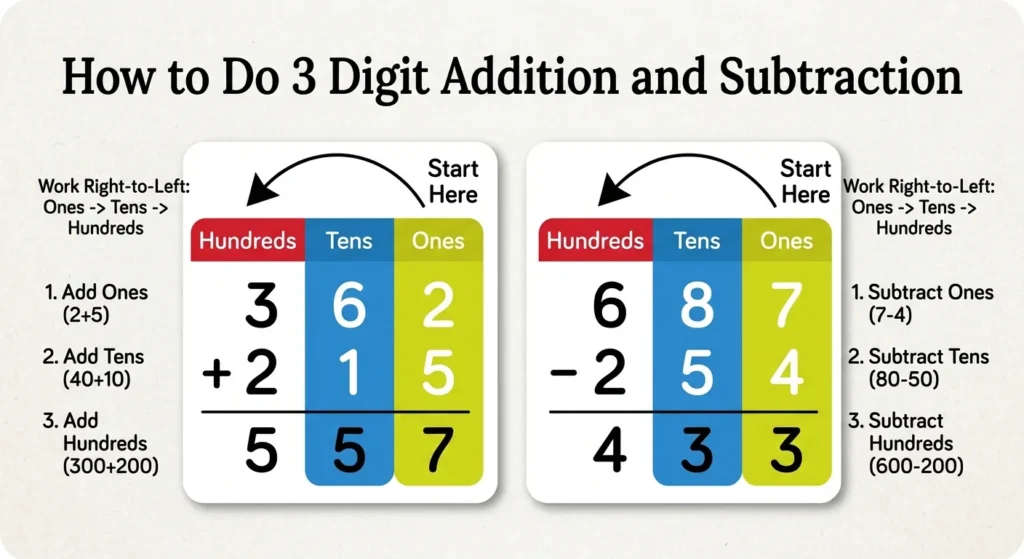
When a column total reaches ten or more in addition, carry one to the next column on the left. When the top digit is too small to subtract from, borrow one from the column on the left and add ten to the current column.
That is the whole procedure. Everything below is about making each of those moves make sense, so that adding and subtracting 3 digit numbers becomes something your child can reason about rather than something they perform from memory.
One rule worth stating early: always start on the right. Children often want to start on the left, because that is how they read. Starting on the left works until the first regrouping, then it collapses.
Give the reason, not just the rule. You start on the right because carrying moves leftward, and you cannot know what a column will hold until you have finished the column to its right.
3-Digit Addition Without Regrouping
Start here even if your child seems ready for harder work. Column addition grade 3 style needs to become automatic before regrouping is added on top of it.
Example: 342 + 215
| Hundreds | Tens | Ones | |
|---|---|---|---|
| 3 | 4 | 2 | |
| + | 2 | 1 | 5 |
| = | 5 | 5 | 7 |
Step 1. Add the ones: 2 plus 5 is 7. Write 7 in the ones column.
Step 2. Add the tens: 4 tens plus 1 ten is 5 tens. Write 5 in the tens column.
Step 3. Add the hundreds: 3 hundreds plus 2 hundreds is 5 hundreds. Write 5 in the hundreds column.
The answer is 557.
Say the columns in full while you work: “four tens plus one ten is five tens,” not “four plus one is five.” It takes two extra seconds and it keeps the meaning of the digits alive. Give your child six to eight problems of this type across two sessions, using numbers where no column reaches ten, before moving on. Children who find even this stage slow will benefit from more work on Grade 2 addition first.
3-Digit Addition With Regrouping
3 digit addition with regrouping means one or more columns total ten or more, so the extra has to be traded up to the next column.
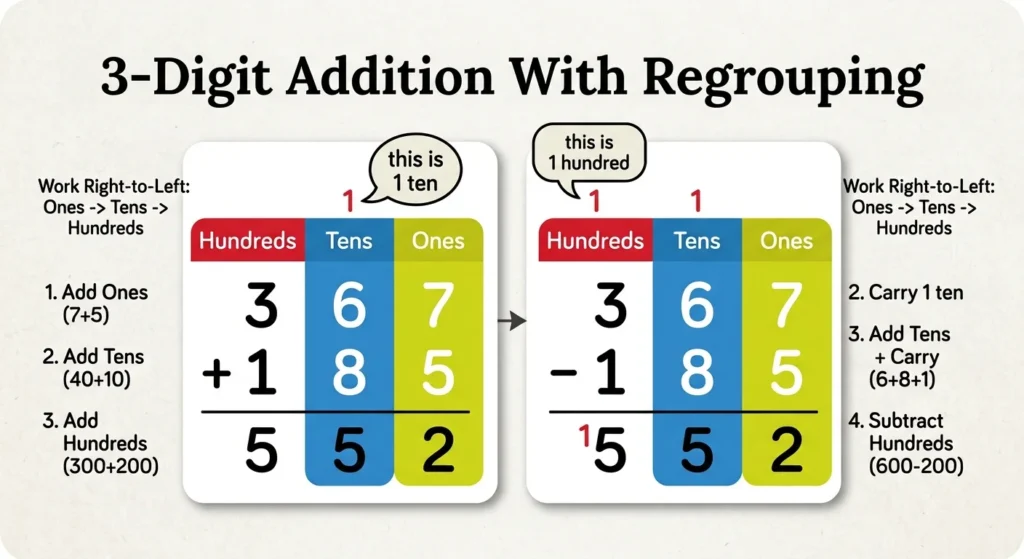
Example: 367 + 185
Step 1. Add the ones. 7 plus 5 is 12. Twelve ones is one ten and two ones. Write 2 in the ones column and carry the 1 to the top of the tens column.
Step 2. Add the tens, including the carried ten. 6 plus 8 plus 1 is 15. Fifteen tens is one hundred and five tens. Write 5 in the tens column and carry the 1 to the hundreds column.
Step 3. Add the hundreds, including the carried hundred. 3 plus 1 plus 1 is 5. Write 5 in the hundreds column.
The answer is 552.
| Hundreds | Tens | Ones | |
|---|---|---|---|
| carried | 1 | 1 | |
| 3 | 6 | 7 | |
| + | 1 | 8 | 5 |
| = | 5 | 5 | 2 |
Three points that prevent most errors at this stage:
Name what the carried digit is. It is not “a 1.” When it sits above the tens column it is one ten. When it sits above the hundreds column it is one hundred. Children who call it a 1 eventually add it into the wrong column.
Write the carried digit somewhere fixed. Small and above the column, every single time. Mental carrying is where answers go wrong, and it hides the error so neither of you can find it.
Check that the answer is sensible. 367 is close to 370 and 185 is close to 190, so the answer should be near 560. An answer of 442 or 5,512 can be rejected before any checking is done.
When both the ones and tens columns regroup, as they do here, the answer crosses into a larger hundreds value. If the hundreds column itself totals ten or more, for example 762 plus 481, the carried hundred becomes one thousand and is written to the left of the hundreds column. Your child will meet this and it is fine, as long as you name it as one thousand rather than treating it as a new rule.
3-Digit Subtraction Without Borrowing
Example: 687 – 254
Step 1. Subtract the ones: 7 minus 4 is 3.
Step 2. Subtract the tens: 8 tens minus 5 tens is 3 tens.
Step 3. Subtract the hundreds: 6 hundreds minus 2 hundreds is 4 hundreds.
The answer is 433.
Two habits to establish now, before the harder version arrives. First, the larger number goes on top. Children sometimes flip a column to avoid a borrow, turning 3 minus 7 into 7 minus 3, which produces a confidently wrong answer. Second, check by adding back: 433 plus 254 should give 687. Building this reflex now means your child already owns a checking method when borrowing starts producing errors. For extra practice at the level just below this one, work through Grade 2 subtraction alongside these examples.
How to Teach 3 Digit Subtraction With Regrouping
To teach 3 digit subtraction with regrouping, use base-ten blocks before pencil and paper. Build the top number from blocks, then try to take the bottom number away.
When there are not enough ones, the child physically trades one ten rod for ten unit cubes, then completes the subtraction.
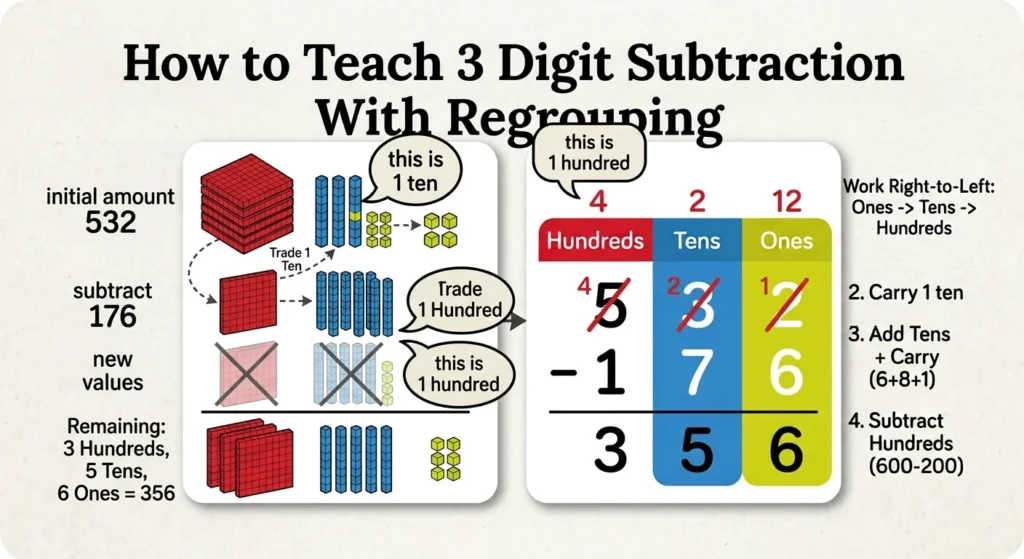
Once the trade has been done with the hands several times, the written method becomes a record of something the child has already done rather than a new rule to memorise.
Here is the written form.
Example: 532 – 176
Step 1. Look at the ones. You cannot take 6 from 2. Borrow one ten from the tens column. The 3 tens become 2 tens, and the 2 ones become 12 ones. Now 12 minus 6 is 6. Write 6.
Step 2. Look at the tens. You now have 2 tens and you need to take away 7 tens. You cannot, so borrow one hundred from the hundreds column. The 5 hundreds become 4 hundreds, and the 2 tens become 12 tens. Now 12 minus 7 is 5. Write 5.
Step 3. Subtract the hundreds: 4 minus 1 is 3. Write 3.
The answer is 356. Check it: 356 plus 176 is 532.
Borrowing across a zero
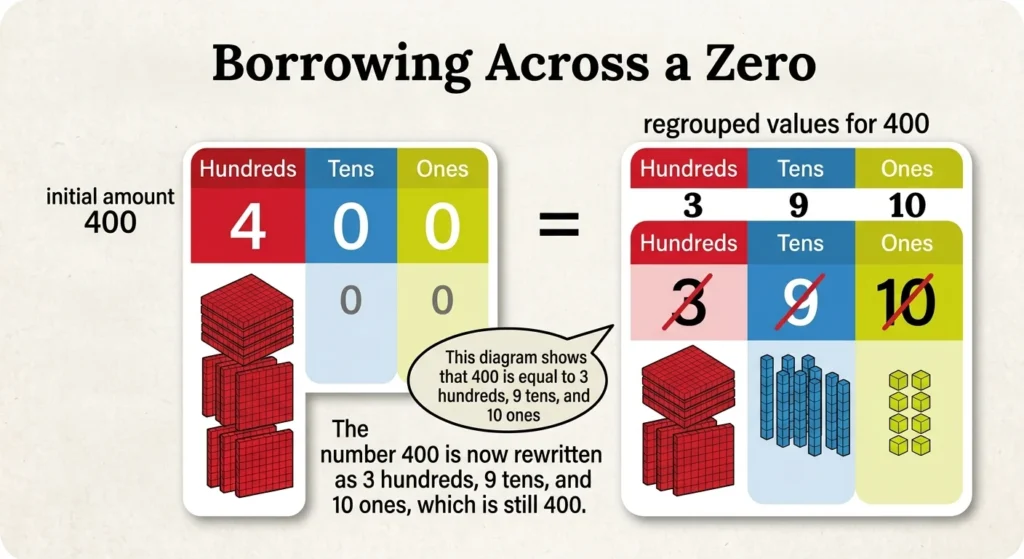
This is the single hardest case in subtraction with regrouping grade 3, and it deserves a session of its own.
Example: 400 – 168
You cannot take 8 from 0, and there are no tens to borrow from. So you go one column further left. Take one hundred from the 4 hundreds, leaving 3 hundreds, and turn it into 10 tens. Now borrow one of those tens for the ones column, leaving 9 tens and giving 10 ones.
The number 400 is now written as 3 hundreds, 9 tens and 10 ones, which is still 400.
Step 1. Ones: 10 minus 8 is 2.
Step 2. Tens: 9 minus 6 is 3.
Step 3. Hundreds: 3 minus 1 is 2.
The answer is 232.
The sentence that makes this click for most children is this: 400 is the same as 39 tens and 10 ones. Show it with blocks once and the zeros stop being frightening.
Visual Models That Make Regrouping Make Sense
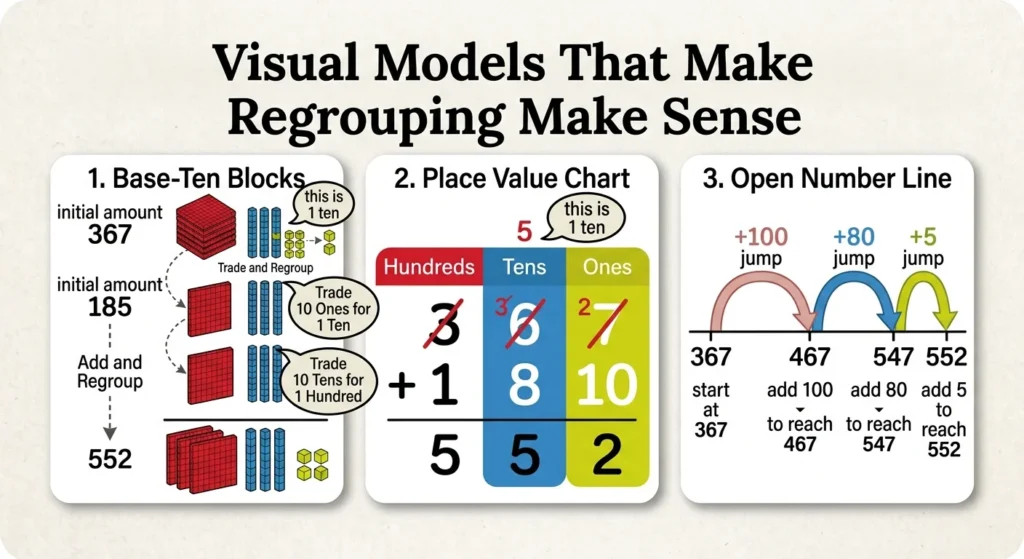
Base-ten blocks
Base ten blocks addition subtraction work is the most direct model there is. Flats are hundreds, rods are tens, small cubes are ones. Ten cubes trade for a rod. Ten rods trade for a flat.
If you do not have a set, cut squares of graph paper into 10 by 10 flats, 1 by 10 strips, and single squares. Bottle caps, dried beans in groups of ten inside small bags, and straws bundled with rubber bands all work just as well.
Have the child build both numbers, combine or remove, trade where needed, and only then write the sum or difference. The written method should always follow the physical one for the first few sessions.
Place value charts
A three-column chart labelled hundreds, tens and ones fixes the most common error in the whole topic, which is misaligned columns. Draw the chart on paper, or turn a sheet sideways so the ruled lines become vertical column guides. Squared exercise paper does the same job with one digit per square.
Number lines
Number lines suit subtraction as distance, which is a different and useful way to see it. For 532 minus 176, start at 176 and jump up: 4 to reach 180, 20 to reach 200, 300 to reach 500, and 32 to reach 532.
Add the jumps: 4 plus 20 plus 300 plus 32 is 356. This is the same answer reached a different way, and children who find borrowing painful often find this method a relief.
It also builds the number sense that mental math strategies grade 3 depends on. If your child has not used this model before, start with the basics in number line for Class 1.
Expanded form
Writing 367 plus 185 as (300 + 60 + 7) + (100 + 80 + 5) shows why carrying happens. The hundreds give 400, the tens give 140 and the ones give 12. Combine them: 400 plus 140 plus 12 is 552. The carried digits in the column method are exactly the 100 hidden inside 140 and the 10 hidden inside 12.
10 Hands-On Activities and Games
These addition and subtraction activities for grade 3 use materials you already have. Each one takes ten to twenty minutes.
For more ideas at a nearby level, see our collection of fun math activities for 2nd graders and math games for 2nd grade, most of which scale up to 3-digit numbers with no change other than bigger numbers.
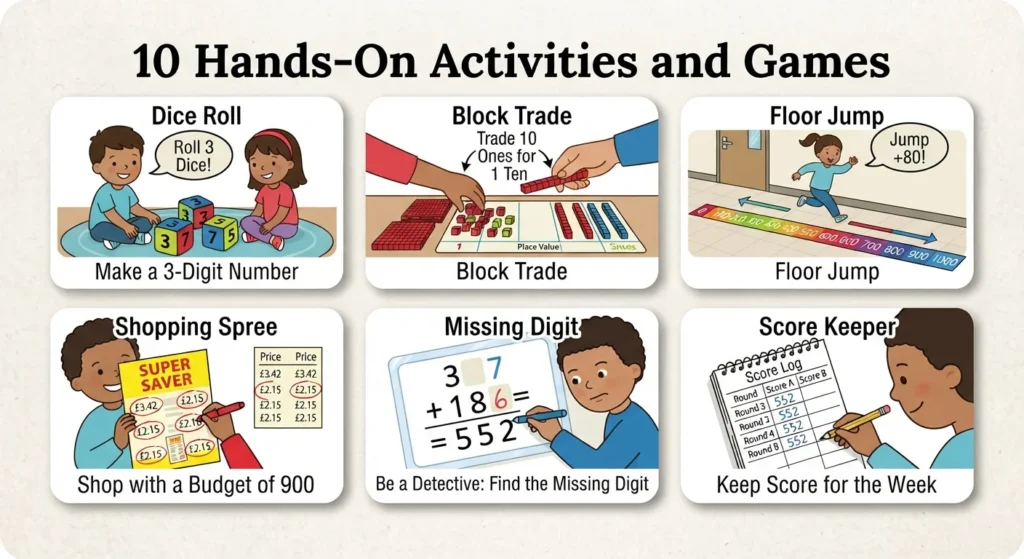
1. Trading game with blocks. Each player rolls three dice to make a 3-digit number and collects that many blocks in cubes, rods and flats.
Every time a player holds ten cubes, they must trade for a rod, and ten rods for a flat. The first to reach one flat wins. This teaches regrouping before it is ever written down.
2. Roll and add. Roll six dice. Arrange them into two 3-digit numbers, add them, and score the total. Play five rounds and compare. The strategy of putting large digits in the hundreds place is a place value lesson your child discovers rather than is told.
3. Target 500. Roll six dice and arrange them into two 3-digit numbers whose difference is as close to 500 as possible. Score the gap. Lowest total after five rounds wins. This is one of the best addition and subtraction games for kids because it forces estimation before calculation.
4. Shopping receipt challenge. Give your child a supermarket flyer and a budget of 900. They pick items, total them, and work out the change. Real prices make the arithmetic matter, and mixed addition and subtraction in one task is closer to how the skill is actually used.
5. Missing digit detective. Write a completed column problem with two digits blanked out, such as 4_6 plus 2_8 equals 714. The child works backwards to find them. Puzzles like this are the bridge from calculation to reasoning, and there are more of them in our set of math puzzles for 2nd graders.
6. Floor number line jumps. Tape a number line from 0 to 1000 in steps of 100 along a corridor. Call out a subtraction and have your child walk the jumps. Physical movement helps children who lose track of steps on paper.
7. Scorekeeper for the week. Give your child the job of keeping a running total: cricket runs, board game points, steps walked, pages read. Each day they add the new number and find the difference from the previous day.
8. Distance log. Use a map or a car odometer. Record journeys in kilometres, total them, and find differences between routes. Working with distances gives 3-digit numbers a natural home.
9. Regrouping story swap. Each player writes a word problem using two 3-digit numbers, then swaps and solves the other person’s. Writing a problem requires understanding the structure of one, which is harder and more valuable than solving it.
10. Four-in-a-row differences. Draw a 4 by 4 grid and fill it with 3-digit answers. Players take turns choosing two numbers from a list, subtracting them, and claiming the matching square. First to four in a row wins.
3 Digit Word Problems From Real Life
3 digit word problems are where the skill proves itself. Work through these with your child, reading the question twice before any writing starts.
If word problems are the sticking point rather than the arithmetic, our guide on how to solve math word problems breaks down the reading and planning stages, and Grade 2 word problems give easier examples to warm up with.
One step. A library has 428 books on the ground floor and 265 upstairs. How many books in total? 428 plus 265 is 693 books.
One step, subtraction. A school printed 750 exam papers and used 386. How many are left? 750 minus 386 is 364 papers.
Comparison. Riya scored 512 points and Arif scored 478. How many more did Riya score? 512 minus 478 is 34 points.
Two step. A shop had 640 notebooks, sold 275 on Monday and received 130 more on Tuesday. How many now? 640 minus 275 is 365, then 365 plus 130 is 495 notebooks.
Two step with a hidden question. A farmer collected 246 eggs on Saturday and 189 on Sunday, then sold 300. How many are left? Total collected is 435, then 435 minus 300 is 135 eggs.
Teach the same four moves each time. Read it twice. Say what is being asked in your own words. Decide whether the amount is getting bigger or smaller. Estimate before calculating. That last step catches almost every serious error.
Mental Math and Estimation Strategies
Estimation is not a lesser skill than calculation. It is the check that makes calculation trustworthy.
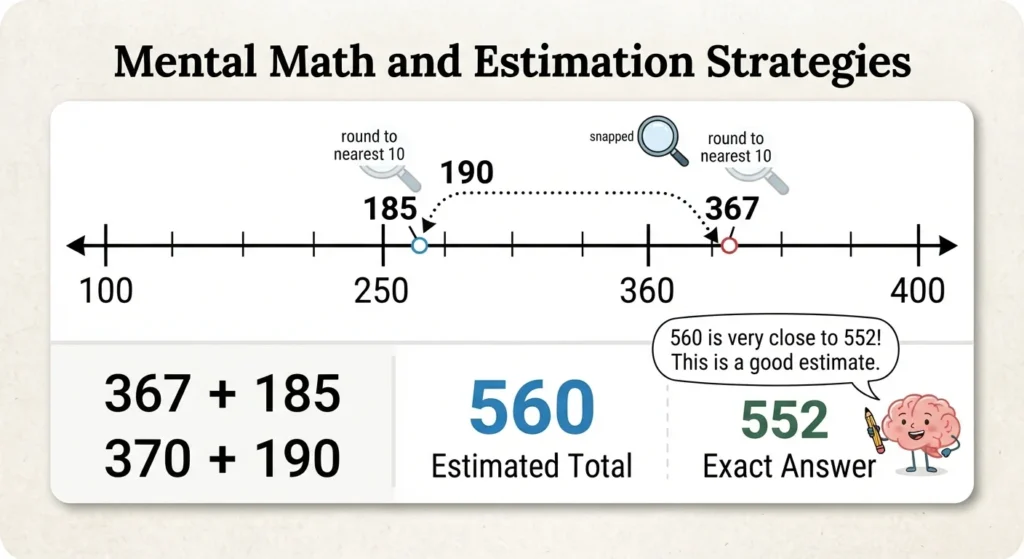
Round and add. For 367 plus 185, round to 370 and 190. The estimate is 560, so the answer should be somewhere near it. 552 passes.
Front-end estimation. Add only the hundreds: 300 plus 100 is 400. The real answer must be more than 400 and less than 600. Quick, rough and effective.
Compensation. To add 398 plus 246, add 400 plus 246 to get 646, then subtract the extra 2 to get 644. Children enjoy this one because it feels like a trick, and it builds real flexibility with numbers.
Counting up for subtraction. For 500 minus 274, count up from 274: 26 to reach 300, then 200 to reach 500. The answer is 226. No borrowing required.
Checking with the inverse. Subtraction is checked by addition, and addition by subtraction. If 532 minus 176 gives 356, then 356 plus 176 must give 532. Make this the closing step of every subtraction for a month and it becomes automatic.
Common Mistakes and How to Fix Them
Misaligned columns. Writing 342 above 56 with the 5 under the 3. Fix it with squared paper, one digit per square, or a drawn place value chart.
Forgetting to carry. The ones column gives 13, the 3 is written and the ten is lost. Fix it by insisting the carried digit is written above the column, small, every time.
Adding the carried digit at the wrong moment. Adding 6 plus 8 to get 14, writing 4, then remembering the carried 1 and changing it to 5. Fix it by adding the carried digit first: say “1 and 6 is 7, and 8 is 15.”
Flipping a column to avoid borrowing. Turning 2 minus 6 into 6 minus 2. This is the most common subtraction error and it produces answers that look reasonable. Fix it by going back to blocks. You cannot take six cubes from two cubes, and holding the blocks makes that undeniable.
Borrowing but not reducing. Turning 2 ones into 12 ones without dropping the tens digit from 3 to 2. Fix it by crossing out the original digit and writing the new one above it, always.
Panicking at zeros. Freezing on 500 minus 274. Fix it by rewriting 500 as 4 hundreds, 9 tens and 10 ones before subtracting, or by counting up on a number line instead.
Answers that are wildly wrong. Getting 1,204 from two numbers in the 300s. Fix it with estimation before calculation, not after.
Tips for Parents Teaching at Home
Keep sessions to fifteen minutes. Concentration on multi-step arithmetic fades quickly at eight or nine years old, and a short, focused session beats a long, tearful one.
Ask “how did you get that?” for correct answers too, not only wrong ones. If you only ask after mistakes, the question becomes an accusation and your child stops explaining honestly.
When there is an error, find the column it happened in rather than marking the whole problem wrong. “Your hundreds column is right, let’s look at the tens again” keeps a child working. A cross through the page ends the session.
Say the value, not the digit. “Six tens plus eight tens” rather than “six plus eight.” Your language becomes their internal voice.
Do not time anything. Speed is a side effect of understanding, not a route to it. A child who is being timed will guess, and guessing hides the exact confusion you need to see.
Let the blocks stay out longer than you think necessary. Children are often moved to abstract written work the moment they get one answer right. One correct answer is not fluency.
Use real numbers from your own week: bills, distances, scores, page counts. Applied addition and subtraction practice is remembered far better than a page of sums.
Tips for Teachers in the Classroom
Sequence the cases deliberately. No regrouping, then regrouping in the ones only, then the tens only, then both, then across a zero. Mixing these together in week one produces a class where half the children are lost for reasons you cannot diagnose.
Use error analysis as a whole-class activity. Put a worked problem with a deliberate mistake on the board and ask the class to find it. Children who can spot a misplaced carry in someone else’s work rarely make it in their own.
Ask for two methods on at least one problem per lesson: column method and an open number line, or column method and expanded form. Agreement between two methods is a genuine check, and children who can only do one method have no way to verify themselves.
Keep base-ten blocks available for every child, not just those who are struggling. When blocks are handed only to a low group they become a badge, and children refuse them.
Mixed practice beats blocked practice. A worksheet of twenty subtractions in a row lets a child apply one procedure on autopilot. Mixing addition and subtraction on the same page forces the decision of which operation is needed, which is the skill that transfers.
Build a daily five-minute number talk into the routine. One problem, mental strategies only, several children explaining different routes to the same answer.
From Column Arithmetic to Olympiad Reasoning
Competition math rarely asks for a plain sum. It asks questions where a sum is one step inside a larger piece of reasoning.
Grade 3 is the right time to start pointing that way, using the same 3-digit numbers your child is already working with.
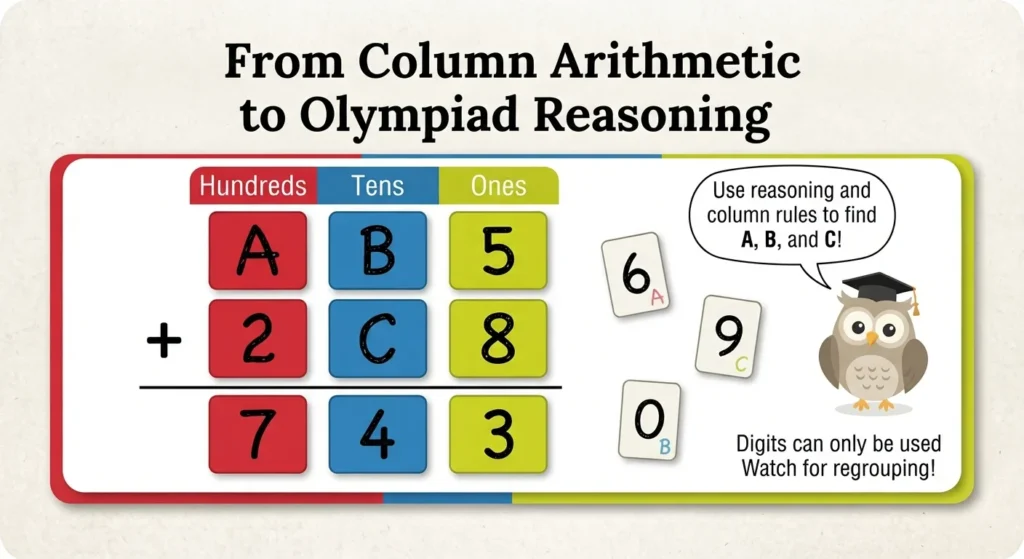
Reverse the question. Instead of asking for 347 plus 268, give the answer and one addend and ask for the other. Missing-addend problems require the inverse relationship rather than a procedure.
Add constraints. Using the digits 1, 3, 4, 6, 7 and 9 once each, make two 3-digit numbers with the largest possible sum. Then the smallest. Then the sum closest to 1,000. The arithmetic is easy. The thinking is not.
Ask about patterns. What happens to the sum when you swap the tens and ones digits of both numbers? Why? Questions like this move a child from calculating to noticing.
Use digit puzzles. In A B 5 plus 2 C 8 equals 7 4 3, find A, B and C. This requires reasoning about carrying rather than performing it.
Chain the steps. A three-part word problem where each answer feeds the next builds the stamina that longer competition problems need.
None of this requires new arithmetic. It requires asking different questions about arithmetic your child can already do, which is exactly what separates competition-style thinking from drill. When your child enjoys these, the next step is our junior math olympiad guide and the problem-solving methods in how to solve math olympiad problems.
Practice Questions With Answers
Work through these in short sittings rather than all at once. Mixed sets like these, along with more at the level below, are collected in our math practice for second graders page.
Addition without regrouping
- 234 + 152
- 613 + 275
- 420 + 369
Addition with regrouping
- 268 + 175
- 457 + 386
- 594 + 278
Subtraction without borrowing
- 578 – 243
- 896 – 371
- 749 – 526
Subtraction with borrowing
- 623 – 148
- 805 – 267
- 700 – 385
Word problems
- A cricket team scored 247 runs in the first innings and 198 in the second. What was the total?
- A bookshop had 512 copies of a title and sold 267. How many are left?
- A school collected 385 kilograms of paper in March and 246 kilograms in April, then sent 400 kilograms for recycling. How much is still stored?
Answers
- 386
- 888
- 789
- 443
- 843
- 872
- 335
- 525
- 223
- 475
- 538
- 315
- 445 runs
- 245 copies
- 231 kilograms
Make Preparing for Math Olympiad Simple!



At what age should a child learn 3 digit addition and subtraction?
Most children meet 3-digit addition and subtraction at ages 8 to 9, in Grade 3, after they are secure with 2-digit work and place value up to 999. Some curricula introduce 3-digit addition without regrouping at the end of Grade 2. Readiness matters more than age: if a child is fluent with number facts to 20 and can explain what each digit in a 3-digit number means, they are ready.
What is the difference between carrying and borrowing?
Both are regrouping in opposite directions. Carrying happens when a column totals ten or more, and you move the extra ten to the next column on the left. Borrowing happens in subtraction when the top digit is too small, and one unit is taken from the column on the left and broken into ten of the current unit.
Why does my child keep forgetting to carry?
Usually because the carried digit is being held in their head instead of written down, or because their number facts are not fast enough to spare attention for it. Insist that every carried digit is written above the column, and spend five minutes a day on facts to 20 alongside the column work.
Should my child use fingers or blocks?
Yes, for as long as they need them. Concrete materials are how the understanding gets built, not a sign of falling behind. Children let go of the blocks on their own once the written method feels reliable. Removing them early usually produces memorised steps that break under pressure.
How do I teach subtraction with borrowing across a zero?
Rewrite the number before subtracting. For 500 minus 274, show that 500 is 4 hundreds, 9 tens and 10 ones, which is still 500. Then subtract column by column with no further borrowing. Demonstrate the trade with base-ten blocks first, because the double trade is difficult to believe on paper alone.
How can I check the answer is right?
Use the inverse operation. Check a subtraction by adding the answer to the number you subtracted, and you should get back to the original. Check an addition by subtracting one of the numbers from the total. Estimate first as well, so that a badly wrong answer is caught before any checking begins.
How much daily practice is enough?
Ten to fifteen minutes a day of mixed practice, meaning addition and subtraction on the same page rather than a block of one type. Short daily sessions produce far better retention than a long weekend session, and mixing the operations forces the child to decide which is needed instead of repeating one procedure automatically.
My child can do it with blocks but not on paper. What now?
Work in the middle stage for a week. Have your child do the problem with blocks and record each trade in writing as it happens, so the written line is a record of the physical move. Then remove the blocks but keep a drawn place value chart. Then remove the chart. Skipping these middle steps is the most common reason the paper method fails.
Putting It All Together
3 digit addition and subtraction is not a new skill. It is 2-digit arithmetic with one more column, resting on place value your child already has. The children who find it hard are almost never struggling with the size of the numbers. They are struggling with regrouping, and regrouping only makes sense once the trading rule has been felt with the hands before it is written with a pencil.
So keep the order. Place value first. Addition without regrouping until it is boring. Then carrying, then subtraction without borrowing, then borrowing, then the zero case on its own. Keep the blocks out longer than feels necessary, write every carried and borrowed digit down, and finish every problem with an estimate or an inverse check. Fifteen minutes a day of mixed addition and subtraction practice will move a child further in a month than a weekend of worksheets.
Once the column method is reliable, the interesting work begins: missing addends, digit puzzles, constrained-sum problems and multi-step word problems. That is the road from arithmetic to real mathematical thinking, and Grade 3 is exactly where it starts. When your child is ready for it, 2nd grade math homework and how to solve math olympiad problems are good next stops.

Mikha Piregu is a Content Writer with experience spanning educational content, including math and math olympiad topics, as well as advocacy writing, research-based articles, and SEO-driven web content. He creates high-quality blog content, web copy, and feature articles that support brand visibility, audience engagement, and long-term organic growth through data-informed storytelling. Skilled in WordPress, WooCommerce, and modern digital tools, Mikha adapts content across various platforms, including blogs, websites, campaigns, and advocacy initiatives, with clarity and purpose.


There are no comments posted here yet.
Sign in to leave a comment