 August 21, 2025
 24 min. read

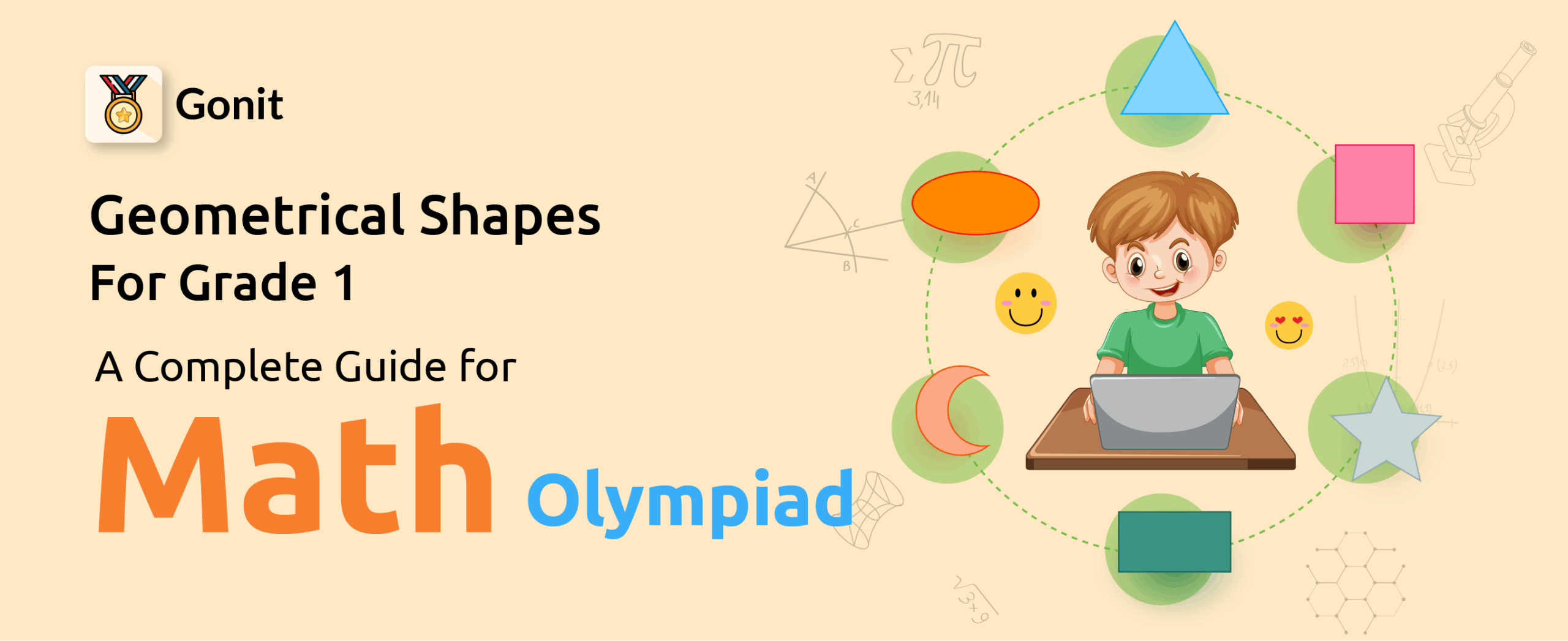
Geometrical shapes for Grade 1 are four flat, 2D figures: circle, square, triangle, and rectangle that children learn to recognise, name, and describe.
At this stage, it’s entirely visual: no formulas, no measurements. Just basic geometric shapes that kids can see and touch every day.
Whether your school calls it shapes for Grade 1, shapes for Class 1, or shapes in maths for Class 1, the topic is the same and so is the confusion most parents face.
They know what to teach, but not how to explain sides, corners, and the square-vs-rectangle confusion in a way a child actually understands.
In this guide, you’ll find simple definitions, shape names for Class 1 with a complete chart, step-by-step teaching methods, common mistake corrections, shapes worksheets for Class 1, project ideas, and ready-to-use activities, everything a parent or teacher needs to teach shapes to Grade 1 students with confidence.
If your child is also building early maths foundations, this topic connects closely with spatial understanding for class 1 and multiplication for Class 1.
What Are Geometrical Shapes?
Geometrical shapes are flat or solid figures that have a defined outline or boundary.
For Grade 1 students, we keep it beautifully simple: a shape is anything around us that has a recognisable form.
In maths, these shapes are called geometric shapes, geometric figures, or geometric forms.
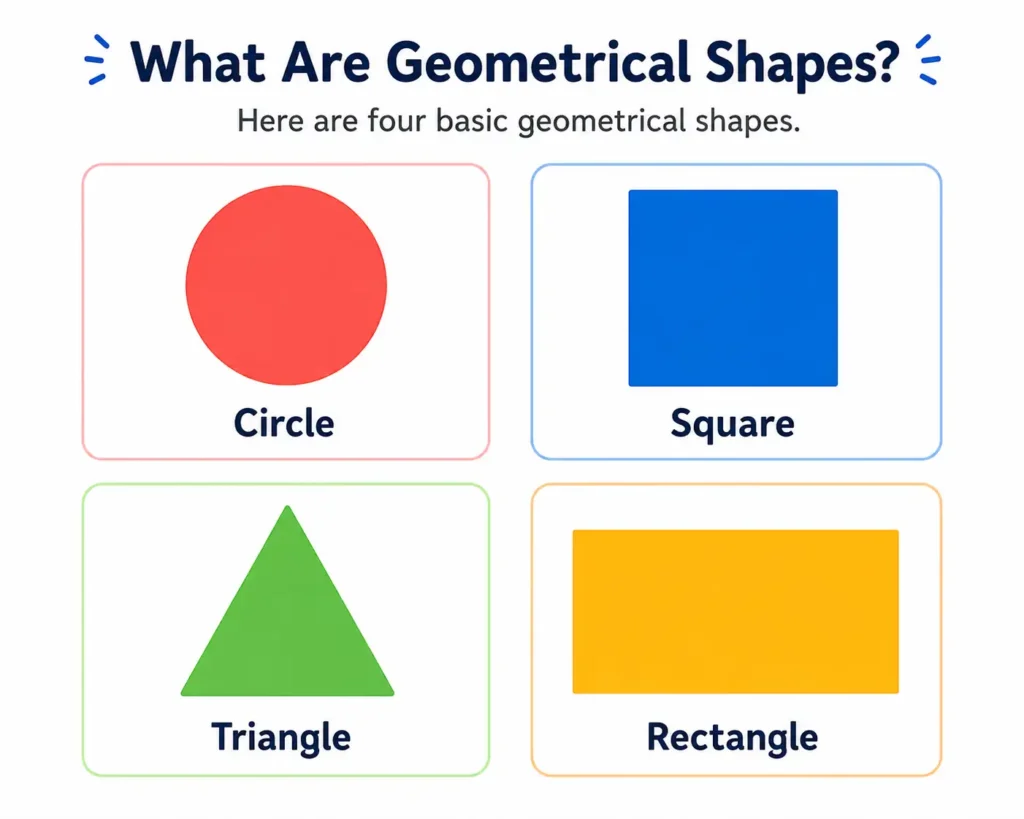
Think of a coin that’s a circle. Think of a door that’s a rectangle.
Your child’s sandwich might be a square. The roof of a house is a triangle. Geometrical shapes are quite literally everywhere these shapes around us are the easiest way to start learning.
At the Grade 1 level, children are introduced to 2D shapes (also called flat shapes or plane shapes).
These are shapes that lie flat on a surface; they have length and width, but no depth.
The introduction to geometrical shapes in Grade 1 is one of the most visual and hands-on topics in early maths.
It focuses on identifying shapes, naming them, and understanding basic properties, making it exciting for young learners.
What is the Definition of Shapes for Class 1?
In the simplest words, a shape is the form or outline of an object. For primary school children in Class 1, shapes are the basic geometric figures they see around them, like circles, squares, triangles, and rectangles.
These are the primary shapes that form the foundation of geometry.
Shapes Name for Class 1 — Complete List with Chart
Many parents search for a quick shapes name list for Class 1, so here is a simple shapes chart your child can refer to.
The four core shape names every Grade 1 student should know are:
| Shape Name | What It Looks Like | Easy Way to Remember |
|---|---|---|
| Circle | Perfectly round | Like the sun or a coin |
| Square | 4 equal sides | Like a chessboard tile |
| Triangle | 3 sides, 3 corners | Like a slice of pizza |
| Rectangle | 2 long + 2 short sides | Like a door or a book |
Some curricula also introduce two extra shape names: oval (a stretched circle, like an egg) and diamond/rhombus (a tilted square, like a kite).
That’s why you’ll sometimes hear about “5 basic shapes” or even 6. For Class 1, though, the four basic shapes above are the primary focus.
You can print this shapes chart for Class 1 and stick it near your child’s study table for daily revision.
Why Learning Shapes Matters in Grade 1?
Shape recognition isn’t just about knowing names; it builds the foundation for almost every area of maths that comes later.
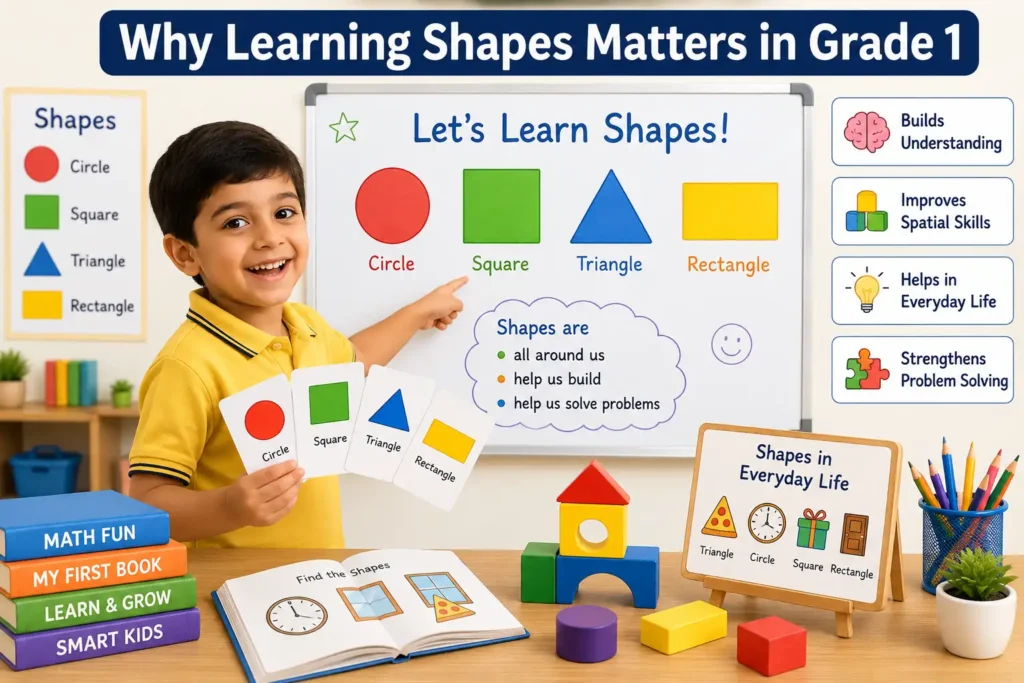
In fact, early geometry strengthens number sense characteristics class 1 skills by helping children compare, classify, and observe. If you’re new to the concept, start with what is number sense for class 1.
It also prepares them for topics like:
because comparison and visual grouping skills overlap.
When children learn to identify and describe geometric shapes, they develop spatial understanding. This is why this chapter is often called “shapes and space” or “shapes and spatial understanding” in the Class 1 syllabus.
It helps with everything from reading maps to understanding fractions for Class 1 later on.
Learning about the properties of shapes for Grade 1, like how many sides a shape has, or how many corners, sharpens logical thinking. Children learn to observe, compare, and categorise.
These are skills they’ll use in science, reading, and daily life.
More immediately, identifying shapes for Grade 1 feeds directly into pattern recognition, number sense, and even early measurement concepts.
This is why geometry for Grade 1 is such an essential topic in the curriculum and it appears directly in the IMO syllabus for Class 1 under “Geometry.”
The 4 Basic 2D Shapes for Grade 1 Students
Let’s meet the four basic shapes for Grade 1.
For each one, we’ll follow a simple teaching sequence: See it → Name it → Count its sides and corners → Spot it in real life.
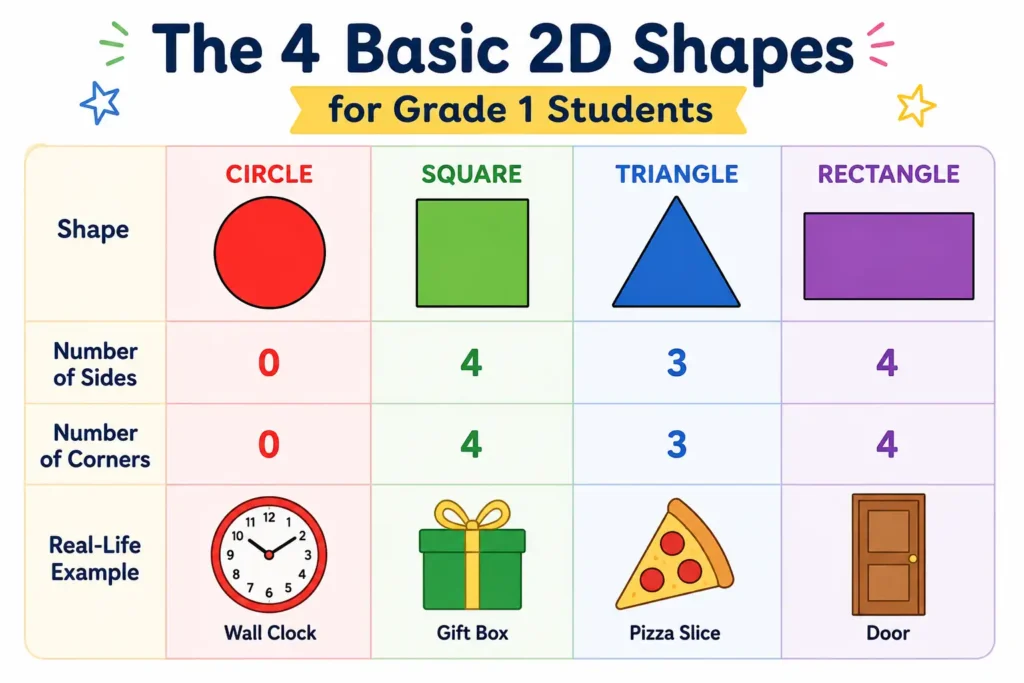
This approach helps children build understanding step by step rather than just memorising facts.
| Shape | Sides | Corners | Real-Life Example |
|---|---|---|---|
| Circle | 0 | 0 | Clock, coin, sun |
| Square | 4 (equal) | 4 | Chessboard tile, sticky note |
| Triangle | 3 | 3 | Pizza slice, mountain peak |
| Rectangle | 4 (2 long, 2 short) | 4 | Door, book, phone screen |
Circle
A circle is a perfectly round, closed shape.
It has no straight edges and no sharp points; it’s one smooth, continuous curve.
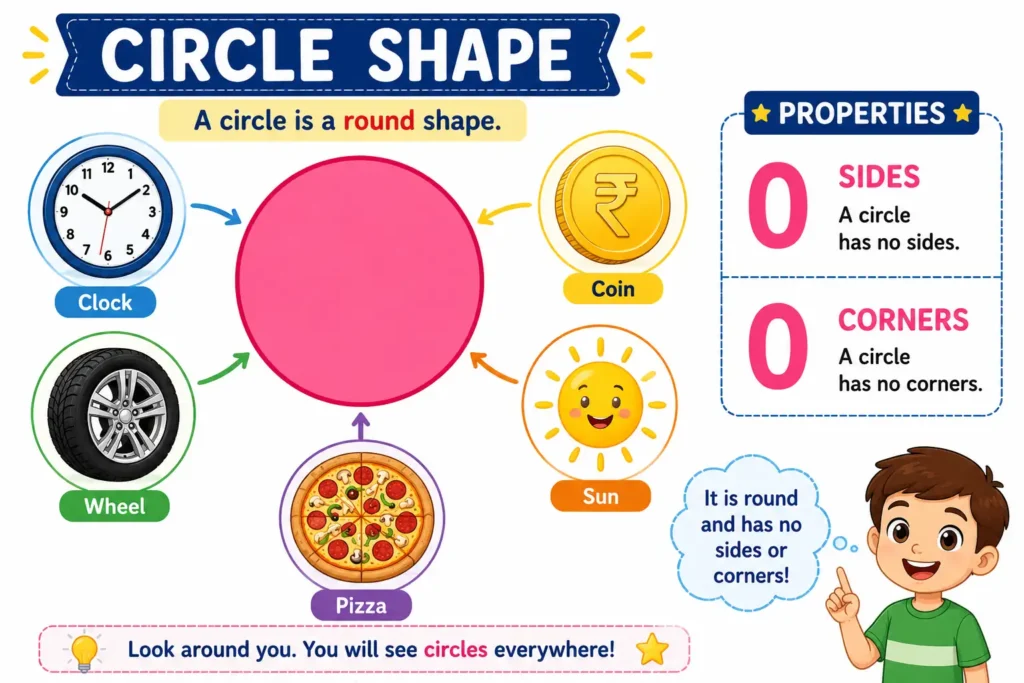
Sides: 0 | Corners: 0
Real-life shapes examples: the sun in the sky, a coin, a clock face, a wheel, a pizza, a full moon.
Did you know? A circle is the only common 2D shape with no sides and no corners at all. That smooth edge is called a “curve.” So if a worksheet asks “how many sides does a circle have?” the answer is zero!
Circles are often seen when children begin learning the number line for class 1, where numbers are placed inside circular markers.
And when a circle (like a pizza) is divided into equal parts, it becomes the perfect introduction to fractions for Class 1.
Square
A square has four straight sides that are all exactly the same length.
It also has four corners (where two sides meet). Because all four sides match, a square looks perfectly even and balanced.
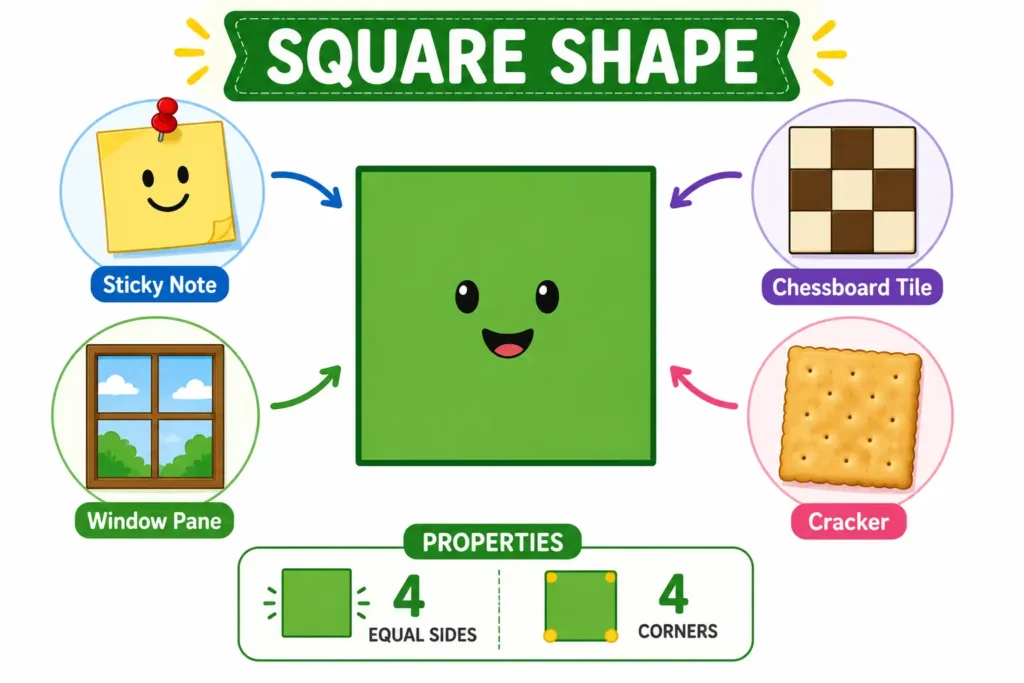
Sides: 4 (all equal) | Corners: 4
Real-life shapes examples (square shape objects): a chessboard tile, a sticky note, a window pane, a sandwich cut into quarters, a cracker.
Did you know? Every square is also a rectangle, but not every rectangle is a square. We’ll explore why in a later section!
A square is a basic geometric shape that children encounter in everyday objects.
From tiles on the floor to square-shaped crackers, examples of square shapes are everywhere.
Triangle
A triangle has three straight sides and three corners.
It can point upward, sideways, or even downward, but as long as it has three sides and three corners, it’s still a triangle.
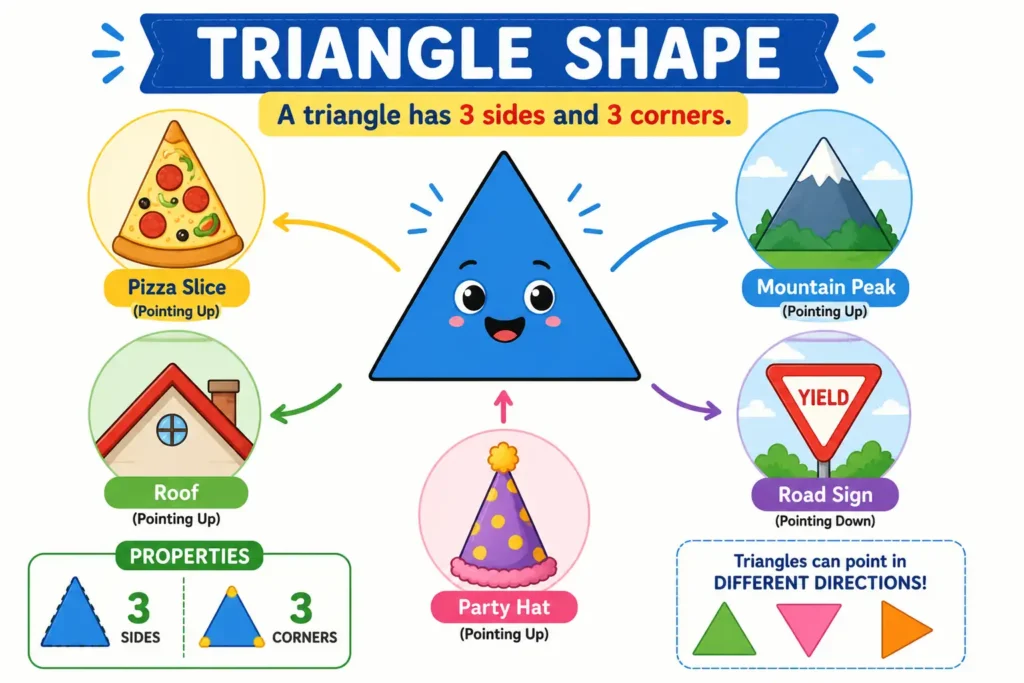
Sides: 3 | Corners: 3
Real-life shapes examples: a slice of pizza, the peak of a mountain, the roof of a house, a yield/warning road sign, a party hat.
Did you know? Triangles are incredibly strong shapes. That’s why they’re used in bridges, rooftops, and even the Eiffel Tower!
Children sometimes confuse triangles with other shapes when they’re tilted.
The key is always to count: three sides, three corners that confirm it’s a triangle, no matter which direction it faces.
Counting sides and corners is also great practice for addition and subtraction for Class 1, since both skills rely on careful one-by-one counting.
Rectangle
A rectangle has four straight sides and four corners, just like a square.
But here’s the difference: a rectangle has two long sides and two short sides. The opposite sides are equal in length.
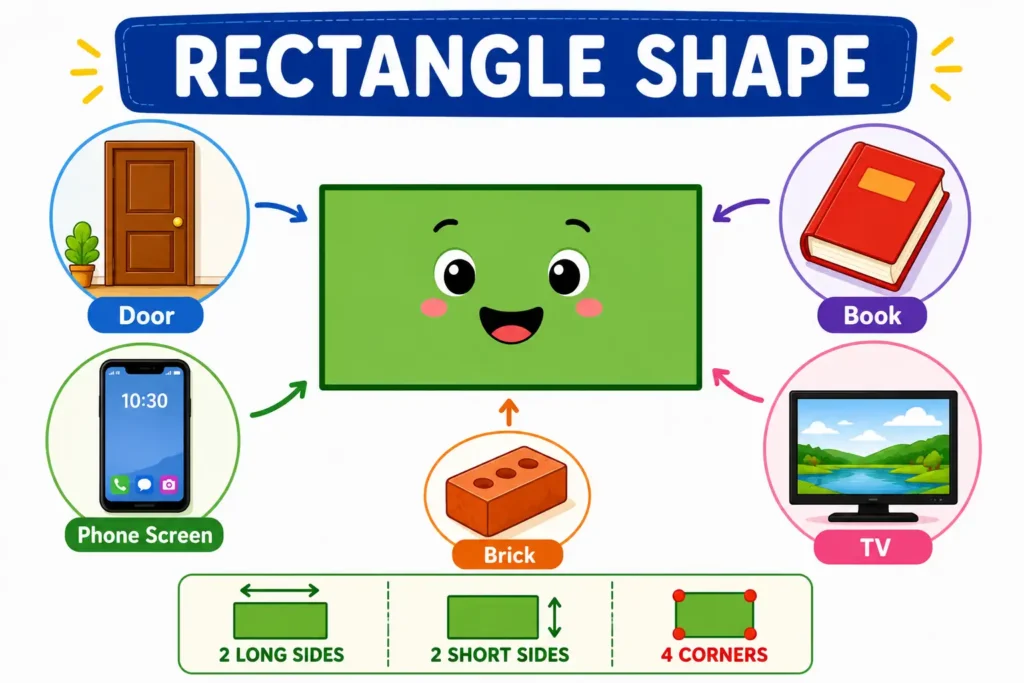
Sides: 4 (2 long, 2 short) | Corners: 4
Real-life shapes examples (rectangle shape objects): a door, a book, a phone screen, a brick, a TV, a sheet of paper, a bed.
Did you know? Most smartphones, tablets, laptops, TV are rectangles! That’s how common this shape is in everyday life. A long, rounded rectangle is sometimes called an “oblong” shape in everyday language.
Many classroom tools like worksheets and books are rectangle-shaped, just like in steps to draw a number line for class 1 maths, where rectangular space is divided evenly.
Understanding Sides and Corners — Explained Simply
Two words come up again and again when talking about the properties of shapes for Grade 1: sides and corners.
Let’s make sure your child understands both clearly.
This idea of edges and meeting points strengthens the visual logic used later in number ordering for class 1.
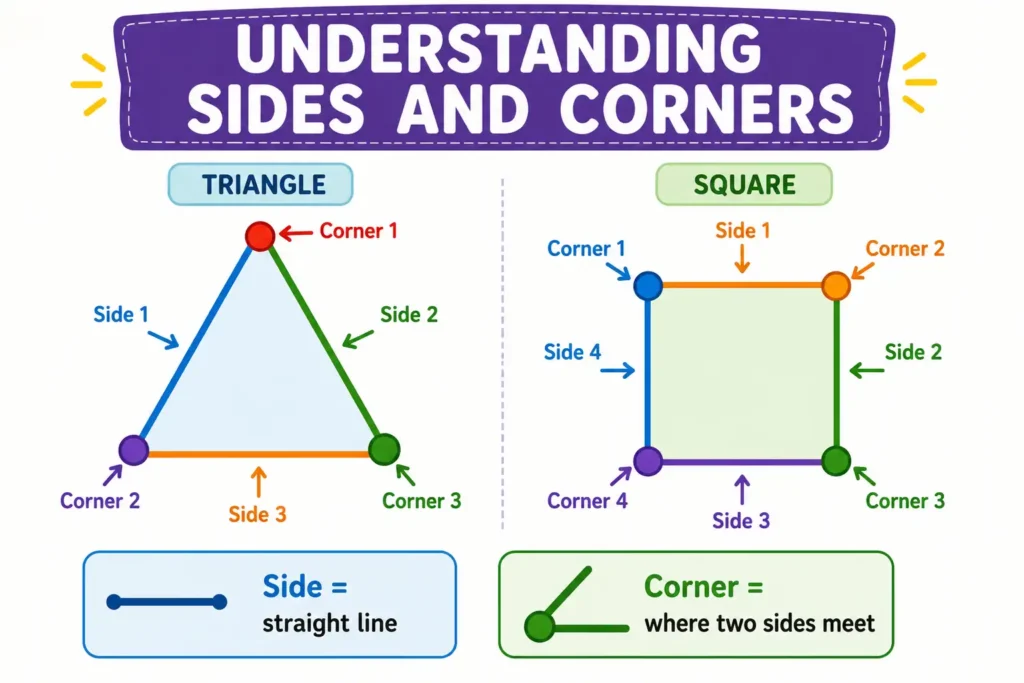
What is a side? A side is a straight line that forms part of a shape. Think of it like a straight road. It goes from one point to another without curving or bending.
What is a corner? A corner (also called a vertex in maths) is the point where two sides meet. Think of it like a crossroads: it’s the spot where two roads join. Corners are the “pointy” parts of a shape.
Here’s a simple way to remember: count the corners by touching each pointy part of the shape, one by one. Then count the sides by tracing along each flat edge.
For young learners, the easiest way to practise is to physically draw a triangle on a piece of paper, and ask your child to point to each side and each corner. Touching and counting is far more effective than just looking.
How Many Sides and Corners Does Each Shape Have?
| Shape | Sides | Corners |
|---|---|---|
| Circle | 0 | 0 |
| Triangle | 3 | 3 |
| Square | 4 | 4 |
| Rectangle | 4 | 4 |
This is one of the most common questions on any shapes worksheet for Class 1. Knowing sides and corners is the key to identifying basic shapes correctly.
Objects with One Corner, Three Corners, and No Corners
Class 1 worksheets often ask children to name objects by their corners, so let’s cover the most common ones:
Objects with one corner: an ice cream cone, a party hat, and a funnel. These are the classic answers when a worksheet asks you to “name three objects which have one corner.”
Objects with three corners: a pizza slice, a samosa, a folded paper hat, and a triangular road sign.
Objects with no corners: a ball, a coin, a bangle, a plate, and a clock face anything round and smooth.
Practising these makes “fill in the blanks on shapes for Class 1” questions feel easy.
Square vs Rectangle — What’s the Difference?
This is the question almost every Grade 1 student gets confused about.
It’s one of the most important things to get right early, so let’s break it down clearly.
This comparison skill mirrors what they practice in the difference between ascending and descending order topics.
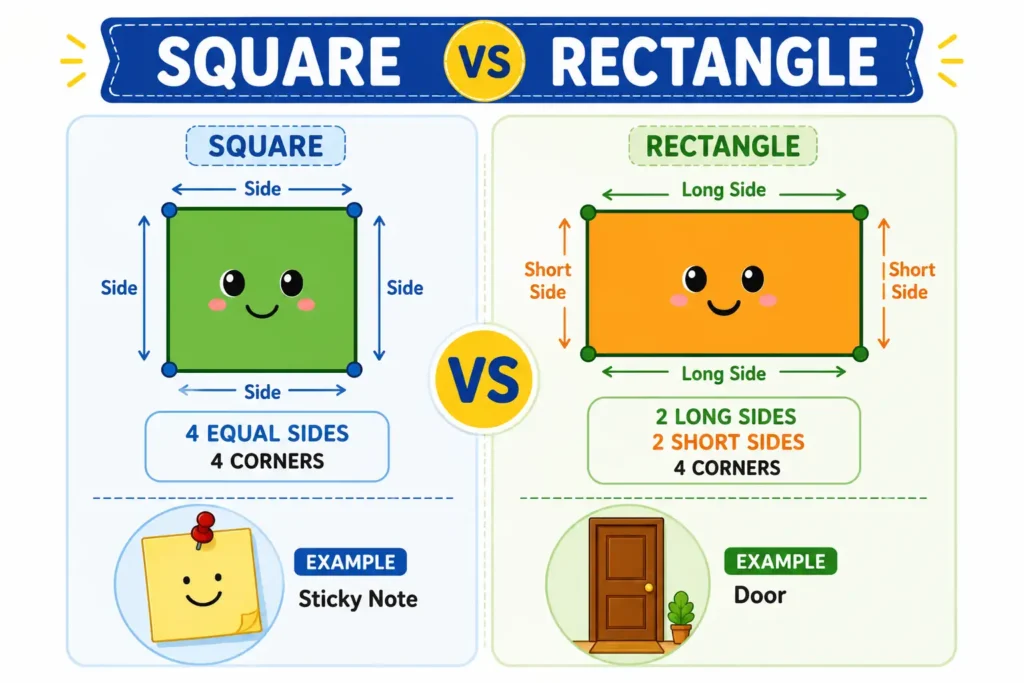
Both a square and a rectangle have 4 sides and 4 corners. So what makes them different?
- A square has ALL four sides the same length. Every side is equal.
- A rectangle has two long sides and two short sides. Opposite sides are equal, but not all four.
Here’s a real-life way to picture it:
- A sticky note is a square all four edges are the same length.
- A door is a rectangle it’s tall and narrow, with two long sides and two shorter sides.
Now here’s the fun part: a square is actually a special kind of rectangle one where all four sides happen to be equal.
But not every rectangle is a square, because most rectangles have sides of different lengths.
| Feature | Square | Rectangle |
|---|---|---|
| Number of sides | 4 | 4 |
| Number of corners | 4 | 4 |
| Side lengths | All 4 sides equal | 2 long, 2 short |
| Real-life example | Sticky note, chessboard tile | Door, book, TV screen |
Identifying Shapes — Tips for Grade 1 Students
Identifying shapes is one of the core skills taught in Grade 1 geometry.
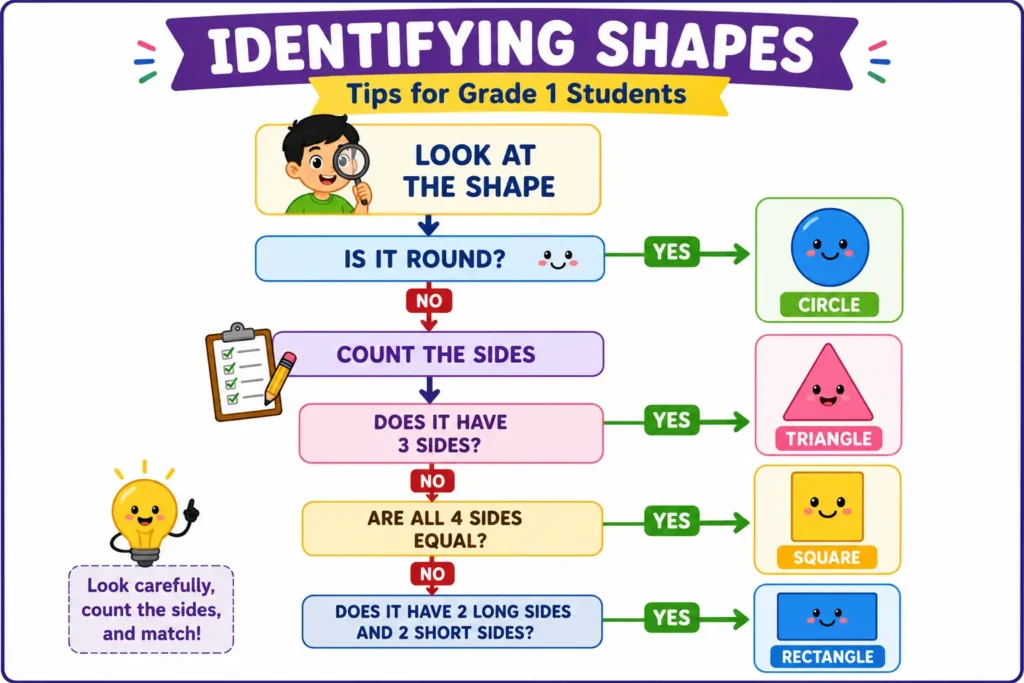
Here’s a quick method children can follow when they see any shape:
- Is it round? If it has no straight sides and no corners, it’s a circle.
- Count the sides. If there are 3 sides and 3 corners, it’s a triangle.
- Are all four sides equal? If yes, it’s a square.
- Are there 2 long sides and 2 short sides? If yes, it’s a rectangle.
This simple decision tree helps first graders identify geometric shapes quickly, whether on a worksheet, in a test, or during a shape hunt at home.
A fun way to test this skill: show three triangles and one circle and ask, “Which shape is the odd one out?” Spotting differences this way builds the same reasoning used in odd one out questions for Class 1.
Shape With No Corners and No Sides
A common question children ask: “Which shape has no corners?”
The answer is the circle. It is the only basic geometric shape with no straight sides and no corners at all.
It has just one smooth, curved edge. So whenever a question asks “which shape has no straight sides?” or “name a shape with no sides” the circle is your answer.
Common Mistakes Grade 1 Students Make And How to Gently Correct Them
Every child makes shape mistakes when they’re learning.
It’s completely normal and actually a sign that they’re thinking!
Here are the most common ones, and how to guide your child through them.
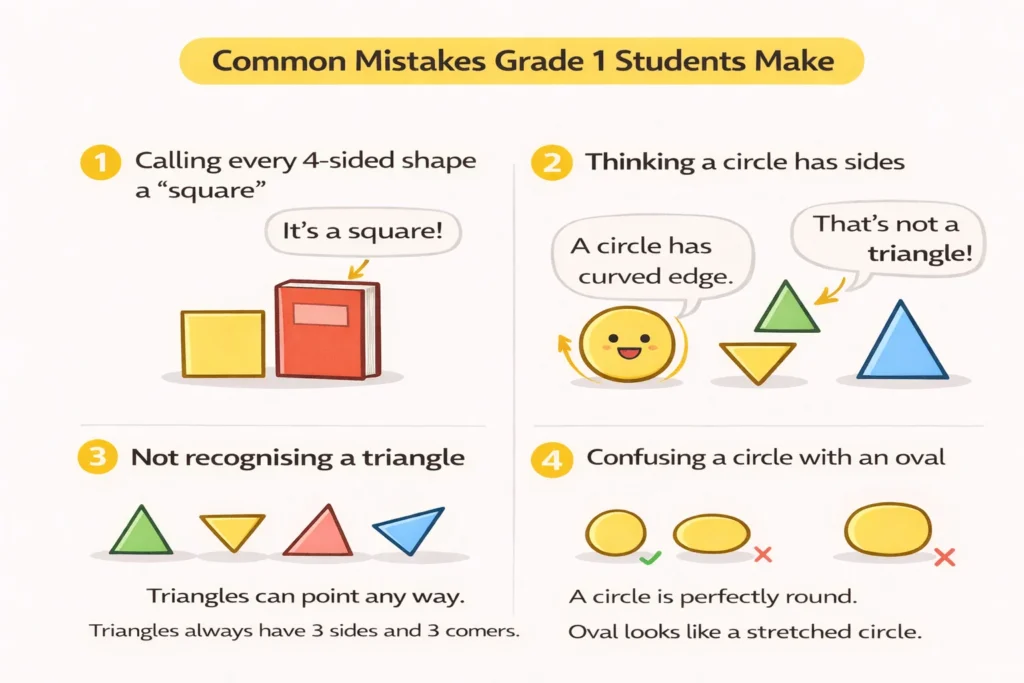
Mistake 1: Calling every 4-sided shape a “square”
This is the most common mix-up. If it has four sides, many children assume it must be a square.
Gently point to a door or a book and ask: “Are all four sides the same length?”
Help them measure with a finger to feel the difference.
Mistake 2: Thinking a circle has sides
Some children want to count the curved edge of a circle as a “side.” Reinforce that sides must be straight.
Ask: “Is this edge straight, or is it curved?” The curved edge of a circle is called a curve, not a side.
Mistake 3: Not recognising a triangle when it’s upside down or tilted
A triangle pointing downward is still a triangle! Show your child triangles in different orientations and ask: “How many sides does it have? How many corners?”
The answers (3 and 3) always confirm it’s a triangle, no matter which way it faces.
Mistake 4: Confusing a circle with an oval
A circle is perfectly round every point on its edge is the same distance from the centre.
An oval is stretched. If it looks like a squashed circle, it’s an oval. An egg is an oval; a coin is a circle. For Grade 1, we focus on perfect circles.
Mistake 5: Thinking shape names change based on size
A tiny triangle is still a triangle. A giant rectangle is still a rectangle.
Shape names are about structure (sides and corners), not size. This is an important concept in basic geometry for kids.
How to Teach Geometrical Shapes at Home — A Step-by-Step Guide
You don’t need to be a maths teacher to teach shapes effectively.
All you need is a little structure and a lot of everyday objects. Here’s how to do it.
This same structured progression is used when teaching how to teach number line maths class 1 concepts, and it mirrors the gentle approach in how to teach ascending and descending order to kids.
The See → Name → Count → Compare Sequence
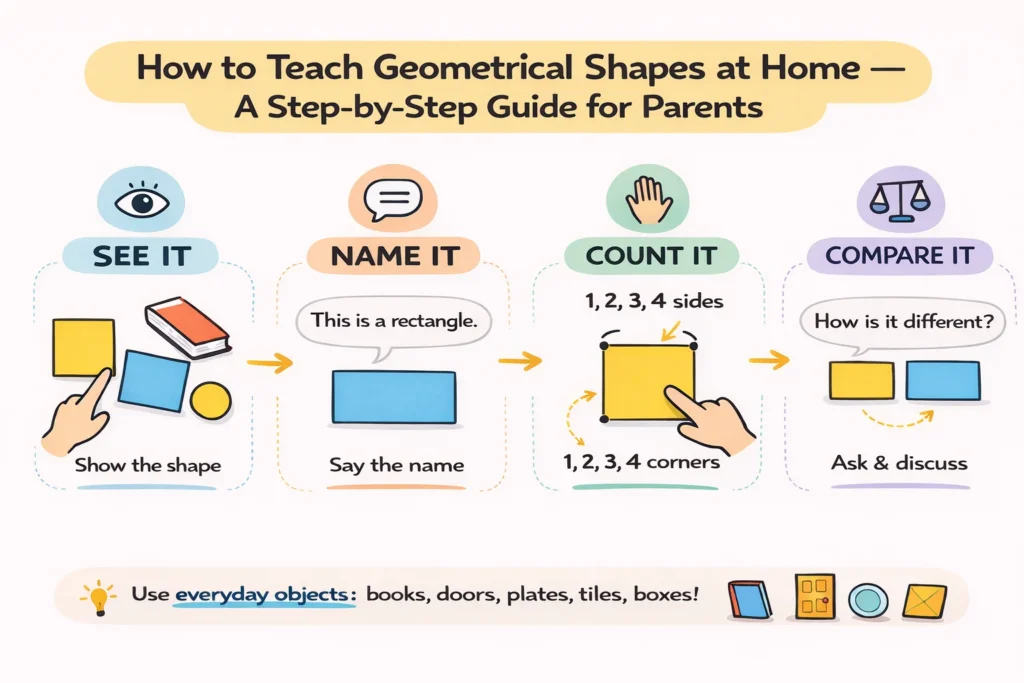
This is the most effective teaching order for young children:
- See it: Show your child the shape visually. Point to a real object or draw it.
- Name it: Say the name clearly: “This is a rectangle.” Ask your child to repeat it.
- Count it: Count the sides together, then count the corners. Use fingers to touch each one.
- Compare it: Ask: “How is this shape different from a square?” Comparison deepens understanding.
Introduce one shape at a time. Spend a day or two on the circle, then move to the square, then the triangle, then the rectangle. There’s no rush.
Use Household Objects
Your home is already a classroom. Look for circles (coins, plates, wheels), squares (tiles, crackers, napkins), triangles (sandwich halves, decorative elements), and rectangles (books, doors, phones).
Point them out naturally during the day. This is one of the best shape activities for Grade 1, and it costs nothing!
Informal Assessment Tips
You don’t need a test. Instead, casually ask: “Can you find something shaped like a circle in this room?” or
“How many corners does your book have?” If your child answers confidently, they’ve got it.
Remember: children learn shapes at their own pace. Some children will identify all four shapes in a few days.
Others may take a couple of weeks. Both are perfectly normal. Your consistent, calm guidance is what makes the biggest difference.
Fun Activities to Practise Shapes for Grade 1
Learning works best when it feels like play.
Here are five hands-on activity ideas that double as a shapes worksheet for Grade 1, no printing required! For more game-based learning ideas beyond shapes, see our critical thinking activities for Grade 1.
Activity 1: Shape Hunt
Walk around your home or classroom and challenge your child to find one example of each shape.
Keep a simple tally. Who can find a triangle fastest? This turns identifying shapes for Grade 1 into an exciting game.
Activity 2: Shape Tracing
Draw each shape on paper in a large size. Ask your child to trace over the outline with their finger first, then with a pencil or crayon.
Tracing helps build muscle memory for the shape’s form.
Activity 3: Shape Sorting
Collect small household objects: a button (circle), a cracker (square), a book (rectangle), a folded paper (triangle).
Mix them up and ask your child to sort them into groups by shape. This is a simple but powerful shapes activity for Class 1.
Activity 4: Draw From Memory
Say a shape name and ask your child to draw it from memory.
Don’t correct details like size; focus on whether the key properties are right. Did their triangle have 3 sides? Great!
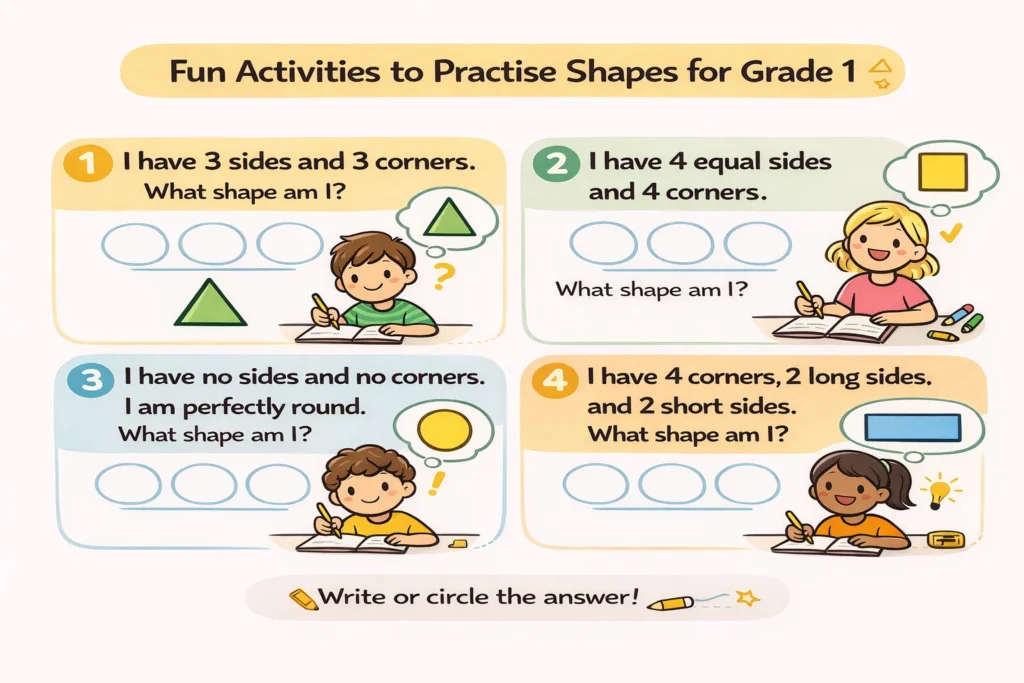
Activity 5: Mini Identify-the-Shape Exercises (Worksheet-Style)
Try these quick verbal or written exercises perfect as a simple shapes worksheet for Grade 1:
- “I have 3 sides and 3 corners. What shape am I?” (Answer: Triangle)
- “I have 4 equal sides and 4 corners. What shape am I?” (Answer: Square)
- “I have no sides and no corners. I am perfectly round. What shape am I?” (Answer: Circle)
- “I have 4 corners, 2 long sides, and 2 short sides. What shape am I?” (Answer: Rectangle)
These exercises build confidence and are great for quick revision before a class test or Math Olympiad preparation.
If your child is appearing for the Olympiad, check the full IMO syllabus for Class 1 and learn how to apply for the Maths Olympiad for Class 1.
Shapes Project for Class 1 — Easy Ideas
Schools often assign a shapes project for Class 1, and parents are sometimes unsure where to start.
Here are three simple, low-cost project ideas your child can complete in an afternoon:
Project 1: Shape Collage House
Cut out coloured paper shapes and glue them into a house: a square for the wall, a triangle for the roof, a rectangle for the door, and circles for the sun and windows.
This is the most popular drawing-with-shapes project for Class 1 and reinforces all four basic shapes at once.
Project 2: Shapes Around Us Photo Chart
Help your child photograph (or draw) one real object for each shape: a clock for a circle, a tile for a square, a samosa for a triangle, a book for rectangle.
Paste them on a chart paper with labels. This makes a beautiful “shapes around us” classroom display.
Project 3: Shape Animal Drawing
Using only circles, squares, triangles, and rectangles, draw an animal: a circle cat, a triangle fish, or a rectangle robot dog. Drawing with shapes builds creativity while quietly practising shape recognition.
Drawing with Shapes for Class 1
Drawing is one of the most natural ways young children internalise geometric forms.
Start by asking your child to draw each shape on its own, then combine them: a triangle on top of a square makes a house; two circles and a rectangle make a bus.
Within a few sessions, your child will start seeing the basic geometric shapes hidden inside everyday drawings.
Shapes Worksheet for Class 1 — Practice Questions with Answers
Here are additional questions on shapes for Class 1 that parents and teachers can use:
Fill in the blanks:
- A circle has ______ sides and ______ corners. (Answer: 0, 0)
- A triangle has ______ sides and ______ corners. (Answer: 3, 3)
- A shape with 4 equal sides is called a ______. (Answer: square)
- A rectangle has ______ long sides and ______ short sides. (Answer: 2, 2)
Identify the shape:
- Name a shape with no corners. → ______ (Answer: circle)
- Which shape looks like a box? → ______ (Answer: square)
- Which shape looks like a door? → ______ (Answer: rectangle)
- Name three objects which have one corner. → (Answer: ice cream cone, party hat, funnel)
Match the shape to the object:
| Object | Shape |
|---|---|
| Clock | Circle |
| Door | Rectangle |
| Roof | Triangle |
| Window pane | Square |
These types of questions are commonly found in Grade 1 shape worksheets and help reinforce visual recognition.
You can also turn any of the activities above into a printable shapes worksheet for Class 1 with answers for quick home revision.
Real-Life Shapes Examples for Kids — Shapes Around Us
One of the best ways to teach shapes is by pointing them out in everyday life.
Here are common geometric shapes around us, organised by shape:
Circle examples: clocks, coins, wheels, the sun, pizzas, buttons, plates, bangles.
Square examples (square shape objects): sticky notes, chessboard tiles, crackers, window panes, floor tiles, napkins.
Triangle examples: pizza slices, mountain peaks, roof shapes, yield road signs, party hats, sandwiches cut diagonally.
Rectangle examples (rectangle shape objects at home): doors, books, phone screens, bricks, TVs, sheets of paper, beds, tables.
Pointing out these objects during daily routines is one of the best ways to reinforce shape learning naturally.
When a child connects maths shapes to real objects, the learning sticks.
Types of Geometrical Shapes: 2D Shapes vs 3D Shapes
In geometry, shapes are grouped into two main categories: 2D shapes and 3D shapes.
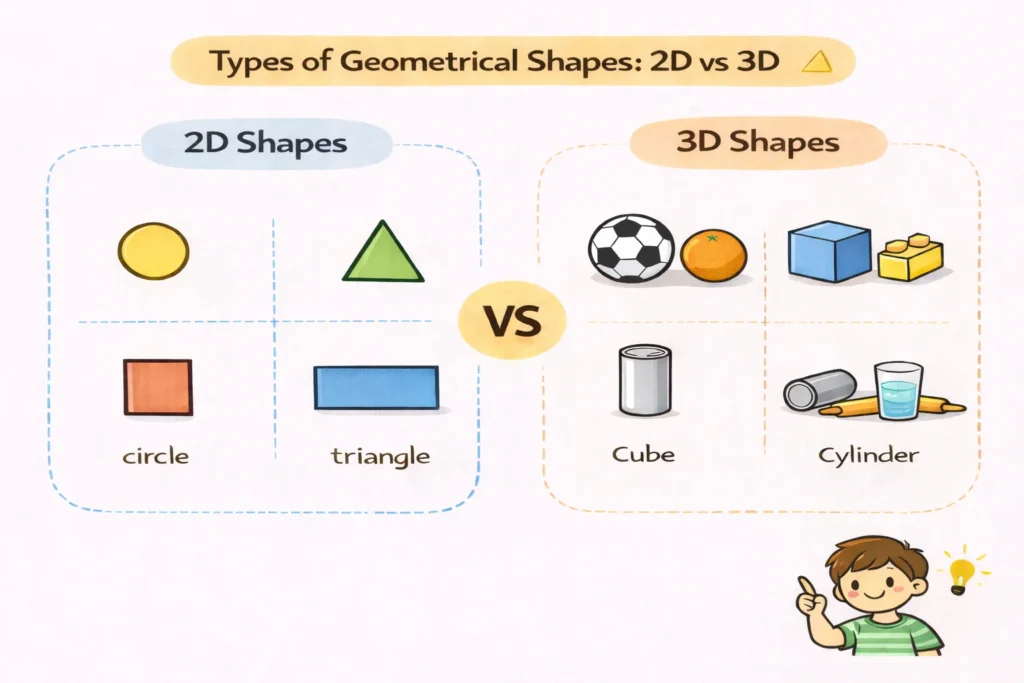
You may have heard the term “3D shapes” (also called solid shapes for Class 1).
These are shapes that have length, width, AND height they take up real space, like a ball, a box, or a can.
What Are 2D Shapes for Grade 1?
2D shapes (also called plane shapes or flat shapes) are shapes that lie flat on a surface. They have length and width but no depth or height.
The 2D shapes for Grade 1 are circle, square, triangle, and rectangle. They are called “2D” because they exist in two dimensions. You can draw them on paper.
What Are 3D Shapes for Grade 1? (Solid Shapes for Class 1)
3D shapes (also called solid shapes) are figures that have three dimensions: length, width, and height. Unlike flat shapes, you can hold 3D shapes in your hand.
Here are a few common solid shapes for Class 1 with real-life examples:
- Sphere: a ball, a globe, an orange
- Cube: a dice, a building block
- Cylinder: a tin can, a glass, a rolling pin
- Cone: a party hat, an ice cream cone
- Cuboid: a box, a brick, a book
A fun way to connect the two: a sphere is the 3D version of a circle, and a cube is the 3D version of a square.
2D vs 3D Shapes — Key Differences
| Feature | 2D Shapes | 3D Shapes |
|---|---|---|
| Dimensions | Length and width | Length, width, and height |
| Also called | Flat shapes, plane shapes | Solid shapes |
| Can you hold it? | No (draw on paper) | Yes (hold in hand) |
| Grade 1 examples | Circle, square, triangle, rectangle | Sphere, cube, cylinder |
For Grade 1, we focus on 2D shapes (plane shapes) first.
Once your child is confident with circles, squares, triangles, and rectangles, 3D shapes (typically introduced in Grade 2 and beyond) will come much more easily.
For now, if your child asks about 3D shapes, simply say: “Those are solid shapes. We’ll explore them soon! For now, let’s master the flat shapes first.”
Shapes and Patterns for Grade 1
Once children can identify the four basic shapes, they’re ready to explore shapes and patterns.
Pattern recognition is a natural extension of shape learning — it works the same way as alphabet patterns for Class 1 and number sequences for Class 1 maths, just with shapes instead of letters or numbers.
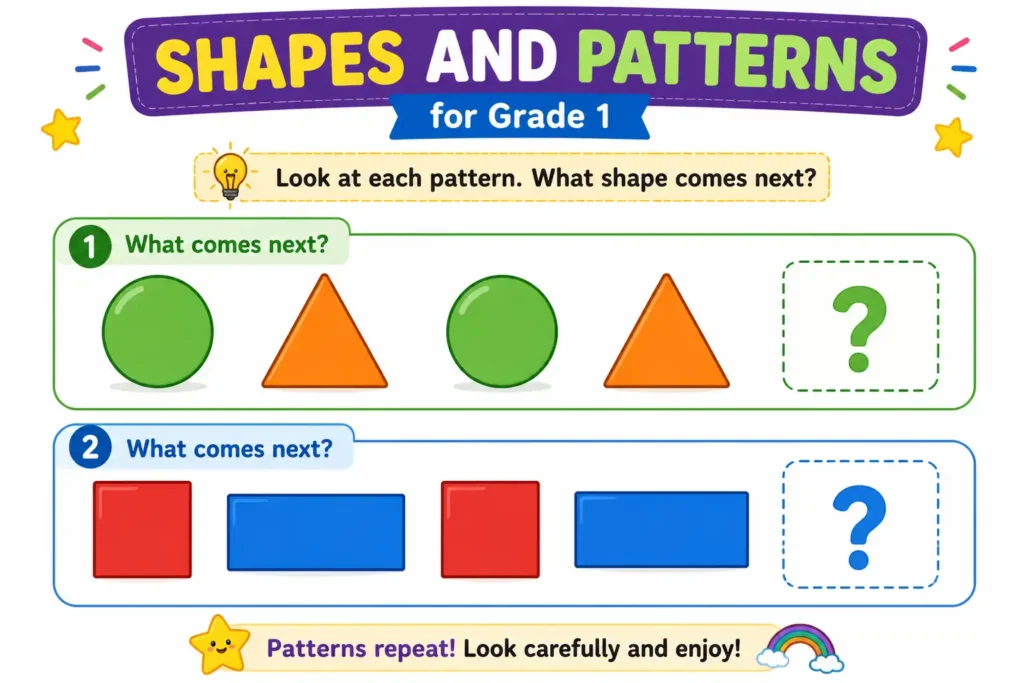
Try these simple pattern activities:
- Shape sequence: Circle, square, circle, square. What comes next?
- Colour + shape: Red triangle, blue circle, red triangle, blue circle, continue the pattern.
- Shape drawing: Draw a row of alternating rectangles and triangles.
Understanding shapes and patterns for Grade 1 strengthens logical thinking and prepares children for more complex maths topics, including geometric patterns introduced later in primary school.
What are geometrical shapes for Grade 1?
Geometrical shapes for Grade 1 are flat, 2D figures that children aged 6-7 learn to recognise and describe. The four core shapes are the circle, square, triangle, and rectangle. Each shape is defined by its number of sides and corners. At this level, the focus is on visual recognition, naming shapes, and understanding basic properties, not on formulas or measurements.
How many shapes should a Grade 1 student know?
Grade 1 students typically focus on four basic 2D shapes: circle, square, triangle, and rectangle. These four cover the most common shapes in daily life and provide the foundation for more complex geometry in later grades. Some curricula may introduce oval and diamond (rhombus), but the four core shapes are the primary focus for ages 6–7.
What is the difference between a square and a rectangle?
Both a square and a rectangle have 4 sides and 4 corners. The key difference is in the side lengths. A square has all four sides equal in length. A rectangle has two longer sides and two shorter sides. In fact, a square is a special type of rectangle one where all four sides happen to be the same length. A sticky note is a square; a book is a rectangle.
What are 2D shapes for Grade 1?
2D shapes (also called plane shapes or flat shapes) are shapes that lie flat on a surface. They have length and width but no depth or height. The 2D shapes for Grade 1 are circle, square, triangle, and rectangle. They are called “2D” because they exist in two dimensions. You can draw them on paper, unlike 3D shapes (like a ball or a box), which you can hold in your hand.
How do I teach shapes to a 6-year-old?
The most effective approach uses four steps: See it (show the shape visually), Name it (say the name together), Count it (count the sides and corners using fingers), and Compare it (ask how it’s different from other shapes). Use real-life objects from around the home, introduce one shape at a time, and reinforce through play, shape hunts, sorting, tracing, and drawing. Keep it hands-on and low-pressure.
What are some real-life shapes examples?
Real-life shapes examples are everywhere! Circles: clocks, coins, wheels, the sun, pizzas. Squares: sticky notes, chessboard tiles, crackers, window panes. Triangles: pizza slices, mountain peaks, roof shapes, yield road signs. Rectangles: doors, books, phone screens, bricks, TVs. Pointing out these objects during daily routines is one of the best ways to reinforce shape learning naturally.
What is the difference between 2D and 3D shapes for Grade 1?
2D shapes are flat; they have only length and width. You can draw them on paper. Examples include circles, squares, triangles, and rectangles. 3D shapes are solid; they have length, width, and height. You can hold them in your hand. Examples include spheres, cubes, cylinders, and cones. Grade 1 focuses mainly on 2D shapes.
What shape has no sides and no corners?
A circle has no sides and no corners. It is the only basic shape that is perfectly round with just one continuous curved edge.
What are four basic shapes?
The four basic shapes are circle, square, triangle, and rectangle. These are the primary shapes taught in Grade 1 and are the most common geometric figures in everyday life.
Name three objects that have one corner?
An ice cream cone, a party hat, and a funnel each have one corner. This is a common Class 1 worksheet question; any object with a single pointed tip works as an answer.
What is a good shapes project for Class 1?
Easy shapes projects for Class 1 include a shape collage house (square wall, triangle roof, rectangle door, circle sun), a “shapes around us” photo chart, or drawing an animal using only the four basic shapes. All three can be completed with paper, glue, and crayons in an afternoon.
Make Preparing for Math Olympiad Simple!



Final Thought
Understanding geometrical shapes for Grade 1 is much more than a school exercise. It’s the start of a child’s lifelong relationship with maths and the world around them.
You now have everything you need: clear definitions of basic geometric shapes, the complete shapes name list for Class 1, the four core shapes with their properties, a step-by-step teaching sequence, real-life shapes around us, common mistake corrections, shapes worksheets with answers, project ideas, and fun activities.
Whether you’re a parent working at the kitchen table or a teacher planning a geometry lesson for first graders, this guide gives you a solid, confidence-building framework.
Start with one shape today and watch your child’s understanding grow and when your little learner is ready for the next challenge, explore our guide on how to apply for the Maths Olympiad for Class 1.