 April 4, 2026
 15 min. read

The SOF IMO is one of the few school-level exams that tests how you think, not just what you’ve memorized.
For students in Classes 1–12, it’s also one of the best early investments in competitive math.
This guide covers everything: syllabus, dates, exam pattern, and a step-by-step prep roadmap so you can stop guessing and start preparing.
Let’s start from the beginning.
What is SOF IMO?
The International Mathematics Olympiad (IMO), organized by the Science Olympiad Foundation (SOF), is one of the largest and most prestigious school-level math competitions in the world.
It’s open to students from Classes 1 to 12 and is conducted annually across thousands of schools in India and internationally.
SOF IMO isn’t just a test of school math; it assesses mathematical reasoning, logical thinking, and the ability to apply concepts in real-world and higher-order problem situations.
It aligns with NEP’s emphasis on developing problem-solving and critical thinking skills from an early age.
Why does it matter?
- It gives students a structured competitive exposure beyond board exams
- It identifies and nurtures mathematical talent early
- Top performers receive cash scholarships, medals, and national/international recognition
- It builds skills that are directly useful for JEE, NTSE, and future competitive exams
How Does It Differ from the International IMO?
Important: Two competitions share the “IMO” acronym. The SOF IMO is a school-level MCQ-based competition organised by the Science Olympiad Foundation for Classes 1–12 across India and internationally. This is what this guide covers. The International Mathematical Olympiad (IMO 2026) is an elite competition held in Shanghai, China, for national math teams, featuring proof-based problems. They are not the same exam.
SOF IMO 2026–27 Exam Dates
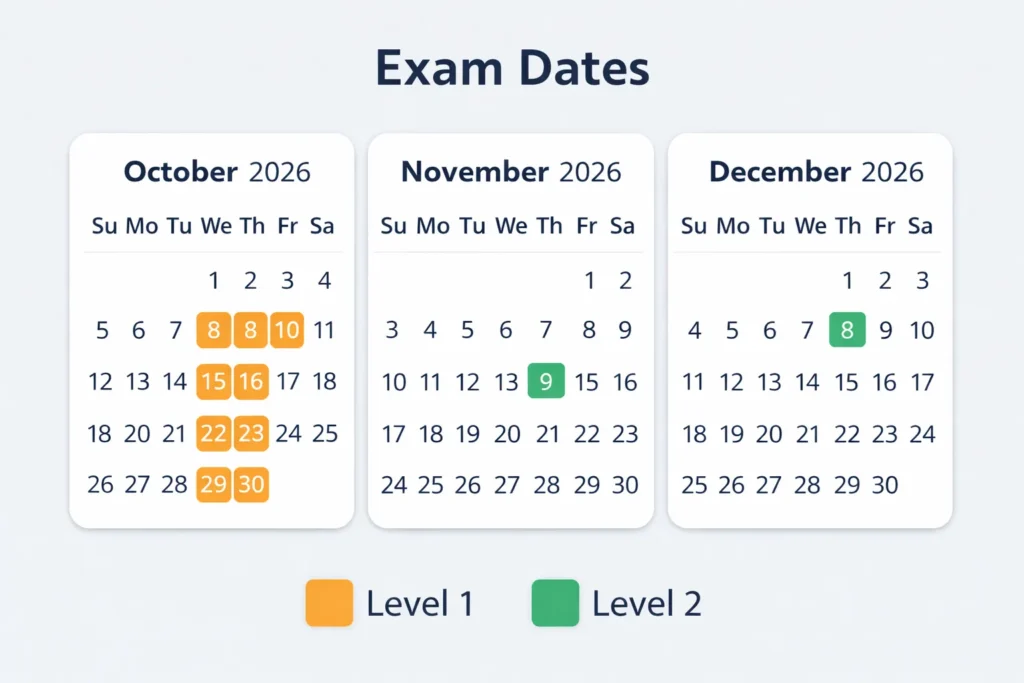
SOF IMO Level 1 is conducted across three date options.
Schools choose one date and all students from that school appear on the same day.
| Event | Date |
| Level 1 — Date 1 | 23 October 2026 |
| Level 1 — Date 2 | 26 November 2026 |
| Level 1 — Date 3 | 10 December 2026 |
| Level 1 Results | Level 1 Results | Typically mid-January 2027. See SOF IMO result date 2026–27 for updates |
| Level 2 | Tentatively February 2027 (announced by December 2026) |
| Level 2 Results | Typically March 2027 |
| Registration Deadline | 30 days before your school’s chosen exam date |
Note: Level 2 dates are centrally fixed by SOF (typically the 2nd or 3rd Sunday of February) and are not chosen by schools.
Level 2 is a separate date for Maharashtra. Always confirm current dates at sofworld.org.
Actionable takeaway: Check with your school coordinator right away to find out which date your school has registered for.
Missing the registration window means missing the exam entirely.
SOF IMO Eligibility and Registration
Who can participate?
- Any student enrolled in Classes 1 to 12 in a school recognized by SOF
- No minimum academic requirement for Level 1 it’s open to all
- Level 2 is restricted to Classes 3 to 12 (students of Classes 1 and 2 are assessed only at Level 1)
How does registration work?
Registration is entirely school-based. Individual students cannot register directly with SOF. Here’s the process:
- SOF sends registration forms and guidelines to registered schools before the academic year begins
- The school assigns a coordinator (usually a teacher) who collects student details and fees
- The school submits a consolidated registration form to SOF at least 30 days before the chosen exam date
- SOF generates roll numbers and sends admit cards/exam instructions back to the school
- Students collect their admit cards from their school
Registration fee: ₹125 per student (for Indian students). International students pay USD 9.
Students with a major physical disability or whose parent was martyred in defence operations are exempt from the fee.
If your school isn’t registered: Ask your school coordinator or principal to register your school at sofworld.org. Schools with at least 10 registered students per class can participate.
SOF IMO Exam Pattern and Marking Scheme
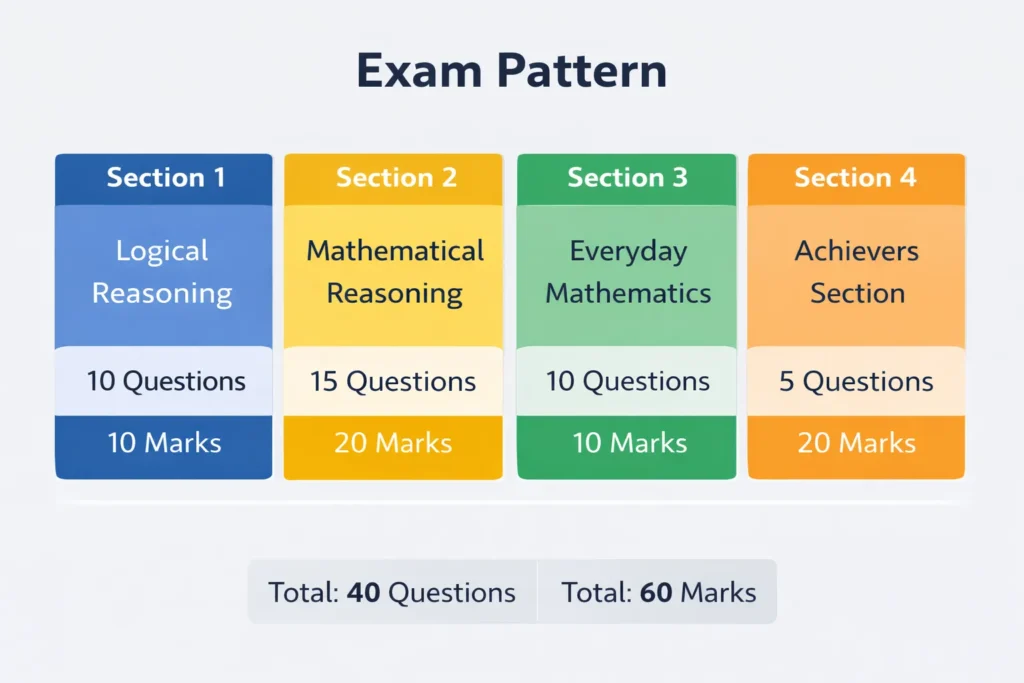
The SOF IMO exam pattern follows a pen-and-paper, multiple-choice format.
Duration is 60 minutes for all classes. There is no negative marking.
SOF IMO Exam Pattern (Classes 1–12)
| Section | Name | Classes 1–4 | Classes 5–12 | Marks per Question |
| Section 1 | Logical Reasoning | 10 Qs | 15 Qs | 1 mark |
| Section 2 | Mathematical Reasoning | 10 Qs | 20 Qs | 1 mark |
| Section 3 | Everyday Mathematics | 10 Qs | 10 Qs | 1 mark |
| Section 4 | Achievers Section (HOTS) | 5 Qs | 5 Qs | 3 marks |
| Total | 35 Qs / 40 marks | 50 Qs / 60 marks |
Key insight: The Achievers Section carries 3 marks per question significantly higher than the rest.
A student who answers all five correctly gains 15 marks, which can shift their rank dramatically. This section is where preparation strategy really matters.
Level 2 pattern difference: At Level 2, the Logical Reasoning and Everyday Mathematics sections are dropped.
The exam focuses only on Mathematical Reasoning and the Achievers Section, with the overall difficulty raised considerably.
SOF IMO Syllabus — Class-wise (Grades 1–12)
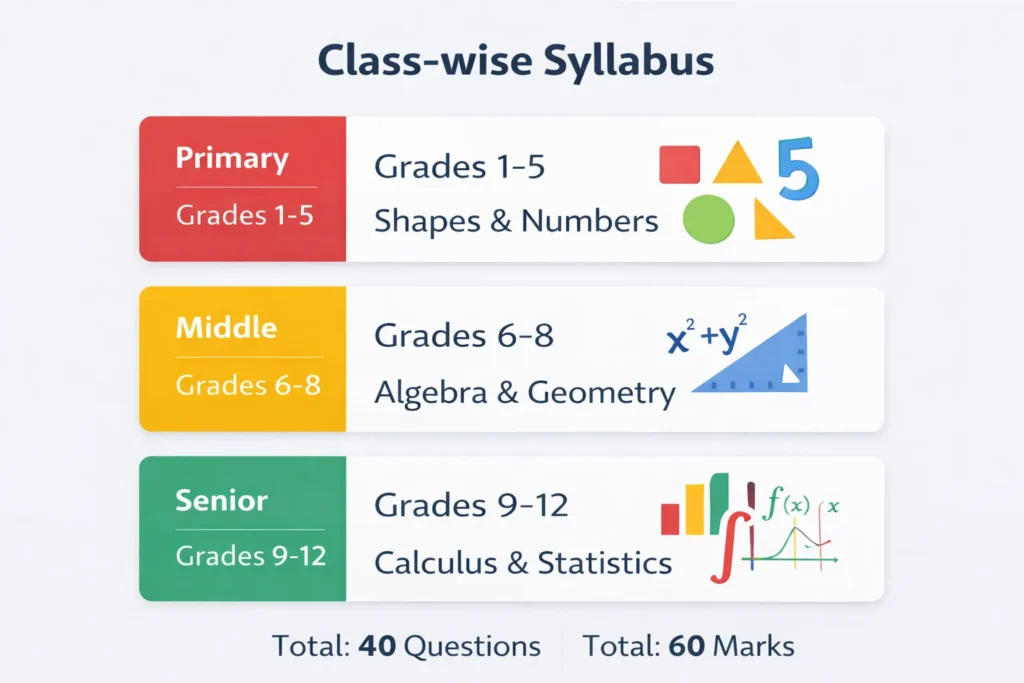
The SOF IMO syllabus is based on CBSE, ICSE, and State Board curricula.
The structure across all sections remains the same (Sections 1–4), but the topics scale with each class.
One important rule: approximately 60% of questions come from the current class syllabus, and 40% from the previous class (except the Achievers Section, which is 100% from the current class).
| Class | Section 1: Logical Reasoning Topics | Section 2 & 3: Key Math Topics |
|---|---|---|
| 1 | Patterns, Odd One Out, Geometrical Shapes, Spatial Understanding, Analogy, Ranking, Problems Based on Figures | Numerals & Number Sense (2-digit), Number Names & Sequences, Addition & Subtraction, Multiplication, Lengths, Weights, Time, Money, Fractions, Shapes and Solids, Ordering Numbers, Ordinal Numbers |
| 2 | Patterns, Analogy, Odd One Out, Geometrical Shapes, Ranking Test, Grouping | Number Sense (3-digit), Addition & Subtraction, Multiplication, Division, Fractions, Length, Weight, Capacity, Time, Temperature, Money, Geometry |
| 3 | Analogy, Classification, Mirror Images, Embedded Figures, Ranking, Patterns, Grouping | Large Numbers, Addition & Subtraction, Multiplication, Division, Fractions, Money, Measurement, Data Handling, Geometry, Time |
| 4 | Series Completion, Analogy, Classification, Coding-Decoding, Mirror Images, Geometrical Shapes | Large Numbers, Roman Numerals, Fractions, Decimals, Factors & Multiples, Measurement, Time, Perimeter & Area, Symmetry, Data Handling |
| 5 | Series, Analogy, Classification, Coding-Decoding, Direction Sense, Venn Diagrams, Ranking | Large Numbers, Fractions & Decimals, HCF & LCM, Ratio & Proportion, Percentage, Unitary Method, Area & Perimeter, Volume, Geometry, Data Handling |
| 6 | Analogy, Classification, Series, Coding-Decoding, Blood Relations, Direction Sense, Venn Diagrams | Knowing Our Numbers, Whole Numbers, Playing with Numbers, Basic Geometrical Ideas, Integers, Fractions, Decimals, Data Handling, Mensuration, Algebra, Ratio & Proportion, Symmetry, Practical Geometry |
| 7 | Verbal & Non-Verbal Reasoning, Analogy, Series, Blood Relations, Coding-Decoding, Direction & Distance | Integers, Fractions & Decimals, Data Handling, Simple Equations, Lines & Angles, Triangles, Congruence, Ratio & Proportion, Percentage, Profit & Loss, Simple Interest, Algebraic Expressions, Symmetry, Mensuration |
| 8 | Analogy, Series, Odd One Out, Coding-Decoding, Blood Relations, Direction Sense, Logical Venn Diagrams | Rational Numbers, Squares & Cubes, Exponents & Powers, Algebraic Expressions & Factorisation, Linear Equations, Understanding Shapes, Mensuration, Data Handling, Introduction to Graphs, Direct & Inverse Proportions |
| 9 | Advanced Verbal & Non-Verbal Reasoning, Series, Analogy, Data Sufficiency | Number Systems, Polynomials, Coordinate Geometry, Linear Equations in Two Variables, Triangles, Quadrilaterals, Circles, Heron’s Formula, Surface Areas & Volumes, Statistics, Probability |
| 10 | Logical, Analytical & Verbal Reasoning, Data Interpretation | Real Numbers, Polynomials, Pair of Linear Equations, Quadratic Equations, Arithmetic Progressions, Triangles, Coordinate Geometry, Trigonometry, Circles, Mensuration, Statistics & Probability |
| 11 | Higher-order Verbal & Non-Verbal Reasoning, Analytical Puzzles | Sets, Relations & Functions, Trigonometry, Principle of Mathematical Induction, Complex Numbers, Quadratic Equations, Permutations & Combinations, Binomial Theorem, Sequences & Series, Straight Lines, Conic Sections, Limits & Derivatives, Statistics, Probability |
| 12 | Higher-order Reasoning, Data Interpretation | Relations & Functions, Inverse Trigonometry, Matrices & Determinants, Continuity & Differentiability, Differentiation & Applications, Integrals, Differential Equations, Vectors, 3D Geometry, Linear Programming, Probability |
Free resource: SOF has released official class-wise sample papers for IMO 2026–27 in PDF format.
Download them free at SOF IMO Sample Papers 2026–27, structured exactly like the actual exam.
Actionable takeaway: Before jumping into new topics, revise your previous class’s syllabus. That 40% can make or break your score.
Level 1 vs Level 2 — What’s the Difference?
| Feature | Level 1 | Level 2 |
| Who can appear | All students, Classes 1–12 | Qualifiers from Classes 3–12 only |
| Eligibility to appear | School registration (no min. marks) | Top 5% class-wise from Level 1 OR zone-wise top 25 rank holders OR class topper (if 10+ students from same class appeared and scored 50%+) |
| Registration | Through school | Automatic — no separate registration needed |
| Sections | Logical Reasoning, Mathematical Reasoning, Everyday Math, Achievers | Mathematical Reasoning + Achievers Section only |
| Difficulty | Moderate — concept application | High — advanced problem-solving and HOTS |
| Duration | 60 minutes | 60 minutes |
| Negative Marking | None | None |
| Awards | School, Zonal & International ranks | International & Zonal ranks (higher prestige) |
Key takeaway: If you qualify for Level 2, don’t underestimate the jump in difficulty.
Read our SOF IMO Level 2 preparation guide for an advanced strategy built specifically for qualifiers.
The Logical Reasoning and Everyday Math comfort zones are gone, it’s purely mathematical depth and the Achievers Section from that point.
SOF IMO Awards and Scholarships
Here’s a full breakdown of SOF IMO awards and prizes for 2026–27:
| Award Level | What You Receive |
| International Rank 1 (per class) | Cash prize of ₹5,000 + Gold Medal + Certificate of Outstanding Performance |
| International Rank 2 (per class) | Cash prize of ₹5,000 + Silver Medal + Certificate of Outstanding Performance |
| International Rank 3 (per class) | Cash prize of ₹5,000 + Bronze Medal + Certificate of Outstanding Performance |
| Zonal Rank 1 (per class, per zone) | Cash prize of ₹5,000 + Gold Medal + Merit Certificate |
| Academic Excellence Scholarship | ₹5,000 cash — awarded to 260 students from Classes 1–10 |
| School Topper (per class) | Medal of Distinction + Merit Certificate |
| All Participants | Certificate of Participation + Student Performance Report (SPR) |
Every student who participates receives a Student Performance Report (SPR), not just toppers.
The SPR shows your score broken down by section, your national percentile, and areas of strength and weakness.
For a full walkthrough on checking SOF IMO results and what the SPR contains, see our dedicated results guide.
Scores are available at results.sofworld.org approximately 4–5 weeks after the Level 1 exam.
How to Prepare for SOF IMO — Step-by-Step Strategy
For a detailed 60-day roadmap, see our guide on how to prepare for SOF IMO.
The Olympiad Mindset Shift
The single biggest mistake students make is treating SOF IMO like a school exam. It isn’t. School exams test recall and procedure.
Olympiads test your ability to think with math to see patterns, apply concepts in unfamiliar situations, and work quickly under time pressure.
That shift in mindset is step zero.
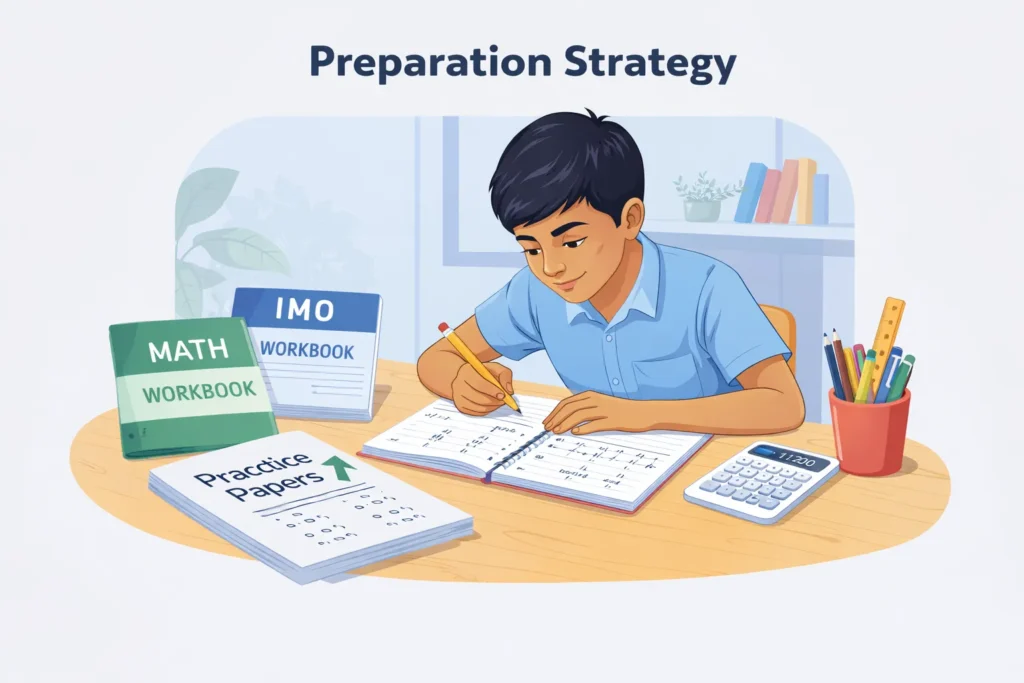
Preparation by Grade Group
Primary (Classes 1–4):
- Start with building number sense and shape recognition; these appear heavily in Sections 1 and 2
- Practice puzzle books and visual reasoning activities alongside math
- Work through one or two previous year papers together with a parent or teacher the format feels unfamiliar the first time
- Focus on accuracy over speed at this stage
Middle School (Classes 5–8):
- Section 1 (Logical Reasoning) can be fully mastered with targeted practice 20–30 minutes daily
- For Sections 2 and 3, build on school concepts but practice application-based questions, not just textbook exercises
- The Achievers Section is where middle schoolers can gain the most edge: practice HOTS questions from previous papers and SOF workbooks
- Common mistake: skipping revision of the previous class syllabus do not skip it
Secondary (Classes 9–12):
- Start early the syllabus is wide and conceptually deep
- Focus on coordinate geometry, trigonometry, and algebra for Classes 9–10; limits, calculus, and probability for Classes 11–12
- At this level, the Achievers Section is extremely competitive practice multi-concept problems that combine two or three topics
- Time management is critical: with 50 questions in 60 minutes, you have ~72 seconds per question
Common Mistakes and Specific Fixes
| Mistake | Fix |
| Only practicing from school textbooks | Add Olympiad-specific workbooks that include application and reasoning questions |
| Ignoring the Logical Reasoning section | Dedicate 15–20 minutes daily to reasoning practice, it’s high-scoring and improvable fast |
| Solving questions without checking solutions | Review why an answer is correct, not just what it is |
| Leaving the Achievers Section for last and rushing it | Attempt it with fresh concentration it carries 3× the marks |
| Not attempting previous year papers under timed conditions | Simulate real exam pressure: sit, time yourself, no interruptions |
| Starting preparation a week before the exam | Start 8–12 weeks out for meaningful improvement |
Speed and Accuracy Tips
- Do mental math drills for 10 minutes daily it dramatically reduces time spent on calculation
- For Logical Reasoning, learn to eliminate wrong options quickly rather than solving from scratch
- In the actual exam, do a quick pass first: attempt all questions you’re confident about, then return to harder ones
- Don’t spend more than 90 seconds on any single question in the first pass
SOF IMO Study Plan
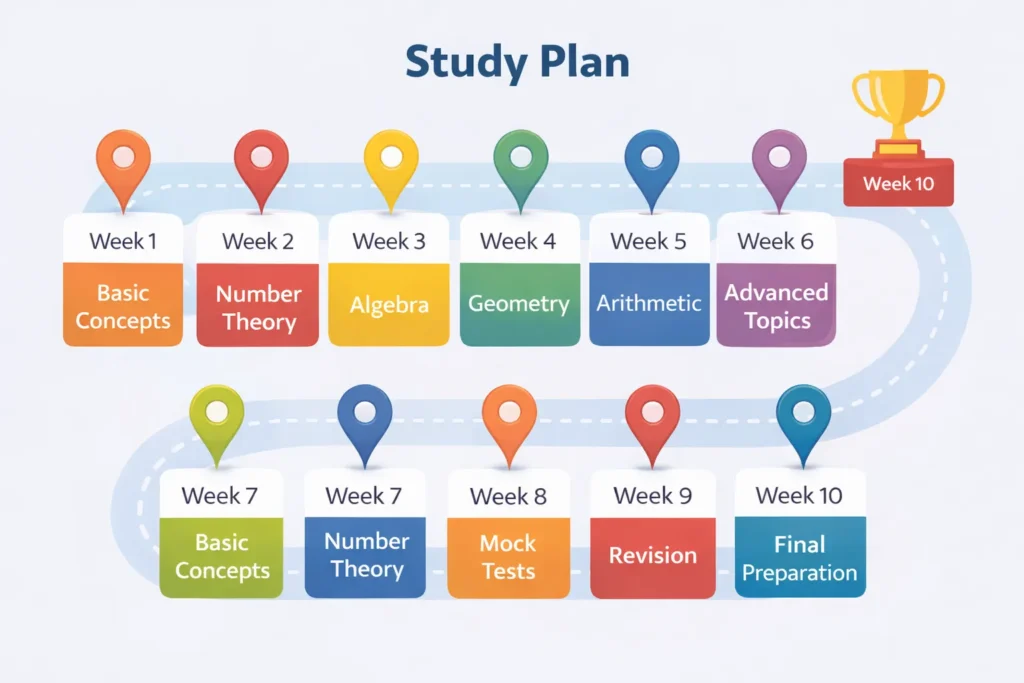
| Week | Focus Area | Daily Time |
| Week 1 | Understand the syllabus; identify weak topics; download free sample papers from sofworld.org | 30–45 min |
| Week 2 | Revise previous class syllabus (the 40% component) | 45 min |
| Week 3 | Section 1 — Logical Reasoning (all topic types) | 45 min |
| Week 4 | Section 2 — first half of current class math topics | 45–60 min |
| Week 5 | Section 2 — second half of current class math topics | 45–60 min |
| Week 6 | Section 3 — Everyday Mathematics, application-style problems | 45 min |
| Week 7 | Achievers Section deep dive — HOTS problems, previous year Achievers questions | 60 min |
| Week 8 | First full timed mock test → thorough error review | 1 mock + 45 min review |
| Week 9 | Targeted revision of weak areas from mock results | 60 min |
| Week 10 | Two more timed mocks + light revision of key formulas and concepts | 1 mock every 3–4 days |
This plan works for Classes 5 and above. For Classes 1–4, aim for 20–30 minutes daily with an emphasis on practice papers over a 6–8 week window.
Best Books and Resources for SOF IMO Preparation
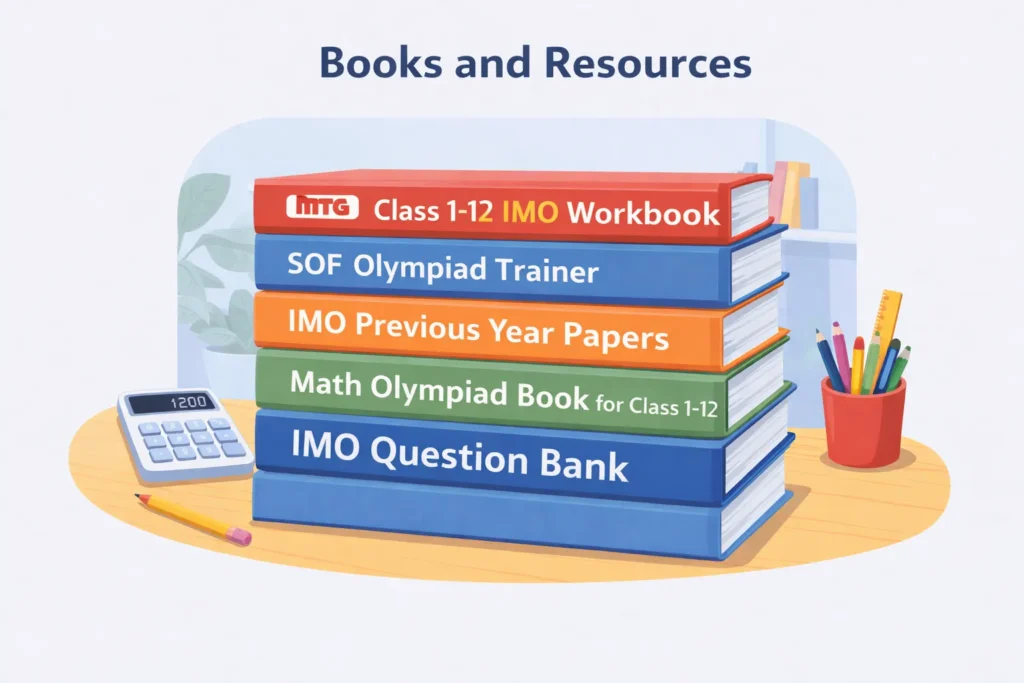
By Grade Group
Classes 1–5:
- SOF IMO Workbooks (published by MTG Learning Media) these are the most closely aligned with the actual exam
- Math Olympiad Contest Problems (Grades 1–5) excellent for building early problem-solving instincts
Classes 6–8:
- MTG IMO Workbooks (class-specific)
- Mathematics for Olympiads by R.D. Sharma (for concept building)
- Previous year SOF IMO question papers (available free at sofworld.org)
Classes 9–12:
- MTG IMO Workbooks (class-specific)
- NCERT textbooks as base + Olympiad-specific practice books
- S.L. Loney’s Trigonometry and Hall & Knight’s Higher Algebra for deeper concept work
Online Practice
SOF’s official website provides free class-wise sample question papers that always start there before buying anything.
For structured digital practice with adaptive difficulty and class-wise topic tracking, the Gonit App is worth exploring as a supplementary tool alongside your books.
Make Preparing for Math Olympiad Simple!



Free starting point: Download the official IMO 2026–27 sample papers at sofworld.org/imo → Sample Papers.
No sign-up required.
Actionable takeaway: Don’t buy ten books. Pick one class-specific workbook, finish it thoroughly, and layer in previous year papers and timed mock tests. Depth over breadth wins.
Benefits of Participating in SOF IMO

Academic growth: The Olympiad pushes you to understand why math works, not just how to perform procedures.
This depth pays dividends in school exams and competitive entrances like JEE.
Competitive exposure: Most students have never experienced exam-level time pressure or ranking until high school.
IMO introduces this healthily, at a younger age, with a structure designed for learning.
Scholarships and recognition: Top rank holders receive cash prizes of ₹5,000 each plus medals and certificates.
The Academic Excellence Scholarship rewards 260 students from Classes 1–10. Even students who don’t rank receive a Certificate of Participation and their SPR both of which have real value.
College applications and portfolios: Olympiad participation and ranks add real weight to school profiles and scholarship applications at reputed institutions.
Early identification of talent: If a student consistently performs well across SOF exams from middle school.
It’s often an early indicator of aptitude for engineering, data science, finance, or research fields where mathematical thinking is foundational.
SOF IMO vs Higher Olympiads (Brief Comparison)
It helps to understand where SOF IMO sits in the larger ecosystem.
| Feature | SOF IMO | INMO (Indian National MO) | International IMO |
| Organizer | Science Olympiad Foundation | HBCSE | International Mathematical Union |
| Eligibility | Classes 1–12 | Class 12 and below (via PRMO → RMO pathway) | National team selection |
| Format | MCQ (multiple choice) | Proof-based, subjective | Proof-based, subjective |
| Difficulty | School level to moderately advanced | Very high — research-adjacent | Elite — world’s brightest math students |
| Primary purpose | Broad participation; identify talent early | Identify national-level talent | Represent country internationally |
SOF IMO is an excellent starting point that builds problem-solving habits early.
If a student excels here and wants to push further, the path leads through PRMO → RMO → INMO → IMO Training Camp → International IMO.
Most students who reach the international IMO started with structured competitive math practice in middle school which is exactly what SOF IMO offers.
What is the SOF IMO exam?
The SOF IMO is the International Mathematics Olympiad organized by the Science Olympiad Foundation for students in Classes 1–12. It is a school-level MCQ-based competition not the same as the International Mathematical Olympiad held for national teams in Shanghai.
Who is eligible for SOF IMO?
Any student enrolled in Classes 1 to 12 in a school registered with SOF is eligible for Level 1. No minimum marks are required. Level 2 is open only to students from Classes 3 to 12 who qualify through Level 1 performance.
How many levels are there in SOF IMO, and who qualifies for Level 2?
There are two levels. To qualify for Level 2, a student must be among the top 5% of their class nationally from Level 1, a zone-wise top 25 rank holder, or a class topper where at least 10 students from that class appeared and scored 50% or above.
What are the SOF IMO 2026–27 exam dates?
Level 1: 23 October, 26 November, or 10 December 2026 (schools choose one date). Level 2: tentatively February 2027, announced by December 2026.
Is there negative marking in SOF IMO?
No. There is no negative marking at Level 1 or Level 2. Attempt every question.
What is the SOF IMO registration fee?
₹125 per student for Indian students; USD 9 for international students. Registration goes through the school; only individual students cannot register directly with SOF.
What books are best for SOF IMO preparation?
MTG IMO Workbooks (class-specific) are the most widely recommended. Pair them with free official sample papers from sofworld.org and NCERT textbooks for Classes 9–12.
What is the Student Performance Report (SPR)?
The SPR is a detailed feedback report issued to every participant after the results. It shows section-wise scores, national percentile, and comparative performance analysis. Available at results.sofworld.org approximately 4–5 weeks after your exam date.
Make Preparing for Math Olympiad Simple!
Final Thought
The SOF IMO rewards consistent effort over last-minute cramming. You now have the dates, the syllabus, the exam pattern, and a preparation plan. The only thing left is to start.
Do three things today: find out your school’s exam date, download your class syllabus from sofworld.org, and solve one practice section from an IMO workbook.
That’s it. Momentum beats a perfect plan every time.
The skills you build preparing for SOF IMO mathematical reasoning, problem-solving under pressure, conceptual depth will serve you well beyond the Olympiad itself.
Start early, practice smart, and the results will follow.