


Area is the total space or surface inside a two-dimensional shape, measured in square units (such as cm² or m²). Perimeter is the total distance or length all the way around the outside edge of a shape, measured in linear units (such as cm or m)
- Area and Perimeter in One Minute
- What Is Perimeter?
- What Is Area?
- What Is the Difference Between Area and Perimeter?
- Units of Area and Perimeter
- Area and Perimeter Formulas for Every Common Shape
- How to Find Area and Perimeter
- Same Perimeter, Different Area
- How to Find a Missing Side from the Area or Perimeter
- Area and Perimeter of Composite Shapes
- Area and Perimeter Word Problems from Everyday Life
- Common Mistakes with Area and Perimeter
- Area and Perimeter Activities for Home and Classroom
- Tips for Parents Helping with Area and Perimeter at Home
- Tips for Teachers Delivering Area and Perimeter Lessons
- Area and Perimeter in Olympiad Problems
- Area and Perimeter in the NCERT Syllabus: Class 4 to Class 7
- Area and Perimeter Practice Questions with Answers
- Bringing It Together
Area and perimeter are the first two measurements children meet that describe the same shape in completely different ways, and mixing them up is the single most common mistake in Class 4 to Class 6 geometry. The good news is that the confusion has one root cause, and once you fix it, most of the errors disappear on their own.
This guide explains area and perimeter, their units and formulas, step-by-step calculations, worked examples, composite shapes, reverse problems, real-life word problems, hands-on activities, and practice questions with answers.
Area and Perimeter in One Minute
Area and perimeter are two different measurements of the same flat shape. Perimeter is the total distance around the outside edge of the shape, found by adding the lengths of all its sides, and measured in linear units such as centimetres or metres.
Area is the amount of flat surface the shape covers, found by a formula that depends on the shape, and measured in square units such as square centimetres or square metres.
For a rectangle 12 m long and 8 m wide:
- Perimeter = 2 × (12 + 8) = 40 m
- Area = 12 × 8 = 96 m²
The perimeter tells you how much fencing you would need to go around that plot. The area tells you how much grass you would need to cover it. They answer different questions, they use different units, and changing one does not automatically change the other.
Here is the quick reference every student should have:
| Shape | Perimeter | Area |
|---|---|---|
| Square (side s) | 4s | s² |
| Rectangle (length l, breadth b) | 2(l + b) | l × b |
| Triangle (sides a, b, c) | a + b + c | ½ × base × height |
| Circle (radius r) | 2πr (circumference) | πr² |
| Parallelogram (sides a, b) | 2(a + b) | base × height |
What Is Perimeter?
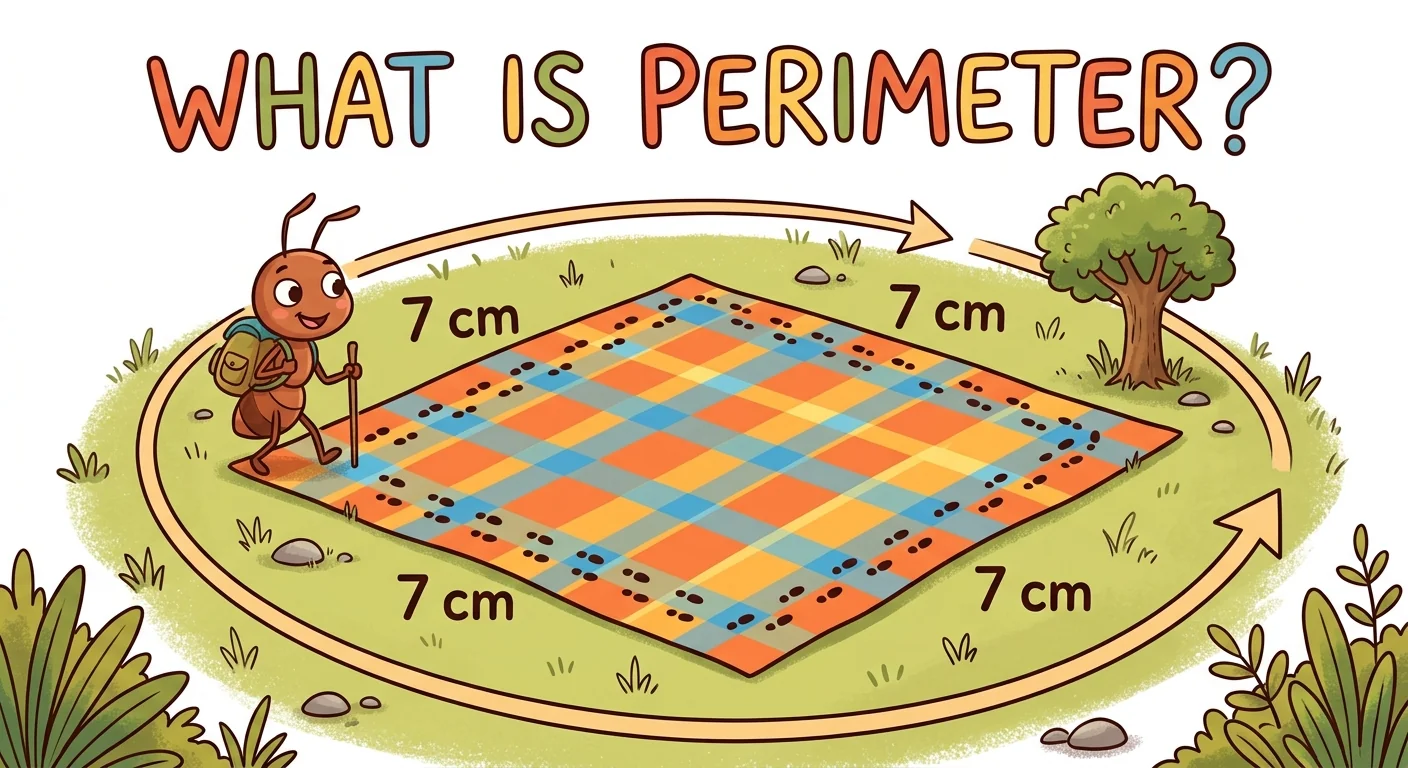
Perimeter is the total length of the boundary of a closed two-dimensional shape. You find it by adding the lengths of all the sides.
Walking around the edge
Before you say a single formula to your child, try this. Ask them to walk right around the edge of a carpet, a mattress or the school ground, heel to toe, counting their steps. The number of steps they counted is the perimeter of that shape, measured in units of one footstep.
That is all perimeter is. It is the distance you travel if you start at one corner, walk along every side, and arrive back where you started. An ant walking around the rim of a plate is travelling the perimeter of the plate. A boy running one full lap of a rectangular field is covering the perimeter of the field.
The word itself helps. “Peri” means around and “metron” means measure, so perimeter literally means the measure around.
Because perimeter is just a total distance, you never need a formula to find it. You can always add the sides one by one. The formulas exist only to save time. For a square with four equal sides of 7 cm, you could write 7 + 7 + 7 + 7 = 28 cm, or you could write 4 × 7 = 28 cm. Both are correct. The second is faster, and it is worth letting your child use the slow method until the fast one feels obvious.
One important rule: perimeter only exists for closed shapes. If a shape has a gap in its boundary, there is no “around” to measure.
Perimeter is always measured in linear units
Perimeter is a length, so it is measured in ordinary length units:
- millimetres (mm) for very small shapes
- centimetres (cm) for notebook-sized shapes
- metres (m) for rooms, gardens and plots
- kilometres (km) for distances around a park, lake or town
Choose the unit that matches the size of the shape. The perimeter of a postage stamp belongs in centimetres. The perimeter of a cricket ground belongs in metres.
What Is Area?
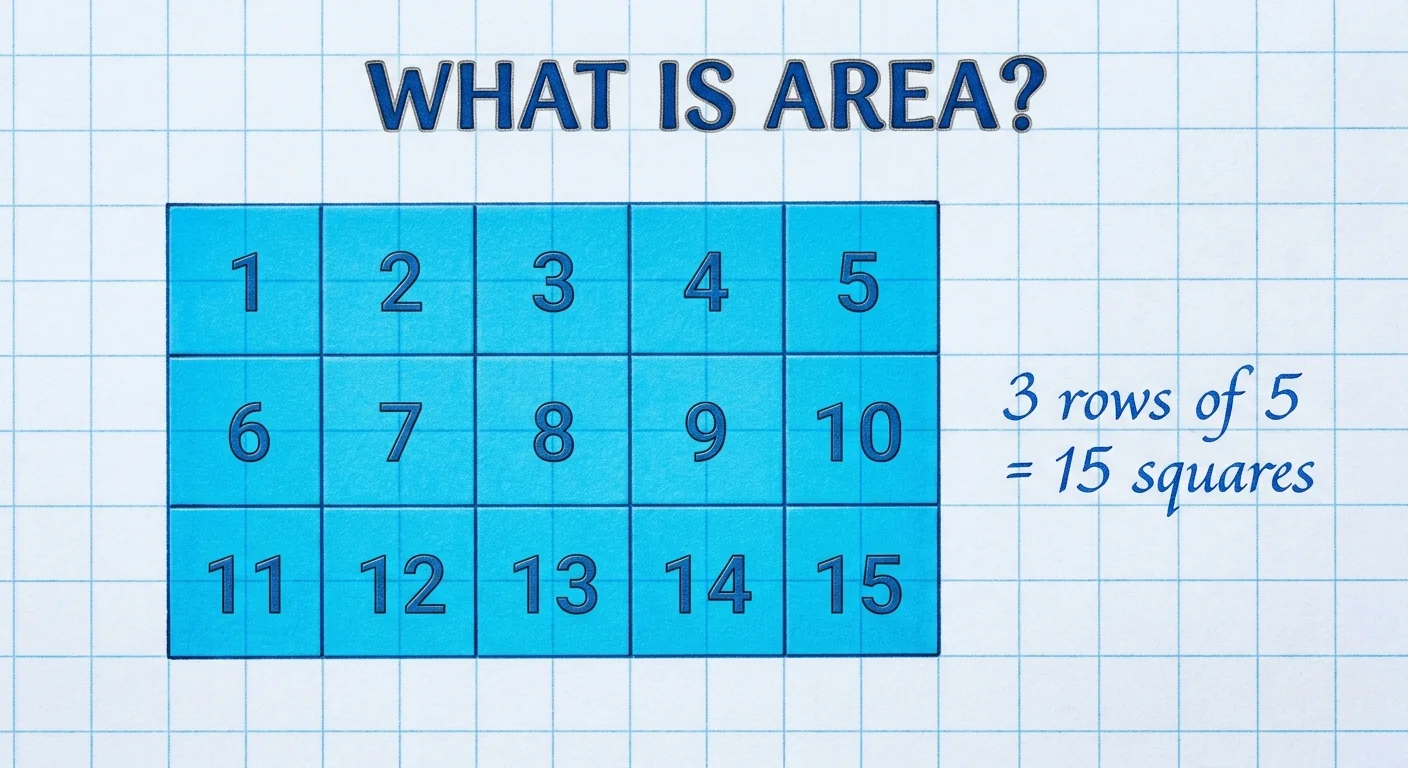
Area is the amount of flat surface a two-dimensional shape covers. It is measured in square units.
Covering the surface
Perimeter is about the edge. Area is about everything inside the edge.
Try this with your child. Take a sheet of graph paper and ask them to draw any rectangle along the grid lines. Now ask them to colour in the inside. The number of little squares they coloured is the area. Nothing more complicated than that.
If perimeter answers “how far is it around?”, then area answers “how much does it cover?” Think of a floor. The perimeter is the skirting board you would run along the walls. The area is the number of tiles you need to cover the floor itself.
Here is the moment where the formula stops being a mystery. Ask your child to draw a rectangle 5 squares long and 3 squares wide on graph paper, then count every small square inside it. They will count 15. Now ask what 5 × 3 is. The same 15. The multiplication is not a rule handed down from a textbook. It is a shortcut for counting rows. There are 3 rows with 5 squares in each row, so instead of counting 15 squares one at a time, you multiply 5 by 3.
Once a child sees that area is counting squares, every area formula that follows becomes a way of counting squares more cleverly.
Why area is measured in square units
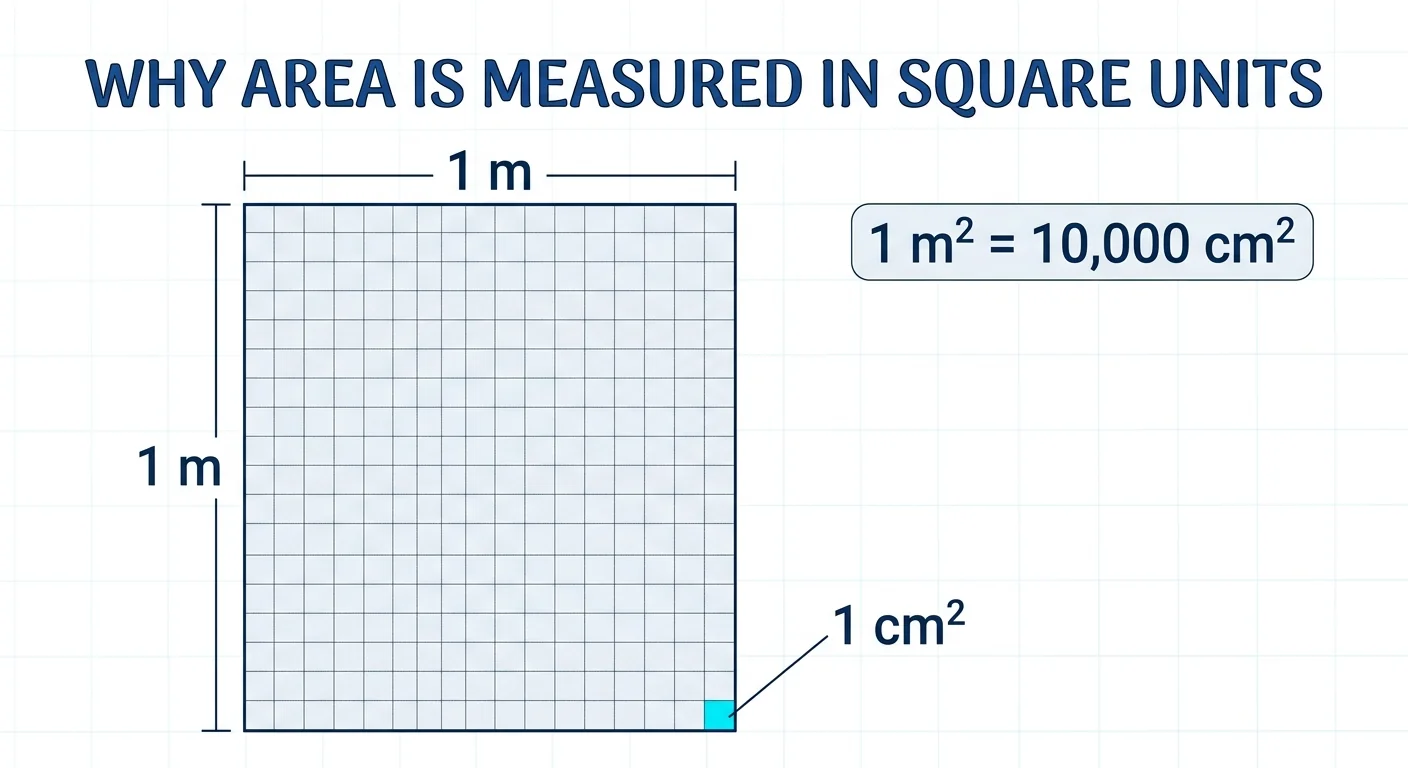
This is the part almost every explanation skips, and it is the part that causes the most lasting confusion.
Take a square that is exactly 1 cm long and 1 cm wide. That tiny square is the unit of area, and we call it one square centimetre, written 1 cm². It is not a centimetre. It is a square whose sides happen to measure a centimetre.
Now the area of any shape is simply the answer to the question: how many of these little 1 cm by 1 cm squares would fit inside it?
A rectangle 5 cm by 3 cm holds exactly 15 of those squares, so its area is 15 cm². The small raised 2 is not decoration and it does not mean “multiply by 2”. It is there to remind you that you are counting squares, not lengths.
Every length unit has a matching area unit:
| Length unit | Matching area unit | Typically used for |
|---|---|---|
| 1 mm | 1 mm² | a grain of rice, a stamp detail |
| 1 cm | 1 cm² | a photograph, a notebook page |
| 1 m | 1 m² | a floor, a wall, a carpet |
| 1 km | 1 km² | a town, a forest, a district |
If your child can explain what a square centimetre looks like, they will almost never put the wrong unit on an answer again.
What Is the Difference Between Area and Perimeter?
The difference between area and perimeter is that perimeter measures the boundary of a shape while area measures the surface inside that boundary.
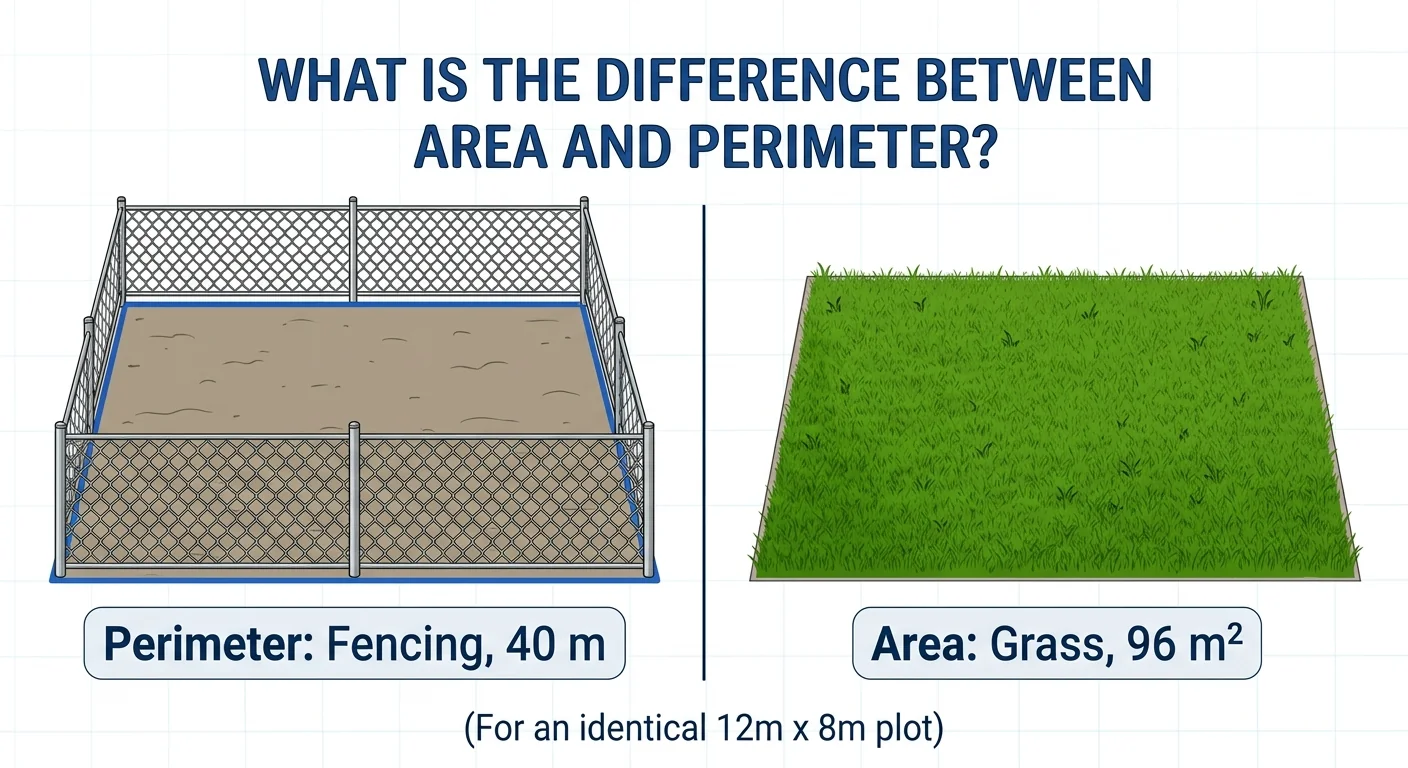
Perimeter is found by adding the side lengths and is written in linear units such as cm or m. Area is found by multiplying the dimensions according to the shape and is written in square units such as cm² or m².
Comparison table
| Feature | Perimeter | Area |
|---|---|---|
| What it measures | Distance around the boundary | Surface covered inside the boundary |
| How you find it | Add all the side lengths | Multiply, using the formula for that shape |
| Unit | Linear: mm, cm, m, km | Square: mm², cm², m², km² |
| Everyday question | How much fencing or ribbon do I need? | How much paint, grass or tiling do I need? |
| For a 12 m by 8 m plot | 40 m | 96 m² |
| Think of it as | Walking the edge | Colouring the inside |
| Depends on | Only the lengths of the sides | How those sides are arranged |
| Does it exist for open shapes? | No, the shape must be closed | No, the shape must be closed |
The one test that settles every question
When your child cannot decide which one a question wants, have them ask a single question out loud: am I buying something that goes around the edge, or something that fills the middle?
Fencing, ribbon, lace, tape, a picture frame, a boundary wall and a running track all go around the edge. That is perimeter.
Paint, grass, carpet, tiles, wallpaper, cloth for a tablecloth and soil for a garden bed all fill the middle. That is area.
This one test resolves the great majority of word problem errors, and it works long before a child has memorised a single formula.
Units of Area and Perimeter
Getting the unit right is worth as many marks as getting the number right, and in real life it matters more. This is where early measurement skills start to pay off. A shopkeeper who confuses 40 m of fencing with 40 m² of turf will deliver the wrong thing.
Perimeter units are linear. Whatever unit the sides are given in, the perimeter is in the same unit. Sides in cm give a perimeter in cm. Sides in m give a perimeter in m.
Area units are square. Whatever unit the sides are given in, the area is in that unit squared. Sides in cm give an area in cm². Sides in m give an area in m².
Two practical rules:
Rule 1: convert before you calculate, never after. If a rectangle is 2 m by 50 cm, convert first. Either make both measurements metres (2 m by 0.5 m, giving an area of 1 m²) or make both centimetres (200 cm by 50 cm, giving 10,000 cm²). Do not multiply 2 by 50 and hope to fix the unit later.
Rule 2: area conversions are not the same as length conversions. This catches out even strong students. There are 100 cm in 1 m, so it feels natural to say there are 100 cm² in 1 m². There are not. A square metre is a square 100 cm by 100 cm, which holds 100 × 100 = 10,000 small squares. So 1 m² = 10,000 cm².
The same logic gives you the rest:
- 1 cm = 10 mm, and 1 cm² = 100 mm²
- 1 m = 100 cm, and 1 m² = 10,000 cm²
- 1 km = 1,000 m, and 1 km² = 1,000,000 m²
In every case, you square the length conversion factor. Draw it once on graph paper with your child and it will stick.
Area and Perimeter Formulas for Every Common Shape
Here is the complete reference for the shapes a Class 4 to Class 7 student will meet. Every side in these shapes is a straight line segment, apart from the circle. Keep it somewhere visible while your child is working, but do not let it replace understanding. Every one of these formulas is explained and derived in the next section.
| Shape | Perimeter formula | Area formula | What the letters mean |
|---|---|---|---|
| Square | P = 4s | A = s² | s is the side |
| Rectangle | P = 2(l + b) | A = l × b | l is length, b is breadth |
| Triangle | P = a + b + c | A = ½ × b × h | a, b, c are the sides; b is base, h is height |
| Right-angled triangle | P = a + b + c | A = ½ × b × h | the two short sides are the base and height |
| Equilateral triangle | P = 3a | A = ½ × a × h | a is the side |
| Circle | C = 2πr | A = πr² | r is the radius |
| Parallelogram | P = 2(a + b) | A = b × h | a and b are the sides; b is base, h is perpendicular height |
| Rhombus | P = 4a | A = b × h | a is the side |
| Regular pentagon | P = 5a | not in Class 4 to 7 scope | a is the side |
| Any polygon | P = sum of all sides | split into known shapes | works for every closed shape |
Two things are worth noticing in this table. First, every single perimeter formula is just a faster way of adding the sides. Second, the area formulas all look different because each one is a different clever way of counting squares.
How to Find Area and Perimeter
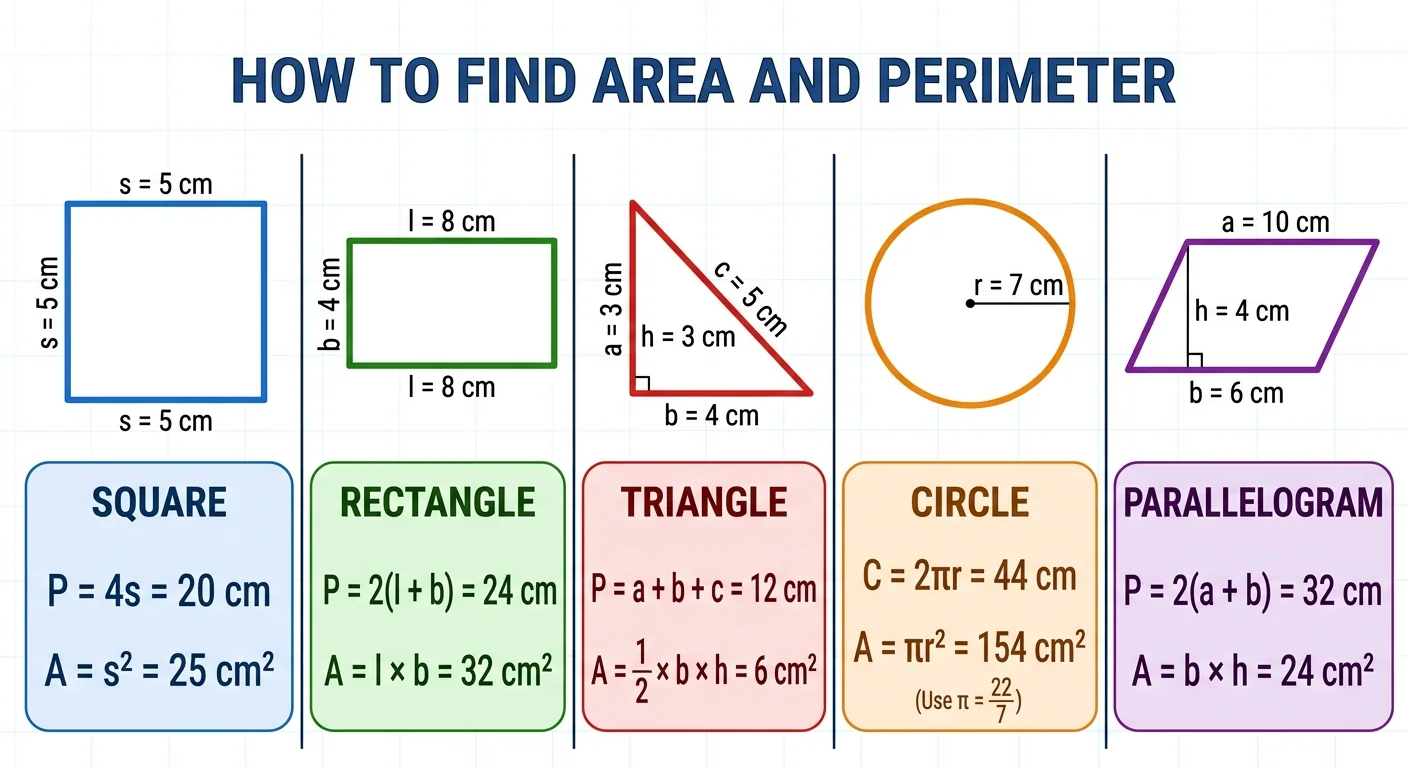
To find the perimeter of a shape, add the lengths of all its sides and write the answer in linear units. To find the area, identify the shape, apply its area formula, and write the answer in square units. For a rectangle, perimeter is 2 × (length + breadth) and area is length × breadth. For a triangle, perimeter is the sum of the three sides and area is ½ × base × height.
The four-step method that works for any shape
Whatever the shape, the same four steps work every time.
- Name the shape and label what you know. Write the measurements on a quick sketch. A sketch catches half of all errors before they happen.
- Decide which measurement the question wants. Boundary or surface? Fencing or filling?
- Apply the right formula, with the numbers substituted in. Write the formula first, then put the numbers in. This makes mistakes visible.
- Write the answer with the correct unit. Linear for perimeter, square for area.
Now here is step 3 for each shape your child will meet.
How to find the area and perimeter of a square
A square has four equal sides, which makes it the simplest case.
Perimeter: all four sides are the same, so instead of adding s + s + s + s, multiply: P = 4s
Area: a square of side s holds s rows of s little squares, so A = s × s = s²
Worked example. A square handkerchief has a side of 7 cm. Find its perimeter and area.
- Perimeter = 4 × 7 = 28 cm
- Area = 7 × 7 = 49 cm²
So you would need 28 cm of lace to edge it, and it covers 49 cm² of surface.
How to find the area and perimeter of a rectangle
A rectangle has two pairs of equal sides: two lengths and two breadths.
Perimeter: add all four sides, which is l + b + l + b. Grouping them gives P = 2(l + b)
Area: the rectangle holds b rows of l squares each, so A = l × b
Worked example. A rectangular garden is 12 m long and 8 m wide. Find its perimeter and area.
- Perimeter = 2 × (12 + 8) = 2 × 20 = 40 m
- Area = 12 × 8 = 96 m²
You would need 40 m of fencing to go around it, and 96 m² of grass to cover it.
A note on words. In Indian textbooks you will see “breadth”, and in many other books “width”. They mean exactly the same thing: the shorter pair of sides.
How to find the area and perimeter of a triangle
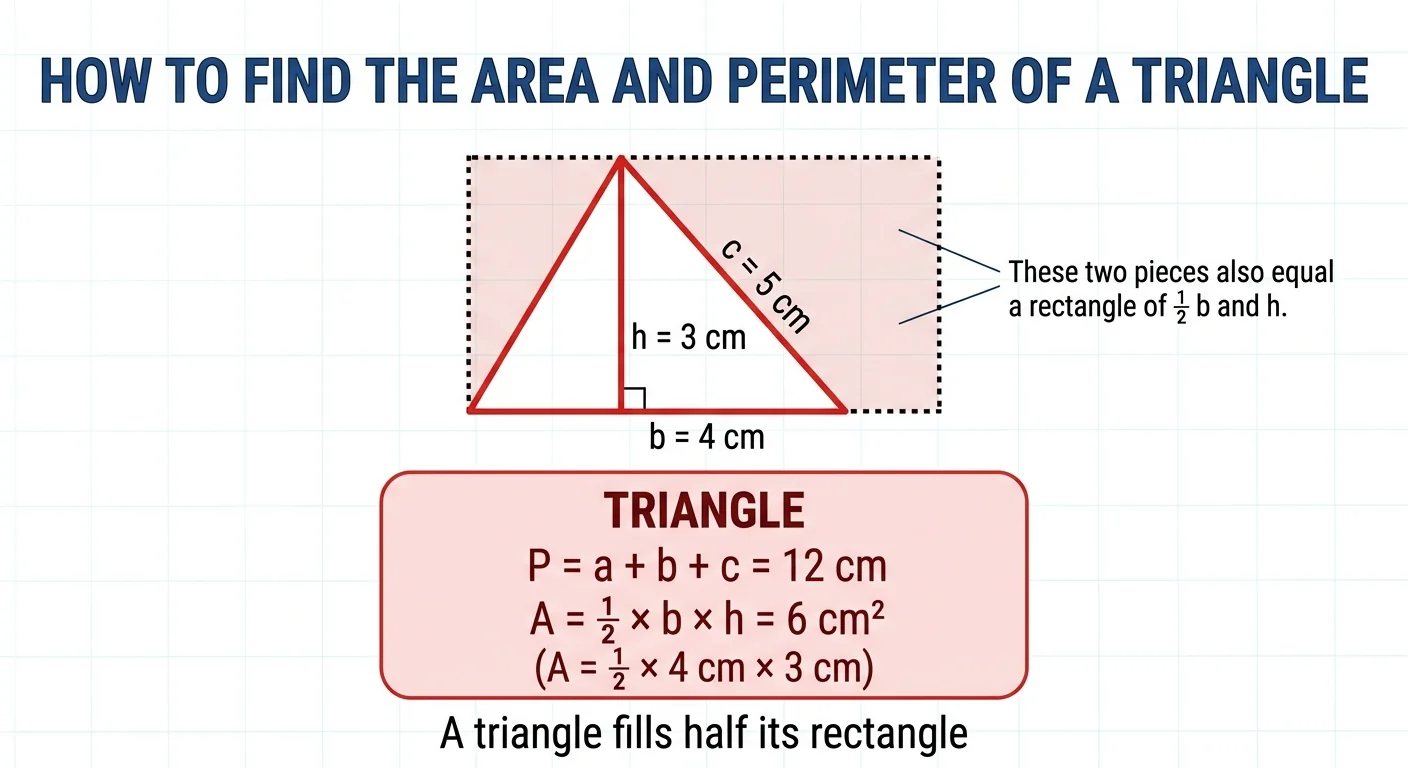
Perimeter: there is no shortcut for a general triangle. Add the three sides: P = a + b + c. If the triangle is equilateral, all three sides are equal, so P = 3a.
Area: this is where the derivation matters. Draw any triangle, then draw a rectangle around it with the same base and the same height. The triangle fills exactly half of that rectangle, every single time, whatever the shape of the triangle. The rectangle’s area is base × height, so the triangle’s area is A = ½ × base × height.
The height is the perpendicular distance from the base straight up to the opposite corner, meeting it at a right angle. It is not a slanting side. For a right-angled triangle the two shorter sides are already perpendicular to each other, so they serve as base and height directly.
Worked example. A triangular flag has sides of 6 cm, 8 cm and 10 cm. The base is the 8 cm side, and the height to that base is 6 cm. Find the perimeter and the area.
- Perimeter = 6 + 8 + 10 = 24 cm
- Area = ½ × 8 × 6 = ½ × 48 = 24 cm²
This example is worth pausing on with your child. The perimeter is 24 and the area is 24, and yet they are completely different quantities. One is 24 cm and the other is 24 cm². The numbers matching is a coincidence of this particular triangle, not a relationship. If your child can explain why 24 cm and 24 cm² are not the same thing, they have understood the chapter.
How to find the area and circumference of a circle
A circle has no straight sides, so it needs its own approach.
The radius (r) is the distance from the centre to any point on the circle. The diameter (d) is the full distance across the circle through the centre, so d = 2r.
Perimeter: the distance around a circle has a special name, circumference. The formula is C = 2πr, or equally C = πd.
Where does π come from? Here is an activity that answers it better than any explanation. Take a round object such as a bangle, a tin or a plate. Wrap a thread around the rim, then straighten the thread against a ruler: that is the circumference. Now measure across the widest part: that is the diameter. Divide the circumference by the diameter. Whatever object you pick, large or small, you will get a number very close to 3.14. That fixed number is π. It is the same for every circle in the world, which is exactly why it gets its own symbol. Use 22/7 when the radius is a multiple of 7, and 3.14 otherwise.
Area: the formula is A = πr². Here is the picture behind it. Cut a circle into many thin slices like a pizza, then lay the slices alternately pointing up and down. They fit together into something very close to a rectangle. The height of that rectangle is the radius r, and its length is half the circumference, which is πr. So the area is πr × r = πr².
Worked example. A circular table mat has a radius of 7 cm. Find its circumference and area. Use π = 22/7.
- Circumference = 2 × (22/7) × 7 = 44 cm
- Area = (22/7) × 7 × 7 = 22 × 7 = 154 cm²
So you would need 44 cm of ribbon to edge the mat, and it covers 154 cm².
One frequent question: is circumference the same as perimeter? Yes in meaning. Circumference is simply the name we give to the perimeter of a circle. Use “perimeter” for shapes with straight sides and “circumference” for circles, and your child will match what the textbook expects.
How to find the area and perimeter of a parallelogram
A parallelogram is a four-sided shape whose opposite sides are parallel and equal, like a rectangle that has been pushed over to one side.
Perimeter: opposite sides are equal, so P = 2(a + b), exactly like a rectangle.
Area: here is the derivation, and it is a satisfying one. Draw a parallelogram on paper. Cut a right-angled triangle off one end, straight down from the top corner. Slide that triangle across to the other end. You now have a rectangle, with no paper added and none taken away. That rectangle has the same base and the same height as the parallelogram you started with. So A = base × height.
The height is the perpendicular distance between the two parallel sides. It is not the slanting side. This is the single most common parallelogram error, and the cut-and-slide activity is the cure, because a child who has done it can see that the slant side is longer than the height.
Worked example. A parallelogram has sides of 10 cm and 6 cm. The perpendicular height to the 10 cm base is 4 cm. Find the perimeter and area.
- Perimeter = 2 × (10 + 6) = 2 × 16 = 32 cm
- Area = 10 × 4 = 40 cm²
Notice that the 6 cm side never appears in the area calculation, and the 4 cm height never appears in the perimeter calculation. That is not an error. The perimeter cares about the sides. The area cares about the base and the perpendicular height.
Same Perimeter, Different Area
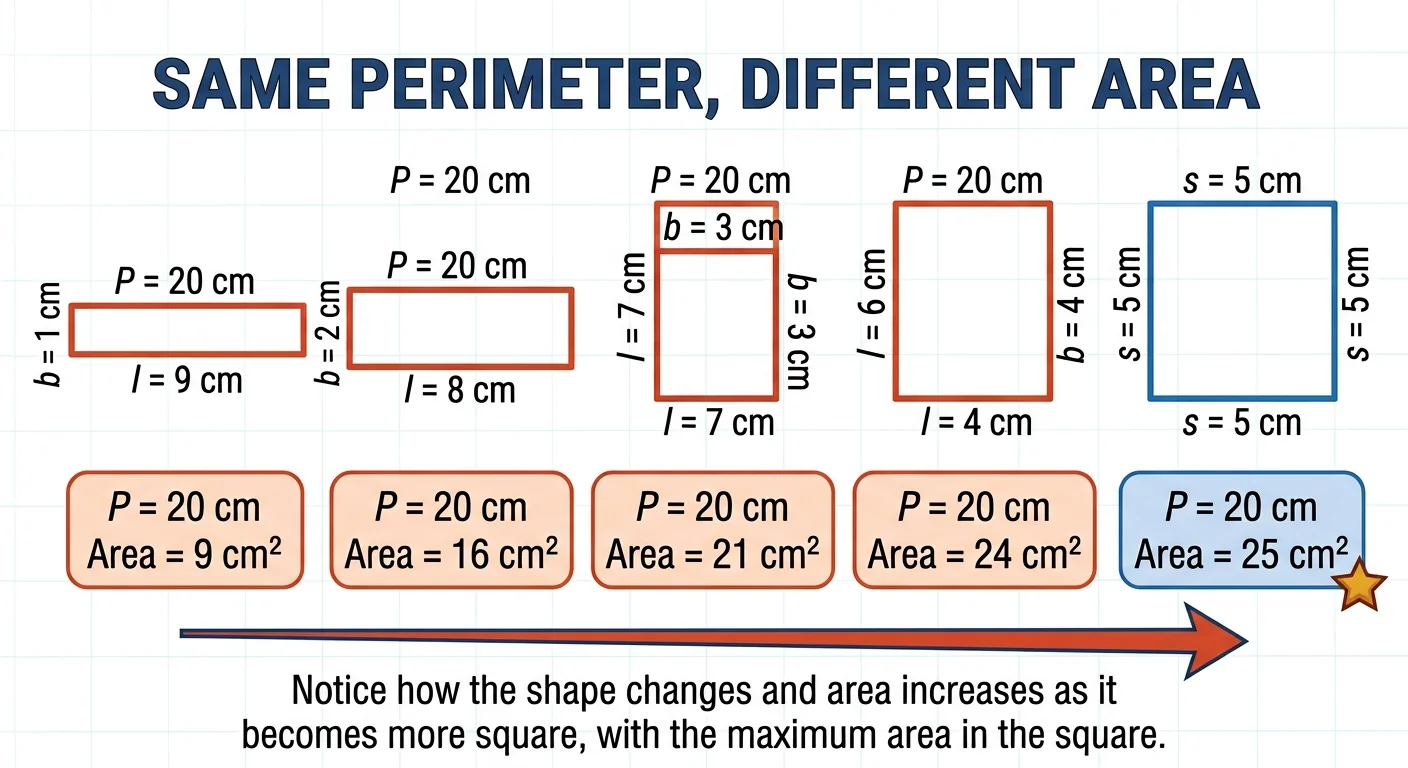
If your child takes away only one idea from this guide, make it this one: area and perimeter are independent. Knowing one tells you almost nothing about the other.
Most students quietly assume that a bigger perimeter means a bigger area. It is an understandable assumption, and it is wrong. Here is the proof.
Imagine you have 20 cm of string. You can lay it out as any rectangle you like, so long as you use all 20 cm. Every one of these rectangles has a perimeter of exactly 20 cm:
| Length | Breadth | Perimeter | Area |
|---|---|---|---|
| 9 cm | 1 cm | 20 cm | 9 cm² |
| 8 cm | 2 cm | 20 cm | 16 cm² |
| 7 cm | 3 cm | 20 cm | 21 cm² |
| 6 cm | 4 cm | 20 cm | 24 cm² |
| 5 cm | 5 cm | 20 cm | 25 cm² |
Same perimeter every time. The area ranges from 9 cm² all the way to 25 cm², which is nearly three times as much. The long thin rectangle wastes the string on two very long sides. The square uses it most efficiently.
This gives you a useful result to share: for a fixed perimeter, the square always has the largest area. That is why a farmer with a fixed length of fencing gets the most land by making the plot as square as possible.
Now turn the question around. Suppose every rectangle must have an area of exactly 36 cm²:
| Length | Breadth | Area | Perimeter |
|---|---|---|---|
| 36 cm | 1 cm | 36 cm² | 74 cm |
| 18 cm | 2 cm | 36 cm² | 40 cm |
| 12 cm | 3 cm | 36 cm² | 30 cm |
| 9 cm | 4 cm | 36 cm² | 26 cm |
| 6 cm | 6 cm | 36 cm² | 24 cm |
Same area every time, and the perimeter ranges from 24 cm to 74 cm. Again the square is the efficient one: for a fixed area, the square needs the least perimeter.
Both tables are worth building with your child rather than reading. Twenty centimetres of string and a sheet of graph paper is all you need, and the discovery lands far harder when they find it themselves.
How to Find a Missing Side from the Area or Perimeter
Most questions give you the sides and ask for the area or perimeter. The harder and more interesting questions run backwards: they give you the area or the perimeter and ask for a missing side. These are called reverse problems, and they appear constantly in exams and olympiads because they test whether a student understands the formula or has only memorised it.
The method is always the same: write the formula, put in what you know, and work backwards to the unknown.
Example 1: find the side of a square from its area. A square carrom board has an area of 81 cm². What is its side, and what is its perimeter?
- Area = s², so s² = 81
- s = 9, because 9 × 9 = 81
- Perimeter = 4 × 9 = 36 cm
Example 2: find the breadth of a rectangle from its perimeter. A rectangular field has a perimeter of 30 m. Its length is 9 m. Find the breadth and the area.
- Perimeter = 2(l + b), so 30 = 2 × (9 + b)
- Divide both sides by 2: 15 = 9 + b
- So b = 15 − 9 = 6 m
- Area = 9 × 6 = 54 m²
Example 3: find the height of a triangle from its area. A triangular park has an area of 48 m² and a base of 12 m. Find its height.
- Area = ½ × base × height, so 48 = ½ × 12 × h
- 48 = 6 × h
- h = 48 ÷ 6 = 8 m
A useful habit: once your child has found the missing side, have them substitute it back into the original formula to check. In Example 3, ½ × 12 × 8 = 48, which matches the area given. Thirty seconds of checking catches almost every arithmetic slip.
Area and Perimeter of Composite Shapes
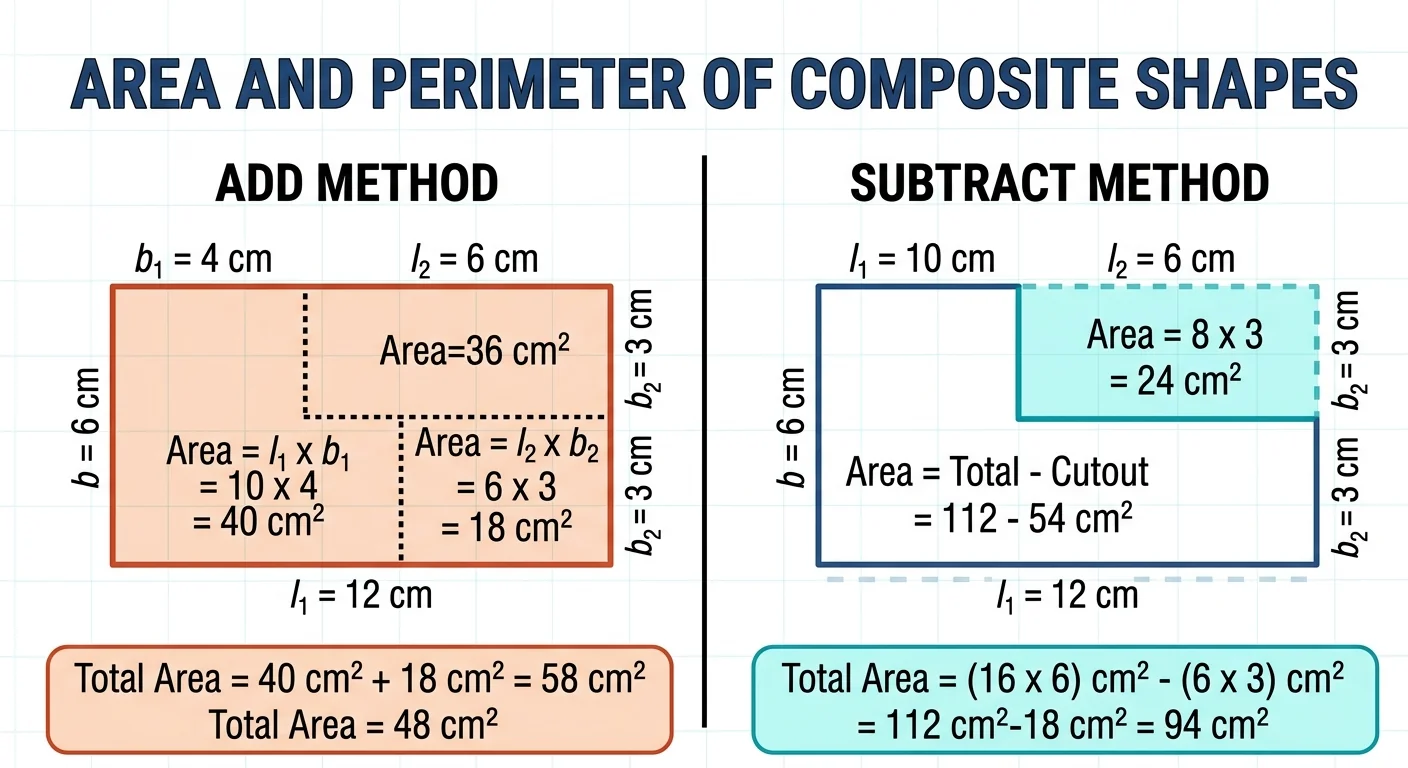
Real rooms, plots and plans are rarely perfect rectangles. A composite shape, also called a compound shape, is one made by joining or cutting simple shapes. L-shaped rooms and plots with a corner removed are the usual examples, and they are a Class 5 and Class 6 staple.
There are two methods for the area, and you can usually choose either.
The add method: cut the shape into simple rectangles, find each area, and add them.
The subtract method: draw the large rectangle that would enclose the whole shape, find its area, then subtract the area of the missing piece.
For the perimeter there is only one method: go around the outside, side by side, adding as you go. Do not use any formula, and do not include any internal cut lines you drew to help yourself.
Worked example 1: an L-shaped room. A room is a 10 m by 6 m rectangle with a 4 m by 3 m rectangle removed from one corner. Find the area and the perimeter.
Area by the subtract method: – Large rectangle = 10 × 6 = 60 m² – Missing corner = 4 × 3 = 12 m² – Area = 60 − 12 = 48 m²
Area by the add method, as a check: – Split the L into a 10 m by 3 m piece and a 6 m by 3 m piece – 30 + 18 = 48 m². The two methods agree.
Perimeter: walk around the outside, listing each side as you go: 10 m, then 6 m, then 6 m, then 3 m, then 4 m, then 3 m. – Perimeter = 10 + 6 + 6 + 3 + 4 + 3 = 32 m
Here is the part worth dwelling on. The original 10 m by 6 m rectangle had a perimeter of 2 × (10 + 6) = 32 m. Cutting a rectangular corner out of it reduced the area from 60 m² to 48 m², but left the perimeter completely unchanged at 32 m. The two short new edges exactly replace the two edges they removed.
That single example demonstrates the independence idea better than any amount of explanation, and it is a favourite of olympiad setters precisely because students assume that making a shape smaller must shrink its perimeter.
Worked example 2: a lawn with a pond in it. A rectangular lawn is 12 m by 7 m. A square pond of side 3 m sits in the middle. How much grass covers the lawn?
- Lawn area = 12 × 7 = 84 m²
- Pond area = 3 × 3 = 9 m²
- Grass area = 84 − 9 = 75 m²
Note that this question asks only about area. The perimeter of the grassy region would need both the outer boundary and the edge of the pond, which is a different question with a different answer.
Area and Perimeter Word Problems from Everyday Life
Word problems are where area and perimeter stop being formulas and start being useful. In each of these, the first step is the same: decide whether the question is about the boundary or the surface.
Problem 1: fencing a garden (perimeter) A rectangular kitchen garden measures 15 m by 10 m. Fencing wire costs ₹120 per metre. What will it cost to fence the garden completely?
- Fencing goes around the edge, so this is perimeter.
- Perimeter = 2 × (15 + 10) = 2 × 25 = 50 m
- Cost = 50 × 120 = ₹6,000
Problem 2: tiling a floor (area) A room floor measures 6 m by 4.5 m. Square tiles of side 0.5 m are to be laid. How many tiles are needed?
- Tiles fill the surface, so this is area.
- Floor area = 6 × 4.5 = 27 m²
- Area of one tile = 0.5 × 0.5 = 0.25 m²
- Number of tiles = 27 ÷ 0.25 = 108 tiles
Problem 3: framing a picture (perimeter) A photograph measures 30 cm by 20 cm. A wooden frame costs ₹8 per centimetre. What does the frame cost?
- A frame goes around the edge, so this is perimeter.
- Perimeter = 2 × (30 + 20) = 100 cm
- Cost = 100 × 8 = ₹800
Problem 4: painting a wall (area) A wall is 5 m long and 3 m high. One litre of paint covers 10 m². How much paint is needed, and what does it cost at ₹450 per litre?
- Paint covers the surface, so this is area.
- Wall area = 5 × 3 = 15 m²
- Paint needed = 15 ÷ 10 = 1.5 litres
- Cost = 1.5 × 450 = ₹675
Problem 5: both measurements in one question A rectangular plot is 25 m by 16 m. The owner wants to put a boundary wall around it at ₹900 per metre and lay grass inside at ₹60 per square metre. Find the total cost.
- Wall is perimeter: 2 × (25 + 16) = 82 m, costing 82 × 900 = ₹73,800
- Grass is area: 25 × 16 = 400 m², costing 400 × 60 = ₹24,000
- Total = ₹97,800
Problem 5 is the one to practise most. Questions that mix both measurements are where careless readers lose marks, and the boundary-or-surface test sorts them out in seconds.
Common Mistakes with Area and Perimeter
Mistake 1: using the area formula when the question wants perimeter. A child asked for the perimeter of a 12 m by 8 m plot writes 96 m. They have calculated the area and labelled it perimeter. The fix: before touching the numbers, say out loud whether the question is about the edge or the inside.
Mistake 2: writing cm instead of cm², or the other way round. An area answer of 49 cm or a perimeter answer of 28 cm² is wrong even when the number is right. The fix: go back to the 1 cm by 1 cm tile. If you are counting tiles, the answer ends in a small 2.
Mistake 3: using the slant side instead of the perpendicular height. In a triangle or a parallelogram, the sloping side is longer than the height, so this always gives an answer that is too big. The fix: the cut-and-slide activity with a paper parallelogram, and the habit of marking the height with a small right-angle square on every sketch.
Mistake 4: forgetting that the two methods for composite shapes must agree. Students often add when they should subtract. The fix: do it both ways. Adding the pieces and subtracting from the enclosing rectangle must give the same answer. If they differ, one of them is wrong.
Mistake 5: converting area units like length units. Writing 1 m² = 100 cm² instead of 10,000 cm². The fix: draw the metre square divided into a 100 by 100 grid of centimetre squares once. The picture does the work.
Mistake 6: assuming a bigger perimeter means a bigger area. The 20 cm string table above disproves it. The fix: have the child build the table themselves rather than being told.
Mistake 7: mixing units within one calculation. Multiplying 2 m by 50 cm and writing the answer as 100 of something. The fix: make both measurements the same unit before any multiplication, every single time.
8 Area and Perimeter Activities for Home and Classroom
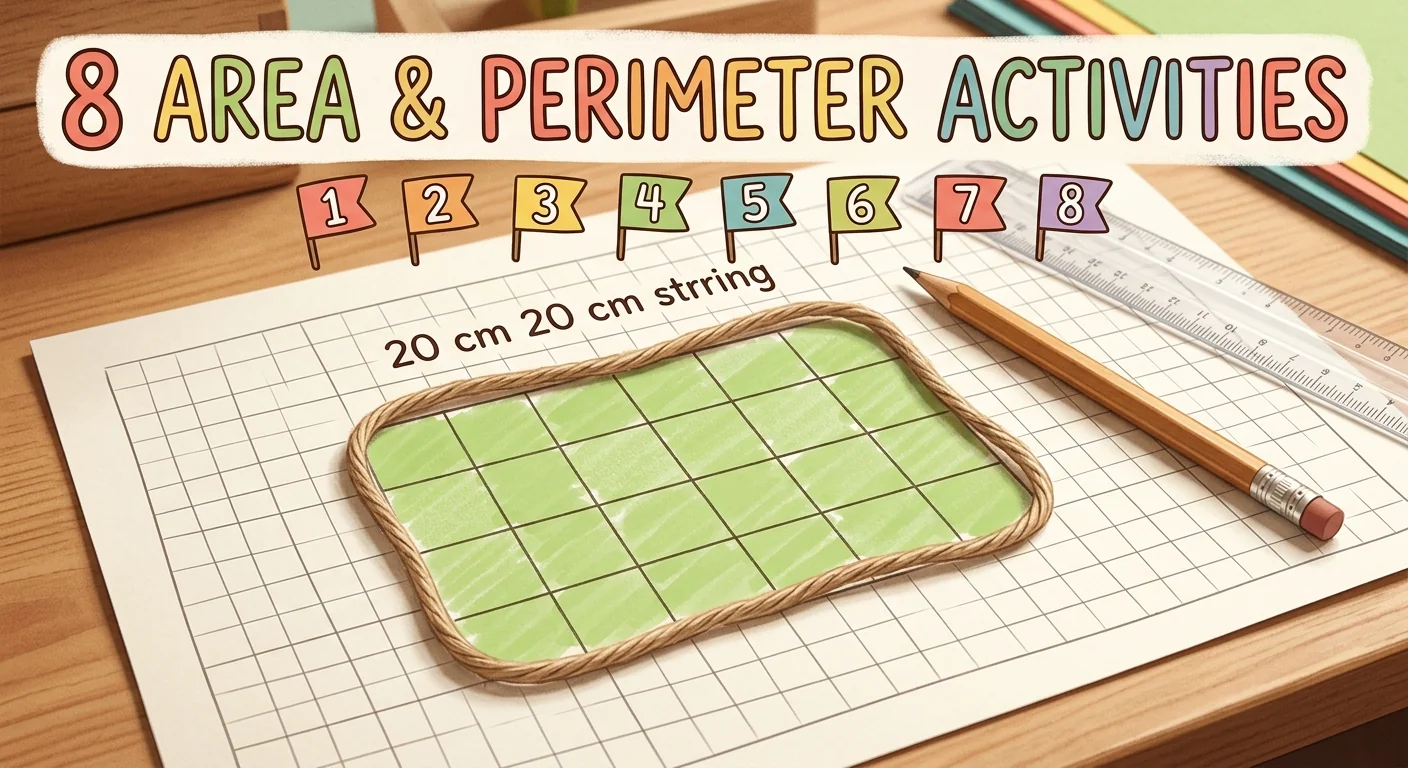
None of these need anything you would have to buy.
1. The string challenge. Cut a piece of string exactly 20 cm long and tie it into a loop. On graph paper, lay the loop out as different rectangles and record the length, breadth and area of each. Which shape gives the biggest area? This is the independence lesson, discovered rather than told.
2. Graph paper monsters. Ask your child to draw any wild, blocky shape along the grid lines of graph paper. Then have them count the squares inside (area) and the grid edges around the outside (perimeter). Then swap papers and check each other’s counts. It is good visual reasoning practice as well as area practice. Irregular shapes make area feel like counting again, which is exactly right.
3. Footstep perimeter. Measure the perimeter of a room, a balcony or a courtyard in footsteps, then measure one footstep with a tape and convert to metres. Compare the estimate against the tape measurement of the real perimeter.
4. Newspaper square metre. Tape sheets of newspaper together to make a square exactly 1 m by 1 m. Lay it on the floor and ask how many of these would cover the room. Then measure the room and check. Nothing builds spatial understanding of a square metre faster.
5. Floor tile counting. Most Indian homes have square floor tiles. Measure one tile, then count the tiles along two walls. Multiply to get the room area without ever using a tape on the whole floor. Then check against the tape.
6. Design your own garden. Give your child a budget, say ₹10,000, with fencing at ₹120 per metre and grass at ₹50 per square metre. Ask them to design a rectangular garden that uses the budget as fully as possible. This forces them to juggle both measurements at once.
7. Rangoli and area. Draw a rangoli design on graph paper using only straight lines along the grid. Count the squares each colour covers. Composite shapes become natural here because a rangoli is made of joined simple shapes.
8. The same-area hunt. Challenge your child to find five different rectangles with whole number sides that all have an area of 24 cm², then rank them by perimeter. This is reverse problem practice wearing a disguise.
Tips for Parents Helping with Area and Perimeter at Home
Start with the hands, not the formula. Before any worksheet, walk a perimeter and colour an area. Children who have physically done both rarely confuse them later.
Ask “edge or inside?” every time. Make it the first question for every problem, until your child asks it without prompting. It is a small piece of critical thinking that pays off far beyond this chapter. It is the single highest-value habit in this chapter.
Let the slow method survive. If your child wants to add 7 + 7 + 7 + 7 rather than use 4 × 7, let them. The shortcut will arrive on its own once the idea is secure, and it will be a shortcut rather than a rule.
Use the home as the textbook. Ask how much grass the balcony would need, how much lace a dupatta edge would take, how many tiles the kitchen floor holds. Real objects with real rupee costs stick in a way worksheets do not.
Check the unit before the number. When marking practice work, look at the unit first. If the unit is wrong, the misunderstanding is conceptual and worth more attention than any arithmetic slip.
Do not rush to the circle. Circles are Class 7 territory in most syllabuses. If your child is in Class 4 or 5, squares, rectangles and composite shapes are where the time is best spent.
Tips for Teachers Delivering Area and Perimeter Lessons
Teach them separately before comparing them. Introducing area and perimeter in the same lesson is the most common cause of lifelong confusion. Give perimeter its own lesson, let it settle, then introduce area, and only then compare the two.
Build the square unit physically. Hand out 1 cm paper squares and have students tile a rectangle before any formula appears. Students who have tiled understand why area multiplies.
Derive, do not declare. The triangle inside a rectangle, the parallelogram cut and slid, the circle cut into slices. Each takes five minutes and replaces weeks of formula drilling.
Use the same shape for both measurements. Working out the perimeter and the area of the same rectangle in the same breath makes the two different questions impossible to miss.
Set reverse problems early. Give the area and ask for the side from the very first week. Students who meet reverse problems only before an exam treat them as a special trick rather than as the same idea read backwards.
Make composite shapes a lesson, not a footnote. Two methods, the requirement that they agree, and the corner-cut result that area changes while perimeter does not. This is the richest lesson in the chapter and it is usually the one that gets squeezed.
Assess the unit separately from the number. Marking the unit as its own point tells students it carries real meaning.
Area and Perimeter in Olympiad Problems
Area and perimeter look like simple topics, which is exactly why olympiad setters love them. The formulas take a week to learn. The reasoning takes years to master.
Here is what olympiad versions of these questions look like.
Shaded region problems. A shape sits inside another shape and you are asked for the area between them. The method is the subtract method from the composite shapes section, applied to circles inside squares or squares inside circles. A circle of radius 7 cm inside a square of side 14 cm leaves a shaded area of 196 − 154 = 42 cm².
Optimisation problems. Given a fixed length of fencing, what is the largest area you can enclose? The string table earlier gives the answer for rectangles: make it a square. Olympiad versions extend this to one side being a wall, or to fixed area with minimum perimeter.
Invariance problems. The corner-cut L-shape is the classic. Cut a rectangular notch from the corner of a rectangle and the perimeter does not change at all. Problems built on this reward students who reason about the boundary rather than reaching for a formula.
Multi-step reverse problems. The area of a rectangle is given, along with the fact that the length is three times the breadth. Find the perimeter. This pattern turns up constantly in math olympiad questions. These chain a reverse problem into a forward one, and they are standard in IMO, Math Kangaroo and SOF IMO papers at the Class 5 to Class 7 level.
Dissection problems. A shape is cut and rearranged, and the student must say which measurements changed. Rearranging preserves area but almost always changes perimeter. Students who have done the parallelogram cut-and-slide already have the intuition.
The common thread is that none of these can be solved by remembering a formula. They all reward a student who genuinely understands what area and perimeter measure, which is the best argument there is for teaching the concepts before the formulas.
Area and Perimeter in the NCERT Syllabus: Class 4 to Class 7
| Class | What is covered |
|---|---|
| Class 4 | Perimeter of simple shapes by adding sides. Area introduced informally by counting squares on a grid. No formulas yet. |
| Class 5 | Area and perimeter of squares and rectangles using formulas. Introduction to composite shapes made of rectangles. Units of area formally introduced. |
| Class 6 | Perimeter of regular polygons and triangles. Area of squares and rectangles extended to real-life problems. Composite shapes developed further. |
| Class 7 | Area of triangles and parallelograms. Circumference and area of circles, with π. Area of paths and borders around rectangles. Conversion between area units. |
If your child is struggling in Class 6, the gap is often back in Class 4 or 5, in the square-counting stage that was passed over too quickly. Going back to graph paper is not a step backwards. It is usually the fastest route forward.
Area and Perimeter Practice Questions with Answers
Work through these in order. They move from simple shapes to composite shapes and reverse problems.
Level 1: basic shapes
- Find the perimeter and area of a square of side 12 cm.
- Find the perimeter and area of a rectangle 15 m long and 9 m wide.
- Find the perimeter of a triangle with sides 7 cm, 9 cm and 11 cm.
- Find the area of a triangle with base 10 cm and height 6 cm.
- Find the circumference and area of a circle of radius 14 cm. Use π = 22/7.
Level 2: composite shapes
- An L-shaped plot is a 14 m by 9 m rectangle with a 5 m by 4 m rectangle cut from one corner. Find its area.
- A rectangular hall is 20 m by 12 m. A square storeroom of side 4 m is built inside one corner. Find the floor area of the hall outside the storeroom.
- A rectangular park 30 m by 20 m has a 2 m wide path running all the way around the outside of it. Find the area of the path.
Level 3: reverse problems
- A square has an area of 144 cm². Find its side and its perimeter.
- A rectangle has a perimeter of 44 m and a length of 14 m. Find its breadth and area.
- A triangle has an area of 60 cm² and a base of 15 cm. Find its height.
- A rectangle has an area of 72 cm² and its length is twice its breadth. Find both sides and the perimeter.
Level 4: word problems
- Fencing a rectangular field 40 m by 25 m costs ₹150 per metre. Find the total cost.
- A floor 8 m by 6 m is to be covered with square tiles of side 40 cm. How many tiles are needed?
Answers
- Perimeter 48 cm, area 144 cm²
- Perimeter 48 m, area 135 m²
- 27 cm
- 30 cm²
- Circumference 88 cm, area 616 cm²
- 126 − 20 = 106 m²
- 240 − 16 = 224 m²
- Outer rectangle 34 m by 24 m = 816 m²; park = 600 m²; path = 216 m²
- Side 12 cm, perimeter 48 cm
- Breadth 8 m, area 112 m²
- 8 cm
- Breadth 6 cm, length 12 cm, perimeter 36 cm
- Perimeter 130 m, cost ₹19,500
- Floor 48 m² = 480,000 cm²; tile 1,600 cm²; 300 tiles
Make Preparing for Math Olympiad Simple!


What is the difference between area and perimeter?
Perimeter is the distance around the boundary of a shape, found by adding all the side lengths and written in linear units such as cm or m. Area is the amount of surface the shape covers, found using a formula for that shape and written in square units such as cm² or m². A 12 m by 8 m plot has a perimeter of 40 m and an area of 96 m².
How do you find area and perimeter?
Add all the side lengths to get the perimeter, then apply the shape’s area formula to get the area. For a rectangle, perimeter is 2 × (length + breadth) and area is length × breadth. For a square, perimeter is 4 × side and area is side × side. For a triangle, perimeter is the sum of the three sides and area is ½ × base × height. Always write perimeter in linear units and area in square units.
What are the formulas for area and perimeter?
Square: perimeter 4s, area s². Rectangle: perimeter 2(l + b), area l × b. Triangle: perimeter a + b + c, area ½ × base × height. Circle: circumference 2πr, area πr². Parallelogram: perimeter 2(a + b), area base × height.
Can two shapes have the same perimeter but different areas?
Yes, and this is one of the most important ideas in the topic. Every rectangle with a perimeter of 20 cm uses the same boundary length, but a 9 cm by 1 cm rectangle has an area of 9 cm² while a 5 cm by 5 cm square has an area of 25 cm². For a fixed perimeter, the square always encloses the largest area.
Why is area measured in square units?
Because area counts how many unit squares fit inside a shape. The unit of area is a square measuring 1 cm by 1 cm, called one square centimetre and written 1 cm². The small 2 is a reminder that you are counting squares rather than lengths. It does not mean multiply by 2.
Is circumference the same as perimeter?
In meaning, yes. Circumference is simply the name given to the perimeter of a circle. Because a circle has no straight sides, you cannot add side lengths, so you use the formula C = 2πr instead.
How many square centimetres are in a square metre?
There are 10,000 cm² in 1 m², not 100. A square metre is a square 100 cm by 100 cm, which holds 100 × 100 = 10,000 centimetre squares. Area conversion factors are the square of the length conversion factors.
How do you explain the difference between area and perimeter to a child?
Ask whether they are buying something that goes around the edge or something that fills the middle. Fencing, ribbon and picture frames go around the edge, so they are perimeter. Paint, grass, tiles and carpet fill the middle, so they are area. Walking around the edge of a room and then colouring in a shape on paper makes the distinction physical before it becomes mathematical.
At what Class do children learn area and perimeter?
Perimeter and informal square counting begin in Class 4. Formulas for squares and rectangles arrive in Class 5. Composite shapes and polygon perimeters develop in Class 6. Triangles, parallelograms and circles come in Class 7.
What happens to the perimeter if you cut a corner out of a rectangle?
Nothing, as long as the cut is a rectangular notch at a corner. The area gets smaller, but the two new edges exactly replace the two edges they removed, so the perimeter stays the same. A 10 m by 6 m rectangle has a perimeter of 32 m, and it still has a perimeter of 32 m after a 4 m by 3 m corner is cut away, even though the area drops from 60 m² to 48 m².
Bringing It Together
Area and perimeter are not two chapters. They are two questions about the same shape: how far is it around, and how much does it cover.
A child who can walk a perimeter, count an area in squares, explain why a square centimetre is a square, and tell you that cutting a corner off a rectangle changes one measurement but not the other has understood this topic more deeply than one who has memorised every formula in the table.
Start with the string and the graph paper. The formulas will follow, and they will make sense when they arrive.

Mikha Piregu is a Content Writer with experience spanning educational content, including math and math olympiad topics, as well as advocacy writing, research-based articles, and SEO-driven web content. He creates high-quality blog content, web copy, and feature articles that support brand visibility, audience engagement, and long-term organic growth through data-informed storytelling. Skilled in WordPress, WooCommerce, and modern digital tools, Mikha adapts content across various platforms, including blogs, websites, campaigns, and advocacy initiatives, with clarity and purpose.

There are no comments posted here yet.
Sign in to leave a comment