

A line segment is a straight path between two fixed points, with a definite beginning, a definite end, and a length you can measure with a ruler. If your child has come home confused about why a line, a ray, and a line segment are not the same thing, you are in the right place.
- Start With a Point: The Smallest Idea in Geometry
- What a Line Is in Geometry?
- What is a Ray?
- What Is a Line Segment in Geometry?
- Line vs Ray vs Line Segment: The Comparison That Clears Up Confusion
- Line Segment Symbol and Notation
- Properties of a Line Segment
- How to Measure a Line Segment With a Ruler
- How to Draw a Line Segment of a Given Length
- How Line Segments Build Every Shape
- Real-Life Examples of Line Segments
- Worked Examples
- Common Mistakes Students Make
- Hands-On Line Segment Activities
- Tips for Parents Teaching Geometry at Home
- Tips for Teachers Delivering a Line Segment Lesson
- Line Segments in Olympiad-Style Problems
- Practice Questions With Answers
- Conclusion
This guide builds the idea from the ground up, in the order NCERT uses, so the difference becomes obvious instead of something to memorise. It also fits into the wider picture of geometry for kids, where every straight-sided figure begins with this one idea.
By the end you will be able to explain what a line segment is, write its symbol correctly, find its midpoint, measure and draw one accurately, spot line segments around your house, and run ten activities that make all of it concrete.
Start With a Point: The Smallest Idea in Geometry
Every idea in geometry is built out of points, so this is where to begin.
A point marks an exact position. It has no length, no width and no thickness. When you press a sharp pencil onto paper and lift it straight up, the tiny dot left behind is a model of a point. The real point is even smaller than that dot, because a mathematical point has no size at all. It only tells you where.
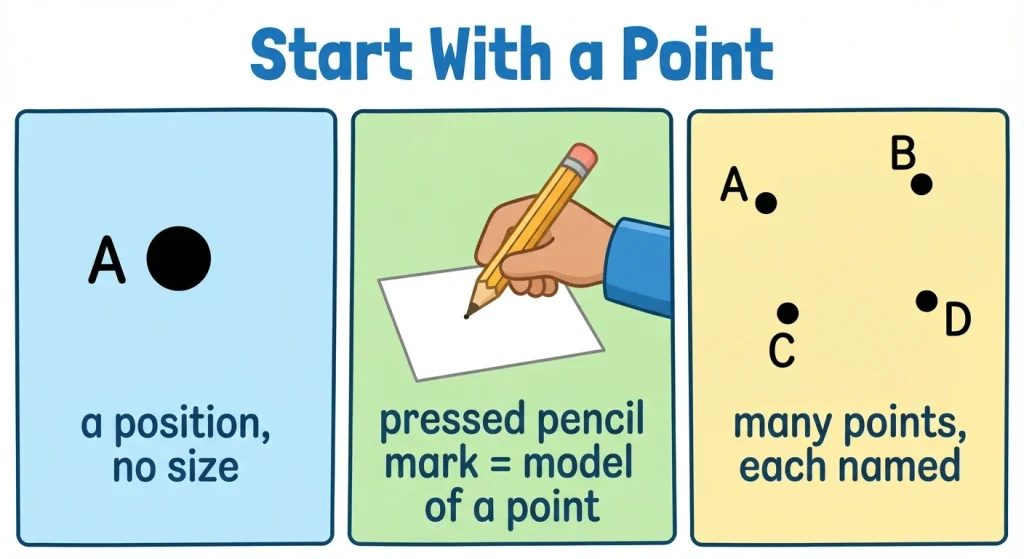
We name a point with a single capital letter: point A, point B, point P. The letter sits next to the dot, not on top of it, so the dot stays readable.
Two things are worth saying out loud to a Class 3 or Class 4 child, because they are not obvious:
- A point has a position but no size. The dot on the page is only a marker for it.
- You can mark as many points as you like on a page, and each one needs its own name.
Working with positions in this way is also the first step toward spatial understanding, the skill that underpins all later geometry. Once a child is comfortable that a point is a position, everything else follows, because a line, a ray and a line segment are all just different answers to the question “what happens if you keep going from this point?”
What a Line Is in Geometry?
A line is a straight path that goes on forever in both directions. It has no beginning and no end, so it has no length that anyone could measure.
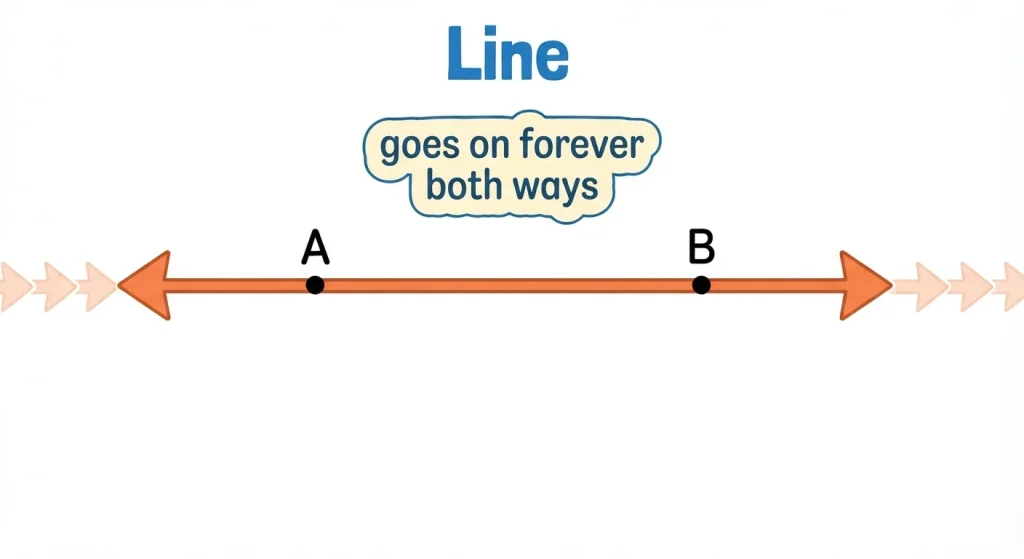
That last part is the part children find strange, and it is worth sitting with. If something never stops, you can never finish measuring it. So a line has no length, not an unknown length and not a very big length. No length at all.
On paper we draw a line as a straight stroke with an arrowhead at each end. The arrowheads are a promise: this drawing stops at the edge of the page, but the line itself does not.
A line through points A and B is written as AB with a double-headed arrow above the letters. You may also see a line named with a single small letter, such as line l, which is the style used in NCERT exercises.
Two facts your child will meet again and again:
- Two points are enough to fix exactly one line. Mark A and B anywhere, and there is one and only one line that passes through both.
- A line is made of infinitely many points, which is why you can always mark a new one between any two you already have.
If your child has already worked with a number line, they have met this idea once before: the number line is drawn with arrowheads for exactly the same reason.
What is a Ray?
A ray is the halfway case. It starts at one fixed point and goes on forever in one direction only.
The fixed point is called the initial point or starting point. The other end never arrives, so it is drawn with a single arrowhead.
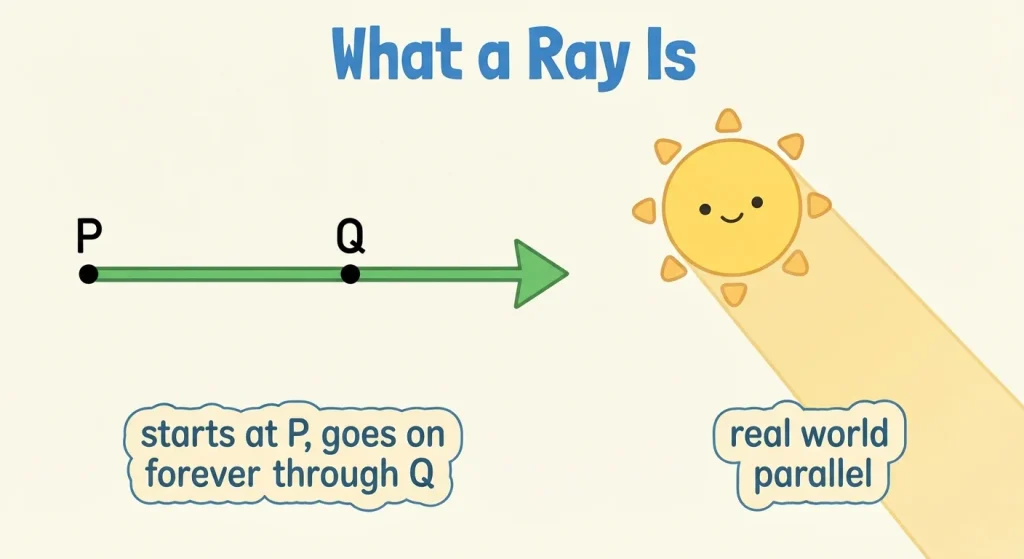
The classic example is sunlight. A sunbeam starts at the sun and travels outward with no end that you can reach. A torch beam in a dark room behaves the same way: there is a clear starting point at the bulb, and the light simply keeps going.
A ray starting at P and passing through Q is written PQ with a single arrow above the letters, pointing right. Order matters here in a way it does not for lines and segments. Ray PQ starts at P. Ray QP starts at Q. They are two different rays, even though they lie along the same straight path.
Like a line, a ray cannot be measured, because one of its ends never stops.
What Is a Line Segment in Geometry?
A line segment is a part of a line that has two endpoints. Because it begins at one point and ends at another, it has a fixed, finite length that can be measured with a ruler. A line segment is the shortest path between its two endpoints, and it is always straight.
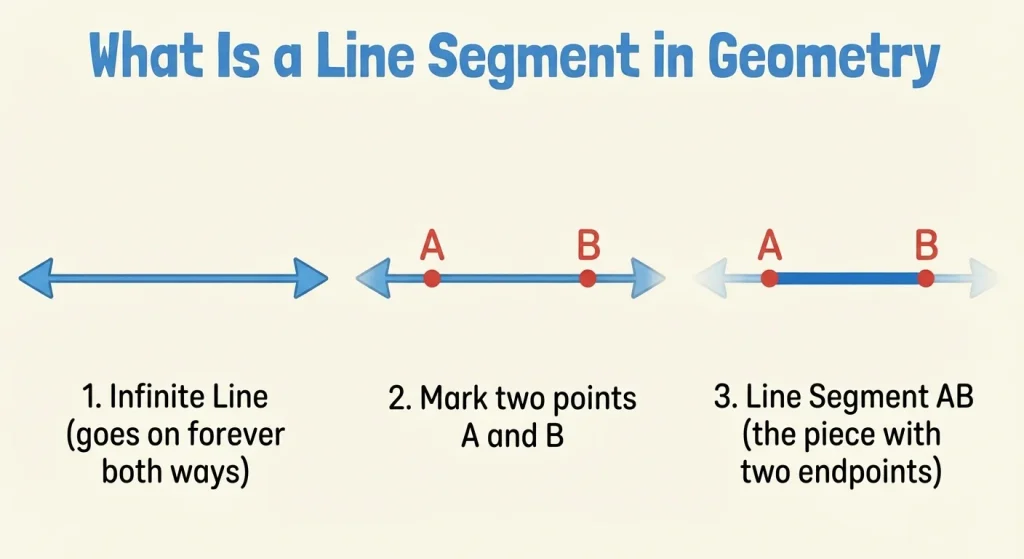
That short block is the definition to memorise. Here is what it means in practice.
Take a line, which runs on forever. Mark two points on it, A and B. Now keep only the part of the line between A and B, including A and B themselves. What you are holding is line segment AB. The two points you marked are its endpoints, and the piece between them has a definite length.
Why a Line Segment Can Be Measured
A line segment can be measured for one reason only: it stops. Both of its ends are pinned to a specific point, so there is a definite distance between them. That distance is the length of the line segment.
We measure that length in standard units. In Indian classrooms this is almost always centimetres and millimetres for schoolwork, and metres for larger distances. A segment drawn in an exercise book might be 6 cm long. The edge of a notebook might be 24 cm. The length of a classroom wall might be 7 m.
What the Line Segment Definition Means in Class
Across Class 3 to Class 5, children meet line segments informally: straight edges, straight paths, sides of shapes, and measuring with a scale. The vocabulary arrives gradually.
In Class 6, under basic geometrical ideas, the formal treatment appears: points, line segments, lines, rays, intersecting lines and the notation that goes with them. So if you are supporting a Class 4 child, your job is to make the idea solid and physical. The symbols can follow. The early groundwork sits in topics like geometrical shapes and straight versus curved edges.
Line vs Ray vs Line Segment: The Comparison That Clears Up Confusion
The difference between a line and a line segment is the endpoints. A line has no endpoints and extends forever in both directions, so it cannot be measured.
A line segment has two endpoints, a fixed length, and can be measured. A ray sits between them, with one endpoint and one direction that continues forever.
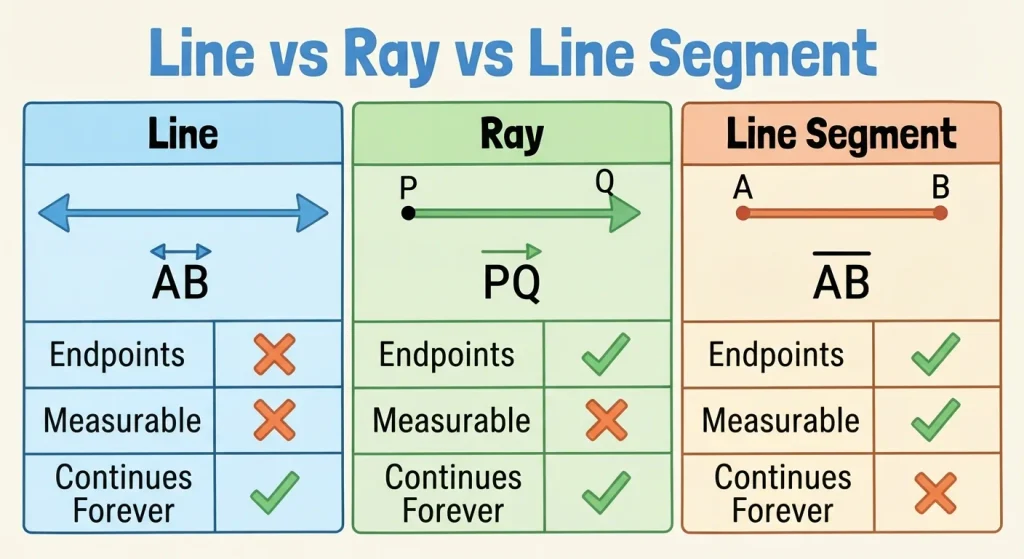
The Comparison Table
| Feature | Line | Ray | Line segment |
|---|---|---|---|
| Endpoints | None | One | Two |
| Does it end? | No, both directions continue forever | No, one direction continues forever | Yes, both ends are fixed |
| Can you measure its length? | No | No | Yes |
| How it is drawn | Arrowheads at both ends | One endpoint, one arrowhead | Two clear endpoints, no arrowheads |
| Symbol for A and B | AB with a double-headed arrow above | AB with a single arrow above, pointing right | AB with a straight bar above |
| Does the order of letters matter? | No, line AB is line BA | Yes, ray AB is not ray BA | No, segment AB is segment BA |
| Everyday model | A perfectly straight road with no ends | A beam from a torch | The edge of your ruler |
Why Students Mix These Up
Three reasons, and naming them helps:
- All three look the same on paper. A child sees a straight stroke and stops reading. The arrowheads carry all the information, and arrowheads are small.
- The words sound related. Line, line segment and ray are not visually distinct terms, and “segment” is not a word children use elsewhere.
- Only the segment matches real life. Everything a child can actually touch is a segment. Lines and rays are drawn as if they end, because the page ends. The drawing contradicts the definition, and children trust the drawing.
The fix is to make arrowheads mean something. Every time you draw one of the three, say the arrowhead out loud: “this end keeps going”.
A Memory Hook That Sticks
Count the endpoints, and read the arrowheads as the word “forever”.
- Zero endpoints, forever in two directions: line.
- One endpoint, forever in one direction: ray.
- Two endpoints, no forever at all: line segment.
Then add the measuring test, which is the one that survives exam pressure: if you can measure it, it is a line segment. A ruler can only measure something that stops at both ends.
Line Segment Symbol and Notation
Notation is not decoration. In an exam, writing the wrong symbol turns a correct answer into a wrong one, so this section is worth ten minutes of real attention.
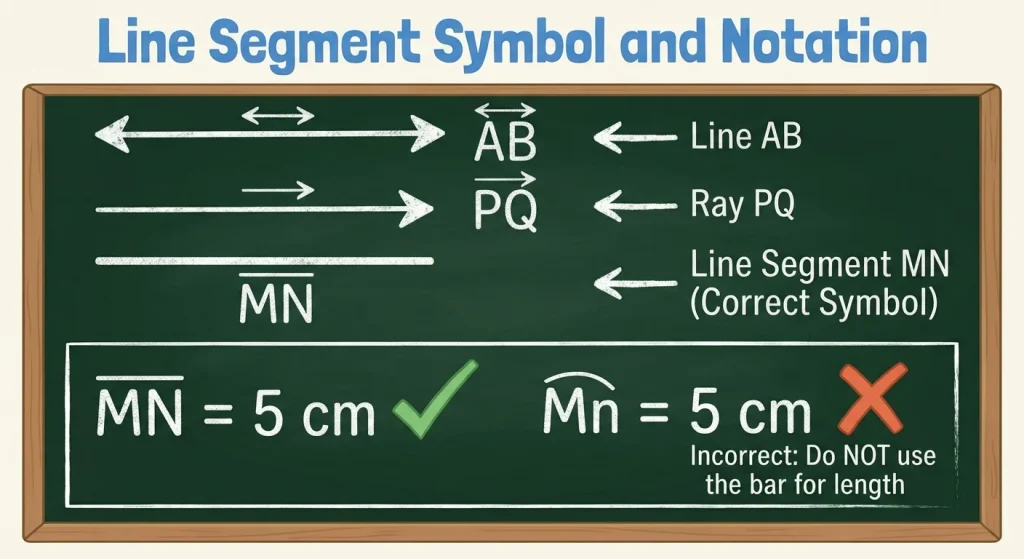
How to Name a Line Segment
Name a line segment by naming its two endpoints with capital letters. A segment with endpoints A and B is called line segment AB.
Order does not matter. Segment AB and segment BA are the same segment, because both describe the same stretch between the same two points. This is a useful contrast to draw with rays, where order does matter.
The Overline Symbol
The line segment symbol is a straight bar written above the two letters, called an overline or a bar.
So line segment AB is written as AB with a bar across the top of both letters. Say it aloud as “segment AB” or “line segment AB”.
The three symbols side by side:
| Figure | Written form | Read as |
|---|---|---|
| Line through A and B | AB with a double-headed arrow above | line AB |
| Ray from A through B | AB with a right-pointing arrow above | ray AB |
| Line segment from A to B | AB with a straight bar above | segment AB |
Notice the pattern. The symbol drawn above the letters is a miniature of the figure itself. Arrowheads on both ends means it continues both ways. One arrowhead means one way. A plain bar with no arrowheads means it stops at both ends. Point this out once and most children stop guessing.
Writing the Length of a Line Segment
Here is the distinction that almost every website skips, and that teachers mark strictly.
- AB with a bar means the line segment itself, the figure.
- AB with no bar means the length of that segment, a number.
So you would write: AB = 5 cm. You would not write the bar there, because 5 cm is a measurement, not a figure. A figure cannot equal 5 cm; its length can.
If your child writes the bar on both, correct it gently once and then check for it in every exercise for a week. It becomes automatic quickly.
Properties of a Line Segment
Line segments have a small, fixed set of properties, and every geometry topic in middle school leans on them.
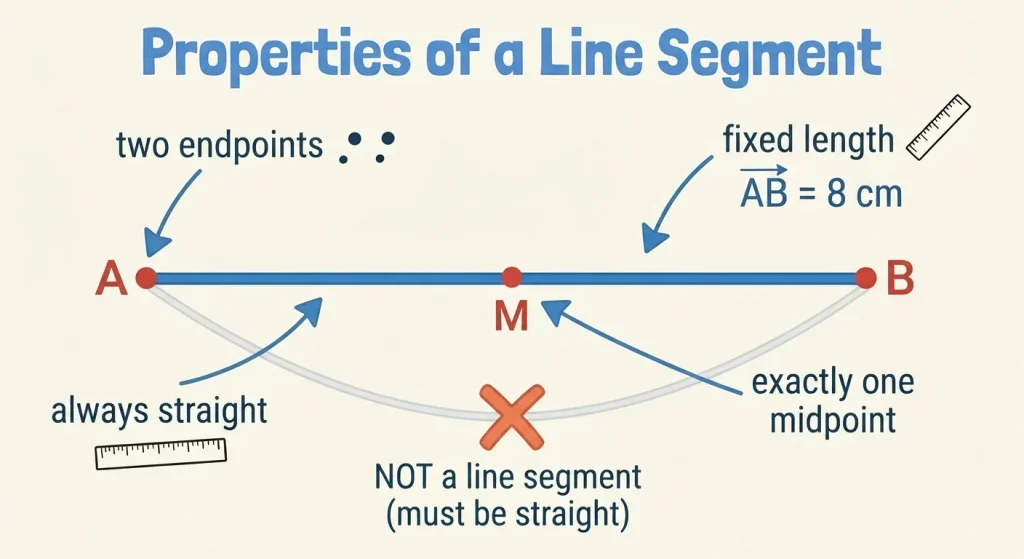
- It has exactly two endpoints. No more, no fewer. Those endpoints belong to the segment.
- It has a fixed, finite length. The length never changes unless you draw a different segment.
- It is always straight. A curved path between two points is a curve, not a segment, no matter how gentle the bend.
- It is the shortest path between its two endpoints. Any other route from A to B is longer. This is why a straight shortcut across a park beats following the footpath.
- It contains infinitely many points. Between any two points on the segment, you can always mark another.
- It cannot be extended. The moment you extend it, it is a different segment, or a ray, or a line.
- It has exactly one midpoint.
- Two segments of the same length are congruent.
The last two deserve their own sections.
Midpoint of a Line Segment
The midpoint of a line segment is the point that divides it into two equal parts. It sits exactly halfway between the two endpoints, and every segment has exactly one.
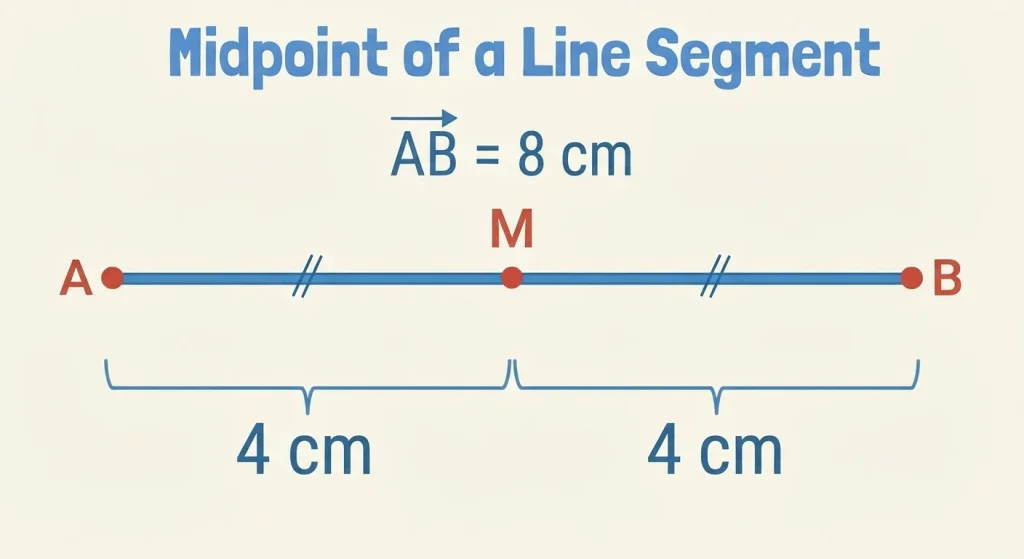
If M is the midpoint of segment AB, then AM = MB, and each of those equals half of AB.
Worked example 1. Line segment AB is 8 cm long. M is its midpoint. How long is AM?
Half of 8 cm is 4 cm. So AM = 4 cm, and MB = 4 cm as well.
Worked example 2. P is the midpoint of segment XY, and XP = 3.5 cm. How long is XY?
The midpoint splits XY into two equal halves, and one half is 3.5 cm. So XY = 3.5 + 3.5 = 7 cm.
Worked example 3. Segment CD is 15 cm. M is the midpoint. A point N lies on segment MD so that MN = 2 cm. How far is N from C?
CM is half of 15 cm, which is 7.5 cm. N is 2 cm further along, so CN = 7.5 + 2 = 9.5 cm.
To find a midpoint by hand, measure the full length, halve it, and mark that distance from either endpoint. Both endpoints should give you the same mark, which is a built-in accuracy check worth teaching.
Bisector of a Line Segment
To bisect means to cut into two equal parts. A bisector of a line segment is any line, ray or segment that passes through its midpoint and splits it into two equal pieces.
A segment has only one midpoint, but infinitely many bisectors, because many different lines can pass through that single point at different angles. One of them is special: the bisector that crosses the segment at a right angle is called the perpendicular bisector. Your child will meet it formally in later classes, so a one-line mention now is enough.
Congruent Line Segments
Two line segments are congruent when they have the same length. Position does not matter, and direction does not matter. A 6 cm segment drawn horizontally and a 6 cm segment drawn at a slant are congruent.
This matters because it is how we define an equilateral triangle (three congruent sides), a square (four congruent sides), and the equal-sides marks your child will see as small tick marks on diagrams.
How to Measure a Line Segment With a Ruler
Measuring looks trivial to an adult and is not trivial to an eight-year-old. These five steps, followed in order, remove almost every error.
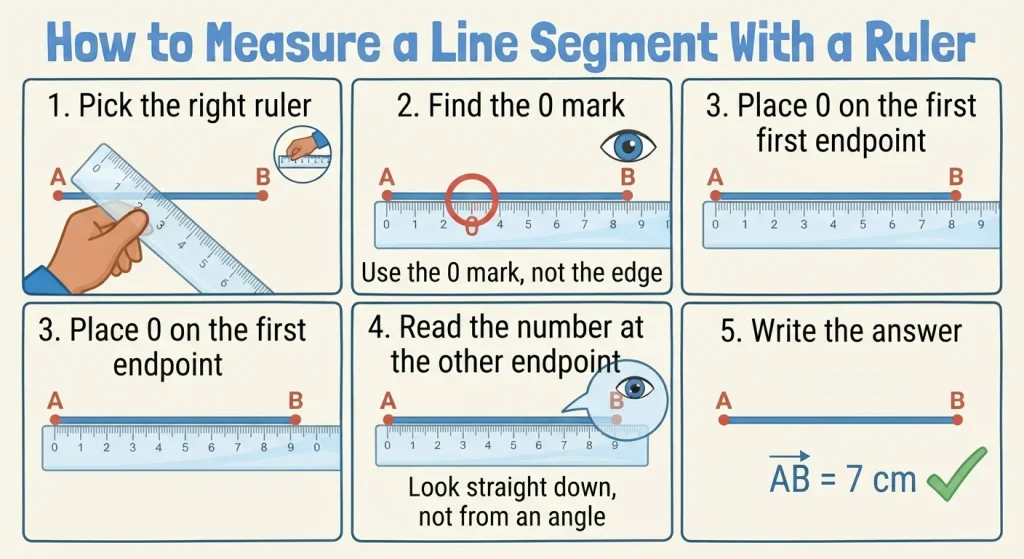
If measurement itself is still shaky, it is worth going back to the basics of measurement for Class 1 before pushing on with notation.
Step 1. Pick the right scale. For schoolwork use a transparent plastic ruler with centimetre and millimetre markings. A transparent ruler lets your child see the segment underneath it, which matters more than it sounds.
Step 2. Find the 0 mark, not the edge. Most rulers have a small blank strip before the 0. If your child lines the segment up with the physical edge of the ruler, every single measurement will be wrong by the same small amount. Have them point to the 0 before they start, every time, until it is a habit.
Step 3. Place 0 on the first endpoint. Lay the ruler flat along the segment so that the 0 mark sits exactly on endpoint A, and the edge of the ruler runs exactly along the segment.
Step 4. Read the number at the other endpoint. Look straight down at the ruler, not from an angle, and read the mark that lines up with endpoint B. If B falls between two centimetre marks, count the small millimetre marks: each one is 0.1 cm.
Step 5. Write the answer with its unit. If B falls on 7, write AB = 7 cm. A number without a unit is an incomplete answer, and most teachers deduct for it.
When the Segment Does Not Start at Zero
Sometimes the ruler slips, or an exam question deliberately shows a segment starting at 2 cm. The method still works: subtract.
If endpoint A sits at the 2 cm mark and endpoint B sits at the 9 cm mark, then AB = 9 minus 2 = 7 cm. Teaching this on purpose is worth doing, because it shows that length is a difference between positions, which is the same idea that makes the number line work. Children who have practised length, weight and time measurement usually pick this up in one go.
How to Draw a Line Segment of a Given Length
Suppose the question says: draw a line segment of length 5 cm. There are two accepted methods, and your child will be asked for both at different stages.
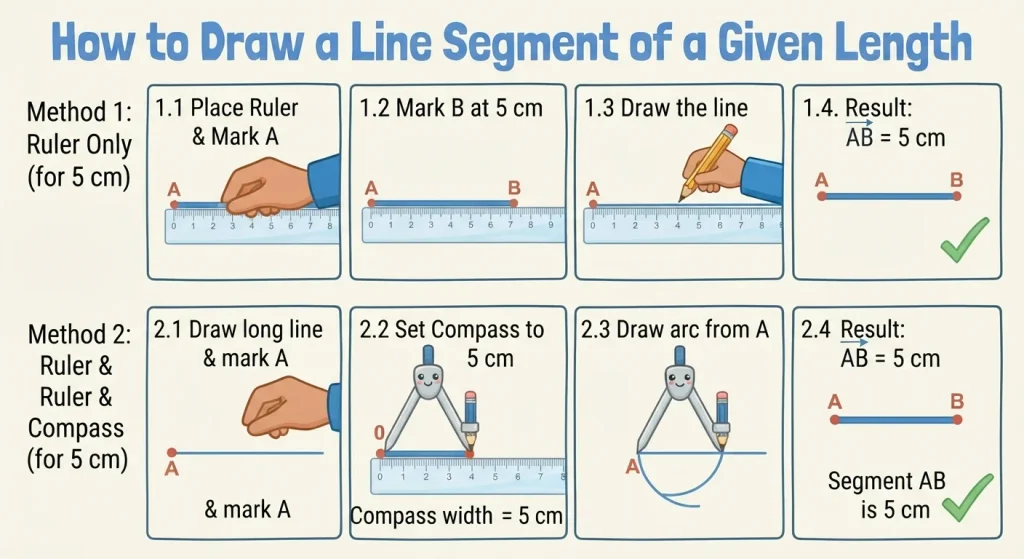
Method 1: Using a Ruler Only
- Place the ruler on the paper and hold it still with your non-writing hand.
- Mark a point at the 0 mark with a sharp pencil and label it A.
- Without moving the ruler, mark a second point at the 5 cm mark and label it B.
- Join A and B by drawing along the ruler’s edge in one smooth stroke.
- Check your work by measuring the finished segment. It should read exactly 5 cm.
The result is line segment AB, with AB = 5 cm.
Method 2: Using a Ruler and Compass
This method is more accurate, and it is the one examiners usually want once construction is formally introduced.
- Draw a long straight line on the paper and mark a point A on it.
- Open the compass and set its width using the ruler: place the metal point at 0 and the pencil tip exactly at 5 cm.
- Keep that opening fixed. Do not let the compass close while you move it.
- Place the metal point of the compass on A and draw a small arc that crosses the line.
- Label the crossing point B.
- Segment AB is your 5 cm line segment.
Why bother with a compass when a ruler is faster? Because the compass transfers a length without reading it again. That is the skill every later construction depends on: copying a segment, bisecting it, building triangles. It is worth saying this to your child, because “the slower method is the more useful one” is otherwise a hard sell.
How Line Segments Build Every Shape
Here is the idea that turns a vocabulary word into real geometry: every straight-sided shape is made entirely of line segments.
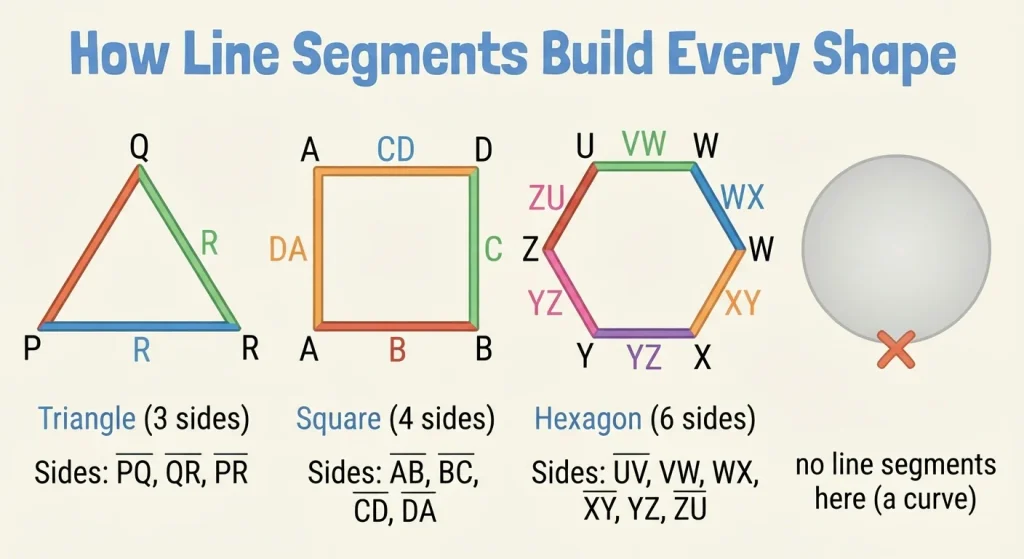
A closed figure made of line segments is called a polygon. The segments are its sides, and the points where two sides meet are its vertices.
- A triangle has three sides. Triangle PQR is built from segments PQ, QR and RP.
- A quadrilateral has four sides. Square ABCD is built from segments AB, BC, CD and DA, and in a square all four are congruent.
- A pentagon has five, a hexagon has six, and the pattern continues.
This is the bridge from vocabulary into geometry work at the Class 2 level and beyond, where naming sides and counting vertices becomes routine.
This also explains perimeter. The perimeter of a polygon is just the total of the lengths of its line segments. A rectangle with sides of 6 cm, 4 cm, 6 cm and 4 cm has a perimeter of 20 cm, because you are adding up four segment lengths.
A circle, by contrast, has no line segments in its boundary at all, which is exactly why its boundary is called a circumference and needs a completely different method. Pointing this out makes the definition of a polygon land properly.
Real-Life Examples of Line Segments
Line segments are not a textbook invention. Nearly every straight edge your child can touch is one, because real objects stop.
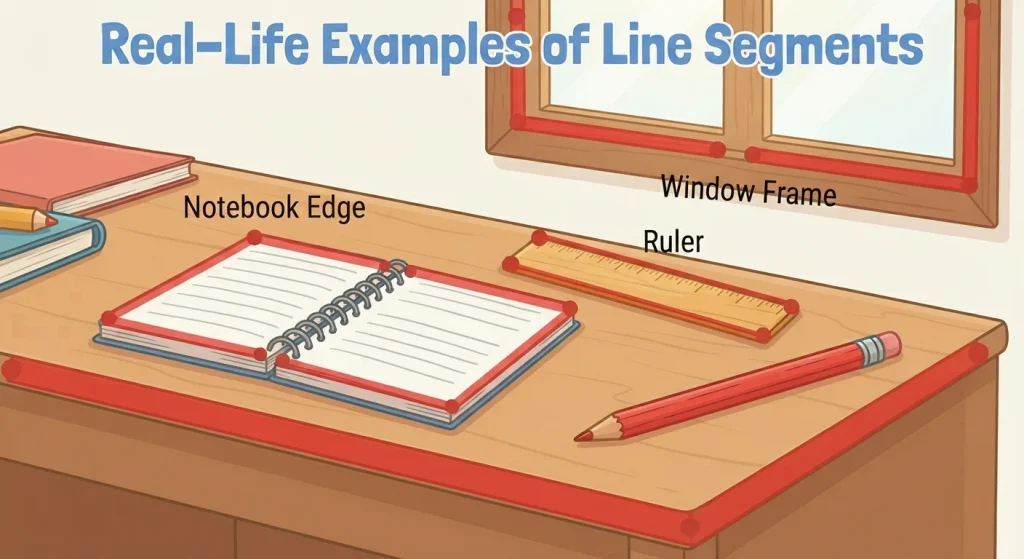
- The edges of a book or notebook. Each edge starts at one corner and ends at another. Four segments make the front cover’s boundary.
- The edge of a ruler or scale. It begins and ends, which is precisely why it can be used to measure other segments.
- Door frames and window frames. Each straight piece of the frame is a segment, and together they form rectangles.
- Zebra crossing stripes. Each white stripe has two clear ends on the road.
- The sides of a chessboard or a carrom board, and every line drawn inside the grid.
- Matchsticks, agarbatti sticks, pencils, straws. Any straight object with two ends is a physical model of a segment.
- The hands of a clock. Each hand runs from the centre to its tip.
- Cricket stumps, the straight lines on a badminton court, the edges of floor tiles.
Now the contrast that makes the idea precise. A torch beam in a dark room is a model of a ray, because it starts at the bulb and keeps going until something stops it. A straight railway track disappearing to the horizon is often used as a model of a line, because it looks like it never ends. And the curved rim of a glass is neither, because it is not straight.
Ask your child to justify each one out loud: “does it have two ends?” That single question does all the sorting.
Worked Examples
Example 1. Naming segments. A figure shows three points P, Q and R marked in order on a straight path. Name all the line segments.
Pick every possible pair of points: P and Q, Q and R, P and R. So the line segments are PQ, QR and PR. Many children miss PR because it is not drawn as a separate stroke, but it is still a segment joining two points on the path.
Example 2. Identifying the figure. A figure shows a straight stroke with a dot at the left end and an arrowhead on the right. What is it?
One endpoint and one arrowhead means it continues forever in one direction. It is a ray, not a line segment.
Example 3. Comparing lengths. Segment AB measures 6.5 cm and segment CD measures 65 mm. Which is longer?
Convert to the same unit first. 65 mm = 6.5 cm. They are equal, so AB and CD are congruent. Unit mismatch is a favourite exam trap.
Example 4. Using the midpoint. M is the midpoint of segment RS. If RM = 4.2 cm, find RS.
Both halves are equal, so RS = 4.2 + 4.2 = 8.4 cm.
Example 5. Segments in a shape. How many line segments form the boundary of a hexagon?
A hexagon has six sides, and each side is a line segment. The answer is 6.
Example 6. Reading a ruler that does not start at zero. A segment starts at the 3 cm mark and ends at the 11.5 cm mark. Find its length.
11.5 minus 3 = 8.5 cm.
Common Mistakes Students Make
Mistake 1: thinking a line segment goes on forever. Correction: a segment stops at both ends. Say “two endpoints, no arrows” while pointing at the drawing.
Mistake 2: writing the wrong symbol. Correction: match the symbol to the picture. Two arrowheads for a line, one for a ray, a plain bar for a segment. Drill it with five quick figures a day for a week.
Mistake 3: putting the bar on the length. Correction: the bar names the figure. AB = 5 cm has no bar, because a number is not a figure.
Mistake 4: measuring from the edge of the ruler. Correction: find the 0 mark first. Make it a spoken step, not a silent one.
Mistake 5: thinking segment AB and segment BA are different. Correction: they are the same segment. Only rays care about order, because only rays have a starting point.
Mistake 6: calling a curved path a line segment. Correction: a segment is straight. Draw a curve and a straight path between the same two points, measure both with a string, and let the result make the argument.
Mistake 7: judging length by appearance. Correction: a slanted segment often looks longer than a horizontal one of the same length. Measure, do not guess.
Mistake 8: treating “the middle bit” as the midpoint. Correction: the midpoint is one exact point where both halves are equal. Check it by measuring from both endpoints.
Mistake 9: forgetting the unit. Correction: AB = 7 is incomplete. AB = 7 cm is an answer.
10 Hands-On Line Segment Activities
All of these use materials you already have at home or in a classroom cupboard. They sit comfortably alongside other fun maths activities if you are building a weekly routine.
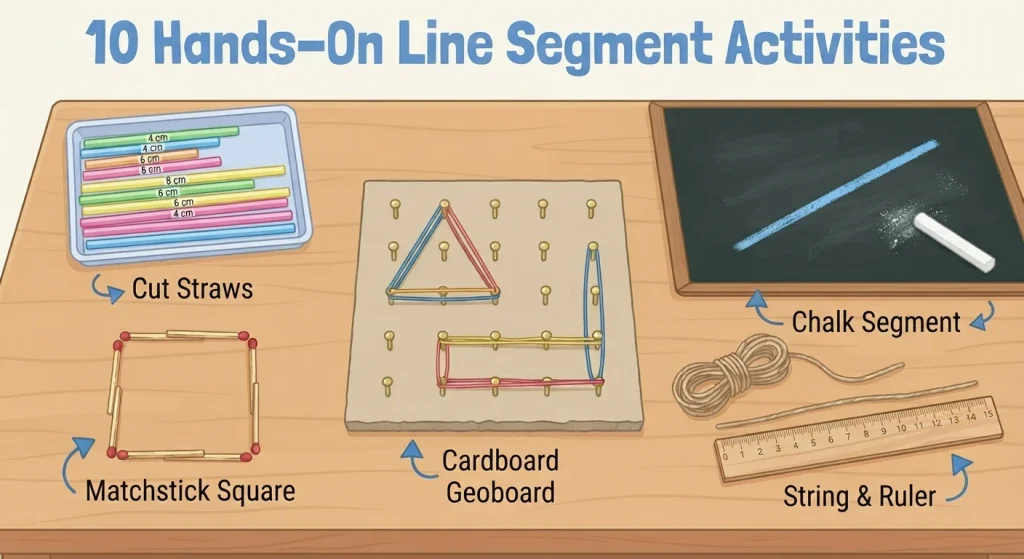
1. The segment hunt. Give your child ten minutes and a notebook. Find and list twenty line segments around the house, with a sketch of each. Then find three things that are not segments and explain why. The explaining is where the learning happens.
2. Straw geometry. Cut drinking straws into pieces of 4 cm, 6 cm and 8 cm. Each piece is a physical line segment. Use them to build triangles and quadrilaterals, and discover which sets of three lengths refuse to close into a triangle.
3. The dot-and-join game. Mark four points on a blank page, no three in a straight line. Challenge: join every pair of points and count the segments. The answer is six. Then try five points and count again.
4. Cardboard geoboard. Push ten pins or small nails through a piece of thick cardboard in a grid, and use rubber bands to stretch segments between them. Call out a shape and let your child build it.
5. Matchstick puzzles. Lay out matchsticks to form shapes, then pose classic puzzles: move two matchsticks to make three squares into four. Every matchstick is a line segment, and the puzzle is pure segment-counting. More in the same vein sits in these maths puzzles.
6. Chalk segments outside. Draw large segments on the floor or courtyard and have your child walk along them heel to toe, counting steps. Walking a segment makes “it has two ends” physical in a way paper cannot.
7. The ruler relay. Draw eight segments of different lengths on a sheet. Time your child measuring and labelling all eight. Repeat the next day and try to beat the time without losing accuracy. Speed plus accuracy is the real skill.
8. Draw and check, in pairs. One person writes a length on a slip of paper, the other draws a segment of that length without measuring. Then measure together and score the difference in millimetres. Lowest total after ten rounds wins. Estimation improves fast.
9. String versus straight. Pin two points on a board. Lay a string along a curved route between them, cut it, then lay a second string along the straight route and cut it. Compare the two strings. This proves the shortest-path property instead of asserting it.
10. Sort the figures. Make fifteen cards, each showing a line, a ray or a segment. Your child sorts them into three piles against a timer and then says the symbol for each. Shuffle and repeat. This is the single most effective drill for the three-way confusion.
Tips for Parents Teaching Geometry at Home
- Go physical before symbolic. Let your child hold straws and matchsticks for a few days before you introduce the overline. A symbol attached to a felt experience sticks; a symbol attached to nothing does not.
- Use the word in ordinary conversation. “Cut the chapati along a straight segment.” “How long is that segment of the table edge?” Repetition in a normal voice does more than drilling.
- Ask for justification, not answers. “How do you know that is a segment?” is a better question than “what is that?” because it forces the endpoint test, and it quietly builds critical thinking at the same time.
- Let them be wrong out loud. A child who says “a line and a line segment are the same” has given you the exact thing to fix. Correct the idea, not the child.
- Keep sessions to fifteen minutes. Short and daily beats an hour on Sunday, especially for Class 3 to 5.
- Do not jump ahead. Coordinates, distance formulas and midpoint formulas are not Class 3 to 6 content. Introducing them early makes a simple idea feel hard.
Tips for Teachers Delivering a Line Segment Lesson
- Teach in sequence, never out of order. Point, line, ray, segment. Breaking the sequence is the main reason the three-way confusion survives into Class 7.
- Introduce the arrowhead as a word. Every time you draw one, say “forever”. Children stop reading arrowheads as decoration within a lesson or two.
- Use a non-example early. Draw a curve between two points and ask whether it is a segment. The discussion sharpens the definition faster than another correct example would, and it exercises visual reasoning rather than recall.
- Separate the figure from its measure explicitly. Write segment AB with the bar on one side of the board and AB = 5 cm on the other, and point at both while you explain. Students who see the contrast once rarely confuse them later.
- Build in a measurement check. Have students measure from both endpoints when marking a midpoint. Self-checking is a transferable habit.
- Close with counting. End the lesson by asking how many segments are formed by three points on a line, then four. It takes two minutes and quietly starts combinatorial thinking.
Line Segments in Olympiad-Style Problems
Competition papers at the junior level rarely ask “what is a line segment”. They ask you to count or compare them, and the point of this section is to show that the basic definition is doing real work. For the wider method, see how to solve maths Olympiad problems.
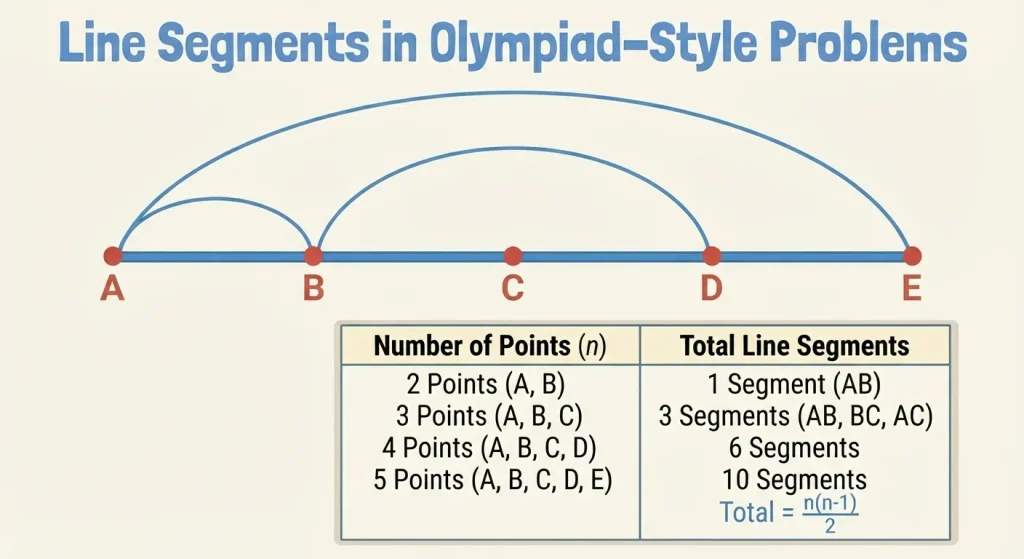
Counting segments between points. Place points on a straight line and count how many segments they create. Every pair of points gives exactly one segment.
| Points on the line | Line segments formed |
|---|---|
| 2 | 1 |
| 3 | 3 |
| 4 | 6 |
| 5 | 10 |
| 6 | 15 |
The pattern 1, 3, 6, 10, 15 is the set of triangular numbers, and the jumps grow by one each time. A Class 5 child can find it by careful listing. The shortcut, for older students, is that with n points you get n multiplied by (n minus 1), divided by 2.
Counting segments in a figure. Give a figure made of overlapping strokes and ask how many line segments it contains. The trick is to count systematically, shortest first, and to remember that a long stroke containing a marked point contains three segments, not one.
Comparing without measuring. Olympiad questions often ask which of two paths is shorter, where measurement is not possible. The shortest-path property settles most of them: the straight segment beats any other route between the same two points. This is the seed of the triangle inequality that appears in later rounds.
Perimeter puzzles. Questions that ask for the perimeter of an irregular figure are segment-addition questions wearing a disguise. Label every segment, add them up, and watch for sides whose lengths must be deduced from the others.
If your child is working toward a contest, the junior maths Olympiad guide and a set of maths Olympiad questions are the natural next step.
Practice Questions With Answers
- How many endpoints does a line segment have?
- Which figure can be measured: a line, a ray or a line segment?
- Write the correct symbol name for a segment joining M and N.
- Segment AB is 12 cm long. P is its midpoint. Find AP.
- XY = 9 cm and PQ = 90 mm. Are they congruent?
- How many line segments form a pentagon?
- A segment runs from the 4 cm mark to the 10.5 cm mark on a ruler. Find its length.
- Four points are marked on a straight line. How many line segments are formed?
- True or false: segment PQ and segment QP are different segments.
- Name the three line segments in triangle ABC.
Answers
- Two.
- A line segment, because both of its ends are fixed.
- Segment MN, written as MN with a bar above the letters.
- 6 cm.
- Yes. 90 mm equals 9 cm, so they are congruent.
- Five.
- 6.5 cm.
- Six.
- False. They are the same segment.
- AB, BC and CA.
Make Preparing for Math Olympiad Simple!



What is a line segment in simple words?
A line segment is a straight path between two points that has a definite start, a definite end, and a length you can measure with a ruler. The edge of your notebook is a line segment.
What is the difference between a line and a line segment?
A line has no endpoints and continues forever in both directions, so it cannot be measured. A line segment has two endpoints and a fixed length, so it can be measured. A line segment is a part of a line.
What is the difference between a ray and a line segment?
A ray has one endpoint and continues forever in one direction, so it cannot be measured. A line segment has two endpoints and can be measured. Ray AB and ray BA are different; segment AB and segment BA are the same.
What is the symbol for a line segment?
A straight bar, called an overline, written above the two endpoint letters. Segment AB is written as AB with a bar across the top.
How do you write the length of a line segment?
Without the bar. The figure is written as AB with a bar; its length is written as AB = 5 cm.
How many endpoints does a line segment have?
Exactly two, and both belong to the segment.
Can a line segment be curved?
No. A line segment is always straight. A curved path between two points is a curve, and it is longer than the segment joining the same two points.
What is the midpoint of a line segment?
The point that divides the segment into two equal parts. Every line segment has exactly one midpoint, and it lies exactly halfway between the endpoints.
How many line segments does a triangle have?
Three. Each side of a triangle is a line segment, and together they form a closed figure.
Are all sides of shapes line segments?
All sides of polygons are, because polygons are closed figures made of straight sides. A circle has no sides and therefore no line segments in its boundary.
In which class is the line segment taught?
Children meet straight edges and measurement informally from Class 3 onward. The formal treatment, with points, lines, rays, segments and their symbols, appears in the Class 6 geometry chapter under basic geometrical ideas.
Can two line segments have the same length?
Yes. Two segments with the same length are called congruent, no matter where they are drawn or which direction they face.
Conclusion
A line segment is the smallest complete idea in geometry: two endpoints, a straight path, and a length you can measure.
Once that lands, your child tells a line from a ray by counting endpoints instead of memorising a list.
Keep it physical. Straws, matchsticks and chalk first, notation second.
Fifteen minutes a day, with your child explaining out loud, beats an hour of silent worksheets.

Mikha Piregu is a Content Writer with experience spanning educational content, including math and math olympiad topics, as well as advocacy writing, research-based articles, and SEO-driven web content. He creates high-quality blog content, web copy, and feature articles that support brand visibility, audience engagement, and long-term organic growth through data-informed storytelling. Skilled in WordPress, WooCommerce, and modern digital tools, Mikha adapts content across various platforms, including blogs, websites, campaigns, and advocacy initiatives, with clarity and purpose.

There are no comments posted here yet.
Sign in to leave a comment