


Subtracting fractions is done by making sure the bottom numbers (denominators) are the same, subtracting the top numbers (numerators), and simplifying the final result if needed.
- What subtracting fractions actually means
- Why only the numerator changes with like denominators
- Case 1: Subtracting fractions with like denominators
- Simplifying your answer using the HCF
- Why unlike denominators must be made equal first
- How to find the LCM of two denominators
- Turning the LCM into equivalent fractions
- Case 2: Subtracting fractions with unlike denominators
- Case 3: Subtracting fractions from whole numbers
- Case 4: Subtracting mixed numbers with like denominators
- Case 5: Subtracting mixed numbers with unlike denominators
- Case 6: Subtracting mixed numbers with borrowing
- The mistake almost every child makes
- Word problems from everyday life
- How fraction subtraction connects to everything else
- Common mistakes at each stage
- Eight activities to practise at home and in class
- Tips for parents
- Tips for teachers
- From fraction subtraction to Olympiad problems
- Practice questions with answers
- Frequently asked questions
When the denominators already match, you subtract straight away. When they do not, you find the LCM of the two denominators, rewrite both fractions with that shared denominator, and then subtract.
That is the whole method. The difficulty your Class 5 or Class 6 child runs into is knowing which case they are looking at, and what to do when the first fraction turns out to be smaller than the second.
This guide covers every case, in the order a child should learn them: like denominators, unlike denominators, whole numbers, mixed numbers, and the borrowing case textbooks rush. Each gets a full worked example, and the most common error is dealt with head on.
What subtracting fractions actually means
Before any rule, your child needs a picture in their head.
If your child is still unsure which number is which, it is worth revisiting the numerator and the denominator of a fraction before going further.
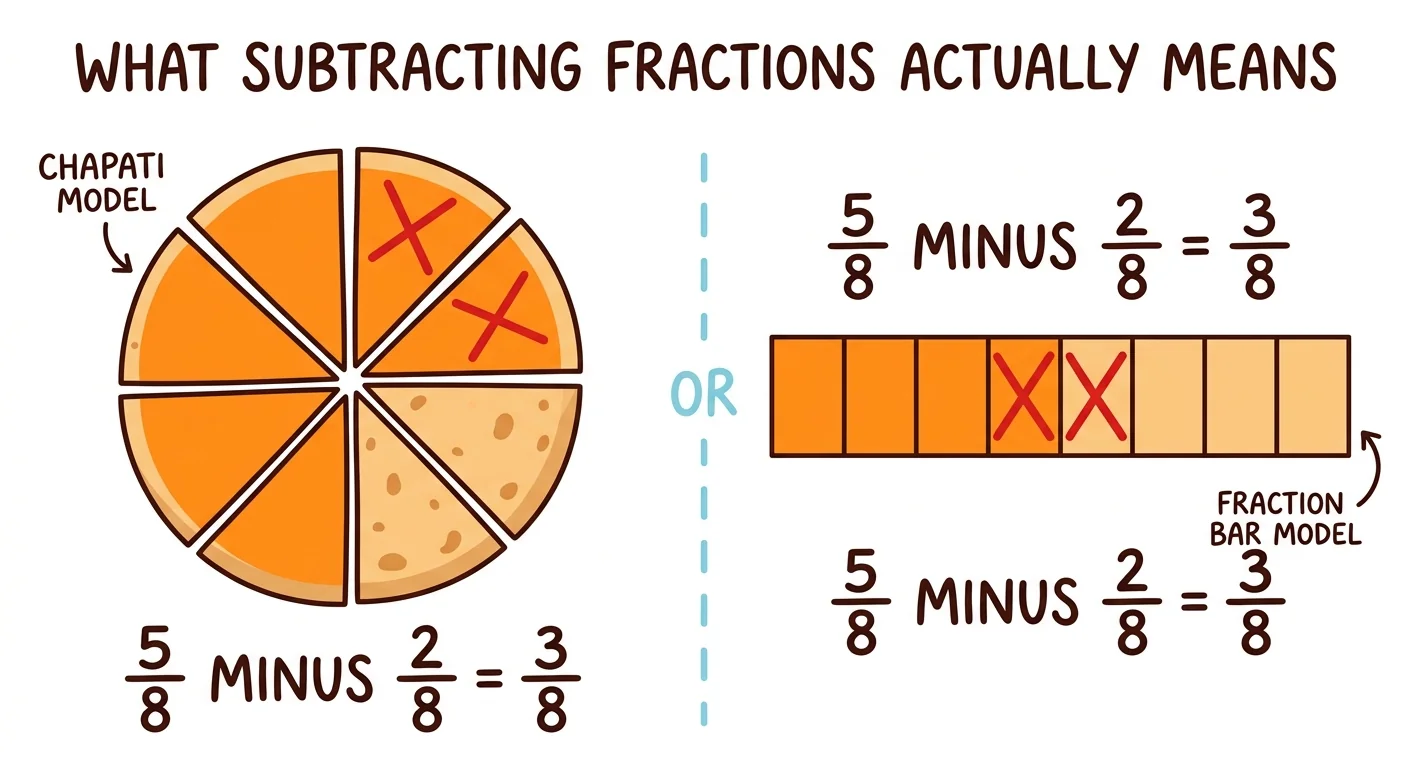
Take a chapati and cut it into 8 equal pieces. Each piece is 1/8 of the chapati. If there are 5 pieces on the plate and someone eats 2 of them, how many are left? Three pieces, so 3/8 of the chapati. Your child just did 5/8 minus 2/8 without touching a single rule.
That is all fraction subtraction is. You start with a certain number of equal parts and you take some of those parts away.
Two visual models make this concrete, and both are worth drawing on paper before any written sums happen.
Fraction bars. Draw a long rectangle and divide it into 8 equal strips. Shade 5 of them. Now cross out 2 of the shaded strips. Count what is still shaded: 3 strips out of 8. The bar never changes size. The number of strips it is cut into never changes. Only the shaded count changes.
The number line. If your child needs a refresher on reading positions along a line, the basics of the number line are worth five minutes first. Draw a line from 0 to 1 and mark eight equal jumps along it: 1/8, 2/8, 3/8 and so on up to 8/8. Put a finger on 5/8 and jump backwards two steps. You land on 3/8. Subtraction on a number line means jumping to the left, exactly as it does with whole numbers. The only difference is the size of each jump.
Once a child can see the answer before calculating it, the written method stops being a mystery and becomes a shortcut for something they already understand.
Why only the numerator changes with like denominators
This is the question most guides skip, and it is the one that prevents the biggest error later.
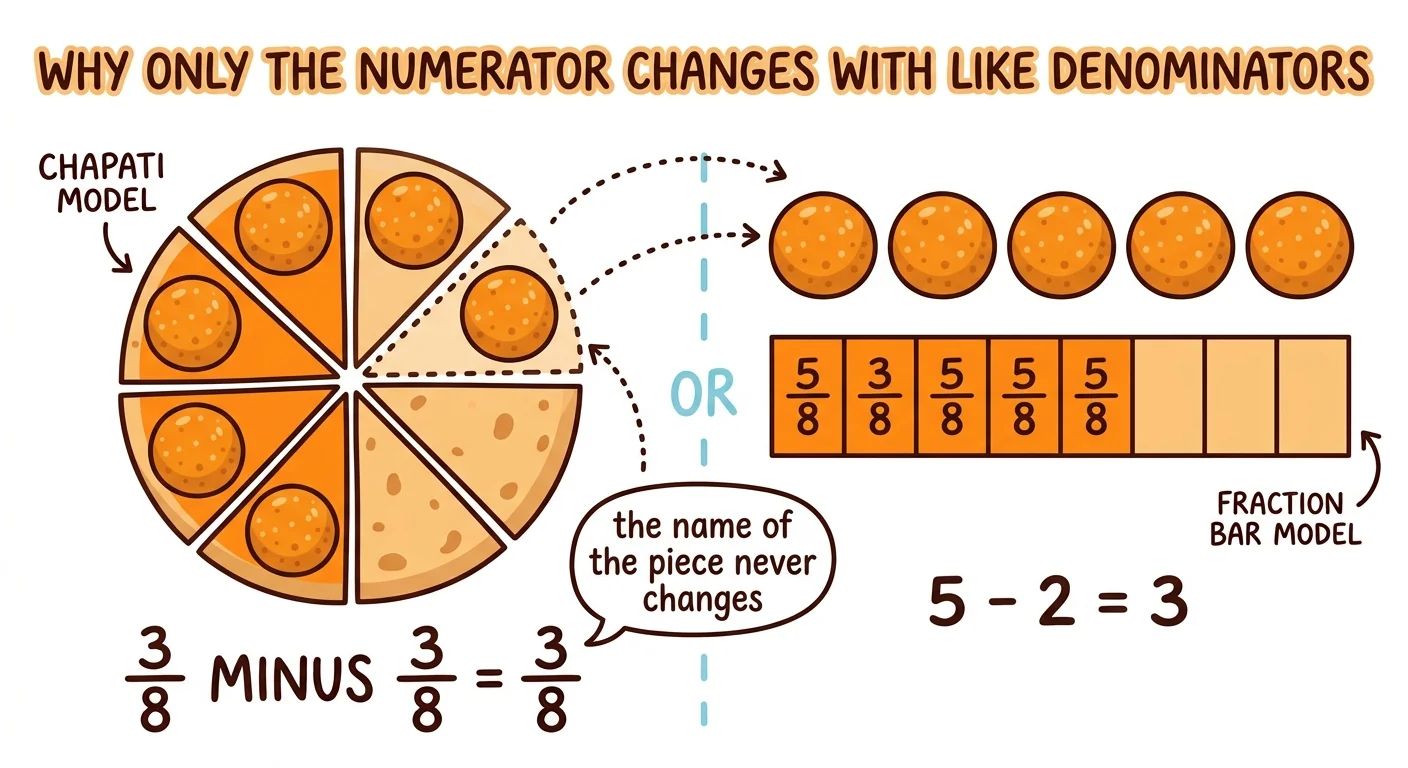
Look at the names of the two numbers in a fraction. The denominator, the bottom number, tells you how big each piece is, because it tells you how many equal pieces the whole was cut into. The numerator, the top number, tells you how many of those pieces you have.
Now think about a real example. You have 5 laddoos and you give away 2 laddoos. You have 3 laddoos left. The word “laddoo” did not change. You did not end up with 3 of something else.
Eighths work the same way. “Eighth” is the name of the piece. If you have 5 eighths and take away 2 eighths, you have 3 eighths. The counting number changes. The name of the piece stays exactly the same.
So when your child asks why the bottom number does not change, the answer is simple and honest: because the size of the pieces did not change. Nobody re-cut the chapati in the middle of the sum.
Case 1: Subtracting fractions with like denominators
Fractions with the same denominator are called like fractions. This is the easiest case, and every later case eventually gets converted into this one. If your child has already worked through adding fractions with like denominators, the preparation here will feel familiar.
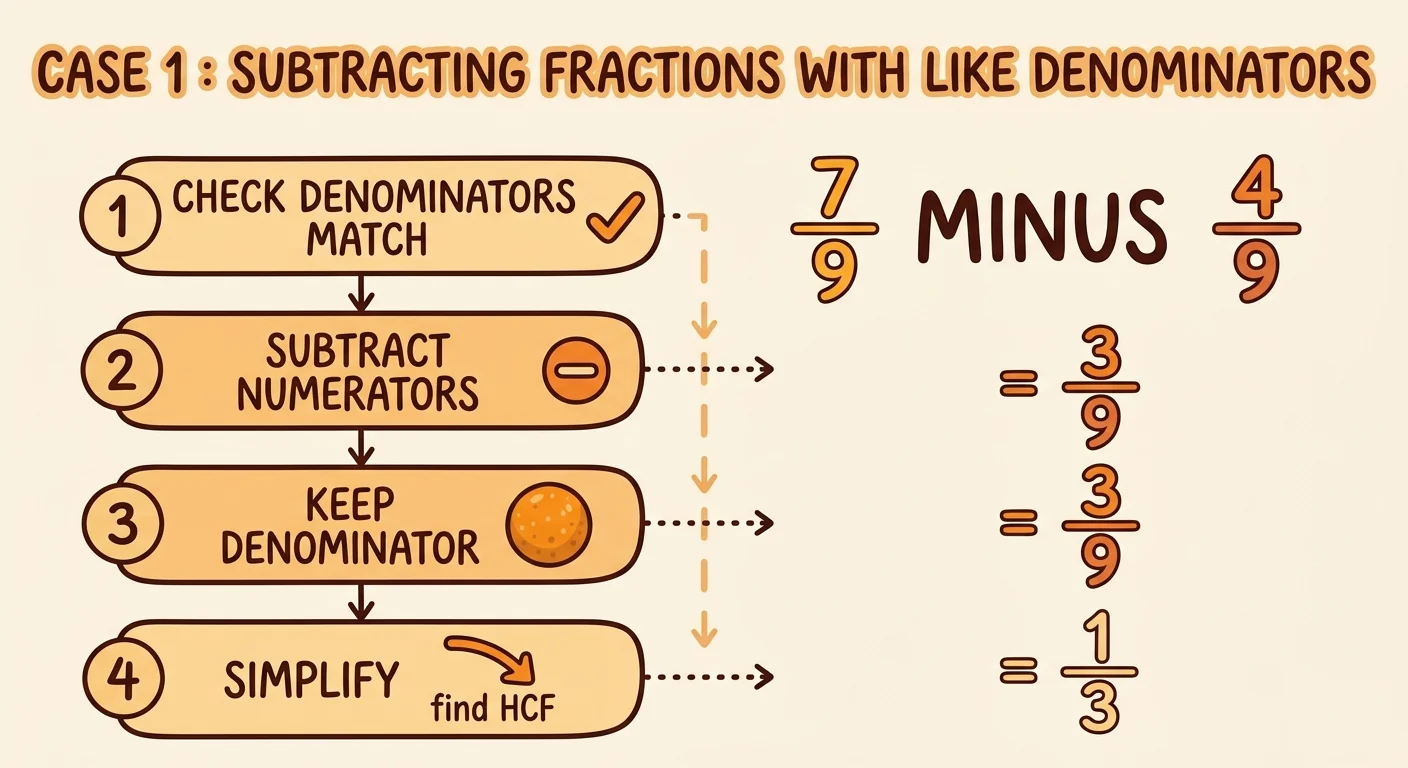
The method
- Check that both denominators are the same.
- Subtract the second numerator from the first.
- Keep the denominator unchanged.
- Simplify the answer if possible.
Worked example 1: 5/8 minus 2/8
Both denominators are 8, so we can go straight ahead.
5 minus 2 = 3
Answer: 3/8. The 3 and the 8 share no common factor other than 1, so this is already in its simplest form.
Worked example 2: 7/9 minus 4/9
7 minus 4 = 3, giving 3/9.
Both 3 and 9 can be divided by 3, so 3/9 simplifies to 1/3.
Answer: 1/3.
Worked example 3: 11/12 minus 5/12
11 minus 5 = 6, giving 6/12.
Both numbers divide by 6, so the answer is 1/2.
Answer: 1/2.
Notice what happened in the last two examples. The subtraction itself took two seconds. The simplification was the part that needed care. That is normal, and it is why the next section matters.
Simplifying your answer using the HCF
In CBSE and NCERT maths, an answer is expected in its lowest terms. A child who writes 6/12 instead of 1/2 has done the subtraction correctly and still loses the mark.
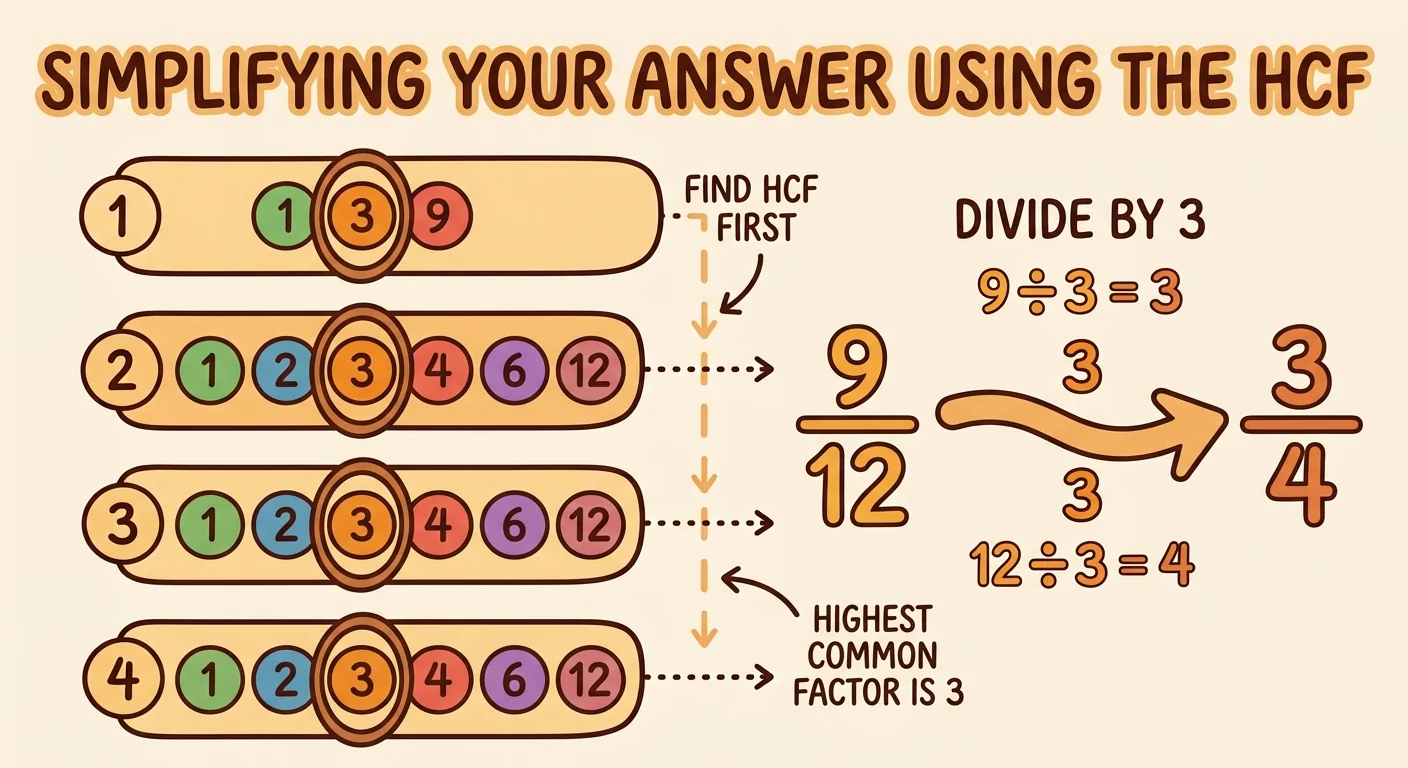
To simplify a fraction, find the highest common factor, or HCF, of the numerator and the denominator, then divide both by it.
Worked example: simplify 9/12
Factors of 9: 1, 3, 9 Factors of 12: 1, 2, 3, 4, 6, 12 Common factors: 1 and 3. The highest is 3.
9 divided by 3 = 3 12 divided by 3 = 4
Answer: 3/4.
Worked example: simplify 8/20
Factors of 8: 1, 2, 4, 8 Factors of 20: 1, 2, 4, 5, 10, 20 The HCF is 4.
8 divided by 4 = 2, and 20 divided by 4 = 5.
Answer: 2/5.
A useful habit to build: after every fraction answer, ask one question out loud. “Can the top and bottom both be divided by the same number?” If yes, divide. If no, the answer is finished. Treat simplifying as part of the sum, never as an optional extra step.
Why unlike denominators must be made equal first
Here is where most children get stuck, and here is where a good explanation saves weeks of confusion.
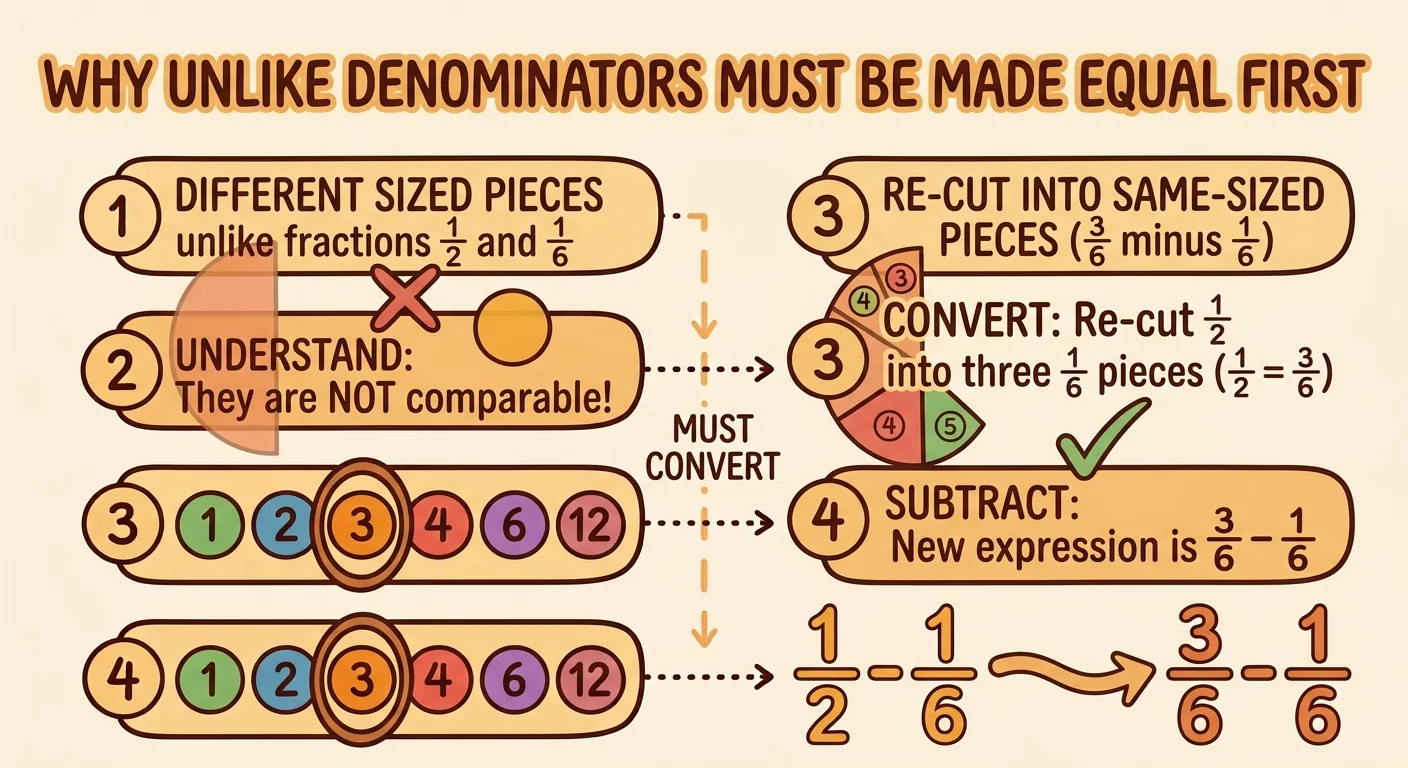
Try to subtract 1/2 minus 1/6 by taking the pieces away directly. You have one piece called a half. You want to remove one piece called a sixth. These are different sized pieces. Removing a small piece from a big piece does not leave you with a whole number of either kind, so there is nothing sensible to count.
Compare it to something physical. You can subtract 300 grams from 1 kilogram only after you notice that 1 kilogram is 1000 grams. You cannot subtract grams from kilograms while they are still written in different units. You convert first, then subtract.
Fractions behave the same way. The denominator is the unit. Halves and sixths are different units, so they must be rewritten in a shared unit before any subtraction can happen.
And there is a shared unit available here. One half is exactly the same amount as three sixths. Cut the half into three equal parts and every part is a sixth. So:
1/2 minus 1/6 becomes 3/6 minus 1/6, which is 2/6, which simplifies to 1/3.
Nothing about the quantities changed. We only renamed them so they could be counted together. That is the whole idea behind common denominators, and once a child sees it this way, finding the LCM stops feeling like an arbitrary rule handed down by a textbook.
How to find the LCM of two denominators
The lowest common multiple, or LCM, of the two denominators is the smallest number that both denominators divide into exactly. It becomes the new shared denominator.
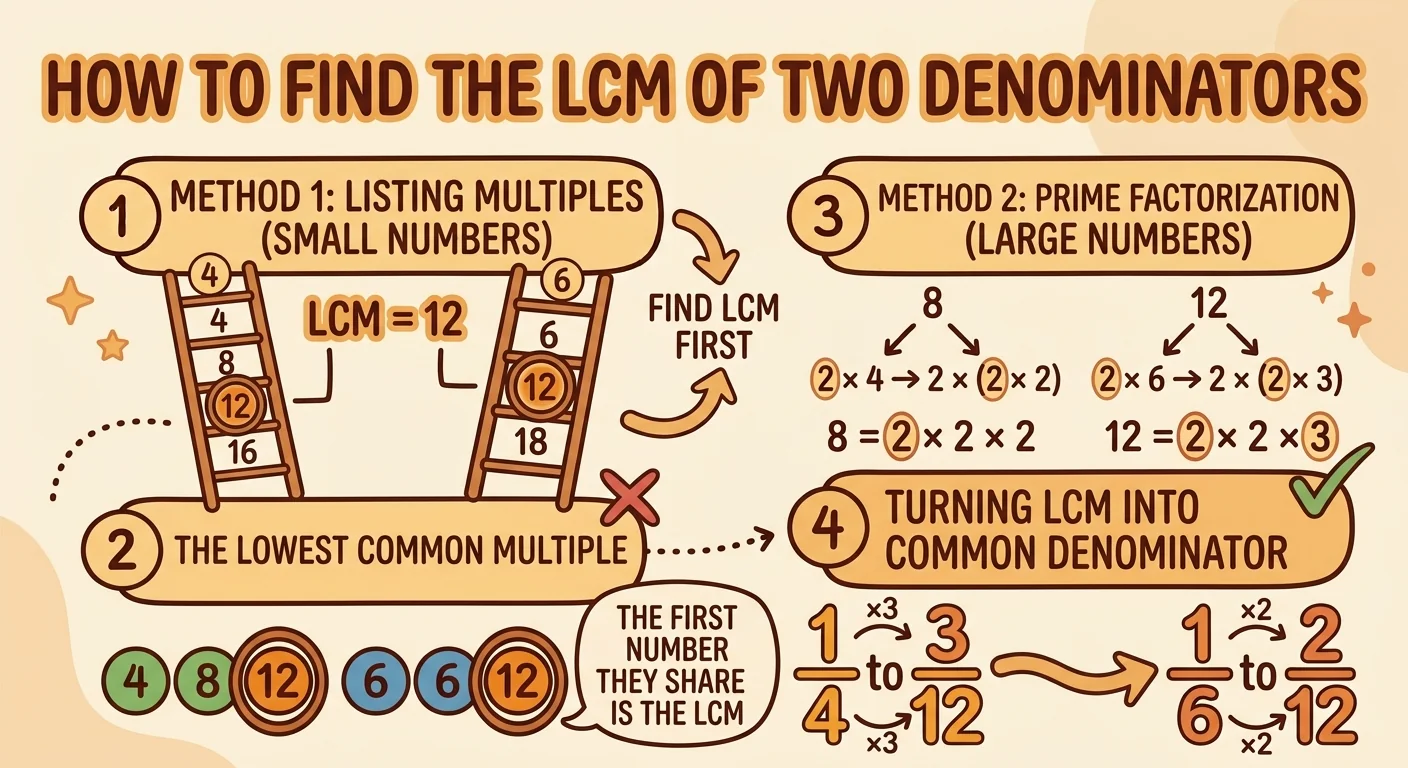
There are two reliable methods, and your child should be comfortable with both.
Method 1: Listing multiples
Best for small denominators.
Find the LCM of 4 and 6.
Multiples of 4: 4, 8, 12, 16, 20 Multiples of 6: 6, 12, 18, 24
The first number that appears in both lists is 12.
LCM of 4 and 6 = 12.
Method 2: Prime factorisation
Best for larger denominators where listing takes too long.
Find the LCM of 8 and 12.
8 = 2 x 2 x 2 12 = 2 x 2 x 3
Take the highest power of each prime that appears: three 2s and one 3.
2 x 2 x 2 x 3 = 24
LCM of 8 and 12 = 24.
A shortcut worth knowing. If the smaller denominator divides exactly into the larger one, the larger denominator is already the LCM. For 3 and 12, the LCM is simply 12. Children waste a surprising amount of time multiplying denominators together when the answer is already sitting in front of them.
Turning the LCM into equivalent fractions
Finding the LCM is only half the job. Now each fraction has to be rewritten with that LCM as its denominator, without changing its value. This is equivalent fractions, a topic your child already met in Class 4 and Class 5.
The rule: whatever you multiply the denominator by, you must multiply the numerator by the same number.
Worked example: rewrite 3/4 and 1/6 with a denominator of 12
For 3/4: 4 x 3 = 12, so multiply the top by 3 as well. 3 x 3 = 9. So 3/4 = 9/12.
For 1/6: 6 x 2 = 12, so multiply the top by 2 as well. 1 x 2 = 2. So 1/6 = 2/12.
Check this with a drawing if your child looks doubtful. Shade three quarters of a rectangle, then cut each quarter into three smaller pieces. The shaded area has not moved. It is now described as 9 pieces out of 12.
Case 2: Subtracting fractions with unlike denominators
This is the case that appears most often in exams and the one parents ask about most.
The method
- Find the LCM of the two denominators.
- Convert both fractions into equivalent fractions with the LCM as the denominator.
- Subtract the numerators and keep the common denominator.
- Simplify the answer.
Worked example 1: 3/4 minus 1/6
Step 1. Multiples of 4 are 4, 8, 12. Multiples of 6 are 6, 12. The LCM is 12.
Step 2. 3/4 = 9/12 and 1/6 = 2/12.
Step 3. 9/12 minus 2/12 = 7/12.
Step 4. 7 and 12 have no common factor, so 7/12 is final.
Answer: 7/12.
Worked example 2: 5/6 minus 1/4
Step 1. The LCM of 6 and 4 is 12.
Step 2. 5/6 = 10/12 and 1/4 = 3/12.
Step 3. 10/12 minus 3/12 = 7/12.
Answer: 7/12.
Worked example 3: 7/10 minus 1/2
Step 1. 2 divides into 10 exactly, so the LCM is 10.
Step 2. 1/2 = 5/10. The first fraction already has denominator 10.
Step 3. 7/10 minus 5/10 = 2/10.
Step 4. The HCF of 2 and 10 is 2, so 2/10 = 1/5.
Answer: 1/5.
Worked example 4: 2/3 minus 2/5
Step 1. The LCM of 3 and 5 is 15.
Step 2. 2/3 = 10/15 and 2/5 = 6/15.
Step 3. 10/15 minus 6/15 = 4/15.
Answer: 4/15.
Worth pointing out to your child: in the last example both numerators were 2, yet the answer was not 0. The size of the pieces decides the value, and thirds are bigger than fifths.
Case 3: Subtracting fractions from whole numbers
This case gets skipped in a lot of material, and then it appears in a test and the child freezes. It deserves its own practice.
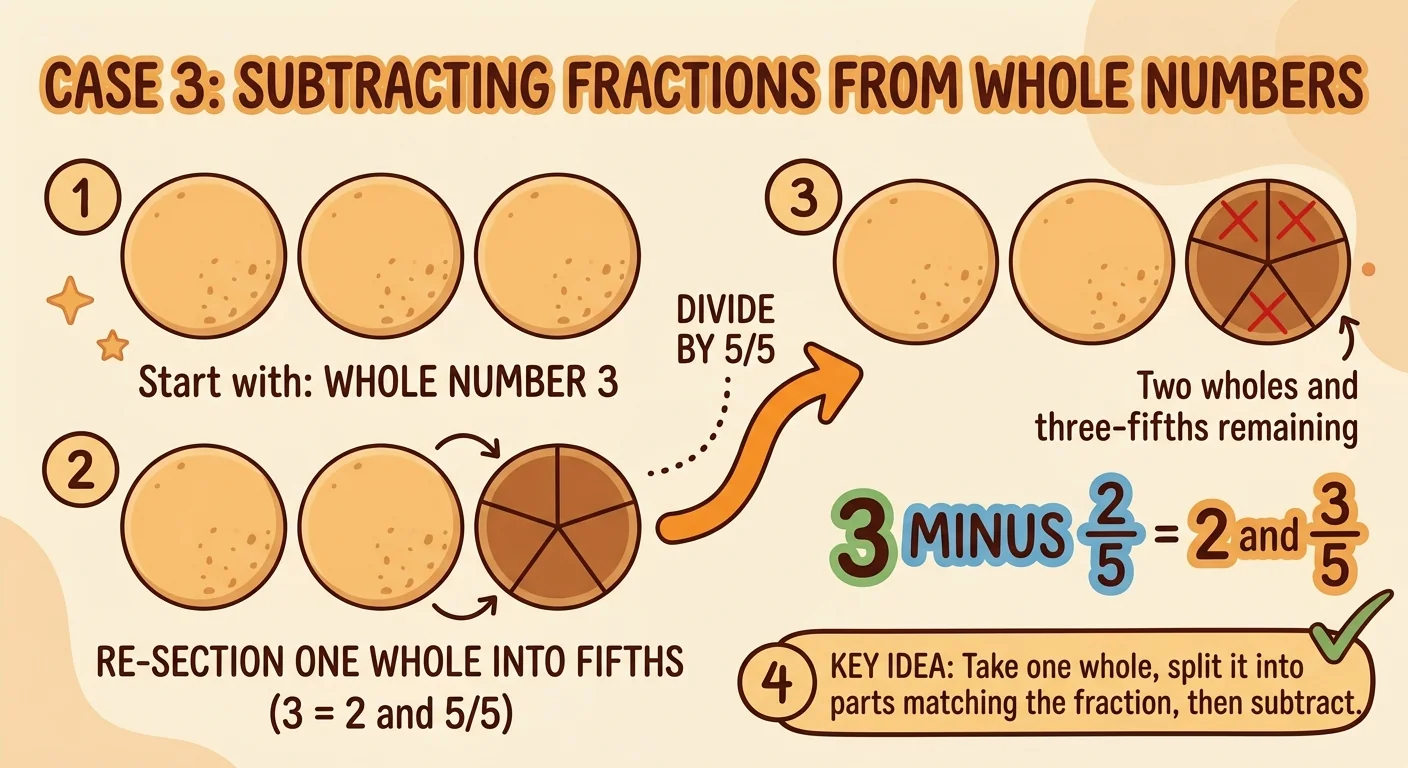
The key idea is that any whole number can be written as a fraction. The number 1 is 1 whole, which is 2/2, or 5/5, or 8/8, or any number over itself. So a whole number can always be rewritten with whatever denominator you need.
The method
- Take one whole out of the whole number.
- Write that one whole as a fraction with the same denominator as the fraction being subtracted.
- Subtract.
- Write the remaining whole number alongside the fractional answer.
Worked example 1: 1 minus 3/8
Write 1 as 8/8.
8/8 minus 3/8 = 5/8.
Answer: 5/8.
Worked example 2: 3 minus 2/5
Take one whole from the 3, leaving 2. Write that whole as 5/5.
So 3 becomes 2 and 5/5.
Now subtract the fraction: 5/5 minus 2/5 = 3/5.
Answer: 2 and 3/5.
Check it a different way if you like. 3 = 15/5, and 15/5 minus 2/5 = 13/5, which is 2 and 3/5. Same answer.
Worked example 3: 5 minus 1 and 2/3
Here a mixed number is being taken away from a whole number.
Take one whole from the 5, leaving 4. Write that whole as 3/3, so 5 becomes 4 and 3/3.
Subtract the whole numbers: 4 minus 1 = 3. Subtract the fractions: 3/3 minus 2/3 = 1/3.
Answer: 3 and 1/3.
Case 4: Subtracting mixed numbers with like denominators
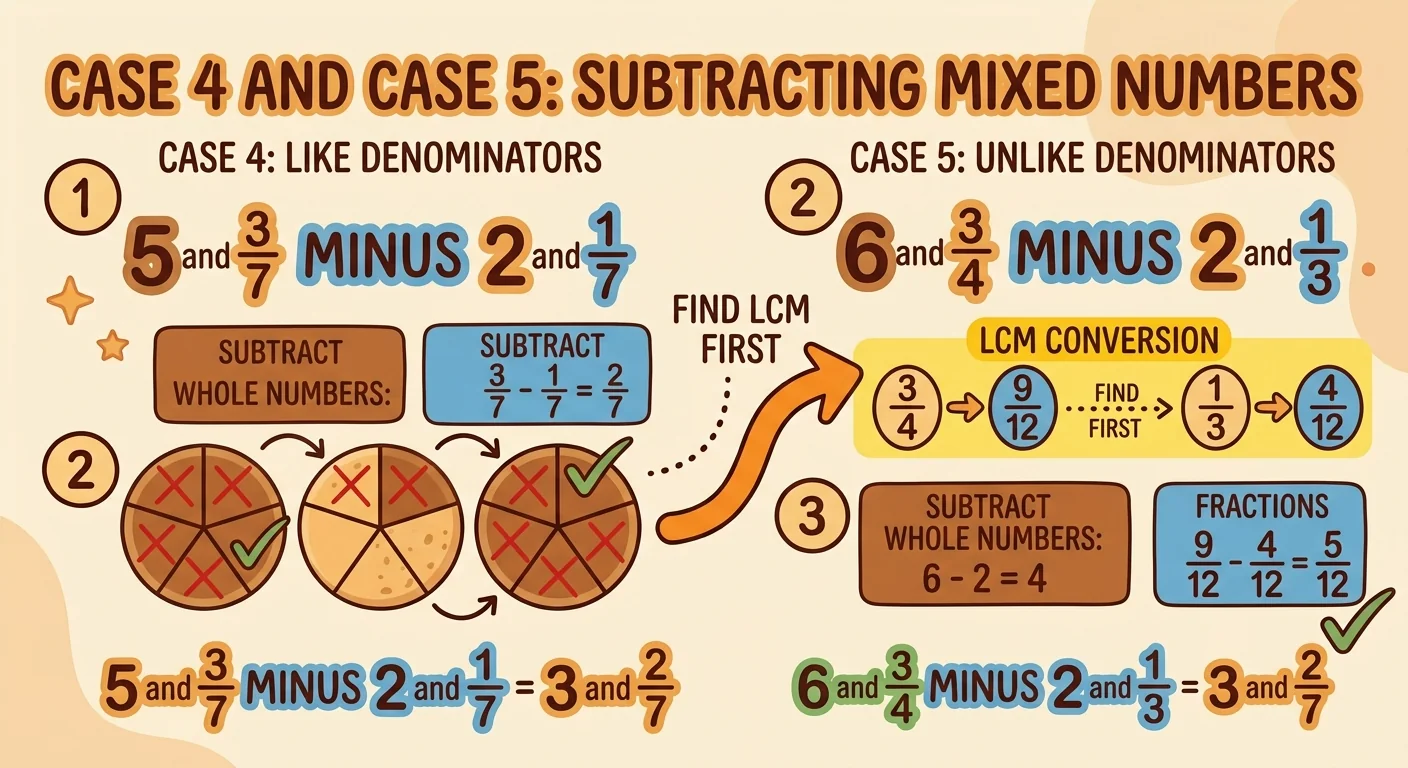
A mixed number has a whole number part and a fraction part, such as 5 and 3/7. When the denominators match and the first fraction is the larger one, this case is straightforward.
The method
- Subtract the whole number parts.
- Subtract the fraction parts.
- Put the two results together.
- Simplify.
Worked example 1: 5 and 3/7 minus 2 and 1/7
Whole numbers: 5 minus 2 = 3. Fractions: 3/7 minus 1/7 = 2/7.
Answer: 3 and 2/7.
Worked example 2: 7 and 5/8 minus 3 and 1/8
Whole numbers: 7 minus 3 = 4. Fractions: 5/8 minus 1/8 = 4/8, which simplifies to 1/2.
Answer: 4 and 1/2.
Before starting, teach your child to run one quick check: is the first fraction bigger than the second? In both examples above it was, so the method works cleanly. When it is not, you need Case 6.
Case 5: Subtracting mixed numbers with unlike denominators
Now two skills combine. Nothing new is introduced, which is worth saying out loud to a nervous child.
The method
- Find the LCM of the two denominators.
- Rewrite both fraction parts with that denominator.
- Subtract the whole numbers.
- Subtract the fractions.
- Combine and simplify.
Worked example 1: 6 and 3/4 minus 2 and 1/3
Step 1. The LCM of 4 and 3 is 12.
Step 2. 3/4 = 9/12 and 1/3 = 4/12.
Step 3. Whole numbers: 6 minus 2 = 4.
Step 4. Fractions: 9/12 minus 4/12 = 5/12.
Answer: 4 and 5/12.
Worked example 2: 8 and 2/5 minus 3 and 1/4
Step 1. The LCM of 5 and 4 is 20.
Step 2. 2/5 = 8/20 and 1/4 = 5/20.
Step 3. Whole numbers: 8 minus 3 = 5.
Step 4. Fractions: 8/20 minus 5/20 = 3/20.
Answer: 5 and 3/20.
Case 6: Subtracting mixed numbers with borrowing
This is the hardest case, the one textbooks rush and children fear. Take it slowly.
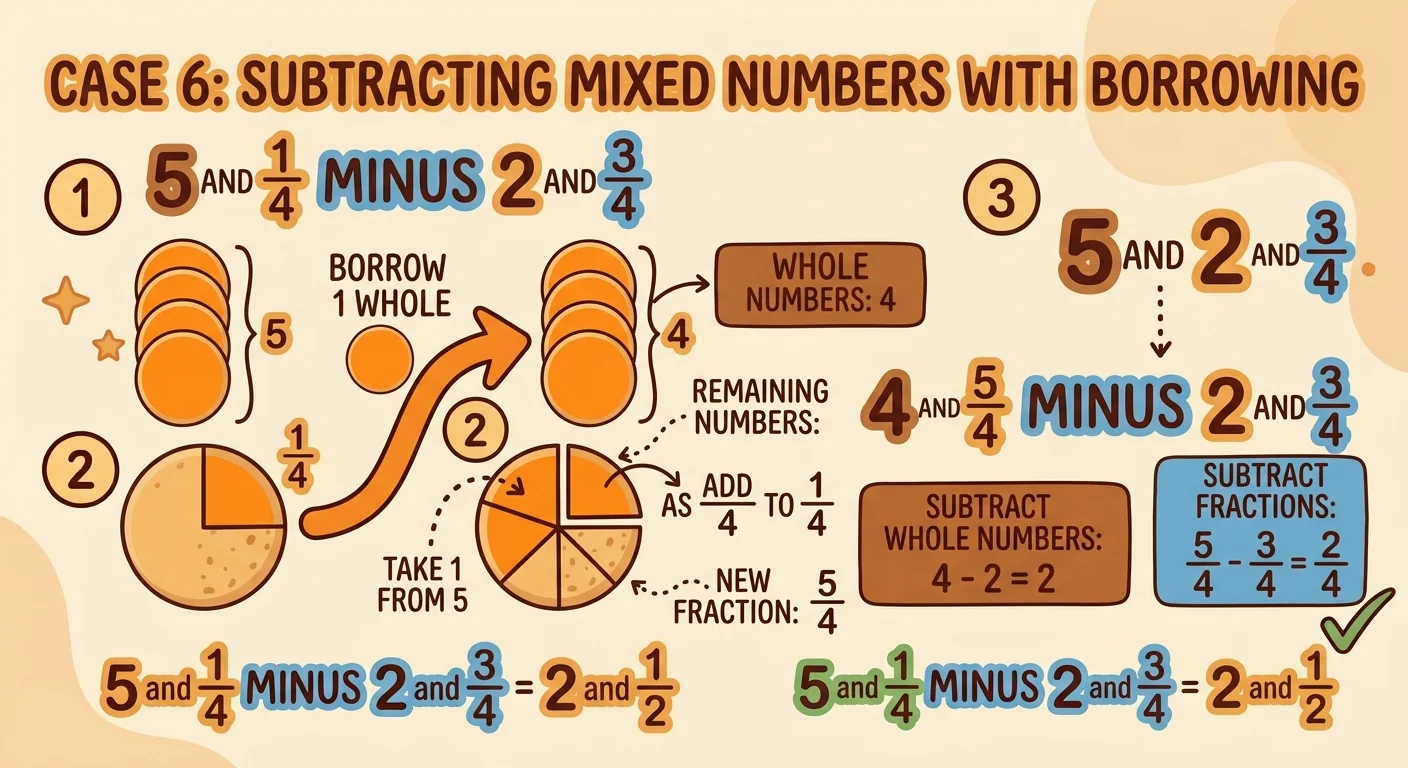
Look at 5 and 1/4 minus 2 and 3/4. Try the Case 4 method and you hit a wall at the fraction step, because 1/4 is smaller than 3/4. You cannot take three quarters away from one quarter.
Your child has solved this problem before, with whole numbers. In 52 minus 38, you cannot take 8 from 2, so you borrow ten from the tens column and turn 2 into 12, exactly as in addition and subtraction with regrouping. Fraction subtraction borrows in exactly the same way, with one difference: you borrow a whole, and a whole is worth as many pieces as the denominator says.
The method
- Make the denominators the same if they are not already.
- Check whether the first fraction is smaller than the second. If it is, borrow.
- To borrow, reduce the whole number by 1 and add that whole to the fraction as denominator-over-denominator.
- Subtract the whole numbers, then the fractions.
- Simplify.
Worked example 1: 5 and 1/4 minus 2 and 3/4
Step 1. Denominators already match.
Step 2. 1/4 is smaller than 3/4, so borrow.
Step 3. Take 1 from the 5, leaving 4. One whole is 4/4. Add it to the existing 1/4: 4/4 plus 1/4 = 5/4.
So 5 and 1/4 becomes 4 and 5/4.
Step 4. Whole numbers: 4 minus 2 = 2. Fractions: 5/4 minus 3/4 = 2/4.
Step 5. 2/4 simplifies to 1/2.
Answer: 2 and 1/2.
Worked example 2: 7 and 1/3 minus 2 and 3/4
Step 1. The LCM of 3 and 4 is 12. So 7 and 1/3 becomes 7 and 4/12, and 2 and 3/4 becomes 2 and 9/12.
Step 2. 4/12 is smaller than 9/12, so borrow.
Step 3. Take 1 from the 7, leaving 6. One whole is 12/12. Add: 12/12 plus 4/12 = 16/12.
So we now have 6 and 16/12 minus 2 and 9/12.
Step 4. Whole numbers: 6 minus 2 = 4. Fractions: 16/12 minus 9/12 = 7/12.
Answer: 4 and 7/12.
Worked example 3: 4 and 2/5 minus 1 and 7/10
Step 1. The LCM of 5 and 10 is 10. So 4 and 2/5 becomes 4 and 4/10.
Step 2. 4/10 is smaller than 7/10, so borrow.
Step 3. Take 1 from the 4, leaving 3. One whole is 10/10. Add: 10/10 plus 4/10 = 14/10. We now have 3 and 14/10 minus 1 and 7/10.
Step 4. Whole numbers: 3 minus 1 = 2. Fractions: 14/10 minus 7/10 = 7/10.
Answer: 2 and 7/10.
If borrowing keeps going wrong, there is a reliable alternative: convert both mixed numbers into improper fractions, subtract, then convert back. For the first example, 5 and 1/4 is 21/4 and 2 and 3/4 is 11/4, so 21/4 minus 11/4 = 10/4 = 2 and 1/2. The same answer. Many children find this method safer, and it is perfectly acceptable in CBSE exams. Teach borrowing for understanding and keep the improper fraction method as a backup.
The mistake almost every child makes
Ask your child to work out 1/2 minus 1/4 and watch what they write. A large number of students produce this:
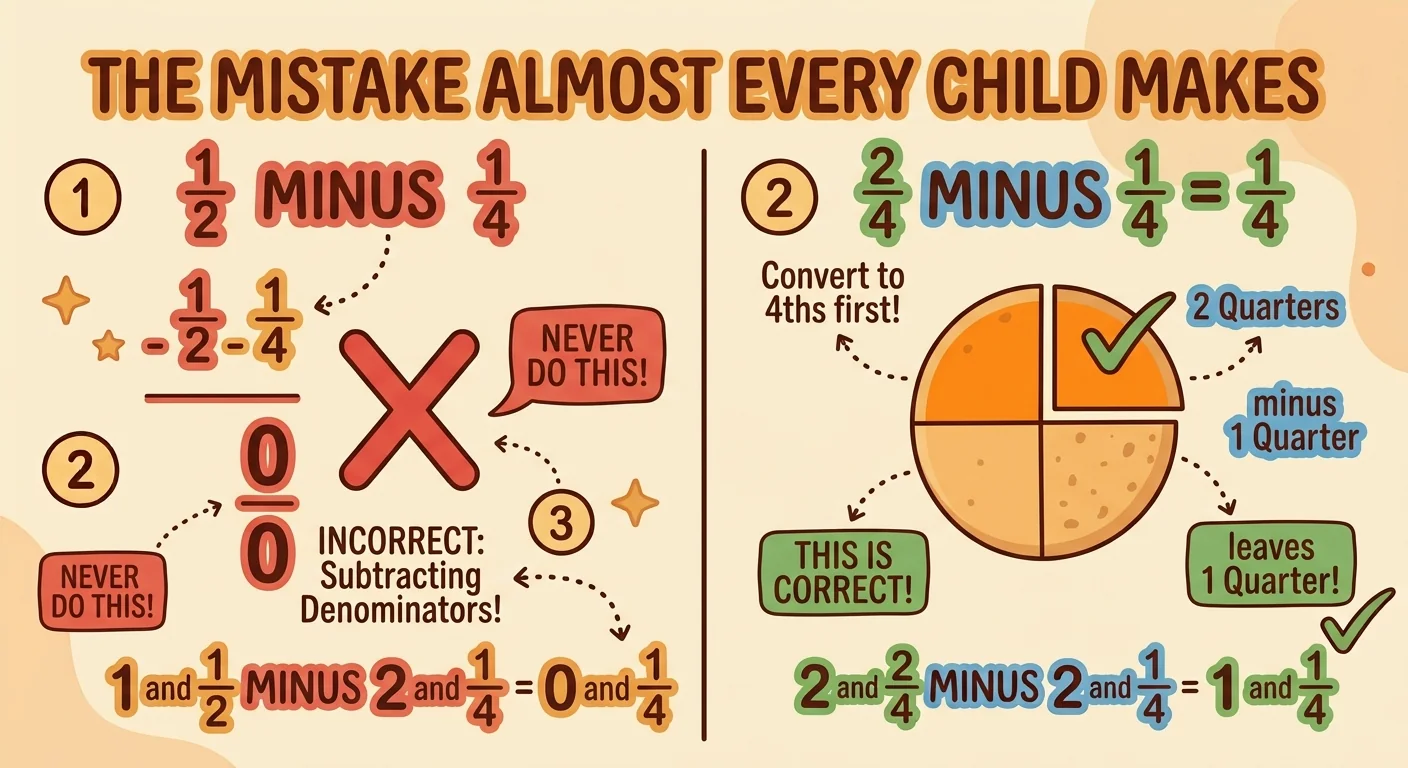
1 minus 1 = 0 on the top 2 minus 4 = negative 2 on the bottom Answer: 0
Or some version of the same idea. It is a reasonable guess, because this is exactly how addition and subtraction work with ordinary numbers, and nobody has told them why fractions are different.
Show them why it cannot be right, using food. Take half a roti. Take away a quarter of a roti. Is there nothing left? Obviously not. There is clearly a piece sitting on the plate, and it is a quarter.
Then do it properly. Rewrite 1/2 as 2/4. Now 2/4 minus 1/4 = 1/4, which is exactly the piece on the plate.
The underlying reason is the one from earlier in this guide. The denominator is not a quantity being subtracted. It is a label describing the size of the pieces. You never subtract labels. You make the labels match, then subtract the counts.
One sentence worth repeating until it sticks: we subtract the numerators, we match the denominators.
Word problems from everyday life
Fraction subtraction shows up constantly once you start looking for it. If your child reads the question and freezes, the general approach in how to solve math word problems applies here too.
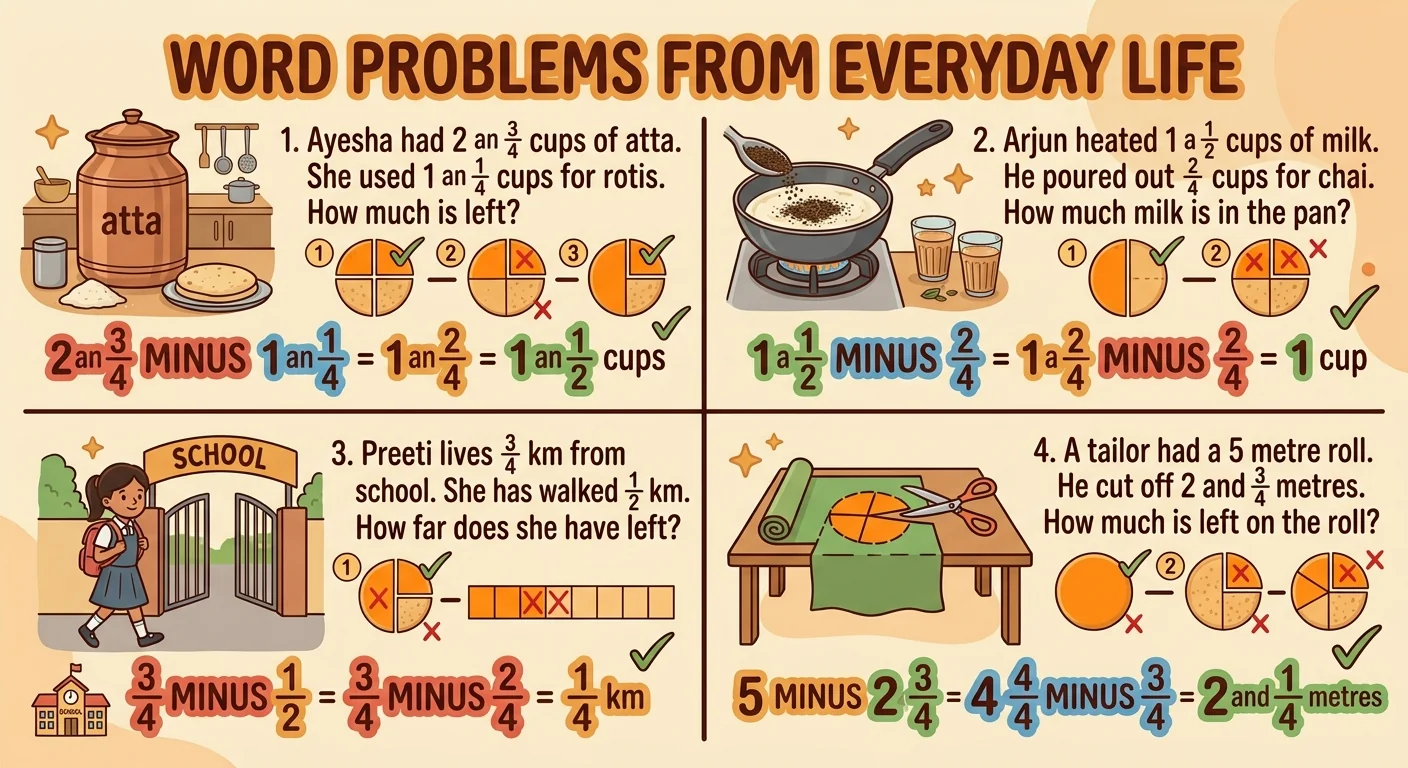
Cooking. Amma had 3/4 kg of atta in the container. She used 1/2 kg to make rotis. How much is left?
3/4 minus 1/2. The LCM of 4 and 2 is 4, so 1/2 = 2/4. Then 3/4 minus 2/4 = 1/4.
Answer: 1/4 kg of atta is left.
Milk. A family had 2 and 1/2 litres of milk. They used 3/4 litre for tea. How much remains?
2 and 1/2 becomes 2 and 2/4. Since 2/4 is smaller than 3/4, borrow: 1 and 6/4. Then 6/4 minus 3/4 = 3/4.
Answer: 1 and 3/4 litres.
Distance. Riya’s school is 7/8 km from home. She has walked 1/3 km. How much further must she walk?
The LCM of 8 and 3 is 24. So 7/8 = 21/24 and 1/3 = 8/24. Then 21/24 minus 8/24 = 13/24.
Answer: 13/24 km.
Time. Arjun has 1 and 1/2 hours before dinner. He spends 2/3 of an hour on homework. How much time is left?
1 and 1/2 is 3/2. The LCM of 2 and 3 is 6, so 3/2 = 9/6 and 2/3 = 4/6. Then 9/6 minus 4/6 = 5/6.
Answer: 5/6 of an hour, which is 50 minutes. Converting the fraction into minutes is easier for children who are already confident telling the time on a clock.
Length. A tailor has a 5 metre roll of cloth and cuts off 2 and 3/4 metres. How much is left on the roll?
5 becomes 4 and 4/4. Whole numbers: 4 minus 2 = 2. Fractions: 4/4 minus 3/4 = 1/4.
Answer: 2 and 1/4 metres.
Encourage your child to say the answer in a full sentence, with the unit attached. A bare “1/4” is a number. “One fourth of a kilogram of atta is left” is an answer to a question, and it forces a sanity check.
How fraction subtraction connects to everything else
Fraction subtraction is not an isolated chapter. It sits in the middle of a web of skills, and weakness anywhere shows up here.
Early fraction sense. Everything here rests on knowing what a fraction is in the first place, which is built from fractions for Class 3 onwards.
Equivalent fractions. Every unlike denominator problem is an equivalent fractions problem wearing a disguise. A child who cannot confidently say that 3/4 equals 9/12 will never be fluent at subtraction.
LCM and HCF. The LCM creates the common denominator at the start. The HCF simplifies the answer at the end. Fraction subtraction is one of the few places where both appear in a single sum, which makes it excellent revision for both.
Fraction addition. Addition and subtraction of fractions use identical preparation. Same LCM, same equivalent fractions, same simplification. Only the final operation differs. If your child is comfortable adding fractions, say so, because it means they already know most of this.
Whole number subtraction. Borrowing in Case 6 is the same logic as borrowing in 52 minus 38. Pointing out that connection turns the hardest case into something familiar.
Decimals and percentages. In Class 6 and beyond, 1/2 minus 1/4 becomes 0.5 minus 0.25 and later 50% minus 25%, which is why converting a decimal to a fraction belongs in the same revision block. The fraction version is the foundation underneath both.
Common mistakes at each stage
At the start: subtracting the denominators. Covered above. Fix it by returning to the chapati and the laddoo language.
Finding the LCM: multiplying the denominators every time. For 3/8 minus 1/4, a child might use 32 instead of 8. The answer still comes out right after simplification, but the numbers get ugly and errors creep in. Fix it by always checking first whether the smaller denominator divides into the larger one.
Converting: forgetting to change the numerator. A child writes 3/4 = 3/12 instead of 9/12. This is the single most common cause of wrong answers in Case 2. Fix it by writing the multiplier above the arrow on both top and bottom, so the pair is visible.
Mixed numbers: ignoring the whole number. A child subtracts the fractions, gets an answer, and forgets the whole number part entirely. Fix it by insisting the whole numbers get written down first, before any fraction work begins.
Borrowing: taking 10 instead of the denominator. A child who has just done decimal subtraction may turn 5 and 1/4 into 4 and 11/4. Fix it by asking the question out loud every time: “How many quarters are in one whole?”
At the end: forgetting to simplify. Fix it with the habit described earlier. Every fraction answer gets one final question before the pen goes down.
Eight activities to practise at home and in class
None of these need anything you would have to buy.
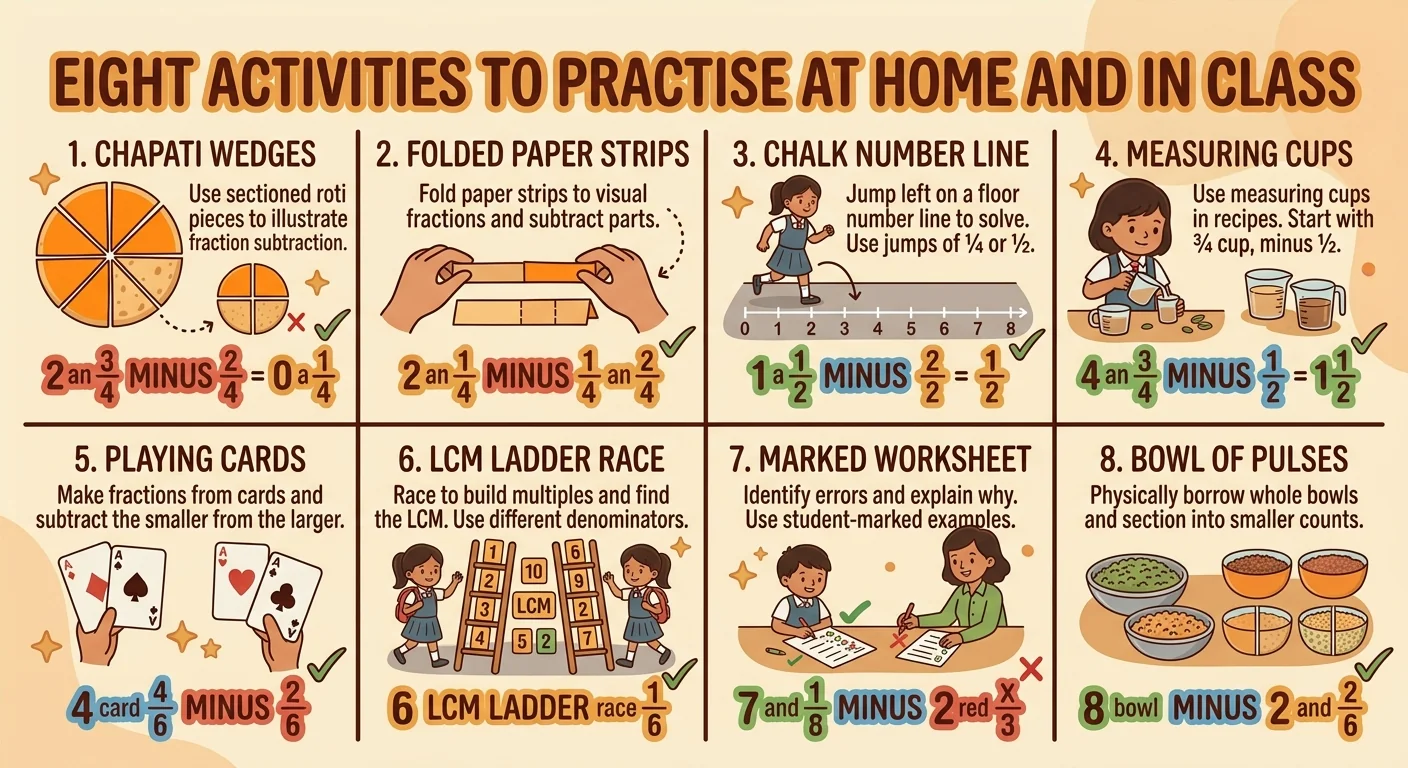
1. The chapati challenge. At mealtime, cut a chapati into 8 equal pieces. Ask your child to remove 3 and say the subtraction sentence out loud: 8/8 minus 3/8 = 5/8. Vary the number of pieces each day.
2. Paper strip fraction bars. Cut strips of paper of equal length. Fold one into halves, one into quarters, one into sixths, one into eighths. Label every section. Now subtraction becomes physical: lay the sixths strip on top of the halves strip and see how many sixths cover a half.
3. Floor number line. Use chalk or masking tape to mark a line from 0 to 2 on the floor, divided into quarters. Call out a sum such as 7/4 minus 3/4 and let your child hop backwards to the answer. Movement fixes the idea of subtraction as jumping left.
4. Kitchen measuring. Keep a 1/4 cup and a 1/2 cup measure on the counter. Ask questions while cooking: we need 3/4 cup of rice and we have already put in 1/2 cup, so how much more? Real answers with real consequences hold attention.
5. Fraction war. Use a deck of cards with face cards removed. Each player turns over two cards to make a fraction. Both players subtract the smaller fraction from the larger one, and whoever has the bigger difference wins the round. This drills unlike denominators without feeling like a worksheet.
6. The LCM ladder race. Call out two denominators. Both players write the multiples of each number as a ladder, racing to circle the first shared number. Fast, competitive, and it builds the exact reflex Case 2 needs.
7. Spot the error. Write five fraction subtractions on paper, three correct and two containing the classic mistakes from the section above. Ask your child to be the teacher and mark them. Finding errors is harder than avoiding them, and it builds real understanding.
8. The borrowing bank. Keep a bowl of 12 small objects such as pulses or buttons. One bowl is “one whole”, divided into 12 parts. When a sum needs borrowing, physically bring one whole bowl in and count out its 12 pieces. After doing this three or four times, borrowing with fractions stops feeling abstract.
9. Ribbon cutting. Give your child a strip of ribbon or string marked in metres and half metres. Ask them to cut 2 and 3/4 metres from a 5 metre length and work out what is left before measuring to check.
Tips for parents
Start with food, paper or the number line every single time a new case is introduced. Reach for the written method only after your child can predict roughly what the answer should be.
Do not rush to the next case. A child who is shaky on like denominators will not survive borrowing. Spend a full week on Cases 1 and 2 if that is what it takes.
When an answer is wrong, ask your child to explain their steps rather than correcting them straight away. Nine times out of ten they will catch the error themselves while explaining, and that is far more useful than being told.
Keep sessions short. Fifteen focused minutes beats an hour of frustration, especially with fractions.
Praise the method, not just the answer. “You remembered to check the denominators first” teaches more than “correct”.
If your child keeps making the same error, go back one level rather than repeating the same practice. Trouble with Case 2 usually means equivalent fractions need work, not that more subtraction questions are needed. For a much younger sibling starting out, teaching fractions to Grade 2 students covers the stage before this one.
Tips for teachers
Teach like denominators until the class is genuinely bored before introducing unlike denominators. The boredom is the signal that the foundation is secure.
Introduce the unlike denominator case with a problem the class cannot solve yet, such as 1/2 minus 1/3 with fraction bars. Let them struggle for two minutes. Discovering the need for a common unit is far more powerful than being handed the LCM rule.
Use consistent language across the whole unit. Pick either “like and unlike fractions” or “same and different denominators” and stay with it. Switching terms mid unit creates confusion that looks like weak maths.
Build in error analysis tasks. Showing a worked solution with a deliberate mistake and asking students to find it reveals misconceptions faster than marking twenty correct sums.
Set mixed practice rather than blocked practice once all six cases have been taught. Students who only ever see a page of borrowing problems learn to borrow without checking whether borrowing is needed.
Connect to NCERT exercises explicitly. Class 5 covers like and simple unlike fractions, and Class 6 extends into mixed numbers and harder unlike denominators, so sequencing your lessons along that progression keeps you aligned with the textbook your students carry.
From fraction subtraction to Olympiad problems
Competition maths rarely asks a child to compute 3/4 minus 1/6. Browsing a few math olympiad questions shows the difference immediately. It asks questions where fraction subtraction is one step inside a bigger idea, and children who are fluent at the basics have room in their heads for the clever part.
Comparing differences. Which is larger, 1/2 minus 1/3 or 1/3 minus 1/4? Work both out: 1/6 and 1/12. The first is larger. Children often assume the gaps between unit fractions stay the same, and seeing that they shrink is a genuine insight.
Spotting a pattern. Calculate 1/2 minus 1/3, then 1/3 minus 1/4, then 1/4 minus 1/5. The answers are 1/6, 1/12 and 1/20. Each answer has the two denominators multiplied together on the bottom. This is the pattern that unlocks telescoping sums at higher levels, and a Class 6 student can find it unaided.
Equal differences in disguise. Which is bigger, 5/7 minus 1/2 or 1/2 minus 2/7? Both come to 3/14. Questions like this reward careful work rather than guessing, which is exactly the habit built in how to solve math olympiad problems.
Working backwards. A tank is 7/8 full. After some water is used, it is 1/3 full. What fraction was used? The answer is 7/8 minus 1/3 = 21/24 minus 8/24 = 13/24. Olympiad problems love this structure, where the subtraction is hidden inside the situation.
Practice questions with answers
Work through these in order. The difficulty rises steadily.
Like denominators
- 7/11 minus 3/11
- 11/14 minus 4/14
Unlike denominators
- 5/6 minus 1/3
- 7/8 minus 2/5
Whole numbers
- 4 minus 3/7
- 2 minus 5/6
Mixed numbers, like denominators
- 9 and 5/6 minus 4 and 1/6
- 6 and 7/10 minus 2 and 3/10
Mixed numbers, unlike denominators
- 5 and 2/3 minus 2 and 1/4
- 7 and 3/5 minus 1 and 1/2
Mixed numbers with borrowing
- 6 and 1/5 minus 3 and 4/5
- 8 and 1/6 minus 2 and 3/4
Challenge
- 3 minus 1 and 5/8
- 10 and 1/4 minus 3 and 5/6
Answers
- 4/11
- 7/14 = 1/2
- 3/6 = 1/2
- 19/40
- 3 and 4/7
- 1 and 1/6
- 5 and 4/6 = 5 and 2/3
- 4 and 4/10 = 4 and 2/5
- 3 and 5/12
- 6 and 1/10
- 2 and 2/5
- 5 and 5/12
- 1 and 3/8
- 6 and 5/12
Frequently asked questions
How do you subtract fractions?
To subtract fractions, make sure both fractions have the same denominator. If they already match, subtract the numerators and keep the denominator unchanged. If they do not match, find the LCM of the two denominators, rewrite both fractions with that denominator, then subtract the numerators. Simplify the final answer using the HCF.
How do you subtract fractions with different denominators?
Find the LCM of the two denominators, convert each fraction into an equivalent fraction with the LCM as its denominator, subtract the numerators while keeping the common denominator, and simplify. For example, 3/4 minus 1/6 becomes 9/12 minus 2/12, which equals 7/12.
Why does the denominator stay the same when subtracting like fractions?
Because the denominator describes the size of each piece, not a quantity being removed. If you have 5 eighths and take away 2 eighths, you have 3 eighths. The pieces were never re-cut, so their size and their name do not change.
Why can I not just subtract both the numerators and the denominators?
Because that would change the size of the pieces in the middle of the calculation. Test it on 1/2 minus 1/4. Subtracting both parts suggests nothing is left, but half a roti minus a quarter of a roti obviously leaves a quarter. The correct method is 2/4 minus 1/4 = 1/4.
Do I always have to use the LCM?
No, any common denominator works, including the product of the two denominators. The LCM simply keeps the numbers smallest and reduces the simplifying work at the end. Using 32 instead of 8 for 3/8 minus 1/4 gives the right answer by a longer road.
How do I subtract a fraction from a whole number?
Take one whole out of the whole number and write it as a fraction with the denominator you need. For 3 minus 2/5, rewrite 3 as 2 and 5/5, then subtract 2/5 from 5/5 to get 3/5. The answer is 2 and 3/5.
When do I need to borrow in fraction subtraction?
Borrow when the first fraction is smaller than the second after both have been given a common denominator. For 5 and 1/4 minus 2 and 3/4, one quarter is smaller than three quarters, so you reduce the 5 to 4 and turn 1/4 into 5/4 before subtracting.
Can the answer to a fraction subtraction be negative?
Yes, if you subtract a larger fraction from a smaller one. In Class 5 and Class 6, questions are almost always arranged so this does not happen, and negative numbers are introduced separately. If your child gets a negative result, the first thing to check is whether the fractions were written in the wrong order.
Is it better to use borrowing or to convert to improper fractions?
Both are correct and both appear in NCERT material. Borrowing keeps the whole numbers visible and builds a link to whole number subtraction. Converting to improper fractions involves fewer decisions and suits children who find borrowing fiddly. Teach the first for understanding and keep the second available.
Which class covers subtracting fractions?
Like fractions and simple unlike fractions are introduced in Class 5. Class 6 extends the work to harder unlike denominators, mixed numbers and word problems, and expects answers in lowest terms.

Mikha Piregu is a Content Writer with experience spanning educational content, including math and math olympiad topics, as well as advocacy writing, research-based articles, and SEO-driven web content. He creates high-quality blog content, web copy, and feature articles that support brand visibility, audience engagement, and long-term organic growth through data-informed storytelling. Skilled in WordPress, WooCommerce, and modern digital tools, Mikha adapts content across various platforms, including blogs, websites, campaigns, and advocacy initiatives, with clarity and purpose.

There are no comments posted here yet.
Sign in to leave a comment