


Divisibility rules are quick shortcuts to check if a number can be divided by another number without leaving a remainder.
Divisibility rules are quick tests that tell you whether one number divides another exactly, with no remainder, without dividing. A number is divisible by 2 if its last digit is even, by 3 if its digit sum is a multiple of 3, by 5 if it ends in 0 or 5, and so on for every divisor from 1 to 12.
- What Does Divisibility Actually Mean?
- Why Divisibility Rules Work at All
- Divisibility Rules 1 to 12, With the Reasoning Behind Each
- Combination Rules for Composite Divisors
- Divisibility Rules Chart (1 to 12)
- How to Check a Large Number Using Several Rules
- How Divisibility Connects to Factors, Multiples, Primes, HCF and LCM
- Divisibility Rules in Olympiad Problems
- Common Mistakes and How to Correct Them
- Activities and Mental Maths Games
- Tips for Parents Helping at Home
- Tips for Teachers in the Classroom
- Practice Questions With Answers
- Frequently Asked Questions
- Final Thoughts
A child who has memorised “add the digits for 3” has nothing to fall back on when the number is 47,952 and the pressure is on. A child who understands why adding the digits works will reconstruct the rule from scratch, every time, years later.
This guide gives you all twelve rules, the reasoning behind each one, worked examples on large numbers, a reference chart, combination rules for composite divisors, Olympiad style applications, activities you can run at home, and practice questions with answers.
What Does Divisibility Actually Mean?
One number is divisible by another when the division leaves no remainder. That is the whole definition.
Take 56 and 8. When you divide 56 by 8 you get 7, a whole number, nothing left over. So 56 is divisible by 8. Take 56 and 9. You get 6 with 2 left over, so 56 is not divisible by 9.
Three ways of saying the same thing, all of which your child will meet in the NCERT textbook:
- 56 is divisible by 8
- 8 is a factor of 56
- 56 is a multiple of 8
One point to settle early: divisibility is about whole numbers only. Every number can be divided by 9 in the sense that 56 divided by 9 gives 6.22, but that is not what divisibility asks. Divisibility asks whether the answer lands exactly on a whole number.
A quick recap: factors, multiples and remainders
If factors and multiples are still shaky, fix that before touching the rules, because the rules are tools for finding factors.
A factor of a number divides it exactly. The factors of 24 are 1, 2, 3, 4, 6, 8, 12 and 24.
A multiple of a number is what you get when you multiply it by a whole number. The multiples of 7 are 7, 14, 21, 28, 35 and onwards forever.
A remainder is what is left when the division does not come out exactly. 25 divided by 4 is 6 remainder 1. Divisibility means the remainder is 0.
A prime number has exactly two factors, 1 and itself: 2, 3, 5, 7, 11, 13 and so on. A composite number has more than two factors, like 6, 8, 9 and 12.
Why Divisibility Rules Work at All
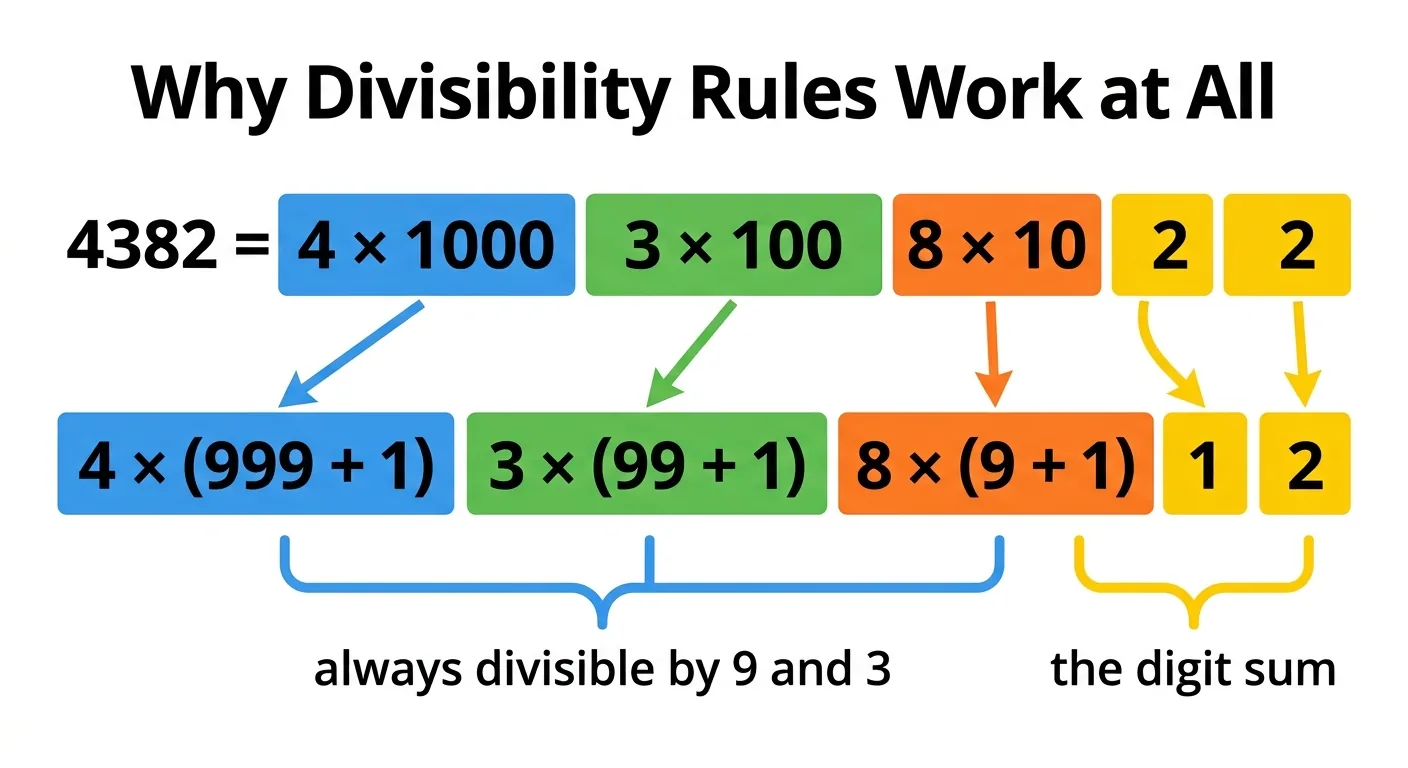
Here is the question almost no textbook answers. Why should adding up the digits of a number tell you anything at all about whether 3 divides it?
The answer is place value. Our number system is built on powers of ten, and every power of ten carries useful properties.
Write 4,382 in expanded form:
4382 = 4 x 1000 + 3 x 100 + 8 x 10 + 2
Look at what that gives you. The numbers 10, 100 and 1000 are all multiples of 2, of 5 and of 10. So whatever those first three terms contribute, they contribute a multiple of 2 or 5 or 10 already. Only the last digit, the 2, is unaccounted for. That is why the rules for 2, 5 and 10 look only at the last digit. There is nothing left to check anywhere else.
Now take a different angle on the same number. Since 1000 = 999 + 1, and 100 = 99 + 1, and 10 = 9 + 1:
4382 = 4 x (999 + 1) + 3 x (99 + 1) + 8 x (9 + 1) + 2
Split that into two parts: everything built from 999, 99 and 9, plus the leftovers 4 + 3 + 8 + 2. The first part is a multiple of 9, and so also a multiple of 3, whatever the digits happen to be. So the only thing that decides divisibility by 3 or 9 is the leftover part, which is exactly the sum of the digits. That is the whole proof, and a Class 6 student can follow it.
The same reasoning explains 4 and 8. Since 100 is a multiple of 4, every hundred, thousand and ten thousand inside a number is already divisible by 4, so only the last two digits matter. Since 1000 is a multiple of 8, only the last three digits matter for 8.
So the rules are not twelve unrelated tricks. They are three ideas:
- Last digits, for divisors that divide a power of ten (2, 4, 5, 8, 10)
- Digit sums, for divisors that divide 9 (3 and 9)
- Alternating digit sums, for 11, because 11 divides 99, 9999 and every even length string of nines
Everything else, 6 and 12 included, is a combination of those three.
Divisibility Rules 1 to 12, With the Reasoning Behind Each
Each rule below comes in four parts: the rule itself, why it is true, two worked examples on large numbers, and a quick check your child can use under exam pressure. Work through them in the order given rather than jumping to 7, because the later rules lean on the earlier ones.
Divisibility rule for 1
The rule: every whole number is divisible by 1.
Why it works: dividing by 1 means splitting a quantity into groups of one. You can always do that, and nothing is ever left over. 1 is a factor of every number, which is why 1 appears in every factor list your child writes.
Quick check: there is nothing to check. If a question asks whether 68,431 is divisible by 1, the answer is yes.
Divisibility rule for 2
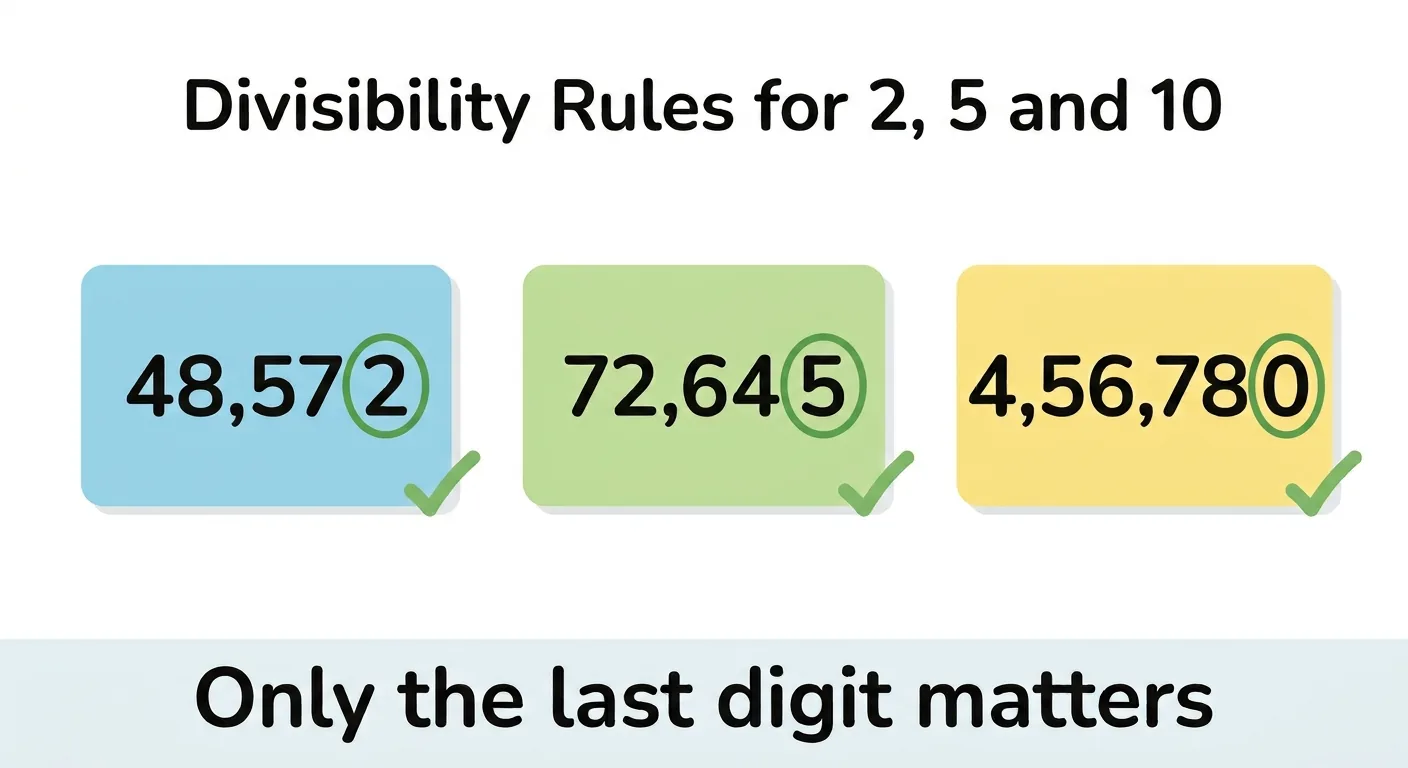
The rule: a number is divisible by 2 if its last digit is 0, 2, 4, 6 or 8.
Why it works: 10 is a multiple of 2, so every ten, hundred and thousand in a number is already even. In 7,436 the part 7,430 is a multiple of 10 and so certainly a multiple of 2. The only thing that can spoil it is the last digit. Check 6, and you have checked the whole number.
Worked example 1: is 48,572 divisible by 2? The last digit is 2, which is even. Yes.
Worked example 2: is 3,96,847 divisible by 2? The last digit is 7, which is odd. No. Notice how little the other five digits mattered.
Quick check: if the last digit is even, the number is even, however long it is.
Divisibility rule for 5
The rule: a number is divisible by 5 if its last digit is 0 or 5.
Why it works: the same place value argument. 10 is a multiple of 5, so everything to the left of the units digit is already a multiple of 5. What remains is the last digit, and the only single digits divisible by 5 are 0 and 5.
Worked example 1: is 72,645 divisible by 5? The last digit is 5. Yes, and in fact 72,645 divided by 5 is 14,529.
Worked example 2: is 1,20,308 divisible by 5? The last digit is 8. No.
Quick check: ends in 0 or 5, nothing else counts. A number ending in 50 or 500 is divisible by 5 twice over, which matters when you are hunting for factors.
Divisibility rule for 10
The rule: a number is divisible by 10 if its last digit is 0.
Why it works: 10 = 2 x 5, so a number divisible by 10 must be divisible by both 2 and 5. The only digit that is both even and a multiple of 5 is 0. This is your child’s first combination rule, even if nobody calls it that.
Worked example 1: is 4,56,780 divisible by 10? It ends in 0. Yes.
Worked example 2: is 65,075 divisible by 10? It ends in 5, so it passes the test for 5 but fails the test for 2. No.
Quick check: count the zeros at the end. Two zeros means divisible by 100, three means divisible by 1000.
Divisibility rule for 3
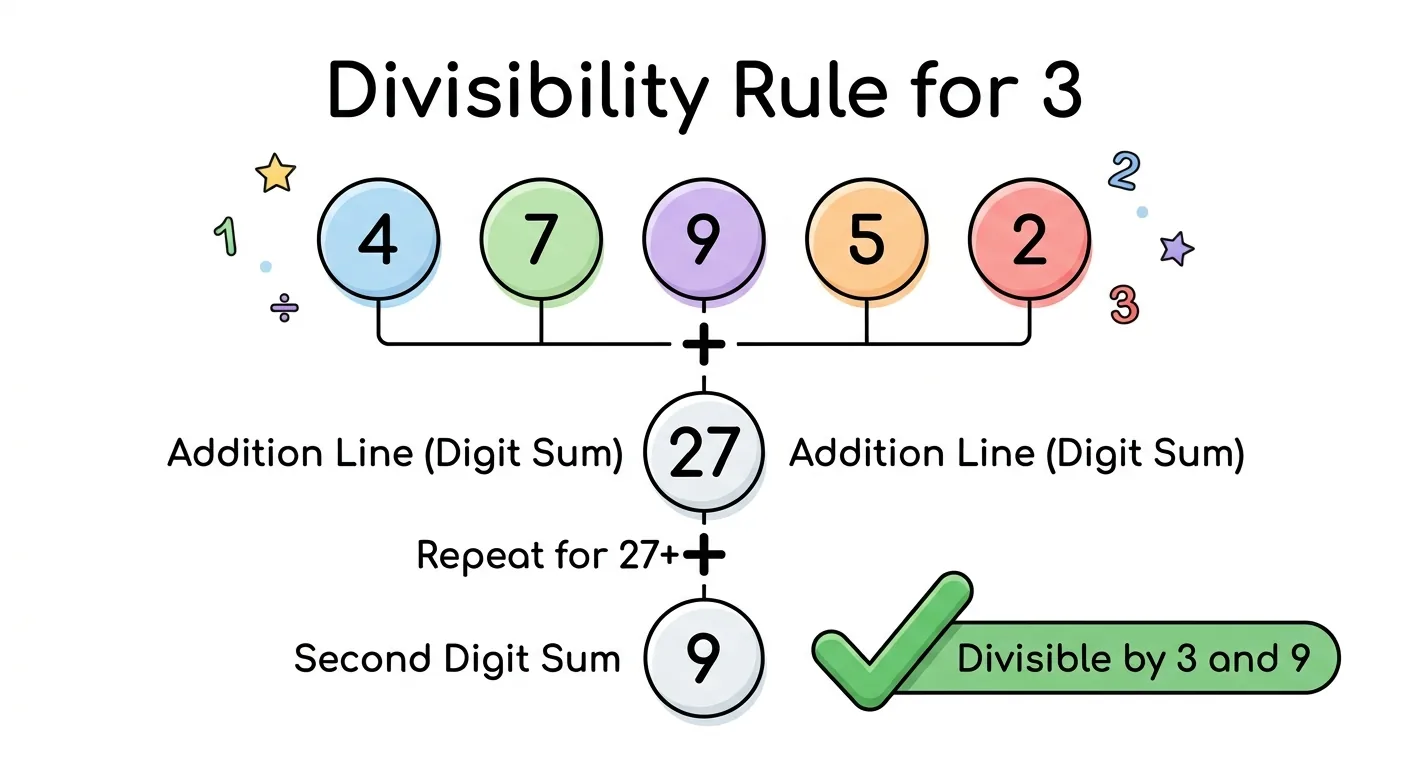
The rule: a number is divisible by 3 if the sum of its digits is divisible by 3.
Why it works: this is the rule children memorise and lose, so it is the one worth slowing down for.
Take 231. Write it as 2 hundreds, 3 tens and 1 unit. Now replace each place value with a string of nines plus one:
231 = 2 x (99 + 1) + 3 x (9 + 1) + 1
Multiply out and you get 2 x 99 + 3 x 9, plus 2 + 3 + 1. The first group is built entirely from 99 and 9, which are both multiples of 3, so that group is a multiple of 3 no matter which digits you started with. The second group is just the digit sum, 6. Since 6 is a multiple of 3, the whole number is.
Say it to your child in one sentence: every 10 is a 9 plus 1, every 100 is a 99 plus 1, and all the nines are already divisible by 3, so the only part that still needs checking is the pile of leftover ones, which is the digit sum.
Worked example 1: is 47,952 divisible by 3? Add the digits: 4 + 7 + 9 + 5 + 2 = 27. Since 27 is a multiple of 3, yes. If 27 is still too big to judge, add again: 2 + 7 = 9, a multiple of 3.
Worked example 2: is 2,16,847 divisible by 3? Add the digits: 2 + 1 + 6 + 8 + 4 + 7 = 28. Then 2 + 8 = 10, which is not a multiple of 3. No. And the remainder when you divide 28 by 3 is 1, which is also the remainder when you divide 2,16,847 by 3. The digit sum carries the remainder too.
Quick check: strike out digits that are 3, 6, 9 or that pair up to a multiple of 3 before adding. In 47,952 you can cross out the 9, and 4 + 5 = 9, leaving 7 + 2 = 9. Three nines, so it is divisible by 3 and by 9.
Divisibility rule for 9
The rule: a number is divisible by 9 if the sum of its digits is divisible by 9.
Why it works: exactly the same proof as for 3, only cleaner. The part built from 9, 99 and 999 is a multiple of 9 by construction. The leftover part is the digit sum. So the digit sum decides it.
This is the rule to use when you want to show a child that these are not tricks. Ask them to pick any five digit number, add its digits, and compare. The relationship holds every single time, and a child who has tested it twenty times on their own numbers owns it in a way no amount of revision can match.
Worked example 1: is 84,357 divisible by 9? Add: 8 + 4 + 3 + 5 + 7 = 27, and 2 + 7 = 9. Yes. Dividing confirms it: 84,357 divided by 9 is 9,373.
Worked example 2: is 6,21,470 divisible by 9? Add: 6 + 2 + 1 + 4 + 7 + 0 = 20, and 2 + 0 = 2. No. The remainder is 2.
Memory aid: every multiple of 9 is a multiple of 3, but not the other way round. 24 passes the test for 3 and fails the test for 9. So if the digit sum is divisible by 9, you can stop: the number is divisible by both 3 and 9.
Divisibility rule for 4
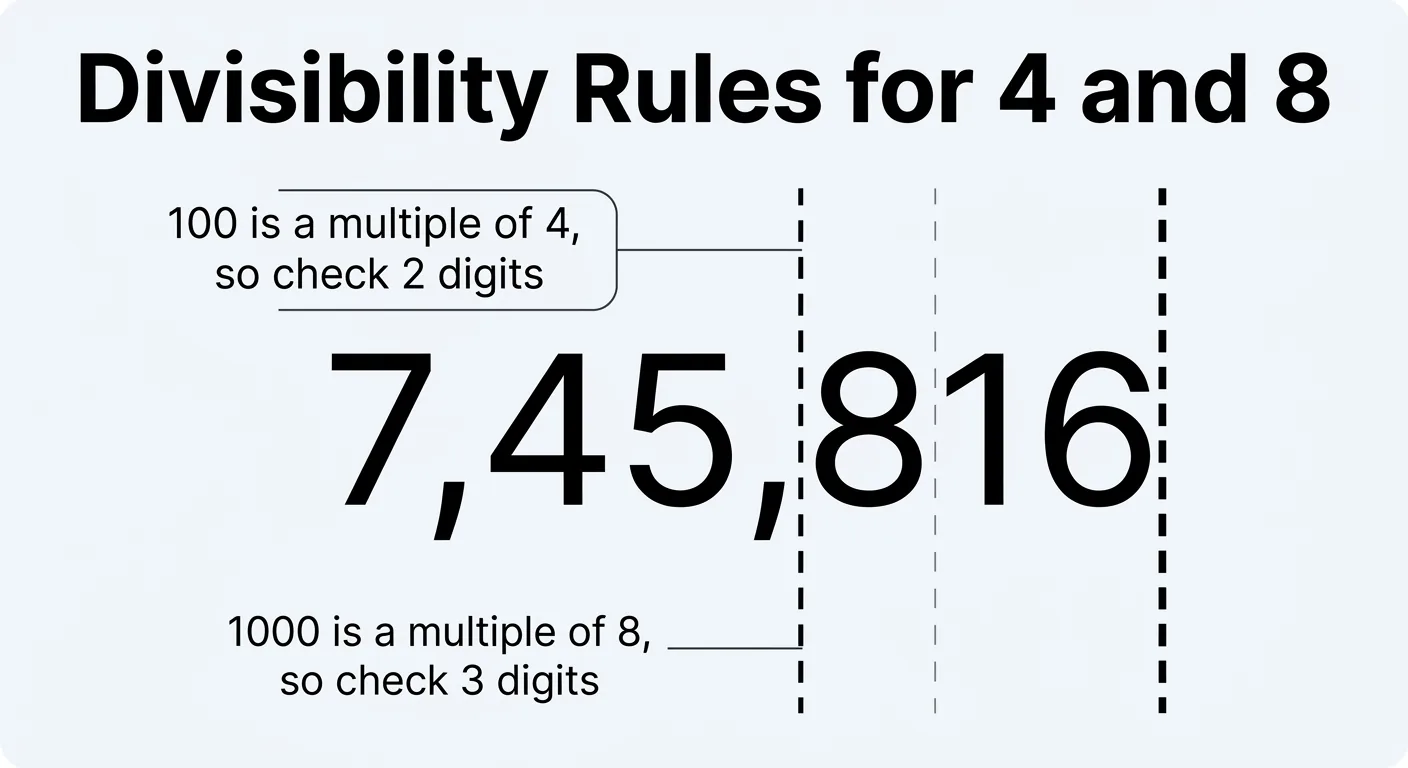
The rule: a number is divisible by 4 if the number formed by its last two digits is divisible by 4.
Why it works: 100 is 4 x 25. So every hundred inside a number is already a multiple of 4, and so is every thousand, every ten thousand and every lakh, because they are all multiples of 100. In 7,13,528 the part 7,13,500 is a multiple of 100 and therefore a multiple of 4 with nothing left over. Only the last two digits, 28, are still in question.
This is the rule children most often mangle by adding the digits instead, borrowing the method from 3 and 9. Adding digits does not work for 4, and the reason is in the proof: 4 does not divide 9, 99 or 999, so the nines trick has nothing to stand on.
Worked example 1: is 7,13,528 divisible by 4? Last two digits: 28. Since 28 = 4 x 7, yes.
Worked example 2: is 92,654 divisible by 4? Last two digits: 54. Since 54 divided by 4 is 13.5, no. The number is even, so it passes the test for 2, but 2 and 4 are different questions.
Quick check: if the last two digits are hard to judge, halve them twice. 28 halved is 14, halved again is 7, a whole number, so 28 is divisible by 4. With 54: halved is 27, halved again is 13.5, so no.
Divisibility rule for 8
The rule: a number is divisible by 8 if the number formed by its last three digits is divisible by 8.
Why it works: 1000 is 8 x 125. So every thousand inside a number is already a multiple of 8. In 45,816 the part 45,000 is a multiple of 1000 and therefore of 8. Only the last three digits, 816, need testing. Note that 100 is not a multiple of 8, which is precisely why two digits are not enough here and three are.
The pattern is now visible to your child, and it is worth naming out loud: 2 needs one digit because 10 is a multiple of 2, 4 needs two digits because 100 is a multiple of 4, 8 needs three digits because 1000 is a multiple of 8. Each step up doubles the divisor and takes one more digit.
Worked example 1: is 7,45,816 divisible by 8? Last three digits: 816. Since 816 = 8 x 10², yes.
Worked example 2: is 2,16,302 divisible by 8? Last three digits: 302. Since 302 divided by 8 is 37.75, no. Watch what happens here: 302 is divisible by 2 and the full number is divisible by 2, but not by 4 or 8.
Quick check: halve three times. 816 to 408 to 204 to 102, all whole numbers, so 816 is divisible by 8. With 302: 151, then 75.5, so no.
Divisibility rule for 11
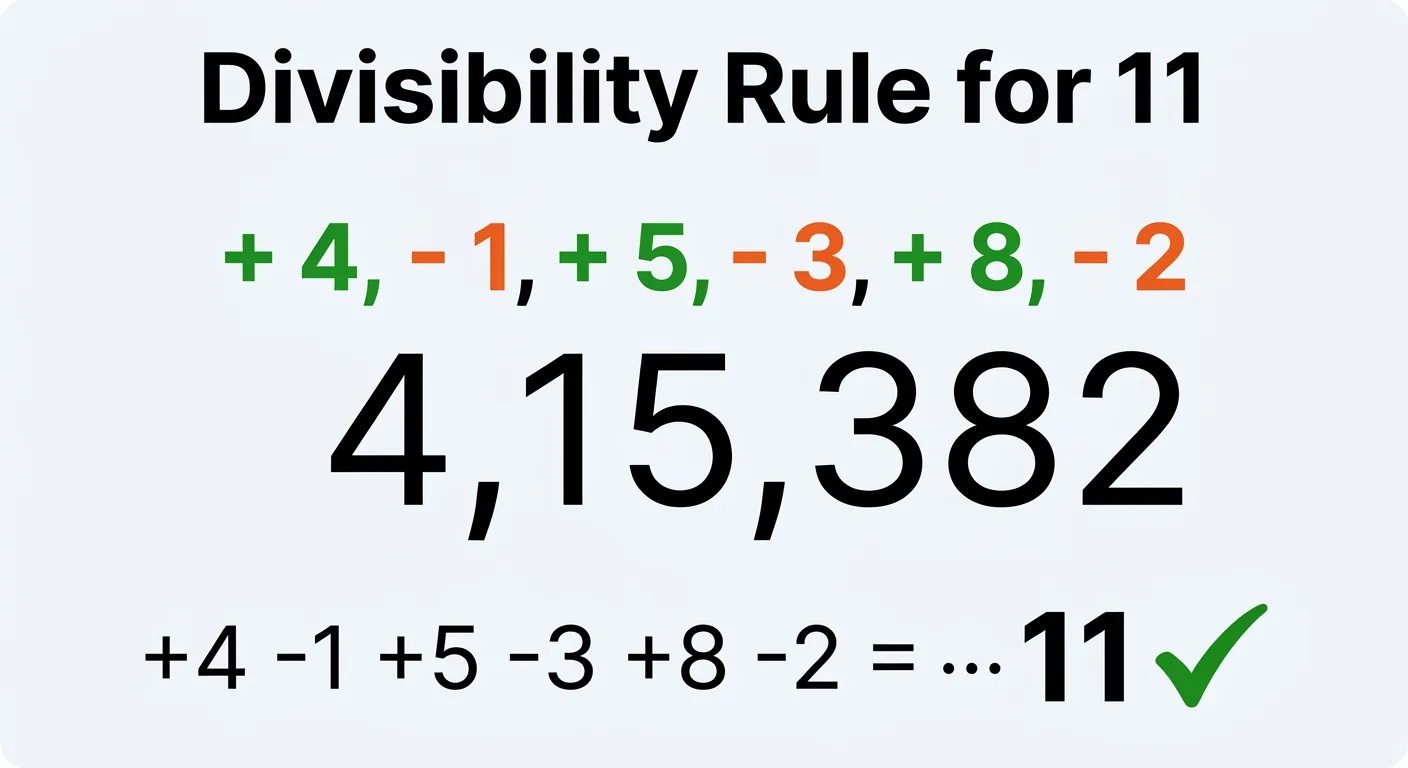
The rule: add and subtract the digits alternately, from left to right. If the result is 0 or a multiple of 11, the number is divisible by 11.
Why it works: the nines trick again, with a twist. Look at what the powers of ten do around 11:
- 10 = 11 minus 1
- 100 = 99 + 1, and 99 = 11 x 9
- 1000 = 1001 minus 1, and 1001 = 11 x 91
- 10000 = 9999 + 1, and 9999 = 11 x 909
So each place value is one more or one less than a multiple of 11, and the sign flips as you move along. Units sit at plus one, tens at minus one, hundreds at plus one, and so on. Throw away all the exact multiples of 11 and what remains is the digits with alternating signs. That is the rule.
Worked example 1: is 8,15,692 divisible by 11? Alternate from the left: 8 minus 1 + 5 minus 6 + 9 minus 2 = 13. Since 13 is not a multiple of 11, no.
Worked example 2: is 4,15,382 divisible by 11? Alternate: 4 minus 1 + 5 minus 3 + 8 minus 2 = 11. Since 11 is a multiple of 11, yes. Check: 4,15,382 divided by 11 is 37,762.
A second method: group the digits in pairs from the right and add the pairs. For 4,15,382: 41 + 53 + 82 = 176, and 1 minus 7 + 6 = 0. Divisible. This works because 100 leaves remainder 1 when divided by 11, so each two digit block contributes its own value.
Quick check: a four digit number with a repeated pattern like 4,554 or 2,772 is often divisible by 11. Palindromes with an even number of digits always are.
Divisibility rule for 7
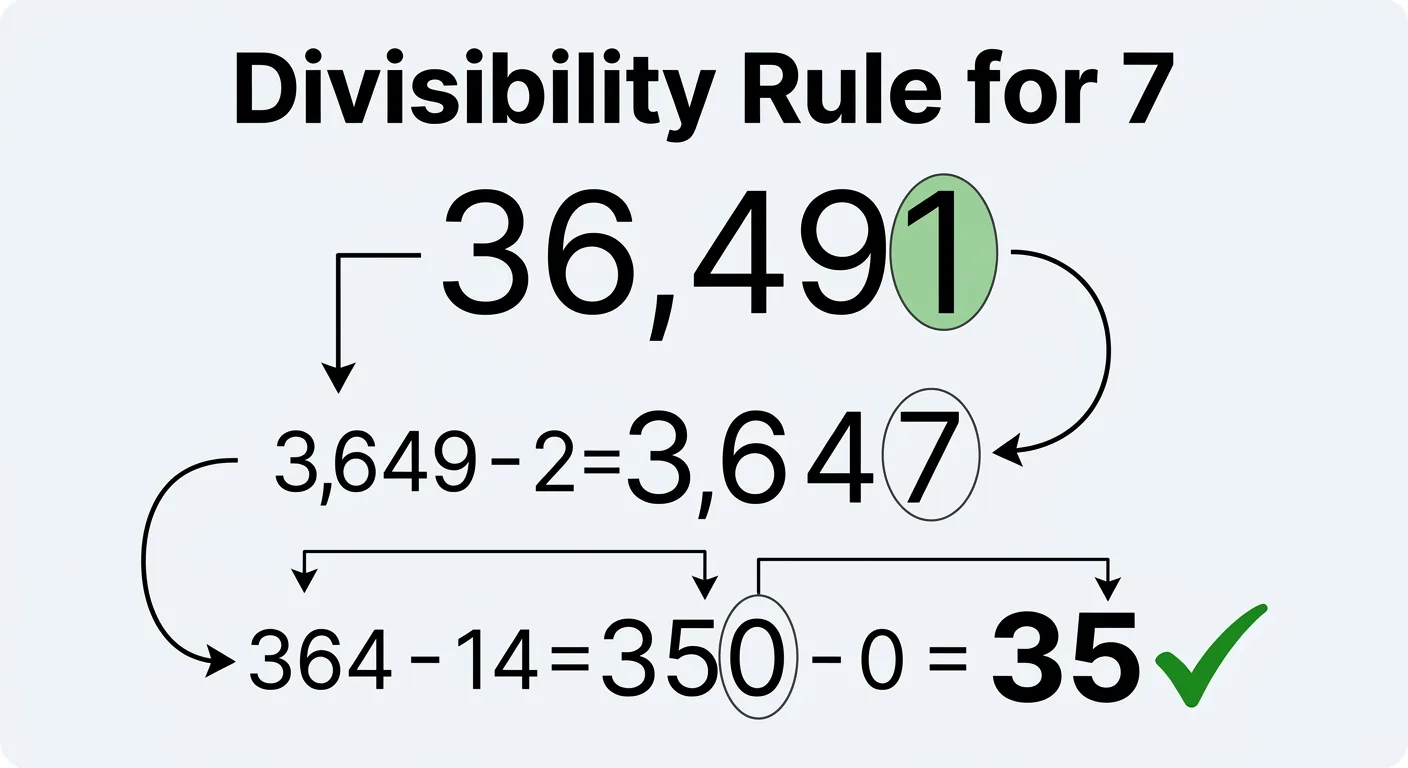
This is the hard one, and pretending otherwise does your child no favours. 7 divides no power of ten and does not divide 9, so neither the last digits trick nor the digit sum trick applies. There is no clean shortcut, only workable procedures. Three of them follow, and the third is simply honest division.
Method 1, double and subtract. Take the last digit, double it, and subtract that from the number made by the remaining digits. If the result is divisible by 7, so was the original. Repeat as often as needed.
Why it works: removing the last digit and subtracting twice that digit changes the number by an exact multiple of 7, so it cannot change the answer to the question “is this divisible by 7”. It can only make the number smaller.
Worked example 1: is 36,491 divisible by 7? Last digit 1, double it to 2, and 3,649 minus 2 = 3,647. Repeat: last digit 7, double to 14, and 364 minus 14 = 350. Repeat: last digit 0, double to 0, and 35 minus 0 = 35. Since 35 = 7 x 5, yes, 36,491 is divisible by 7.
Method 2, multiply by 5 and add. Take the last digit, multiply by 5, and add it to the number made by the remaining digits. If the result is divisible by 7, so was the original. This version was found in 2019 by Chika Ofili, a twelve year old student, who also produced a proof for it. Many children find adding easier than subtracting, so it is worth offering.
Worked example 2: is 10,878 divisible by 7? Last digit 8, times 5 is 40, and 1,087 + 40 = 1,127. Again: last digit 7, times 5 is 35, and 112 + 35 = 147. Again: last digit 7, times 5 is 35, and 14 + 35 = 49. Since 49 = 7 x 7, yes.
Method 3, chunk and compare. For a large number, subtract the nearest easy multiple of 7 and work with what is left. To test 4,214: you know 4,200 is 7 x 600, so subtract it and you are left with 14, which is 7 x 2. Yes. This method uses the times tables your child already has and often beats both of the others in an exam.
Quick check: memorise the multiples of 7 up to 7 x 12 = 84 so the final step is instant. And accept that for a five or six digit number, straightforward long division is sometimes faster than three rounds of doubling. Knowing when not to use a shortcut is part of the skill.
Divisibility rule for 6
The rule: a number is divisible by 6 if it is divisible by both 2 and 3.
Why it works: 6 = 2 x 3, and 2 and 3 share no common factor. When two numbers share no common factor, passing both tests guarantees divisibility by their product. So a number divisible by 2 and by 3 has both of those primes in its factor list, which means it has 6 as a factor.
Worked example 1: is 51,738 divisible by 6? Last digit 8, so it is even. Digit sum 5 + 1 + 7 + 3 + 8 = 24, a multiple of 3. Both pass, so yes.
Worked example 2: is 42,715 divisible by 6? Digit sum is 4 + 2 + 7 + 1 + 5 = 19, which is not a multiple of 3, and the last digit 5 is odd. Fails both, so no.
Quick check: test for 2 first, because it takes one second and eliminates half of all numbers.
Divisibility rule for 12
The rule: a number is divisible by 12 if it is divisible by both 3 and 4.
Why it works: 12 = 4 x 3, and 4 and 3 share no common factor, so both tests together are enough. Note which pair you use. Testing for 2 and 6 would not do, because 2 and 6 share the factor 2, so a number could pass both and still miss 12. Take 18: it is even and it is divisible by 6, yet it is not divisible by 12.
Worked example 1: is 7,38,516 divisible by 12? Digit sum 7 + 3 + 8 + 5 + 1 + 6 = 30, a multiple of 3. Last two digits 16, divisible by 4. Both pass, so yes.
Worked example 2: is 58,642 divisible by 12? Digit sum 5 + 8 + 6 + 4 + 2 = 25, not a multiple of 3. No, and there is no need to check the 4 test at all.
Quick check: check the digit sum first. It is the test more numbers fail, so it saves work.
Combination Rules for Composite Divisors
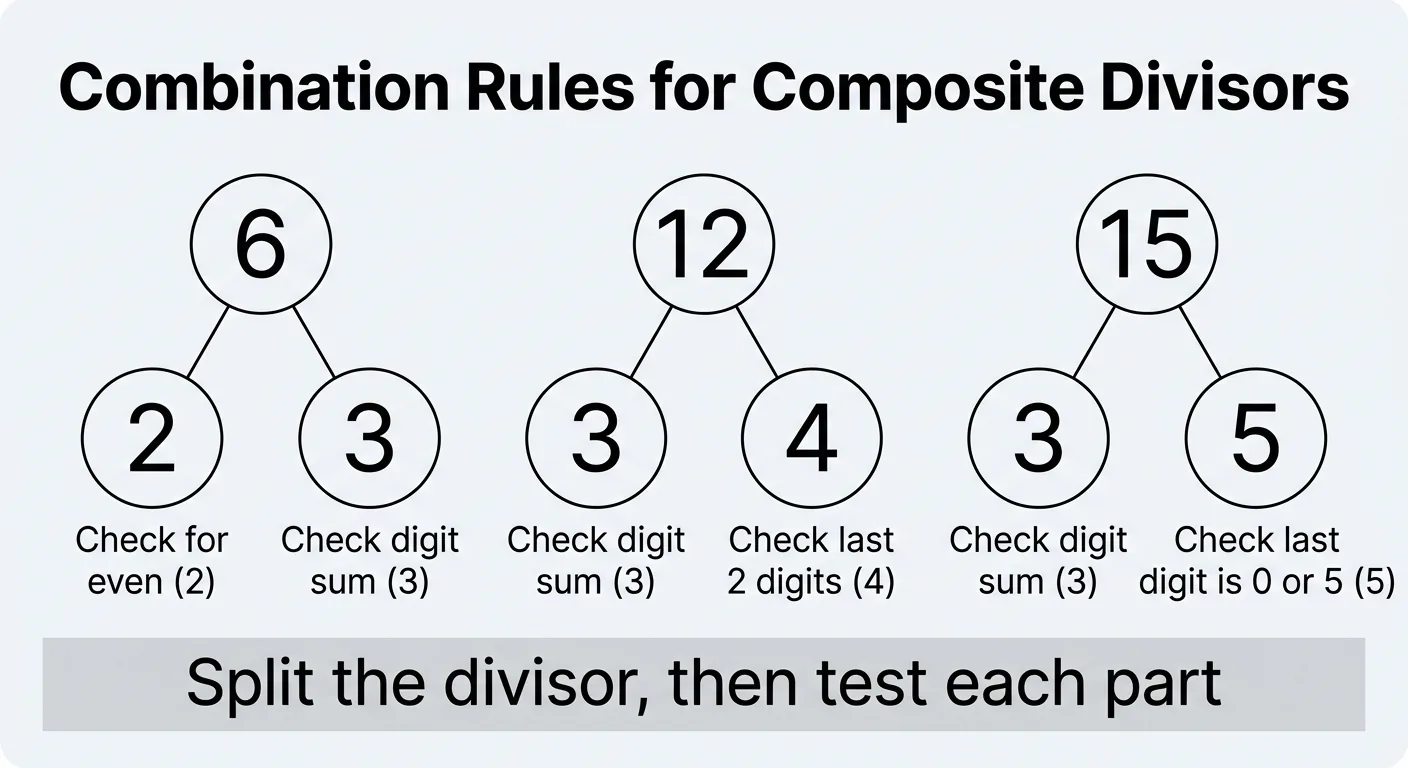
Once your child can test for the primes and the powers, they do not need to learn any more rules. They can build their own.
The principle in one line: to test divisibility by a composite number, split it into factors that share nothing in common, then apply the rule for each factor.
Divisibility by 6 = divisible by 2 and by 3. Since 6 = 2 x 3 and those two primes share no factor, passing both tests means both primes are present, so 6 divides the number.
Divisibility by 12 = divisible by 3 and by 4. Since 12 = 3 x 4 and 3 and 4 share no factor, both tests together are enough. Using 2 and 6 instead would fail, because they overlap.
Divisibility by 15 = divisible by 3 and by 5. Since 15 = 3 x 5, test the digit sum for 3 and the last digit for 5. Is 1,23,450 divisible by 15? Digit sum is 15, so yes for 3. Last digit is 0, so yes for 5. The number is divisible by 15.
The important part is the “share nothing in common” condition, and it is easy to show why with a counterexample. To test for 8, splitting it as 2 x 4 does not work: 4 is even and divisible by 4, yet 4 is not divisible by 8. The two tests overlap, so passing both proves less than it looks.
With the principle in hand, your child can now derive rules nobody taught them:
| Divisor | Split into | Tests to run |
|---|---|---|
| 14 | 2 x 7 | Even, and the rule for 7 |
| 15 | 3 x 5 | Digit sum for 3, last digit for 5 |
| 18 | 2 x 9 | Even, and digit sum for 9 |
| 20 | 4 x 5 | Last two digits for 4, last digit for 5 |
| 24 | 3 x 8 | Digit sum for 3, last three digits for 8 |
| 36 | 4 x 9 | Last two digits for 4, digit sum for 9 |
| 45 | 5 x 9 | Last digit for 5, digit sum for 9 |
| 72 | 8 x 9 | Last three digits for 8, digit sum for 9 |
Notice 18 uses 2 and 9, not 3 and 6. And 72 uses 8 and 9, not 6 and 12. The rule to teach is simple: break the divisor into its prime factors, take each prime raised to its highest power, and test those.
Divisibility Rules Chart (1 to 12)
This is the chart to print or screenshot. Every rule in one place, with its reason beside it, because the reason is what keeps the rule from fading.
| Divisor | Rule | Why it works | Example |
|---|---|---|---|
| 1 | Always divisible | Every number splits into groups of one | 68,431 yes |
| 2 | Last digit is 0, 2, 4, 6 or 8 | 10 is a multiple of 2 | 48,572 yes |
| 3 | Digit sum is divisible by 3 | 9, 99, 999 are all multiples of 3 | 47,952 yes (sum 27) |
| 4 | Last two digits divisible by 4 | 100 is a multiple of 4 | 7,13,528 yes (28) |
| 5 | Last digit is 0 or 5 | 10 is a multiple of 5 | 72,645 yes |
| 6 | Passes the tests for 2 and 3 | 6 = 2 x 3, no shared factor | 51,738 yes |
| 7 | Double the last digit, subtract from the rest, repeat | No power of ten helps, so a procedure is needed | 36,491 yes (ends at 35) |
| 8 | Last three digits divisible by 8 | 1000 is a multiple of 8 | 7,45,816 yes (816) |
| 9 | Digit sum is divisible by 9 | 9, 99, 999 are all multiples of 9 | 84,357 yes (sum 27) |
| 10 | Last digit is 0 | 10 = 2 x 5, so it needs both | 4,56,780 yes |
| 11 | Alternating digit sum is 0 or a multiple of 11 | Place values sit one away from multiples of 11 | 4,15,382 yes (sum 11) |
| 12 | Passes the tests for 3 and 4 | 12 = 3 x 4, no shared factor | 7,38,516 yes |
How to Check a Large Number Using Several Rules
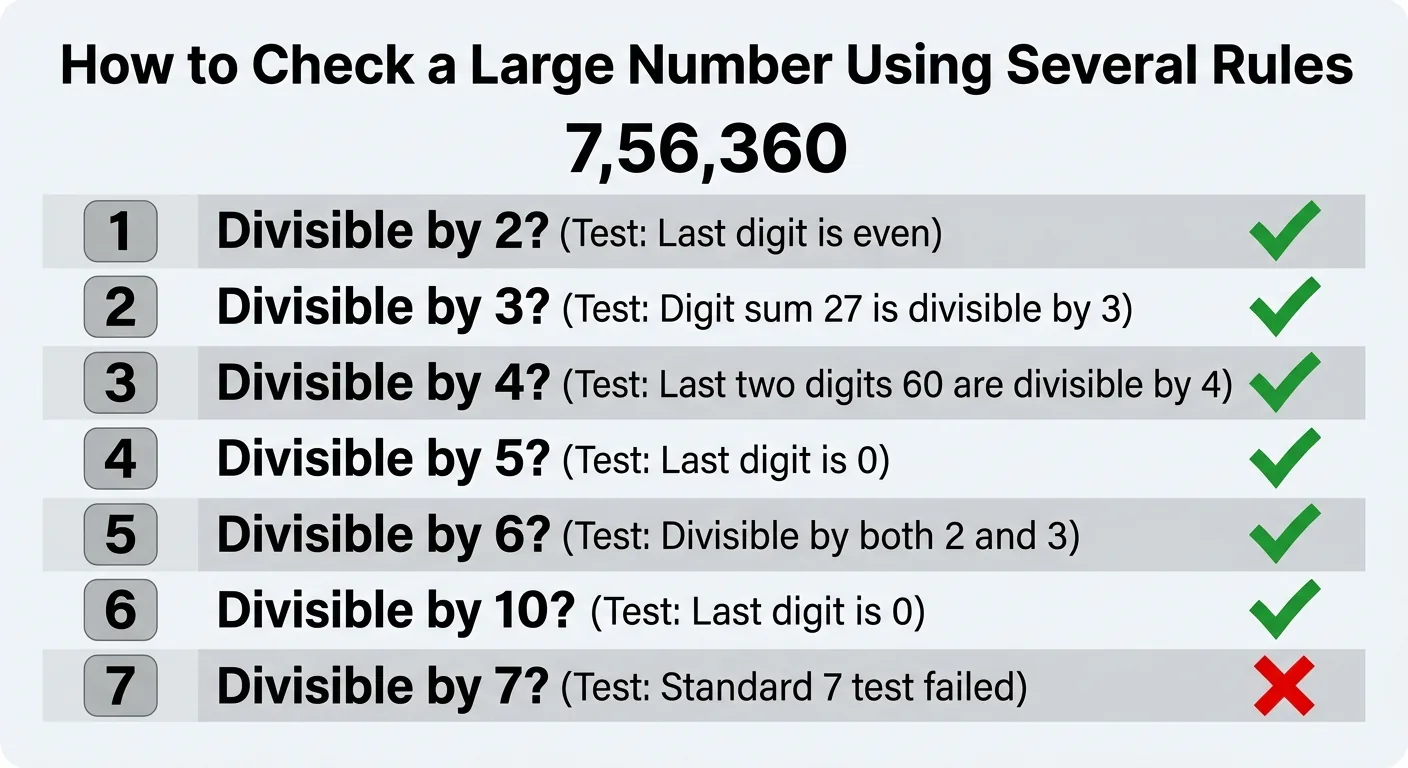
Give your child a 5 or 6 digit number and ask which of 2 to 12 divide it, and the work goes faster in a fixed order. Here is the sequence, applied to 7,56,360.
- Check 2. Last digit is 0, which is even. Divisible by 2.
- Check 5 and 10. Last digit is 0, so both pass. Divisible by 5 and by 10.
- Add the digits once, use it twice. 7 + 5 + 6 + 3 + 6 + 0 = 27. Since 27 is a multiple of 9, the number is divisible by both 3 and 9. One addition settled two rules.
- Check 4, then 8. Last two digits are 60, and 60 divided by 4 is 15, so yes for 4. Last three digits are 360, and 360 = 8 x 45, so yes for 8.
- Combine what you have. Divisible by 2 and 3, so divisible by 6. Divisible by 3 and 4, so divisible by 12.
- Check 11. Alternating sum: 7 minus 5 + 6 minus 3 + 6 minus 0 = 11, a multiple of 11. Divisible by 11.
- Check 7 last, because it costs the most. Double the last digit: 0, and 75,636 minus 0 = 75,636. Again: 6 doubled is 12, and 7,563 minus 12 = 7,551. Again: 1 doubled is 2, and 755 minus 2 = 753. Again: 3 doubled is 6, and 75 minus 6 = 69. Since 69 is not a multiple of 7, no.
So 7,56,360 is divisible by 1, 2, 3, 4, 5, 6, 8, 9, 10, 11 and 12, but not by 7.
The order matters because the cheap tests knock out most candidates and the digit sum does double duty. Teach the order, not just the rules.
How Divisibility Connects to Factors, Multiples, Primes, HCF and LCM
In the NCERT sequence, divisibility rules do not stand alone. They sit inside the Playing with Numbers chapter, and everything after them leans on them.
Finding factors. To list the factors of 1,260, your child does not need to try every number. Run the tests: it is even, so 2 is a factor. Digit sum is 9, so 3 and 9 are factors. It ends in 0, so 5 and 10 are factors. Last two digits are 60, so 4 is a factor. From 2 and 3 comes 6, from 3 and 4 comes 12. Within a minute they have most of the factor list without a single long division.
Prime factorisation. Divisibility rules decide which prime to divide by at each step of a factor tree. For 1,260: divide by 2 to get 630, by 2 again to get 315, by 3 to get 105, by 3 to get 35, by 5 to get 7. So 1,260 = 2 x 2 x 3 x 3 x 5 x 7. Without the rules this is guesswork; with them it is a procedure.
Testing for primes. To check whether 221 is prime, test the small primes in turn. Not even, digit sum 5 so not divisible by 3, does not end in 0 or 5, and the rule for 7 gives 22 minus 2 = 20, so no. Then 11: alternating sum 2 minus 2 + 1 = 1, so no. Then 13, which divides it: 221 = 13 x 17. Not prime.
HCF. To find the HCF of 84 and 126, prime factorise both using the rules, then take the common primes. 84 = 2 x 2 x 3 x 7 and 126 = 2 x 3 x 3 x 7, so the HCF is 2 x 3 x 7 = 42.
LCM. Same factorisations, but take each prime at its highest power: 2 x 2 x 3 x 3 x 7 = 252.
Simplifying fractions. This is where the rules earn their keep in later classes. Faced with 468 over 585, a child who knows the rules sees that both digit sums are multiples of 9 (18 and 18), divides both by 9 to get 52 over 65, spots 13 as a common factor and lands on 4 over 5. A child without the rules starts guessing.
Divisibility Rules in Olympiad Problems
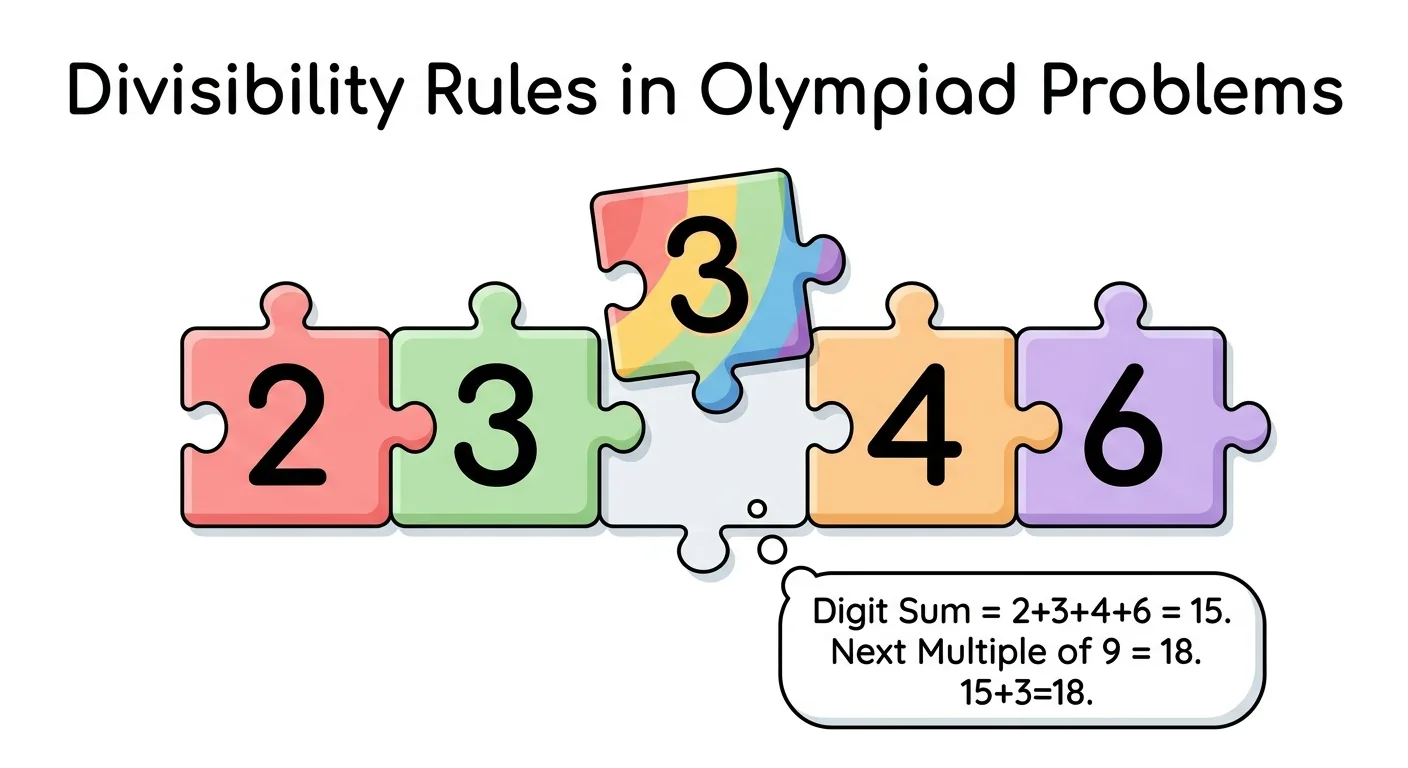
Olympiad papers rarely ask “is 3,528 divisible by 4”. They ask questions where divisibility is the key that unlocks something else. Three patterns come up again and again in the SOF IMO syllabus, the IOQM syllabus and school olympiad question papers.
Pattern 1, missing digit problems. The number 23_46 is divisible by 9. Find the missing digit.
Sum the known digits: 2 + 3 + 4 + 6 = 15. For divisibility by 9 the total must reach the next multiple of 9, which is 18. So the missing digit is 3, and the number is 23,346. Check: 2 + 3 + 3 + 4 + 6 = 18, a multiple of 9.
A harder version: the number 4_7_ is divisible by both 4 and 9. Find both digits. The 4 test says the last two digits must be divisible by 4, so with 7 in the tens place the options are 72 and 76. The 9 test says the digit sum must be a multiple of 9. For 4a72: 4 + a + 7 + 2 = 13 + a, so a = 5, giving 4,572. For 4a76: 4 + a + 7 + 6 = 17 + a, so a = 1, giving 4,176. Both work.
Pattern 2, remainder problems. What is the remainder when 7,28,453 is divided by 9?
The digit sum does more than answer yes or no. It carries the remainder. Sum: 7 + 2 + 8 + 4 + 5 + 3 = 29, and 2 + 9 = 11, and 1 + 1 = 2. The remainder is 2. This works because the discarded part was built from nines, which leave no remainder at all. The same trick gives remainders for 3 and for 11.
Pattern 3, multi-rule reasoning. Find the smallest 4 digit number divisible by both 8 and 9.
Since 8 and 9 share no factor, the number must be divisible by 72. The smallest 4 digit number is 1,000, and 1,000 divided by 72 is 13 remainder 64, so the next multiple of 72 is 14 x 72 = 1,008. Check: last three digits 008 divided by 8 is 1, and digit sum is 9. Both tests pass.
Another: how many 3 digit numbers are divisible by both 6 and 15? They must be divisible by the LCM, which is 30. The 3 digit multiples of 30 run from 120 to 990, giving 30 numbers in total.
What ties these together is that the rules are being used to reason, not just to check. That is the step from school maths to competition maths, and it is available to any child who understands where the rules come from.
Common Mistakes and How to Correct Them
Adding the digits to test for 4 or 8. The commonest error by far. The child borrows the method from 3 and 9 because it feels like the general method. Correction: say out loud that digit sums only work for 3 and 9, because only 3 and 9 divide into 9, 99 and 999. For 4 and 8 the question is about the end of the number, not all of it.
Confusing 4 and 8. A child checks two digits for 8, or three for 4. Correction: anchor it to the powers of ten. 100 is a multiple of 4, so two digits. 1000 is a multiple of 8, so three digits.
Thinking divisible by 2 and 4 means divisible by 8. It does not. 2,16,302 is divisible by 2 but not 4. And 92,620 is divisible by 4 but its last three digits, 620, are not divisible by 8. Correction: for 8, test 8 directly.
Applying rules to decimals. Divisibility is a question about whole numbers. 12.6 is not “divisible by 3” in any meaningful sense, even though its digits sum to 9. Correction: check the number is a whole number first.
Forgetting that 0 counts as even. A child decides 4,56,780 is not divisible by 2 because the last digit is “nothing”. Correction: 0 is even, and any number ending in 0 is divisible by 2, 5 and 10.
Stopping the 7 procedure too early. After one round the number is still large and the child guesses. Correction: the steps repeat as many times as needed, until the number is small enough to recognise from the 7 times table.
Alternating the wrong way for 11. Starting with a subtraction, or losing track of the signs halfway. Correction: write plus and minus signs above the digits before touching any arithmetic. The direction does not matter as long as it alternates, because a result of minus 11 is just as good as plus 11.
Assuming a rule must exist for every divisor. Children ask for the rule for 7 as though it should be as neat as the rule for 5. Correction: tell them honestly that 7 has no neat rule, and that this is a fact about 7 and our base ten system, not a gap in their knowledge.
8 Activities and Mental Maths Games
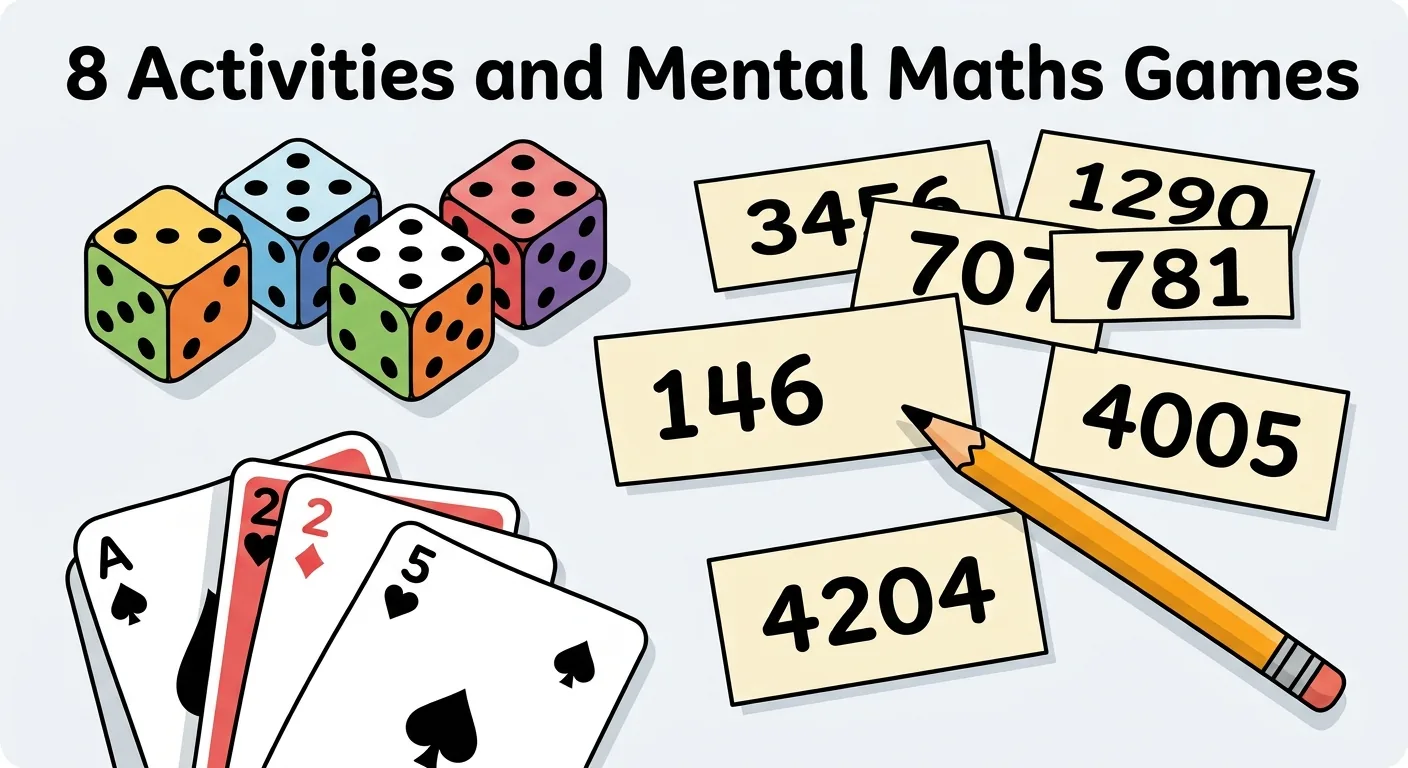
All of these use paper, dice or playing cards. Nothing needs buying.
- Digit sum sort. Write twenty 4 digit numbers on slips of paper. Your child sorts them into piles: divisible by 3, divisible by 9, neither. Timed, with a rematch to beat their own record.
- Dice build. Roll four dice and arrange the digits into the largest 4 digit number divisible by 3. Then the smallest. Rolling is the fun part; the reasoning happens between rolls.
- Card tens and units. Deal two playing cards (ace as 1, picture cards removed) to make a two digit number, then ask which of 2, 3, 4, 5 and 6 divide it. First correct answer takes the cards.
- The 9 magic trick. Your child picks any number, scrambles its digits, and subtracts the smaller from the larger. The answer is always divisible by 9. Let them test it ten times before you explain why: scrambling does not change the digit sum, so the difference is forced to be a multiple of 9.
- Vehicle number hunt. On a journey, call out the number plate and race to say which divisors from 2 to 12 work. Five minutes of this beats a page of worksheet practice.
- Sharing sweets. Give a real quantity, say 48 laddoos, and ask how many ways they can be shared equally among a class with no leftovers. The divisibility rules generate the answer list, and the physical framing keeps the meaning attached.
- Missing digit challenge. Write 5_3_6 on paper and set a target: make it divisible by 4 and by 9. This is Olympiad training disguised as a puzzle, and there is often more than one answer, which is itself a good discovery.
- Rule detective. Give your child a number like 2,520 and a time limit of two minutes to find every divisor from 1 to 12 that works. The answer is all of them except 11, which usually surprises them enough to check twice.
Tips for Parents Helping at Home
- Teach the reason before the rule. Ten minutes on the nines idea will save months of re-teaching. If your child can explain why adding digits works for 3, they will never need to revise it.
- Use big numbers from the start. A rule tested only on 24 and 36 looks pointless, because the child can divide those in their head anyway. Give them 47,952 and the shortcut suddenly means something.
- Let them check with division. After every rule-based answer, divide and confirm. Trust in the rule has to be earned, and the confirmation step builds it.
- Do not rush rule 7. It is genuinely harder than the others. A child who is fluent with 2, 3, 4, 5, 8, 9, 10 and 11 is in good shape even if 7 takes another year.
- Keep sessions short. Ten minutes of mental practice beats an hour of worksheets. Divisibility is a fluency skill, and fluency comes from frequency.
- Ask them to teach you. Get your child to explain the rule for 4 to you, while you play the confused learner who keeps wanting to add the digits. Correcting your mistake fixes the idea in their head.
Tips for Teachers in the Classroom
- Derive, do not announce. Put 10 = 9 + 1 and 100 = 99 + 1 on the board and let the class find the rule for 3 themselves. The discovery takes one lesson and removes the need for several revision lessons later.
- Sequence by difficulty, not by number order. Teach 2, 5 and 10 together, then 4 and 8 as a pair, then 3 and 9 as a pair, then 6 and 12 as combinations, then 11, and 7 last.
- Make the pattern visible. A wall chart of the twelve rules with the reason beside each turns passive display into a reference students actually use.
- Use whole class voting. Put a 5 digit number on the board and ask for hands on each divisor. Wrong answers expose misconceptions faster than marked work.
- Build in missing digit work early. It converts a checking skill into a reasoning skill and prepares students for olympiad papers without extra material.
- Connect it forward. When the class reaches HCF, LCM and simplifying fractions, go back to the divisibility chart explicitly. Students who see the link stop treating each chapter as a separate island.
Practice Questions With Answers
Set A: straightforward checks
- Is 3,618 divisible by 3?
- Is 42,780 divisible by 5 and 10?
- Is 51,324 divisible by 4?
- Is 68,139 divisible by 9?
- Is 7,23,416 divisible by 8?
Set B: larger numbers and harder divisors
- Is 8,52,471 divisible by 11?
- Is 2,15,348 divisible by 7?
- Is 9,36,504 divisible by 12?
- Which of 2, 3, 4, 5, 6, 8, 9, 10 and 12 divide 1,80,000?
- Is 45,675 divisible by 15?
Set C: missing digits
- The number 7,4_6 is divisible by 9. Find the missing digit.
- The number 23,5_2 is divisible by 4 but not by 8. Find the missing digit.
- The number 1_,235 is divisible by 11. Find the missing digit.
Set D: Olympiad style
- What is the remainder when 5,67,893 is divided by 9?
- Find the smallest 4 digit number divisible by both 6 and 8.
- How many 3 digit numbers are divisible by both 4 and 9?
Answers
- Yes. Digit sum 3 + 6 + 1 + 8 = 18, a multiple of 3.
- Yes to both. Last digit is 0.
- Yes. Last two digits 24, and 24 = 4 x 6.
- Yes. Digit sum 6 + 8 + 1 + 3 + 9 = 27, a multiple of 9, which also means it is divisible by 3.
- Yes. Last three digits 416, and 416 = 8 x 52.
- No. Alternating sum 8 minus 5 + 2 minus 4 + 7 minus 1 = 7, not a multiple of 11.
- Yes. Double and subtract: 21,534 minus 16 = 21,518; then 2,151 minus 16 = 2,135; then 213 minus 10 = 203; then 20 minus 6 = 14. Since 14 = 7 x 2, 2,15,348 is divisible by 7.
- Yes. Digit sum 9 + 3 + 6 + 5 + 0 + 4 = 27, a multiple of 3, and last two digits 04, divisible by 4.
- All of them. 1,80,000 is even, digit sum is 9, last two digits 00, last three digits 000, and it ends in 0, so every listed divisor works.
- Yes. Digit sum 4 + 5 + 6 + 7 + 5 = 27, a multiple of 3, and the last digit is 5.
- 1. Known digits sum to 7 + 4 + 6 = 17, and the next multiple of 9 is 18, so the missing digit is 1, giving 7,416.
- 3 or 7. The last two digits must be divisible by 4, so the options are 12, 32, 52, 72 and 92, giving digits 1, 3, 5, 7 and 9. Now test 8 on the last three digits: 512, 552 and 592 are all divisible by 8, while 532 and 572 are not. The digits that pass the 4 test and fail the 8 test are 3 and 7.
- The missing digit is 5. The alternating sum of 1a,235 is 1 minus a + 2 minus 3 + 5 = 5 minus a, and for that to be 0 or a multiple of 11, a must be 5. The number is 15,235, and 15,235 divided by 11 is 1,385.
- 2. Digit sum 5 + 6 + 7 + 8 + 9 + 3 = 38, then 3 + 8 = 11, then 1 + 1 = 2.
- 1,008. Since 6 and 8 share a factor, use the LCM, which is 24. The first 4 digit multiple of 24 is 42 x 24 = 1,008.
- 25. The number must be divisible by 36. The 3 digit multiples of 36 run from 108 to 972, which gives 25 numbers.
Make Preparing for Math Olympiad Simple!


Frequently Asked Questions
What are the divisibility rules?
Divisibility rules are quick tests that show whether one number divides another exactly, with no remainder, without doing the division. A number is divisible by 2 if its last digit is even, by 3 if its digit sum is a multiple of 3, by 4 if its last two digits form a multiple of 4, by 5 if it ends in 0 or 5, by 6 if it passes the tests for 2 and 3, by 8 if its last three digits form a multiple of 8, by 9 if its digit sum is a multiple of 9, by 10 if it ends in 0, by 11 if its alternating digit sum is 0 or a multiple of 11, and by 12 if it passes the tests for 3 and 4.
What is the divisibility rule for 3 and 9?
Both are digit sum rules. A number is divisible by 3 if the sum of its digits is divisible by 3, and divisible by 9 if the sum of its digits is divisible by 9. They work because 9, 99 and 999 are all multiples of both 3 and 9, so the only part of the number that still needs checking is the sum of its digits. For 47,952 the digit sum is 27, so the number is divisible by both 3 and 9.
Why do divisibility rules work?
Because of place value. Every number is built from units, tens, hundreds and so on, and each power of ten has a fixed relationship with small divisors. 10 is a multiple of 2 and 5, so only the last digit matters for those. 100 is a multiple of 4 and 1000 is a multiple of 8, so only the last two or three digits matter. 9, 99 and 999 are multiples of 3 and 9, so only the digit sum matters. The rules are consequences of how we write numbers.
In which class are divisibility rules taught?
In the CBSE and NCERT sequence, the rules for 2, 5 and 10 appear around Class 4 and 5, and the full set from 2 to 11 is covered in Class 6 in the Playing with Numbers chapter. Class 7 applies them to factors, multiples, HCF, LCM and simplifying fractions.
Is there a divisibility rule for 7?
There is a procedure rather than a one-glance rule. Double the last digit and subtract it from the number formed by the remaining digits, repeating until the result is small enough to recognise. An alternative is to multiply the last digit by 5 and add it to the rest. No single-step test exists for 7, because 7 does not divide any power of ten or any string of nines.
What is the divisibility rule for 13?
Multiply the last digit by 4 and add it to the number formed by the remaining digits, repeating as needed. For 2,795: 279 + 20 = 299, then 29 + 36 = 65, and 65 = 13 x 5, so 2,795 is divisible by 13. This is beyond the Class 6 syllabus but appears in olympiad papers.
Can divisibility rules be used for decimals?
No. Divisibility is defined for whole numbers only. A decimal such as 12.6 is not divisible by 3 in the technical sense, even though its digits sum to 9.
How do I test divisibility by a number like 24 or 36?
Break the divisor into factors that share nothing in common and test each. For 24, use 3 and 8. For 36, use 4 and 9. For 72, use 8 and 9. The general method is to take the prime factorisation of the divisor and test each prime at its highest power.
Does a number divisible by 2 and 3 have to be divisible by 6?
Yes, because 2 and 3 share no common factor, so passing both tests means both primes are present in the number’s factorisation. The same logic does not hold for 2 and 4 when testing for 8, because those two overlap.
Final Thoughts
Divisibility rules only stick when a child knows where they come from. Every rule in this guide traces back to the same idea: our number system runs on powers of ten, and each power of ten sits in a fixed relationship with the small divisors. Once that clicks, your child is not remembering twelve separate tricks any more. They are working out each rule from something they understand.
Start with the reason, use numbers big enough for the shortcut to feel worth it, and let your child confirm the answer by dividing. Ten minutes a few times a week will do more than an hour of worksheets, and the rules they rebuild for themselves are the ones that survive the exam.

Mikha Piregu is a Content Writer with experience spanning educational content, including math and math olympiad topics, as well as advocacy writing, research-based articles, and SEO-driven web content. He creates high-quality blog content, web copy, and feature articles that support brand visibility, audience engagement, and long-term organic growth through data-informed storytelling. Skilled in WordPress, WooCommerce, and modern digital tools, Mikha adapts content across various platforms, including blogs, websites, campaigns, and advocacy initiatives, with clarity and purpose.

There are no comments posted here yet.
Sign in to leave a comment