


A quadrilateral is a closed, flat shape with four straight sides, four vertices and four interior angles that always add up to 360 degrees. The six main types are the square, rectangle, parallelogram, rhombus, trapezium and kite.
- What Is a Quadrilateral?
- The Angle Sum Property of Quadrilaterals
- The Six Types of Quadrilaterals and Their Properties
- Quadrilateral Properties Compared Side by Side
- The Quadrilateral Family Hierarchy
- Diagonals of Quadrilaterals
- How to Identify a Quadrilateral From Its Properties
- Quadrilaterals in Real Life
- Common Mistakes Students Make
- Ten Activities for Teaching Quadrilaterals
- Tips for Parents Teaching at Home
- Tips for Teachers in the Classroom
- Quadrilaterals in Olympiad Geometry
- Practice Questions With Answers
- Conclusion
Most guides stop there and list six shapes to memorise. This one shows you the family tree instead, so questions like “is a square a rhombus?” stop being guesswork and become something your child can reason out.
Everything here sits inside the CBSE and NCERT scope for Class 4 to Class 7.
What Is a Quadrilateral?
A quadrilateral is a closed, flat 2D shape made of exactly four straight sides. Every quadrilateral has four sides, four angles and four vertices, and its interior angles always add up to 360 degrees. The name comes from the Latin words quadri, meaning four, and latus, meaning side.
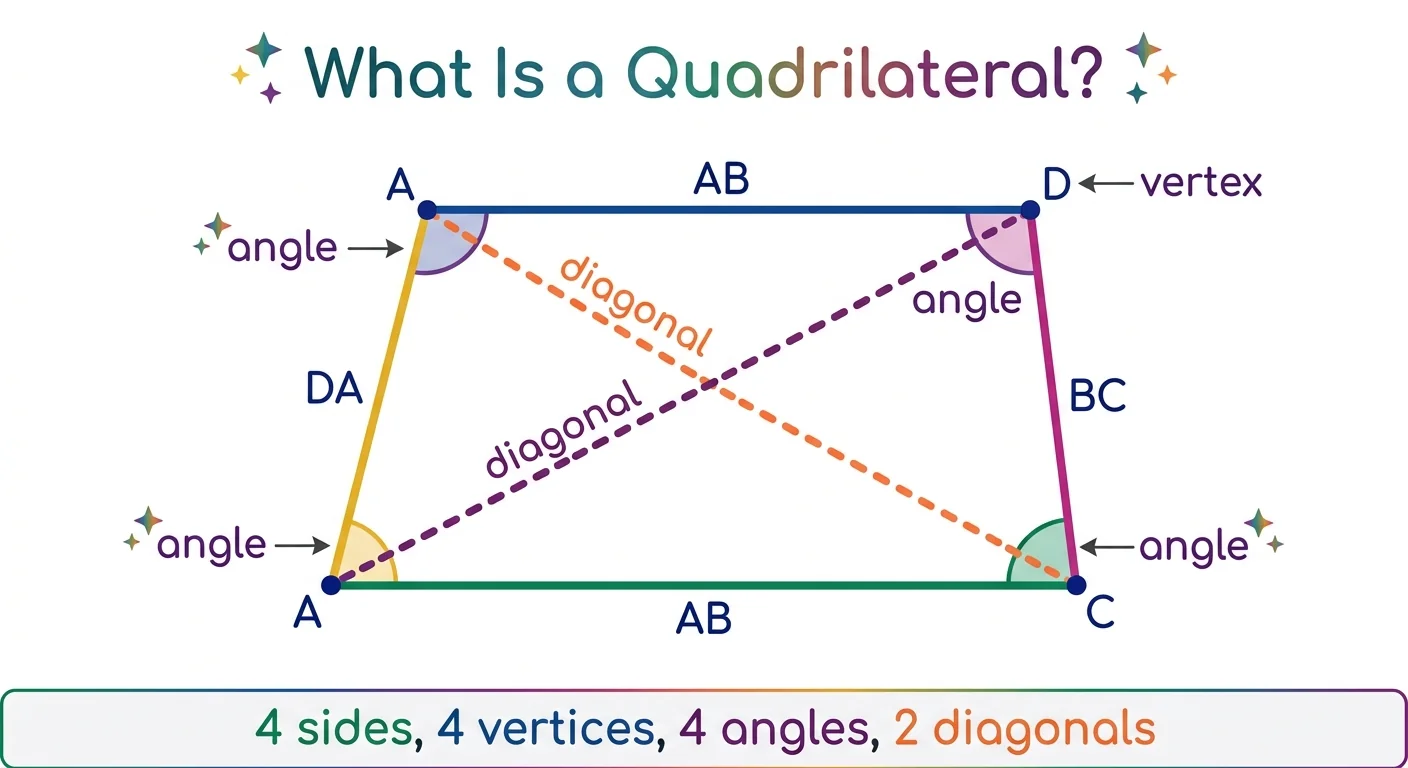
That definition is deliberately wide. It lets in the neat shapes your child already knows, such as squares and rectangles, and it also lets in lopsided four-sided shapes with no equal sides and no parallel sides at all. Those lopsided ones are called irregular quadrilaterals, and they are just as much quadrilaterals as a square is.
The Parts of a Quadrilateral
Take a quadrilateral, drawn with four straight line segments, and label its corners A, B, C and D going around the shape.
- Sides are the four straight edges: AB, BC, CD and DA.
- Vertices are the four corners: A, B, C and D. One corner on its own is a vertex.
- Angles sit at the vertices: angle A, angle B, angle C and angle D.
- Adjacent sides share a corner. AB and BC are adjacent because they meet at B.
- Opposite sides do not touch. AB and CD are opposite, and so are BC and DA.
- Opposite angles sit across the shape from each other, so A is opposite C, and B is opposite D.
- Diagonals are the straight lines joining opposite corners. Every quadrilateral has exactly two: AC and BD.
Those last two words, opposite and diagonal, do most of the heavy lifting later on. If your child is shaky on them, spend an extra minute here before moving on.
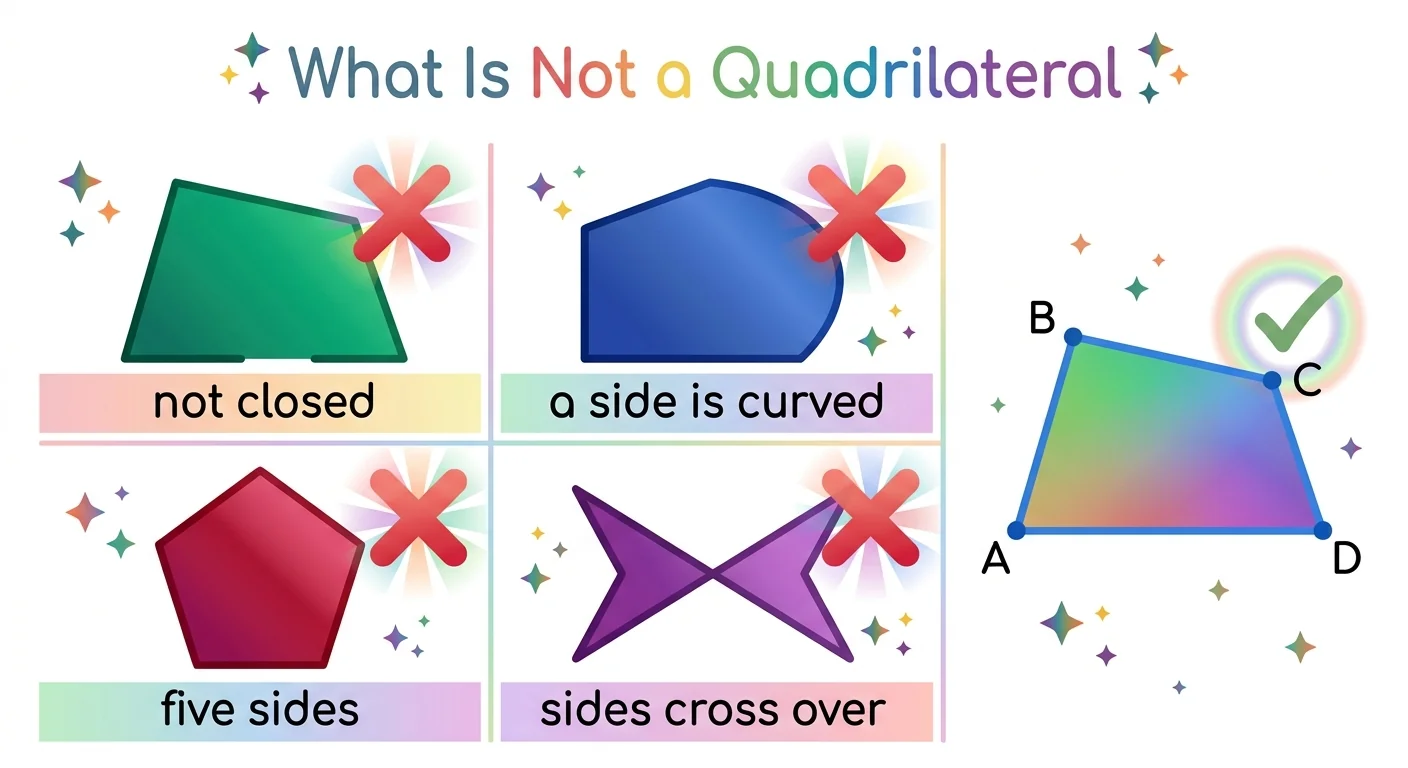
What Is Not a Quadrilateral
Four things disqualify a shape:
- It is open. If the four lines do not join up all the way round, it is not a closed shape and not a quadrilateral.
- A side is curved. All four sides must be straight line segments. A shape with one curved edge is out.
- It does not have exactly four sides. Three sides make a triangle, five make a pentagon.
- Sides cross over each other. A crossed or self-intersecting four-sided figure is a special case that is not studied at this level.
The Angle Sum Property of Quadrilaterals
The interior angles of any quadrilateral add up to 360 degrees. This holds for every quadrilateral without exception, from a perfect square to the most lopsided irregular shape your child can draw.
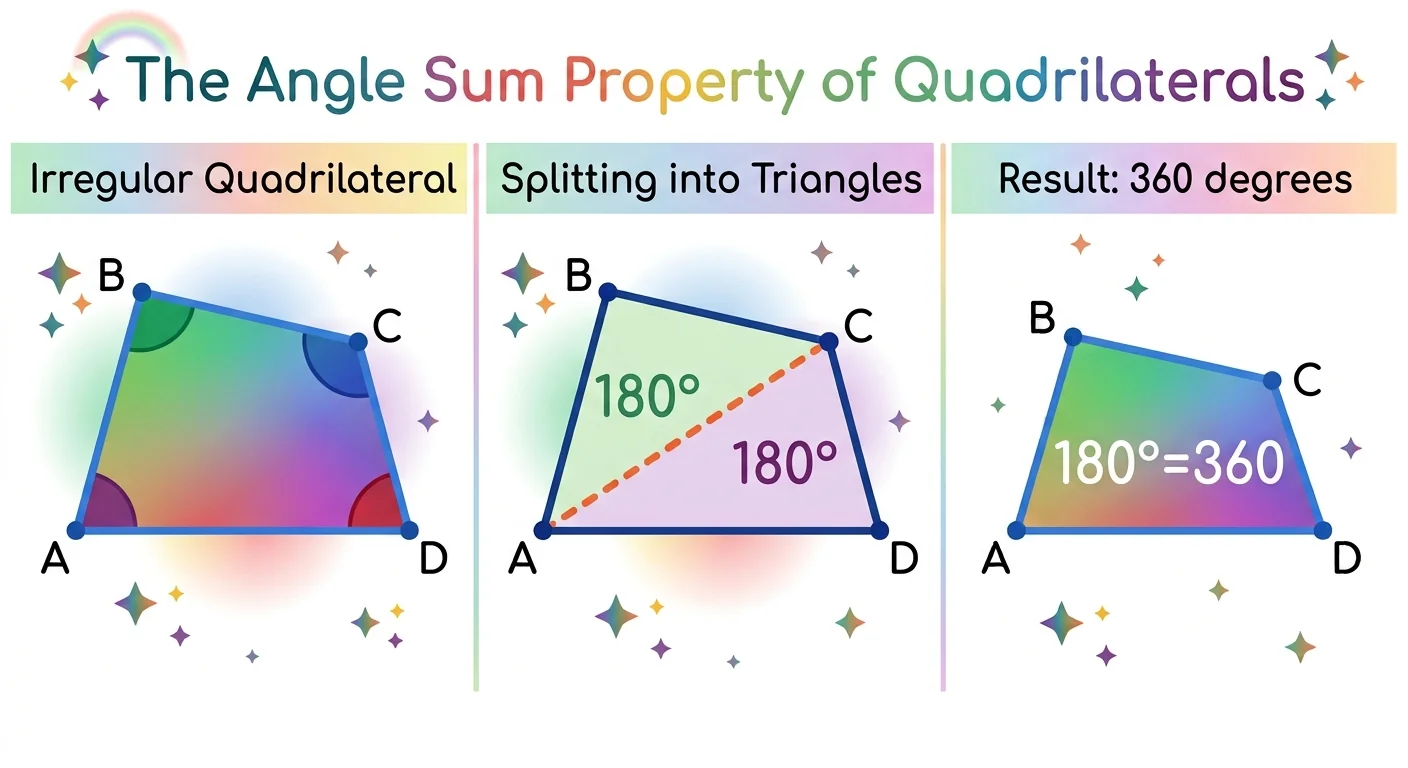
Most books ask children to memorise that number. There is a much better option, because the reason behind it is something a Class 5 student can see for themselves in under a minute.
Why the Angles Add Up to 360 Degrees
Your child already knows that the three angles of a triangle add up to 180 degrees. Build on that.
- Draw any quadrilateral ABCD. It does not need to be neat.
- Draw one diagonal, say from A to C. The shape is now split into two triangles: triangle ABC and triangle ACD.
- The angles of triangle ABC add up to 180 degrees. The angles of triangle ACD add up to 180 degrees.
- Together, those six angles make up exactly the four angles of the original quadrilateral. Nothing is left over and nothing is counted twice.
- So the four angles of the quadrilateral add up to 180 + 180 = 360 degrees.
That is the whole argument. It works on any quadrilateral, which is exactly why the rule has no exceptions. Ask your child to draw three wildly different quadrilaterals and run the diagonal trick on each one. Seeing it hold three times is worth more than reading the rule ten times.
Using the Angle Sum to Find a Missing Angle
This is the most common exam use of the property. Three angles of a quadrilateral measure 95 degrees, 80 degrees and 110 degrees. What is the fourth?
Add the three you know: 95 + 80 + 110 = 285. Subtract from the total: 360 – 285 = 75. The fourth angle is 75 degrees.
The same idea handles ratio questions, which turn up often in Class 7. If the four angles are in the ratio 2 : 3 : 4 : 6, add the parts to get 15, divide 360 by 15 to get 24 degrees per part, then multiply: 48, 72, 96 and 144 degrees. Check that they add to 360 before writing the answer down.
The Six Types of Quadrilaterals and Their Properties
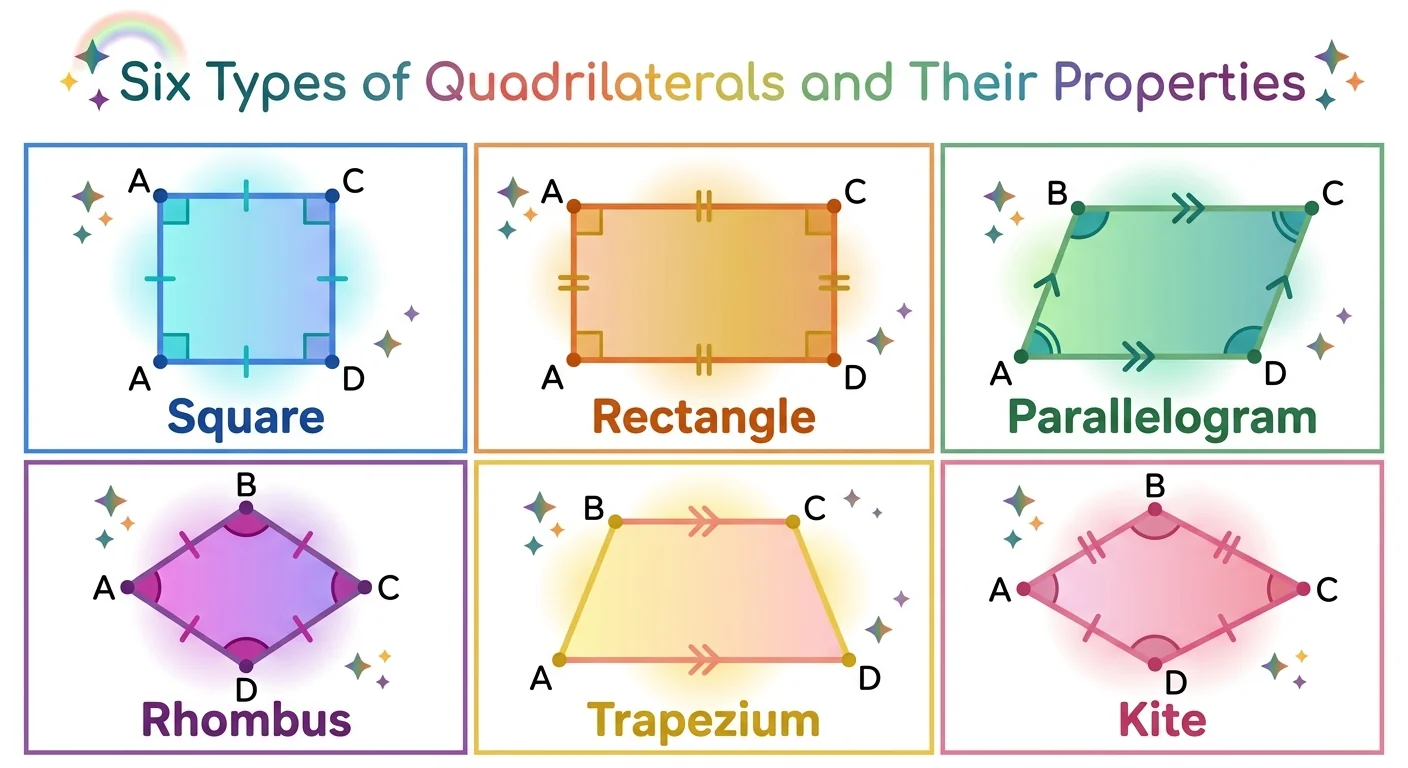
These are the six types in the Class 4 to Class 7 syllabus. Read each one looking at four things: its sides, its angles, its diagonals and its lines of symmetry. Keeping that order the same for every shape is what makes the comparison table later on click into place.
Square
A square is a quadrilateral with four equal sides and four right angles.
- Sides: all four sides equal. Opposite sides parallel.
- Angles: all four angles are 90 degrees.
- Diagonals: equal in length, they cut each other exactly in half, they meet at 90 degrees, and each one splits the corner angles into two 45 degree halves.
- Lines of symmetry: four, two through opposite corners and two through the midpoints of opposite sides.
The square is the most special quadrilateral there is. It is the only one where every side is equal and every angle is equal, which makes it the only regular quadrilateral. Hold on to that word special, because it is the key to the family tree.
Where you see it: floor tiles, a carrom board, a chessboard square, a window pane, a sticky note.
Rectangle
A rectangle is a quadrilateral with four right angles and opposite sides equal.
- Sides: opposite sides are equal and parallel. Adjacent sides are usually different lengths.
- Angles: all four angles are 90 degrees.
- Diagonals: equal in length and they cut each other in half. They do not meet at right angles unless the rectangle happens to be a square.
- Lines of symmetry: two, both through the midpoints of opposite sides. The diagonals of a rectangle are not lines of symmetry, which surprises most children.
That last point is worth a minute of folding. Fold a rectangular sheet of paper along a diagonal and the halves do not match. Fold a square along its diagonal and they do.
Where you see it: a notebook cover, a door, a cricket pitch, a mobile phone screen, a brick face.
Parallelogram
A parallelogram is a quadrilateral with both pairs of opposite sides parallel.
- Sides: opposite sides are parallel and equal in length.
- Angles: opposite angles are equal. Any two angles next to each other add up to 180 degrees.
- Diagonals: they cut each other exactly in half. They are not equal in length and they do not meet at right angles.
- Lines of symmetry: none. A parallelogram does have rotational symmetry, so turning it half a turn leaves it looking the same, but no fold line matches the two halves.
The parallelogram is the parent shape of the family. Squares, rectangles and rhombuses are all parallelograms with extra conditions added on top.
Where you see it: the face of a leaning stack of books, the pattern in a diamond-mesh fence, a parallel ruler, the side view of a folding clothes rack.
Rhombus
A rhombus is a quadrilateral with all four sides equal and opposite sides parallel.
- Sides: all four sides equal. Opposite sides parallel.
- Angles: opposite angles are equal. Adjacent angles add to 180 degrees. The angles are not 90 degrees unless the rhombus happens to be a square.
- Diagonals: they cut each other in half at right angles, and each diagonal splits the corner angles it passes through into two equal halves. The two diagonals are not equal in length.
- Lines of symmetry: two, and both of them are its diagonals.
A useful way to say it to a child: a rhombus is a square that has been pushed over at the top. All the sides stay the same length, but the corners stop being right angles.
Where you see it: the diamond on a playing card, a road sign turned on its point, rangoli tiles, the lattice in a window grille.
Trapezium
A trapezium is a quadrilateral with one pair of opposite sides parallel. In Indian and British textbooks this shape is called a trapezium, so that is the word used throughout NCERT and the word your child will meet in the exam.
- Sides: one pair of opposite sides is parallel. These two are called the parallel sides or bases, and they are almost always different lengths. The other two sides are not parallel.
- Angles: the two angles sitting on the same non-parallel side add up to 180 degrees. Beyond that, the angles can be anything.
- Diagonals: they cross each other, but neither one cuts the other in half, and they are not equal in length.
- Lines of symmetry: none for an ordinary trapezium.
The isosceles trapezium. This is the tidy version, and it turns up often enough to be worth naming. In an isosceles trapezium the two non-parallel sides are equal in length. That one change brings three consequences: the two angles along each parallel side are equal, the diagonals become equal in length, and the shape gains exactly one line of symmetry, running through the midpoints of the two parallel sides.
Where you see it: a flowerpot seen from the side, a lampshade, the cross-section of a canal, the side of a handbag, a bucket.
Kite
A kite is a quadrilateral with two pairs of equal sides, where the equal sides are next to each other rather than opposite.
- Sides: two pairs of adjacent sides are equal. A kite has two short sides meeting at one corner and two long sides meeting at the opposite corner. No sides are parallel.
- Angles: one pair of opposite angles is equal. These are the two angles where a short side meets a long side. The other two angles are generally different from each other.
- Diagonals: the two diagonals meet at right angles. The longer diagonal cuts the shorter one exactly in half, but the shorter one does not return the favour.
- Lines of symmetry: one, along the longer diagonal.
The kite is the shape children find easiest to picture and hardest to describe, because every other type in this list has its equal sides opposite each other. The kite is the exception, and saying that out loud helps.
Where you see it: a flying kite, an arrowhead, a diamond-shaped pendant, certain rangoli motifs, some vaulted ceiling panels.
Quadrilateral Properties Compared Side by Side
This is the table to print and stick above your child’s desk. Everything in the six sections above is here in one view.
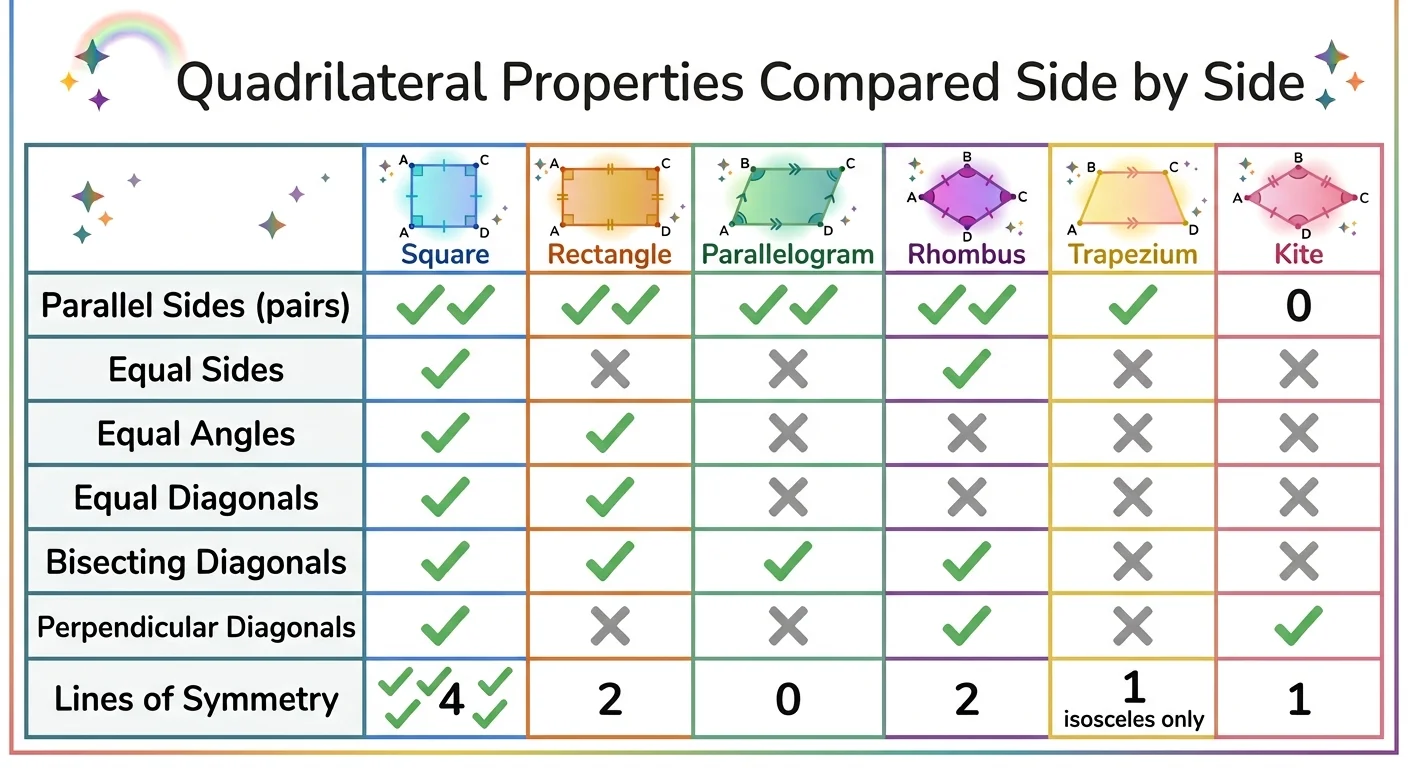
| Property | Square | Rectangle | Parallelogram | Rhombus | Trapezium | Kite |
|---|---|---|---|---|---|---|
| Pairs of parallel sides | 2 | 2 | 2 | 2 | 1 | 0 |
| All four sides equal | Yes | No | No | Yes | No | No |
| Opposite sides equal | Yes | Yes | Yes | Yes | No | No |
| Adjacent sides equal | Yes | No | No | Yes | No | Yes, two pairs |
| All four angles equal | Yes, all 90 degrees | Yes, all 90 degrees | No | No | No | No |
| Opposite angles equal | Yes | Yes | Yes | Yes | No | One pair only |
| Diagonals equal in length | Yes | Yes | No | No | No, except isosceles | No |
| Diagonals bisect each other | Yes | Yes | Yes | Yes | No | One bisects the other |
| Diagonals meet at right angles | Yes | No | No | Yes | No | Yes |
| Lines of symmetry | 4 | 2 | 0 | 2 | 0, or 1 if isosceles | 1 |
One pattern is worth pointing out to your child straight away. Read the square column: it says yes to almost everything. Read the trapezium and kite columns: mostly no. That is not an accident, and the next section explains why.
The Quadrilateral Family Hierarchy
Here is the idea that makes everything above easier to hold in your head. The six types are not six separate shapes. They are one family, and each type is a more specific version of the one above it.
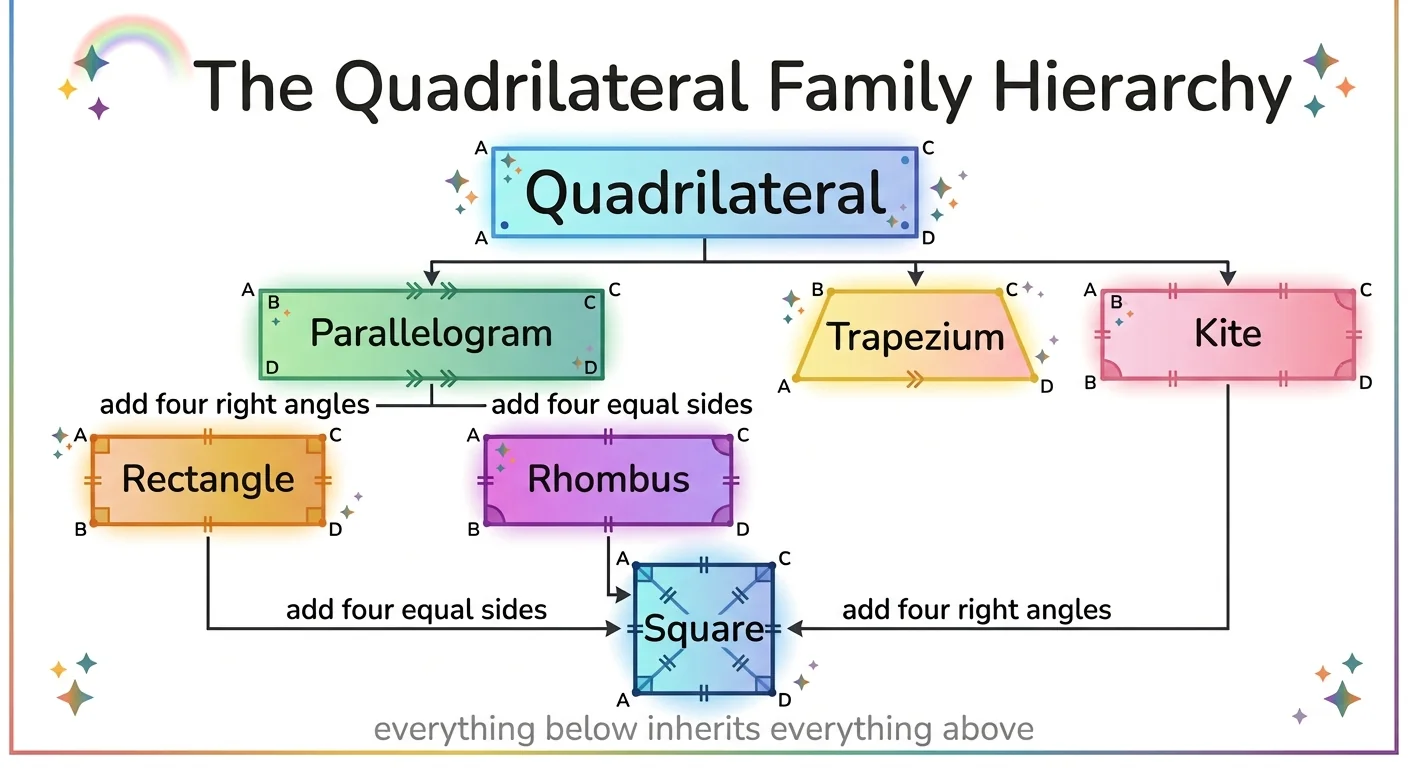
Start at the top with quadrilateral, the widest category: any closed shape with four straight sides. Then add conditions, one at a time.
- Add two pairs of parallel sides and you get a parallelogram.
- Take a parallelogram and add four right angles, and you get a rectangle.
- Take a parallelogram and add four equal sides instead, and you get a rhombus.
- Take either one and add the missing condition, so four right angles and four equal sides together, and you get a square.
The square sits at the bottom of the tree because it has the most conditions on it. The quadrilateral sits at the top because it has the fewest. Trapeziums and kites branch off separately, because they only have one pair of parallel sides or none at all, which means they can never be parallelograms.
[FAMILY TREE DIAGRAM GOES HERE] Top-down tree: Quadrilateral at the top, branching to Parallelogram (2 parallel pairs), Trapezium (1 parallel pair) and Kite (no parallel sides). Parallelogram branches to Rectangle (add 4 right angles) and Rhombus (add 4 equal sides), and both converge on Square at the bottom. See the image brief at the end of this document.
Read it downward. Each arrow adds one condition, and every type inherits everything above it, which is why the square sits at the very bottom.
Reading the Family Tree
The rule for reading any hierarchy like this one is simple: everything below inherits everything above.
A square is below rectangle, which is below parallelogram, which is below quadrilateral. So a square has every property a rectangle has, plus every property a parallelogram has, plus every property a quadrilateral has, plus its own extras. That is exactly why the square column in the table says yes so often.
It also works the other way round, and this is where the confusion usually sits. Going down the tree is not guaranteed. Every square is a rectangle, but most rectangles are not squares. Every rhombus is a parallelogram, but most parallelograms are not rhombuses. Going up is always true, going down is only sometimes true.
A shortcut phrase that sticks with children: all squares are rectangles, but not all rectangles are squares. Have them say the same sentence with other pairs until the pattern feels obvious.
Why a Square Is Also a Rectangle and a Rhombus
This is the single most common sticking point at this level, so it is worth handling head on.
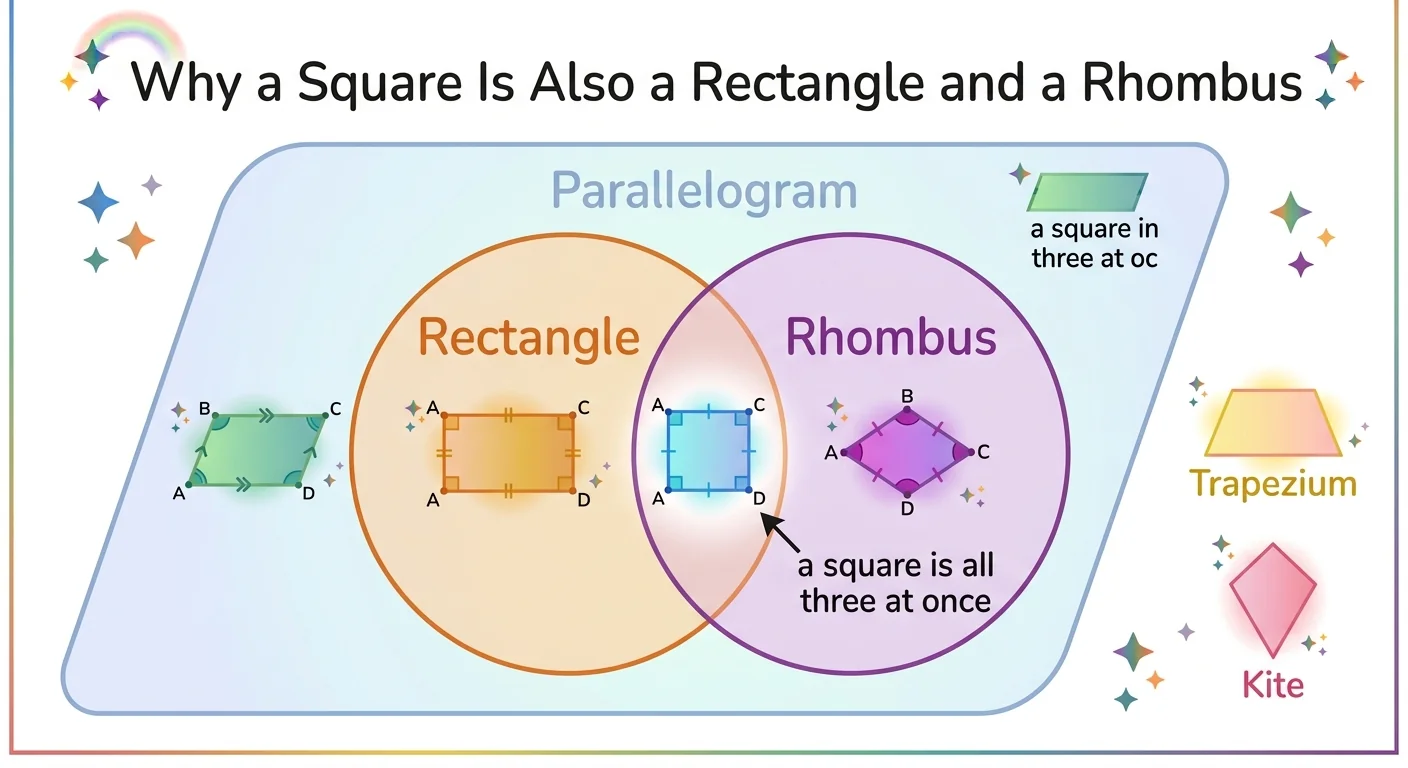
Ask what the definition of a rectangle actually says. A rectangle is a quadrilateral with four right angles and opposite sides equal. Now check a square against that definition. Does it have four right angles? Yes. Are its opposite sides equal? Yes, in fact all four are equal. The square meets every condition, so the square is a rectangle.
Now do the same with rhombus. A rhombus is a quadrilateral with all four sides equal and opposite sides parallel. Does a square have four equal sides? Yes. Are its opposite sides parallel? Yes. So the square is also a rhombus.
So all three of these statements are true at the same time:
- A square is a rectangle.
- A square is a rhombus.
- A square is a parallelogram.
The objection children raise is usually some version of “but it doesn’t look like a rectangle”. The honest answer is that in everyday speech, calling something a rectangle usually implies it is not a square, in the same way that calling someone a parent usually implies more than one child even though it does not have to. Mathematics does not work that way. In mathematics a definition is a checklist, and anything that passes the checklist belongs in the category, no matter what we would call it in conversation.
There is a practical payoff too. Because a square is a rectangle, every rule about rectangles automatically applies to squares. Your child does not have to learn the rules twice.
Diagonals of Quadrilaterals
Diagonals are the most underused tool in this topic. Many textbooks mention them in passing. In practice they are the fastest way to tell two similar-looking quadrilaterals apart, and they are where a lot of Olympiad reasoning lives.
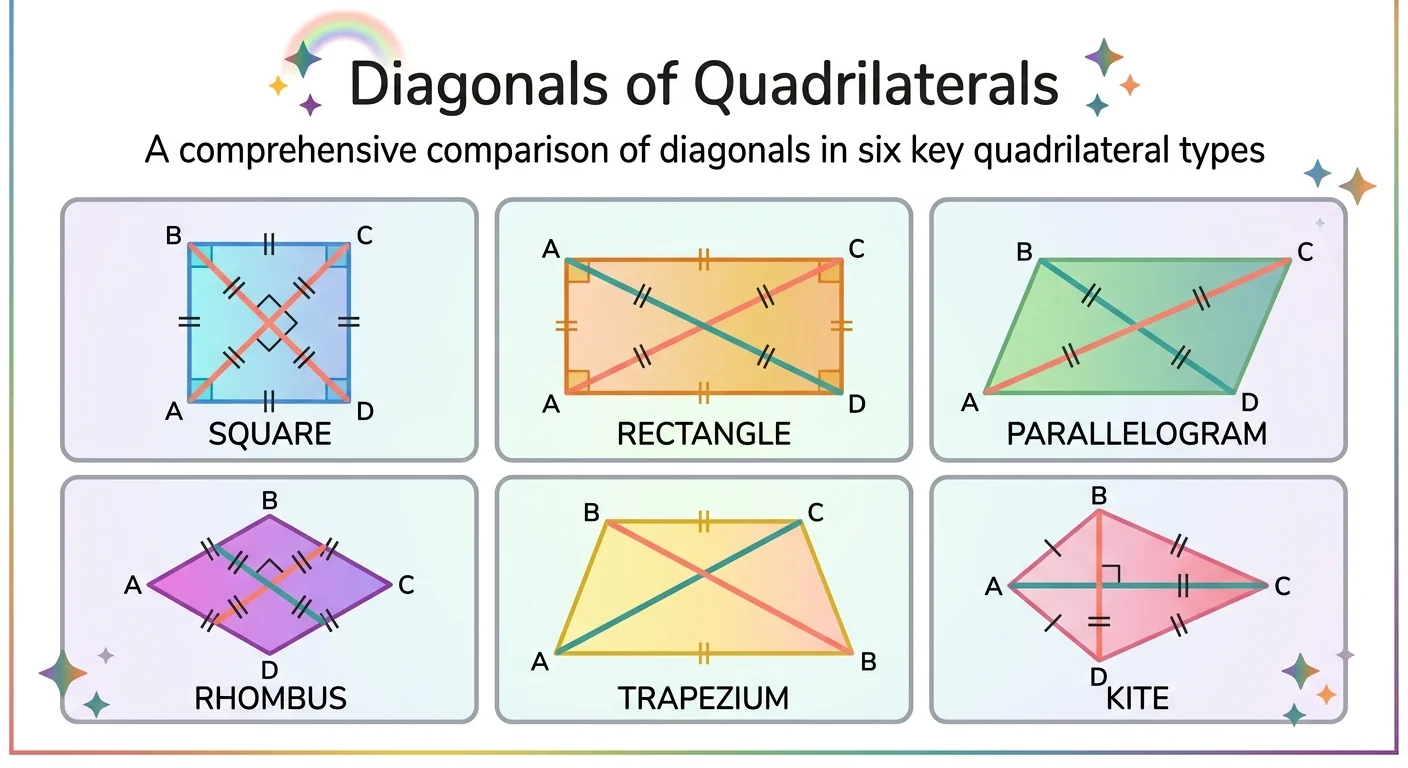
Every quadrilateral has exactly two diagonals, each joining a pair of opposite corners.
The Three Diagonal Questions
For any quadrilateral, ask three questions in this order:
- Are the two diagonals equal in length?
- Does each diagonal cut the other exactly in half? The word for this is bisect.
- Do the diagonals cross at right angles?
Three yes-or-no answers give eight possible combinations, and each of the main quadrilateral types has its own signature. That is what makes diagonals such a good diagnostic tool.
Diagonal Properties of Each Type
| Type | Equal? | Bisect each other? | At right angles? | Extra |
|---|---|---|---|---|
| Square | Yes | Yes | Yes | Each diagonal splits the corner angles into 45 degree halves |
| Rectangle | Yes | Yes | No | The two diagonals split the rectangle into four triangles of equal area |
| Parallelogram | No | Yes | No | The crossing point is the exact centre of the shape |
| Rhombus | No | Yes | Yes | Each diagonal bisects the two corner angles it passes through |
| Trapezium | No | No | No | Isosceles trapezium only: the diagonals are equal |
| Kite | No | One bisects the other | Yes | The longer diagonal is the line of symmetry |
Read the table across and two pairs stand out. Square and rhombus both have perpendicular diagonals, and the only thing separating them is whether the diagonals are also equal. Square and rectangle both have equal diagonals, and the only thing separating them is whether the diagonals are also perpendicular. Those two facts alone will resolve most classification questions your child meets.
How to Identify a Quadrilateral From Its Properties
When your child is given a shape, or a set of measurements taken with a ruler and a protractor, and asked what it is, this sequence gets them there in five steps. Work from the widest question down to the narrowest.
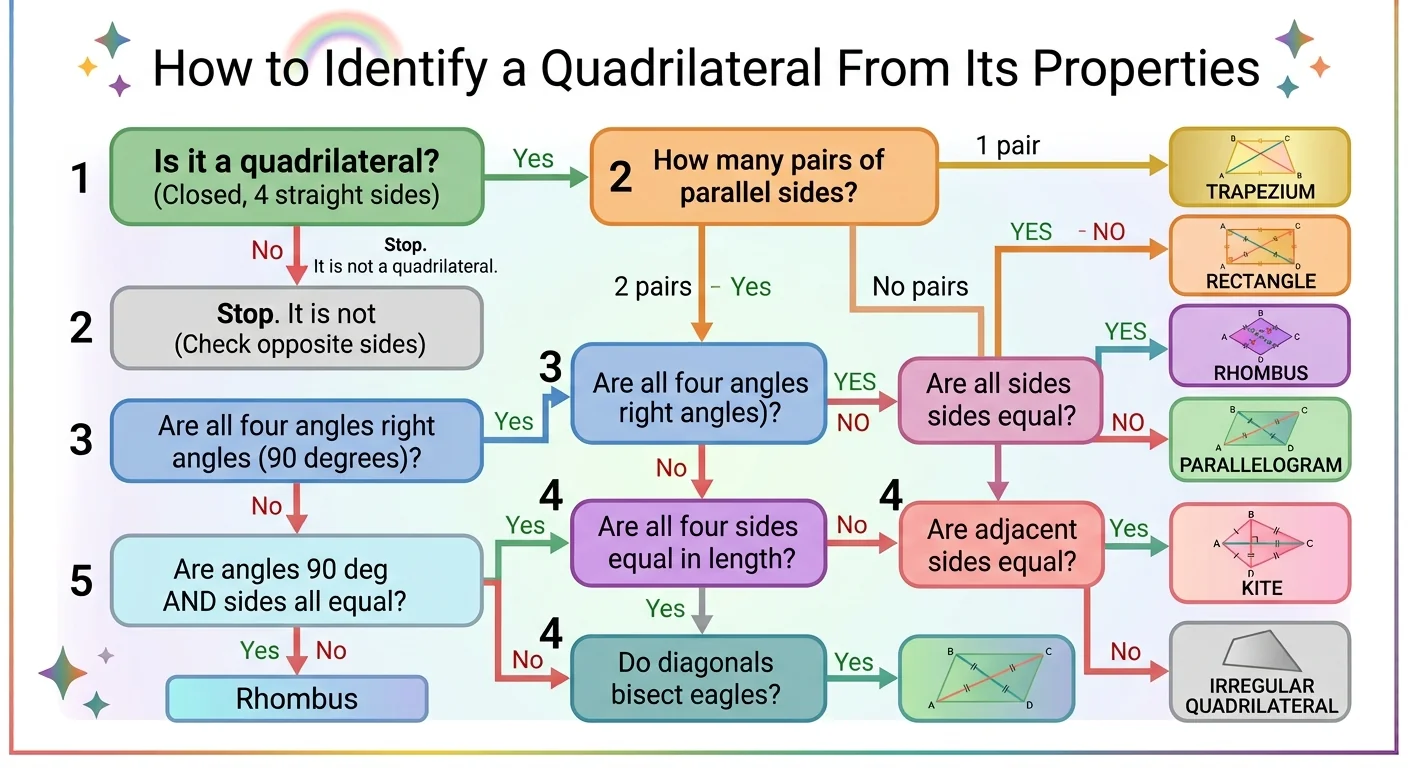
- Check that it is a quadrilateral at all. Four straight sides, closed, no crossings. If not, stop here.
- Count the pairs of parallel sides. Two pairs means you are in the parallelogram branch, so go to step 3. One pair means it is a trapezium, so go to step 5. No pairs means it is a kite or an irregular quadrilateral, so go to step 5.
- Check the angles. Measure each one with a protractor if you are not sure by eye. If all four angles are 90 degrees, it is a rectangle, and you need step 4 to go further. If the angles are not right angles, it is a parallelogram or a rhombus, and step 4 decides which.
- Check the sides. If all four sides are equal, the shape is a square when the angles were right angles, and a rhombus when they were not. If only opposite sides are equal, the shape is a rectangle when the angles were right angles, and a parallelogram when they were not.
- Use the diagonals to confirm or to break a tie. Equal diagonals that bisect each other but do not meet at right angles means rectangle. Perpendicular diagonals that bisect each other but are not equal means rhombus. Both equal and perpendicular means square. Perpendicular diagonals where only one bisects the other means kite. One pair of parallel sides with equal diagonals means isosceles trapezium.
Worked example. A quadrilateral has all four sides measuring 7 cm. Its diagonals measure 9 cm and 11 cm, and they cross at right angles. What is it?
Step 2 and step 4 tell you all sides are equal, so it is a square or a rhombus. Step 5 settles it: the diagonals are perpendicular but not equal, so it cannot be a square. The shape is a rhombus.
Quadrilaterals in Real Life
Pointing at shapes in the room is the cheapest teaching tool available, and it works because children stop treating geometry as something that only exists on paper.
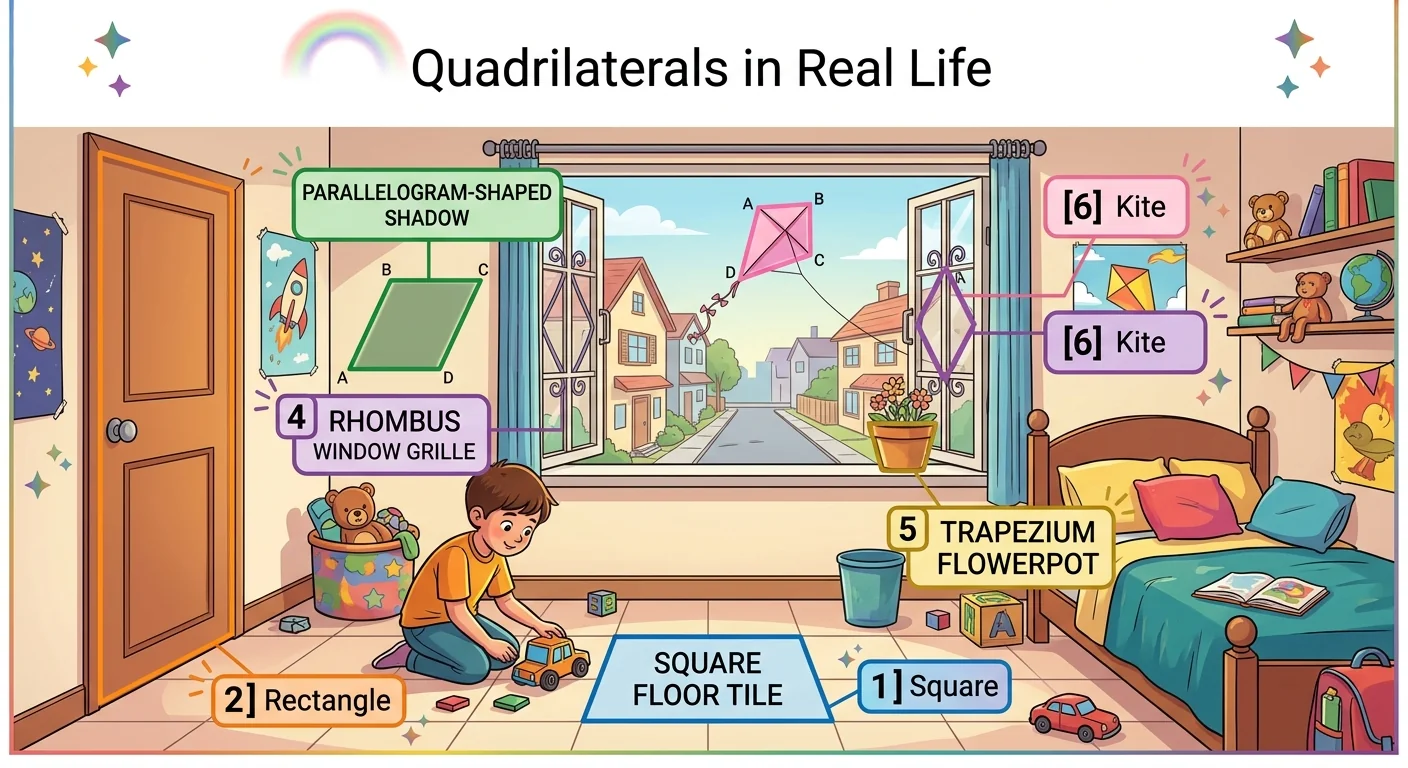
| Type | Where to find it |
|---|---|
| Square | Floor and bathroom tiles, carrom board, a single chessboard square, sticky notes, a folded handkerchief |
| Rectangle | Doors, notebook covers, phone screens, currency notes, cricket pitch, bricks, a classroom blackboard |
| Parallelogram | A leaning stack of books, diamond-mesh fencing, the side view of a folding clothes rack, parallel rulers, shadows of rectangular windows on a wall |
| Rhombus | The diamond suit on a playing card, rangoli tiles, window grille lattices, some tile patterns in older buildings |
| Trapezium | A flowerpot or bucket seen from the side, a lampshade, the cross-section of a canal, handbag outlines, the side of a table lamp |
| Kite | A flying kite, arrowheads, pendants, some temple carvings and rangoli motifs |
A good five-minute exercise: walk around the house with your child and find one example of each type. The trapezium and the kite are the hard ones, which is exactly why the hunt is useful.
Common Mistakes Students Make
These six errors cover most of what goes wrong in Class 4 to Class 7.
Thinking a square is not a rectangle. The fix is to read the definition of a rectangle out loud and check the square against it item by item. Definitions are checklists, not descriptions of how a shape looks.
Confusing a rhombus with a parallelogram. Both have opposite sides parallel and opposite angles equal. The difference is that a rhombus has all four sides equal. Ask: are all four sides the same length? That one question separates them.
Confusing a rhombus with a square. Both have four equal sides. The difference is the angles. A square has four right angles, a rhombus generally does not. Checking the diagonals works too: both are perpendicular, but only the square has equal diagonals.
Thinking a trapezium is a parallelogram. A trapezium has only one pair of parallel sides, so it can never be a parallelogram. Counting the pairs of parallel sides before anything else prevents this.
Believing the diagonals of a rectangle are lines of symmetry. They are not. Folding a rectangular sheet along its diagonal proves it in two seconds.
Assuming a shape changes when it is rotated. Turn a square on its point and children often call it a diamond or a rhombus. It is still a square. Properties do not depend on which way up a shape is sitting.
Ten Activities for Teaching Quadrilaterals
All of these use materials you already have at home or in a classroom cupboard.
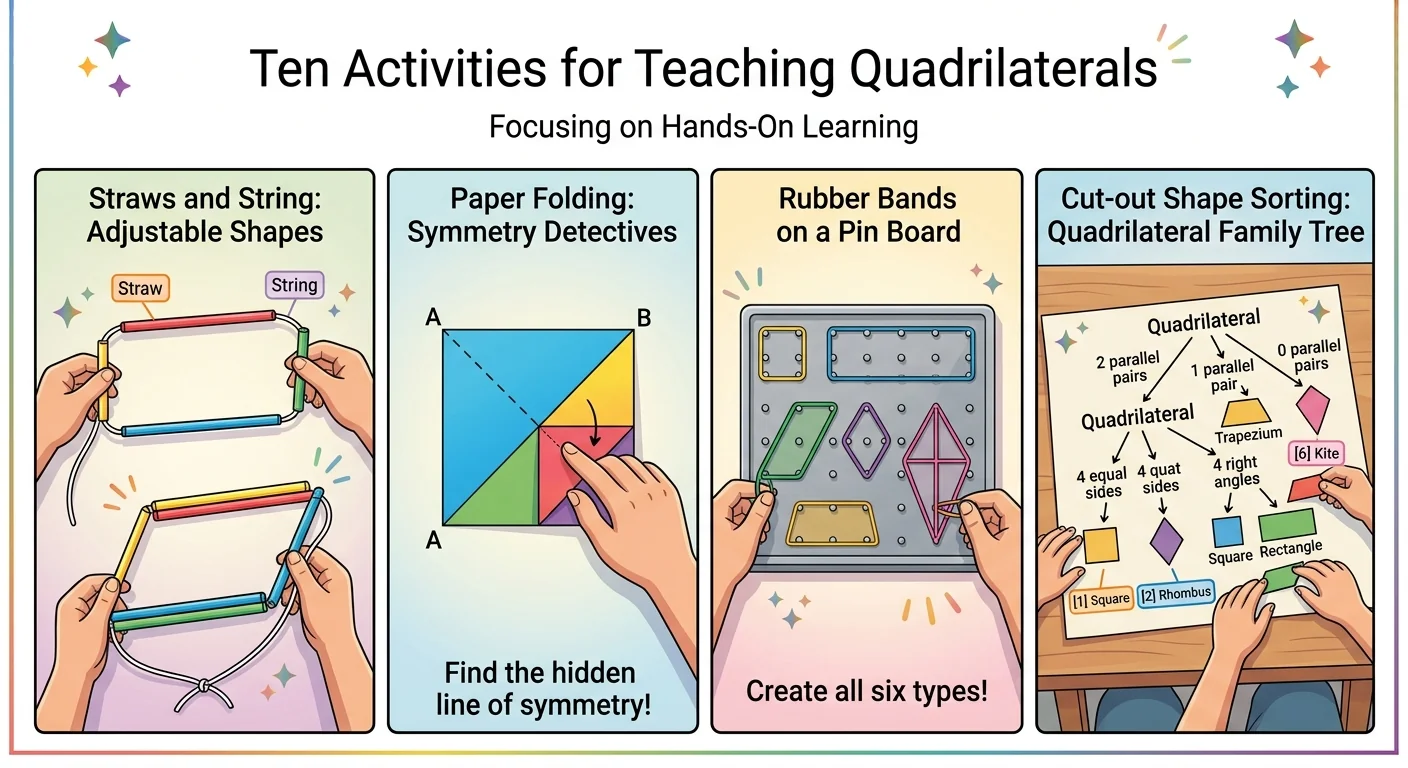
- Straw and string shapes. Thread string through four drinking straws and tie it into a loop. Push the frame into a square, then lean it over into a rhombus. The sides never change length, only the angles do. This makes the square-rhombus relationship physical.
- The paper fold test. Cut out each of the six shapes and fold them in every way you can. Count the folds where the halves match exactly. That count is the number of lines of symmetry, discovered rather than memorised.
- Geoboard or nail board. Stretch rubber bands around a grid of pins to make each type. Challenge your child to make a parallelogram that is not a rectangle, then a rhombus that is not a square.
- The property sorting game. Write properties on slips of paper: four right angles, all sides equal, one pair of parallel sides, perpendicular diagonals. Draw a slip and have your child name every type that fits. Most slips have more than one answer, which is the point.
- Build the family tree. Give your child cut-out shapes and have them arrange the tree themselves on a large sheet, with the square at the bottom. Making them place the shapes is far more effective than showing them a finished diagram.
- Shape hunt with a camera. Walk around the house or school and photograph one example of each type. Print or sketch them and label each with its properties.
- Twenty questions, shapes edition. You think of a quadrilateral. Your child asks only yes-or-no property questions to identify it. This forces them to ask the useful questions rather than guessing names.
- Diagonal detective. Draw several quadrilaterals with only their diagonals marked and nothing else. Have your child name each one using the diagonal table. This is the single best preparation for the kind of visual reasoning Olympiad problems ask for.
- The angle sum check. Cut a paper quadrilateral into four corner pieces and arrange the four angles around a point. They fit perfectly into a full turn, showing 360 degrees without any measuring.
- True or false cards. Write statements like “every rectangle is a parallelogram” and “every parallelogram is a rectangle” on cards. Sorting them into true and false piles hammers home that the hierarchy works upward, not downward.
Tips for Parents Teaching at Home
Teach the family before the members. Spend the first session on what makes something a quadrilateral and on the family tree. The individual properties land much faster afterwards.
Use one consistent order. Sides, then angles, then diagonals, then symmetry, every single time. The repetition is what builds a mental checklist.
Let them draw badly on purpose. Lopsided, irregular quadrilaterals are important. If every example is a neat square or rectangle, children quietly conclude that quadrilaterals have to look tidy.
Ask “how do you know” every time. The useful answer names a property, not an appearance. “Because all four sides are equal and the angles are not 90 degrees” beats “because it looks like one”.
Keep sessions short. Fifteen or twenty minutes with one shape, done well, beats an hour covering all six at once.
Don’t rush to area and perimeter. Those are separate skills. Classification needs to be solid first, otherwise formulas get attached to the wrong shapes.
Tips for Teachers in the Classroom
Open with the sorting problem, not the definitions. Give students a pile of cut-out quadrilaterals and ask them to group them however they like. Their groupings reveal what they already notice, and the lesson can start from there.
Make the hierarchy a wall display. Build it across several lessons, adding each type as it is taught. A tree that grows in front of the class is remembered far better than one handed out complete.
Plan for the square-rectangle argument. It will come up, and it is a productive argument. Let students debate it before you settle it, then settle it with the definition.
Use non-examples deliberately. Show a parallelogram that is not a rhombus and a rhombus that is not a square. Non-examples sharpen a category faster than more examples of the same thing.
Assess with properties, not pictures. Ask “name a quadrilateral whose diagonals bisect each other at right angles but are not equal” rather than “name this shape”. The first question cannot be answered by recognition alone.
Connect to symmetry and tiling. Quadrilaterals sit naturally alongside lines of symmetry and tessellation, and teaching them together saves time in both topics.
Quadrilaterals in Olympiad Geometry
Olympiad problems at the junior level rarely ask a child to name a shape. They ask them to deduce one. The properties in this guide are the deduction tools, and three patterns come up again and again.
Working backwards from diagonals. A problem will tell you that the diagonals of a quadrilateral bisect each other at right angles and are unequal, then ask for something else about the shape. Recognising that this forces a rhombus unlocks the whole problem.
Using the angle sum as an equation. Angles given in a ratio, or expressed with an unknown such as x, x + 20, 2x and 3x, turn the 360 degree property into a one-step equation. Class 6 and Class 7 Olympiad papers lean on this constantly.
Splitting into triangles. The diagonal trick from the angle sum proof is a general strategy. Any quadrilateral problem can become two triangle problems, and triangles have far more usable rules.
A typical junior question: the diagonals of a quadrilateral are equal and bisect each other, but they do not meet at right angles. What is the shape? Equal and bisecting points at rectangle or square, and not perpendicular rules out the square. The answer is a rectangle, reached entirely by elimination, which is the heart of how Olympiad problems get solved.
This is also why the family hierarchy matters beyond classification. Olympiad reasoning is relational. It asks what must follow if certain things are true, and a child who sees quadrilaterals as a nested family is already thinking in exactly that way. Working through olympiad-style questions is the fastest way to turn that into a habit.
Practice Questions With Answers
Work through these with your child, then check the answers below.
- Three angles of a quadrilateral are 70 degrees, 105 degrees and 95 degrees. Find the fourth angle.
- A quadrilateral has all four sides equal and all four angles equal to 90 degrees. Name it.
- The angles of a quadrilateral are in the ratio 1 : 2 : 3 : 4. Find all four angles.
- True or false: every rhombus is a parallelogram.
- True or false: every parallelogram is a rhombus.
- A quadrilateral has diagonals that are equal in length and bisect each other at right angles. Name it.
- Which quadrilateral has exactly one line of symmetry and two pairs of equal adjacent sides?
- A quadrilateral has one pair of parallel sides and two equal diagonals. Name it.
- How many lines of symmetry does a parallelogram that is not a rectangle or a rhombus have?
- Name a quadrilateral whose diagonals bisect each other but are neither equal nor perpendicular.
Answers
- 90 degrees. The three given angles add to 270, and 360 – 270 = 90.
- A square.
- 36, 72, 108 and 144 degrees. The ratio parts add to 10, and 360 divided by 10 is 36 degrees per part.
- True. A rhombus has both pairs of opposite sides parallel, which is the definition of a parallelogram.
- False. A parallelogram only becomes a rhombus when all four of its sides are equal.
- A square. Equal diagonals point to a rectangle or square, and perpendicular diagonals narrow it to the square.
- A kite.
- An isosceles trapezium.
- None. A parallelogram has rotational symmetry but no lines of symmetry.
- A parallelogram.
Make Preparing for Math Olympiad Simple!


What is a quadrilateral?
A quadrilateral is a closed, flat shape with exactly four straight sides, four angles and four vertices. The interior angles of every quadrilateral add up to 360 degrees.
What are the types of quadrilaterals and their properties?
The six main types studied in Class 4 to Class 7 are the square, rectangle, parallelogram, rhombus, trapezium and kite. The square has four equal sides and four right angles. The rectangle has four right angles with opposite sides equal. The parallelogram has two pairs of parallel sides with opposite angles equal. The rhombus has four equal sides with opposite sides parallel. The trapezium has one pair of parallel sides. The kite has two pairs of equal adjacent sides.
Is a square a rectangle?
Yes. A rectangle is defined as a quadrilateral with four right angles and opposite sides equal, and a square meets both conditions. A square is also a rhombus and a parallelogram. The reverse is not true, since most rectangles are not squares.
What is the difference between a rhombus and a parallelogram?
Both have two pairs of parallel sides and equal opposite angles. The difference is that a rhombus has all four sides equal, while a parallelogram only needs its opposite sides to be equal. Every rhombus is a parallelogram, but most parallelograms are not rhombuses.
Why do the angles of a quadrilateral add up to 360 degrees?
Drawing one diagonal splits any quadrilateral into two triangles. Each triangle’s angles add to 180 degrees, and together those angles make up exactly the four angles of the quadrilateral, so the total is 360 degrees.
Is a trapezium a parallelogram?
No. A trapezium has only one pair of parallel sides, and a parallelogram needs two pairs. A trapezium can never be a parallelogram.
Why is it called a trapezium and not a trapezoid?
Indian and British textbooks, including NCERT, use trapezium for a quadrilateral with one pair of parallel sides. American textbooks call the same shape a trapezoid. Your child should use trapezium in CBSE exams.
How many lines of symmetry does each quadrilateral have?
A square has four, a rectangle has two, a rhombus has two, a kite has one, an isosceles trapezium has one, and a parallelogram and an ordinary trapezium have none.
What is an irregular quadrilateral?
An irregular quadrilateral is any four-sided shape that does not fit one of the named types, with no equal sides and no parallel sides. It is still a quadrilateral, and its angles still add up to 360 degrees.
At what class are quadrilaterals taught in CBSE?
Children meet quadrilaterals as four-sided shapes from Class 4, work on naming types and basic properties in Class 5 and Class 6, and study angle sum, diagonals and classification more formally in Class 7.
Conclusion
Quadrilaterals get easier once your child sees one family instead of six shapes. The angle sum holds because every quadrilateral splits into two triangles. The square says yes to almost every property because it sits at the bottom of the tree and inherits everything above it.
If they remember one thing, make it this: going up the family tree is always true; going down is only sometimes true. Every square is a rectangle, but most rectangles are not squares.

Mikha Piregu is a Content Writer with experience spanning educational content, including math and math olympiad topics, as well as advocacy writing, research-based articles, and SEO-driven web content. He creates high-quality blog content, web copy, and feature articles that support brand visibility, audience engagement, and long-term organic growth through data-informed storytelling. Skilled in WordPress, WooCommerce, and modern digital tools, Mikha adapts content across various platforms, including blogs, websites, campaigns, and advocacy initiatives, with clarity and purpose.

There are no comments posted here yet.
Sign in to leave a comment