 April 7, 2026
 14 min. read

The SOF IMO syllabus 2026–27 covers mathematical reasoning, logical reasoning, everyday mathematics, and higher-order thinking across Classes 1 to 12.
Most students searching for it end up with five browser tabs open and no clear answer about what to actually study first. Topic lists without context.
In this guide you will find a clear, class-wise breakdown of the SOF IMO syllabus (Class 1–12), with simple explanations, priority topics, and a practical preparation roadmap for students.
If you’re also looking for exam dates, eligibility, and registration details, complete SOF IMO guide covers all of that in one place.
SOF IMO Exam Structure and Sections
Before you look at the syllabus for your class, it helps to understand how the paper is built.
The SOF IMO has four sections, and knowing what each one tests tells you exactly how to prepare.
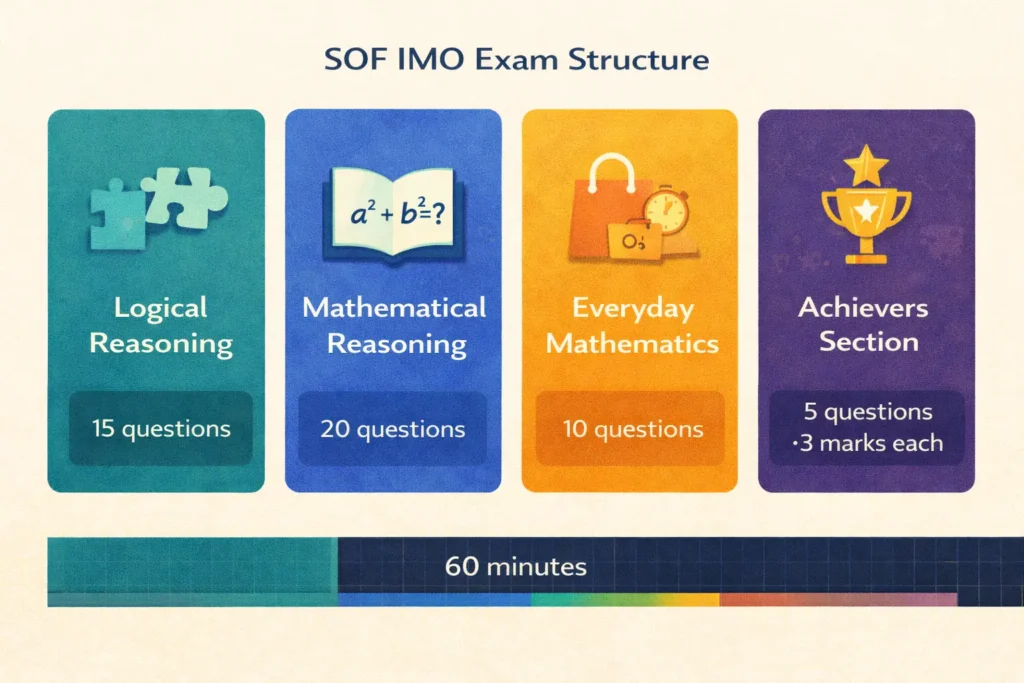
| Section | What It Tests | Questions (Class 1–4) | Questions (Class 5–12) |
| Section 1: Logical Reasoning | Pattern recognition, sequences, analogies, visual and verbal reasoning | 10 | 15 |
| Section 2: Mathematical Reasoning | Core math topics from current and previous class curriculum | 20 | 20 |
| Section 3: Everyday Mathematics | Application of math topics to real-world scenarios | — | 10 |
| Section 4: Achievers Section | Higher-order thinking (HOTS) based on current class topics | 5 | 5 |
| Total | 35 | 50 |
Time limit: 60 minutes for all classes. All questions are multiple-choice (MCQs).
Level 1 vs Level 2 — what’s different?
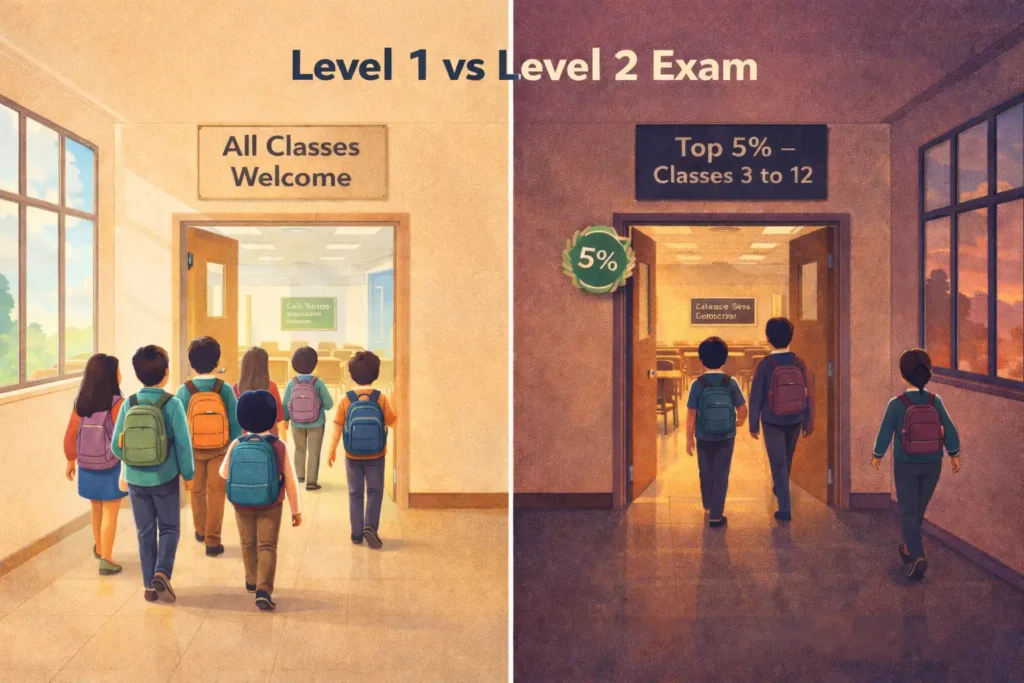
Level 1 is open to all students and is held at your school. In Level 1, 60% of questions come from your current class syllabus and 40% from the previous class so Class 7 students will also see some Class 6 content.
The Achievers Section is the exception: it’s 100% from the current class.
Level 2 is for Classes 3–12 only. The top 5% of Level 1 performers (class-wise) qualify.
The topics covered are the same, but questions are noticeably harder, more application-based, fewer straightforward recall questions. Classes 1 and 2 are ranked only on Level 1.
SOF IMO Syllabus 2026–27 — Class-wise Breakdown
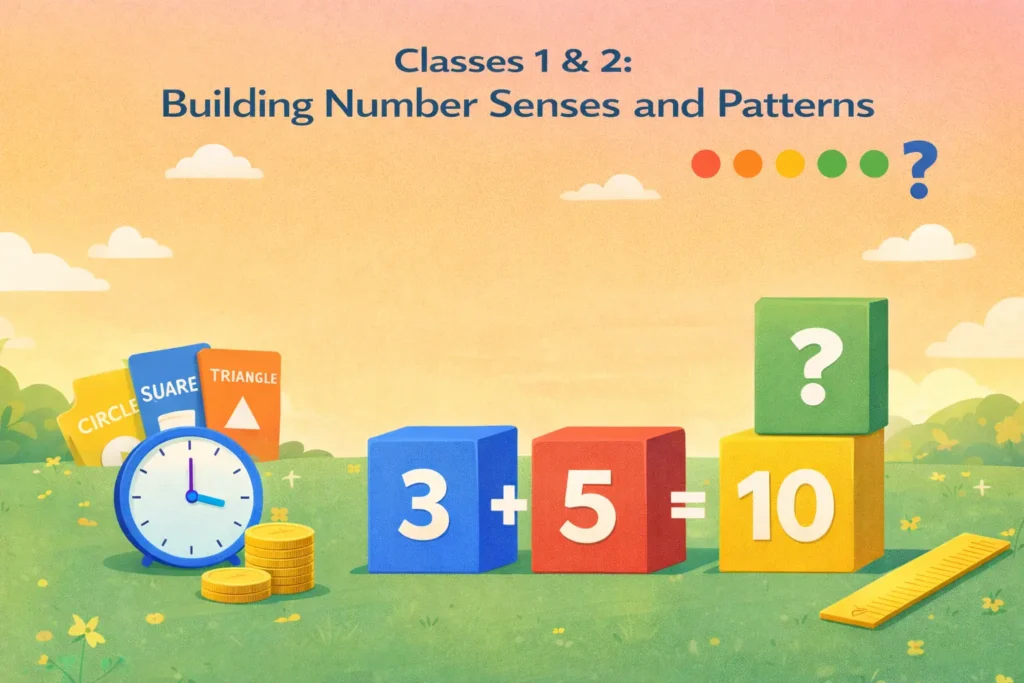
Classes 1 & 2 — Building Number Sense and Patterns
At this stage, the IMO tests whether young students can recognize patterns, count confidently, and apply basic arithmetic in simple scenarios.
It’s not about complex math, it’s about foundational thinking.
Class 1 Syllabus:
| Topic | What It Means | How It Appears in the Olympiad |
| Numerals and Number Names | Reading and writing numbers up to 2 digits, including ordinal positioning. See also:ascending and descending order and number line basics | Match numbers to words, fill in missing numbers, number position questions |
| Number Sense (2-digit) | Comparing, ordering, and placing numbers. Understand the difference between number sense and arithmetic | “Which number comes between 34 and 36?” ordering and rules for ordering numbers |
| Addition and Subtraction | Basic operations, leading into early multiplication concepts | Word problems with simple scenarios |
| Lengths, Weights, Time, Money | Basic measurement and comparison | “Which is heavier?” picture-based questions |
| Geometrical Shapes and Solids | Identifying 2D and 3D shapes. Also tested alongside spatial understanding | Pick the odd shape, match shape names |
| Patterns | Completing number or picture sequences. Related: skip counting and backward counting | “What comes next in this pattern?” also tests forward and backward counting |
| Logical Reasoning | Spatial understanding, odd one out, ranking, analogy | Visual puzzles, grouping, simple analogies |
Class 2 Syllabus: Topics extend into 3-digit numbers, Pictographs, Temperature, and Lines & Shapes. Logical Reasoning adds Coding-Decoding and Embedded Figures.
Priority topics: Number Sense and Addition/Subtraction carry the most marks. Understanding why number sense matters at this stage helps students build the right foundation early.
Patterns appear in both Logical Reasoning and Everyday Mathematics our guide on number sequences for Class 1 explains exactly how these pattern questions are structured in the Olympiad.
The 5 characteristics of number sense are also worth reviewing to understand what the examiner is actually testing.
For parents: This level is very manageable with 15–20 minutes of guided practice per day. Use real objects at home — coins for money questions, clocks for time, and toys for shape identification.
Our guide on number sense resources for parents lists specific tools and activities for this age group.
For structured practice on sequences and patterns, read how to teach number sequences to Class 1 students and strategies for teaching number sense to first graders.
The Olympiad tests understanding, not memorization focus on the “why” behind each answer.
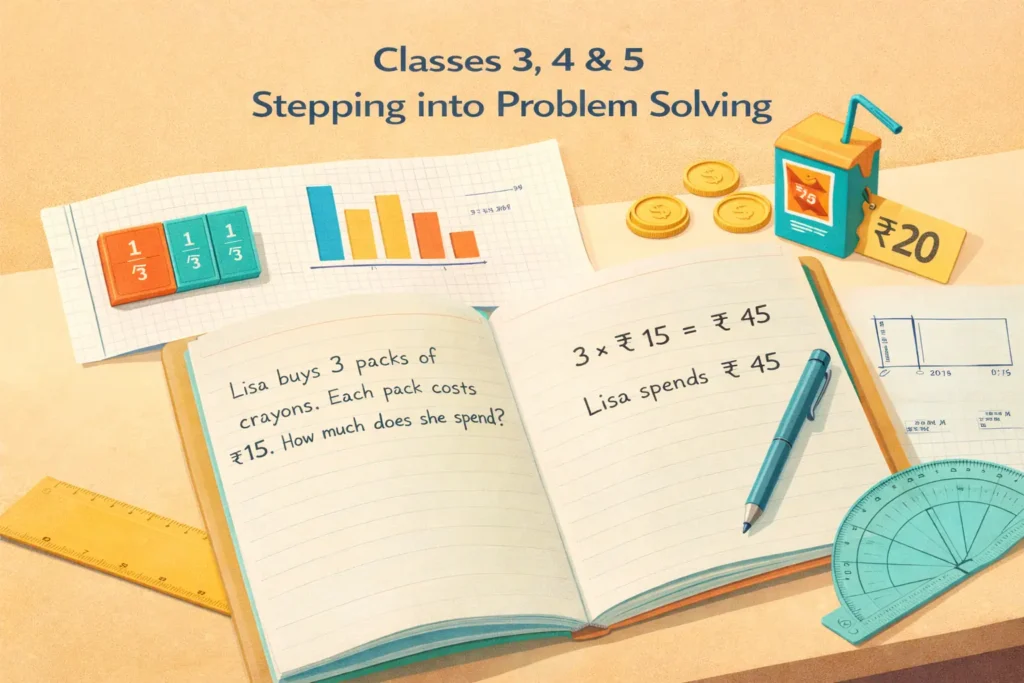
Classes 3, 4 & 5 — Stepping into Problem Solving
This is where the Olympiad starts feeling meaningfully different from school exams.
The shift is from “recall the answer” to “figure out the answer.” Word problems increase, fractions appear, and the Logical Reasoning section becomes more structured.
If you’re wondering what type of questions are asked in Math Olympiads at this stage, the answer is almost always application not recall.
Class 3 Syllabus:
| Topic | What It Means | How It Appears in the Olympiad |
| Number Sense (4-digit numbers) | Place value, expanded form, comparison. See also: number ordering and rules for ordering numbers | “What is the place value of 7 in 3,742?” tests the same skills as ascending and descending order |
| Computation Operations | Addition, subtraction, multiplication, division | Multi-step word problems |
| Fractions | Basic fractions, half and quarter | Shade the fraction, compare simple fractions |
| Geometry | Lines, angles, shapes, perimeter | Identify shapes, calculate basic perimeter |
| Length, Weight, Capacity, Time, Money | Measuring and converting units | Unit conversion and real-life application |
| Data Handling | Reading bar graphs and pictographs | “How many more students prefer cricket over football?” |
| Logical Reasoning | Analogy, coding-decoding, mirror images, direction sense. Analogies are one of the most frequently tested LR types. See math analogies for kids | Pattern-based and directional puzzles |
Class 4 adds: Multiples and Factors, Roman Numerals, Symmetry, and more complex Data Handling.
Class 5 adds: Large numbers (up to 7 digits), Decimals, Percentage basics, Area, and introduction to Profit and Loss.
Common weak areas at this stage:
- Word problems: Students often rush past the question. Teach them to underline the key values and the question itself before solving. Our guide on how to solve math word problems walks through this step-by-step in detail and word problems for kids cover class-wise examples from Class 1 to Class 5.
- Fractions: Comparing fractions with unlike denominators trips up most Class 5 students it needs deliberate practice.
- Data Handling: Bar graph questions seem visual but require careful reading of scales.
Study tip: A student in Class 5 can cover the core Mathematical Reasoning topics in 6–8 weeks with focused 30-minute daily sessions.
Logical Reasoning should be practiced separately 10 questions per day builds speed over time.
If you want a structured approach to improving problem-solving skills for IMO, this guide covers the method used by consistent top performers.
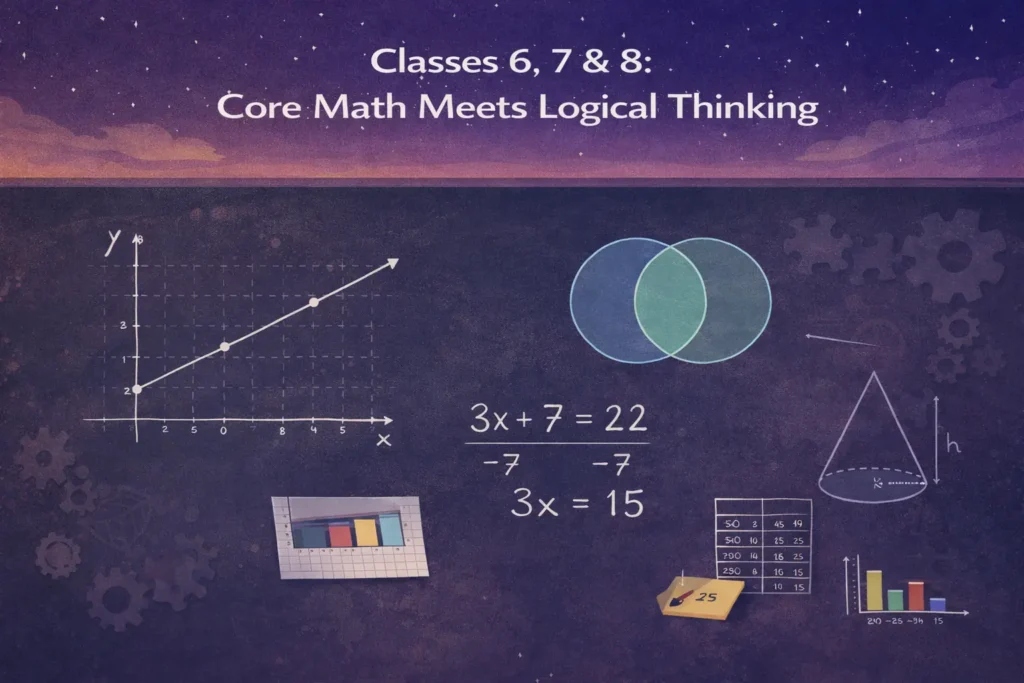
Classes 6, 7 & 8 — Core Math Meets Logical Thinking
This is the stage where the gap between school math and Olympiad math widens most noticeably. NCERT gives you the formulas.
The IMO asks you to apply them in unfamiliar ways. The Logical Reasoning section also gets significantly more layered.
Class 6 Syllabus:
| Topic | What It Means | How It Appears in the Olympiad |
| Integers | Negative numbers, number line | Multi-step operations with negative numbers |
| Fractions and Decimals | Operations with fractions and decimals | Word problems, comparison, ordering |
| Ratio and Proportion | Expressing and applying ratios | Unitary method, recipe-type problems |
| Basic Algebra | Variables, simple equations | “If 3x + 5 = 20, find x” |
| Geometry | Lines, angles, triangles, circles | Angle calculation, identify types |
| Mensuration | Perimeter, Area of 2D shapes | Area of composite figures |
| Data Handling | Mean, median, mode | Real-data-based calculation |
| Logical Reasoning | Verbal and Non-Verbal reasoning: blood relations, Venn diagrams, series | Multi-step logical puzzles |
Class 7 adds: Algebraic Expressions, Congruence of Triangles, Exponents, and Symmetry.
Class 8 adds: Squares, Cubes and their Roots, Linear Equations in One Variable, Direct and Inverse Proportion, Quadrilaterals, Visualizing Solid Shapes, and Introduction to Graphs.
Where school curriculum ends and Olympiad extends:
- School teaches you the formula for the area of a triangle. The Olympiad gives you an irregular figure made of triangles and asks you to find the area combining multiple concepts.
- School tests Ratio at the chapter level. The IMO mixes ratio with percentage and data in the same question.
- Logical Reasoning: This is almost entirely absent from school exams at this level. The 15 questions in Section 1 require dedicated, separate preparation.
Common mistakes at Classes 6–8:
- Treating Logical Reasoning as an afterthought. Many students score 14–15/20 in Mathematical Reasoning but only 7–8/15 in Logical Reasoning. Balancing both sections is the key to improving your rank.
- Skipping the Achievers Section entirely during practice. Even getting 2–3 of those 5 questions correct can make a significant rank difference.
Classes 9, 10, 11 & 12 — Advanced Application and Reasoning
At this level, the SOF IMO syllabus aligns closely with board exam preparation but demands higher conceptual clarity.
The Achievers Section here is genuinely challenging; these are not questions you can crack with formula recall alone.
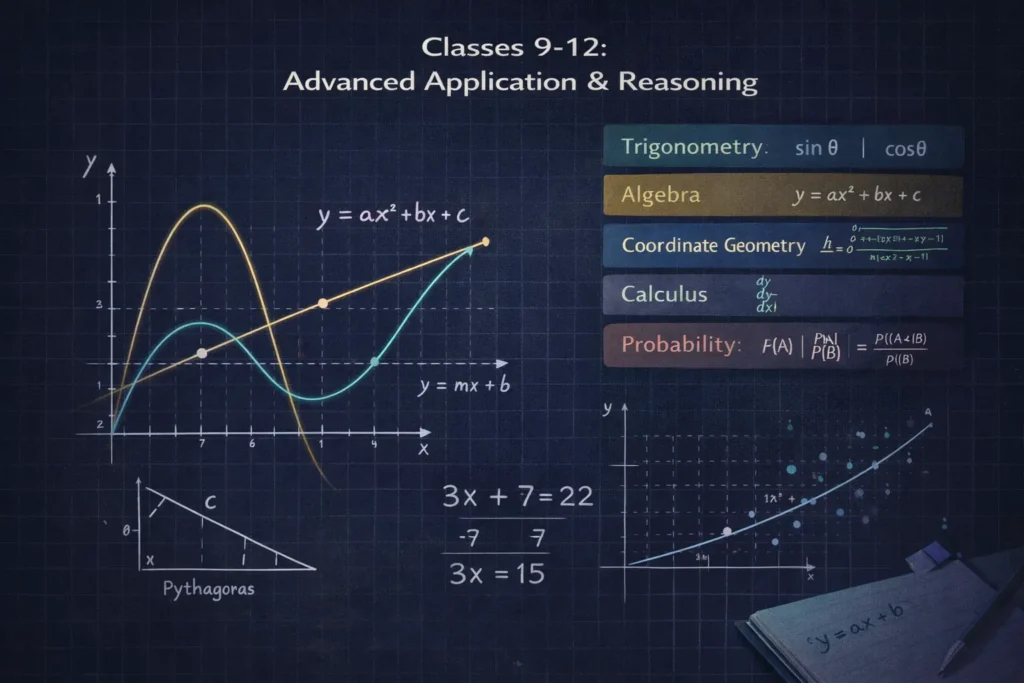
Class 9 Syllabus:
| Topic | Difficulty Note |
| Number Systems (Real Numbers) | Foundation — high scoring |
| Polynomials | Moderate — conceptual clarity needed |
| Linear Equations in Two Variables | High scoring if practiced well |
| Coordinate Geometry (Basics) | Moderate — visual understanding helps |
| Triangles and Congruence | Moderate |
| Quadrilaterals and Areas | Higher difficulty in application |
| Circles | Tough in Achievers Section |
| Mensuration (Surface Area, Volume) | High scoring — formula-heavy |
| Statistics and Probability (Intro) | Scoring — manageable with practice |
Class 10 adds: Arithmetic Progressions, Quadratic Equations, Trigonometry (including heights and distances), Coordinate Geometry (Distance & Section Formula), Similar Triangles, and detailed Probability.
Class 11 adds: Sets and Functions, Permutations and Combinations, Binomial Theorem, Sequences and Series, Straight Lines, Conic Sections, Limits and Derivatives (Intro), and Statistics.
Class 12 adds: Relations and Functions, Matrices and Determinants, Continuity and Differentiability, Integrals, Differential Equations, Vectors, 3D Geometry, and Probability (advanced).
Level 1 vs Level 2 scope for Classes 9–12: The topics are the same at both levels. Level 2 simply increases question complexity except multi-concept integration and more abstract application in every section, especially Achievers.
High-scoring vs high-difficulty topics:
| Category | Topics |
| High-scoring (master these first) | Mensuration, Arithmetic Progressions, Coordinate Geometry, Probability |
| High-difficulty but rank-differentiating | Circles (Class 9–10), Trigonometry applications, Integration (Class 12), Permutations & Combinations (Class 11) |
| Achievers Section focus | Any topic above + multi-step application depth over breadth |
School Curriculum vs SOF IMO Syllabus — What’s Different?
The good news: you don’t need a separate study plan for the IMO.
The syllabus mirrors CBSE, ICSE, and State Board curricula. What changes is the depth and type of questions.
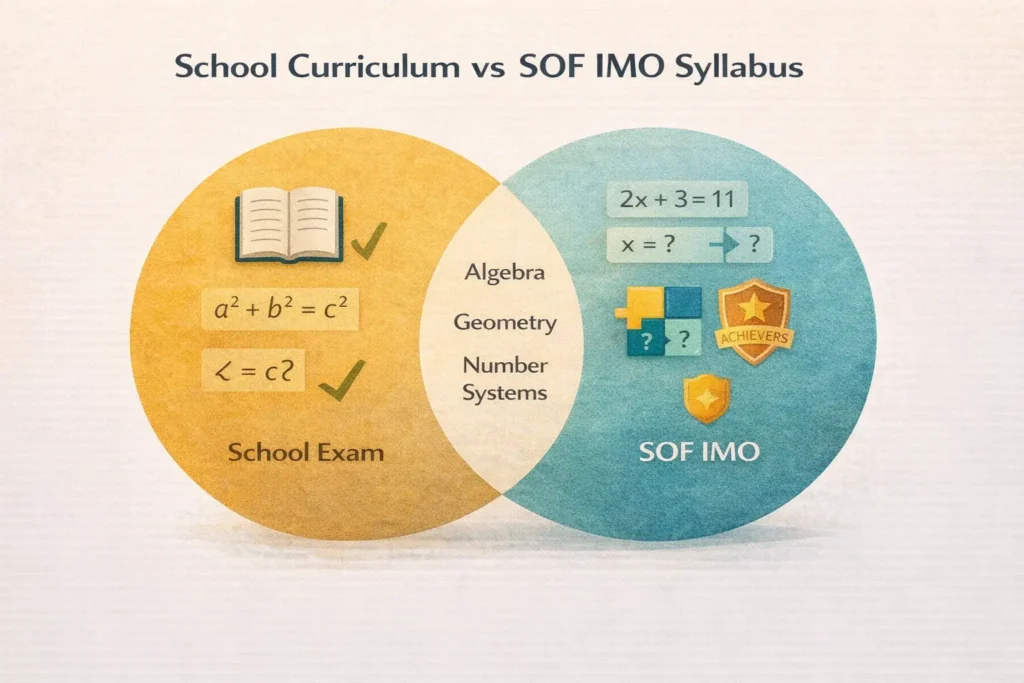
| Aspect | School Exam | SOF IMO |
| Question type | Mostly direct application, step-by-step | Applied, multi-concept, unfamiliar contexts |
| Logical Reasoning | Absent (most boards) | 15 dedicated questions (Classes 5–12) |
| Achievers Section | Not tested | 5 HOTS questions — 3 marks each, highest difficulty |
| Previous class content | Rarely tested | 40% of Level 1 from previous year |
| Time pressure | Typically more relaxed | 60 minutes for 35–50 questions — speed matters |
The practical takeaway: nail your school chapters first, then push 20–30% deeper on each topic. That extra depth is exactly what the Achievers Section tests.
How to Prioritize Your Syllabus (Topic-wise Study Roadmap)
This is the part most syllabus guides skip. Here’s how to structure your preparation:
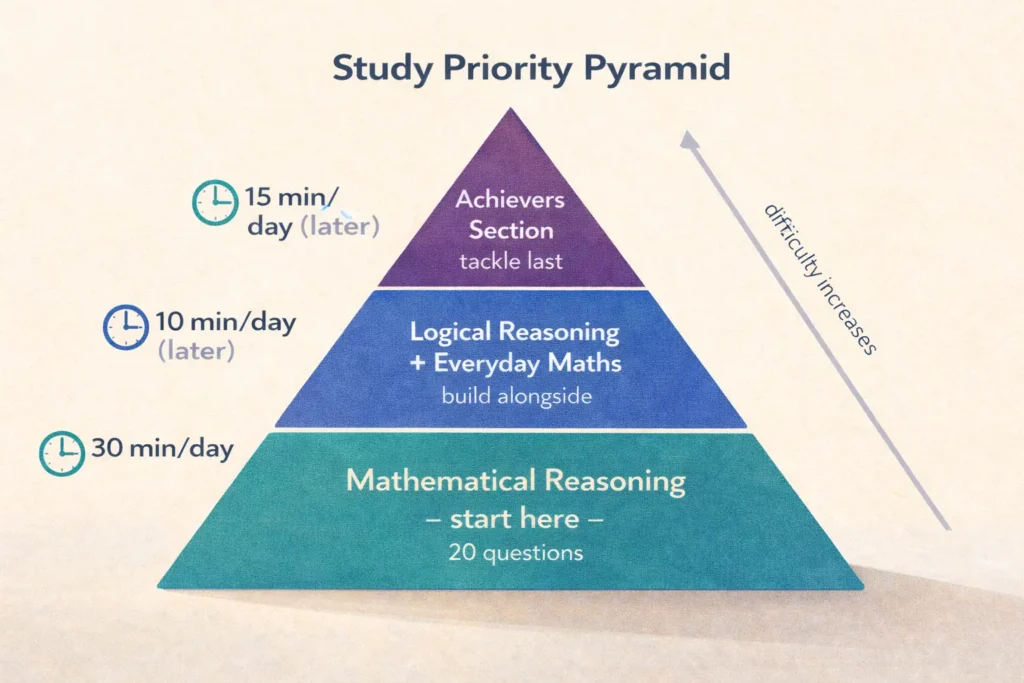
Step 1: Master Mathematical Reasoning first. This section carries the most questions (20 in all classes) and overlaps directly with your school preparation.
If you’re studying for your board or unit test, you’re already building IMO readiness just to push for conceptual depth, not just formula recall.
Step 2: Build Logical Reasoning through daily short practice. Do 10–15 Logical Reasoning questions every day. It doesn’t feel productive in the short term, but speed and accuracy here compound over 4–6 weeks.
Step 3: Tackle the Achievers Section last. Attempt these only after your Section 2 topics are solid. These questions often combine two or three concepts you need strong foundations before they make sense.
| Priority | Section | Why It Matters |
| High | Mathematical Reasoning | Maximum questions, directly tied to school prep |
| Medium | Logical Reasoning | Consistent scorer — dedicated daily practice |
| Medium | Everyday Mathematics | Scoring if you understand application of Section 2 topics |
| Stretch | Achievers Section | Rank differentiator — pursue after mastering above |
Time estimates by class group:
- Classes 1–2: 4–5 weeks of 20 minutes/day
- Classes 3–5: 6–8 weeks of 30 minutes/day
- Classes 6–8: 8–10 weeks of 45 minutes/day
- Classes 9–12: 10–12 weeks of 45–60 minutes/day (or integrate with board prep)
Common Mistakes Students Make While Preparing
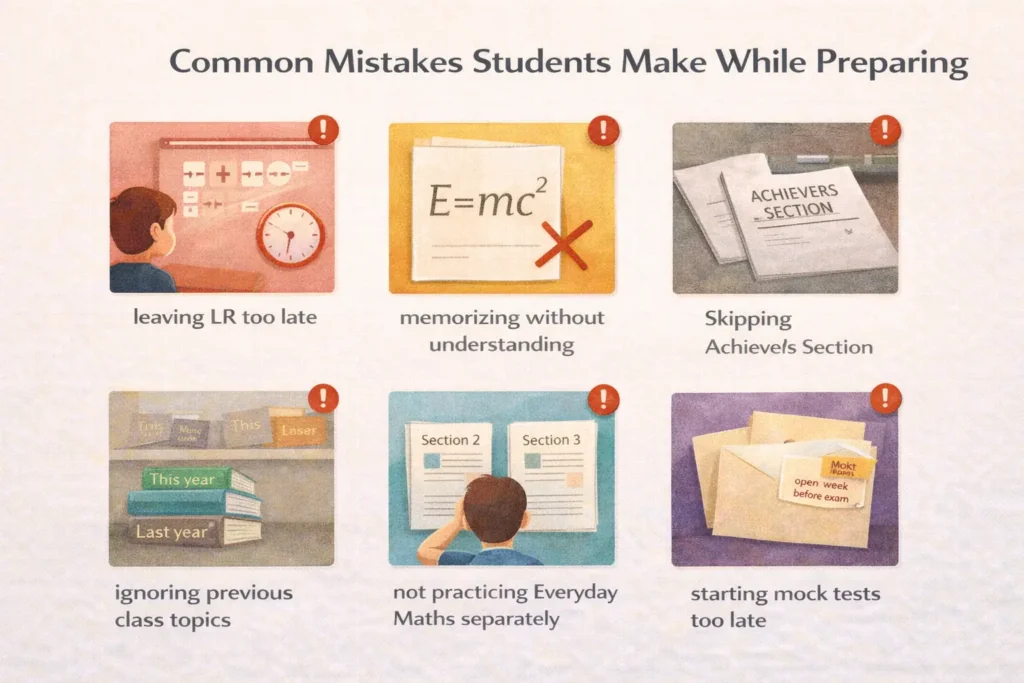
1. Ignoring Logical Reasoning until last week. Fix: Start LR practice from day one — just 10 questions per day keeps it manageable.
2. Memorizing formulas without understanding the concept (Classes 6–12). Fix: After learning a formula, solve at least one problem that uses it in a non-standard way before moving on.
3. Skipping the Achievers Section during practice (Classes 5–12). Fix: Attempt all 5 Achievers questions in mock tests even if you get them wrong understanding the solution builds the thinking pattern.
4. Only practicing current-class topics and forgetting that 40% comes from the previous class (Level 1). Fix: Spend the first 2 weeks of preparation reviewing the previous year’s key topics before diving into the current syllabus.
5. Treating Everyday Mathematics as separate from Mathematical Reasoning (Classes 5–12). Fix: It isn’t. Section 3 uses the same topics but in real-world contexts. If your Mathematical Reasoning is strong, Section 3 should follow naturally with a little contextual practice.
6. Attempting full mock tests too late. Fix: Start mock tests by week 4 of preparation. Timed practice reveals weak spots that topic-by-topic study misses.
Beginner vs Returning Student — Tailored Approach
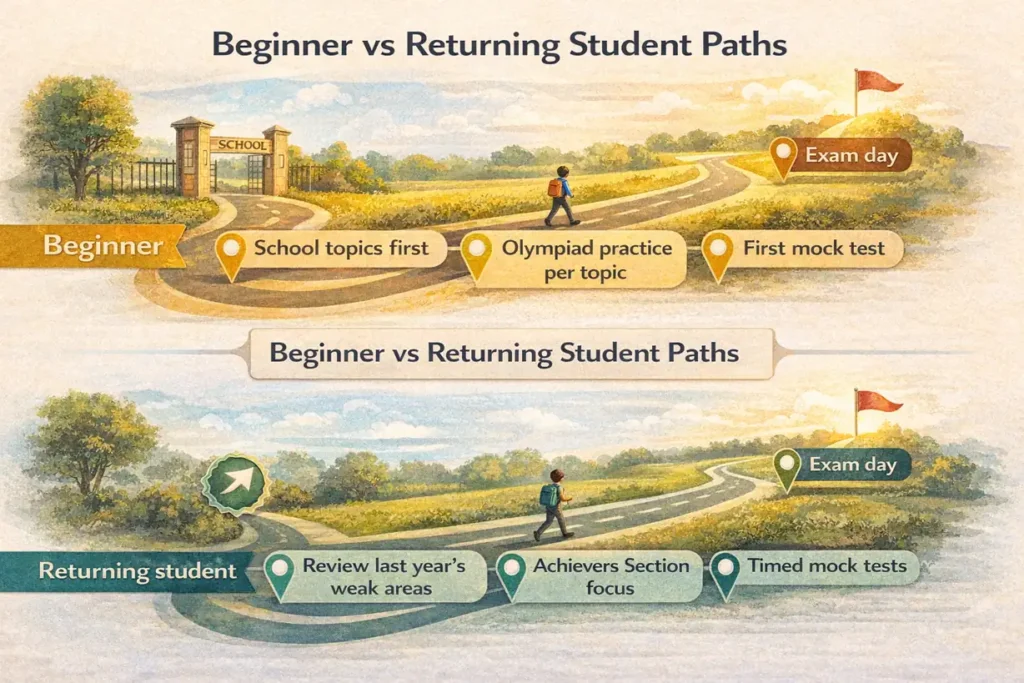
If you’re appearing in SOF IMO for the first time:
Start with Section 2 (Mathematical Reasoning) it’s the most familiar and builds your confidence early. Use your school NCERT textbook as the base.
Once you’ve covered 3–4 core topics, attempt 10–15 Olympiad-style questions per topic to understand how school concepts translate into IMO questions.
Don’t worry about the Achievers Section in your first attempt; getting comfortable with the format is the real goal.
If you’re a returning student aiming for a higher rank:
Go straight to your previous year’s result analysis. Where did you lose marks in Logical Reasoning, Everyday Math, or Achievers?
Target that section first. Most returning students improve their rank by 30–50% simply by treating the Achievers Section seriously in their second attempt.
Platforms like Gonit App offer structured, class-wise IMO practice that adapts to your current level, whether you’re starting fresh or working through identified weak areas.
Make Preparing for Math Olympiad Simple!



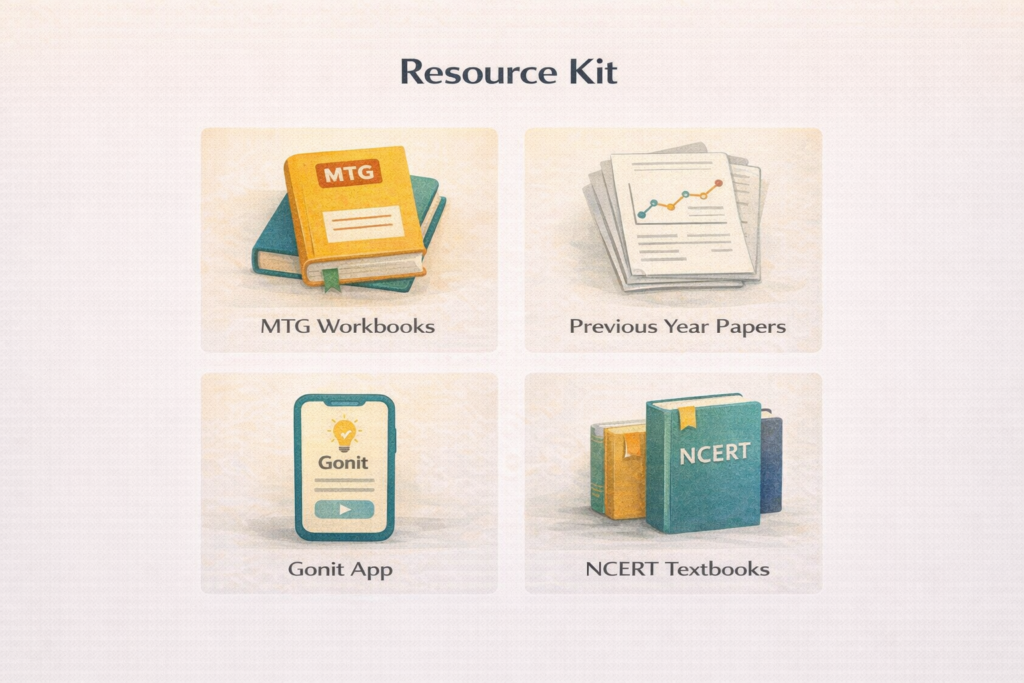
Recommended Resources for Each Syllabus Section
For Mathematical Reasoning:
- NCERT textbooks (your primary base don’t underestimate them)
- MTG IMO Workbooks (class-specific, widely available, Olympiad-aligned)
- SOF’s official sample papers (available on sofworld.org)
For Logical Reasoning:
- RS Aggarwal’s Verbal and Non-Verbal Reasoning (Classes 6–12)
- SOF Olympiad Trainer’s logical reasoning worksheets (available online)
- Any Olympiad prep book with a dedicated LR section for Classes 3–5
For Achievers Section:
- Previous year IMO papers (SOF releases these officially)
- MTG’s “10 in One” Olympiad series
For digital, adaptive practice: Gonit App offers class-wise Olympiad practice aligned with the SOF IMO syllabus, a useful option if you want structured progress tracking alongside book-based preparation.
What is the SOF IMO syllabus for Class 5?
The Class 5 SOF IMO syllabus covers Numerals (up to 7-digit numbers), Decimals, Fractions, Percentages, Area and Perimeter, Time and Work basics, Profit and Loss (intro), Geometry (Triangles and Quadrilaterals), and Data Handling (bar graphs, pie charts). Logical Reasoning includes Analogy, Coding-Decoding, Series Completion, and Direction Sense. Section 3 tests these same mathematical topics in real-life problem contexts.
Is the IMO syllabus different from the school syllabus?
Not entirely — the SOF IMO syllabus is based on CBSE, ICSE, and State Board curricula. What differs is the nature of questions. School exams test whether you know the concept; the IMO tests whether you can apply it in new situations. Additionally, the Logical Reasoning section (Section 1) has no equivalent in school exams and requires separate preparation.
What topics are in the Achievers Section of SOF IMO?
The Achievers Section covers the same mathematical topics as Section 2, but from the current class only and at a significantly higher difficulty level. These are HOTS (Higher Order Thinking Skills) questions that often combine multiple concepts in one problem. At Classes 9–12, expect proof-level reasoning and multi-step application. This section is where top ranks are decided.
How do I prepare for SOF IMO based on the syllabus?
Start with Section 2 (Mathematical Reasoning) using your school textbook as the base. Once 3–4 topics are covered, practice Olympiad-style questions at a slightly deeper level. Build Logical Reasoning daily with 10–15 targeted questions. Only after both sections feel solid should you shift focus to the Achievers Section. Use previous year papers in the final 2–3 weeks to simulate exam conditions.
What is the SOF IMO syllabus for Class 10?
The Class 10 syllabus includes Real Numbers, Polynomials, Pair of Linear Equations in Two Variables, Quadratic Equations, Arithmetic Progressions, Coordinate Geometry, Triangles (similarity and congruence), Circles, Trigonometry (including Applications), Mensuration (Surface Area and Volume), Statistics, and Probability. The Logical Reasoning section includes Verbal and Non-Verbal Reasoning at a higher complexity level.
Is there a difference between Level 1 and Level 2 IMO syllabus?
The topics are the same at both levels. The key difference is difficulty. Level 2 questions require more conceptual depth, multi-step reasoning, and precise application. Level 1 also draws 40% of questions from the previous class, while Level 2 focuses more heavily on the current class syllabus. If you’re preparing for Level 2, the Achievers Section becomes especially important to practice.
Which topics carry the most marks in SOF IMO?
Section 2 (Mathematical Reasoning) has the highest question count — 20 questions in every class. This is where you should invest the most preparation time. In terms of individual topics, Mensuration, Number Systems, Algebra, and Geometry consistently appear across multiple classes and contribute a significant share of marks.
How long does it take to complete the IMO syllabus?
For Classes 3–5, a 6–8 week plan with 30 minutes of daily practice is sufficient to cover the core syllabus. Classes 6–8 typically need 8–10 weeks. Classes 9–12 benefit from integrating IMO prep with board exam preparation over 10–12 weeks. Logical Reasoning should run as a daily parallel track throughout, rather than being studied in one block.
Make Preparing for Math Olympiad Simple!
Conclusion
The SOF IMO syllabus is manageable when you know what to prioritize and how to approach each section.
You now have a clear class-wise breakdown, key topics, and a practical study roadmap. The next step is simple: identify your weak areas and start with Mathematical Reasoning.
For structured, syllabus-aligned Olympiad practice, explore the Gonit App designed for Grade 1–12 students.