

Decimal to fraction conversion takes three steps: count the decimal places, write the digits over the matching power of 10, then simplify using the HCF.
- How to Convert a Decimal to a Fraction
- What Decimals and Fractions Actually Mean
- Place Value: The Bridge Between Decimals and Fractions
- The Core Method: Three Steps That Always Work
- Converting Tenths: One Decimal Place
- Converting Hundredths: Two Decimal Places
- Converting Thousandths: Three Decimal Places
- Simplifying Fractions After Conversion Using HCF
- Decimal to Fraction Chart for Common Values
- Converting Decimals Greater Than 1
- A Gentle Introduction to Recurring Decimals
- Where Decimal to Fraction Conversion Shows Up in Real Life
- Common Mistakes and How to Correct Them
- Six Hands-On Activities and Games
- Tips for Parents Helping at Home
- Tips for Teachers Delivering the Lesson
- How This Connects to Percentages, Ratios and Olympiad Problems
- Practice Questions with Answers
- Conclusion
One decimal place gives a denominator of 10, two decimal places give 100, and three decimal places give 1000. So 0.7 becomes 7/10, 0.25 becomes 25/100, which simplifies to 1/4, and 0.125 becomes 125/1000, which simplifies to 1/8. No calculator is needed because the denominator is already decided by the place the last digit sits in.
Under CBSE and NCERT, this is a Class 5 and Class 6 skill, and the answer is expected in simplest form. A fraction left as 25/100 is usually marked incomplete.
This guide covers the full method, worked examples for tenths, hundredths and thousandths, a decimal to fraction chart, mixed numbers, recurring decimals, common mistakes, and practice questions with answers.
How to Convert a Decimal to a Fraction
To convert a decimal to a fraction, write the digits after the decimal point as the numerator, use the matching power of 10 as the denominator, then simplify using the HCF.
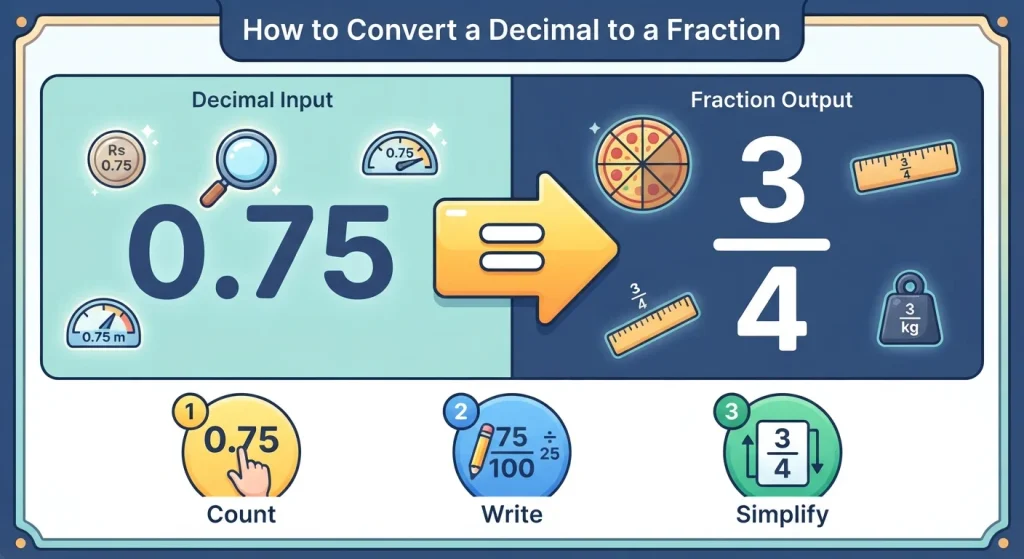
One decimal place means a denominator of 10, two decimal places means 100, and three decimal places means 1000. So 0.7 becomes 7/10, 0.25 becomes 25/100 which simplifies to 1/4, and 0.125 becomes 125/1000 which simplifies to 1/8.
That is the whole method in three steps. The rest of this guide explains why it works, which is what turns a memorised rule into real understanding your child can use under pressure.
What Decimals and Fractions Actually Mean
Decimals and fractions are two different ways of writing the same value. They are not two separate systems, and this single idea removes most of the confusion children carry into Class 5 and Class 6.
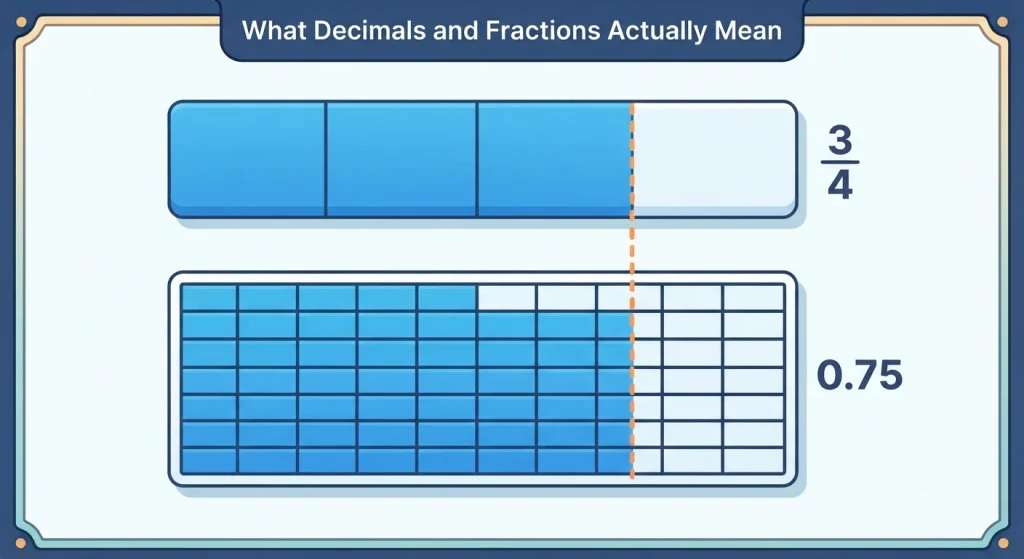
A fraction tells you how many equal parts of a whole you have. In 3/4, the whole has been cut into 4 equal parts and you are holding 3 of them. The bottom number, the denominator, says how many parts the whole was cut into. The top number, the numerator, says how many of those parts you have.
A decimal does exactly the same job, but the cutting is fixed in advance. A decimal always cuts the whole into 10 parts, then each of those into 10 again, and so on. The digits after the decimal point tell you how many of those parts you have. So 0.75 means seven tenths plus five hundredths, which is the same amount as 3/4.
Here is the test that makes the connection obvious. Ask your child to shade 3 out of 4 squares on a strip, and separately to shade 75 out of 100 squares on a hundred grid. The shaded area is identical. The value has not changed. Only the way of writing it has.
Once a child accepts that decimals are fractions in disguise, the conversion stops feeling like a trick. You are not transforming one thing into another thing. You are simply rewriting the same number in the other notation.
Place Value: The Bridge Between Decimals and Fractions
Place value is the reason decimal to fraction conversion works at all. Your child already knows that in 452, the 4 means four hundreds because of where it sits. Decimal places follow the same rule, just travelling in the other direction.
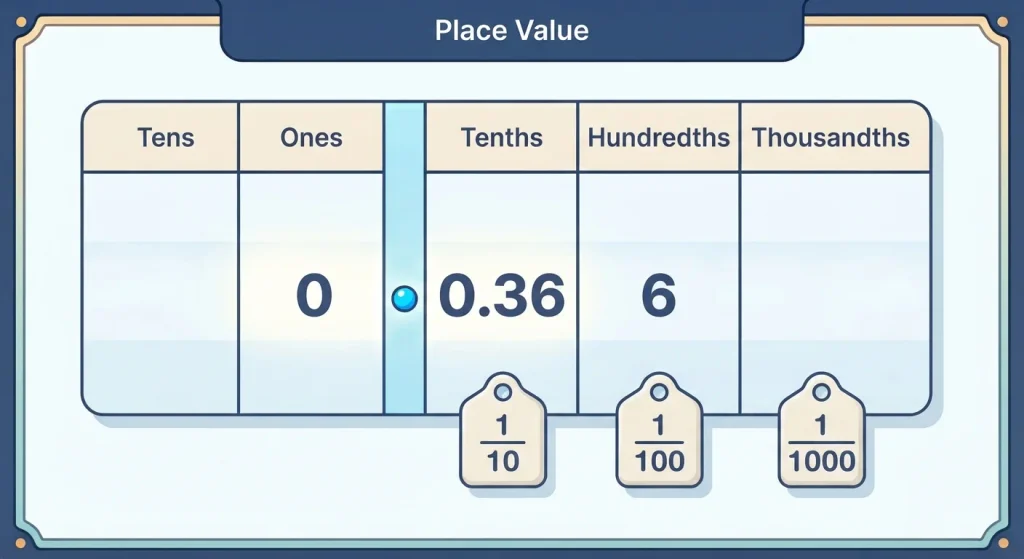
Moving left from the decimal point, each place is worth ten times more. Moving right, each place is worth ten times less. That is the entire system.
| Place | Written as a fraction | Written as a decimal | Read as |
|---|---|---|---|
| Ones | 1/1 | 1 | one |
| Tenths | 1/10 | 0.1 | one tenth |
| Hundredths | 1/100 | 0.01 | one hundredth |
| Thousandths | 1/1000 | 0.001 | one thousandth |
Notice what the middle column shows. Every decimal place already has a fraction printed inside it. The tenths place is a fraction with 10 underneath. The hundredths place is a fraction with 100 underneath. Nobody has to invent the denominator during conversion. You are reading off something that was there the whole time.
Try this with the number 0.36. The 3 sits in the tenths place, so it is worth 3/10. The 6 sits in the hundredths place, so it is worth 6/100. Add them and you get 30/100 plus 6/100, which is 36/100. That matches the shortcut of writing 36 over 100, and now your child can see where the shortcut came from.
This is worth spending a full session on before any conversion practice begins. A child who can say out loud that the last digit of 0.36 is in the hundredths place will never guess wrongly between 10, 100 and 1000.
The Core Method: Three Steps That Always Work
Every terminating decimal converts to a fraction using the same three decimal to fraction steps. Learn these once and they cover tenths, hundredths, thousandths and beyond.
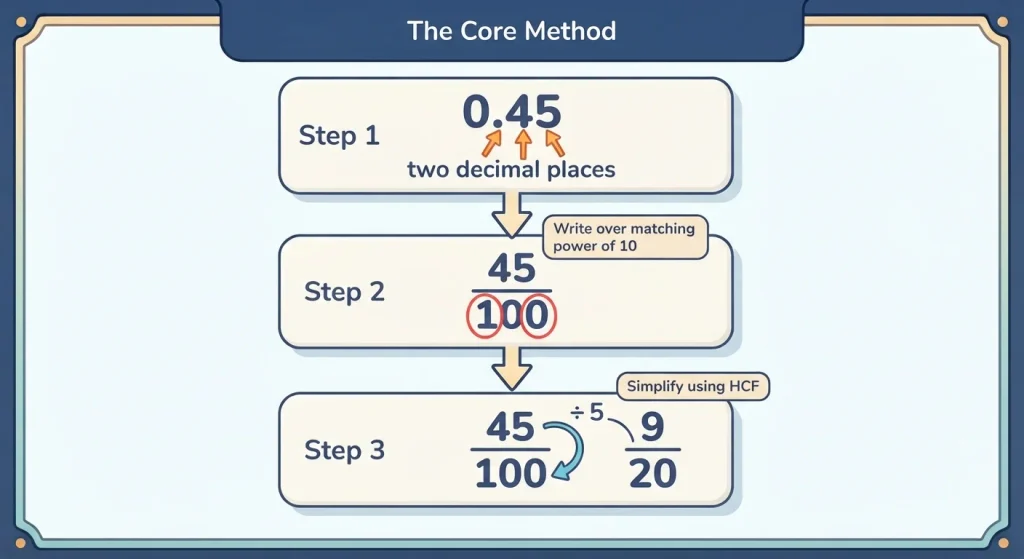
- Count the decimal places. Count how many digits sit to the right of the decimal point. In 0.45 there are two digits, so there are two decimal places.
- Write the digits over the matching power of 10. Drop the decimal point and write the digits as the numerator. The denominator is 1 followed by as many zeros as there were decimal places. Two decimal places gives 100, so 0.45 becomes 45/100.
- Simplify using the HCF. Find the highest common factor of the numerator and denominator, then divide both by it. The HCF of 45 and 100 is 5, so 45/100 becomes 9/20.
The answer is 0.45 = 9/20.
The reason step 2 works is the place value idea from the previous section. The last digit of 0.45 sits in the hundredths place, so the whole number is being measured in hundredths. Forty-five hundredths written as a fraction is 45/100. Nothing has been invented.
One warning worth giving early. Step 3 is not optional. In CBSE and NCERT marking, a fraction left as 45/100 when it could be written as 9/20 is usually treated as incomplete. More importantly, an unsimplified fraction hides the size of the number. Most children cannot picture 45/100, but they can picture 9/20 once they see it is a little under half.
Converting Tenths: One Decimal Place
A decimal with one digit after the point is measured in tenths, so the denominator is 10.
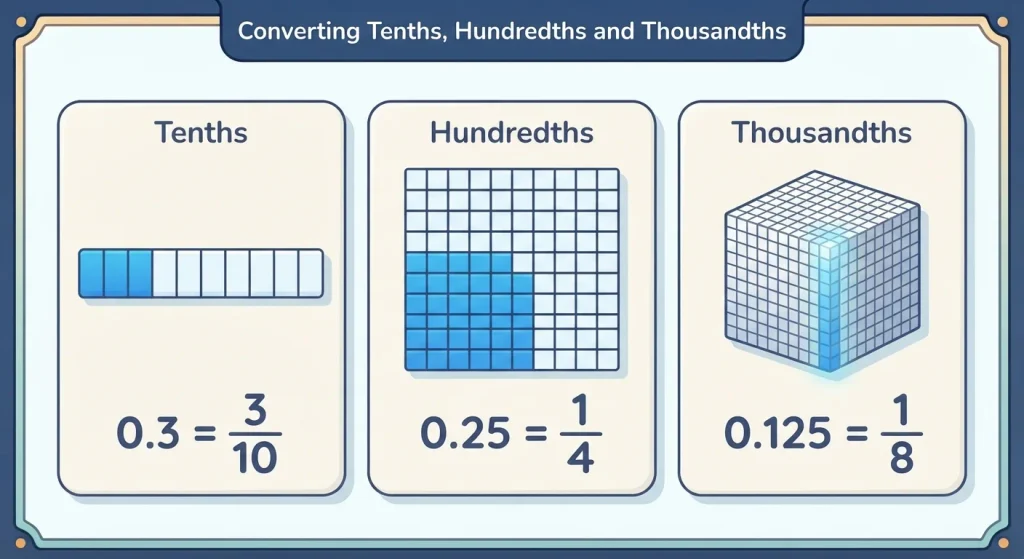
Worked example 1: convert 0.3
There is one decimal place, so the denominator is 10. The digit is 3, so the fraction is 3/10. Now check for simplification. The factors of 3 are 1 and 3. The factors of 10 are 1, 2, 5 and 10. The only common factor is 1, so 3/10 is already in its simplest form.
Answer: 0.3 = 3/10
Worked example 2: convert 0.6
One decimal place gives 6/10. This time simplification is possible. Both 6 and 10 divide by 2, so divide top and bottom by 2 to get 3/5.
Answer: 0.6 = 3/5
Worked example 3: convert 0.5
One decimal place gives 5/10. Both numbers divide by 5, giving 1/2. This is the conversion most children already know by sight, which makes it a useful confidence anchor. Point out that the rule they have just learned produces the answer they already trusted.
Answer: 0.5 = 1/2
A good habit at this stage is to say the decimal in words before writing anything. Reading 0.6 as six tenths makes the fraction 6/10 almost automatic.
Converting Hundredths: Two Decimal Places
Two digits after the point means the number is measured in hundredths, so the denominator is 100.
Worked example 1: convert 0.25
Two decimal places gives 25/100. Now find the HCF of 25 and 100. The factors of 25 are 1, 5 and 25. The factors of 100 include 1, 2, 4, 5, 10, 20, 25, 50 and 100. The highest common factor is 25. Divide both by 25 and you get 1/4.
Answer: 0.25 = 1/4
Worked example 2: convert 0.08
Be careful here. There are still two decimal places, so the denominator is still 100. The digits are 0 and 8, which read as 8, so the fraction is 8/100. The HCF of 8 and 100 is 4, giving 2/25.
Answer: 0.08 = 2/25
Children often want to write 0.08 as 8/10 because they see only one non-zero digit. Go back to place value. The 8 sits in the hundredths column, so it is 8 hundredths, not 8 tenths.
Worked example 3: convert 0.72
Two decimal places gives 72/100. The HCF of 72 and 100 is 4. Dividing both gives 18/25.
Answer: 0.72 = 18/25
Converting Thousandths: Three Decimal Places
Three digits after the point means the number is measured in thousandths, so the denominator is 1000.
Worked example 1: convert 0.125
Three decimal places gives 125/1000. The HCF of 125 and 1000 is 125. Dividing both gives 1/8.
Answer: 0.125 = 1/8
This one is worth memorising, because 1/8 turns up constantly in measurement and in competition questions.
Worked example 2: convert 0.004
Three decimal places, so the denominator is 1000. The digits read as 4, giving 4/1000. The HCF of 4 and 1000 is 4, so the answer is 1/250.
Answer: 0.004 = 1/250
Worked example 3: convert 0.375
Three decimal places gives 375/1000. The HCF of 375 and 1000 is 125. Dividing both gives 3/8.
Answer: 0.375 = 3/8
If finding the HCF of larger numbers feels hard, simplify in stages instead. For 375/1000, divide both by 5 to get 75/200, then by 5 again to get 15/40, then by 5 once more to get 3/8. Repeated small steps reach the same place as one big step, and they are far easier for a Class 5 child to manage without errors.
Simplifying Fractions After Conversion Using HCF
Simplifying means writing the same value with smaller numbers. The fraction 50/100 and the fraction 1/2 are the same amount. One is just easier to picture.
HCF stands for highest common factor. A factor of a number is any whole number that divides into it exactly. The highest common factor of two numbers is the largest number that divides into both of them.
How to simplify step by step
- List the factors of the numerator. For 30/100, the factors of 30 are 1, 2, 3, 5, 6, 10, 15 and 30.
- List the factors of the denominator. The factors of 100 are 1, 2, 4, 5, 10, 20, 25, 50 and 100.
- Find the largest number in both lists. Both lists contain 1, 2, 5 and 10. The largest is 10, so the HCF is 10.
- Divide numerator and denominator by the HCF. 30 divided by 10 is 3. 100 divided by 10 is 10. The simplified fraction is 3/10.
- Check you cannot go further. The only common factor of 3 and 10 is 1, so the fraction is in its simplest form.
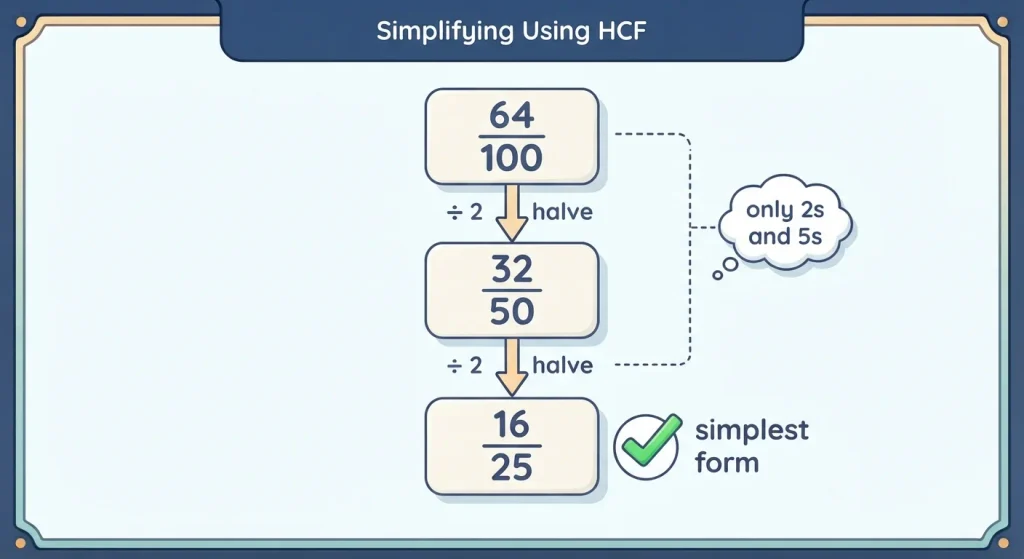
If listing factors feels slow, there is a faster route that suits decimal to fraction work specifically. Because every denominator here is 10, 100 or 1000, it is made only of 2s and 5s. So you only ever need to check whether the numerator divides by 2, by 5, or by both. Keep dividing by 2 while both numbers are even. Then keep dividing by 5 while both end in 0 or 5. When neither works, you have finished.
Take 0.64. That gives 64/100. Both are even, so halve both to get 32/50. Both are still even, so halve again to get 16/25. Now 16 is even but 25 is not, and 16 does not end in 0 or 5. You are done.
Answer: 0.64 = 16/25
This shortcut is worth teaching explicitly, because it removes the most common reason children skip simplification, which is that finding the HCF feels like a separate hard task bolted onto the end.
Decimal to Fraction Chart for Common Values
Some conversions appear so often that recognising them instantly saves real time. Use this decimal to fraction chart as a reference to keep near the study table.
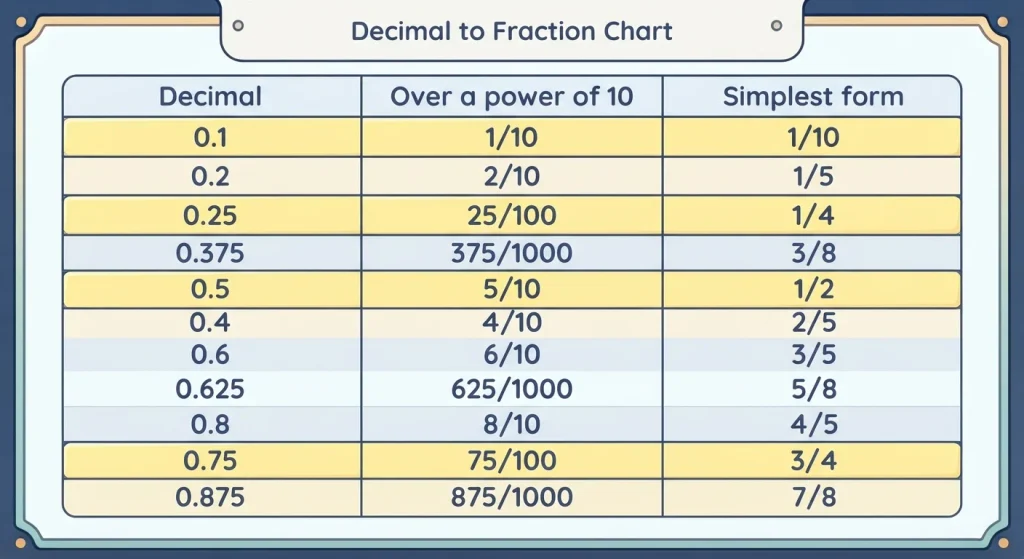
The goal is recognition through repeated use, not memorisation drills.
| Decimal | Fraction over a power of 10 | Simplest form |
|---|---|---|
| 0.1 | 1/10 | 1/10 |
| 0.125 | 125/1000 | 1/8 |
| 0.2 | 2/10 | 1/5 |
| 0.25 | 25/100 | 1/4 |
| 0.3 | 3/10 | 3/10 |
| 0.333… | recurring | 1/3 |
| 0.375 | 375/1000 | 3/8 |
| 0.4 | 4/10 | 2/5 |
| 0.5 | 5/10 | 1/2 |
| 0.6 | 6/10 | 3/5 |
| 0.625 | 625/1000 | 5/8 |
| 0.666… | recurring | 2/3 |
| 0.75 | 75/100 | 3/4 |
| 0.8 | 8/10 | 4/5 |
| 0.875 | 875/1000 | 7/8 |
The middle column matters as much as the last one. If a child only memorises that 0.75 is 3/4, the knowledge is fragile. If they can also say that 0.75 is 75 hundredths and that 75/100 simplifies to 3/4, they can rebuild the answer whenever memory fails.
Converting Decimals Greater Than 1
When a decimal has a whole number part, that part is simply set aside. It does not take part in the conversion at all.
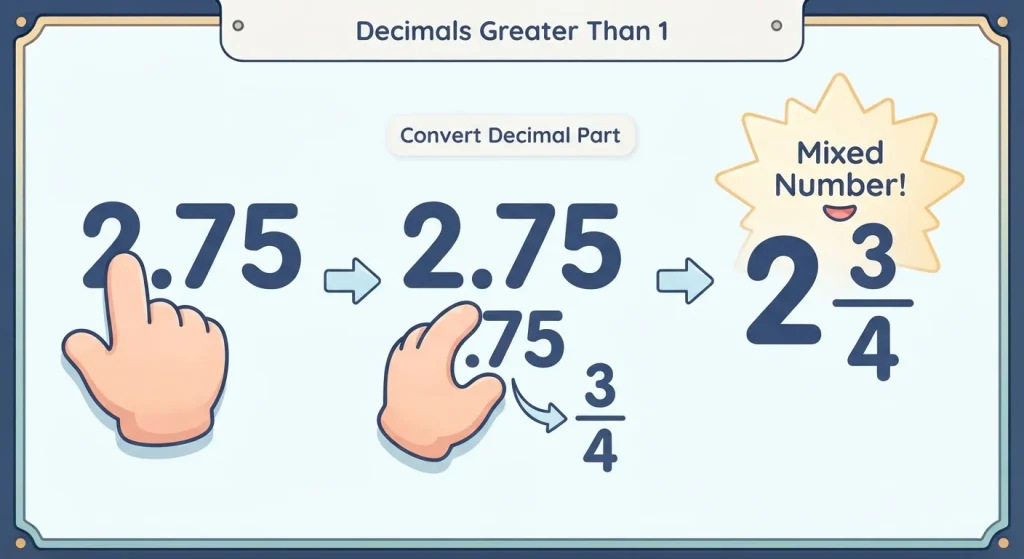
Worked example 1: convert 1.5
The whole number is 1. Keep it aside. Convert only 0.5, which gives 5/10, which simplifies to 1/2. Now put the whole number back in front: 1 and 1/2. Read this as one and a half.
Answer: 1.5 = 1 1/2
Worked example 2: convert 2.75
The whole number is 2. Convert 0.75, which gives 75/100. The HCF of 75 and 100 is 25, so this simplifies to 3/4. Putting the whole number back gives 2 and 3/4.
Answer: 2.75 = 2 3/4
Worked example 3: convert 3.04
The whole number is 3. There are two decimal places, so 0.04 becomes 4/100. The HCF of 4 and 100 is 4, giving 1/25. The answer is 3 and 1/25.
Answer: 3.04 = 3 1/25
If a question asks for an improper fraction instead of a mixed number, convert at the end. For 2 and 3/4, multiply the whole number by the denominator and add the numerator: 2 times 4 is 8, plus 3 is 11, so the improper fraction is 11/4. Doing this at the end rather than the start keeps the conversion itself simple.
A Gentle Introduction to Recurring Decimals
Everything so far has dealt with terminating decimals, which are decimals that stop. Convert a terminating decimal to a fraction confidently first. Only then is it worth looking at decimals that never stop.
Some fractions produce decimals that repeat forever. Divide 1 by 3 and you get 0.3333 with the 3 continuing without end. This is called a recurring decimal, and it is written with a bar over the repeating digit.
For Class 5 and Class 6, the right level of treatment is recognition rather than technique. Your child should be able to say three things:
- A recurring decimal never ends and never settles into a final digit.
- Recurring decimals still equal exact fractions. They are not approximations.
- The three worth recognising by sight are 0.333… equals 1/3, 0.666… equals 2/3, and 0.1666… equals 1/6.
For a curious child who wants to know how the conversion actually works, here is the idea at a level they can follow. Suppose the number is 0.333 continuing. Multiply it by 10 and you get 3.333 continuing. The part after the decimal point is identical in both. So subtracting the first from the second removes the endless tail completely, leaving 9 times the number equals 3. Divide both sides by 9 and the number is 3/9, which simplifies to 1/3.
That trick is formally taught in later classes. Showing it early is fine as long as it is offered as something interesting rather than something to be tested on. The essential message at this stage is that recurring decimals belong to the same family. They are still just fractions wearing different clothes.
Where Decimal to Fraction Conversion Shows Up in Real Life
Children work harder at a skill they have seen outside the textbook. These three contexts need no special materials and appear in most homes every week.
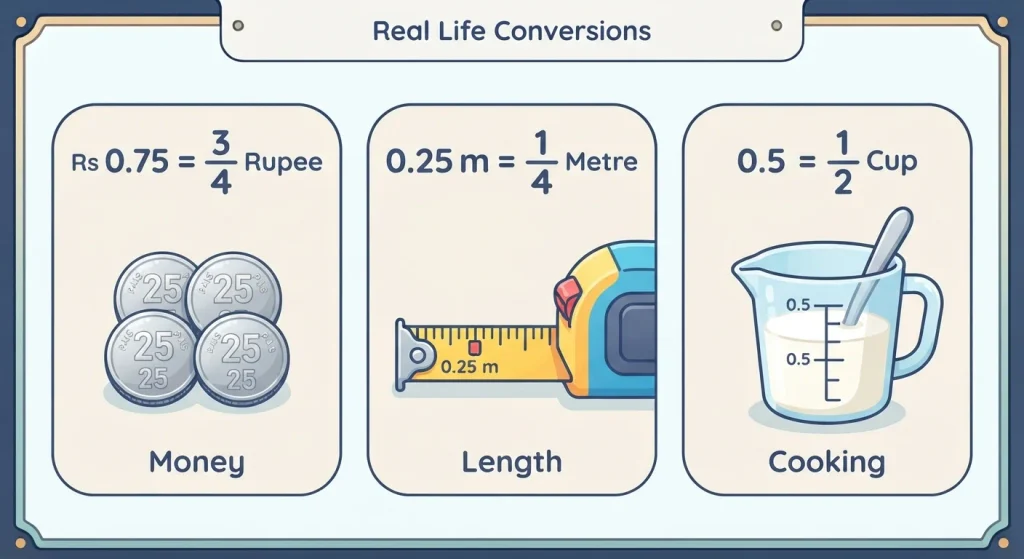
Money: rupees and paise
The rupee is divided into 100 paise, which makes money problems a perfect hundredths model. A price of Rs 0.50 is 50 paise, which is 50/100 of a rupee, which simplifies to half a rupee. A price of Rs 2.25 is 2 rupees and 25 paise, or 2 and 1/4 rupees.
Try this at the shop. If a packet costs Rs 12.75, ask what fraction of a rupee the paise part represents. The answer is 75/100, which is 3/4. Children who find abstract hundredths hard often get this instantly, because they already know four 25 paise coins make a rupee.
Measurement: metres, centimetres and kilograms
A metre has 100 centimetres, so length measurement converts the same way as money. A length of 0.4 m is 40 centimetres, which is 40/100 of a metre, which simplifies to 2/5 of a metre. A length of 1.25 m is 1 metre and 25 centimetres, or 1 and 1/4 metres.
Weight works in thousandths, since a kilogram holds 1000 grams. A packet of 0.250 kg is 250/1000 of a kilogram, which simplifies to 1/4 kg. Ask your child to check a packet of atta or sugar and convert the printed weight. The label does the setup for you.
Cooking and sharing
Recipes move between the two forms constantly. A recipe asking for 0.5 cup of milk is asking for half a cup, and the measuring cup is marked in fractions, not decimals. A child who cannot convert has to guess.
Sharing works the same way. If four children share a chocolate bar equally, each gets 0.25 of it, which is 1/4. Saying both forms out loud while doing the actual sharing builds the link faster than a page of practice sums.
One more setting worth mentioning. Cricket scoring uses decimal overs in a way that trips up adults too. An economy rate of 4.5 runs per over means four and a half runs, and 4.5 overs bowled means four overs and three balls. This is a good discussion for an older child, because it shows that the same decimal can mean different things depending on what the whole has been divided into.
Common Mistakes and How to Correct Them
Most conversion errors come from a small set of misunderstandings. Recognising which one is happening tells you exactly what to reteach.
Counting digits instead of decimal places
A child writes 0.08 as 8/10 because they see one meaningful digit. The fix is to count positions, not digits. Write the number in a place value chart and point at the column the last digit occupies.
Losing the zero in the denominator
A child writes 0.125 as 125/100. The fix is a habit: count the decimal places out loud, then write that many zeros while counting them out loud too.
Leaving the fraction unsimplified
A child stops at 45/100. The fix is to build a closing question into every answer: can the top and bottom both be divided by the same number? Asking it every single time turns it into a reflex.
Simplifying only partly
A child turns 8/100 into 4/50 and stops. The fix is the check step. After simplifying, ask the same question again. Keep asking until the answer is no.
Bringing the whole number into the fraction
A child converts 2.5 into 25/10. The fix is a physical one. Cover the whole number with a finger, convert what remains, then uncover it and write it in front.
Treating decimals and fractions as different systems
This is the deepest error and the hardest to spot, because the child may still get correct answers. The signal is that they cannot say which is bigger, 0.7 or 3/4, without converting. The fix is repeated side-by-side comparison on a number line, marking both forms on the same mark.
Mixing up numerator and denominator
A child writes 10/3 for 0.3. The fix is language. The denominator names the parts, so it must be the bigger idea: tenths, hundredths, thousandths. Say the name of the part first, then the count.
Six Hands-On Activities and Games
These need only paper, a pen and things already in the house. Each one takes ten to fifteen minutes.
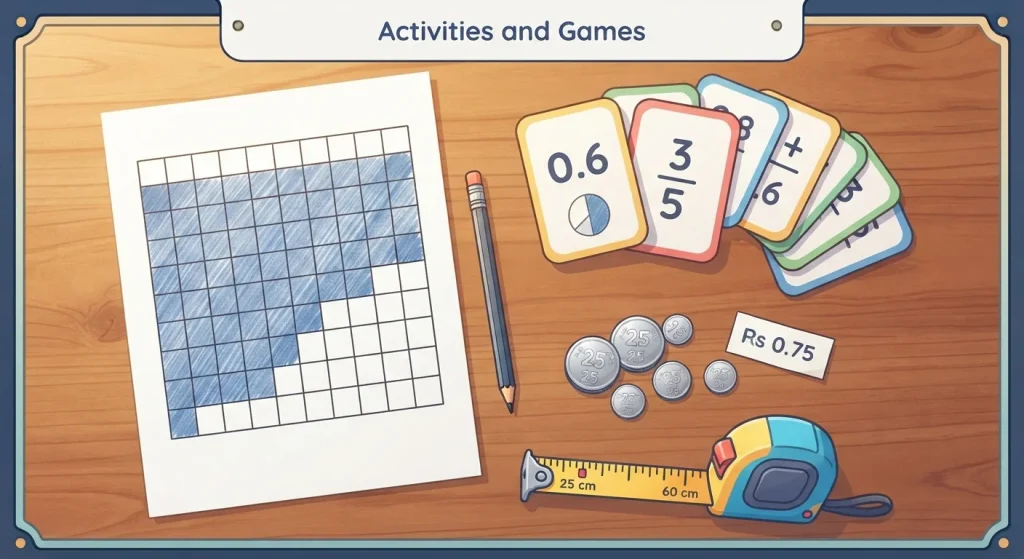
1. The hundred grid shade
Draw a 10 by 10 grid. Call out a decimal such as 0.36 and ask your child to shade that many squares, then write the fraction underneath. Because the grid has exactly 100 squares, the denominator is visible rather than remembered. Repeat with 0.5 and 0.05 in the same session so the difference becomes obvious.
2. Paise sorting
Put out a handful of coins. Write a decimal amount in rupees on a slip and ask your child to make it with coins, then write the fraction of a rupee. Rs 0.75 becomes three 25 paise coins and the fraction 3/4. This connects a physical quantity to both notations at once.
3. Conversion snap
Make two sets of cards, one with decimals and one with simplified fractions. Deal them out and play snap, where a match means the two cards show the same value. Start with only the easy pairs from the chart, then add harder ones.
4. Measuring tape hunt
Give your child a measuring tape and a list of decimal lengths such as 0.25 m and 0.6 m. They find an object matching each length, then write the fraction of a metre. Measurement makes the conversion feel like a description of something real.
5. Number line placement
Draw a line from 0 to 1 and mark only 0, 1/2 and 1. Call out decimals and fractions alternately and ask your child to place each one. Ask which pairs landed on the same spot. This directly attacks the two-separate-systems misconception.
6. Recipe rewrite
Take a simple recipe and rewrite the quantities as decimals, then hand it back and ask your child to convert them into the fractions the measuring cups actually use. Cooking the result afterwards is the best possible answer key.
Bonus: beat the chart
Once the decimal to fraction chart is familiar, cover the last column and time how long it takes to fill in. Track improvement over a week. Keep this light, since the point is fluency and not speed pressure.
Tips for Parents Helping at Home
You do not need to be confident at maths yourself to be useful here. What helps most is asking the right questions.
- Ask your child to explain the step rather than just produce the answer. If they can say why the denominator is 100, the understanding is real.
- Work from the place value chart whenever there is doubt. It settles almost every disagreement without either of you guessing.
- Let wrong answers stay on the page. Crossing out and rewriting hides the thinking you need to see.
- Do small sessions often rather than long ones occasionally. Fifteen minutes four times a week beats an hour on Sunday.
- Use the same language the school uses. If the textbook says HCF, say HCF, not greatest common divisor.
- Praise the checking step specifically. Children get plenty of praise for right answers and almost none for catching their own errors.
- Keep a running list of conversions your child got wrong, and revisit that exact list a week later. Repeating what is already known feels productive but changes nothing.
Tips for Teachers Delivering the Lesson
A class will contain children at very different points, so the sequence matters more than the pace.
- Spend a full lesson on place value before any conversion. The time is recovered several times over.
- Introduce the hundred grid before the rule. Children who meet 0.36 as a shaded picture rarely misread the denominator later.
- Teach simplification as part of the conversion, not as a separate topic afterwards. Splitting them is the main reason children leave answers unsimplified.
- Give the 2s and 5s shortcut explicitly. Many children can simplify but avoid it because full factor listing feels too slow.
- Use decimals with leading zeros such as 0.05 and 0.004 early. They expose the counting-digits error while it is still easy to correct.
- Ask for the reasoning in words on at least one question per worksheet. It reveals the two-separate-systems misconception that correct answers can hide.
- Pair decimals with equivalent fractions on a shared number line as a recurring warm-up through the term.
How This Connects to Percentages, Ratios and Olympiad Problems
Decimal to fraction conversion is not a standalone topic. It is a hinge that several later topics turn on.
Percentages. A percentage is a fraction with 100 underneath, which is exactly what a two-place decimal produces. So 0.45 is 45/100 is 45 per cent. A child who is fluent at conversion has already done most of the work for the percentage chapter. Discount problems become easy: a 20 per cent discount is 0.2, which is 1/5, so the saving is one fifth of the price.
Ratios. Ratios and fractions share the same structure. If two quantities are in the ratio 3 to 4, the first is 3/7 of the total, which is about 0.43. Moving between the forms lets a child check whether an answer is sensible before committing to it.
Olympiad style problems. Competition questions rarely ask for a plain conversion. They hide it inside something else. A typical question might give a number whose decimal form is 0.36 and ask for the sum of the numerator and denominator when written in simplest form. The answer requires converting to 36/100, simplifying to 9/25, then adding to get 34. A child who skips simplification gets 136 and loses the mark.
Other common patterns worth practising:
- Ordering a mixed list of decimals and fractions from smallest to largest. Converting everything into one form first is the reliable route.
- Finding which fractions produce terminating decimals. A fraction terminates only when its simplified denominator is built from 2s and 5s alone, which is why 1/8 terminates and 1/3 does not.
- Working backwards from a simplified fraction to the original decimal, which tests whether the relationship is understood in both directions.
This is why conversion deserves more time than its small place in the syllabus suggests. It is a foundation for percentage, ratio, proportion and a good share of early competition arithmetic.
Practice Questions with Answers
Work through these in order. The difficulty climbs gradually, and each level assumes the one before it is comfortable.
Level 1: tenths
- Convert 0.7 to a fraction.
- Convert 0.2 to a fraction in its simplest form.
- Convert 0.9 to a fraction.
- Convert 0.4 to a fraction in its simplest form.
Level 2: hundredths
- Convert 0.35 to a fraction in its simplest form.
- Convert 0.06 to a fraction in its simplest form.
- Convert 0.80 to a fraction in its simplest form.
- Convert 0.44 to a fraction in its simplest form.
Level 3: thousandths
- Convert 0.625 to a fraction in its simplest form.
- Convert 0.020 to a fraction in its simplest form.
- Convert 0.875 to a fraction in its simplest form.
Level 4: decimals greater than 1
- Convert 1.6 to a mixed number in its simplest form.
- Convert 4.05 to a mixed number in its simplest form.
- Convert 2.250 to a mixed number in its simplest form.
Level 5: applied and challenge
- A pencil costs Rs 3.50. What fraction of a rupee is the paise part, in simplest form?
- A ribbon is 0.75 m long. What fraction of a metre is this?
- Write 0.36 in its simplest form, then add the numerator and the denominator.
- Which is larger, 0.6 or 5/8? Show your working.
- A packet weighs 0.400 kg. Express this as a fraction of a kilogram in simplest form.
- Order these from smallest to largest: 0.45, 1/2, 0.4, 2/5.
Answers
- 7/10
- 1/5
- 9/10
- 2/5
- 7/20
- 3/50
- 4/5
- 11/25
- 5/8
- 1/50
- 7/8
- 1 and 3/5
- 4 and 1/20
- 2 and 1/4
- 1/2
- 3/4
- 9/25, and 9 plus 25 is 34
- 5/8 is larger. Converting 5/8 gives 0.625, which is more than 0.6.
- 2/5
- 0.4 and 2/5 are equal, so the order is 0.4, 2/5, 0.45, 1/2
Question 20 is worth discussing rather than just marking. Two of the values are the same number written differently, which is the whole point of this topic.
Make Preparing for Math Olympiad Simple!



How do you convert a decimal to a fraction?
Count the digits after the decimal point, write those digits as the numerator, and use 1 followed by that many zeros as the denominator. Then simplify by dividing both numbers by their HCF. For example, 0.6 has one decimal place, so it becomes 6/10, which simplifies to 3/5.
What is 0.75 as a fraction?
0.75 is 75/100, which simplifies to 3/4. The HCF of 75 and 100 is 25, and dividing both by 25 gives 3/4.
Do you always have to simplify the fraction?
Yes, unless a question specifically says otherwise. CBSE and NCERT answers are expected in simplest form, and an unsimplified fraction is usually treated as an incomplete answer.
What is a decimal fraction?
A decimal fraction is a fraction whose denominator is a power of 10, such as 7/10, 36/100 or 125/1000. Every terminating decimal becomes a decimal fraction at the first step of conversion, before simplification.
Why is the denominator always a power of 10?
Because decimal places are built on tens. The first place after the point is tenths, the second is hundredths, the third is thousandths. The denominator simply names the place the last digit occupies.
How do you convert a decimal greater than 1?
Set the whole number aside, convert only the decimal part, simplify it, then write the whole number in front. For example, 2.75 becomes 2 and 3/4.
Can every decimal be written as a fraction?
Every terminating decimal can, and so can every recurring decimal, though the method for recurring decimals is taught in later classes. Decimals that neither end nor repeat, such as pi, cannot be written as exact fractions.
When do children learn this in the CBSE syllabus?
Decimals and fractions are introduced separately in Class 4 and Class 5, and the relationship between them is developed through Class 5 and Class 6 under the NCERT scheme. Fluent conversion is expected by the end of Class 6.
What is the fastest way to simplify after converting?
Since the denominator is always 10, 100 or 1000, it contains only 2s and 5s. Keep halving while both numbers are even, then keep dividing by 5 while both end in 0 or 5. When neither works, the fraction is in simplest form.
Why does my child get the right answer but seem confused?
That usually means the procedure is memorised but the place value idea underneath it is missing. A quick test is to ask which is bigger, 0.7 or 3/4. A child who cannot answer without converting is working from a rule rather than an understanding.
Conclusion
Decimal to fraction conversion rests on one idea: the decimal place of the last digit already names the denominator. Count the decimal places, write the digits over that power of 10, then simplify using the HCF.
Three checks tell you where your child stands. Can they convert 0.08 without writing 8/10? Do they simplify without being reminded? Can they say which is bigger, 0.7 or 3/4, and explain how they know?
If any answer is no, go back to the place value chart rather than to more practice sums. More repetitions of a half-understood rule do not turn into understanding.
Work through the practice questions in order, keep the chart visible, and pick one activity a week. By the time percentages and ratios arrive, most of the work will already be done.

Mikha Piregu is a Content Writer with experience spanning educational content, including math and math olympiad topics, as well as advocacy writing, research-based articles, and SEO-driven web content. He creates high-quality blog content, web copy, and feature articles that support brand visibility, audience engagement, and long-term organic growth through data-informed storytelling. Skilled in WordPress, WooCommerce, and modern digital tools, Mikha adapts content across various platforms, including blogs, websites, campaigns, and advocacy initiatives, with clarity and purpose.

There are no comments posted here yet.
Sign in to leave a comment