

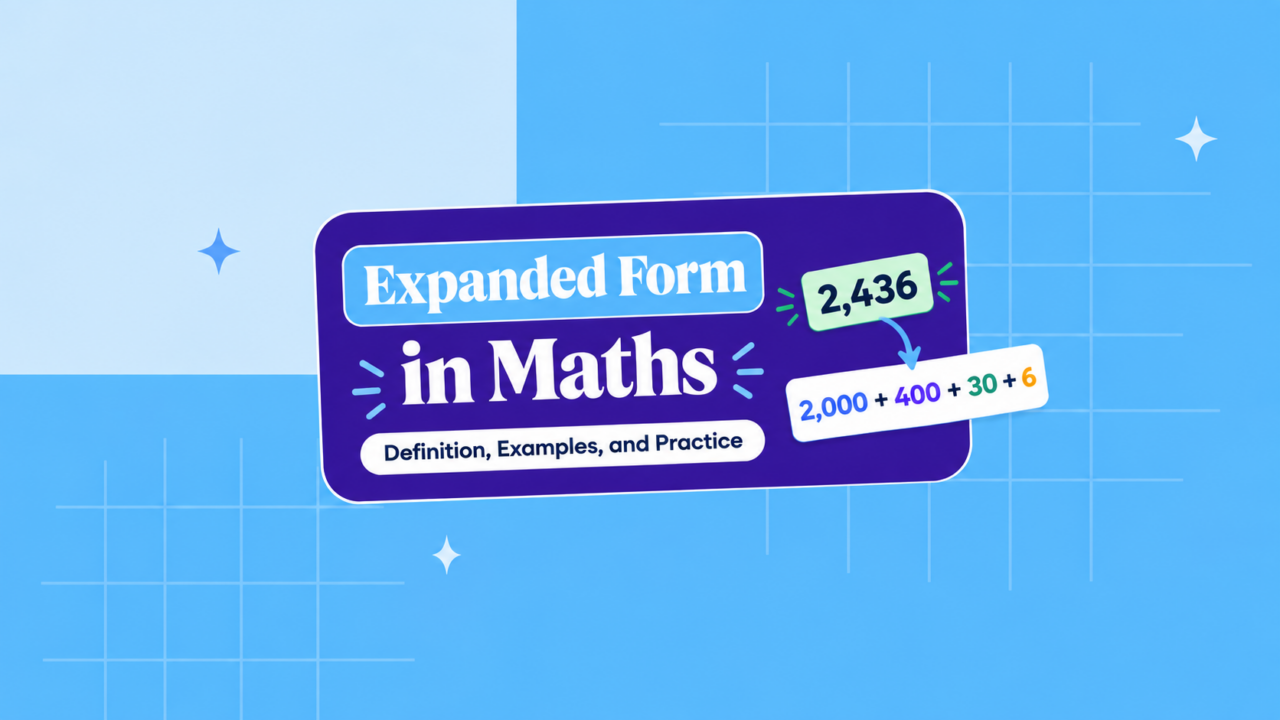
Expanded form is a way of writing a number as the sum of the place values of its digits, so 547 is written as 500 + 40 + 7.
- What Is Expanded Form in Maths?
- Why Expanded Form Matters More Than It Looks
- Place Value: The Foundation of Expanded Form
- Standard Form, Expanded Form and Word Form
- How to Write a Number in Expanded Form
- Expanded Form of 2-Digit Numbers
- Expanded Form of 3-Digit Numbers
- Expanded Form of 4-Digit Numbers
- Expanded Form of 5-Digit and Larger Numbers
- How to Handle Zeros in Expanded Form
- Three Ways to Write Expanded Form
- Expanded Form of Decimals
- How to Convert Expanded Form Back to Standard Form
- Expanded Form in Real Life
- Common Mistakes with Expanded Form and How to Fix Them
- Activities and Games to Practise Expanded Form
- Tips for Parents Helping at Home
- Tips for Teachers Delivering the Lesson
- Expanded Form in Olympiad Number Reasoning
- Practice Questions with Answers
- Conclusion
It is how children from Class 2 onwards learn what a number is actually made of, and the method works the same way for a two-digit number, for a number in crores, and for a decimal.
This guide covers expanded form at every number size, from 2-digit numbers up to 8-digit numbers in lakhs and crores, with a worked example for each.
It also covers the zero placeholder rule that causes most lost marks, all three notation styles, expanded form of decimals, how to convert back to standard form, eight activities you can run at home, and practice questions with answers.
What Is Expanded Form in Maths?
Expanded form is a way of writing a number as the sum of the place values of its digits. Each digit is written with the value it actually carries in its place, so 547 in expanded form is 500 + 40 + 7.
The parts always add back to the original number, which is what makes expanded form a reliable way to check your own work.
Expanded form at a glance:
| Number | Expanded form |
|---|---|
| 36 | 30 + 6 |
| 547 | 500 + 40 + 7 |
| 5,273 | 5,000 + 200 + 70 + 3 |
| 4,56,032 | 4,00,000 + 50,000 + 6,000 + 30 + 2 |
| 12.47 | 10 + 2 + 0.4 + 0.07 |
The idea is simple once you see it. In 547, the 5 is not really a 5, it is 5 hundreds. The 4 is not a 4, it is 4 tens. Expanded form takes a number that looks like three squashed-together digits and opens it up so your child can see what it is made of. In Indian textbooks the same process is often called breaking a number into its place value parts, and it is taught from Class 2 onwards, extending to lakhs and crores by Class 5.
Why Expanded Form Matters More Than It Looks
Parents often treat expanded form as a box-ticking exercise, something the child does for two weeks in Class 3 and never sees again. It is worth more than that, for three reasons.
It makes mental addition possible. A child who knows that 46 is 40 + 6 can add 46 + 32 by doing 40 + 30 and 6 + 2. A child who sees 46 as two unrelated digits has to count, which is why expanded form sits underneath 3-digit addition and subtraction later on.
It explains carrying and borrowing. Regrouping in subtraction only makes sense if you understand that 1 ten can be traded for 10 ones. Expanded form is where that trade becomes visible.
It prepares the ground for algebra. Writing 547 as (5 × 100) + (4 × 10) + (7 × 1) is the same structure as writing a polynomial. Children who are comfortable breaking numbers apart find algebra far less strange four years later.
There is also a quieter benefit. Expanded form gives your child a way to check their own work. If the parts add back to the original number, the answer is right. No parent needed, and it is one of the clearest signs of growing number sense.
Place Value: The Foundation of Expanded Form
You cannot write expanded form without place value, so this is worth five minutes before anything else.
In the Indian place value system, each place is ten times the place to its right. Reading from the right:
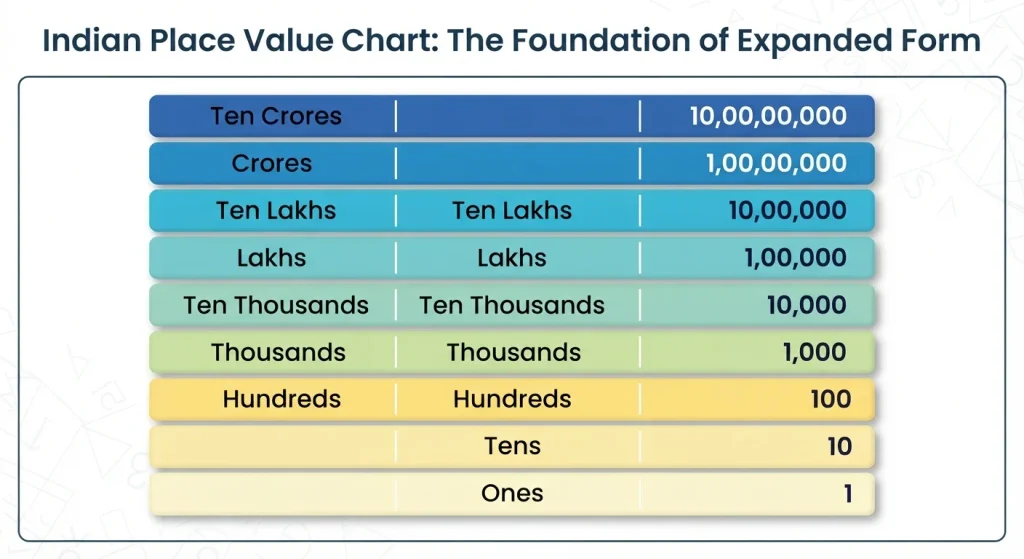
The Indian place value chart
| Place | Value | Written as |
|---|---|---|
| Ones | 1 | 1 |
| Tens | 10 | 10 |
| Hundreds | 100 | 100 |
| Thousands | 1,000 | 1,000 |
| Ten thousands | 10,000 | 10,000 |
| Lakhs | 1,00,000 | 1,00,000 |
| Ten lakhs | 10,00,000 | 10,00,000 |
| Crores | 1,00,00,000 | 1,00,00,000 |
| Ten crores | 10,00,00,000 | 10,00,00,000 |
Commas in the Indian system follow one rule: the first comma goes after three digits from the right, then every two digits after that. So 45678 becomes 45,678 and 1234567 becomes 12,34,567.
This matters for expanded form because the commas tell you where the periods begin, and the periods tell you which place value names to use.
Place value and face value
These two get mixed up constantly, so make the difference explicit.
In the number 7,45,382:
- The face value of 4 is 4. Face value is just the digit itself.
- The place value of 4 is 40,000, because the 4 sits in the ten thousands place.
Expanded form is built from place values, never face values. A child who writes 7 + 4 + 5 + 3 + 8 + 2 has used face values and has the wrong answer.
Standard Form, Expanded Form and Word Form
Three ways of writing the same number, and children are asked to switch between them constantly.
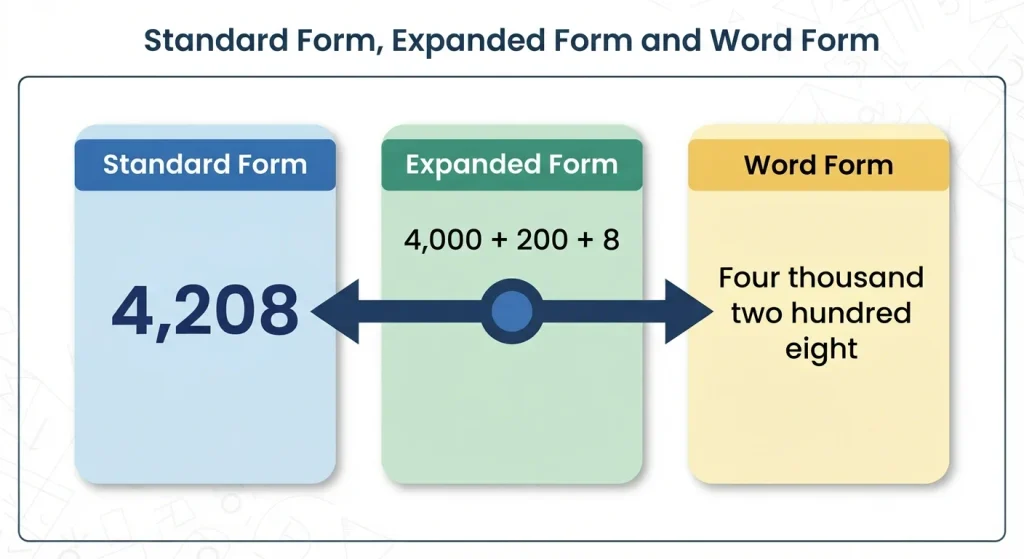
| Form | What it looks like | Example for 4,208 |
|---|---|---|
| Standard form | The ordinary way we write numbers | 4,208 |
| Expanded form | Each place value written out and added | 4,000 + 200 + 8 |
| Word form | The number written in words | Four thousand two hundred eight |
The link between them is worth saying out loud: expanded form is the bridge. Word form tells you the names of the parts. Expanded form tells you the values of the parts. Standard form packs those parts back into one compact number.
If your child can move in all six directions between these three forms, their number sense is in good shape.
How to Write a Number in Expanded Form
Four steps, and they work for any number of any size.
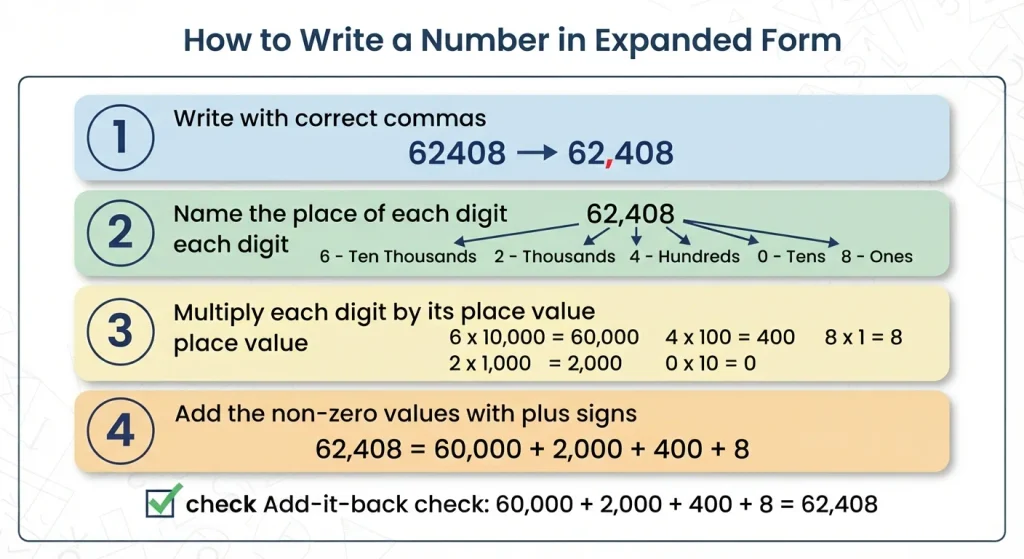
- Write the number with correct commas. This groups the digits into periods and makes the next step easier. 62408 becomes 62,408.
- Name the place of each digit, starting from the left. In 62,408: 6 is in ten thousands, 2 is in thousands, 4 is in hundreds, 0 is in tens, 8 is in ones.
- Multiply each digit by its place value. 6 × 10,000 = 60,000. 2 × 1,000 = 2,000. 4 × 100 = 400. 0 × 10 = 0. 8 × 1 = 8.
- Add the non-zero values with plus signs. 62,408 = 60,000 + 2,000 + 400 + 8.
The check: add the parts back. 60,000 + 2,000 + 400 + 8 = 62,408. If the total matches, the expanded form is correct. Teach your child to do this every single time and you will remove most errors without ever correcting them yourself.
Expanded Form of 2-Digit Numbers
Two-digit numbers are where expanded form begins, usually in Class 2 or early Class 3. There are only two places to think about: tens and ones.
Worked example 1: 47
- 4 is in the tens place, so it is worth 40.
- 7 is in the ones place, so it is worth 7.
- Expanded form: 47 = 40 + 7
Worked example 2: 83
- 8 tens = 80, 3 ones = 3
- 83 = 80 + 3
Worked example 3: 90
- 9 tens = 90, 0 ones = 0
- 90 = 90 + 0, or simply 90
That last one surprises children, and it is a good surprise. Let them sit with it. A number like 90 has nothing in the ones place, so its expanded form has only one meaningful part.
Quick practice: 25, 61, 78, 39, 50. Answers: 20 + 5, 60 + 1, 70 + 8, 30 + 9, 50.
Expanded Form of 3-Digit Numbers
Class 3 is where expanded form of numbers becomes a named skill in most CBSE schools. Three places now: hundreds, tens, ones.
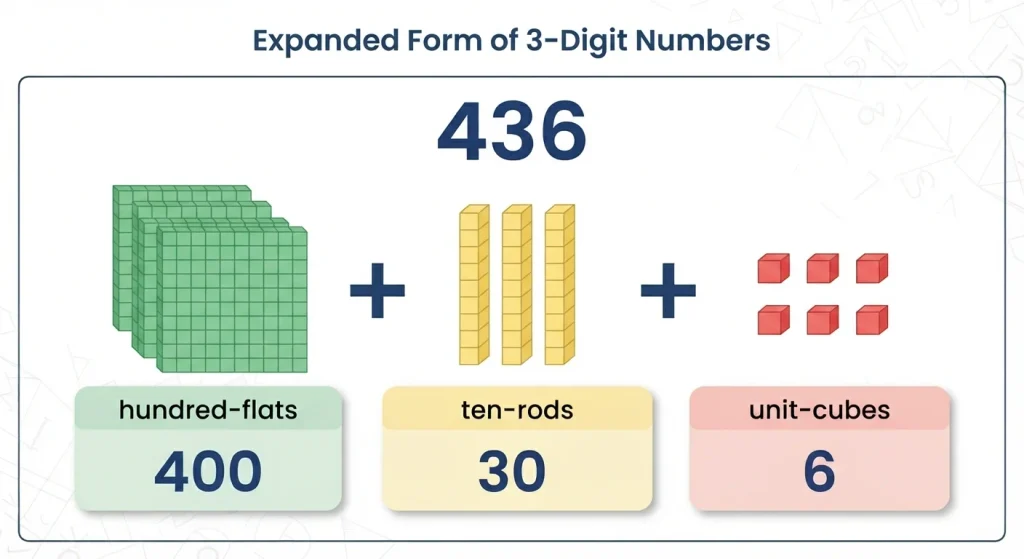
Worked example 1: 436
| Digit | Place | Value |
|---|---|---|
| 4 | Hundreds | 400 |
| 3 | Tens | 30 |
| 6 | Ones | 6 |
436 = 400 + 30 + 6
Worked example 2: 589
- 5 hundreds = 500, 8 tens = 80, 9 ones = 9
- 589 = 500 + 80 + 9
Worked example 3: 207
- 2 hundreds = 200, 0 tens = 0, 7 ones = 7
- 207 = 200 + 7
Notice what happened in the third example. The zero contributed nothing, so it disappeared from the sum. That is correct, and it is also the moment to be careful, which is why zeros get their own section below.
Quick practice: 352, 806, 740, 199. Answers: 300 + 50 + 2, 800 + 6, 700 + 40, 100 + 90 + 9.
Expanded Form of 4-Digit Numbers
Four-digit numbers arrive in Class 3 and are fully expected by Class 4. The thousands place joins in, and the first comma appears.
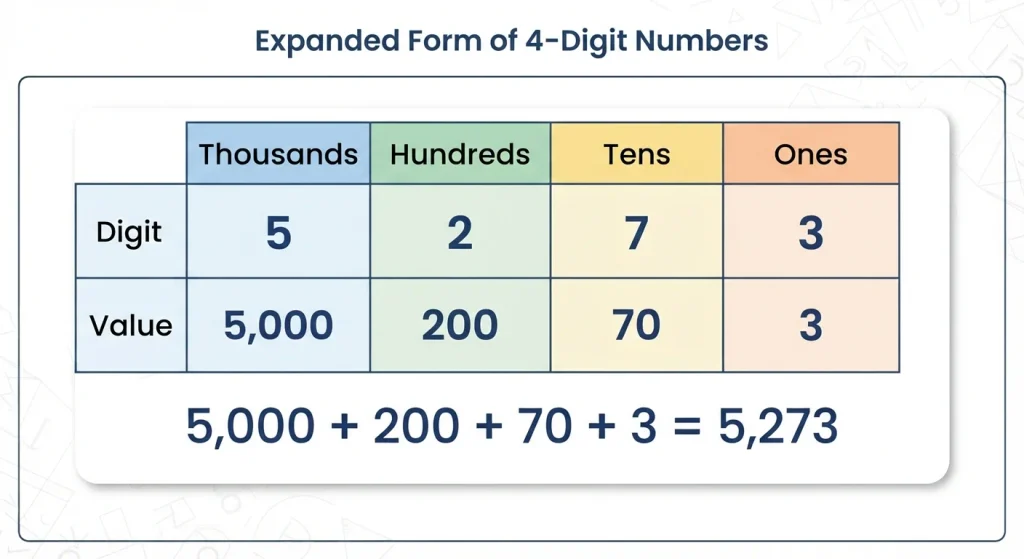
Worked example 1: 5,273
| Digit | Place | Value |
|---|---|---|
| 5 | Thousands | 5,000 |
| 2 | Hundreds | 200 |
| 7 | Tens | 70 |
| 3 | Ones | 3 |
5,273 = 5,000 + 200 + 70 + 3
Worked example 2: 9,677
- 9,677 = 9,000 + 600 + 70 + 7
Worked example 3: 4,008
- 4 thousands = 4,000, 0 hundreds, 0 tens, 8 ones = 8
- 4,008 = 4,000 + 8
A useful habit from here on: say the number out loud before writing. “Four thousand and eight” already tells you there are only two parts.
Quick practice: 3,415; 7,060; 2,909; 8,800. Answers: 3,000 + 400 + 10 + 5; 7,000 + 60; 2,000 + 900 + 9; 8,000 + 800.
Expanded Form of 5-Digit and Larger Numbers
This is where most online guides stop and where Indian students need the most help, because NCERT Class 4 introduces numbers up to one lakh and Class 5 extends to crores.
Five-digit numbers
Worked example: 62,408
| Digit | Place | Value |
|---|---|---|
| 6 | Ten thousands | 60,000 |
| 2 | Thousands | 2,000 |
| 4 | Hundreds | 400 |
| 0 | Tens | 0 |
| 8 | Ones | 8 |
62,408 = 60,000 + 2,000 + 400 + 8
Worked example: 93,407
93,407 = 90,000 + 3,000 + 400 + 7
Six and seven digit numbers in lakhs
At six digits the lakhs place appears, and the comma pattern changes. 456032 is written 4,56,032, not 456,032.
Worked example: 4,56,032
| Digit | Place | Value |
|---|---|---|
| 4 | Lakhs | 4,00,000 |
| 5 | Ten thousands | 50,000 |
| 6 | Thousands | 6,000 |
| 0 | Hundreds | 0 |
| 3 | Tens | 30 |
| 2 | Ones | 2 |
4,56,032 = 4,00,000 + 50,000 + 6,000 + 30 + 2
Worked example: 72,50,486 (seven digits, ten lakhs place)
72,50,486 = 70,00,000 + 2,00,000 + 50,000 + 400 + 80 + 6
Eight-digit numbers in crores
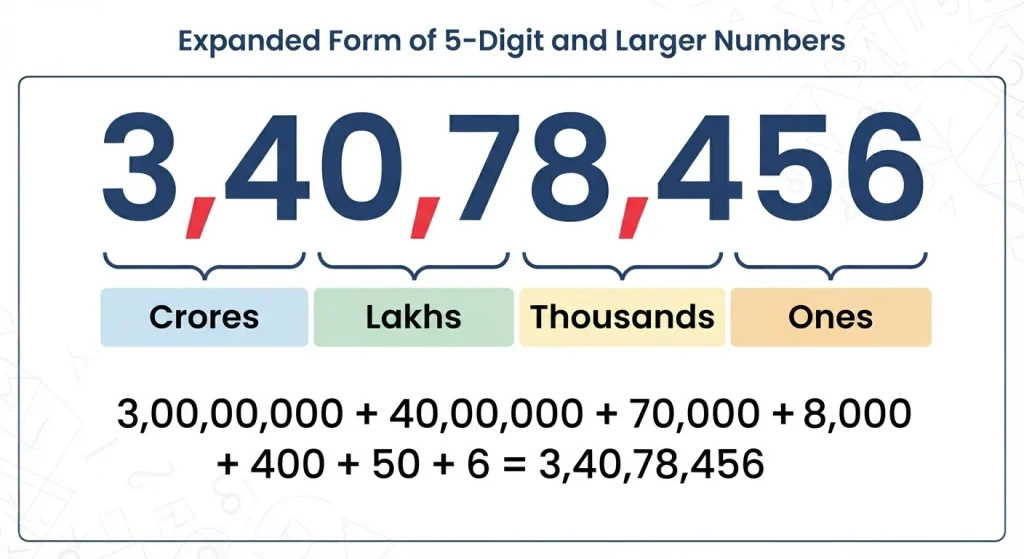
Worked example: 3,40,78,456
| Digit | Place | Value |
|---|---|---|
| 3 | Crores | 3,00,00,000 |
| 4 | Ten lakhs | 40,00,000 |
| 0 | Lakhs | 0 |
| 7 | Ten thousands | 70,000 |
| 8 | Thousands | 8,000 |
| 4 | Hundreds | 400 |
| 5 | Tens | 50 |
| 6 | Ones | 6 |
3,40,78,456 = 3,00,00,000 + 40,00,000 + 70,000 + 8,000 + 400 + 50 + 6
Large numbers look intimidating and are not. The method has not changed since 47. Only the number of rows in the table has grown.
How to Handle Zeros in Expanded Form
The rule: a zero contributes nothing to the sum, so it is left out of the expanded form, but the place it holds is never ignored. Its job is to keep the other digits in their correct places.
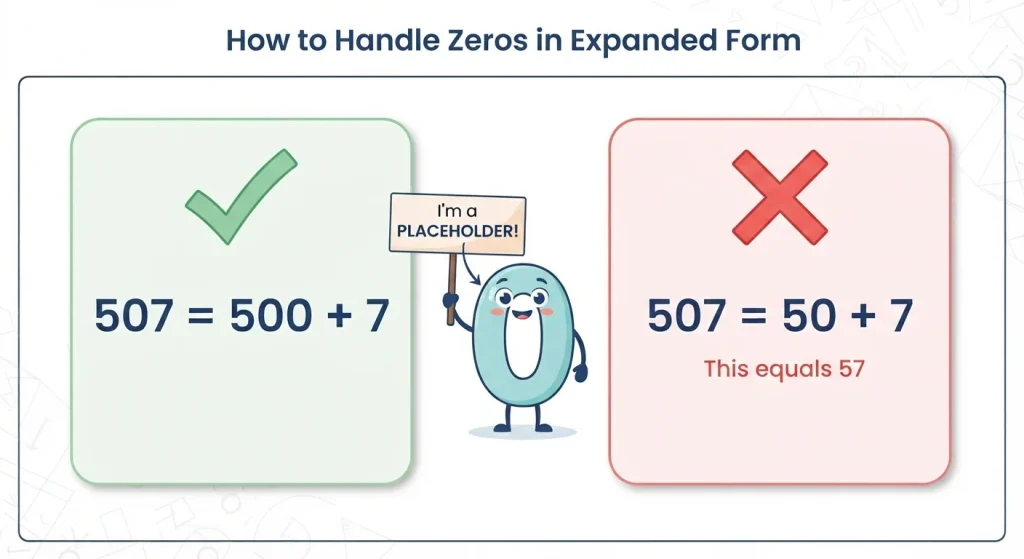
This is the error that costs the most marks, so it is worth doing slowly.
Example: 507
- Correct: 507 = 500 + 7
- Also accepted in many Class 3 textbooks: 500 + 0 + 7
- Wrong: 50 + 7, which equals 57
The wrong answer appears when a child skips the zero and slides the 5 into the tens place. The zero is not optional furniture. It is the reason the 5 means five hundred.
Example: 9,040
- Correct: 9,040 = 9,000 + 40
- Wrong: 9,000 + 400, which puts the 4 in the wrong place
- Wrong: 94, which collapses the number entirely
Example: 6,00,805
- Correct: 6,00,805 = 6,00,000 + 800 + 5
A simple test you can give your child: write the expanded form, then add it up. If the total is not the number you started with, a zero has gone wrong somewhere. In practice, nine times out of ten it has.
On whether to write the zeros: both styles are acceptable. Younger learners in Class 2 and Class 3 often write 507 = 500 + 0 + 7 because it keeps every place visible and makes the structure obvious. From Class 4 onwards the shorter form 500 + 7 is standard. Follow whichever your child’s school uses, and do not let a disagreement about style become a disagreement about maths.
Three Ways to Write Expanded Form
The same number can be expanded in three different notations. Textbooks move between them without always saying so, which is why children get confused about what the question wants.
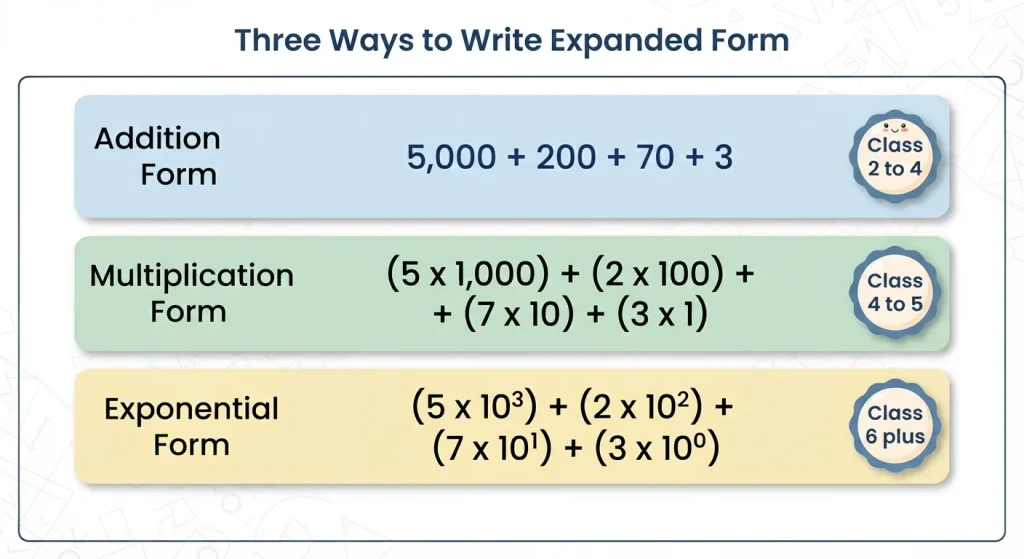
| Notation | 5,273 written this way | Usually expected in |
|---|---|---|
| Addition form | 5,000 + 200 + 70 + 3 | Class 2 to Class 4 |
| Multiplication form | (5 × 1,000) + (2 × 100) + (7 × 10) + (3 × 1) | Class 4 to Class 5 |
| Exponential form | (5 × 10³) + (2 × 10²) + (7 × 10¹) + (3 × 10⁰) | Class 6 and above |
Addition form
The one most people mean by expanded form. Write each place value and add. This is what a Class 3 exam paper is asking for unless it says otherwise.
7,409 = 7,000 + 400 + 9
Multiplication form
Also called expanded notation. Each digit is written next to the place value it sits in, multiplied out. This version makes the structure of the number much more obvious, which is why it shows up once children are confident with multiplication and are working with larger numbers.
3,216 = (3 × 1,000) + (2 × 100) + (1 × 10) + (6 × 1)
For Indian large numbers it works the same way:
4,56,032 = (4 × 1,00,000) + (5 × 10,000) + (6 × 1,000) + (3 × 10) + (2 × 1)
Exponential form
For Class 6 learners and above, powers of ten replace the written-out place values. Each place is ten to the power of its position, counting from zero at the ones place.
5,273 = (5 × 10³) + (2 × 10²) + (7 × 10¹) + (3 × 10⁰)
This is the version that connects directly to standard index notation in physics and to how computers represent numbers. It is not needed before Class 6, but a curious Class 5 child will enjoy it.
If a question does not specify, addition form is the safe answer. If the question uses the phrase “expanded notation”, it usually wants the multiplication form.
Expanded Form of Decimals
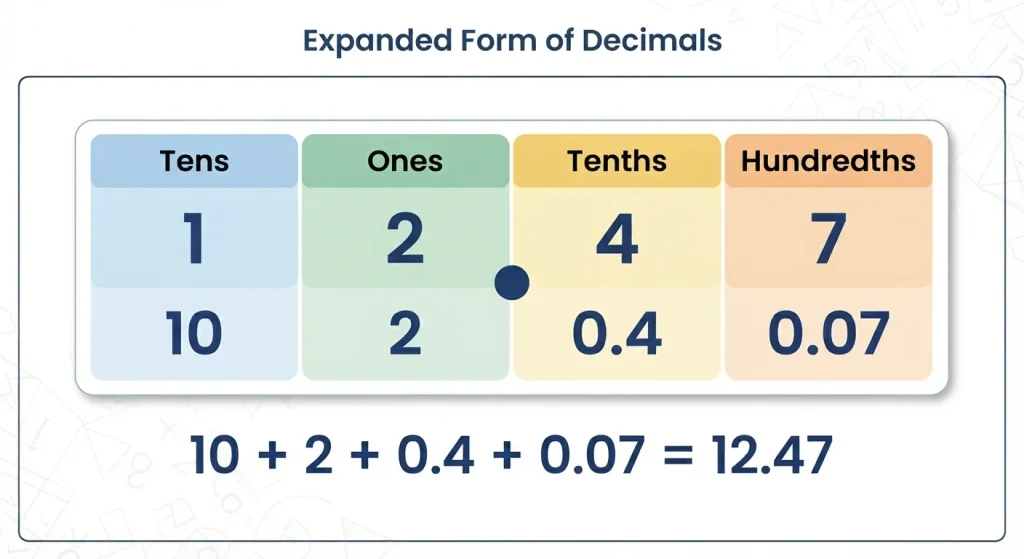
Once whole numbers are secure, decimals follow the same rule with one change: places to the right of the decimal point are worth less than one.
| Place | Value | As a fraction |
|---|---|---|
| Tenths | 0.1 | 1/10 |
| Hundredths | 0.01 | 1/100 |
| Thousandths | 0.001 | 1/1000 |
Worked example 1: 3.4
- 3 ones = 3, 4 tenths = 0.4
- 3.4 = 3 + 0.4
Worked example 2: 12.47
- 1 ten = 10, 2 ones = 2, 4 tenths = 0.4, 7 hundredths = 0.07
- 12.47 = 10 + 2 + 0.4 + 0.07
Worked example 3: 3.482
- 3.482 = 3 + 0.4 + 0.08 + 0.002
Worked example 4: 567.25
- 567.25 = 500 + 60 + 7 + 0.2 + 0.05
Worked example 5, with a zero: 8.09
- 8 ones = 8, 0 tenths = 0, 9 hundredths = 0.09
- 8.09 = 8 + 0.09
That last example catches almost everyone. The child sees a 9 and writes 0.9. The 9 is in the hundredths place, so it is worth 0.09. Count the places after the decimal point every time.
The fraction version is also accepted and is often clearer: 3.482 = 3 + 4/10 + 8/100 + 2/1000. Use whichever version matches your child’s textbook, and if fractions are still shaky, go back over the numerator and denominator of a fraction first.
One thing to avoid: 12.47 = 10 + 2 + 0.47 is not expanded form. It stops halfway. Expanded form breaks the number down to one digit per place, and 0.47 still has two digits in it.
How to Convert Expanded Form Back to Standard Form
The reverse direction gets far less practice than it deserves, and exam papers ask for it regularly.
The method: line each value up with its place, then write the digits in order, using zero for any place that is missing.
Example 1: 7,00,000 + 20,000 + 8,000 + 3
| Place | Value given | Digit |
|---|---|---|
| Lakhs | 7,00,000 | 7 |
| Ten thousands | 20,000 | 2 |
| Thousands | 8,000 | 8 |
| Hundreds | none | 0 |
| Tens | none | 0 |
| Ones | 3 | 3 |
Standard form: 7,28,003
Example 2: 5 lakhs + 4 ten thousands + 9 ones
Fill the gaps with zeros: 5, 4, 0, 0, 0, 9 gives 5,40,009.
Example 3: 500 + 60 + 7 + 0.2 + 0.05 gives 567.25
The habit to build: before writing anything, ask which places are missing. Those are the ones that need a zero, and those are the ones children forget.
Expanded Form in Real Life
Expanded form is not only a classroom exercise. It is how we read and make sense of big numbers.
Reading population figures. Delhi’s population is often quoted as about 3,40,78,456. Expanded, that is 3,00,00,000 + 40,00,000 + 70,000 + 8,000 + 400 + 50 + 6, which tells you immediately that it is three crore and forty lakh, plus change. A child who can expand the number can read it aloud. A child who cannot sees a string of digits and guesses.
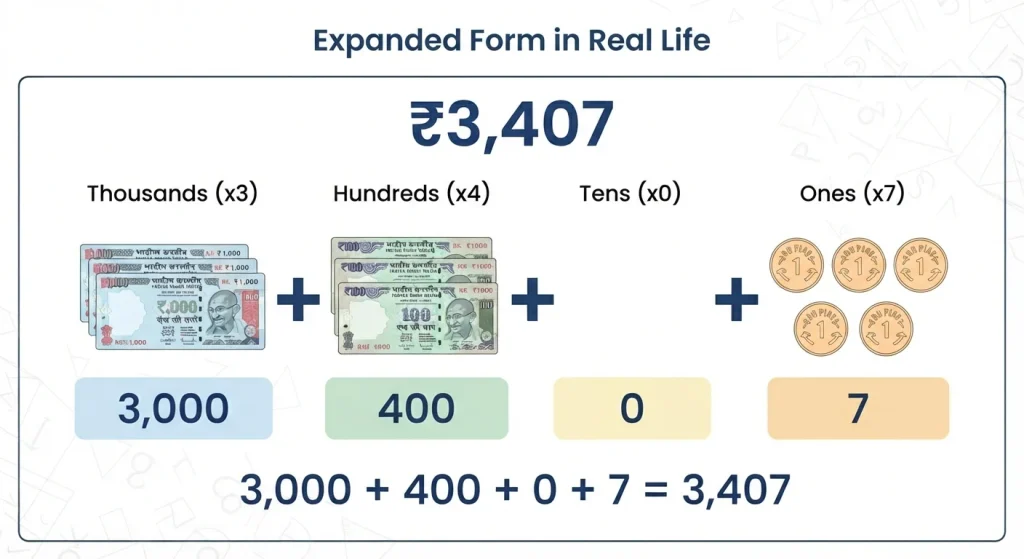
Money. A school fee of ₹24,500 is 2 ten thousands, 4 thousands and 5 hundreds. When a shopkeeper counts out ₹24,500 in notes, they are performing expanded form physically: two ₹10,000 bundles, four ₹1,000 notes, five ₹100 notes. Paise work the same way on the decimal side, where ₹18.75 is 18 rupees + 7 ten-paise + 5 paise. It is the same thinking that money word problems for Class 3 depend on.
Distances. The distance from Delhi to Chennai by road is roughly 2,180 km, which is 2,000 + 100 + 80. Expanding it makes it easier to estimate, which pairs naturally with rounding to the nearest 10, and easier to compare with another distance.
Reading a cricket scoreboard or a census table. Any time your child meets a number with four or more digits in the newspaper, the quickest way to help them read it is to break it into places out loud.
Common Mistakes with Expanded Form and How to Fix Them
| Mistake | What the child writes | What to say |
|---|---|---|
| Using face value instead of place value | 547 = 5 + 4 + 7 | “Where is the 5 sitting? What is it worth there?” |
| Dropping a zero’s place | 507 = 50 + 7 | “Add your answer back. Do you get 507?” |
| Putting the zero’s value in the wrong place | 9,040 = 9,000 + 400 | “Count the places from the right. Which place is the 4 in?” |
| Decimal place confusion | 8.09 = 8 + 0.9 | “How many places after the point? Then it is hundredths.” |
| Half-expanded decimals | 12.47 = 10 + 2 + 0.47 | “Can 0.47 be broken down further?” |
| Wrong commas for Indian numbers | 456,032 instead of 4,56,032 | “Three digits first, then two at a time.” |
| Mixing up expanded and word form | 436 = four hundred thirty-six | “Word form uses words. Expanded form uses numbers and plus signs.” |
| Forgetting the plus signs | 436 = 400 30 6 | “The parts have to be added, so show the addition.” |
Every one of these is caught by the same check: add the parts back and see whether you get the original number. Teach the check once and most of the list takes care of itself.
8 Activities and Games to Practise Expanded Form
All eight use things already in the house. None needs printing or buying.
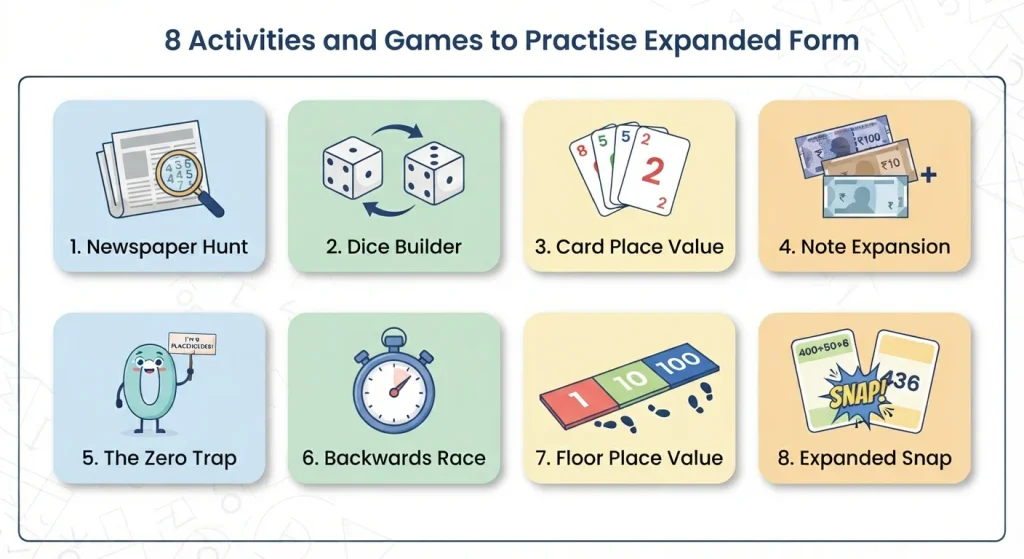
1. Newspaper number hunt. Give your child a page of the newspaper and ask them to find five numbers with four or more digits. For each one, write the expanded form. Sports scores, prices and population figures work well. Ten minutes, no preparation.
2. Dice builder. Roll a die four times to make a 4-digit number, then write it in expanded form. Make it competitive: the largest number wins the round, but only if the expanded form is correct.
3. Playing card place value. Remove the picture cards. Deal five cards and arrange them into the largest possible number, then the smallest. Write both in expanded form. This builds expansion alongside ascending and descending order.
4. Currency note expansion. Use real or paper notes of ₹1, ₹10, ₹100 and ₹1,000. Call out an amount like ₹3,407 and ask your child to lay out the notes. The notes on the table are the expanded form made physical.
5. The zero trap. You write a number with one or two zeros in it, such as 7,05,090. Your child expands it. Then swap roles. Scoring is one point for a correct expansion and two points for successfully trapping the other player.
6. Backwards race. You read out an expanded form, such as “forty thousand plus two thousand plus nine”. Your child writes the standard form. Time it. Children who can do this quickly will not lose marks on reverse questions.
7. Place value chart on the floor. Tape six sheets of paper in a row and label them ones, tens, hundreds, thousands, ten thousands, lakhs. Call out a number and have your child stand on each place in turn, saying what that digit is worth. Physical movement helps younger learners enormously.
8. Expanded form snap. Write numbers on one set of cards and expanded forms on another. Shuffle both and play snap, where a match means the expanded form belongs to the number. Mix in a few near-misses, such as 507 paired with 50 + 7, to make the game worth paying attention to.
Tips for Parents Helping at Home
Ask “what is it worth?” rather than “what is it?” The second question invites face value. The first invites place value.
Say the number out loud before writing. Four thousand and eight is almost impossible to expand incorrectly once you have said it. Forty-zero-eight is a sign the child is reading digits, not numbers.
Let them check their own work. The add-it-back test means your child can verify every answer themselves. Resist the urge to correct, and ask them to run the check instead.
Do not rush to decimals. If your child is shaky on 4-digit whole numbers, decimals will make it worse. Secure the whole numbers first.
Keep sessions short. Ten focused minutes beats forty distracted ones, especially for 8 to 11 year olds.
Match the school’s style. If the textbook writes 507 = 500 + 0 + 7, use that at home too. Consistency matters more than which style is better.
Tips for Teachers Delivering the Lesson
Start concrete. Base ten blocks, bundles of straws or currency notes before any notation. The written form should describe something the child has already seen.
Introduce the zero rule early and deliberately rather than letting it emerge from errors. Plan a whole lesson around numbers like 507, 9,040 and 6,00,805.
Teach the Indian comma pattern alongside the place value chart. Many expansion errors in Class 5 and Class 6 trace back to a misread comma rather than a misunderstanding of place value.
Make the reverse direction routine. Set every expanded form question with a standard form question beside it so students practise both directions equally.
Use the add-it-back check as a class habit from day one. It converts marking into self-marking.
Name the notation styles explicitly. Tell students the difference between expanded form and expanded notation so they know what each question is asking.
Differentiate by number size, not by task. The same activity works for 2-digit and 8-digit numbers, so a mixed-ability class can all do the same thing at different levels.
Expanded Form in Olympiad Number Reasoning
In competitions like IOQM, Math Kangaroo and SOF IMO, expanded form rarely appears as a question in its own right. It appears as a tool for solving something else.
Digit reversal problems. A two-digit number is 10a + b. Reversing it gives 10b + a. Subtracting one from the other gives 9(a – b), which is why the difference between a two-digit number and its reverse is always a multiple of 9. That result comes straight out of expanded form.
Divisibility rules. Why does the digit sum test for 9 work? Because 547 = 5(99 + 1) + 4(9 + 1) + 7, and every part except 5 + 4 + 7 is already a multiple of 9. Expanded form turns a memorised rule into something a child can see.
Place value puzzles. “A 3-digit number has digits adding to 12. The hundreds digit is twice the ones digit. The tens digit is 3. Find the number.” Writing the number as 100a + 10b + c makes this a system of equations rather than a guessing game.
Number construction problems. Questions that ask for the largest or smallest number from a set of digits are place value questions. Children who think in expanded form put the biggest digit in the biggest place without being told.
The pattern is consistent. Olympiad problems reward children who can take a number apart. Expanded form is the first place they learn to do it, and how to solve math olympiad problems shows where that habit leads.
Practice Questions with Answers
Set A: 2 and 3 digit numbers
- Write 64 in expanded form.
- Write 318 in expanded form.
- Write 406 in expanded form.
- Write 970 in expanded form.
Set B: 4 and 5 digit numbers
- Write 2,537 in expanded form.
- Write 8,004 in expanded form.
- Write 41,620 in expanded form.
- Write 60,905 in expanded form.
Set C: lakhs and crores
- Write 3,72,845 in expanded form.
- Write 5,00,037 in expanded form.
- Write 67,09,402 in expanded form.
- Write 2,04,56,018 in expanded form.
Set D: decimals
- Write 7.6 in expanded form.
- Write 45.28 in expanded form.
- Write 9.07 in expanded form.
- Write 120.345 in expanded form.
Set E: reverse direction
- Write the standard form of 60,000 + 3,000 + 500 + 2.
- Write the standard form of 9,00,000 + 40,000 + 7.
- Write the standard form of 200 + 9 + 0.5 + 0.03.
- Write the standard form of (6 × 1,000) + (0 × 100) + (8 × 10) + (4 × 1).
Answers
| Q | Answer |
|---|---|
| 1 | 60 + 4 |
| 2 | 300 + 10 + 8 |
| 3 | 400 + 6 |
| 4 | 900 + 70 |
| 5 | 2,000 + 500 + 30 + 7 |
| 6 | 8,000 + 4 |
| 7 | 40,000 + 1,000 + 600 + 20 |
| 8 | 60,000 + 900 + 5 |
| 9 | 3,00,000 + 70,000 + 2,000 + 800 + 40 + 5 |
| 10 | 5,00,000 + 30 + 7 |
| 11 | 60,00,000 + 7,00,000 + 9,000 + 400 + 2 |
| 12 | 2,00,00,000 + 4,00,000 + 50,000 + 6,000 + 10 + 8 |
| 13 | 7 + 0.6 |
| 14 | 40 + 5 + 0.2 + 0.08 |
| 15 | 9 + 0.07 |
| 16 | 100 + 20 + 0.3 + 0.04 + 0.005 |
| 17 | 63,502 |
| 18 | 9,40,007 |
| 19 | 209.53 |
| 20 | 6,084 |
Make Preparing for Math Olympiad Simple!



What is expanded form in maths?
Expanded form is a way of writing a number that shows the value of each digit separately, added together. For example, 456 in expanded form is 400 + 50 + 6. It makes the place value of every digit visible.
How do you write a number in expanded form?
Write the number with correct commas, name the place of each digit, multiply each digit by its place value, then add the non-zero results with plus signs. For 5,273 this gives 5,000 + 200 + 70 + 3. Check your answer by adding the parts back.
What is the difference between expanded form and standard form?
Standard form is the ordinary compact way we write a number, such as 4,208. Expanded form writes the same number as the sum of its place values, 4,000 + 200 + 8. They are the same number written two ways.
What is expanded notation?
Expanded notation is the multiplication version of expanded form. Instead of 5,000 + 200 + 70 + 3 you write (5 × 1,000) + (2 × 100) + (7 × 10) + (3 × 1). Some textbooks use the two terms interchangeably, so read the question carefully.
Do you include zeros in expanded form?
A zero contributes nothing to the total, so it is usually left out. 507 is written as 500 + 7. Younger classes sometimes write 500 + 0 + 7 to keep every place visible, and both are accepted. What is never acceptable is dropping the zero’s place, which would turn 507 into 50 + 7.
In which class is expanded form taught?
In CBSE and NCERT schools, expanded form starts with 2-digit numbers around Class 2, is formally taught for 3 and 4 digit numbers in Class 3, extends to 5 and 6 digit numbers in Class 4, reaches lakhs and crores in Class 5, and appears with decimals and exponential notation by Class 6.
How do you write decimals in expanded form?
Treat the places after the decimal point as tenths, hundredths and thousandths. For 12.47, write 10 + 2 + 0.4 + 0.07. Count the places after the point carefully, because a digit in the hundredths place is worth 0.0 something, not 0. something.
What is the expanded form of a number with lakhs?
Use the Indian place value names. For 4,56,032 the expanded form is 4,00,000 + 50,000 + 6,000 + 30 + 2. The comma pattern is three digits from the right, then two at a time.
How do you convert expanded form back to standard form?
Add all the values together, or line each value up with its place and write a zero for any place that is missing. 7,00,000 + 20,000 + 8,000 + 3 becomes 7,28,003 because the hundreds and tens places are empty.
Why does my child keep making mistakes with zeros?
Because a zero looks like nothing but does an important job. It holds a place open so the other digits stay where they belong. The fastest fix is the add-it-back check: if the expanded form does not add up to the original number, a zero has been mishandled.
Conclusion
Expanded form is one rule applied at every scale. Break the number into its place values, write them with plus signs, and add them back to check.
That works for 47, for 3,40,78,456 and for 8.09, which is why it is worth getting right early rather than relearning it at each new number size. Keep the zero rule in front of your child, let them run the add-it-back check themselves, and the rest follows.

Mikha Piregu is a Content Writer with experience spanning educational content, including math and math olympiad topics, as well as advocacy writing, research-based articles, and SEO-driven web content. He creates high-quality blog content, web copy, and feature articles that support brand visibility, audience engagement, and long-term organic growth through data-informed storytelling. Skilled in WordPress, WooCommerce, and modern digital tools, Mikha adapts content across various platforms, including blogs, websites, campaigns, and advocacy initiatives, with clarity and purpose.

There are no comments posted here yet.
Sign in to leave a comment