

Long division is a written method for dividing a large number by another number using four repeating steps: divide, multiply, subtract and bring down.
- What is long division?
- When to use long division instead of short division
- Before you start: the long division prerequisites checklist
- The DMSB method: divide, multiply, subtract, bring down
- Long division without remainders: 2-digit by 1-digit
- Long division without remainders: 3-digit by 1-digit
- Long division with remainders
- Long division with 4-digit dividends
- Long division with 2-digit divisors
- Zeros in the quotient: the step most students miss
- Remainders as fractions and decimals
- How to check a long division answer
- Long division word problems in real life
- Long division in Olympiad-style problems
- Common long division mistakes and how to fix them
- hands-on long division activities and games
- Tips for parents helping with long division at home
- Tips for teachers teaching long division
- Long division practice questions with answers
- Final thoughts
You work through the dividend one place value at a time, writing each stage down, and whatever is left at the end is the remainder. In 527 ÷ 8, the four steps repeat twice to give 65 remainder 7.
Those four steps, shortened to DMSB, are the whole method. If your child freezes when a long division sum appears, it is because the sum looks enormous, not because it is hard.
This guide covers the full progression: prerequisites, dividing by a single digit, remainders, zeros in the quotient and two-digit divisors, with every long division example worked out in writing.
What is long division?
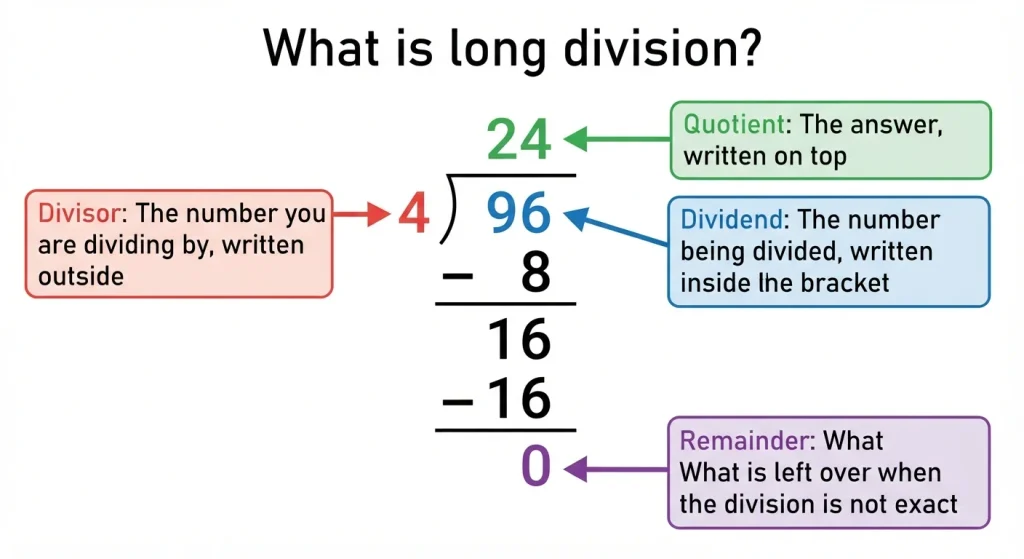
Long division is a written method for dividing a large number by another number, one place value at a time. You repeat four steps, divide, multiply, subtract and bring down, until every digit of the dividend has been used.
The method records each stage on paper instead of asking the child to hold it in their head.
That last sentence is the whole point of the method, and it is worth saying to your child directly. Long division is not harder than mental division. It is easier, because it writes down the parts that would otherwise have to be remembered.
Here is what 96 ÷ 4 looks like laid out:
      24
    -----
  4 ) 96
      8
      --
      16
      16
      --
       0
The parts of a long division sum
Four words do all the work, and your child will meet them in every textbook from Class 4 onwards.
| Term | What it means | In 96 ÷ 4 = 24 |
|---|---|---|
| Dividend | The number being divided, written inside the bracket | 96 |
| Divisor | The number you are dividing by, written outside | 4 |
| Quotient | The answer, written on top | 24 |
| Remainder | What is left over when the division is not exact | 0 |
The relationship between them never changes, and it is the basis of every answer check in this guide:
\text{Dividend} = (\text{Divisor} \times \text{Quotient}) + \text{Remainder}When to use long division instead of short division
Short division is the compact version. The child works mentally and carries the leftover as a small digit beside the next number. It is quick, and for simple sums with a one-digit divisor it is often the better choice.
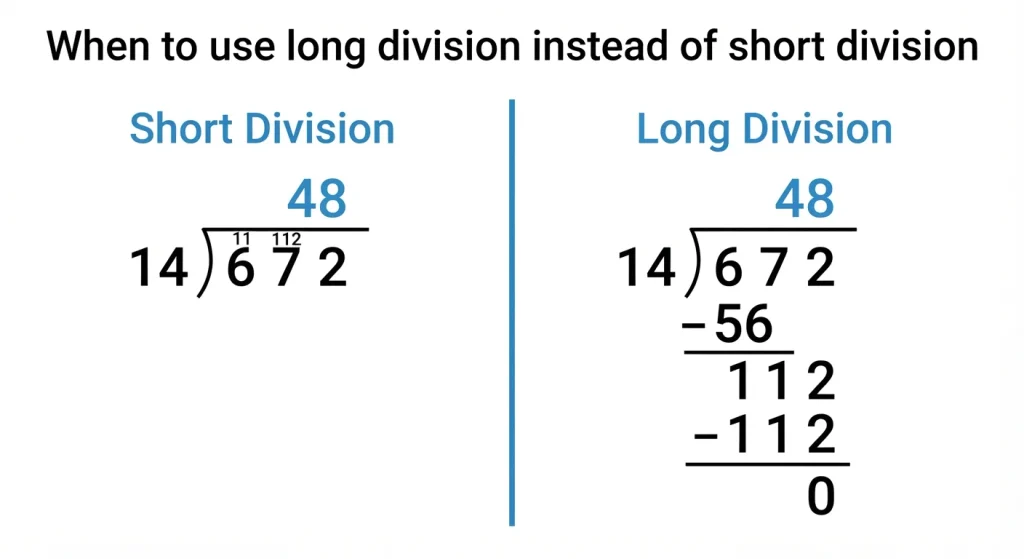
Long division writes those same leftovers out in full. Use it when:
- The divisor has two or more digits. Almost nobody can hold 14 × 7 and a running subtraction in their head at once.
- The dividend is large, typically three digits or more.
- Your child keeps making errors with short division. Writing each subtraction out shows exactly where the slip happened.
- The question asks for working to be shown, which CBSE papers routinely do.
A useful rule for home: if your child gets short division right, let them use it. If they get it wrong and cannot say why, switch to long division until the method is secure, then let them compress it again.
Where long division sits in the CBSE and NCERT scope
The progression across Class 4 to Class 6 is gradual, and knowing where your child sits prevents a lot of unnecessary worry.
| Class | Typical division expectation |
|---|---|
| Class 4 | Divide 2-digit and 3-digit numbers by a 1-digit divisor, with and without remainders. Interpret the remainder in simple sharing contexts. |
| Class 5 | Divide up to 4-digit and 5-digit numbers by 1-digit and 2-digit divisors. Estimate quotients before dividing. Begin dividing decimals. |
| Class 6 | Apply division inside multi-step word problems, factors and multiples, and HCF work. Divisors become routinely two-digit. |
If your Class 4 child is struggling with a two-digit divisor, they are working ahead of the curriculum, not falling behind it.
Before you start: the long division prerequisites checklist
This is the section most guides skip, and it is the reason long division practice so often goes nowhere. The method is only four steps. If a child fails at those steps, the cause is almost always a gap underneath, not the method itself.
Go through these five checks before any long division practice. Each takes two minutes.
- Multiplication tables up to 10. Ask six random multiplication table facts out of order: 7 × 8, 6 × 9, 4 × 7, 8 × 8, 3 × 9, 6 × 7. Your child should answer within about three seconds each. Slow recall is not a tables problem during long division, it becomes an attention problem, because by the time they have worked out 7 × 8 they have forgotten what they were dividing.
- Basic division facts. Ask 42 ÷ 7, 54 ÷ 9, 36 ÷ 6. These should come as quickly as the tables.
- Subtraction with borrowing. Give 83 minus 47 and 406 minus 128 in column form. Long division subtracts at every single step, so a borrowing weakness produces errors that look like division errors.
- Place value to four digits. Ask what the 7 is worth in 4,725. The answer is 700, not 7, and if that is shaky it is worth revisiting place value first. A child who says 7 will not understand why digits line up in columns, and will write the quotient in the wrong place.
- Estimation and rounding. Ask roughly how many 6s fit into 50. Practice with rounding to the nearest 10 builds this instinct. A child who can say “about 8” has the instinct that makes the divide step fast. A child who cannot will guess blindly at every step.
If a check fails
Do not push on. Spend a week on that one skill, then return. A child who knows their tables learns long division in days. A child who does not can practise for a month and get nowhere, and will conclude they are bad at maths when the real gap is three years old.
One scaffold works for every child who is still shaky on tables, and it is the single most useful trick in this guide. Before starting a division, write out the multiples of the divisor down the side of the page. For a divisor of 7:
7, 14, 21, 28, 35, 42, 49, 56, 63, 70Now the divide step is reading, not recall. Remove the list gradually as confidence grows.
The DMSB method: divide, multiply, subtract, bring down
Every long division sum in this guide, and every one your child will meet in school, uses the same four steps in the same order. DMSB is how we will refer to them from here on.
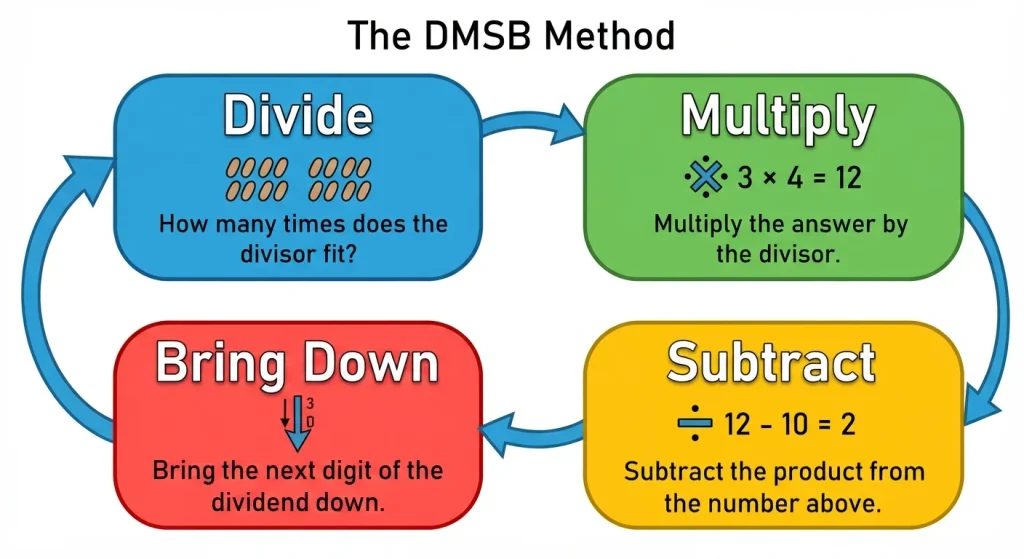
- D for Divide. How many whole times does the divisor fit into the number you are looking at? Write that digit in the quotient, directly above the digit you are working on.
- M for Multiply. Multiply the digit you just wrote by the divisor. Write the product underneath.
- S for Subtract. Subtract the product from the number above it. Write the difference below.
- B for Bring down. Bring the next digit of the dividend down beside that difference.
Then go back to D and repeat. You stop when there are no digits left to bring down. Whatever remains at the bottom is the remainder.
Why each DMSB step makes sense
Children follow DMSB much more reliably once they know it is not arbitrary. Here is the reasoning behind each step, in words you can use directly.
Divide asks a sharing question about one place value at a time. When we divide 96 by 4, the first step is really “9 tens shared into 4 groups gives 2 tens each”. We write 2 in the tens column of the quotient because the answer to that question is 2 tens, not 2 ones.
Multiply works out how much we have actually given away. If each of the 4 groups got 2 tens, we have handed out 4 × 2 = 8 tens altogether.
Subtract finds what is still waiting to be shared. We started with 9 tens and gave away 8 tens, so 1 ten is left over. That leftover has not disappeared, it just cannot be shared as whole tens.
Bring down converts that leftover into the next smaller unit so it can be shared. The 1 ten left over becomes 10 ones, and the 6 ones already in the dividend join it, making 16 ones. That is exactly what bringing down the 6 beside the 1 does on paper.
This is the explanation almost every guide leaves out, and it is the one that stops a child from asking “but why do we bring it down?” for the fourth time.
A memory aid that sticks
The traditional one is Dad, Mother, Sister, Brother, a family going through the steps in order. Say the four words aloud at every step for the first week. Children who say them stop skipping the subtract step, which is the most commonly dropped one.
If your child prefers something local, Dal, Makhani, Sabzi, Bhindi works just as well. The point is not the words. It is that saying them out loud forces the order.
Long division without remainders: 2-digit by 1-digit
Start here, whatever class your child is in. If the first example divides exactly, the child learns the rhythm of DMSB without the extra load of interpreting a leftover.
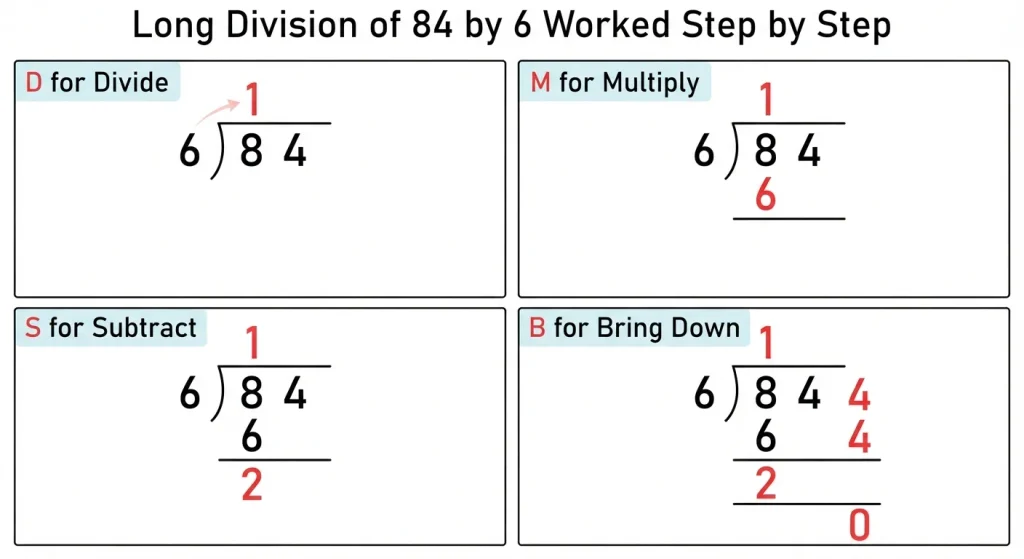
Example: 84 ÷ 6
Set it up with 84 inside the bracket and 6 outside.
D, divide. Look at the first digit, 8. How many whole 6s fit into 8? One, because 6 × 1 = 6 and 6 × 2 = 12 is too big. Write 1 above the 8.
M, multiply. 1 × 6 = 6. Write 6 under the 8.
S, subtract. 8 minus 6 = 2. Write 2 below.
B, bring down. Bring down the 4 beside the 2, making 24.
Now repeat.
D. How many 6s in 24? Exactly 4, since 6 × 4 = 24. Write 4 above the 4 in 84.
M. 4 × 6 = 24. Write it underneath.
S. 24 minus 24 = 0.
B. There is nothing left to bring down, so we stop.
      14
    -----
  6 ) 84
      6
      --
      24
      24
      --
       0
The quotient is 14 and the remainder is 0, so 84 ÷ 6 = 14.
Check it. 14 × 6 = 84. Correct.
Say this out loud while your child watches: the 1 we wrote first is really 1 ten, and the 2 left over after subtracting was 2 tens, which became 20 ones and joined the 4 to make 24. Children who hear this once in the first example rarely misalign digits later.
Long division without remainders: 3-digit by 1-digit
The method does not change at all. There is simply one more round of DMSB.
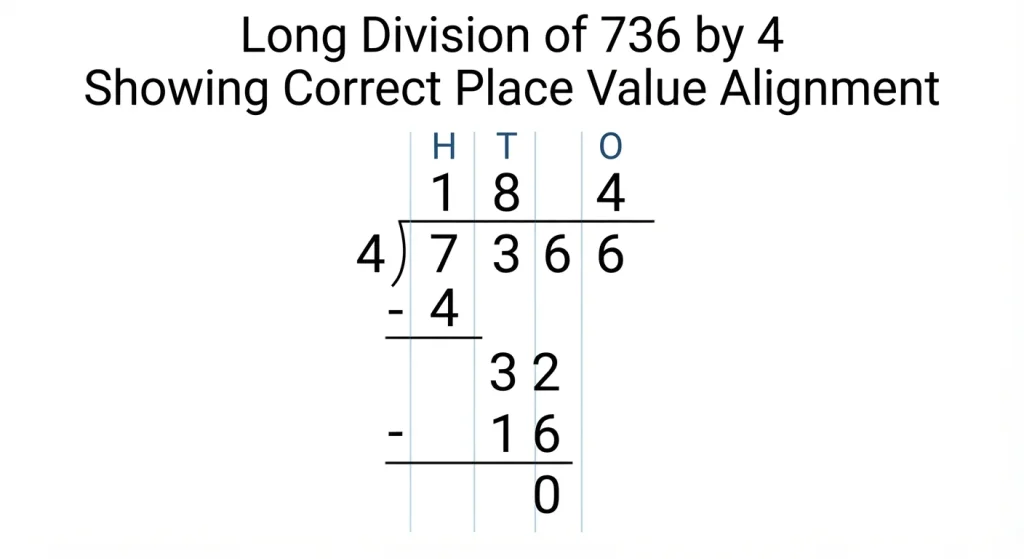
Example: 736 ÷ 4
Round 1. How many 4s in 7? One, since 4 × 1 = 4. Write 1 above the 7. Multiply: 1 × 4 = 4. Subtract: 7 minus 4 = 3. Bring down the 3 to make 33.
Round 2. How many 4s in 33? Eight, since 4 × 8 = 32 and 4 × 9 = 36 would overshoot. Write 8 above the 3. Multiply: 8 × 4 = 32. Subtract: 33 minus 32 = 1. Bring down the 6 to make 16.
Round 3. How many 4s in 16? Exactly 4. Write 4 above the 6. Multiply: 4 × 4 = 16. Subtract: 16 minus 16 = 0. Nothing left to bring down.
       184
     -----
   4 ) 736
       4
       --
       33
       32
       --
        16
        16
        --
         0
So 736 ÷ 4 = 184.
Check it. 184 × 4 = 736. Correct.
When the divisor does not fit into the first digit
This trips up a lot of children, so handle it before it appears in homework. Take 245 ÷ 7. There are no whole 7s in 2, so we do not write anything above the 2. We look at the first two digits together instead, 24, and ask how many 7s fit into 24. The answer is 3, and the 3 goes above the 4, not above the 2.
The rule to say aloud: the quotient digit always goes above the last digit of the number you just divided into. Get this right in Class 4 and the zero-in-the-quotient problem later becomes much smaller.
Long division with remainders
Most real division does not come out evenly, so this is not an advanced case. It is the normal one.
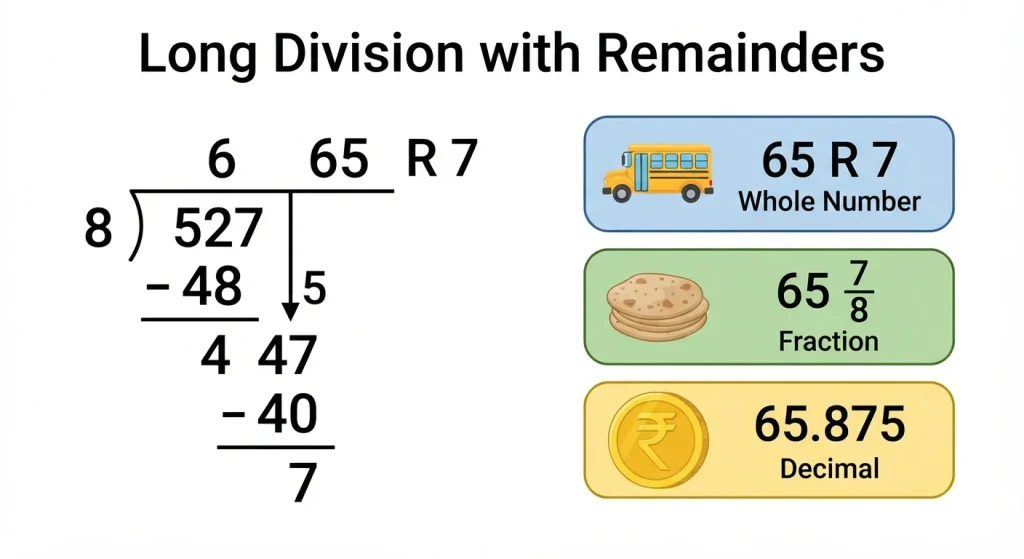
Example: 527 ÷ 8
Round 1. No whole 8s fit into 5, so look at 52. How many 8s in 52? Six, since 8 × 6 = 48 and 8 × 7 = 56 overshoots. Write 6 above the 2. Multiply: 6 × 8 = 48. Subtract: 52 minus 48 = 4. Bring down the 7 to make 47.
Round 2. How many 8s in 47? Five, since 8 × 5 = 40. Write 5 above the 7. Multiply: 5 × 8 = 40. Subtract: 47 minus 40 = 7. There is nothing left to bring down.
       65
     -----
   8 ) 527
       48
       --
        47
        40
        --
         7
So 527 ÷ 8 = 65 remainder 7, usually written 65 R 7.
Check it. (8 × 65) + 7 = 520 + 7 = 527. Correct.
The one rule about remainders
The remainder must always be smaller than the divisor. If it is not, the divide step was too cautious and a larger digit belongs in the quotient.
This is the most useful self-check a child can learn, because it catches errors instantly. If a child dividing by 8 ends with a remainder of 11, they do not need a parent to mark it. They can see for themselves that another 8 still fits.
Long division with 4-digit dividends
By Class 5 the dividends get longer. Nothing new happens. There are simply more rounds of DMSB, and the main risk is losing track rather than misunderstanding.
Example: 3,648 ÷ 7
Round 1. No 7s in 3, so take 36. How many 7s in 36? Five, since 7 × 5 = 35. Write 5 above the 6. Multiply: 35. Subtract: 36 minus 35 = 1. Bring down the 4 to make 14.
Round 2. How many 7s in 14? Exactly 2. Write 2 above the 4. Multiply: 14. Subtract: 14 minus 14 = 0. Bring down the 8 to make 8.
Round 3. How many 7s in 8? One. Write 1 above the 8. Multiply: 7. Subtract: 8 minus 7 = 1. Nothing left to bring down.
        521
      -----
   7 ) 3648
       35
       --
        14
        14
        --
          8
          7
          --
          1
So 3,648 ÷ 7 = 521 R 1.
Check it. (7 × 521) + 1 = 3,647 + 1 = 3,648. Correct.
One practical tip for longer sums: have your child draw faint vertical lines down the page between the columns, or work on squared paper with one digit per square. Most errors in 4-digit and 5-digit division are alignment errors, not arithmetic errors.
Long division with 2-digit divisors
This is the step where confidence usually wobbles, and the reason is specific. With a 1-digit divisor, the divide step is a tables fact your child already knows. With a 2-digit divisor, there is no table for 14 or 23, so the child has to estimate. That is a different skill, and it needs to be taught rather than assumed.
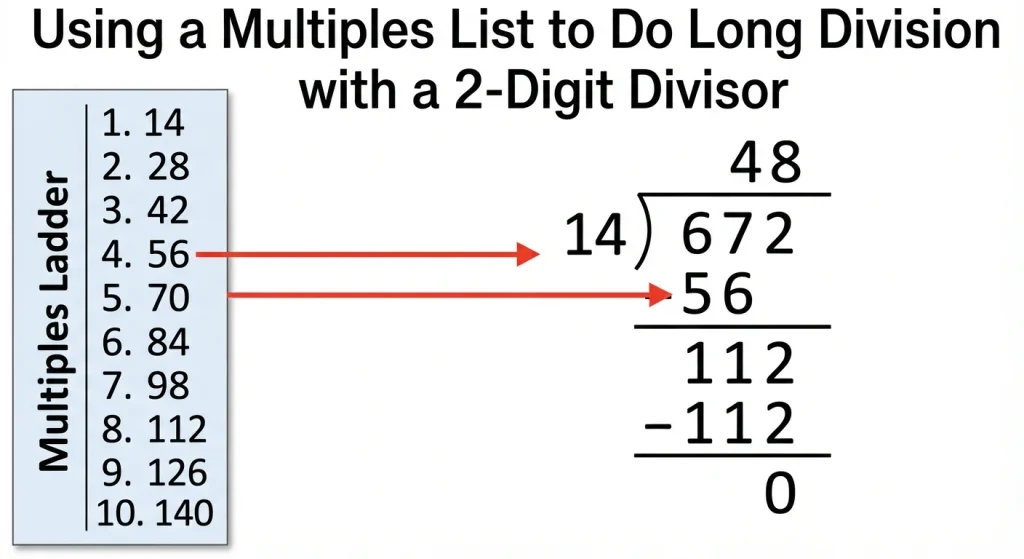
Write the multiples first. For a divisor of 14, before starting anything:
14, 28, 42, 56, 70, 84, 98, 112, 126, 140This takes thirty seconds and turns an estimation problem back into a reading problem. If writing the multiples out is slow, skip counting practice is what fixes it.
Example: 672 ÷ 14
Round 1. No 14s fit into 6, so look at 67. Reading the list, 56 is the largest multiple that does not exceed 67, and 56 is 14 × 4. Write 4 above the 7. Multiply: 4 × 14 = 56. Subtract: 67 minus 56 = 11. Bring down the 2 to make 112.
Round 2. Reading the list again, 112 is exactly 14 × 8. Write 8 above the 2. Multiply: 8 × 14 = 112. Subtract: 112 minus 112 = 0.
        48
      -----
  14 ) 672
        56
        --
       112
       112
       ---
         0
So 672 ÷ 14 = 48.
Check it. 48 × 14 = 672. Correct.
Estimating without the multiples list
Once your child is comfortable, teach rounding as the faster route. To divide by 14, think “about 15” or “about 10”. For 67 ÷ 14, round to roughly 70 ÷ 14, which suggests 5. Try 5: 5 × 14 = 70, which is bigger than 67, so step back to 4. Guessing one too high and correcting is completely normal, and worth saying out loud so your child does not treat it as failure.
Zeros in the quotient: the step most students miss
If your child’s answers are sometimes right and sometimes mysteriously ten times too small, this is almost certainly why. It is the most common structural error in long division, and most guides skip it entirely.
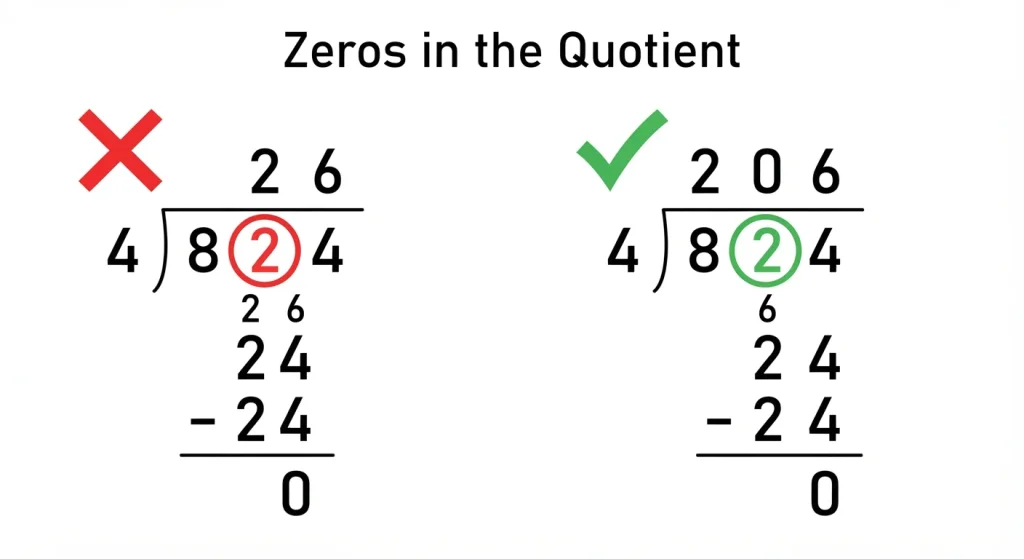
Here is what happens. At some point in the sum, the divisor does not fit into the current number even once. The correct response is to write a 0 in the quotient and carry on. What children do instead is write nothing, bring down the next digit, and continue. The arithmetic that follows is perfect. The answer is still wrong, because a digit is missing from the quotient.
Example: 824 ÷ 4
Round 1. How many 4s in 8? Two. Write 2 above the 8. Multiply: 8. Subtract: 8 minus 8 = 0. Bring down the 2.
Round 2. How many 4s in 2? None. This is the moment. Write 0 above the 2 in the dividend. Multiply: 0 × 4 = 0. Subtract: 2 minus 0 = 2. Bring down the 4 to make 24.
Round 3. How many 4s in 24? Six. Write 6 above the 4. Multiply: 24. Subtract: 24 minus 24 = 0.
      206
    -----
  4 ) 824
      8
      --
      02
       0
      --
       24
       24
       --
        0
So 824 ÷ 4 = 206. A child who skipped the zero would write 26, which is wrong by a factor of nearly ten.
Check it. 206 × 4 = 824. Correct. The check catches this error every time, which is why it is worth making it a habit.
How to stop it happening
The fix is structural, not a matter of concentration.
- Every digit of the dividend gets a digit above it. Count them at the end. 824 has three digits, so the quotient should have three digits unless the leading one would be a zero. If your child wrote 26, the count alone reveals the problem.
- Zero is an answer. Say this explicitly. “None” is not the same as “nothing to write”. When 4 does not fit into 2, the answer to that divide step is zero, and zero gets recorded like any other digit.
- Estimate first. 824 ÷ 4 is roughly 800 ÷ 4, which is about 200. An answer of 26 fails that sense check immediately.
Remainders as fractions and decimals
A remainder is unfinished division. The leftover can still be shared, it just cannot be shared as whole units. There are three ways to express the same answer, and NCERT expects children to choose the one that fits the context.
Take 527 ÷ 8 = 65 R 7 from earlier.
As a whole number remainder
65 R 7. Use this when the things being divided cannot be split. If 527 students are going on a trip in buses of 8, you cannot have 0.875 of a bus. The remainder means 7 students are left over, and you need a 66th bus.
As a fraction
Put the remainder over the divisor, so the leftover becomes a numerator over a denominator:
527 \div 8 = 65\frac{7}{8}The reasoning is simple enough to say out loud. Seven units are left and they are being shared between 8 people, so each person gets seven-eighths more. Simplify where possible: a remainder of 2 divided by 6 becomes two-sixths, which is one-third.
As a decimal
To continue past the remainder, put a decimal point in the quotient, add a decimal point and zeros to the dividend, and keep going with DMSB.
      65.875
    --------
  8 ) 527.000
      48
      --
       47
       40
       --
        70
        64
        --
         60
         56
         --
          40
          40
          --
           0
So 527 ÷ 8 = 65.875.
Check it. 65.875 × 8 = 527. Correct.
The only new rule is placement: the decimal point in the quotient sits directly above the decimal point in the dividend. Put it there before continuing, not afterwards, and it cannot drift.
Which form to use
| Context | Best form | Example |
|---|---|---|
| Things that cannot be split: buses, boxes, pages | Whole number remainder | 527 students in buses of 8 |
| Things that can be shared exactly: cake, ribbon, land | Fraction | 7 chapatis shared among 8 children |
| Money, measurement, anything metric | Decimal | ₹527 shared among 8 people |
How to check a long division answer
Teach this as a non-negotiable final step, not an optional extra. It takes fifteen seconds and it catches almost every error in this guide.
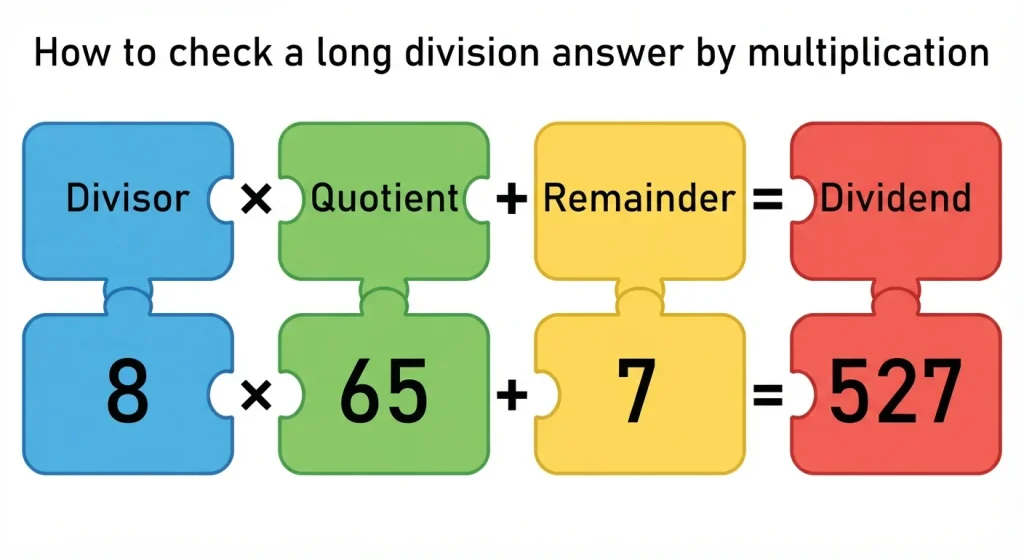
\text{Divisor} \times \text{Quotient} + \text{Remainder} = \text{Dividend}For 527 ÷ 8 = 65 R 7: multiply 8 × 65 = 520, add the remainder 7, giving 527. That matches the original dividend, so the answer is right.
Two extra checks worth building in:
- Is the remainder smaller than the divisor? If not, the quotient is too small.
- Does the size of the answer make sense? 3,648 ÷ 7 should be somewhere near 500, because 7 × 500 = 3,500. An answer of 52 or 5,210 is wrong before any checking begins.
A child who checks their own work stops needing an adult to mark it, and that is the point at which long division stops being stressful at home.
Long division word problems in real life
Children who can divide perfectly on paper often stall on word problems, because the hard part is not the arithmetic. It is deciding what to do with the remainder. Work through these three with your child and the pattern becomes clear.
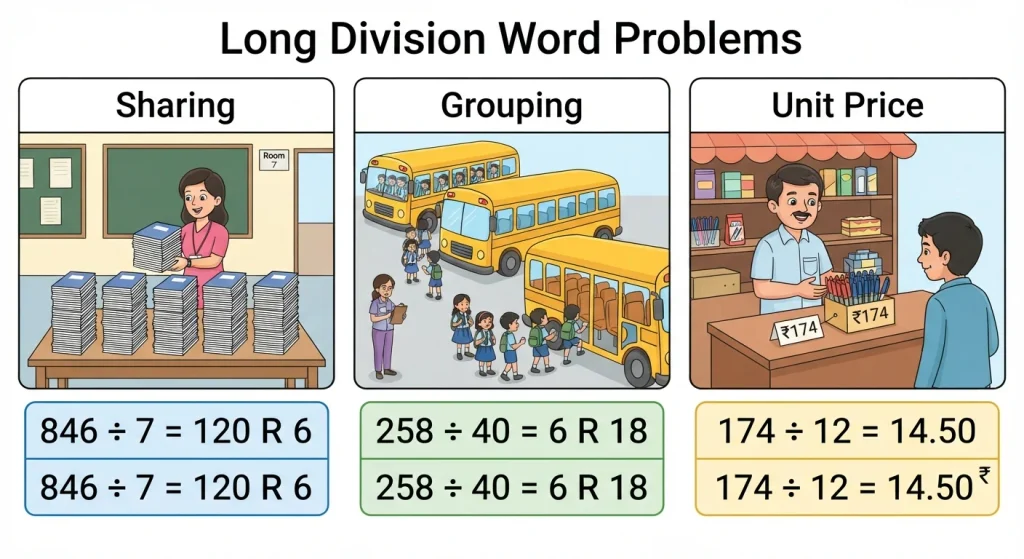
Sharing: when the remainder stays a remainder
A school collected 846 notebooks to distribute equally among 7 classrooms. How many notebooks does each classroom get, and how many are left over?
Divide 846 by 7. Round 1: 8 ÷ 7 is 1, write 1, subtract 7, leaving 1. Bring down 4 to make 14. Round 2: 14 ÷ 7 is 2, subtract 14, leaving 0. Bring down 6. Round 3: 6 ÷ 7 is 0, so write 0 in the quotient, and 6 remains.
The answer is 120 R 6. Each classroom gets 120 notebooks, and 6 are left over.
Notice that this problem contains a zero in the quotient. A child who skips it answers 12, which would mean each classroom gets twelve notebooks out of 846. The sense check catches it.
Grouping: when the remainder means one more
A school is taking 258 students on a trip. Each bus holds 40 students. How many buses are needed?
Divide 258 by 40. Multiples of 40 are 40, 80, 120, 160, 200, 240. The largest that fits inside 258 is 240, which is 40 × 6. Subtract: 258 minus 240 = 18.
So 258 ÷ 40 = 6 R 18. But the answer to the question is 7 buses, not 6. Those 18 students still have to travel, so they need a seventh bus that is only partly full.
This is the single most important idea in division word problems. The division gives 6. The question needs 7. Always ask what the leftover actually means for the people in the problem.
Unit pricing: when the remainder becomes paise
A box of 12 pens costs ₹174. What is the cost of one pen?
Divide 174 by 12. Round 1: no 12s in 1, so take 17. 12 × 1 = 12, so write 1 above the 7, subtract 12, leaving 5. Bring down 4 to make 54. Round 2: 12 × 4 = 48, so write 4, subtract, leaving 6.
So far that is 14 R 6. Money can be divided further, so continue into decimals. For more of this kind, try these money word problems. Place the decimal point in the quotient, bring down a zero to make 60, and 12 × 5 = 60 exactly.
The answer is ₹14.50, which is 14 rupees and 50 paise per pen.
Check it. 14.50 × 12 = ₹174. Correct.
Two more to try together
A factory packs 2,304 biscuits into boxes of 18. How many full boxes does it fill? The answer is 128 boxes exactly, with nothing left over.
A farmer earns ₹8,736 from selling mangoes over 24 days, earning the same amount each day. How much did he earn per day? Divide 8,736 by 24 to get ₹364 per day.
Long division in Olympiad-style problems
Olympiad questions rarely ask a child to divide. They ask something that cannot be answered without dividing, usually as the second or third step. This is why fluency matters beyond the exam: a child who is still thinking hard about DMSB has no attention left for the actual reasoning.
Three patterns come up again and again across Olympiad questions.
Reverse problems. When a number is divided by 7, the quotient is 23 and the remainder is 4. What is the number? Nothing is divided here. The child uses the relationship directly: (7 × 23) + 4 = 165. Children who learned the check as a habit answer this instantly. Children who learned only the procedure stare at it.
Missing digit problems. In the division below, the divisor is 6 and the quotient ends in 4. If 6 × ? = 24, what digit is missing? These reward understanding of the multiply step rather than speed.
Multi-step problems with a trap in the remainder. A shopkeeper has 1,000 sweets. She packs them into boxes of 24 and sells each full box for ₹150. How much does she earn, and how many sweets are left? Dividing 1,000 by 24 gives 41 R 16. The earnings come from the 41 full boxes, 41 × 150 = ₹6,150, and 16 sweets remain unsold. A child who rounds 41 up to 42 here, which is the correct move in the bus problem, gets it wrong. The context decides, every time.
Divisibility reasoning. Older children meet questions like what is the smallest number that must be added to 1,234 to make it divisible by 9? Dividing 1,234 by 9 gives 137 R 1, so 8 more are needed to reach the next multiple. The remainder is the answer to the question, not a leftover to discard.
The common thread is that the remainder carries the meaning. Children drilled only on getting the quotient treat the remainder as debris. Olympiad problems are frequently built on exactly that, which is why solving Olympiad problems starts with arithmetic a child no longer has to think about.
Common long division mistakes and how to fix them
Almost every long division error belongs to one of the four DMSB steps. Find the step and you have found the fix, which is far more useful than telling a child to be careful.
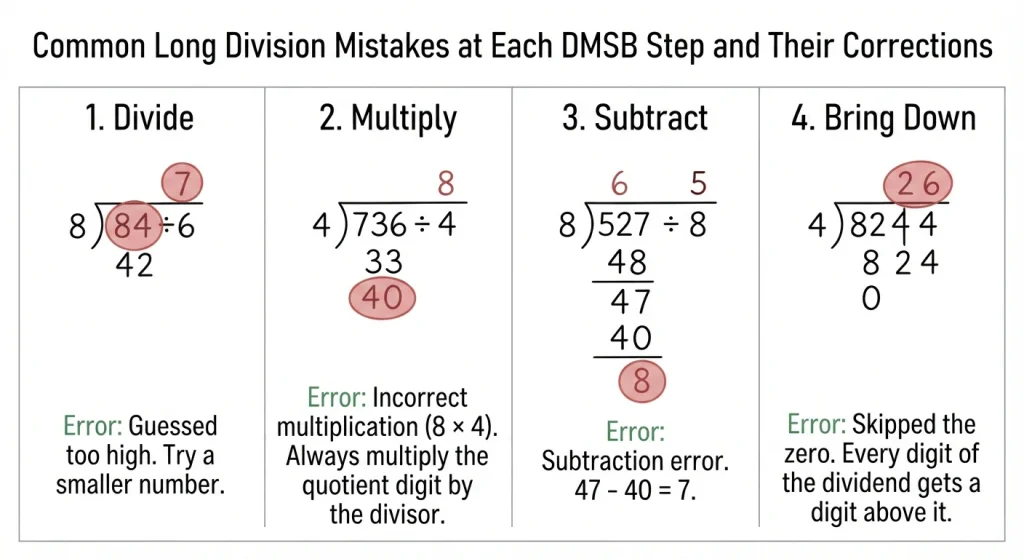
Mistakes at the divide step
Guessing a quotient digit that is too large. The child writes 7, multiplies, and then cannot subtract because the product is bigger than the number above. Fix: treat this as information, not failure. Too big means step down by one and try again. Writing out the multiples of the divisor beforehand prevents it almost entirely.
Guessing too small. The subtraction works, but the leftover is bigger than the divisor. Fix: the remainder rule. If the leftover is larger than the divisor, another whole divisor still fits, so go up by one.
Writing the quotient digit in the wrong column. Usually it drifts one place to the left. Fix: the quotient digit goes above the last digit of the number just divided into. Squared paper, one digit per square, fixes this faster than any explanation.
Skipping the zero. Covered in full earlier, and worth repeating because it is the costliest error of all. Fix: every digit of the dividend gets a digit above it.
Mistakes at the multiply step
Multiplying by the wrong number. The child multiplies the quotient digit by the number above instead of by the divisor. Fix: point at the divisor each time and say “always this one”.
A tables slip. 7 × 8 becomes 54, and everything after it is wrong although the method was right. Fix: this is a tables problem, not a division problem. Go back to the prerequisites and fix it there.
Misaligning the product. The product is written one column off, so the subtraction is wrong. Fix: the product lines up directly under the digits it came from.
Mistakes at the subtract step
Borrowing errors. The most frequent single cause of wrong answers in otherwise well-executed long division. Fix: practise column subtraction separately for a week. Do not try to fix subtraction inside a division lesson, there is too much going on.
Subtracting in the wrong direction. Faced with 3 minus 8 the child writes 5, flipping the numbers to avoid borrowing. Fix: if the top number is smaller, borrowing is required, and the answer is never found by swapping.
Forgetting to subtract at all. The child divides, multiplies, then brings down. Fix: say the four words out loud at every round. This is exactly what the mnemonic is for.
Mistakes at the bring down step
Bringing down two digits at once. Usually happens when the leftover is small and the child wants to hurry. Fix: one digit per round, always. Cross each digit off as it comes down.
Forgetting to bring down. The child stops early and reports a remainder that is far too large. Fix: the remainder rule catches it, and so does checking that every digit has been used.
Losing the place in a long sum. Common with 4-digit and 5-digit dividends. Fix: a vertical line between columns, or squared paper.
The diagnostic table
Use this when marking your child’s work. The symptom points straight at the step that needs attention.
| What you see | Step at fault | What to work on |
|---|---|---|
| Answer is roughly ten times too small | Divide, skipped zero | Count digits in the quotient |
| Remainder larger than the divisor | Divide, guessed low | The remainder rule |
| Cannot complete a subtraction | Divide, guessed high | Multiples list before starting |
| Right method, wrong numbers | Multiply | Multiplication tables |
| Errors only in longer sums | Subtract | Column subtraction with borrowing |
| Digits sliding across columns | Any | Squared paper, one digit per square |
| Answer far too large or small overall | Any | Estimate before dividing |
8 hands-on long division activities and games
Everything below uses things already in the house or the classroom. No purchases, no printing required.
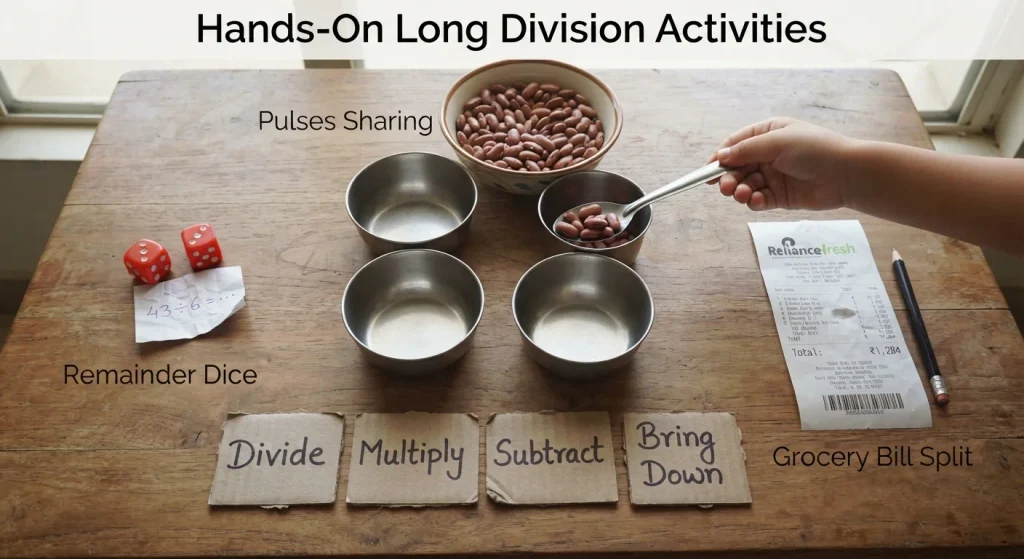
1. The pulses sharing tray
You need: a cup of rajma, chana or any dried pulse, and 4 to 6 small bowls.
Count out 53 beans. Ask your child to share them equally between 4 bowls, one at a time. When they finish, ask how many are in each bowl and how many could not be shared. They will have found 13 R 1 physically. Now write 53 ÷ 4 on paper and work it with DMSB. The written answer matches the bowls.
This is the single best activity for a child who finds remainders abstract. Do it once and the idea lands permanently.
2. Multiples ladder race
You need: paper and a timer.
Call out a divisor, say 8. Your child writes the first ten multiples down the page as fast as they can. Time it. Repeat daily with different divisors and try to beat yesterday’s time.
This builds the exact scaffold used in every 2-digit divisor problem, and it feels like a game rather than tables practice.
3. DMSB step cards
You need: four pieces of paper or old postcards.
Write one word on each: Divide, Multiply, Subtract, Bring down. As your child works a sum, they physically move a stone or coin onto the card for the step they are on. Nothing gets skipped, because skipping is visible.
Retire the cards after a week or two. The point is to build the order, not to depend on the props.
4. Remainder dice
You need: two dice and paper.
Roll both dice to make a two-digit number, say 4 and 3 giving 43. Roll one die again for the divisor, say 6. Divide 43 by 6 and score points equal to the remainder. First to 20 points wins.
Children quickly notice that dividing by 6 can never give a remainder of 6 or more, which is the remainder rule arriving on its own.
5. The grocery bill split
You need: a real shopping bill.
Take the total, say ₹1,284, and ask what each person’s share would be if four people split it. Then ask about three people, where it will not divide evenly, and let your child decide whether to round the paise.
This is where decimals stop being a classroom topic. Nobody pays ₹428 and a remainder.
6. Spot the mistake
You need: paper.
Work a long division sum yourself, deliberately making one error, and ask your child to find it. Alternate the error type: skip a zero, forget to bring down, misalign a product, leave a remainder larger than the divisor.
Finding errors in someone else’s work is far easier than finding them in your own, and it transfers. Children who play this start catching their own mistakes within a fortnight.
7. Cricket averages
You need: any set of real scores.
A batsman scores 847 runs in 23 innings. What is the average? Divide 847 by 23 to get 36 R 19, then continue into decimals for 36.83.
Sport is the easiest route to genuine interest in division for a lot of children, and averages are division in its most natural form.
8. The classroom chain division
You need: a blackboard and a class.
Write one long division sum on the board. Child one does the divide step and sits down. Child two does multiply. Child three subtracts. Child four brings down. Child five starts the next round.
Nobody can do the whole sum alone, so everyone has to track where the method has reached. It also surfaces exactly which step a class finds hardest, because that is where the chain stalls.
Picking the right activity
| If your child | Try |
|---|---|
| Does not understand what a remainder means | Pulses sharing tray |
| Is slow at the divide step | Multiples ladder race |
| Skips steps | DMSB step cards, chain division |
| Makes careless errors | Spot the mistake |
| Finds division pointless | Grocery bill, cricket averages |
Tips for parents helping with long division at home
Find the step, not the mistake. When an answer is wrong, do not re-explain the whole method. Ask your child to talk you through the sum out loud. The place they hesitate is the place that needs work, and it is usually one specific step rather than the method as a whole.
Fix prerequisites separately. If tables or borrowing are the problem, stop the division practice and work on that alone for a week. Mixing the two means your child practises the method while getting the answers wrong, which teaches frustration rather than division.
Keep sessions short. Fifteen minutes of focused practice beats an hour of grinding. Long division demands sustained attention, and a tired child makes alignment errors that look like conceptual gaps.
Let them keep the scaffolds. The multiples list is not cheating. Professional mathematicians use reference tables. Remove the support when your child stops reaching for it, not on a schedule you decided in advance.
Never time them during learning. Speed comes from fluency, and fluency comes from correct repetition. Timing a child who is still learning the method produces guessing, and guessing produces the too-high and too-low errors described earlier.
Say “not yet” instead of “wrong”. A child who believes they are bad at division will avoid it, and avoidance is much harder to fix than a misunderstanding about bringing down.
Model the check every single time. If you always do the multiplication check at the end, your child will too. This one habit removes most of the marking you would otherwise be doing.
Use real numbers. Your electricity bill divided by the days in the month, a packet price divided by the number of pieces, kilometres divided by hours on a drive. Children work harder on questions that are about something real.
Tips for teachers teaching long division
Diagnose before you teach. Run the five prerequisite checks as a five-minute starter with the whole class. You will usually find the class splits into two groups, and the group with weak tables needs an intervention, not a re-explanation of DMSB.
Teach place value language from the first example. Say “4 hundreds shared into 3 groups” rather than “4 divided by 3”. It costs nothing in the early lessons and it prevents the alignment confusion that otherwise surfaces three weeks later.
Do not introduce the zero case late. Most schemes leave it until children are fluent, by which point the habit of writing nothing is already formed. Introduce a sum with a zero in the quotient within the first three lessons, while the method is still being built.
Use one worked example across the whole lesson. Build it on the board step by step rather than showing finished sums. Children need to see the sum grow, because the growing is the method.
Keep short division alongside, not behind. Show the same sum both ways, as Third Space Learning’s materials do. Children who can see that long division is the expanded form of something they already do stop treating it as a separate, harder topic.
Mark by step. Give credit for a correct method with one arithmetic slip. A child who gets 3,648 ÷ 7 wrong because of a tables error has understood long division, and marking the whole answer wrong tells them otherwise.
Use chain division for assessment. The step where the chain stalls tells you what to teach tomorrow, faster than a set of marked books will.
Set fewer questions. Five questions worked carefully, each with a check, teach more than twenty rushed ones. Twenty questions mostly practise whatever error the child started with.
Long division practice questions with answers
Work down the levels in order. Do not move to the next level until the current one is comfortable, and check every answer by multiplication.
Level 1: 2-digit by 1-digit
- 72 ÷ 3
- 96 ÷ 8
- 85 ÷ 5
Level 2: 3-digit by 1-digit
- 456 ÷ 4
- 639 ÷ 3
- 581 ÷ 7
- 742 ÷ 6
Level 3: zeros in the quotient
- 618 ÷ 6
- 927 ÷ 9
- 4,020 ÷ 4
Level 4: 4-digit dividends
- 5,124 ÷ 7
- 8,265 ÷ 5
- 3,476 ÷ 8
Level 5: 2-digit divisors
- 936 ÷ 12
- 1,075 ÷ 25
- 2,184 ÷ 26
- 1,000 ÷ 16
Level 6: remainders as fractions and decimals
- 75 ÷ 4, as a decimal
- 123 ÷ 8, as a decimal
- ₹2,322 ÷ 36, as rupees and paise
Level 7: word problems
- A sweet shop packs 1,728 chocolates into boxes of 24. How many full boxes does it fill?
- ₹7,560 is shared equally among 15 workers. How much does each worker get?
- A school is taking 500 students on a picnic. Each bus seats 45. How many buses are needed?
- When a number is divided by 13, the quotient is 46 and the remainder is 5. What is the number?
- What is the smallest number that must be added to 2,500 to make it divisible by 7?
Answers
| Q | Answer | Q | Answer |
|---|---|---|---|
| 1 | 24 | 14 | 78 |
| 2 | 12 | 15 | 43 |
| 3 | 17 | 16 | 84 |
| 4 | 114 | 17 | 62 R 8 |
| 5 | 213 | 18 | 18.75 (or 18 ¾) |
| 6 | 83 | 19 | 15.375 |
| 7 | 123 R 4 | 20 | ₹64.50 |
| 8 | 103 | 21 | 72 boxes |
| 9 | 103 | 22 | ₹504 |
| 10 | 1,005 | 23 | 12 buses (11 full, 5 students in a 12th) |
| 11 | 732 | 24 | 603, since (13 × 46) + 5 = 603 |
| 12 | 1,653 | 25 | 6, since 2,500 ÷ 7 = 357 R 1 |
| 13 | 434 R 4 |
Two questions here are worth discussing even when your child gets them right. Question 23 needs rounding up, because leftover students still have to travel. Question 25 uses the remainder itself as the route to the answer: the remainder is 1, so 6 more are needed to reach the next multiple of 7.
Make Preparing for Math Olympiad Simple!



What are the 4 steps of long division?
The four steps are divide, multiply, subtract and bring down, remembered as DMSB. You divide the current number by the divisor and write the digit in the quotient, multiply that digit by the divisor, subtract the product, then bring down the next digit of the dividend. You repeat these four steps until no digits remain.
In which class is long division taught in India?
Under the CBSE and NCERT progression, children divide 2-digit and 3-digit numbers by a 1-digit divisor in Class 4, move to 4-digit dividends and 2-digit divisors in Class 5, and apply division inside multi-step problems and factor work in Class 6.
What is the difference between long division and short division?
Short division is the compact form, where the child works out each step mentally and writes only the leftover as a small digit. Long division writes every multiplication and subtraction out in full. They are the same method; long division simply records the parts that short division keeps in the head, which makes it more reliable with large numbers and 2-digit divisors.
Why does my child keep getting the wrong answer even though the method looks right?
The most common cause is a missing zero in the quotient. When the divisor does not fit into a digit, a 0 must be written in the quotient before continuing. Children often write nothing and move on, which gives an answer about ten times too small. Count the digits: every digit of the dividend should have a digit above it.
What do I do when the divisor does not go into the first digit?
Look at the first two digits together. For 245 ÷ 7, there are no 7s in 2, so ask how many 7s fit into 24. The answer is 3, and that 3 is written above the 4, because the quotient digit always sits above the last digit of the number you divided into.
How do I write a remainder as a fraction?
Put the remainder over the divisor. For 527 ÷ 8 = 65 R 7, the answer as a fraction is 65 and 7/8. Simplify the fraction where possible, so a remainder of 2 over a divisor of 6 becomes 1/3.
How do I turn a remainder into a decimal?
Place a decimal point in the quotient directly above a decimal point added to the dividend, add zeros after it, and carry on with DMSB. For 527 ÷ 8, continuing past the remainder of 7 gives 65.875.
How do I check a long division answer?
Multiply the divisor by the quotient and add the remainder. The result should equal the original dividend. For 527 ÷ 8 = 65 R 7, that is (8 × 65) + 7 = 527, so the answer is correct.
Can the remainder be bigger than the divisor?
No. If the remainder is equal to or larger than the divisor, another whole divisor still fits, which means the quotient digit was too small. Increase it by one and work the step again.
How can I help my child who is struggling with long division?
Check the prerequisites before practising the method. Weak multiplication tables, shaky column subtraction with borrowing, or gaps in place value will cause errors that look like division problems but are not. Fix the underlying skill first, and let your child write out the multiples of the divisor before each sum until they no longer reach for the list.
How do you do long division with 2-digit divisors?
The steps are identical, but the divide step needs estimation because there is no multiplication table for numbers like 14 or 26. Write out the first ten multiples of the divisor before starting, then read off the largest one that fits. Guessing one too high and stepping back is normal and is not a mistake.
Final thoughts
Long division only looks like a long method. It is four steps, divide, multiply, subtract and bring down, repeated until the digits run out. Everything else in this guide is a variation on that one loop.
If your child is struggling, resist the urge to re-explain the whole thing. Check the prerequisites first, then find the single DMSB step where the working goes wrong. It is almost always a tables gap, a borrowing slip, or a missing zero in the quotient, and each of those has a specific fix rather than a vague instruction to concentrate harder.
Keep the sessions short, let your child write out the multiples for as long as they need them, and check every answer by multiplication. Fluency comes from correct repetition, not from speed.

Mikha Piregu is a Content Writer with experience spanning educational content, including math and math olympiad topics, as well as advocacy writing, research-based articles, and SEO-driven web content. He creates high-quality blog content, web copy, and feature articles that support brand visibility, audience engagement, and long-term organic growth through data-informed storytelling. Skilled in WordPress, WooCommerce, and modern digital tools, Mikha adapts content across various platforms, including blogs, websites, campaigns, and advocacy initiatives, with clarity and purpose.

There are no comments posted here yet.
Sign in to leave a comment