

Grade 2 counting money math covers two things: recognizing the value of coins and bills, and combining different denominations to find a total.
Most worksheets treat these as separate skills, but they work best as a two-step process. First, your child identifies what each coin or bill is worth.
Then, they add those values together to reach a final amount. Once your child is comfortable with both steps, real-world money situations, like counting change or figuring out if they have enough for a snack, start to make sense on their own.
We’ll walk through both steps, cover the mistakes that trip kids up most often, and show you how to practice with real or play money at home.
If your child is still building on skills from Grade 1 counting money, this article picks up right where that leaves off. And if you’re in Bangladesh or another taka-based household, we’ve built in currency-specific guidance too, since most money math resources default to US coins without ever addressing that gap.
Step One: Identifying Coins and Bills
Before your child can add money together, they need to know what each piece is worth. This sounds obvious, but it’s the step most Grade 2 students stumble on first, mostly because of how coins are designed.
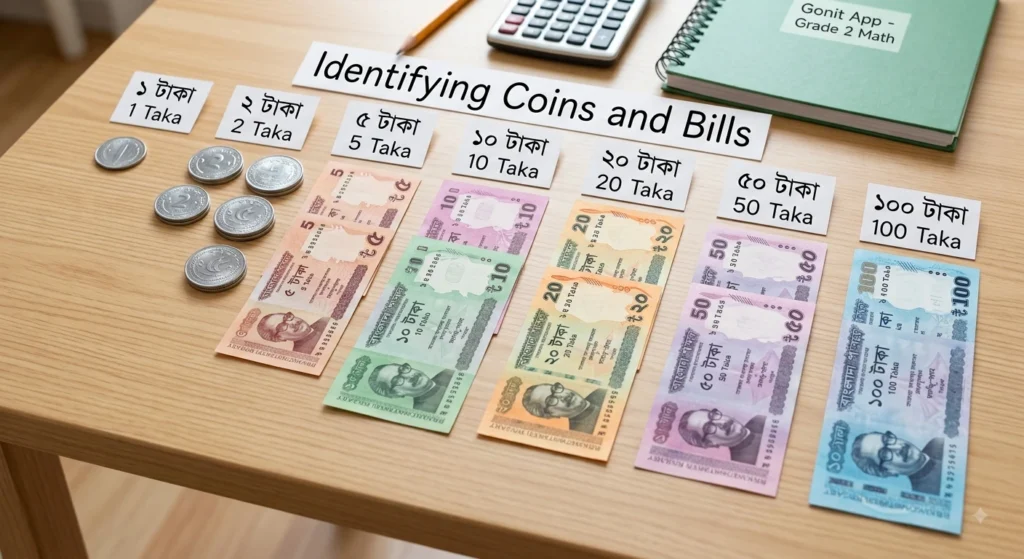
Denomination is just the technical word for the value assigned to a coin or bill, like 1 taka, 5 taka, or 10 taka. Value, in this context, means how much that denomination is actually worth in a transaction, as opposed to its physical size or appearance.
If you’re working with US currency (a common default in imported worksheets), the coins are the same ones covered in our guide to counting pennies, nickels, and dimes:
- Penny: 1 cent
- Nickel: 5 cents
- Dime: 10 cents
- Quarter: 25 cents
If you’re working with Bangladeshi taka, the everyday denominations your Grade 2 child will encounter are:
- Coins: 1 taka, 2 taka, 5 taka
- Notes: 5 taka, 10 taka, 20 taka, 50 taka, 100 taka
Whichever currency you’re using, the teaching approach is the same: have your child sort coins or notes into piles by denomination first, without worrying about totals yet. This builds recognition before it asks for calculation, which keeps the two skills from blurring together.
Step Two: Combining Mixed Denominations
Once your child can identify each coin or bill on sight, the second step is adding them together. This is where most of the actual “money math” happens, and it’s also where kids need the most repetition.
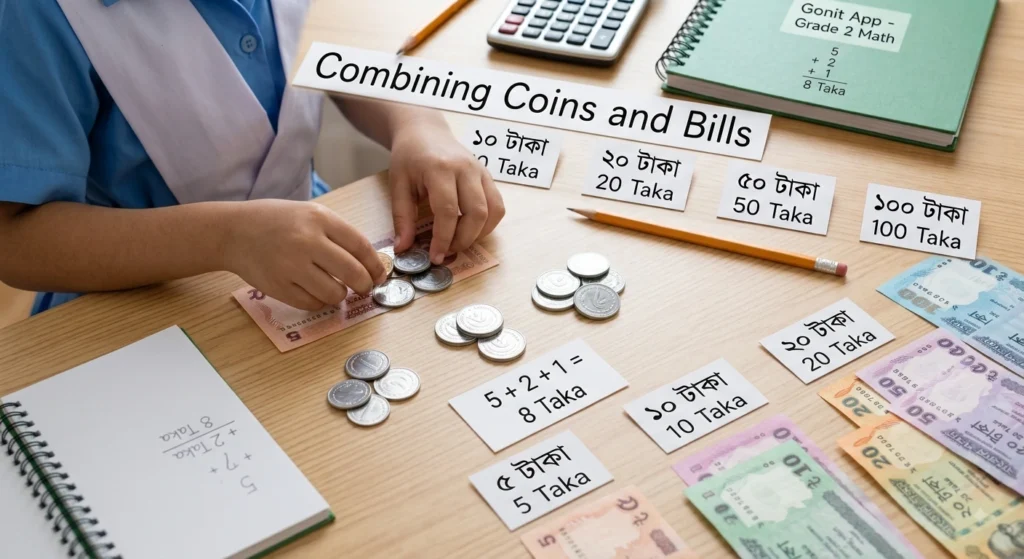
Start with same-denomination groups. Five 2 taka coins are easier to add than a mix of 2 taka and 5 taka coins, because it’s just repeated addition. From there, move to mixed groups: two 5 taka coins and three 1 taka coins equal 13 taka total.
A simple way to structure this at home is to always sort before adding. Have your child lay out coins by type, count each group, write down the subtotal, then add the subtotals together. This habit prevents the most common counting error, which is losing track partway through a mixed pile.
Common Mistakes in Money Math
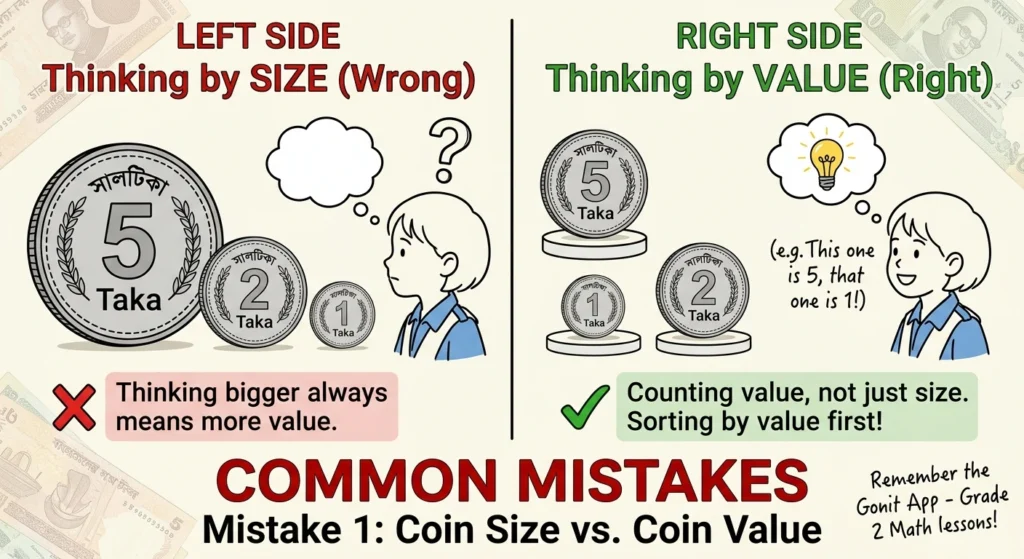
Size-vs-value confusion. This is the single biggest misconception in Grade 2 money math. A 5 taka coin is physically smaller than a 1 taka coin in some coin sets, and kids naturally assume bigger means more valuable. The fix isn’t a lecture, it’s repetition: sort coins by value regularly enough that your child stops relying on size as a shortcut.
Miscounting mixed denominations. When coins of different values are mixed together, kids often count them as if they’re all the same value, essentially just counting objects instead of counting worth. The sort-then-add method above addresses this directly.
Skipping the “same as” check. Kids sometimes forget that different combinations can equal the same total (two 5 taka coins equal one 10 taka note). This matters for real-life situations like making change, where flexibility in combinations is the whole point.
Losing track mid-count. With more than four or five coins in a pile, kids often recount the same coin or skip one. Grouping coins into small clusters as they count, rather than counting one at a time across a large pile, solves this.
Applying It to Real Life
Money math sticks best when it’s tied to something your child actually wants to do, not a worksheet they’re asked to complete.
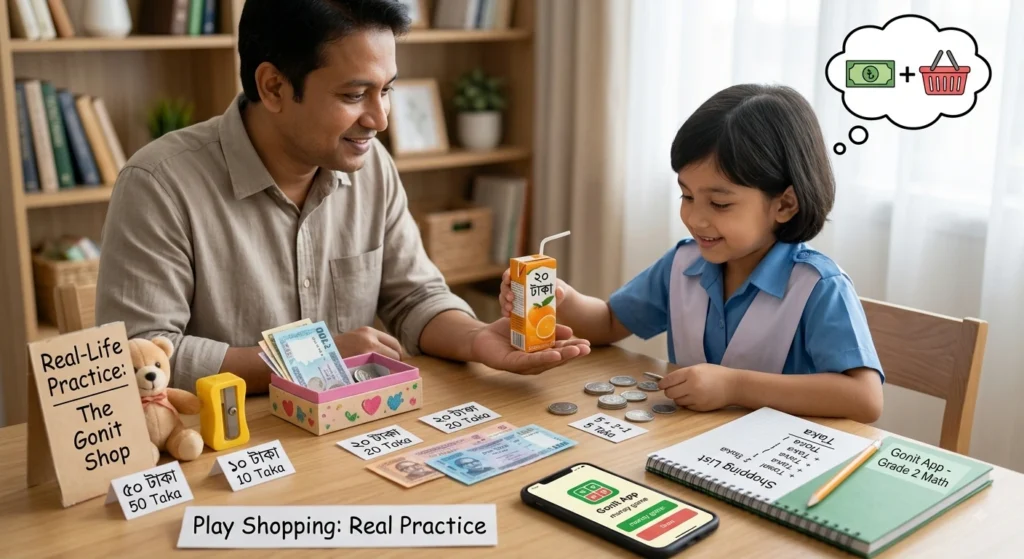
At-home activity: Play shopping. Set up five to six household items with price tags (a toy, a snack, a book). Give your child a fixed amount, real coins and notes if you’re comfortable, or a printed play-money set otherwise, and ask them to “buy” as many items as they can without going over budget. This forces both identification and combination in a low-pressure setting, and it’s genuinely fun for most Grade 2 students.
Allowance tracking. If your child receives a small allowance, have them count it out loud each time and write the total in a simple notebook. This turns an existing routine into repeated, low-effort practice.
Making change. Once your child is confident adding, introduce subtraction: if something costs 35 taka and they hand over a 50 taka note, how much change should they get back? This leans directly on grade 2 subtraction skills, and it’s a natural bridge to word problems and a genuine life skill, since most kids will handle real transactions on their own within a few years.
Sample Money Word Problems
Start simple and increase difficulty gradually. These examples use taka, but the structure works for any currency.
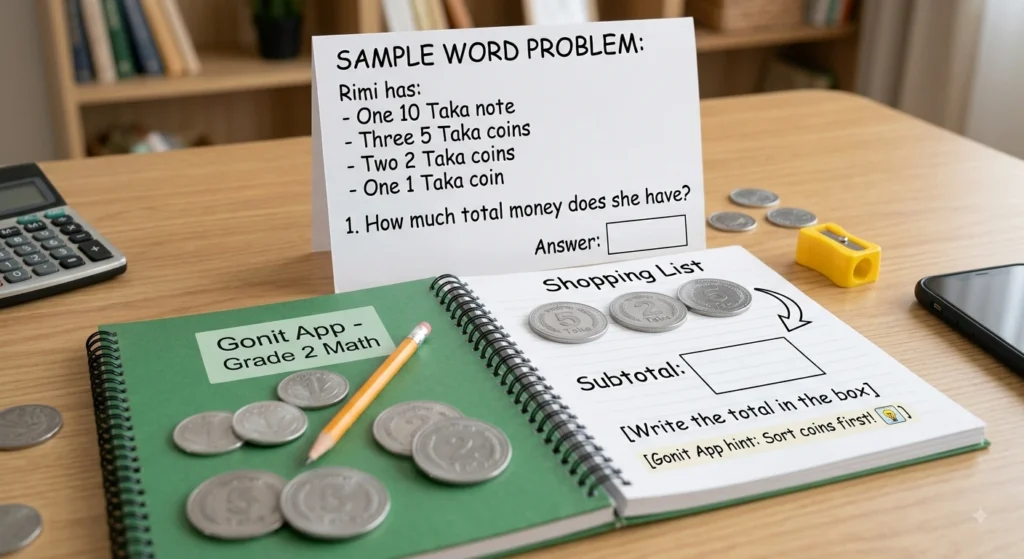
Level 1 (identification and simple addition)
Rimi has one 5 taka coin and two 2 taka coins. How much money does she have in total?
Answer: 9 taka
Level 2 (mixed denominations)
Arif has three 10 taka notes, one 5 taka coin, and two 1 taka coins. How much does he have?
Answer: 37 taka
Level 3 (making change)
A notebook costs 42 taka. Mim pays with a 50 taka note. How much change should she receive?
Answer: 8 taka
Level 4 (multi-step, competition-style)
Tanvir has 65 taka. He buys a pen for 15 taka and a pencil for 8 taka. He then finds two more 5 taka coins in his pocket. How much money does he have now?
Answer: 52 taka
That last example is worth pointing out: it’s the kind of multi-step reasoning that shows up in early rounds of competitions like Math Kangaroo and MOEMS, which regularly use money as a context for testing arithmetic reasoning rather than testing money skills specifically.
If your child is headed toward Olympiad-style math later on, this kind of layered word problem is good early exposure.
Why This Matters Beyond the Classroom
Money math is one of the few Grade 2 topics with an obvious, immediate real-world payoff. Kids who can confidently identify and combine denominations are better prepared for actual shopping trips, allowance management, and the basic financial literacy that becomes more important every year afterward.
It also builds a skill that matters well beyond money itself: multi-step word problem reasoning. The habit of identifying values, combining them, and checking a final answer against a real-world constraint (do I have enough? what’s my change?) is the same reasoning structure used in early competition math.
This same reasoning shows up across the rest of our grade 2 addition and grade 2 measurement guides, along with our skip counting for grade 2 lessons.
Treating money as a stepping stone to word-problem fluency, rather than an isolated worksheet topic, gives your child a head start on both everyday skills and more formal problem solving down the line.
At what age should kids understand money?
Most children begin recognizing individual coins and bills around ages 6 to 7, which aligns with Grade 2 in most curricula. Full confidence combining mixed denominations and making change typically develops between ages 7 and 9, with plenty of individual variation.
How much money should a Grade 2 child be able to count?
By the end of Grade 2, most students can accurately count and combine amounts up to roughly 100 units of their local currency (100 taka or one dollar, for example), including mixed denominations and simple change-making.
Do I need real money to teach this, or is play money enough?
Either works. Real coins and notes add a small layer of authenticity, but a printed or purchased play-money set is just as effective for building the core skills, especially for repeated practice.
Why does my child know how to add but still struggle with money?
This is usually the size-vs-value confusion described above, not a gap in addition skills. Kids often add correctly once they’ve identified the right values; the identification step is where the breakdown happens.
How does Grade 2 money math connect to later math skills?
Money problems are a natural, low-stakes way to practice multi-step word problems, which is a skill that carries directly into upper-elementary math and early Olympiad-style competitions.
What’s the difference between counting coins and counting money?
Counting coins means counting how many physical pieces you have. Counting money means adding up their combined value, regardless of how many pieces that involves. This distinction is exactly what the size-vs-value confusion trips up
Make Preparing for Math Olympiad Simple!



Conclusion
Grade 2 money math isn’t hard once it’s broken into the right order: identify the value first, then combine values into a total. Most of the struggle kids have with money comes from skipping that first step, not from weak addition skills.
A few minutes of sorting coins by denomination before every practice session fixes more problems than another worksheet ever will.
The good news is that this is one of the easiest Grade 2 topics to practice without any extra materials. A shopping game with household items, a running total in an allowance notebook, or a quick change-making question at the dinner table all count as real practice. Keep it low-pressure, keep it tied to something your child actually wants to do, and the skill builds itself over a few weeks.

Mikha Piregu is a Content Writer with experience spanning educational content, including math and math olympiad topics, as well as advocacy writing, research-based articles, and SEO-driven web content. He creates high-quality blog content, web copy, and feature articles that support brand visibility, audience engagement, and long-term organic growth through data-informed storytelling. Skilled in WordPress, WooCommerce, and modern digital tools, Mikha adapts content across various platforms, including blogs, websites, campaigns, and advocacy initiatives, with clarity and purpose.

There are no comments posted here yet.
Sign in to leave a comment