


Metric conversion means changing a measurement from one metric unit to another, such as kilometres to metres or kilograms to grams.
- What Is the Metric System?
- The Metric Prefix Ladder
- The Golden Rule: Multiply or Divide?
- The Decimal Point Shortcut
- Metric Units of Length
- Metric Units of Mass
- Metric Units of Capacity
- Master Metric Conversion Chart
- Metric Conversion Charts and Calculators
- Metric Conversion Calculator
- Multi-Step Conversions
- Mixed-Unit Problems
- Conversion and Place Value
- Metric Conversion in Real Life
- Common Mistakes and Fixes
- Eight Activities and Games
- Tips for Parents and Teachers
- From Class 5 to Olympiad Problems
- Practice Questions with Answers
- Conclusion
The rule has two parts: to convert to a smaller unit, multiply; to convert to a larger unit, divide. The number you multiply or divide by is always a power of 10, which is 10, 100 or 1000.
The metric system has three base units at Class 5 level: the metre (m) for length, the gram (g) for mass, and the litre (l) for capacity. Prefixes scale each one by powers of 10, running from kilo down to milli.
The conversions used most often in Class 5 are 1 km = 1000 m, 1 m = 100 cm, 1 cm = 10 mm, 1 kg = 1000 g, 1 g = 1000 mg and 1 l = 1000 ml.
This guide explains the metric prefix ladder, when to multiply or divide, decimal conversions, charts for length, mass and capacity, worked examples, common mistakes, and eight hands-on activities using everyday kitchen items.
What Is the Metric System?
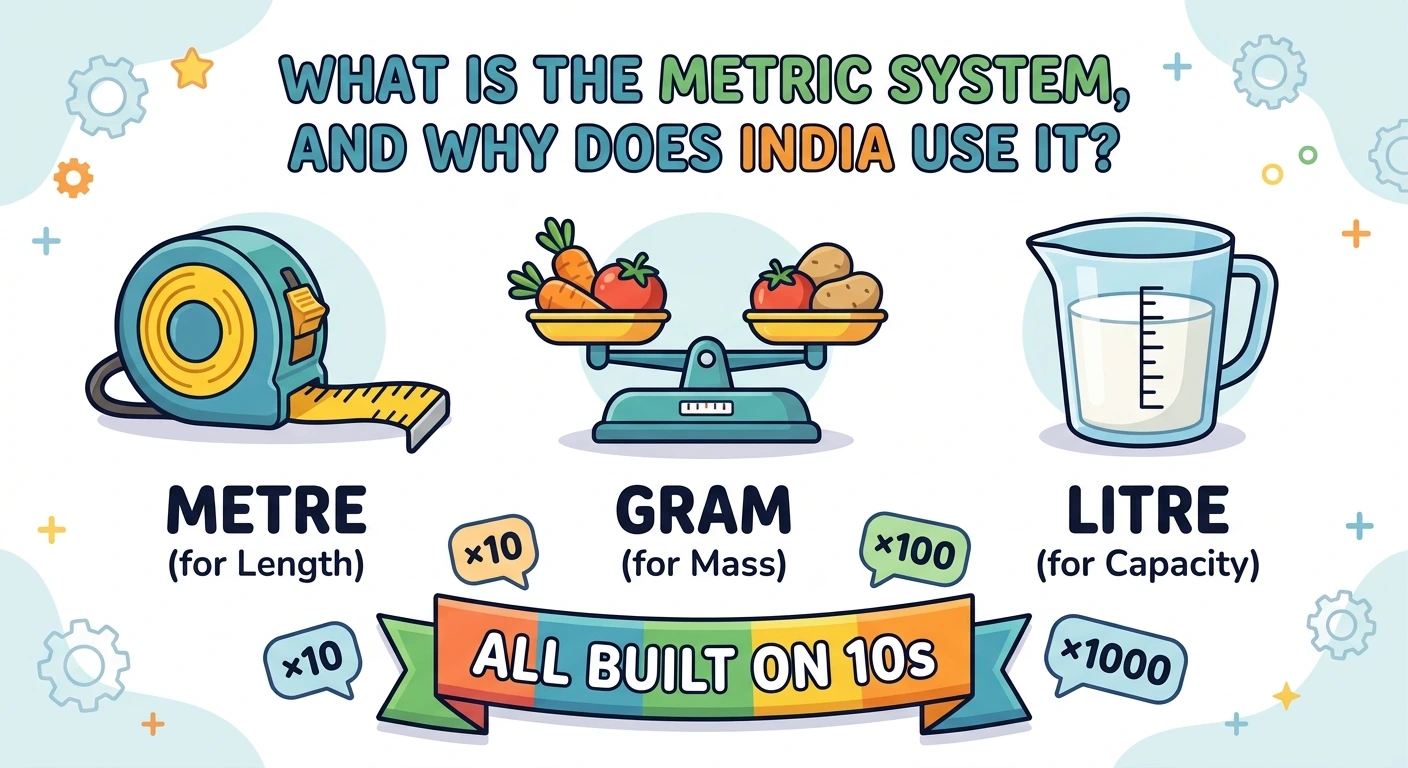
The metric system is a way of measuring in which every unit is built from a base unit by multiplying or dividing by 10. Class 5 needs three base units: the metre (m) for length, the gram (g) for mass, and the litre (l) for capacity.
Everything else is one of these three with a prefix attached. A kilometre is a metre with “kilo” in front. Learn the prefixes once and you know them for all three measurement types at the same time.
India adopted the metric system in 1957. Today every official measurement here is metric: road signs in kilometres, grocery packets in grams, milk in litres, medicine in millilitres. So this is not just a textbook chapter.
Why base-10 matters: in the old imperial system, 1 foot is 12 inches and 1 mile is 1,760 yards, three unrelated numbers to memorise. In the metric system you only ever multiply or divide by 10, 100 or 1000. Nothing else appears, ever. And multiplying by powers of 10 barely needs calculation. You just move digits across place value columns.
The Metric Prefix Ladder
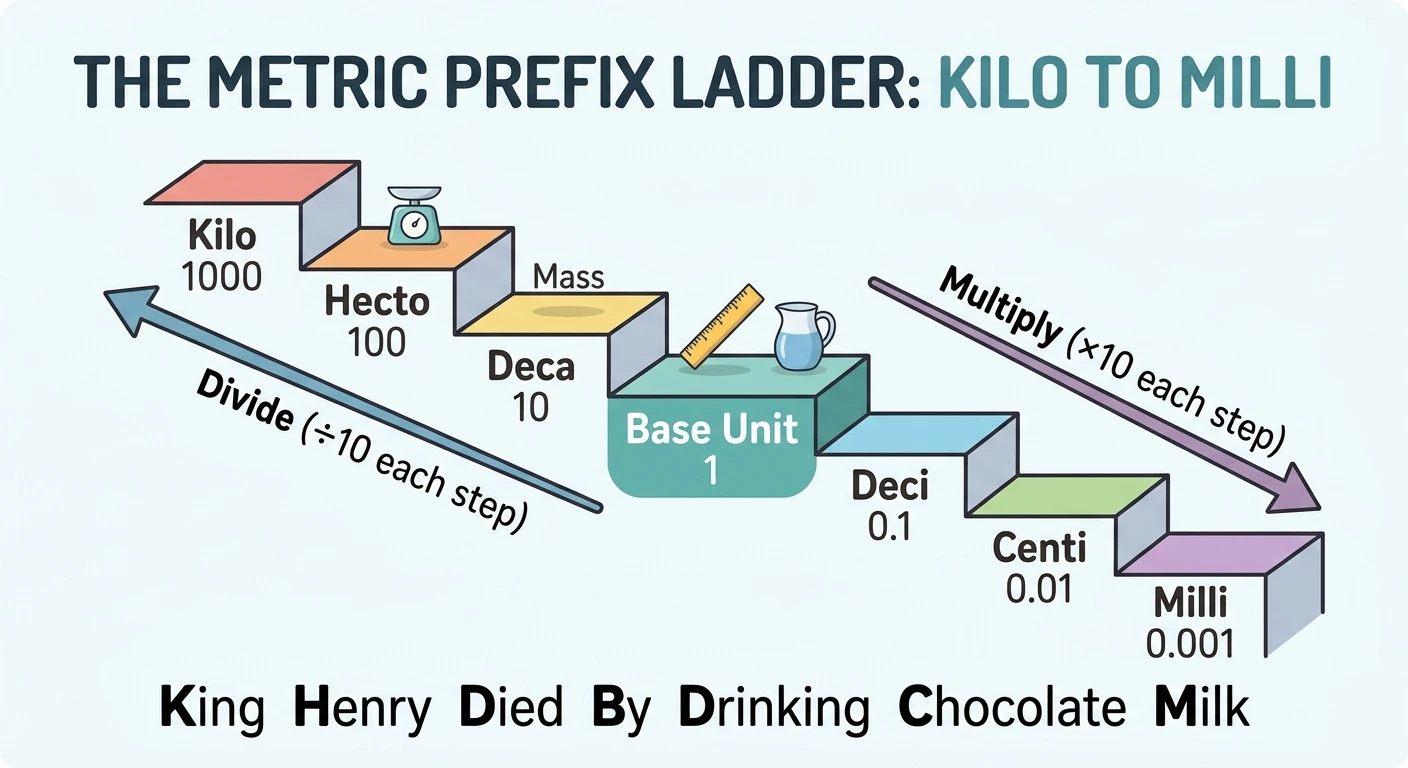
The seven prefixes sit in a fixed order, largest to smallest. Each step down divides by 10.
| Prefix | Value | Power of 10 | Length | Mass | Capacity |
|---|---|---|---|---|---|
| Kilo | 1000 | 10³ | km | kg | kl |
| Hecto | 100 | 10² | hm | hg | hl |
| Deca | 10 | 10¹ | dam | dag | dal |
| Base | 1 | 10⁰ | m | g | l |
| Deci | 0.1 | 10⁻¹ | dm | dg | dl |
| Centi | 0.01 | 10⁻² | cm | cg | cl |
| Milli | 0.001 | 10⁻³ | mm | mg | ml |
The prefixes are words for numbers. Kilo means thousand. Centi means one hundredth, the same root as “century” and “per cent”. Milli means one thousandth. Point out the money link to your child: 100 paise make a rupee, and in exactly the same way 100 centimetres make a metre.
A mnemonic that sticks: King Henry Died By Drinking Chocolate Milk, for Kilo, Hecto, Deca, Base, Deci, Centi, Milli. The B in the middle is the base unit. Everything left of it is bigger, everything right of it is smaller. A sentence your child invents themselves works even better.
One practical note. Hecto, deca and deci barely appear in real use. The rungs that matter are kilo, the base unit, centi and milli. Learn the full ladder for the pattern, but expect to use four rungs of it.
The Golden Rule: Multiply or Divide?
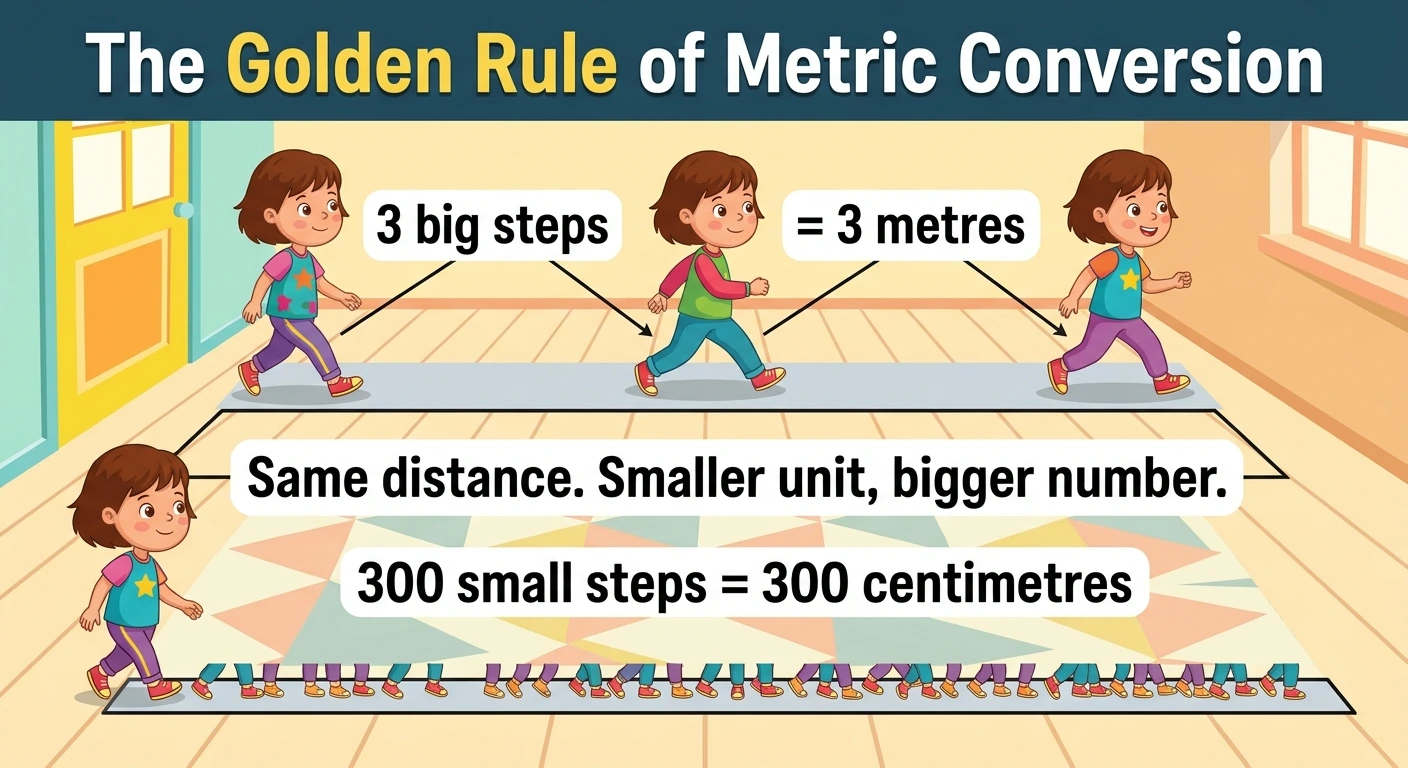
Converting to a smaller unit: multiply. Converting to a larger unit: divide.
There is no third case. But stating the rule is the easy part. Most children can recite it and still reverse it under pressure, because they are recalling words rather than reasoning. So make it something they can work out.
Ask your child: if you measured your room in big steps and then in small steps, which count would be higher? Small steps, obviously. You need more of them to cover the same distance.
That is the whole rule. The room did not change. A smaller unit means you need more of them, so the number gets bigger, which means you multiplied. Bigger units mean fewer of them, a smaller number, so you divided.
Try it concretely. A 2 metre curtain rod in centimetres must be a bigger number, because centimetres are small: 200 cm. A 500 cm rope in metres must be smaller: 5 m.
The two-question check. Before solving anything, have your child answer out loud:
- Am I moving to a smaller unit or a bigger one?
- So should my answer be a bigger number or a smaller one?
Then solve, and check the answer against question 2. A child who converts 5 km and gets 0.005 has already been told the answer should be bigger than 5. They catch it themselves, without you. This single habit prevents nearly every reversal error.
The Decimal Point Shortcut
Because every conversion is a multiplication or division by 10, 100 or 1000, you never really calculate. You move the decimal point.
| Operation | Decimal point | Example |
|---|---|---|
| × 10 | 1 place right | 4.5 → 45 |
| × 100 | 2 places right | 4.5 → 450 |
| × 1000 | 3 places right | 4.5 → 4500 |
| ÷ 10 | 1 place left | 4.5 → 0.45 |
| ÷ 100 | 2 places left | 4.5 → 0.045 |
| ÷ 1000 | 3 places left | 4.5 → 0.0045 |
Here is the neat part. The number of places you move the point is exactly the number of rungs you travel on the ladder, and the direction is the direction you walked. Moving right along the ladder, towards milli, moves the point right. Moving left, towards kilo, moves it left. The point goes the same way you do.
7.2 km to m: kilo to base is 3 rungs right, so 3 places right. 7.2 becomes 7200 m. 45 cm to m: centi to base is 2 rungs left. 45.0 becomes 0.45 m. 3.5 g to mg: 3 rungs right. 3.5 becomes 3500 mg. 250 ml to l: 3 rungs left. 250.0 becomes 0.25 l.
One caution. The shortcut tells you how far and which way to move the point. It does not tell you which direction to go in the first place. That still comes from the golden rule.
Metric Units of Length
Length is where most children meet conversion first. It builds directly on the measurement work from the early classes.
| Conversion | Factor | Conversion | Factor | |
|---|---|---|---|---|
| km → m | × 1000 | m → km | ÷ 1000 | |
| m → cm | × 100 | cm → m | ÷ 100 | |
| cm → mm | × 10 | mm → cm | ÷ 10 | |
| m → mm | × 1000 | mm → m | ÷ 1000 | |
| km → cm | × 100000 | cm → km | ÷ 100000 |
Larger unit to smaller unit (multiply):
- 6 km to m. Multiply by 1000. 6 × 1000 = 6000 m
- 4.5 m to cm. Multiply by 100. 4.5 × 100 = 450 cm
- 12 cm to mm. Multiply by 10. 12 × 10 = 120 mm
- 0.8 km to m. Multiply by 1000. 0.8 × 1000 = 800 m
Smaller unit to larger unit (divide):
- 7500 m to km. Divide by 1000. 7500 ÷ 1000 = 7.5 km
- 325 cm to m. Divide by 100. 325 ÷ 100 = 3.25 m
- 86 mm to cm. Divide by 10. 86 ÷ 10 = 8.6 cm
- 450 m to km. Divide by 1000. 450 ÷ 1000 = 0.45 km
That last answer is worth pausing on. Many children refuse to write an answer below 1 because it looks wrong. Point out that 450 m is less than half a kilometre, so an answer under 1 is exactly right.
Metric Units of Mass
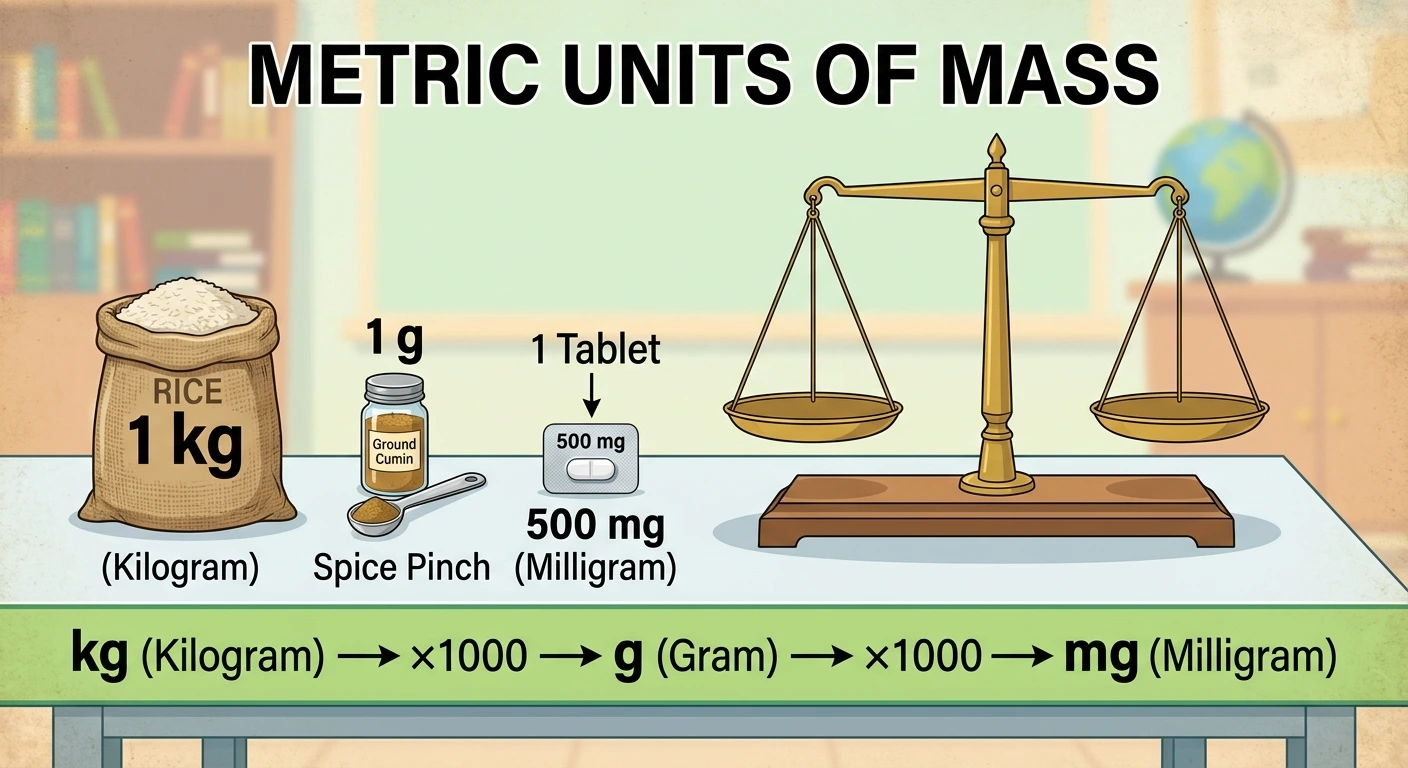
Mass is how much matter something contains. At Class 5 level, calling it weight is fine. Only three units are in common use, and every jump is 1000.
| Conversion | Factor | Conversion | Factor | |
|---|---|---|---|---|
| kg → g | × 1000 | g → kg | ÷ 1000 | |
| g → mg | × 1000 | mg → g | ÷ 1000 | |
| kg → mg | × 1000000 | mg → kg | ÷ 1000000 |
Every step is 1000, so every mass conversion is three decimal places. One conversion mastered is all of them mastered.
Larger to smaller (multiply):
- 5 kg to g. 5 × 1000 = 5000 g
- 2.75 kg to g. 2.75 × 1000 = 2750 g
- 8 g to mg. 8 × 1000 = 8000 mg
- 0.35 g to mg. 0.35 × 1000 = 350 mg
Smaller to larger (divide):
- 4000 g to kg. 4000 ÷ 1000 = 4 kg
- 1250 g to kg. 1250 ÷ 1000 = 1.25 kg
- 500 mg to g. 500 ÷ 1000 = 0.5 g
- 75 g to kg. 75 ÷ 1000 = 0.075 kg
Two extra units turn up in CBSE problems about grain and trucks: 1 quintal = 100 kg, and 1 tonne = 1000 kg. These are not prefix units, so they have to be learnt separately.
Metric Units of Capacity
Capacity is how much a container holds. The base unit is the litre, and as with mass, every step is 1000.
| Conversion | Factor | Conversion | Factor | |
|---|---|---|---|---|
| kl → l | × 1000 | l → kl | ÷ 1000 | |
| l → ml | × 1000 | ml → l | ÷ 1000 | |
| kl → ml | × 1000000 | ml → kl | ÷ 1000000 |
Larger to smaller (multiply):
- 3 l to ml. 3 × 1000 = 3000 ml
- 1.5 l to ml. 1.5 × 1000 = 1500 ml
- 2 kl to l. 2 × 1000 = 2000 l
- 0.25 l to ml. 0.25 × 1000 = 250 ml
Smaller to larger (divide):
- 5000 ml to l. 5000 ÷ 1000 = 5 l
- 750 ml to l. 750 ÷ 1000 = 0.75 l
- 4500 l to kl. 4500 ÷ 1000 = 4.5 kl
- 60 ml to l. 60 ÷ 1000 = 0.06 l
A fact worth sharing with a curious child: 1 ml of water fills exactly 1 cubic centimetre and weighs almost exactly 1 gram. So a one litre bottle of water weighs about a kilogram. It really does.
Master Metric Conversion Chart
| Length | Mass | Capacity | |
|---|---|---|---|
| Base unit | metre (m) | gram (g) | litre (l) |
| Kilo | 1 km = 1000 m | 1 kg = 1000 g | 1 kl = 1000 l |
| Centi | 1 m = 100 cm | ||
| Milli | 1 m = 1000 mm | 1 g = 1000 mg | 1 l = 1000 ml |
| Smallest pair | 1 cm = 10 mm | ||
| Largest span | 1 km = 100000 cm | 1 kg = 1000000 mg | 1 kl = 1000000 ml |
And the only part worth memorising, which is two lines of information:
Down the ladder means multiply, and the decimal point moves right. Up the ladder means divide, and the decimal point moves left.
Metric Conversion Charts and Calculators
Charts and calculators do different jobs, and it is worth being clear with your child about which is which.
A metric conversion chart is a reference. It holds the facts, such as 1 km = 1000 m, and nothing more. Use it while the relationships are still being learnt, pinned somewhere visible. Children stop looking at it on their own once they no longer need it, which is the point.
A metric conversion calculator gives the answer. That makes it useful for checking homework quickly, and risky if it becomes the first thing your child reaches for. A calculator that only prints a number teaches nothing.
So the calculator below is built to show its working rather than hide it. Enter a value, pick the two units, and it tells you which direction you are travelling, whether to multiply or divide, how many rungs of the ladder you cross, and how far the decimal point moves. Read down the steps and you get the same worked example you would get from a teacher.
Metric Conversion Calculator
Converts length, mass and capacity, and shows every step of the working.
The highlighted rungs show the distance travelled on the metric ladder. The number of rungs is the number of places the decimal point moves.
Loading
Answered 0. Correct 0.
| Length | Mass | Capacity |
|---|---|---|
| 1 km = 1000 m | 1 kg = 1000 g | 1 kl = 1000 l |
| 1 m = 100 cm | 1 g = 1000 mg | 1 l = 1000 ml |
| 1 cm = 10 mm | 1 kg = 1000000 mg | 1 kl = 1000000 ml |
| 1 m = 1000 mm | 1 quintal = 100 kg | 1 ml = 1 cubic cm |
| 1 km = 100000 cm | 1 tonne = 1000 kg | 1 l of water weighs about 1 kg |
Down the ladder towards milli means multiply, and the decimal point moves right. Up the ladder towards kilo means divide, and the decimal point moves left.
It has three tabs:
- Convert handles any pair of units across length, mass and capacity, and shows the five steps of the working along with a highlighted ladder.
- Practice generates a question, marks the answer, and explains the method whether the answer was right or wrong. This is the tab to use for revision.
- Chart is the quick reference table, for when you only want the fact.
How to use it well. Have your child predict the answer before typing anything, or at minimum predict whether the answer will be bigger or smaller. Then check. Used that way the calculator confirms thinking that has already happened. Used the other way round, it replaces it.
Multi-Step Conversions
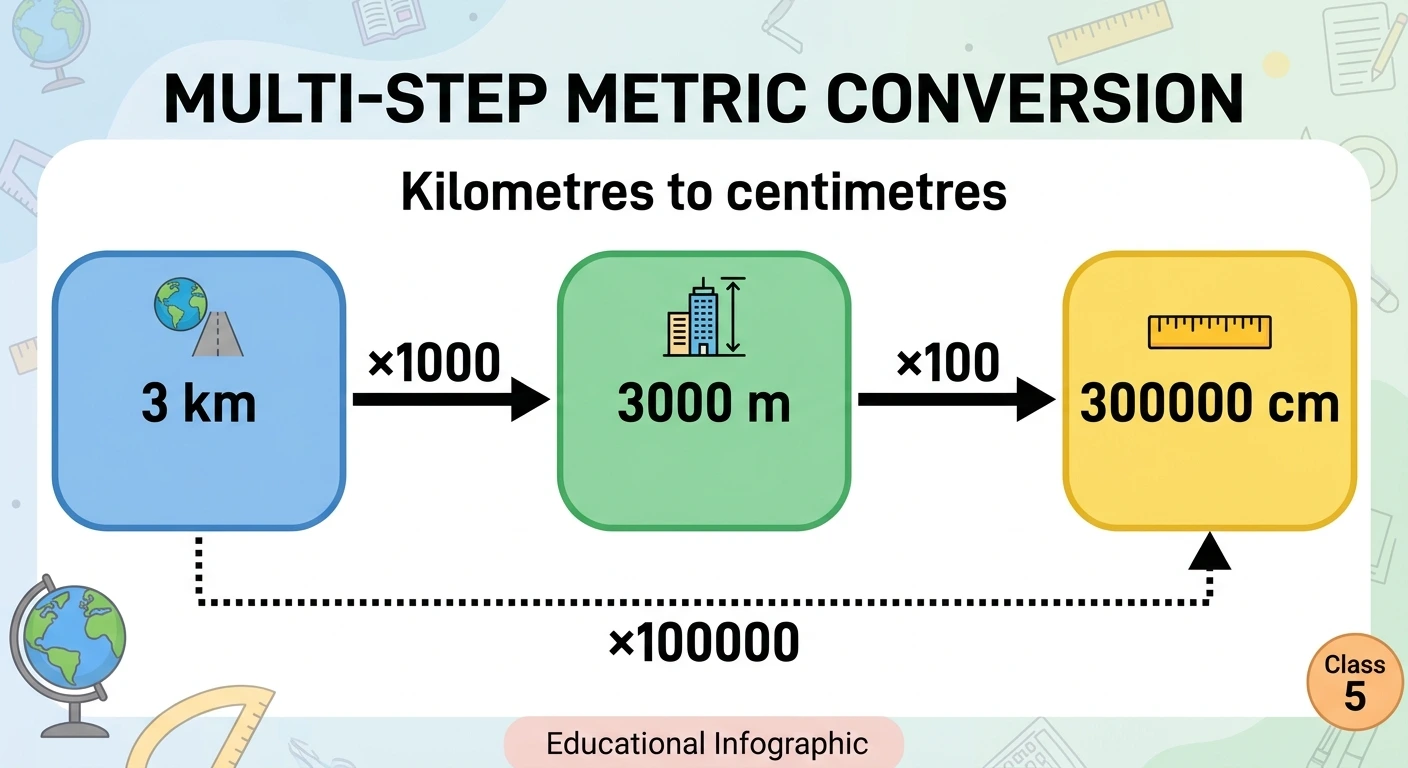
Some conversions skip a rung. Going from kilometres straight to centimetres crosses two gaps. Nothing new is involved. It is the same move done twice, and it leans on comfortable long division and multiplication.
3 km to cm. Chain: 3 × 1000 = 3000 m, then 3000 × 100 = 300000 cm. Single factor: 1 km = 100000 cm, so 3 × 100000 = 300000.
2.5 kg to mg. Chain: 2.5 × 1000 = 2500 g, then 2500 × 1000 = 2500000 mg. Single factor: 1 kg = 1000000 mg.
45000 mm to km. This goes upwards, so divide at every step. 45000 ÷ 10 = 4500 cm, then ÷ 100 = 45 m, then ÷ 1000 = 0.045 km.
The chain method is safer while learning. The single-factor method is faster later. With the decimal view it is quicker still: km to cm is five rungs right, so five places right. Count the rungs, move that many places, done.
Mixed-Unit Problems
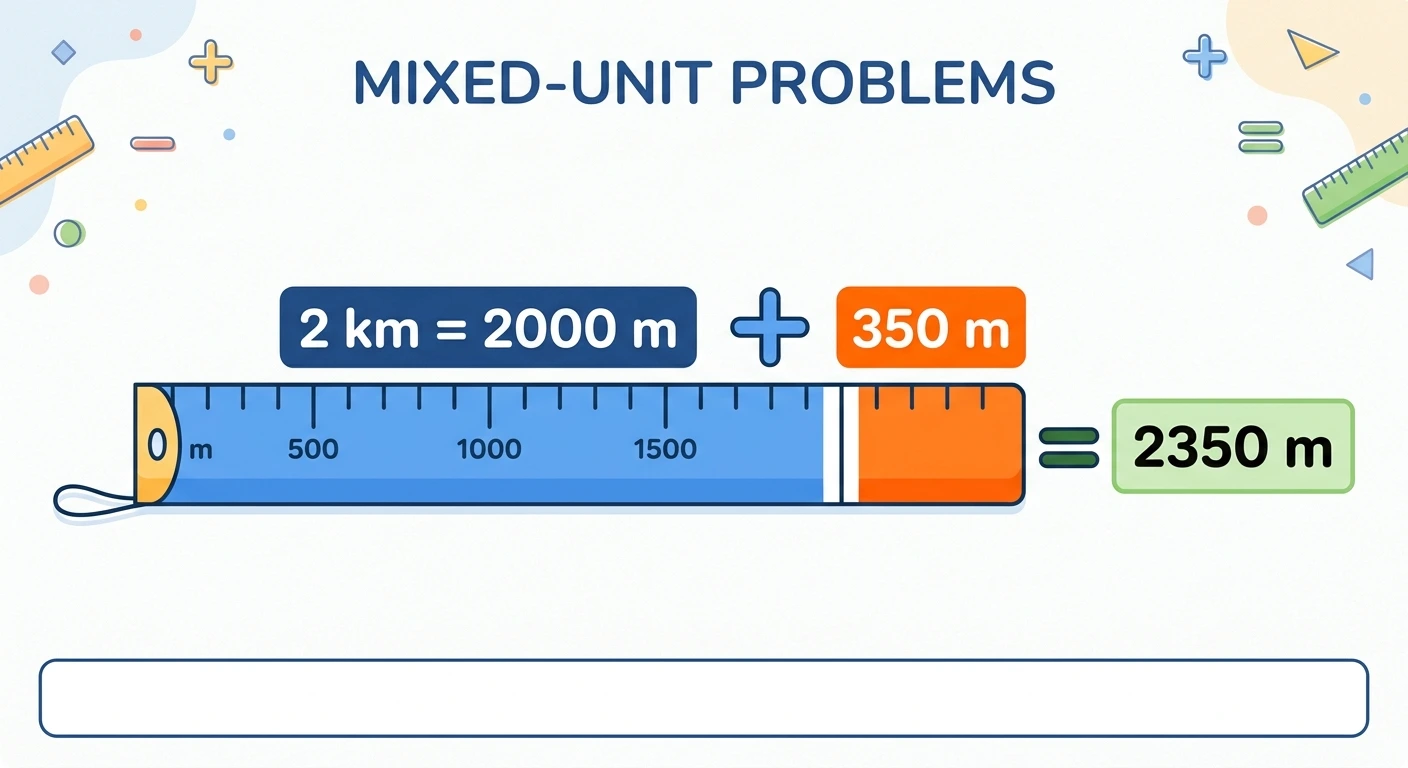
This question type appears constantly in CBSE Class 5 papers and almost never in online conversion guides. A measurement is given in two units at once and has to be rewritten in one.
The method never changes: convert the big part, then add the small part.
- 2 km 350 m. 2 × 1000 = 2000, plus 350 = 2350 m
- 3 kg 250 g. 3 × 1000 = 3000, plus 250 = 3250 g
- 5 m 40 cm. 5 × 100 = 500, plus 40 = 540 cm
The reverse question is just as common, and it is division with a remainder. The quotient is the big unit, the remainder is the small one.
- 4750 m. 4750 ÷ 1000 = 4 remainder 750, so 4 km 750 m
- 2380 g. 2380 ÷ 1000 = 2 remainder 380, so 2 kg 380 g
- 1250 ml. 1250 ÷ 1000 = 1 remainder 250, so 1 l 250 ml
There is a shortcut children find satisfying. When the factor is 1000, read the number from the right: the last three digits are the small unit, everything before them is the big unit. So 15600 ml is 15 l 600 ml, readable straight off the digits. The same works with 100 for metres and centimetres.
Adding and subtracting mixed measurements. Convert everything to the smaller unit, do the arithmetic, convert back.
A rope of 2 m 45 cm is cut from one of 5 m 20 cm. Convert: 520 cm and 245 cm. Subtract: 520 − 245 = 275 cm. Convert back: 2 m 75 cm. Trying to subtract 45 cm from 20 cm directly needs borrowing across units, which is exactly where marks are lost.
Conversion and Place Value
This section makes everything above unnecessary to memorise. Put the place value chart and the prefix ladder side by side.
| Thousands | Hundreds | Tens | Ones | Tenths | Hundredths | Thousandths |
|---|---|---|---|---|---|---|
| 1000 | 100 | 10 | 1 | 0.1 | 0.01 | 0.001 |
| Kilo | Hecto | Deca | Base | Deci | Centi | Milli |
| km | hm | dam | m | dm | cm | mm |
They are the same chart. The metric prefixes are the place value columns with names attached.
Moving one column left in place value divides by 10. Moving one rung up the ladder divides by 10. These are not similar operations. They are the same operation on the same structure. When a child writes 2.5 km as 2500 m, they have slid every digit three columns, which is something they learnt in Class 4.
Two things follow. First, decimals in measurement are not a different kind of number: 0.75 kg and 750 g are one quantity written two ways, just as a decimal and a fraction can be. Second, zeros have a job. The three zeros in 7000 are the three empty columns the 7 moved across, which is why children who see this stop dropping them.
If conversion is going badly and nothing else has helped, check place value and decimals first. Conversion problems are very often decimal problems in disguise.
Metric Conversion in Real Life
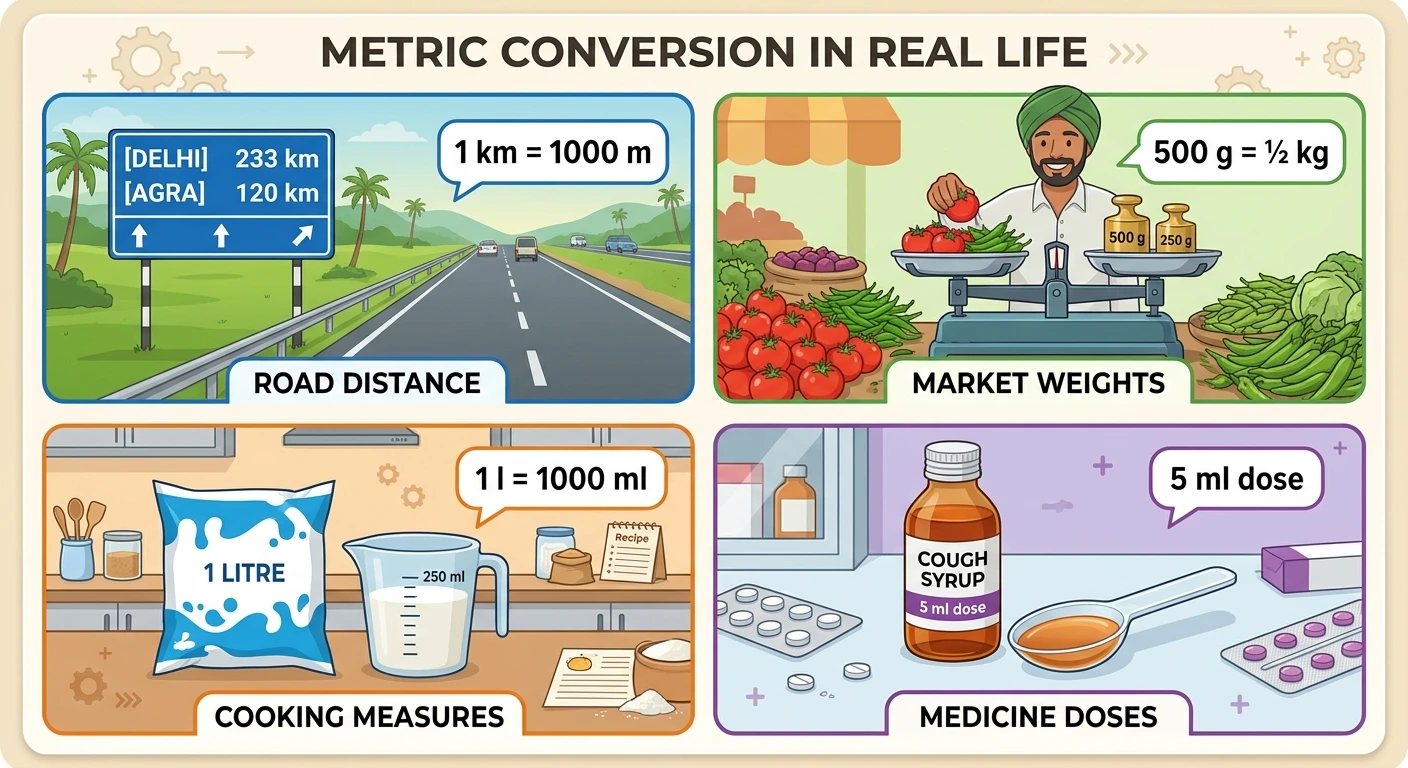
Travel. Road signs here are in kilometres. Delhi to Agra is about 233 km, which is 233000 m. Ask your child how many metres to the next town board, then how many centimetres. The absurdity of the second answer teaches something real: units should match the scale of what you are measuring.
The market. 500 g of tomatoes is half a kilo. Send your child with a list written in grams and ask them to order in kilograms. The conversion happens out loud, under mild social pressure, which fixes it faster than a worksheet.
The kitchen. Halve a recipe together. A litre of milk becomes 500 ml, and 250 g of sugar becomes 125 g. Halving forces conversion in a way doubling sometimes does not.
Medicine. Syrup doses come in millilitres, tablets in milligrams. A 500 mg tablet is half a gram. This is a good place to mention, calmly, that unit errors in medicine have real consequences, which is why pharmacists are so careful. Children find that motivating. It is the clearest answer to “why does this matter?”
Measurement also underpins later topics like area and perimeter, where mismatched units are a common source of lost marks.
Common Mistakes and Fixes
Children make a small number of specific errors, over and over. Here is each one with what to say.
- Dividing when they should multiply. 3 km written as 0.003 m. Ask: “Is a metre bigger or smaller than a kilometre? So do we need more of them or fewer?” Let them answer.
- Using 100 instead of 1000. Writing 4 km = 400 m. Send them back to count rungs. The number of rungs is the number of zeros.
- Losing or adding a zero. 2.5 kg as 250 g. Have them write the multiplication on paper rather than doing it mentally.
- Moving the decimal the wrong way. The point goes the same way you walk along the ladder.
- Refusing an answer below 1. Ask whether 450 m is more or less than a full kilometre. This is decimal discomfort, not conversion failure.
- Forgetting the unit. Writing 2350 instead of 2350 m loses marks even when the arithmetic is perfect. Make it a standing rule: an answer without a unit is not finished.
- Mishandling mixed units. Reading 2 km 350 m as 2350 km. Go back to the two-part method and write both steps down.
- Confusing similar prefixes. Deci and deca, centi and milli. Teach the four that matter and leave the rest as pattern. Children mix up units they never use.
Eight Activities and Games
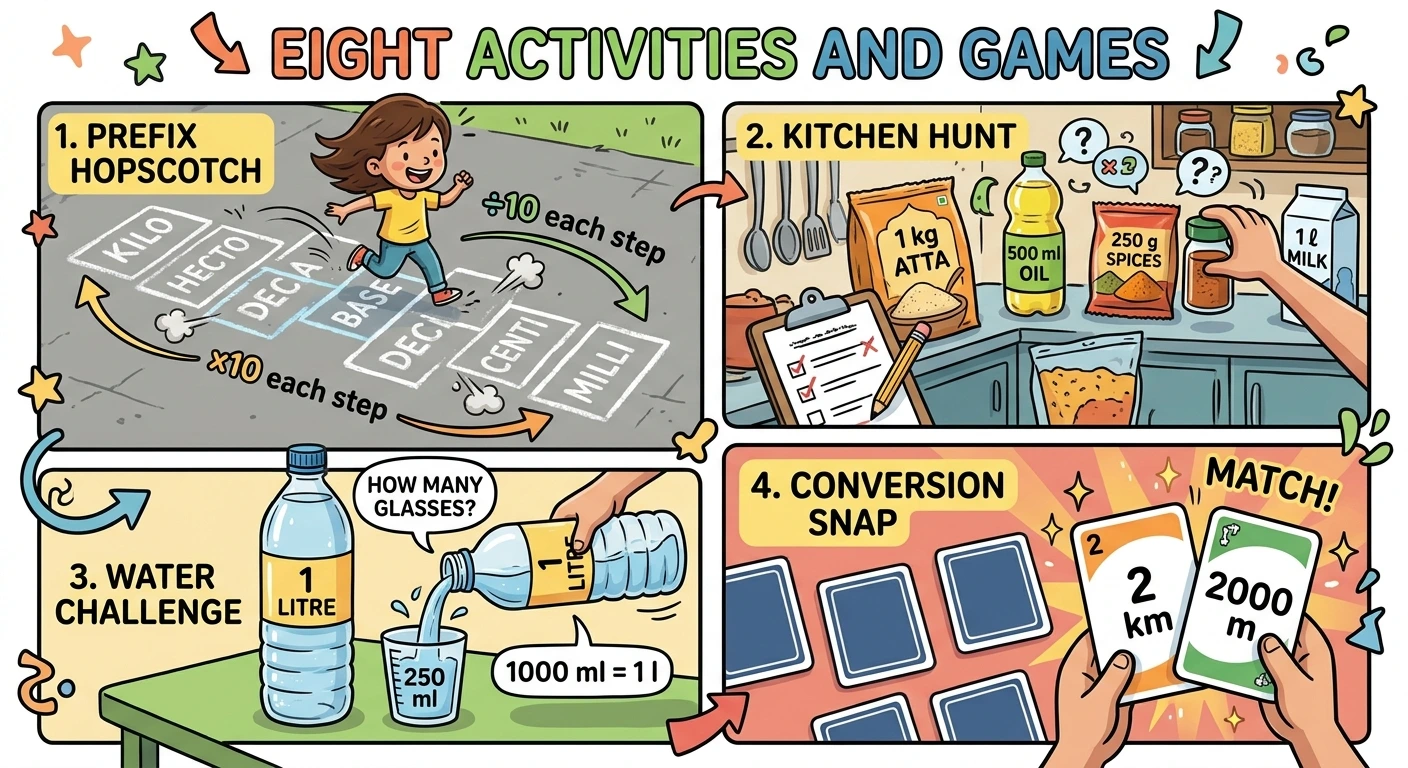
Everything here uses what is already in the house.
- Kitchen conversion hunt. Write down every number on a packet or bottle in the kitchen, then convert each into a different unit. Real packaging, fifteen minutes, no worksheet.
- Metric ladder hopscotch. Chalk seven squares labelled kilo to milli. Call out a conversion and your child hops, counting aloud. The hops are the decimal places. This builds physical memory of direction, which is exactly what the reversal error lacks.
- Measure the house. Table, doorway, their own height, a book. Record everything in centimetres, then rewrite the list in metres and millimetres. Same object, three units.
- Conversion snap. Make fifteen card pairs across length, mass and capacity, such as 2 km and 2000 m. Play memory match, and a pair only counts if they say why it matches.
- The shopkeeper game. One orders in grams, the other repeats the order back in kilograms. Use rice and a kitchen scale if you have one. Swap roles.
- Water transfer challenge. Predict how many 250 ml glasses fill a 1 litre bottle, then test it. Then try 100 ml, then 50 ml. They discover the golden rule with their hands.
- Bigger or smaller. Call out two measurements in different units: 3 km or 2500 m? 800 g or 1 kg? Answer fast. This is the highest-value five minutes here, because comparison forces conversion without announcing itself as practice.
- Design a conversion poster. Have your child make their own prefix ladder, with their own mnemonic and examples. Designing it teaches more than buying one, and it lives on the wall afterwards.
Tips for Parents and Teachers
For parents. Ask the direction question before you check the number. Let them be wrong for a few seconds, because the self-check only becomes a habit if they catch it themselves. Keep the ladder visible near the study table. Use real quantities whenever you can, since measurement is one of the few school topics physically present in your house all day. And keep the tone light: a child who thinks they are bad at measurement will be bad at it, while a child who thinks they have not got the direction straight yet will have it straight next week.
For teachers. Build the ladder with the class before handing out any chart, or students will treat the factors as facts. Teach length, mass and capacity side by side rather than in sequence, since the prefixes are identical and teaching them separately hides the pattern. Spend a full lesson on direction alone, with no arithmetic. Put mixed units in early, because they appear in exams and rarely in textbook practice. And use error analysis as a task: five worked conversions, three wrong, find and explain the errors. Diagnosing a mistake is stronger practice than ten more correct sums.
From Class 5 to Olympiad Problems
Olympiad questions rarely ask for a straight conversion. They hide two or three inside a problem that also needs arithmetic or reasoning, so fluent conversion is what frees up attention for the rest. If your child enjoys this kind of thinking, Olympiad-style questions are the natural next step, and the general approach to word problems applies directly.
Problem 1. A ribbon roll is 15 m long. Pieces of 25 cm are cut from it. How many pieces? Both measurements must share a unit. 15 m = 1500 cm, and 1500 ÷ 25 = 60 pieces, with nothing left over. The conversion is one line of a four-line solution.
Problem 2. A shopkeeper has 4 kg 500 g of sugar, packs it into 250 g packets, and sells each for Rs 12. How much does he earn? Convert: 4 kg 500 g = 4500 g. Packets: 4500 ÷ 250 = 18. Earnings: 18 × 12 = Rs 216.
That is the real argument for making conversion automatic. Not because conversion questions carry many marks, but because every harder measurement problem has one sitting in the middle of it.
Practice Questions with Answers
Length: 1. 9 km = ___ m · 2. 6.4 m = ___ cm · 3. 35 cm = ___ mm · 4. 8200 m = ___ km · 5. 540 cm = ___ m
Mass: 6. 7 kg = ___ g · 7. 3.2 kg = ___ g · 8. 12 g = ___ mg · 9. 6500 g = ___ kg · 10. 850 mg = ___ g
Capacity: 11. 4 l = ___ ml · 12. 2.6 l = ___ ml · 13. 7250 ml = ___ l · 14. 400 ml = ___ l · 15. 9500 l = ___ kl
Multi-step: 16. 5 km = ___ cm · 17. 1.5 kg = ___ mg · 18. 72000 mm = ___ km
Mixed units: 19. 6 km 250 m = ___ m · 20. 2 kg 80 g = ___ g · 21. 3 l 400 ml = ___ ml · 22. Write 8640 m as km and m · 23. Write 5075 g as kg and g
Word problems: 24. A tank holds 2 kl and a family uses 350 l a day. How many full days will it last? · 25. A merchant has 12 m of cloth and cuts 150 cm shirt pieces. How many pieces? · 26. A 150 ml medicine bottle, dose 5 ml three times a day. How many days? · 27. From 4 kg of rice, 1 kg 750 g is used. How much is left?
Answer key
| Q | Answer | Q | Answer | Q | Answer |
|---|---|---|---|---|---|
| 1 | 9000 m | 10 | 0.85 g | 19 | 6250 m |
| 2 | 640 cm | 11 | 4000 ml | 20 | 2080 g |
| 3 | 350 mm | 12 | 2600 ml | 21 | 3400 ml |
| 4 | 8.2 km | 13 | 7.25 l | 22 | 8 km 640 m |
| 5 | 5.4 m | 14 | 0.4 l | 23 | 5 kg 75 g |
| 6 | 7000 g | 15 | 9.5 kl | 24 | 5 full days |
| 7 | 3200 g | 16 | 500000 cm | 25 | 8 pieces |
| 8 | 12000 mg | 17 | 1500000 mg | 26 | 10 days |
| 9 | 6.5 kg | 18 | 0.072 km | 27 | 2 kg 250 g |
If your child manages the first three sets but stumbles on multi-step and mixed units, that is the normal pattern. Go back to sections 9 and 10 rather than doing more single-step practice.
Make Preparing for Math Olympiad Simple!


How do you convert metric units?
Decide whether you are moving to a smaller unit or a larger one. If the new unit is smaller, multiply by the conversion factor. If it is larger, divide. The factor is always 10, 100 or 1000, depending on how many steps you move along the prefix ladder.
What is the rule for metric conversion?
Larger unit to smaller unit, multiply. Smaller unit to larger unit, divide. It works because a smaller unit means you need more of them to measure the same thing, so the number gets bigger.
Why does the metric system use powers of 10?
Because our number system does. Place value already works in tens, hundreds and thousands, so converting units is just moving digits between place value columns.
What is the easiest way to remember the prefixes?
King Henry Died By Drinking Chocolate Milk, for Kilo, Hecto, Deca, Base, Deci, Centi, Milli. The B is the base unit: metre, gram or litre.
How do I convert km to m?
Multiply by 1000, since a metre is smaller. So 7 km = 7000 m, and 2.4 km = 2400 m.
How do I convert kg to g?
Multiply by 1000. So 5 kg = 5000 g. Going back the other way, divide: 2800 g = 2.8 kg.
How do I solve mixed-unit problems like 2 km 350 m?
Convert the larger part into the smaller unit, then add the smaller part. 2000 m plus 350 m gives 2350 m. To reverse it, divide: 2350 ÷ 1000 is 2 remainder 350.
What does a Class 5 student need to know?
Length in km, m, cm and mm; mass in kg, g and mg; capacity in l and ml, with kl in some questions. Students should convert both ways, handle mixed units, and apply conversion inside word problems. Class 6 extends the same material into decimals.Length in km, m, cm and mm; mass in kg, g and mg; capacity in l and ml, with kl in some questions. Students should convert both ways, handle mixed units, and apply conversion inside word problems. Class 6 extends the same material into decimals.
Why does my child keep multiplying when they should divide?
Usually because they learnt the rule as words instead of as a reason. Ask whether the new unit is bigger or smaller, and whether that means more of them or fewer. Children who can answer those two questions stop reversing the rule, because they rebuild it rather than recall it.
Do Class 5 students need inches, pounds and gallons?
No. India uses the metric system for all official and everyday measurement, and the CBSE Class 5 syllabus covers metric units only.
Conclusion
Metric conversion only looks like a list of facts to memorise. It is one idea repeated: every unit is a power of 10 away from every other, so converting is a matter of deciding a direction and moving a decimal point.
Start with the prefix ladder, spend real time on multiply versus divide before touching multi-step problems, and keep the practice physical where you can. Measure things, halve recipes, compare packet weights at the market. The system is already all around your child. The maths lesson is just giving it a name.

Mikha Piregu is a Content Writer with experience spanning educational content, including math and math olympiad topics, as well as advocacy writing, research-based articles, and SEO-driven web content. He creates high-quality blog content, web copy, and feature articles that support brand visibility, audience engagement, and long-term organic growth through data-informed storytelling. Skilled in WordPress, WooCommerce, and modern digital tools, Mikha adapts content across various platforms, including blogs, websites, campaigns, and advocacy initiatives, with clarity and purpose.

There are no comments posted here yet.
Sign in to leave a comment