


The order of operations is a set of rules that defines the sequence in which to evaluate a mathematical expression, so that everyone gets the same answer.
- Why maths needs an agreed order of operations
- What is the order of operations?
- The part the mnemonic gets wrong: equal priority
- How to solve any expression, step by step
- Worked examples, case by case
- Fraction bars group invisibly
- What about 8 ÷ 2(2 + 2)?
- Six mistakes children make
- Do calculators follow the order of operations?
- Order of operations in everyday life
- Eight activities and games
- Tips for parents and teachers
- Order of operations in Olympiad problems
- Practice questions with answers
- Frequently asked questions
- Final thoughts
Work through it in four stages: brackets first, then orders (powers and square roots), then division and multiplication together from left to right, then addition and subtraction together from left to right.
We use the acronym PEMDAS, or BODMAS in some regions, to remember the steps. PEMDAS and BODMAS are different regional acronyms for exactly the same universal rule. Both tell you which calculation to do first in a maths expression that has more than one operation, and both give the same answer every time.
What the acronyms stand for
PEMDAS (used primarily in the United States):
- P: Parentheses
- E: Exponents
- M: Multiplication
- D: Division
- A: Addition
- S: Subtraction
BODMAS (used primarily in the UK, India, Australia and other Commonwealth countries):
- B: Brackets
- O: Orders (powers or square roots)
- D: Division
- M: Multiplication
- A: Addition
- S: Subtraction
So what is PEMDAS, and what is BODMAS? The same rule, under two names. The one real difference is in the letters D and M, and that difference is only cosmetic, as the PEMDAS vs BODMAS section below explains.
That is the rule stated. The rest of this guide covers why it exists, how to apply it step by step, and twenty worked order of operations examples for Class 5 to Class 7, including expressions with brackets, exponents and negative numbers
Why maths needs an agreed order of operations
Most rules in primary maths describe something true about numbers. This one is different. It is not a fact about numbers but an agreement about how to read them, in the way that reading left to right is an agreement about how to read English. Without it, a written expression would be ambiguous, and ambiguous maths is useless.
The order was not chosen at random, though.
Multiplication is shorthand for repeated addition
What does 4 × 2 actually mean? It means 4 + 4. So 3 + 4 × 2 really says 3 + 4 + 4, which is 11. The 4 × 2 was already one package before anyone started calculating, and breaking it open would change what the expression says.
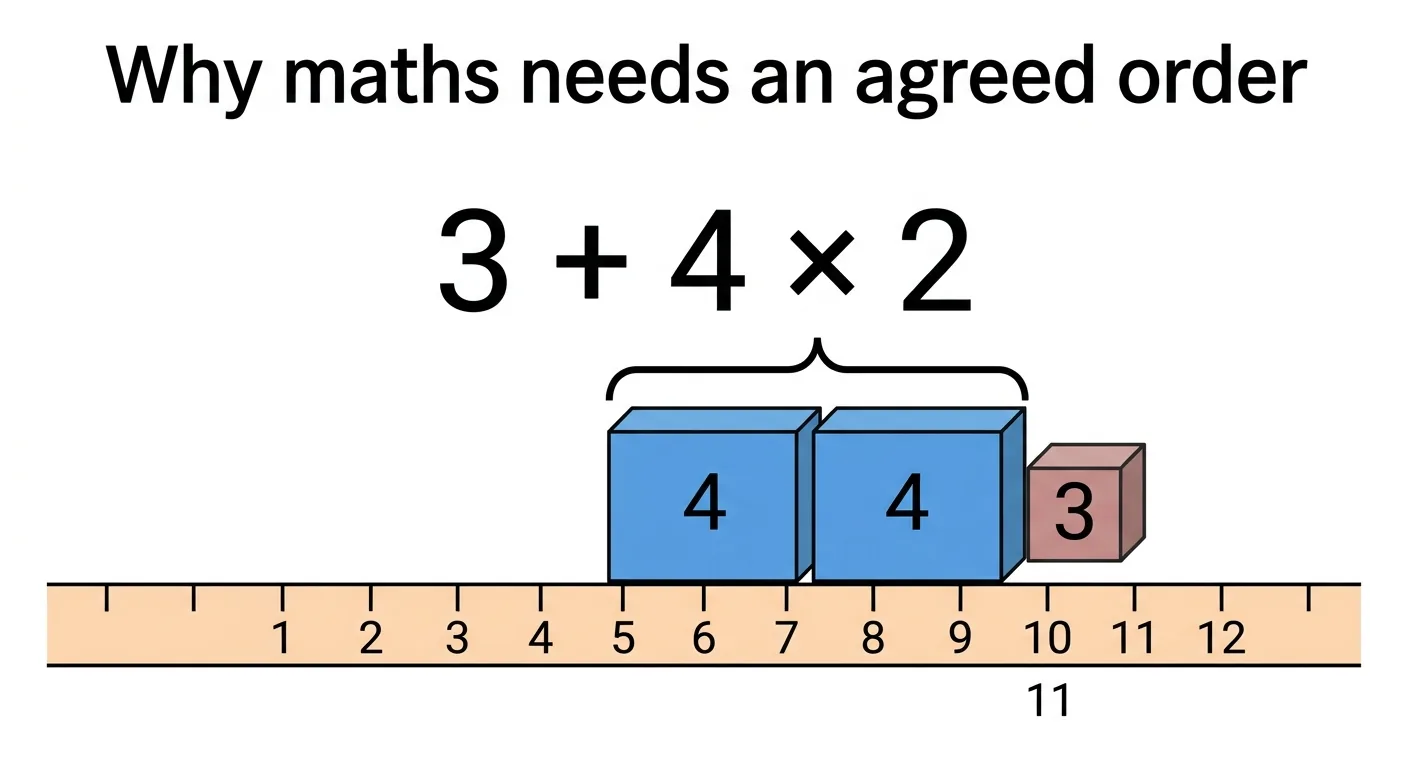
Say this to your child in exactly these words: operations hold on to their numbers with different strengths. Multiplication holds tighter than addition because a multiplication is a bundle of additions, which is also why fluency with the multiplication table makes this topic easier. Orders hold tighter still, because 2³ is a bundle of multiplications.
Why brackets exist
Brackets are the escape hatch. They let you override the default and say “do this bit first.”
3 + 4 × 2 = 11, but (3 + 4) × 2 = 14.
Nothing about the numbers changed. The grouping did. This is why children who ignore brackets get wrong answers more often than children who have not yet met the rule at all: brackets carry information, and skipping them throws it away.
What is the order of operations?
The order of operations is the agreed sequence for working out any expression containing more than one operation. It runs in four stages:
- Brackets: everything inside grouping symbols, innermost first
- Orders: powers, indices and square roots
- Division and multiplication: together, left to right
- Addition and subtraction: together, left to right
That is the complete rule. Everything below is explanation and practice.
The BODMAS rule
BODMAS is the memory aid used in India, the UK and Australia: Brackets, Orders, Division, Multiplication, Addition, Subtraction. Some Indian textbooks write the O as “of”, as in ½ of 20. “Of” behaves exactly like multiplication and sits at the same level as D and M, so nothing else changes.
The PEMDAS rule
PEMDAS is the American version: Parentheses, Exponents, Multiplication, Division, Addition, Subtraction, remembered as Please Excuse My Dear Aunt Sally. You will meet it constantly online, because most of the maths internet is American. It is the same rule your child already knows.
BODMAS vs PEMDAS: what is the difference?
There is no mathematical difference. They are two names for one rule, and both give the same answer to every expression.
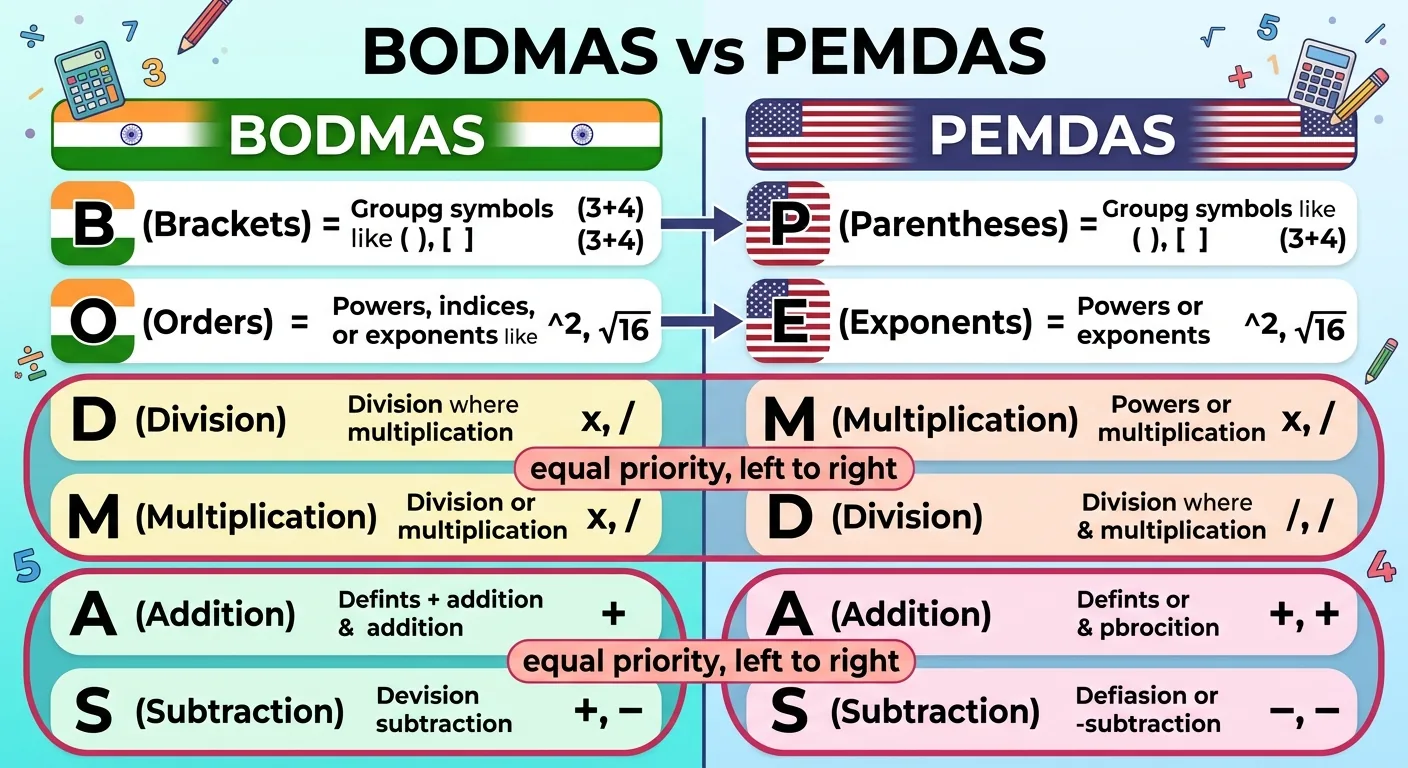
| BODMAS (India, UK) | PEMDAS (US) | Means |
|---|---|---|
| Brackets | Parentheses | ( ), [ ], { } |
| Orders | Exponents | 3², 2⁴, √25 |
| Division | Multiplication | Equal priority, left to right |
| Multiplication | Division | Equal priority, left to right |
| Addition | Addition | Equal priority, left to right |
| Subtraction | Subtraction | Equal priority, left to right |
Notice rows three and four. BODMAS puts D before M; PEMDAS puts M before D. If that order mattered, the two mnemonics would give different answers and half the world would be doing maths wrong. They do not, because division and multiplication have equal priority in both. The letters had to go in some order to make a pronounceable word, and that is all it means.
The part the mnemonic gets wrong: equal priority
BODMAS looks like six steps. It is really four, because two pairs share a level.
Division and multiplication are a pair
Work them in the order they appear, left to right.
12 ÷ 3 × 2
Correct 12 ÷ 3 × 2 = 4 × 2 (12 ÷ 3 comes first) = 8
Wrong 12 ÷ 3 × 2 = 12 ÷ 6 (3 × 2 done first) = 2
Eight and two are not close. This single misunderstanding costs more marks at Class 6 level than any other error in arithmetic.
If your child asks why left to right is the right choice: dividing by 3 is the same as multiplying by one-third, so 12 ÷ 3 × 2 is really 12 × ⅓ × 2. The only number being divided by is the 3. Doing 3 × 2 first would secretly divide by both. The same logic underpins dividing fractions.
Addition and subtraction are a pair
10 − 4 + 3
Correct 10 − 4 + 3 = 6 + 3 (10 − 4 comes first) = 9
Wrong 10 − 4 + 3 = 10 − 7 (4 + 3 done first) = 3
A subtraction sign belongs to the number immediately after it and nothing else. Adding 4 + 3 first would take away the 3 as well, which the expression never asked for. Tell your child: the minus sign owns only the number standing next to it.
Four levels, not six
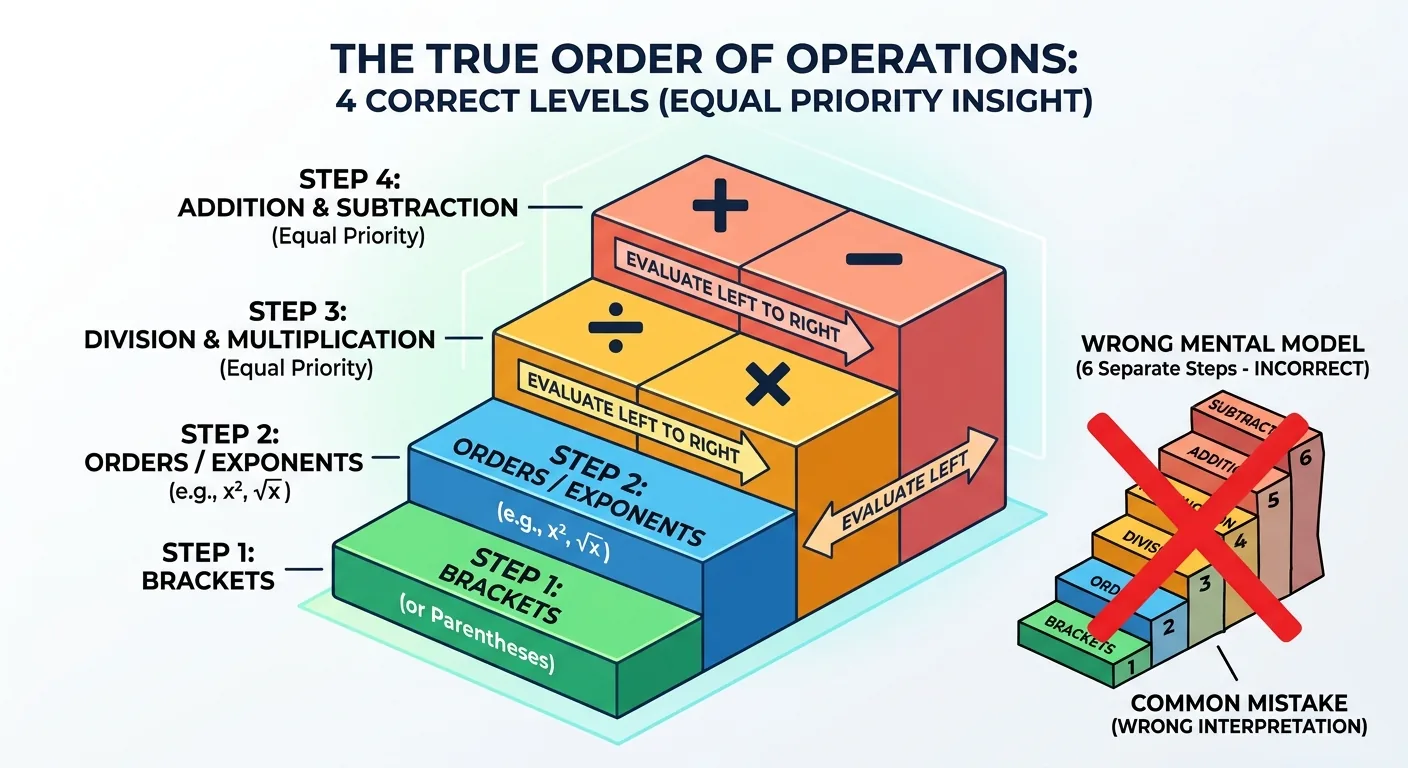
| Level | Do this | Direction |
|---|---|---|
| 1 | B: Brackets | Innermost first |
| 2 | O: Orders | As they appear |
| 3 | D and M | Left to right |
| 4 | A and S | Left to right |
If your child writes these four lines inside the cover of their maths notebook, most of the problem is solved.
How to solve any expression, step by step
- Read the whole expression first. Find the brackets, the powers, and where the division signs are.
- Work out the innermost bracket, applying this same rule inside it.
- Work outwards through the remaining brackets: round, then square, then curly.
- Work out any orders: powers and square roots.
- Do every division and multiplication, left to right, one at a time.
- Do every addition and subtraction, left to right, one at a time.
- Rewrite the full expression after each step, on a new line below the last.
- Check the final line is a single number.
Step 7 matters most. Most wrong answers at this level are not failures to know BODMAS. They are dropped minus signs and expressions that quietly changed shape between one line and the next.
Worked examples, case by case
Cases 1 to 4 are the core Class 5 and 6 material. Cases 5 and 6 are extensions for Class 6 and 7. If your child is getting mixed expressions wrong, start at Case 1 and work forward, because the fault is usually further back than it looks. Each step gets its own line, with the operation being done in bold.
Case 1: Addition and subtraction only
1.1: 15 − 6 + 4
= 9 + 4 (15 − 6) = 13
1.2: 20 + 7 − 12 − 5
= 27 − 12 − 5 = 15 − 5 = 10
1.3: 50 − 18 + 9 − 6 + 2
= 32 + 9 − 6 + 2 = 41 − 6 + 2 = 35 + 2 = 37
Long expressions are where the left-to-right habit either holds or collapses. One operation per line, even when the numbers look easy.
Case 2: Multiplication and division only
2.1: 24 ÷ 6 × 2
= 4 × 2 (24 ÷ 6) = 8
Not 24 ÷ 12 = 2.
2.2: 5 × 8 ÷ 4
= 40 ÷ 4 = 10
2.3: 36 ÷ 3 ÷ 2 × 5
= 12 ÷ 2 × 5 = 6 × 5 = 30
Two division signs in a row catch children out. 36 ÷ 3 ÷ 2 does not mean 36 ÷ 6. If the division itself is shaky, go back to long division before adding the ordering rule on top.
Case 3: Mixed operations without brackets
Clear all the × and ÷ first, left to right, then all the + and −.
3.1: 7 + 3 × 4
= 7 + 12 = 19
3.2: 30 − 18 ÷ 3
= 30 − 6 = 24
3.3: 6 × 4 + 8 ÷ 2
= 24 + 8 ÷ 2 = 24 + 4 = 28
3.4: 45 ÷ 9 × 2 + 7 − 3
= 5 × 2 + 7 − 3 = 10 + 7 − 3 = 17 − 3 = 14
Example 3.4 combines both left-to-right traps in one line. If your child can do it reliably, the core rule is secure.
Case 4: Brackets, including nested brackets
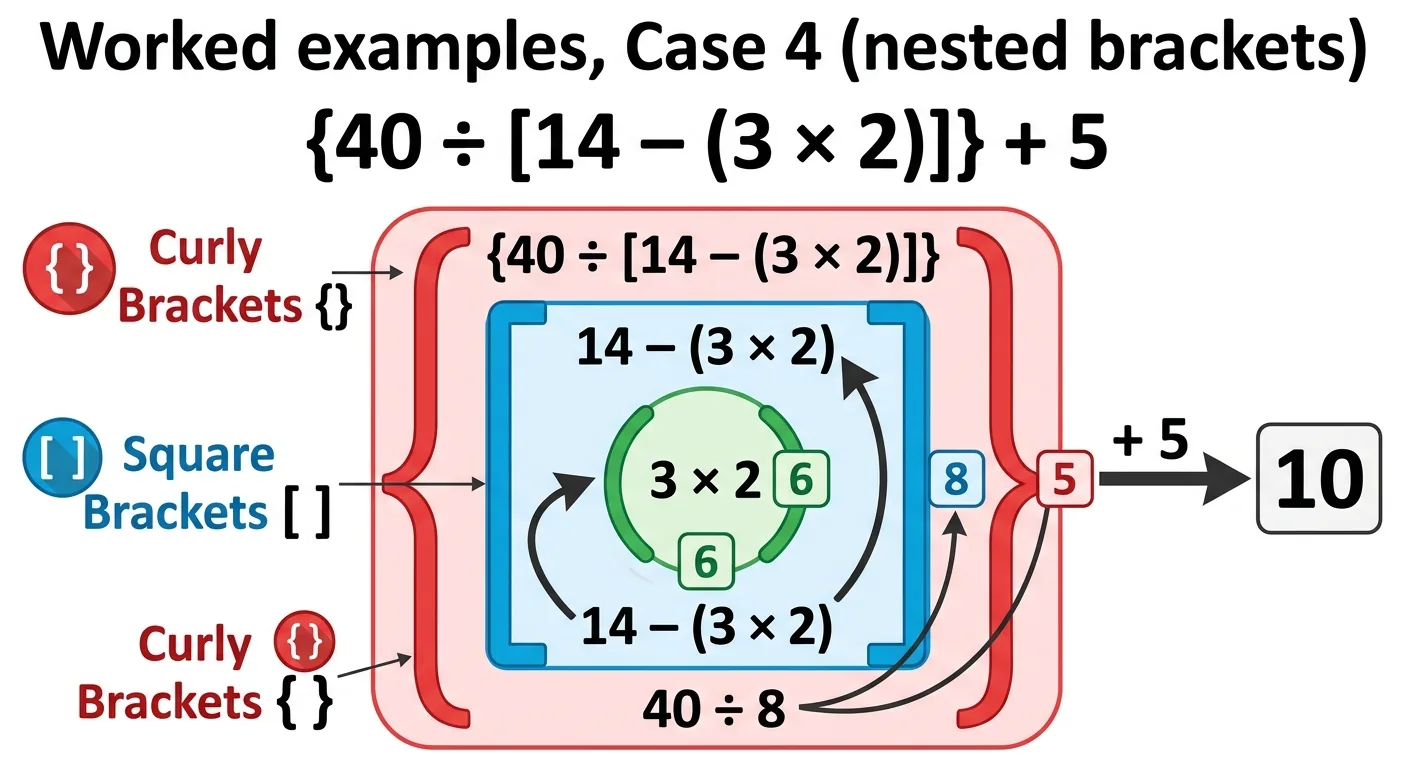
Indian textbooks nest brackets in a fixed order: round ( ) inside square [ ] inside curly { }. Always work from the innermost outwards.
4.1: 8 × (5 + 3)
= 8 × 8 = 64
4.2: (12 − 4) ÷ 2 + 6
= 8 ÷ 2 + 6 = 4 + 6 = 10
4.3: 20 − [3 × (2 + 4)]
= 20 − [3 × 6] (round bracket) = 20 − 18 (square bracket) = 2
4.4: {40 ÷ [14 − (3 × 2)]} + 5
= {40 ÷ [14 − 6]} + 5 (round) = {40 ÷ 8} + 5 (square) = 5 + 5 (curly) = 10
One habit helps enormously: cross out each bracket as soon as it holds a single number, and rewrite the line without it. Children who leave brackets standing lose track of which layer they are on.
Case 5 (Class 6–7 extension): Orders and square roots
Orders sit between brackets and the × ÷ level. A root sign acts like a bracket over everything underneath it.
5.1: 4 + 3²
= 4 + 9 = 13
Not 7² = 49. The power belongs to the 3 alone.
5.2: 2³ × 5 − 10
= 8 × 5 − 10 = 40 − 10 = 30
5.3: √(25 − 9) + 6 × 2
= √16 + 6 × 2 (under the root first) = 4 + 6 × 2 = 4 + 12 = 16
This is the same precedence thinking that later makes factorisation in Class 8 readable.
Case 6 (Class 7 extension): Negative numbers
6.1: −6 + 4 × 3
= −6 + 12 = 6
6.2: 15 − (−4) × 2
= 15 − (−8) = 15 + 8 = 23
One more to know: −3² and (−3)² are different. −3² means −(3²) = −9, because the power is applied before the minus sign. (−3)² means (−3) × (−3) = 9.
Fraction bars group invisibly
From Class 6 onwards, division is often written as a fraction rather than with a ÷ sign. The horizontal bar then does a job most children are never told about: it acts as a bracket around everything above it and everything below it. If the numerator and denominator are still new ground, cover that first.
So (8 + 4) over 3 means (8 + 4) ÷ 3, not 8 + (4 ÷ 3).
F.1: (8 + 4) ÷ 3, written as a fraction
Numerator: 8 + 4 = 12 12 ÷ 3 = 4
F.2: (20 − 5) over (9 − 6), plus 7
Numerator: 20 − 5 = 15 Denominator: 9 − 6 = 3 = 5 + 7 = 12
The practical consequence: when a child rewrites a fraction on one line, they must put the brackets back in themselves. (20 − 5) ÷ (9 − 6) is correct. 20 − 5 ÷ 9 − 6 is a different sum entirely.
What about 8 ÷ 2(2 + 2)?
By the rule as taught in school, the answer is 16:
8 ÷ 2(2 + 2) = 8 ÷ 2 × 4 (bracket first) = 4 × 4 (8 ÷ 2, left to right) = 16
The argument for 1 comes from treating 2(2 + 2) as a single glued-together unit, because the 2 sits against the bracket with no × sign. Some older textbooks do read it that way.
The honest answer to give a Class 6 child: the expression is badly written, and that is the real lesson. If the intended meaning is 16, write 8 ÷ 2 × (2 + 2). If it is 1, write 8 ÷ [2 × (2 + 2)]. Brackets exist to remove doubt, so a question that creates doubt is a badly set question, not a deep puzzle.
Six mistakes children make
| Mistake | What it looks like | The fix |
|---|---|---|
| Multiplying before dividing | 12 ÷ 3 × 2 = 2 | D and M are one level: 12 ÷ 3 × 2 = 8 |
| Adding before subtracting | 10 − 4 + 3 = 3 | A and S are one level: 10 − 4 + 3 = 9 |
| Ignoring brackets | (3 + 5) × 2 = 13 | Brackets first: (3 + 5) × 2 = 16 |
| Going strictly left to right | 7 + 3 × 4 = 40 | × and ÷ outrank + and −: the answer is 19 |
| Starting with the outer bracket | 20 − [3 × (2 + 4)] worked from the square bracket | Innermost first: the answer is 2 |
| Attaching a power to the wrong number | 4 + 3² = 49 | The power belongs to the 3 only: 13 |
The first two are by far the most common, and they share one cause: the mnemonic is being read as six ranked steps rather than four levels. When your child gets one of these wrong, go back to the four-level table rather than re-reciting BODMAS.
Do calculators follow the order of operations?
Some do, some do not.
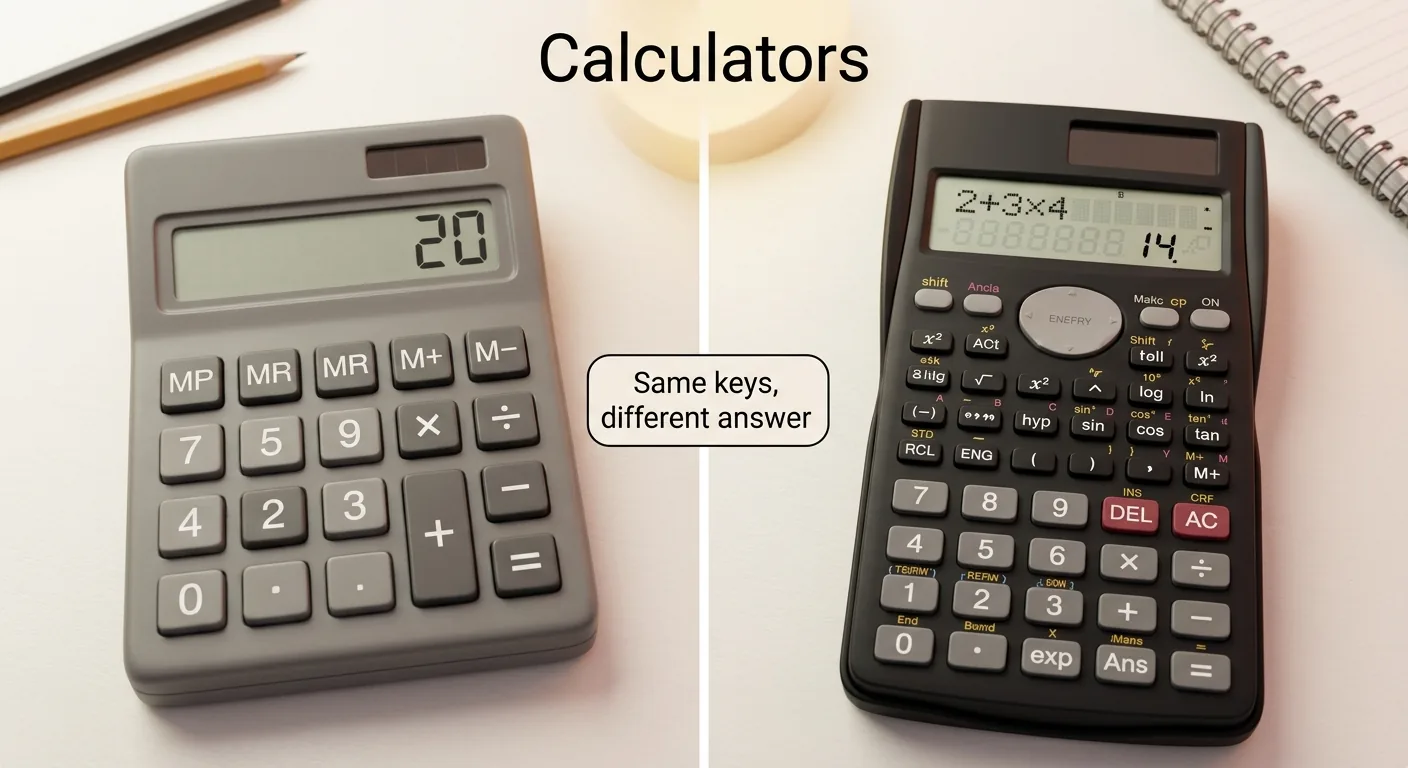
| Device | Type 2 + 3 × 4 and you get |
|---|---|
| Basic four-function calculator | 20 |
| Scientific calculator | 14 |
| Phone calculator, upright | 20 |
| Phone calculator, turned sideways | 14 |
| Spreadsheet | 14 |
Demonstrate this once at home with whatever calculator is in the house. A child who has seen the same expression give 20 on one device and 14 on another understands immediately why the written rule matters. One caution: a spreadsheet reads -3^2 as 9, while written mathematics reads it as −9, so use brackets with negatives and powers.
Order of operations in everyday life
The rule stops being abstract the moment a child writes a real situation as one line of maths. Children who struggle to turn a situation into an expression usually need work on maths word problems rather than on BODMAS itself.
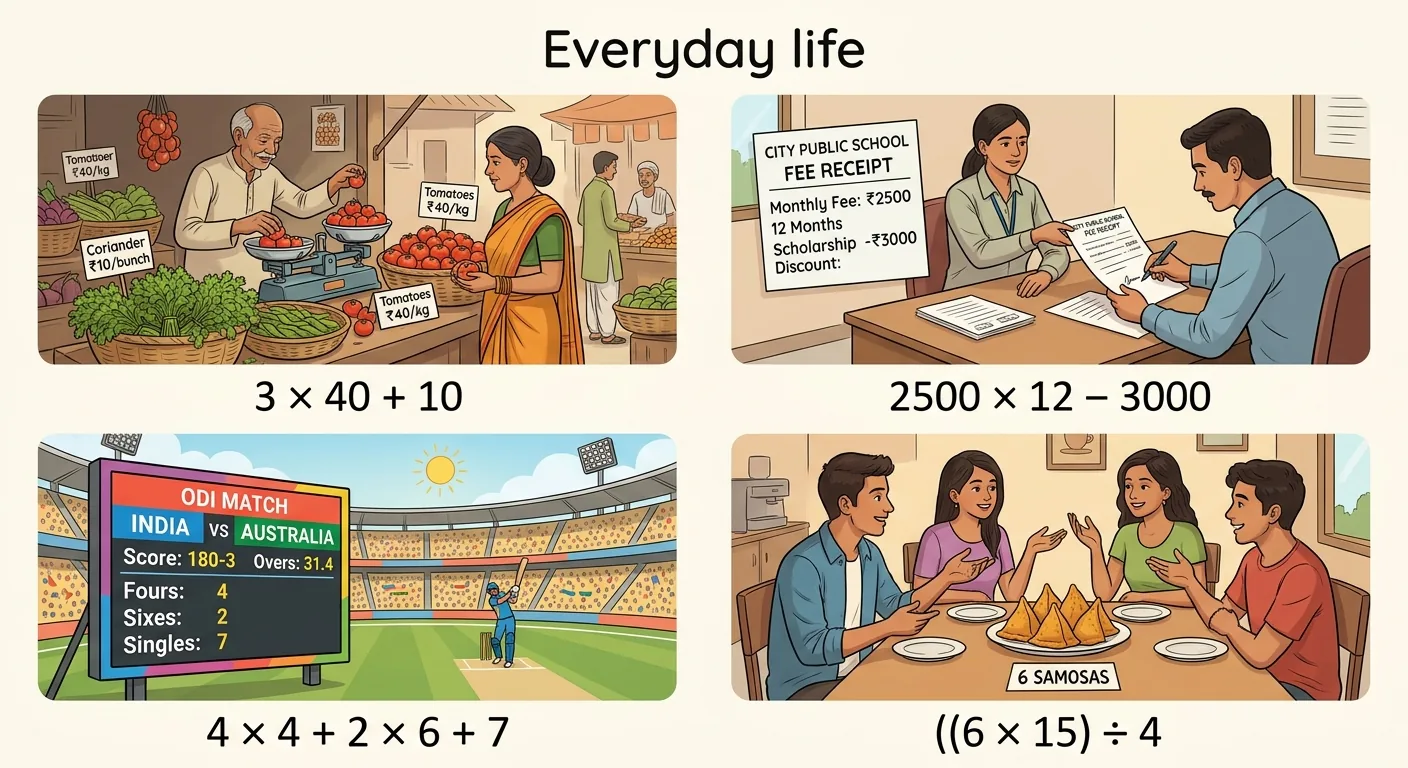
At the sabzi market. 3 kg of tomatoes at ₹40 per kg, plus coriander at ₹10:
3 × 40 + 10 = 120 + 10 = ₹130
School fees. ₹2,500 a month for 12 months, with a ₹3,000 annual discount:
2500 × 12 − 3000 = 30000 − 3000 = ₹27,000
A cricket score. 4 fours, 2 sixes and 7 singles:
4 × 4 + 2 × 6 + 7 = 16 + 12 + 7 = 35 runs
Sharing a bill. Four friends buy 6 samosas at ₹15 each:
(6 × 15) ÷ 4 = 90 ÷ 4 = ₹22.50 each
In each case the convention matches how people already think, which is exactly why it was chosen.
Eight activities and games
All of these need nothing more than paper, dice or a pack of cards.
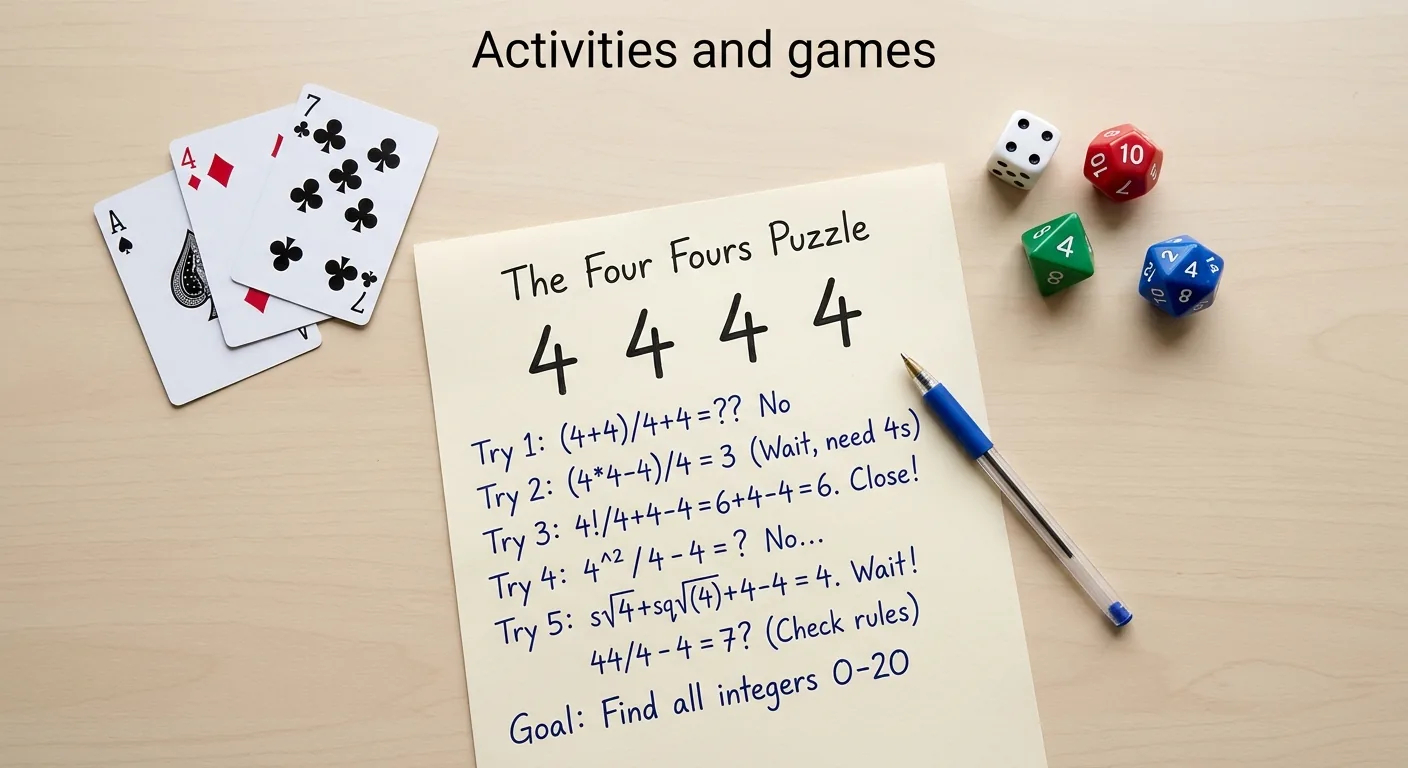
- Four fours. Using exactly four 4s with any operations and brackets, make every number from 0 to 10. For example, (4 × 4 + 4) ÷ 4 = 5. The best order-of-operations activity ever invented.
- Target number. Roll four dice. Use all four numbers once each to get as close as possible to 24.
- Insert the brackets. Write an expression and a target it does not currently reach, and ask your child to add brackets to make it true. Make 3 + 5 × 2 equal 16.
- Human BODMAS line-up. For a classroom: each child holds a number or symbol card and stands in a line forming an expression. Call out the stages; the relevant children step forward and are replaced by one holding the result.
- Expression card sort. Ten expressions, ten answers, some of them the result of common errors. Match the correct pairs and name the mistake behind each leftover.
- Spot the error. Show a worked solution with exactly one wrong step. Harder and more valuable than solving from scratch, and it mirrors what examiners test.
- Same numbers, different answers. Using 2, 3 and 4 once each, how many different results can be made? Children discover for themselves why an order has to be agreed.
- Twenty-four with cards. Deal four playing cards (ace = 1, pictures = 10) and make 24. For more in this vein, see our printable logic puzzles and critical thinking activities.
Tips for parents and teachers
At home
- Ask which level your child is on, not which letter. That question catches the equal-priority error immediately.
- Insist on one operation per line. It feels slow and it is the highest-return habit at this stage.
- When an answer is wrong, check which operation was done first before checking the arithmetic.
- Use 12 ÷ 3 × 2 and 10 − 4 + 3 as a quick diagnostic. Answers of 8 and 9 mean the rule is understood; 2 and 3 mean it is not.
- Keep sessions to ten minutes. This is a precision skill, not an endurance one. Our guide to studying for a maths test has more on short, frequent practice.
In the classroom
- Open with the ambiguity, not the acronym. Put 3 + 4 × 2 on the board, collect both answers, and let the disagreement sit before resolving it.
- Write BODMAS as four rows from day one. A six-item vertical list teaches the error in.
- Teach brackets as a tool: give a target and ask students to insert brackets to reach it.
- Use error analysis as a task type, and delay exponents and integers until Cases 1 to 4 are automatic.
Order of operations in Olympiad problems
Olympiad papers rarely ask students to evaluate an expression. They ask something that requires the rule to be used backwards, which is a much deeper test, as the examples in our collection of Maths Olympiad questions show.
Target number. Using 1, 2, 3 and 4 once each, make 24. One answer: (1 + 3) × (2 + 4). This requires thinking about how grouping changes a value, not just applying a sequence.
Insert the brackets. Add one pair of brackets to 2 + 3 × 4 − 1 so the answer is 19. Without brackets it gives 13. The student must reason about what each possible bracket would do: (2 + 3) × 4 − 1 = 19.
Comparison without calculating. Which is larger, 15 × (8 + 2) or 15 × 8 + 2? Problems like this reward structural understanding over computation speed, which is the habit our guide to improving problem-solving skills is built around.
This is why the order of operations is worth teaching properly rather than quickly. It is the first topic where a child learns that notation carries meaning.
Practice questions with answers
Set A: Class 5
- 18 − 5 + 7
- 40 ÷ 8 × 3
- 9 + 6 × 2
- 25 − 12 ÷ 4
- (14 − 6) × 3
Set B: Class 6
- 7 × 3 − 24 ÷ 6
- 60 ÷ 5 × 2 + 9
- 48 − [5 × (3 + 4)]
- 2³ + 6 × 5
- {36 ÷ [10 − (2 × 3)]} × 2
Set C: Class 7
- √(49 − 13) + 4 × 3
- −5 + 8 × 2 − 4
- (20 − 32) ÷ 4 + 7
- 100 ÷ 5² − 2 × (6 − 4)
- 15 − (−6) ÷ 3
Answers: 1) 20 · 2) 15 · 3) 21 · 4) 22 · 5) 24 · 6) 17 · 7) 33 · 8) 13 · 9) 38 · 10) 18 · 11) 18 · 12) 7 · 13) 4 · 14) 0 · 15) 17
Make Preparing for Math Olympiad Simple!


Frequently asked questions
What is the order of operations?
The agreed sequence for working out an expression with more than one operation: brackets first, then orders (powers and roots), then division and multiplication together from left to right, then addition and subtraction together from left to right.
What is the difference between PEMDAS and BODMAS?
No mathematical difference. BODMAS (Brackets, Orders, Division, Multiplication, Addition, Subtraction) is used in India, the UK and Australia; PEMDAS (Parentheses, Exponents, Multiplication, Division, Addition, Subtraction) is used in the United States. Brackets and parentheses mean the same thing, as do orders and exponents, and both give the same answer to every expression.
Does multiplication always come before division?
No. They have equal priority and are worked in the order they appear, left to right. In 12 ÷ 3 × 2 the division comes first, giving 8.
Does addition always come before subtraction?
No, for the same reason. In 10 − 4 + 3 the subtraction comes first, giving 9.
How do you handle nested brackets?
Innermost outwards: round, then square, then curly. Reduce each bracket to a single number, remove it, and rewrite the line before moving to the next layer.
Why do calculators sometimes give different answers?
Basic four-function calculators work left to right as keys are pressed. Scientific calculators and spreadsheets follow the full rule. Type 2 + 3 × 4 into both and you get 20 on one and 14 on the other.
Which class is the order of operations taught in?
Brackets with the four operations start around Class 5. Class 6 covers mixed expressions and nested brackets. Class 7 extends the rule to integers and fractions, and NCERT’s Ganita Prakash devotes a full Class 7 chapter to arithmetic expressions. It stays relevant well into Class 8 topics.
My child knows BODMAS but still gets questions wrong. Why?
Almost always because the mnemonic is being read as six ranked steps instead of four levels. Test with 12 ÷ 3 × 2 and 10 − 4 + 3. Answers of 2 and 3 instead of 8 and 9 confirm it, and the equal-priority section above is the fix.
Final thoughts
The order of operations is one of the few topics where knowing the rule and using it correctly are genuinely different skills. A child can recite BODMAS perfectly and still lose marks, because the mnemonic hides the thing that matters most: division and multiplication share a level, addition and subtraction share a level, and both pairs are worked left to right.
So if you take one thing from this guide, make it the four-level table rather than the six letters. Pair it with the habit of rewriting the whole expression after every single step, and most of the errors disappear on their own.
And when your child asks why the rule exists, you now have an answer better than “because that is the rule.” It exists so that one line of maths means exactly one thing to everybody who reads it, which is the first real idea in mathematical notation, and the foundation for everything that comes after it.

Mikha Piregu is a Content Writer with experience spanning educational content, including math and math olympiad topics, as well as advocacy writing, research-based articles, and SEO-driven web content. He creates high-quality blog content, web copy, and feature articles that support brand visibility, audience engagement, and long-term organic growth through data-informed storytelling. Skilled in WordPress, WooCommerce, and modern digital tools, Mikha adapts content across various platforms, including blogs, websites, campaigns, and advocacy initiatives, with clarity and purpose.

There are no comments posted here yet.
Sign in to leave a comment