


A ratio compares two quantities by saying how many of one there are for every so many of the other, such as 3 cups of water for every 1 cup of concentrate (3:1).
A proportion is a statement that two ratios are equal, such as 3:1 = 6:2. A ratio is one comparison; a proportion says two of them match.
Ratio and proportion for 5th grade (Class 5) rests on one move: multiply or divide both parts by the same number.
- Ratio vs Proportion: What Is the Difference?
- How to Read and Write a Ratio
- Part-to-Part and Part-to-Whole Ratios
- Equivalent Ratios: Multiply or Divide Both Parts
- Real Life Examples of Ratio and Proportion
- Where Ratio Sits by Grade
- Common Mistakes With Ratios and How to Fix Them
- Try This at Home: The Juice Glass Test
- Ratio Word Problems for Grade 5: Practice Questions
- Conclusion
Ratio vs Proportion: What Is the Difference?
A ratio is one comparison between two amounts, and a proportion says two ratios are equal. The table adds rate and fraction, which your child will meet alongside them.
| Term | What it means | Example | Quick check a child can use |
|---|---|---|---|
| Ratio | A comparison of two amounts | 3 cups of water to 1 cup of concentrate, 3:1 | Can you say “for every 1 cup of concentrate there are 3 cups of water”? |
| Proportion | A statement that two ratios are equal | 3:1 = 6:2 | Can you get from one ratio to the other by multiplying or dividing both numbers by the same number? |
| Rate | A ratio of two different kinds of quantity | 60 km in 2 hours | Does the answer have “per” in it, like km per hour? |
| Unit rate | A rate for exactly 1 of the second quantity | 30 km per hour | Is the second number 1? |
| Fraction | A part out of the whole | 1 cup of concentrate in 4 cups of drink is 1/4 | Is the bottom number the total? |
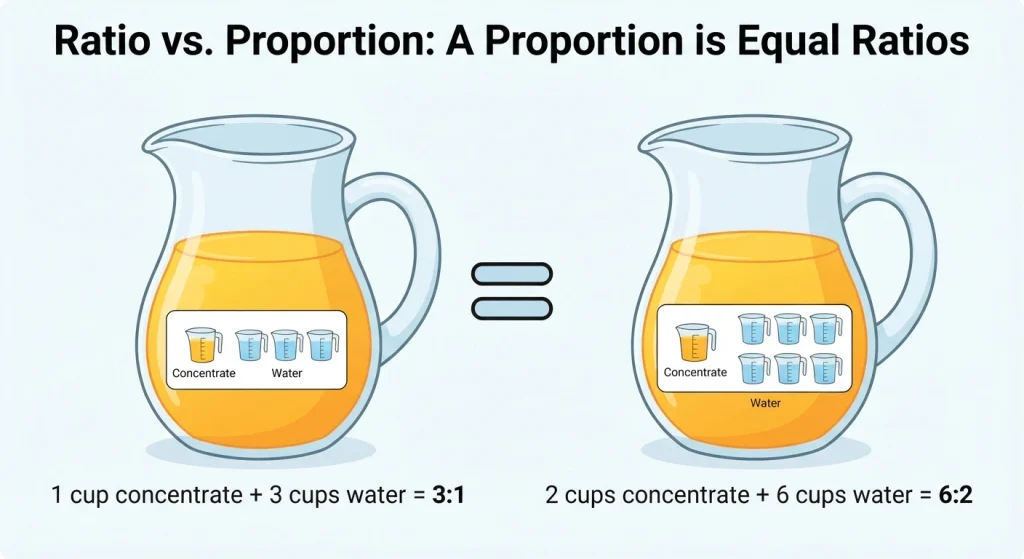
The juice example covers every row of the table. 3:1 is the ratio of water to concentrate. 6:2 is a bigger batch of the same drink, so 3:1 = 6:2 is a proportion. The whole drink is 3 + 1 = 4 cups, so the concentrate is 1/4 of it.
How to Read and Write a Ratio
A ratio can be written three ways: 3:2, 3 to 2, or 3/2. All three are read aloud as “three to two”.
A pencil case holds 3 red pencils and 2 blue pencils.
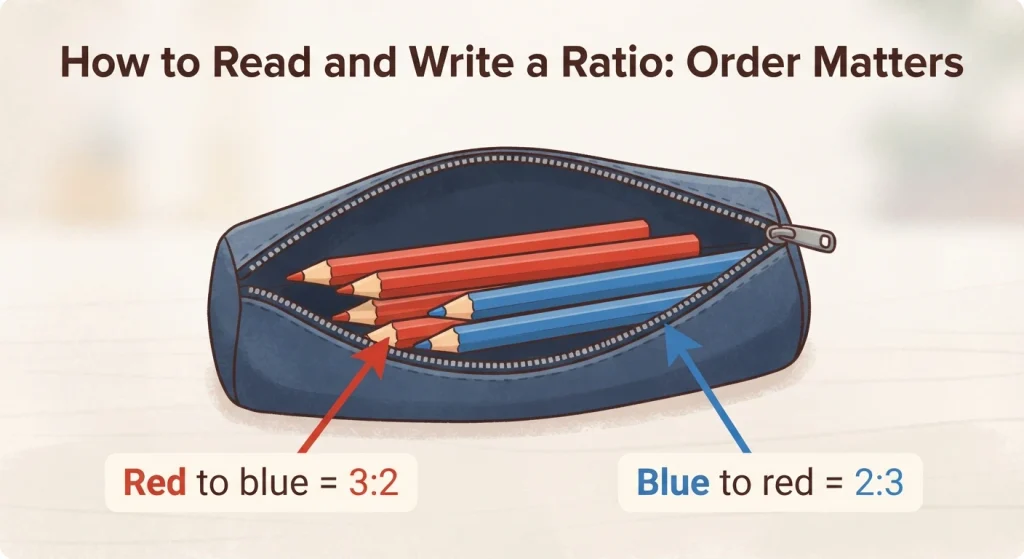
- The ratio of red to blue is 3:2.
- The ratio of blue to red is 2:3.
Order matters because the first number belongs to the first thing named. “Red to blue is 3:2” means for every 3 red pencils there are 2 blue ones. Swap the numbers and you describe a different pencil case, one with fewer red pencils than blue.
The fraction form 3/2 is only a way of writing the comparison. The 3/2 does not mean the red pencils are “3 out of 2”. Say it out loud with your child: “3/2 here means 3 compared with 2.”
Part-to-Part and Part-to-Whole Ratios
A part-to-part ratio compares one group with another group. A part-to-whole ratio compares one group with everything. One fruit bowl shows both.
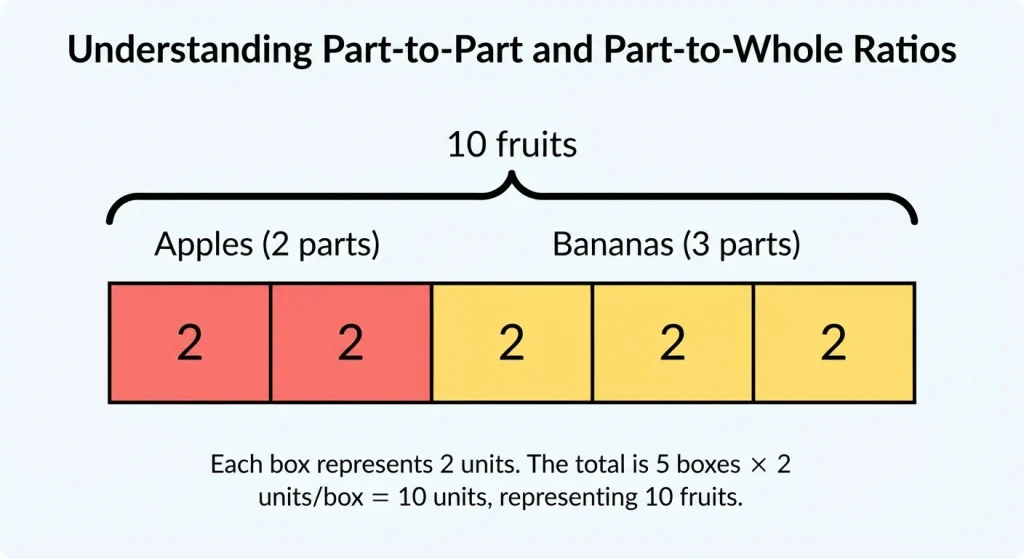
A fruit bowl holds 4 apples and 6 bananas, 10 fruits in all.
- Apples to bananas (part-to-part): 4:6, which simplifies to 2:3.
- Apples to all the fruit (part-to-whole): 4:10, which simplifies to 2:5. Apples are 2/5 of the bowl.
- Bananas to all the fruit (part-to-whole): 6:10, which simplifies to 3:5. Bananas are 3/5 of the bowl.
The two fractions fill the whole bowl: 2/5 + 3/5 = 5/5, worked the same way as adding fractions with like denominators.
So 2:3 does not mean apples are 2/3 of the bowl. To find a fraction of the whole, add the parts first.
Equivalent Ratios: Multiply or Divide Both Parts
Equivalent ratios describe the same comparison with different numbers, such as 2:3, 4:6 and 6:9. Your child makes them by multiplying or dividing both parts by the same number.
A necklace repeats a pattern of 2 red beads and 3 white beads.
| Groups of the pattern | Red beads | White beads | Ratio |
|---|---|---|---|
| 1 | 2 | 3 | 2:3 |
| 2 | 4 | 6 | 4:6 |
| 3 | 6 | 9 | 6:9 |
| 4 | 8 | 12 | 8:12 |
Multiplying keeps the ratio the same because each row adds one more complete group of 2 red and 3 white. A longer necklace made of whole groups has the same pattern, so the comparison stays 2:3. Multiplying both numbers by 4 is a fast way of saying “four groups”.
Adding the same number to both parts breaks the pattern. Add 1 bead of each colour to 2:3 and you get 3:4. Red was 2 beads in every 5 and is now 3 beads in every 7, so the necklace looks different.
The rule is the one your child already uses for equivalent fractions: 2/3 = 4/6 = 6/9 because the top and bottom were multiplied by the same number. A ratio follows the same rule because it is the same kind of comparison.
To simplify a ratio, divide both parts by a number that goes into both. 8:12 divided by 4 gives 2:3. When only 1 divides both parts, the ratio is in simplest form. Spotting shared factors is quicker for a child who knows prime and composite numbers.
[IMAGE: Equivalent ratios diagram: one group of 2 red and 3 white beads, then the same group repeated two, three and four times, labelled 2:3, 4:6, 6:9 and 8:12]
Real Life Examples of Ratio and Proportion
Ratio shows up wherever something is mixed, scaled, shared or priced. Each of the six ratio and proportion examples for kids below is worked in full, so you can repeat it at home. Prices are plain numbers, so they work in any currency.
Example 1: Scaling a Recipe
A pancake recipe for 4 people uses 2 eggs, 250 g of flour and 300 ml of milk. How much of each is needed for 6 people?
6 is not a multiple of 4, so go through 2 people first.
- From 4 people to 2 people, halve everything: 2 eggs become 1 egg, 250 g becomes 125 g, and 300 ml becomes 150 ml.
- From 2 people to 6 people, multiply by 3: 1 egg becomes 3 eggs, 125 g becomes 375 g, and 150 ml becomes 450 ml.
For 6 people: 3 eggs, 375 g of flour and 450 ml of milk.
Check: each amount is the original plus half of it. 2 + 1 = 3, 250 + 125 = 375, and 300 + 150 = 450.
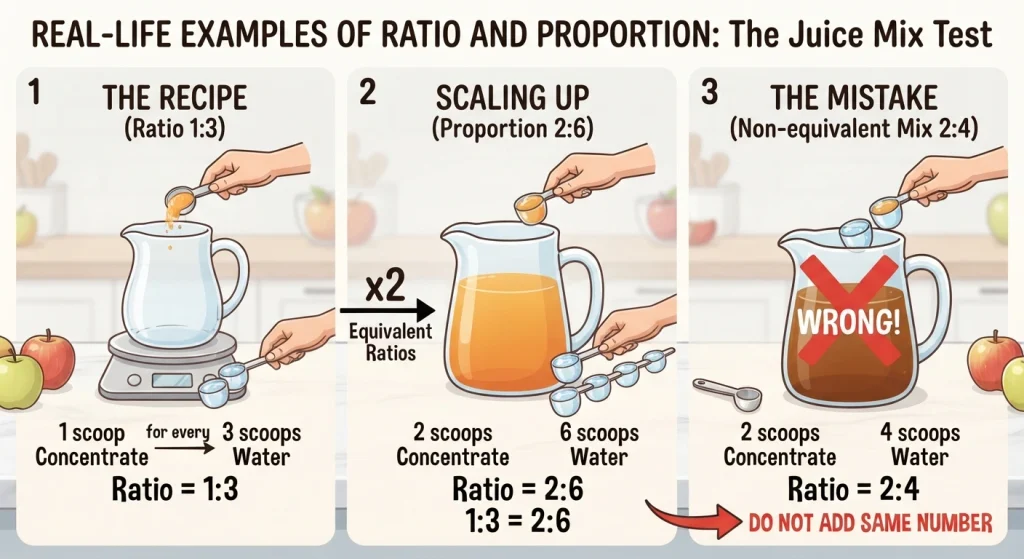
Example 2: Mixing Juice Concentrate
A bottle says to mix 1 part concentrate with 3 parts water. How much of each goes into a 2-litre jug?
- Total parts: 1 + 3 = 4.
- 2 litres is 2,000 ml, so one part is 2,000 ÷ 4 = 500 ml.
- Concentrate is 1 part, so 500 ml. Water is 3 parts, so 3 × 500 = 1,500 ml.
Use 500 ml of concentrate and 1,500 ml of water.
Check: 500 + 1,500 = 2,000 ml, and 500:1,500 divided by 500 is 1:3.
Example 3: Reading a Map Scale
A map scale says 1 cm represents 5 km.
- Two towns are 4 cm apart on the map. The real distance is 4 × 5 = 20 km.
- A road is 35 km long. On the map it is 35 ÷ 5 = 7 cm.
The towns are 20 km apart, and the road is 7 cm long on the map.
Printed maps often give the scale as a ratio, such as 1:100,000. That scale means 1 cm on the map stands for 100,000 cm on the ground. 100,000 cm is 1,000 m, which is 1 km, so every centimetre on that map is one kilometre.
[IMAGE: Map scale illustration: a simple map with two towns joined by a line 4 cm long, a scale bar marked “1 cm = 5 km”, and the label “20 km” along the line]
Example 4: Unit Price for Two Pack Sizes
A 500 g box of cereal costs 150. A 750 g box costs 210. Which is better value?
- Find a weight both boxes divide into: 250 g. 500 g is 2 × 250 g, and 750 g is 3 × 250 g.
- Small box: 150 ÷ 2 = 75 for every 250 g.
- Large box: 210 ÷ 3 = 70 for every 250 g.
The 750 g box is better value: 70 for every 250 g, against 75.
The unit rate per gram agrees: 150 ÷ 500 = 0.30 and 210 ÷ 750 = 0.28. Splitting a price into easy chunks is one of the mental math strategies worth practising.
Example 5: Sharing in a Given Ratio
Ayaan and Mira share 35 stickers in the ratio 3:4. How many does each get?
- Total parts: 3 + 4 = 7.
- One part: 35 ÷ 7 = 5 stickers.
- Ayaan gets 3 × 5 = 15. Mira gets 4 × 5 = 20.
Ayaan gets 15 stickers and Mira gets 20.
Check: 15 + 20 = 35, and 15:20 divided by 5 is 3:4.
[IMAGE: Bar model for sharing 35 stickers in the ratio 3:4: three boxes for Ayaan and four boxes for Mira, each box holding 5, with “35” written over all seven boxes]
Example 6: Speed and Rate
Ravi walks 3 km in 45 minutes. At the same pace, how long does 5 km take?
- Unit rate: 45 ÷ 3 = 15 minutes per km.
- For 5 km: 5 × 15 = 75 minutes.
5 km takes 75 minutes, which is 1 hour 15 minutes.
Check: 3 km in 45 minutes and 5 km in 75 minutes both work out to 15 minutes for each kilometre.
Where Ratio Sits by Grade
Formal ratio lessons usually start in Grade 6 or later, but Grade 5 builds the skills ratio rests on. Placement varies by board and by school, so your child’s own textbook is the final word.
| Curriculum | Formal ratio usually starts | Grade 5 groundwork |
|---|---|---|
| Common Core (US) | Grade 6, standards 6.RP.A.1 to 6.RP.A.3 | Multiplication as scaling, tied to equivalent fractions (5.NF.B.5) |
| NCERT (India) | Class 8 in the current Ganita Prakash books; Class 6 in the older books | Fractions and measurement in Class 5 Maths Mela |
| Singapore MOE | Primary 6 under the 2021 syllabus, moved from Primary 5 | Fractions, percentage and rate |
| NCTB (Bangladesh) | We could not confirm a ratio chapter in Class 5 | Percentage appears in Class 5 |
If your child’s book has no ratio chapter yet, nothing is missing: Grade 5 fraction and scaling work is the groundwork. Some schools introduce ratio in Class 5 anyway, which works well when the lessons build on equivalent fractions.
Common Mistakes With Ratios and How to Fix Them
Most ratio errors come from treating a ratio as two separate numbers instead of one comparison.
Mistake 1: Writing the numbers in the wrong order. With 3 red and 2 blue pencils, a child writes red to blue as 2:3. Fix: Write the words first, “red : blue”, then put each number under its word.
Mistake 2: Reading a part-to-part ratio as a fraction of the whole. Apples to bananas is 2:3, so the child says apples are 2/3 of the bowl. Fix: Add the parts to find the whole first. 2 + 3 = 5, so apples are 2/5.
Mistake 3: Adding the same number to both parts. To double a 2:3 recipe, a child adds 2 to each part and gets 4:5, which is a different mix. Fix: Multiply both parts by the same number. 2:3 doubled is 4:6.
Mistake 4: Comparing amounts in different units. 50 cm of ribbon against 2 m of ribbon is written as 50:2. Fix: Convert first. 2 m is 200 cm, so the ratio is 50:200, which simplifies to 1:4.
Mistake 5: Assuming the bigger pack is cheaper. Fix: Compare the price of the same amount of each pack, as in Example 4.
Try This at Home: The Juice Glass Test
The juice glass test shows a child, in about ten minutes, that multiplying keeps a mix the same and adding does not. The test is a quick way to teach ratios to kids who think “add one of each” is fair.
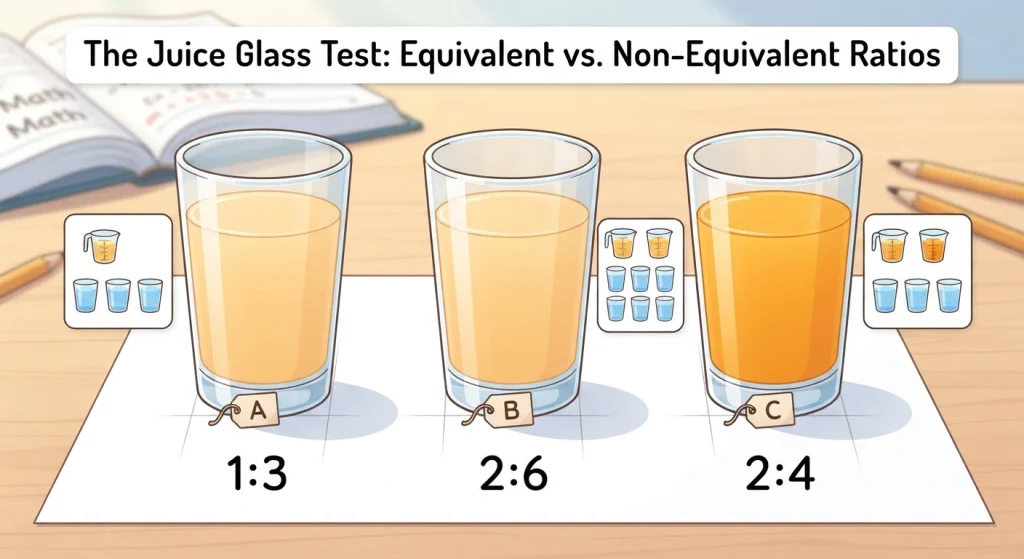
Materials: a coloured juice concentrate or cordial, 3 identical clear glasses, a tablespoon, water, a sheet of white paper, and a pen.
- Label the glasses A, B and C.
- In glass A, put 1 spoon of concentrate and 3 spoons of water (1:3).
- In glass B, put 2 spoons of concentrate and 6 spoons of water (2:6).
- In glass C, take glass A’s recipe and add 1 more spoon to each part: 2 spoons of concentrate and 4 spoons of water (2:4).
- Before stirring, ask your child which two glasses will look and taste the same.
- Stir, hold the glasses in front of the white paper, and compare the colours. Then taste.
Glasses A and B match, because 2:6 is 1:3 with both parts multiplied by 2. Glass C is darker and stronger, because 2:4 simplifies to 1:2, which is more concentrate for each spoon of water.
Ratio Word Problems for Grade 5: Practice Questions
The eight questions below run from easiest to hardest. If your child stalls on the wording, reading the situation instead of hunting for keywords is the habit to build. For more sets, see practice questions by grade.
- A box holds 5 pencils and 7 pens. Write the ratio of pens to pencils.
- Write 15:25 in simplest form.
- Which ratio is equivalent to 2:3? (a) 4:5 (b) 10:15 (c) 3:2
- A class has 12 girls and 18 boys. What fraction of the class are girls?
- A recipe uses 3 cups of flour for every 2 cups of milk. How much milk goes with 9 cups of flour?
- On a map, 1 cm represents 3 km. (a) Two villages are 7 cm apart on the map. How far apart are they really? (b) A road is 18 km long. How long is it on the map?
- A 600 g bag of rice costs 90. A 1 kg bag costs 140. Which is better value?
- In a club, the ratio of boys to girls is 3:5. There are 8 more girls than boys. How many children are in the club?
Answer Key With Reasoning
- Pens are named first, so the ratio is 7:5.
- 5 divides both parts. 15 ÷ 5 = 3 and 25 ÷ 5 = 5, giving 3:5. Only 1 divides both 3 and 5, so 3:5 is in simplest form.
- (b) 10:15. Multiplying both parts of 2:3 by 5 gives 10:15. Option (a) adds 2 to each part, which changes the ratio. Option (c) reverses the order.
- The class has 12 + 18 = 30 children, so girls are 12/30. Dividing the top and bottom by 6 gives 2/5.
- The flour goes from 3 cups to 9 cups, which is 3 times as much. The milk is 2 × 3 = 6 cups.
- (a) 7 × 3 = 21 km. (b) 18 ÷ 3 = 6 cm.
- Compare the price of 100 g. 600 g is 6 × 100 g, so 90 ÷ 6 = 15. 1 kg is 1,000 g, which is 10 × 100 g, so 140 ÷ 10 = 14. The 1 kg bag is better value.
- Boys are 3 parts and girls are 5 parts, so girls have 2 more parts. Those 2 parts are 8 children, so 1 part is 4 children. Boys: 3 × 4 = 12. Girls: 5 × 4 = 20. The club has 32 children. Check: 20 − 12 = 8, and 12:20 simplifies to 3:5.
- Ratio in Early Competition Problems
Olympiad-style ratio questions read like ordinary proportion word problems, but each hides a quantity that stays fixed. Both problems below are original and pitched at Grades 5 and 6.
Problem 1. A jar holds red and blue beads in the ratio 2:1. After 6 blue beads are added, the jar has equal numbers of red and blue beads. How many red beads are in the jar?
Solution. Draw red as 2 boxes and blue as 1 box. The red beads never change. Adding 6 blue beads makes blue match red, so the 6 beads fill exactly one box. One box is 6 beads, and red is 2 × 6 = 12 red beads. Check: before, 12 red and 6 blue is 2:1. After, 12 red and 12 blue are equal.
Problem 2. Tom and Sara have stickers in the ratio 3:2. Tom gives Sara 5 stickers, and the ratio becomes 2:3. How many stickers do they have altogether?
Solution. The total never changes, because stickers only move between the two children. Both ratios have 5 parts in total (3 + 2 and 2 + 3), so one part is the same size before and after. Tom drops from 3 parts to 2, losing 1 part, and he gave away 5 stickers. One part is 5 stickers, so the total is 5 × 5 = 25 stickers. Check: before, 15 and 10 is 3:2. After, 10 and 15 is 2:3.
Both problems reward asking “what stays the same?” before calculating. For more, try these sample math olympiad questions by grade and the four-step method for olympiad problems.
Make Preparing for Math Olympiad Simple!


Is ratio and proportion taught in 5th grade?
Usually not as a full unit. Under Common Core, formal ratio starts in Grade 6, and NCERT’s current books place their ratio chapters in Class 8. Grade 5 builds the base through equivalent fractions and multiplication as scaling, and some schools introduce ratio earlier.
What is the difference between a ratio and a fraction?
A fraction compares a part with the whole, while a ratio can also compare one part with another part. In a bowl of 4 apples and 6 bananas, the ratio of apples to bananas is 2:3, but apples are 2/5 of the bowl. A part-to-whole ratio and a fraction say the same thing.
How do I explain ratio to my child in a simple way?
Use the words “for every”. “For every 1 cup of concentrate we use 3 cups of water” is the ratio 1:3. Then double the jug and ask your child what happens to both numbers.
Is a ratio the same as a rate?
A rate is a ratio between two different kinds of quantity, such as kilometres and hours. A unit rate gives the amount for exactly one of the second quantity, such as 15 minutes per kilometre. Every rate is a ratio, but a ratio such as 3 red beads to 2 white beads is not a rate.
Can a ratio have more than two numbers?
Yes. A trail mix of 2 cups of nuts, 3 cups of raisins and 1 cup of seeds has the ratio 2:3:1. The same rule applies: multiply or divide every part by the same number.
Should my child use cross-multiplication for proportions?
Not yet. Cross-multiplication is a shortcut your child will meet in later grades. In Grade 5, finding the multiplier between two ratios, or working out one part first, builds the understanding that makes the shortcut make sense later.
Can a ratio be turned into a percentage?
Yes, once you know the whole. In juice mixed 1 part concentrate to 3 parts water, the concentrate is 1 part out of 4, which is 1/4, or 25%. Turning 1:3 straight into 1/3 is the slip to watch for.
Conclusion
A ratio is a comparison that stays constant when both parts are multiplied or divided by the same number (e.g., $2:3 = 4:6$).
By asking “for every how many?” and using everyday items like juice or beads, kids easily grasp this core concept early—setting them up for success with unit rates, percentages, and scale drawings in Grade 6 and beyond.

Mikha Piregu is a Content Writer with experience spanning educational content, including math and math olympiad topics, as well as advocacy writing, research-based articles, and SEO-driven web content. He creates high-quality blog content, web copy, and feature articles that support brand visibility, audience engagement, and long-term organic growth through data-informed storytelling. Skilled in WordPress, WooCommerce, and modern digital tools, Mikha adapts content across various platforms, including blogs, websites, campaigns, and advocacy initiatives, with clarity and purpose.

There are no comments posted here yet.
Sign in to leave a comment