


Triangles are three-sided geometric shapes whose interior angles always add up to 180°. They are classified into six main types based on the lengths of their sides and the size of their angles.
Three types are named by the sides: equilateral, isosceles and scalene. Three are named by the angles: acute, right and obtuse.
- What Is a Triangle?
- How Are Triangles Classified? Two Lenses, One Shape
- Types of Triangles Based on Sides
- Types of Triangles Based on Angles
- The Triangle Combination Matrix
- The Angle Sum Property of a Triangle
- How to Identify the Type of a Triangle
- Types of Triangles in Real Life
- Common Mistakes Students Make About Triangles
- Eight Hands-On Activities to Teach Triangle Types
- Tips for Parents Teaching Triangles at Home
- Tips for Teachers Delivering the Lesson
- Triangles in Math Olympiad Problems
- Practice Questions with Answers
- Conclusion
Once your child sees that, triangle classification stops being vocabulary and starts being reasoning, and it becomes one of the most useful early wins in geometry for kids.
This guide walks through the types of triangles in maths one lens at a time, shows you exactly how the two systems combine, works through the angle sum property, and gives you the activities and teaching tips to make it stick at home or in the classroom.
What Is a Triangle?
A triangle is a closed figure made of three straight line segments joined end to end. The name says it: tri means three, and a triangle has three angles.
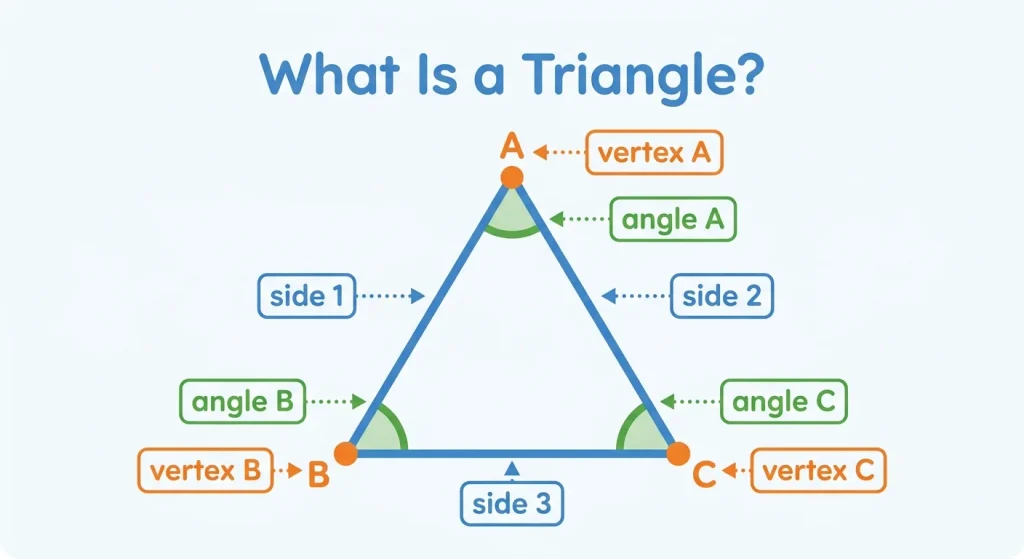
The Three Parts of Every Triangle
Before your child can classify triangles, they need three words, and they need them in their own language, not as textbook definitions.
- Sides. The three straight lines that make the shape. If you trace the outline with a finger without lifting it, you travel along all three sides and come back to where you started.
- Vertices. The three corners where two sides meet. One corner is a vertex, two or more are vertices. Vertices are usually labelled with capital letters, so a triangle with corners A, B and C is called triangle ABC.
- Angles. The amount of turn at each corner, measured in degrees. If your child is still shaky on acute, right and obtuse angles, settle the types of angles first. The angle at vertex A is written as angle A. Three sides, three vertices, three angles, always.
Properties That Every Triangle Shares
Whatever type it is, every triangle follows the same rules. These are the properties of triangles that never change.
- It has exactly three sides, three vertices and three interior angles.
- The three interior angles always add up to 180 degrees. This is the angle sum property, and it is the single most useful fact about triangles.
- The sum of any two sides is always greater than the third side. Try to build a triangle from straws of 3 cm, 4 cm and 10 cm and the two short straws will never reach each other.
- The longest side is always opposite the largest angle, and the shortest side is always opposite the smallest angle. This is the quiet link between the two classification systems, and it is worth saying out loud early.
- A triangle can have at most one right angle or one obtuse angle, never two of either. Two angles of 90 degrees would already use up the full 180 degrees, leaving nothing for the third.
How Are Triangles Classified? Two Lenses, One Shape
Here is the idea that makes everything else easier.
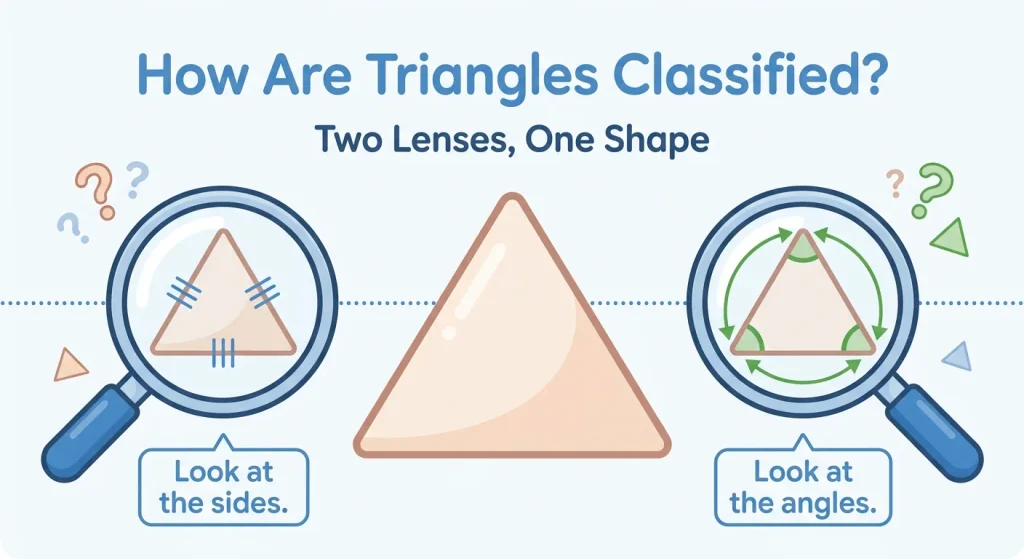
Imagine your child is holding a paper triangle. You ask the first question: how many of its sides are equal? That question has exactly three possible answers, all three, exactly two, or none, and those answers give the three side-based names.
Now ask a completely different question about the same piece of paper: what is the biggest angle inside it? That question also has exactly three possible answers, less than 90 degrees, exactly 90 degrees, or more than 90 degrees, and those give the three angle-based names.
Neither question cancels the other. Both are true at the same time. A triangle is not “either isosceles or right-angled”, it is both an isosceles something and a something right-angled. Triangle classification works like describing a person by height and by hair colour.
Tall and short are on one scale, dark and fair are on another, and every person has a value on both.
So when your child is asked “what type of triangle is this?”, the complete answer usually has two words in it. We will build to that in the combination matrix. First, each lens on its own.
Types of Triangles Based on Sides
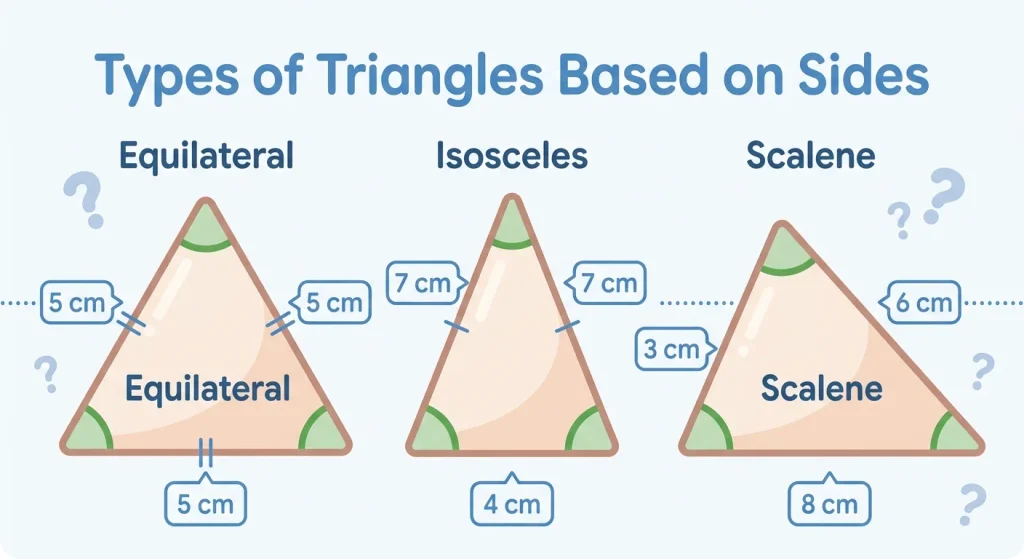
The first lens counts equal sides. Small tick marks on a diagram show which sides are equal: sides with one tick match each other, sides with two ticks match each other.
Equilateral Triangle
An equilateral triangle has all three sides equal in length.
The name helps. Equi means equal and lateral means side, so equilateral means equal sides.
Properties:
- All three sides are the same length.
- All three angles are equal, and because they must add to 180 degrees, each one is exactly 60 degrees. That is 180 divided by 3.
- It has three lines of symmetry. Fold it along a line from any corner to the middle of the opposite side and the two halves match.
- It looks the same whichever way up you turn it.
What it looks like: a perfectly balanced triangle, three equal sides, three tick marks, three 60 degree corners.
In real life: the yield sign on Indian roads, pointing downward. Also the triangular face of a samosa when it is pressed into a regular shape, and the flat musical triangle used in school bands.
Isosceles Triangle
An isosceles triangle has exactly two sides of equal length.
Properties:
- Two sides are equal. These are often called the legs, and the third side is the base.
- The two angles opposite the equal sides are equal. These are the base angles. This matters more than it looks: if your child knows one base angle, they know the other for free.
- It has one line of symmetry, running from the top vertex straight down to the middle of the base.
- The third angle, at the top, can be anything, which is why isosceles triangles come in tall thin versions and wide squat versions.
What it looks like: a triangle that would fold neatly in half down the middle, with two tick marks on the two matching sides.
In real life: a slice of pizza cut from a round pizza, the two equal slanting sides of a simple house roof, and a clothes hanger.
Scalene Triangle
A scalene triangle has no equal sides. All three sides are different lengths.
Properties:
- All three sides are different.
- All three angles are different, which follows directly, because the longest side faces the largest angle.
- It has no lines of symmetry at all.
- Most triangles you draw by accident are scalene. It is the ordinary case, not the odd one.
What it looks like: a lopsided triangle with no two sides matching and nothing neat about it.
In real life: a sail on a sailing boat, a piece of land in an irregular plot, the triangular shape of a slice cut randomly from a chapati.
Sides Comparison Table
| Type | Equal sides | Equal angles | Lines of symmetry | Quick check |
|---|---|---|---|---|
| Equilateral | All 3 | All 3, each 60 degrees | 3 | Every side the same |
| Isosceles | Exactly 2 | The 2 base angles | 1 | Two sides match, one differs |
| Scalene | None | None | 0 | Every side a different length |
Types of Triangles Based on Angles
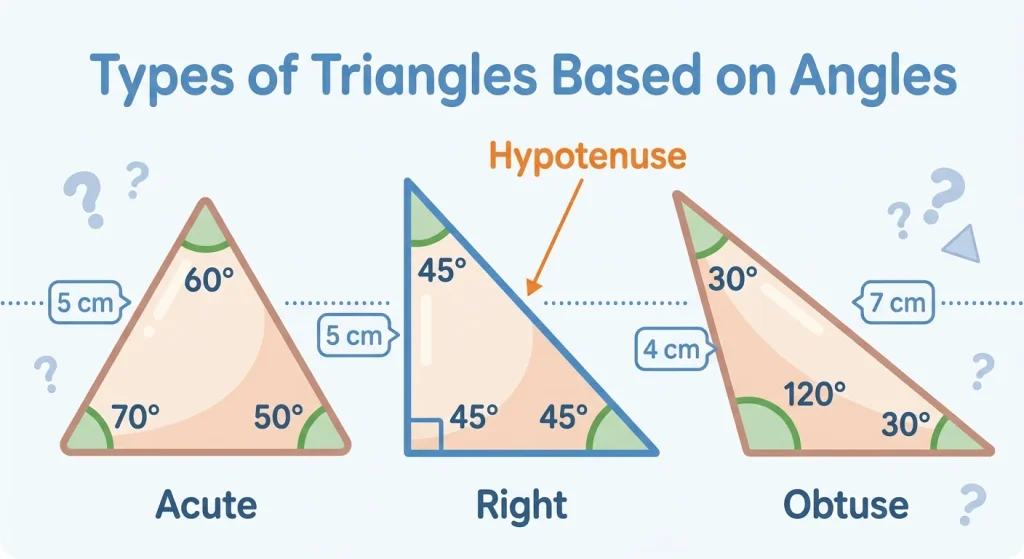
The second lens ignores side lengths entirely and looks only at the biggest angle inside the triangle.
This is where a firm grip on types of angles pays off. If your child is not yet confident with degrees, use the corner of a book or a sheet of paper as a right-angle tester before starting this section.
Acute Triangle
An acute-angled triangle has all three angles less than 90 degrees.
Properties:
- Every one of the three angles is smaller than a right angle.
- Because all three are under 90 and they must total 180, the angles tend to cluster around 60. Something like 50, 60 and 70 degrees.
- It looks compact, with no corner that opens out wide and no square corner.
What it looks like: a tidy triangle where no corner looks wider than the corner of a book.
In real life: the triangular face of a slice of watermelon cut narrow, and the acute triangles formed inside a geodesic dome.
Right Triangle
A right-angled triangle has exactly one angle of 90 degrees.
Properties:
- One angle is exactly 90 degrees. It is marked with a small square instead of an arc.
- The other two angles must add up to 90 degrees, since 180 minus 90 is 90. That means both are acute.
- The side directly opposite the right angle is the longest side of the triangle, and it has a special name: the hypotenuse. Teach this word here, even in Class 4 or 5. It costs nothing now and saves confusion later.
- A triangle can have only one right angle.
What it looks like: a triangle with one perfectly square corner, marked with a tiny square, and the longest side stretching across from it.
In real life: a set square from a geometry box, the triangle formed by a ladder leaning against a wall with the ground, and the cross section of a wheelchair ramp.
Obtuse Triangle
An obtuse-angled triangle has one angle greater than 90 degrees.
Properties:
- Exactly one angle is more than 90 degrees and less than 180 degrees.
- The other two angles are always acute and small, because the obtuse angle has already taken more than half of the 180 degrees.
- It looks stretched out and flat, leaning to one side.
- A triangle can have only one obtuse angle.
What it looks like: a wide, flattened triangle with one corner opened out well past the corner of a book.
In real life: the triangle made by a reclining chair’s back, seat and the floor, and the flat triangular shape of a hand fan opened wide.
Angles Comparison Table
| Type | Largest angle | Other two angles | Special feature | Quick check |
|---|---|---|---|---|
| Acute | Less than 90 degrees | Both acute | No square corner anywhere | All corners narrower than a book corner |
| Right | Exactly 90 degrees | Add to 90 degrees | Has a hypotenuse opposite the right angle | One corner matches a book corner exactly |
| Obtuse | More than 90 degrees | Both acute and small | Looks flattened | One corner wider than a book corner |
The Triangle Combination Matrix
This is the part that most guides skip, and it is the part that turns a list into understanding.
Every triangle has one name from the sides list and one name from the angles list. Put the two together and you get the full description: a scalene right triangle, an isosceles obtuse triangle, an equilateral acute triangle.
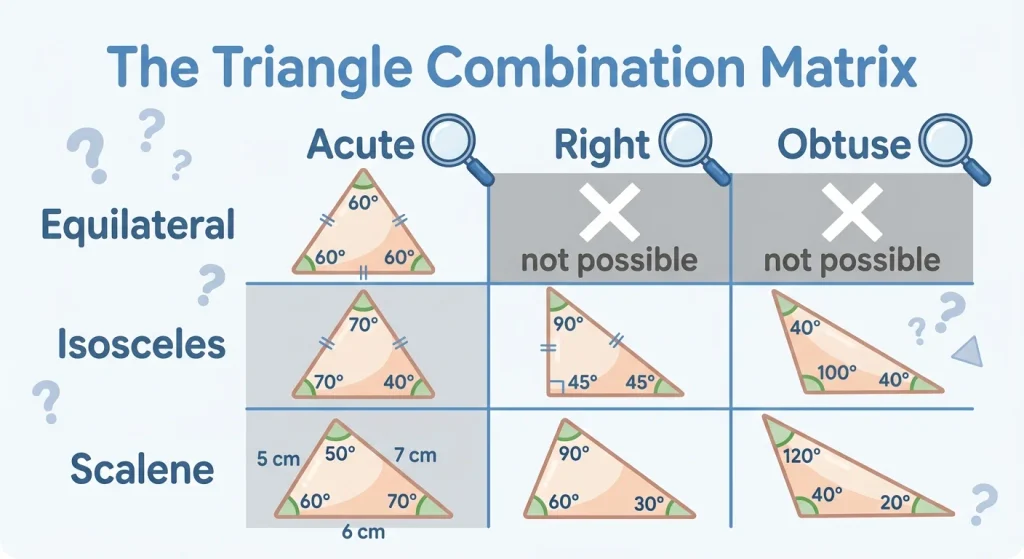
There are nine possible pairings on paper. Only seven of them can actually exist.
The Seven Possible Triangles
| Acute | Right | Obtuse | |
|---|---|---|---|
| Equilateral | Yes, always (60, 60, 60) | Impossible | Impossible |
| Isosceles | Yes (70, 70, 40) | Yes (90, 45, 45) | Yes (100, 40, 40) |
| Scalene | Yes (50, 60, 70) | Yes (90, 60, 30) | Yes (120, 40, 20) |
Read the matrix with your child row by row. An isosceles triangle can be acute, right or obtuse, because its top angle is free to be anything. A scalene triangle can also be all three. The equilateral row is the interesting one, because two of its boxes are closed.
Why Two Combinations Are Impossible
An equilateral triangle can never be right-angled. In an equilateral triangle all three angles are equal, and three equal angles adding to 180 degrees must be 60 degrees each. Sixty is not ninety. There is no room to negotiate.
An equilateral triangle can never be obtuse for exactly the same reason. Each angle is locked at 60 degrees, which is less than 90. So the only honest thing to say about an equilateral triangle is that it is always an acute triangle.
Ask your child the reverse question too, because it is the one Olympiad papers like: can a right-angled triangle be equilateral? No, because its 90 degree angle leaves only 90 degrees for the other two, so they cannot both be 90 as well. Can a right-angled triangle be isosceles? Yes, and there is only one shape it can take, 90, 45 and 45.
When a child can say “this is a scalene obtuse triangle” and explain both halves of that name, they have understood triangle classification properly.
The Angle Sum Property of a Triangle
The angle sum property says that the three interior angles of any triangle add up to 180 degrees. Any triangle, every time, no exceptions.
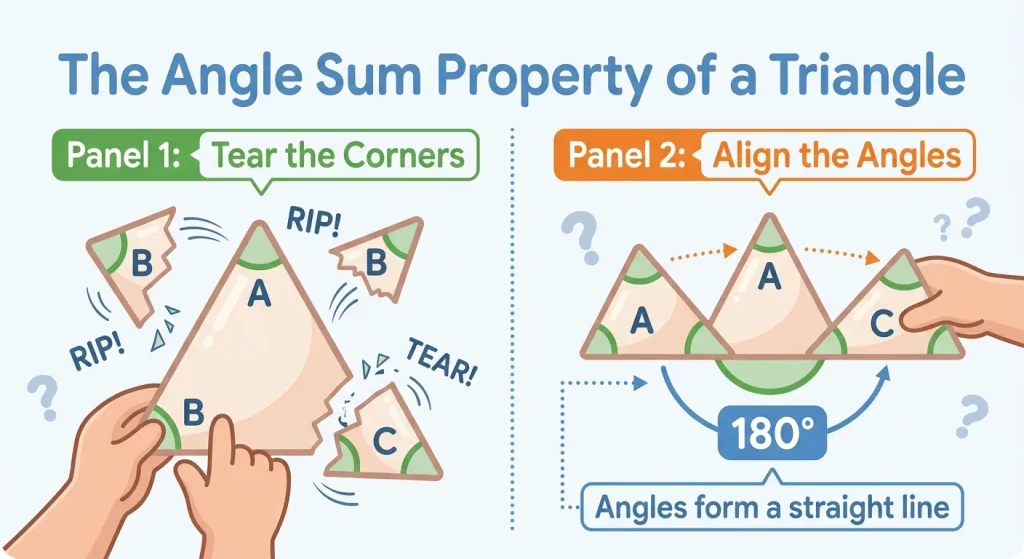
In the CBSE and NCERT sequence, children classify triangles by sides and angles around Class 6, and the angle sum property is stated and used formally in Class 7. That said, it is worth introducing it earlier, informally, the moment a child starts classifying triangles, because it is what makes classification checkable instead of guessable.
Show it before you state it. Cut a paper triangle, tear off all three corners, and place the three torn corners together so their points touch. They form a straight line every single time. A straight line is 180 degrees. That is the proof a nine year old actually believes.
Worked Examples
Example 1. Two angles of a triangle are 60 degrees and 80 degrees. Find the third.
180 minus 60 is 120. 120 minus 80 is 40. The third angle is 40 degrees. All three angles are under 90, so this is an acute triangle. All three are different, so it is scalene. Full name: scalene acute triangle.
Example 2. A right-angled triangle has one angle of 35 degrees. Find the third angle.
The right angle is 90 degrees. 180 minus 90 is 90. 90 minus 35 is 55. The third angle is 55 degrees. The angles are 90, 35 and 55, all different, so this is a scalene right triangle.
Example 3. An isosceles triangle has a top angle of 100 degrees. Find the two base angles.
The two base angles are equal. 180 minus 100 is 80, and that 80 is shared equally between them. 80 divided by 2 is 40. Each base angle is 40 degrees. One angle is above 90 degrees, so this is an isosceles obtuse triangle.
Notice what happened in all three examples. The angle sum property did not just find a missing number, it told us the triangle’s full type. That is the habit to build.
How to Identify the Type of a Triangle
Here is a procedure your child can run on any triangle, whether they are given side lengths, angle measures, or a diagram.
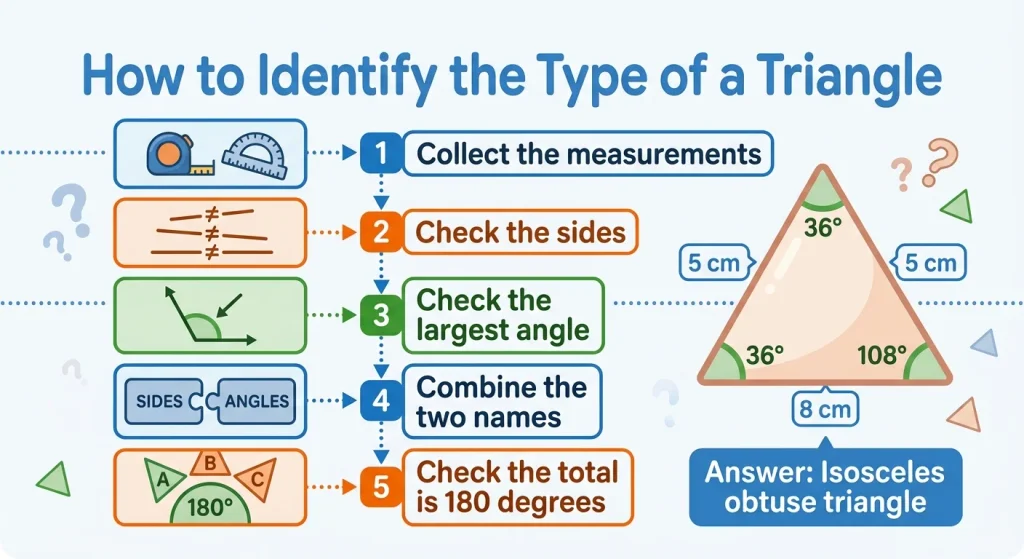
Step 1. Collect what you are given. Write down the three side lengths or the three angles. If only two angles are given, use the angle sum property to find the third before going further.
Step 2. Apply the sides lens. Compare the three side lengths. All three equal means equilateral. Exactly two equal means isosceles. None equal means scalene. If no side lengths are given, use the angles instead: three equal angles means equilateral, two equal angles means isosceles, three different angles means scalene.
Step 3. Apply the angles lens. Find the largest angle. If it is less than 90 degrees, the triangle is acute. If it is exactly 90 degrees, it is right-angled. If it is more than 90 degrees, it is obtuse.
Step 4. Combine the two names. Say the side name and the angle name together, for example “isosceles right triangle”. The side name usually comes first.
Step 5. Check your answer against the rules. Do the three angles total 180 degrees? Did you end up calling it an equilateral right triangle or an equilateral obtuse triangle? If so, something is wrong, because neither exists.
Try it. A triangle has sides 5 cm, 5 cm and 8 cm, and its angles are 36, 36 and 108 degrees. Step 2 gives isosceles, two sides match. Step 3 gives obtuse, the largest angle is 108. The answer is an isosceles obtuse triangle, and 36 plus 36 plus 108 is 180, so the check passes.
Types of Triangles in Real Life
Triangles are everywhere, and not by accident.
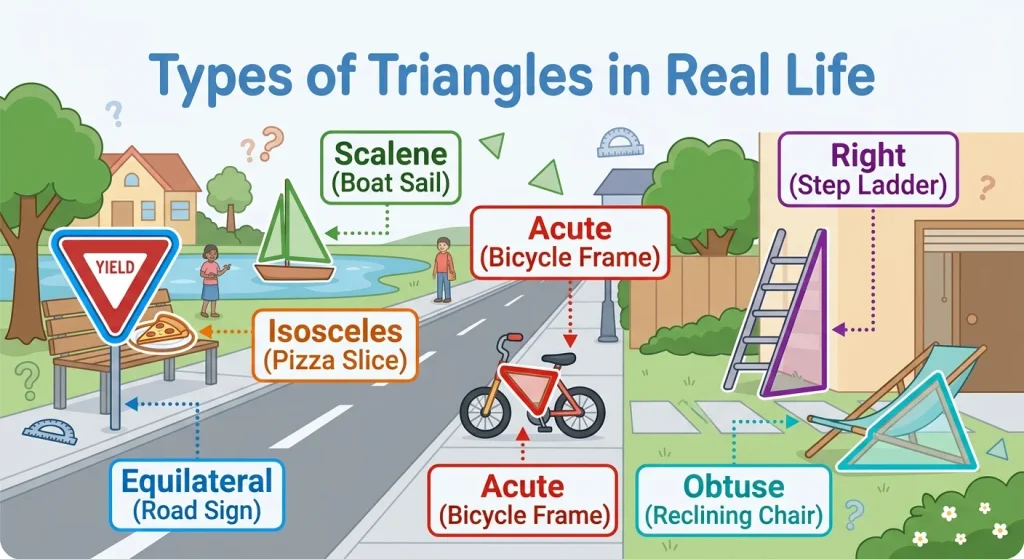
A triangle is the only polygon that cannot be pushed out of shape without breaking or bending a side. Push a square and it collapses into a rhombus. Push a triangle and it holds. That is why builders and engineers reach for them.
| Type | Where you see it |
|---|---|
| Equilateral | Yield road signs, the musical triangle instrument, warning signs on highways |
| Isosceles | Pizza slices, simple roof trusses, clothes hangers, the sides of a tent |
| Scalene | Boat sails, irregular plots of land, mountain profiles |
| Acute | Geodesic domes, the narrow triangles in a bicycle frame |
| Right | Set squares, staircases and ramps, the corner braces in furniture |
| Obtuse | A reclining chair against the floor, an opened hand fan, flat roof overhangs |
Take a walk around the house with your child and name the triangles you find with both words. The roof truss is not just “a triangle”, it is an isosceles acute triangle. The ramp is a scalene right triangle. Ten minutes of this does more for classification than a page of exercises.
Common Mistakes Students Make About Triangles
Mistake 1: treating equilateral as the default triangle. Many children picture a neat equal-sided triangle whenever they hear the word. Then a long thin scalene triangle appears in a question and they do not recognise it as a triangle at all. Fix: draw ten wildly different triangles on one sheet, including very flat and very thin ones, and have your child confirm that all ten are triangles.
Mistake 2: confusing isosceles with scalene. The two sound similar and both have “unequal” somewhere in the definition. Fix: one rule, counted out loud. Isosceles has exactly two equal sides, scalene has zero. Count the tick marks on the diagram.
Mistake 3: thinking the two classification systems are rival answers. A child asked to name a triangle says “it is right-angled”, stops, and loses the other half of the mark. Fix: insist on the two-word answer every single time, even when one word would do.
Mistake 4: only recognising triangles that sit flat on their base. Rotate a right-angled triangle so the square corner is at the top and many children no longer see it. This is a spatial understanding gap rather than a triangle gap. Fix: cut one triangle from card and rotate it slowly through a full turn, asking at each position what type it is. The answer never changes.
Mistake 5: believing a triangle can have two right angles or two obtuse angles. Fix: go back to 180 degrees. Two right angles use up the whole budget and leave nothing for the third corner, so the shape cannot close.
Eight Hands-On Activities to Teach Triangle Types
All of these use paper, string, straws or things already in the house.
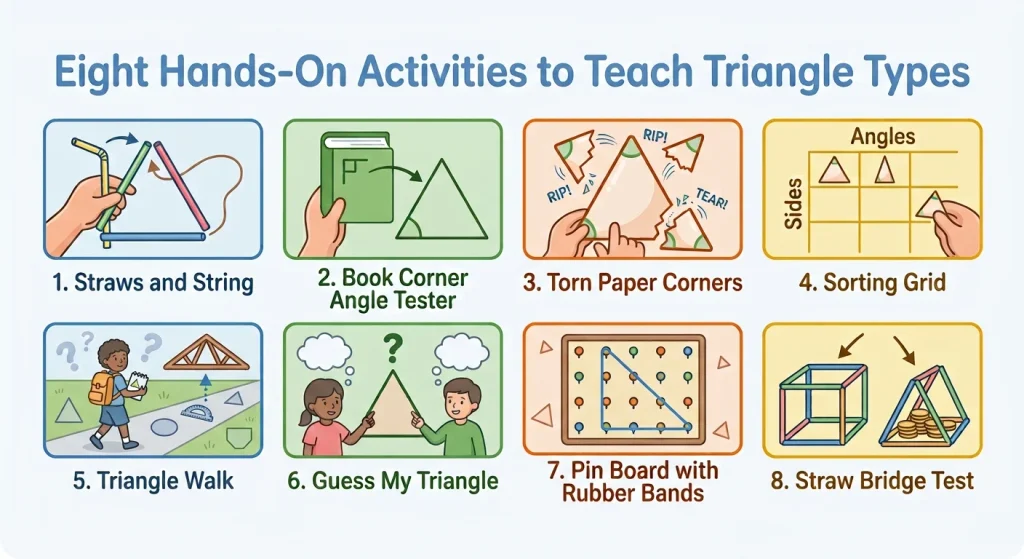
1. The straw triangle box. Cut drinking straws into lengths of 4, 6, 8 and 10 cm, several of each. Thread string through three straws and tie to make a triangle. Challenge: build one equilateral, one isosceles and one scalene triangle. Then try 4, 4 and 10, which refuses to close, and talk about why.
2. Corner-of-a-book angle hunt. Use the corner of any book as a right angle tester. Hold it against each corner of a drawn triangle. Fits exactly means right, corner is narrower means acute, corner is wider means obtuse. No protractor needed.
3. Torn corners proof. Cut any paper triangle, tear off the three corners, arrange the three points touching on a line. They always form a straight line. Repeat with a completely different triangle to show it is not a fluke.
4. Two-word triangle sort. Draw or print twelve assorted triangles. Make a three by three grid on a sheet, sides down the left and angles across the top. Place each triangle in its matrix box. The two empty equilateral boxes make the lesson themselves.
5. Triangle walk. Twenty minutes around the house or the street, photographing or sketching every triangle found. Label each with both names. Roof, ramp, hanger, road sign, bicycle frame.
6. Guess my triangle. One person secretly picks a triangle type. The other asks only yes or no questions: do you have any equal sides, is your biggest angle more than ninety degrees. This forces classification by property rather than by look.
7. Geoboard or pin board. Hammer nails into a board in a grid, or use a cardboard sheet with pins, and stretch rubber bands into triangles. Ask for a right isosceles triangle, then a scalene obtuse one. Rubber bands make rebuilding fast, so children try many more examples than they would on paper.
8. Build the strongest bridge. Give equal straws and tape to two teams, one allowed only squares, the other allowed triangles. Load both with coins until they fail. The triangle team wins, and the lesson about rigidity never has to be stated.
Tips for Parents Teaching Triangles at Home
- Teach one lens at a time. Finish sides completely, then start angles. Mixing both on day one is where the confusion comes from.
- Say the two-word name yourself in ordinary conversation. “That road sign is an equilateral acute triangle.” Children copy the sentences they hear.
- Let your child draw badly on purpose. Lopsided triangles are scalene triangles, and drawing them deliberately kills the idea that triangles must look neat.
- Do not rush to the protractor. When you do bring one out, spend a session on how to use a protractor properly first. The corner of a book settles most angle questions at this stage, and it keeps attention on classification rather than measurement.
- When an answer is wrong, ask which lens they used. Nine times out of ten they applied the right rule to the wrong feature, which is a much easier thing to fix than it looks.
Tips for Teachers Delivering the Lesson
- Open with the sorting activity, not the definitions. Hand out mixed triangles and ask the class to group them however they like. Several groups will sort by sides and several by angles, and that disagreement is your entire lesson hook.
- Put the three by three matrix on the board on day one and leave it up. Fill boxes as you teach rather than revealing it at the end.
- Use non-standard orientations in every example set. Textbook diagrams almost always sit flat on a base, so your examples should not.
- Ask for impossible triangles as a deliberate task. “Draw an equilateral right triangle” produces more mathematical argument than any correct exercise will.
- Introduce the hypotenuse early and use it consistently, so the word is familiar long before the Pythagoras theorem arrives.
- Make the angle sum property a checking tool, not a separate topic. Every classification answer should end with a quick total to 180 degrees.
Triangles in Math Olympiad Problems
Math Olympiad questions almost never ask “what type is this triangle?” directly. They give one or two properties and expect the student to deduce the rest. The reasoning is the same reasoning the combination matrix builds.
A typical Class 5 or 6 level question might say: a triangle has two equal sides and one angle of 90 degrees, so what are the other two angles? A child who knows that isosceles means two equal base angles and that the remaining 90 degrees splits evenly answers 45 and 45 in a few seconds. A child who memorised six definitions as a list has nothing to work with.
Other classic patterns at this level:
- Given one angle of an isosceles triangle, find the rest. There are often two valid cases, depending on whether the given angle is the top angle or a base angle, and spotting both cases is the real test.
- Counting how many triangles of a given type appear inside a larger figure.
- Being asked whether a described triangle can exist at all. Can a triangle have angles of 100 and 95 degrees? No, because those two alone exceed 180.
- Using the longest side opposite the largest angle rule to rank sides without measuring anything.
The habit that carries into competition maths is this, and it sits at the centre of how to solve math olympiad problems: never stop at one property. Keep asking what else follows from what you already know. Triangle classification is the first place in a child’s maths education where that habit can be built properly.
Practice Questions with Answers
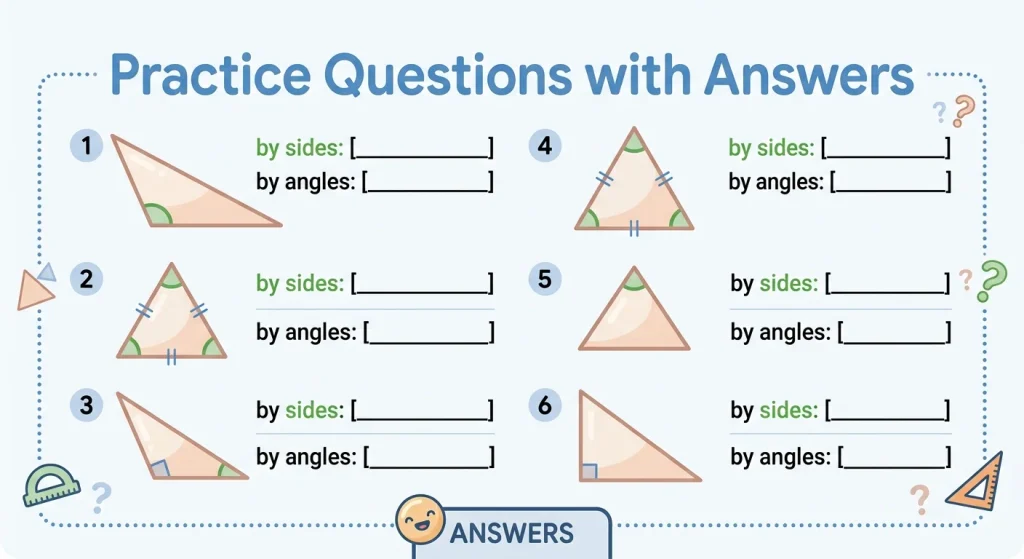
- A triangle has sides 7 cm, 7 cm and 7 cm. Name it using both lenses.
- Two angles of a triangle are 45 degrees and 45 degrees. What is the third angle, and what type of triangle is it?
- Can a triangle have two obtuse angles? Explain.
- A triangle has angles 30, 60 and 90 degrees. Give its full two-word name.
- An isosceles triangle has a base angle of 70 degrees. Find the top angle.
- Which side is the hypotenuse in a right-angled triangle?
- A triangle has sides 6 cm, 9 cm and 11 cm. Classify it by sides.
- One angle of a triangle is 110 degrees and another is 35 degrees. Find the third angle and name the triangle fully.
- True or false: every equilateral triangle is also an acute triangle.
- Can a scalene triangle have a right angle? Give an example if yes.
Answers
- Equilateral by sides, and acute by angles, since each angle is 60 degrees. Equilateral acute triangle.
- 180 minus 45 minus 45 is 90. The third angle is 90 degrees, so it is an isosceles right triangle.
- No. Two angles above 90 degrees already total more than 180 degrees, so the third angle would have no room and the shape could not close.
- Scalene right triangle. All three angles differ, so all three sides differ, and one angle is exactly 90 degrees.
- Both base angles are 70 degrees, so they total 140. 180 minus 140 is 40. The top angle is 40 degrees.
- The side opposite the right angle, which is also the longest side.
- All three sides are different, so it is scalene.
- 180 minus 110 minus 35 is 35. The third angle is 35 degrees. Two angles are equal, so it is isosceles, and one angle is above 90, so it is obtuse. Isosceles obtuse triangle.
- True. All three angles are 60 degrees, which is less than 90.
- Yes. A triangle with angles 90, 60 and 30 degrees has three different angles and therefore three different sides, so it is a scalene right triangle.
Make Preparing for Math Olympiad Simple!


What are the types of triangles in maths?
There are six types of triangles in maths, grouped by two systems. By sides there are equilateral, isosceles and scalene triangles. By angles there are acute, right and obtuse triangles. Every triangle has one name from each group, so a complete description uses two words, such as scalene right triangle.
How are triangles classified by sides and angles?
By sides, count how many sides are equal: three equal sides is equilateral, exactly two is isosceles, none is scalene. By angles, look at the largest angle: under 90 degrees is acute, exactly 90 degrees is right, over 90 degrees is obtuse. Apply both tests to the same triangle to get its full name.
What is the angle sum property of a triangle?
The three interior angles of any triangle add up to 180 degrees. If two angles are known, subtract their total from 180 to find the third.
Can a triangle be both isosceles and right-angled?
Yes. An isosceles right triangle has angles of 90, 45 and 45 degrees. It is the only shape an isosceles right triangle can take.
Why can an equilateral triangle never be a right triangle?
All three angles of an equilateral triangle are equal, and three equal angles summing to 180 degrees must be 60 degrees each. Since 60 is not 90, an equilateral triangle is always acute.
What is the hypotenuse?
The hypotenuse is the side opposite the right angle in a right-angled triangle. It is always the longest side of that triangle.
How many types of triangles are possible when you combine both systems?
Seven. Equilateral triangles can only be acute, while isosceles and scalene triangles can each be acute, right or obtuse.
At which Class do students learn types of triangles?
Children recognise and name triangles from the earliest primary classes, usually alongside the other geometrical shapes taught in Class 1. Formal classification by sides and by angles appears around Class 6 in the CBSE and NCERT sequence, with the angle sum property stated and applied in Class 7. Many schools and Olympiad programmes introduce both earlier.
What is the difference between isosceles and scalene triangles?
An isosceles triangle has exactly two equal sides and two equal angles. A scalene triangle has no equal sides and no equal angles.
Can a triangle have more than one right angle?
No. Two right angles use the full 180 degrees on their own, leaving nothing for the third angle, so the figure cannot close into a triangle.
Conclusion
Triangle classification looks like six words to memorise, but it is really two simple questions asked about the same shape. How many sides are equal? How big is the largest angle? Answer both, and your child can name any triangle in front of them, from the yield sign on the road to the brace under a shelf.
Keep the two-word habit going. A triangle is not just right-angled; it is an isosceles right triangle or a scalene right triangle, and saying both halves out loud is what turns classification into reasoning.
Add the angle sum property as a quick check at the end of every answer, and your child has everything Class 4 to 6 geometry asks for, plus the thinking that Olympiad questions reward later.

Mikha Piregu is a Content Writer with experience spanning educational content, including math and math olympiad topics, as well as advocacy writing, research-based articles, and SEO-driven web content. He creates high-quality blog content, web copy, and feature articles that support brand visibility, audience engagement, and long-term organic growth through data-informed storytelling. Skilled in WordPress, WooCommerce, and modern digital tools, Mikha adapts content across various platforms, including blogs, websites, campaigns, and advocacy initiatives, with clarity and purpose.

There are no comments posted here yet.
Sign in to leave a comment