


To add fractions with like denominators, add the top numbers (numerators) together and keep the bottom number (denominator) the same.
Adding fractions with like denominators means adding fractions that share the same bottom number, such as 2/7 and 3/7. You add the numerators and keep the denominator unchanged: 2/7 + 3/7 = 5/7.
- What Are Like Denominators?
- What CBSE and NCERT Expect in Class 4, 5 and 6
- Visual Models for Adding Like Fractions
- How to Add Fractions with Like Denominators: Step by Step
- When the Answer Is an Improper Fraction
- Adding Three or More Fractions with Like Denominators
- Adding Mixed Numbers with Like Denominators
- The Most Common Mistake and How to Fix It
- Real-Life Word Problems
- Fraction Addition in Olympiad Problems
- From Like Denominators to Unlike Denominators
- Activities and Games
- Tips for Parents and Teachers
- Practice Questions with Answers
- Bringing It Together
Most guides stop at that rule, which is why a child who learns it on Monday writes 5/14 by Friday. The rule says nothing about why the bottom number holds still.
This guide covers the why first, then the full method: adding two fractions, simplifying, handling improper fractions, adding three or more, and adding mixed numbers. Every stage has worked examples, the errors children actually make, and activities you can run with what is already in the house.
What Are Like Denominators?
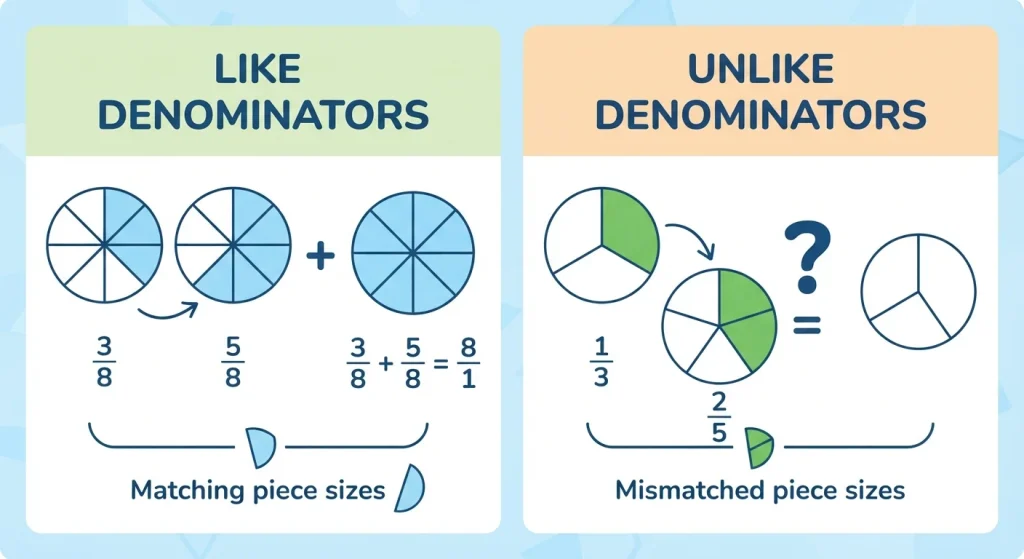
The denominator, at the bottom of a fraction, tells you how many equal parts one whole was cut into. The numerator, on top, tells you how many of those parts you have. In 3/8, the whole was cut into 8 pieces and you are holding 3.
If your child is shaky on this split, start with what the numerator and denominator of a fraction mean before going further.
Like denominators are denominators that match. In 3/8 and 5/8, both wholes were cut into eighths. These are also called like fractions or fractions with the same denominator.
Unlike denominators differ. In 1/3 and 1/5, one whole was cut into thirds and the other into fifths.
Why the distinction matters
Like denominators mean the pieces are the same size.
If your sister cuts her chapati into 4 equal parts and you cut yours into 4, every piece on the table is a quarter and counting them is easy. If she cuts hers into 6 instead, “I have 1 piece, you have 1 piece” tells you nothing about how much chapati that is.
Addition is counting, and you can only count things directly when they are the same kind of thing. That single idea explains the entire method below.
What CBSE and NCERT Expect in Class 4, 5 and 6
Class 4. Halves, quarters and thirds, mostly through pictures and objects. Like fraction addition appears visually: shade 1/4, shade another 1/4, see 2/4.
Class 5. Addition with numbers rather than pictures. Simplification is expected. Improper fractions and mixed numbers are introduced.
Class 6. Revision plus extension: three or more addends, mixed numbers, multi-step word problems, then unlike denominators using the LCM.
If a Class 6 child still adds denominators, the gap is conceptual, not careless. Working back through fractions for Class 3 usually finds it. <h2 id=”why-the-denominator-stays-the-same”>Why Does the Denominator Stay the Same When Adding Fractions?</h2>
The denominator stays the same because it is not a quantity being added. It is the name of the piece size, and adding two amounts of the same thing does not rename the thing.
The laddoo box
Picture a box of 6 laddoos as one whole, so one laddoo is 1/6 of the box. You eat 2, your brother eats 3. Five laddoos are gone, which is 5/6.
Notice what nobody did. Nobody recut the box. It was divided into 6 before the eating and after it. The 6 was never a count of anything that got combined, it was a label. The numerators, 2 and 3, were counts. Counts add. Labels do not.
Say it aloud and the answer appears
Read 2/6 + 3/6 as “2 sixths plus 3 sixths,” not “two over six.”
Now read it like any other sentence: “2 pencils plus 3 pencils.” Nobody answers “5 penpencils.” The answer is 5 pencils, and the object stays the object. So 2 sixths plus 3 sixths is 5 sixths.
Children taught to read fractions this way make the denominator error far less often, because the language carries the logic. Build the habit before the written work.
What goes wrong if you add the denominators
Say a child writes 1/4 + 1/4 = 2/8. Ask one question: simplify 2/8.
It is 1/4. So that answer claims adding a quarter to a quarter leaves you exactly where you started, and the second piece of chapati vanished. The correct answer, 2/4, is a half, which is obviously what two quarters make. Run that check once with real food and the error usually dies.
Visual Models for Adding Like Fractions
Use all three. Each makes a different idea visible.
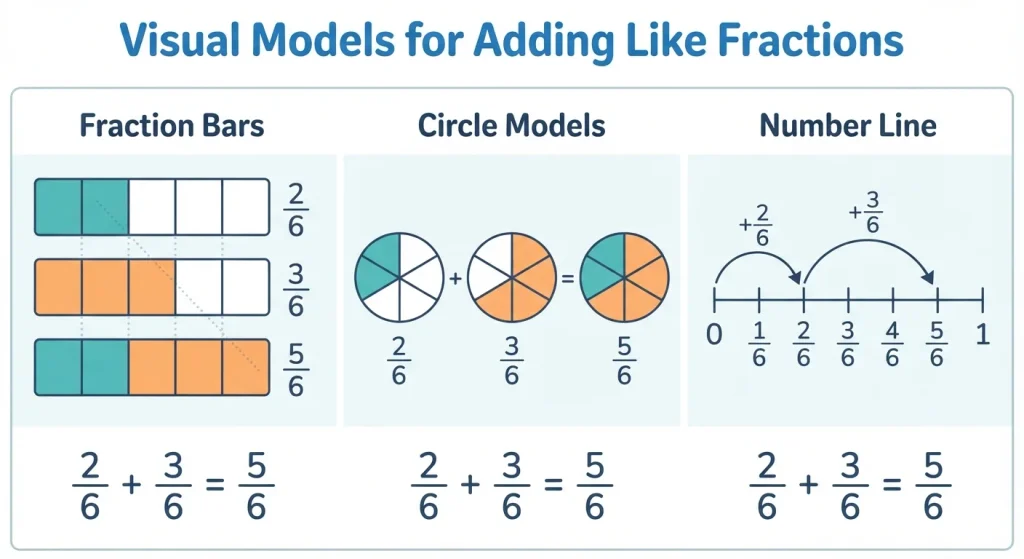
Fraction bars. Draw a rectangle cut into 5 equal strips with 2 shaded, another identical bar with 1 shaded, then slide the shading onto a single bar. The child sees that the bar still has 5 divisions. It never became a 10-part bar. Only the shaded count moved. This is the clearest picture of the fixed denominator, and paper strips from an old notebook do the job.
Circle or pie models. Draw a circle cut into 8 slices. Shade 3, then 2 more. The strength here is that “the whole” is unmistakable, so the child can always see how much is left. Circles matter most for improper fractions, where two circles side by side show instantly that 7/4 is more than one whole.
Number lines. Mark 0 to 1 in sixths, start at 0, jump 2 spaces, then 3 more, land on 5/6. This is the model most often skipped and the one that pays off later, because it shows fractions as numbers with positions and extends past 1 without trouble. A child who is new to it should start with how to draw and read a number line.
How to Add Fractions with Like Denominators: Step by Step
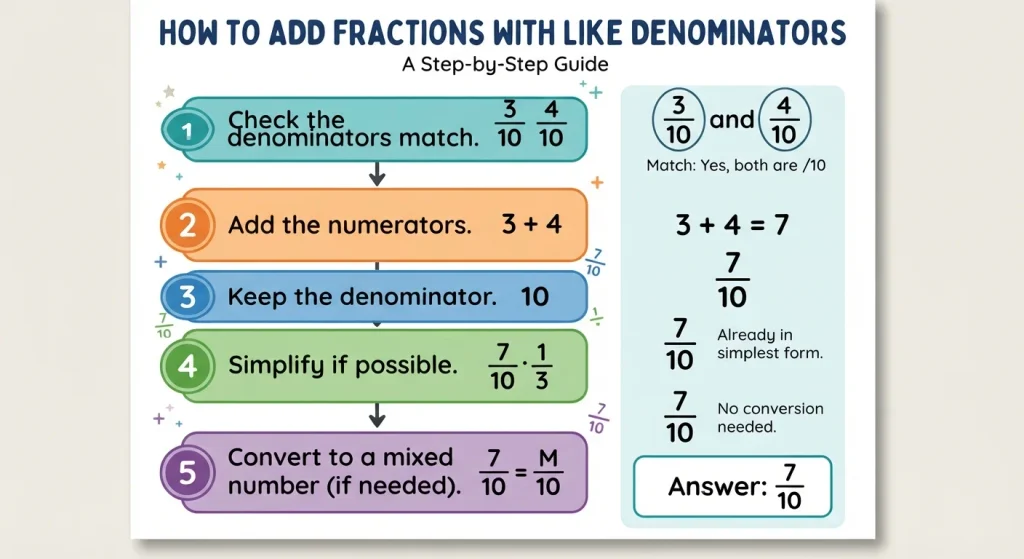
Step 1. Check the denominators are the same.
Step 2. Add the numerators.
Step 3. Write the total over the same denominator.
Step 4. Simplify if the numerator and denominator share a factor.
Step 5. If the answer is improper, convert it to a mixed number.
Worked example: 3/10 + 4/10
Both denominators are 10, so we can add directly. Numerators: 3 + 4 = 7, giving 7/10. The only common factor of 7 and 10 is 1, so it is already simplest, and 7 is smaller than 10, so no conversion is needed.
Answer: 7/10. Read it back as “3 tenths plus 4 tenths equals 7 tenths” and the answer confirms itself.
Worked example: 1/9 + 5/9
Numerators: 1 + 5 = 6, giving 6/9. Both divide by 3.
Answer: 2/3. <h2 id=”simplifying-using-hcf”>Simplifying the Answer Using HCF</h2>
A fraction is in simplest form when the numerator and denominator share no factor except 1. The fastest route is the HCF, the highest common factor: list the factors of each number, find the largest one in both lists, divide top and bottom by it. Children who know their multiplication tables spot the HCF far faster, since factor-finding is table recall in reverse.
Many children add correctly and still lose the mark by leaving the answer unsimplified, so build this in from the start.
Worked example: 5/16 + 3/16
Numerators: 5 + 3 = 8, giving 8/16. Factors of 8 are 1, 2, 4, 8. Factors of 16 are 1, 2, 4, 8, 16. The HCF is 8, so 8 ÷ 8 = 1 and 16 ÷ 8 = 2.
Answer: 1/2.
If the HCF is hard, let the child simplify in small steps instead: 8/16 to 4/8 to 2/4 to 1/2. Same destination, more moves. Speed can come later.
Two quick checks.
If both numbers are even, there is more to do. If the numerator is 1, you are finished.
When the Answer Is an Improper Fraction
Sometimes the numerator is greater than the denominator. The answer is then an improper fraction, which means more than one whole.
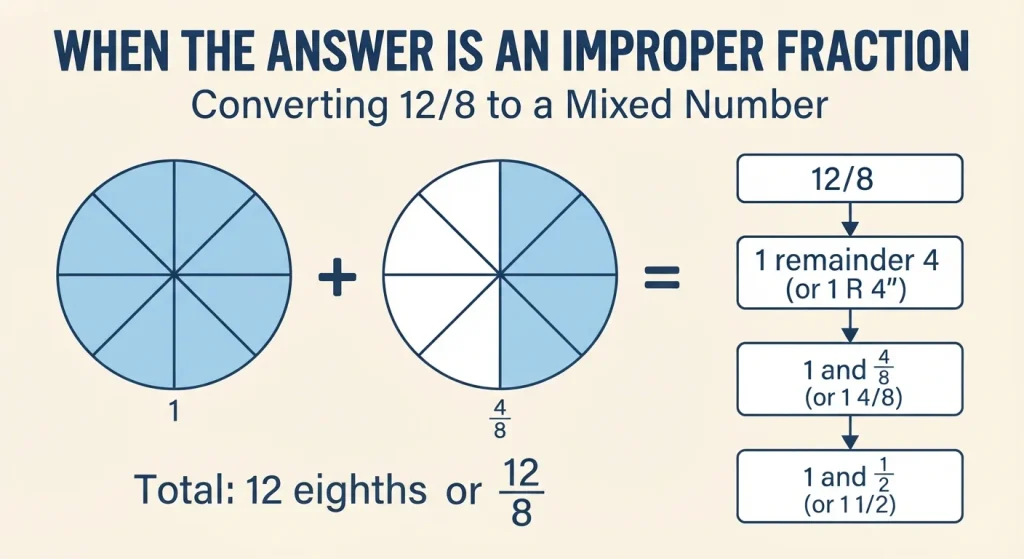
Nothing is wrong with it, but from Class 5 the expected final form is a mixed number.
To convert: divide the numerator by the denominator, make the quotient the whole number and the remainder the new numerator, keep the denominator, then simplify the fraction part. The division itself is ordinary long division with the remainder kept rather than discarded.
Worked example: 5/8 + 7/8
Numerators: 5 + 7 = 12, giving 12/8. Divide: 12 ÷ 8 = 1 remainder 4, so 1 and 4/8. Simplify the fraction part, since the HCF of 4 and 8 is 4.
Answer: 1 and 1/2. Check it against a picture: 5/8 of one pizza plus 7/8 of another should land between one and two pizzas.
Worked example: 7/6 + 5/6
Numerators: 12, giving 12/6. Then 12 ÷ 6 = 2 remainder 0, and when the remainder is zero there is no fraction part at all.
Answer: 2. Point this out explicitly, because it surprises children. Twelve sixths is exactly two whole things.
Adding Three or More Fractions with Like Denominators
Nothing new happens with three addends, because the piece size still never changes. Confirm the denominators match, add every numerator, write the total over the shared denominator, then simplify and convert.
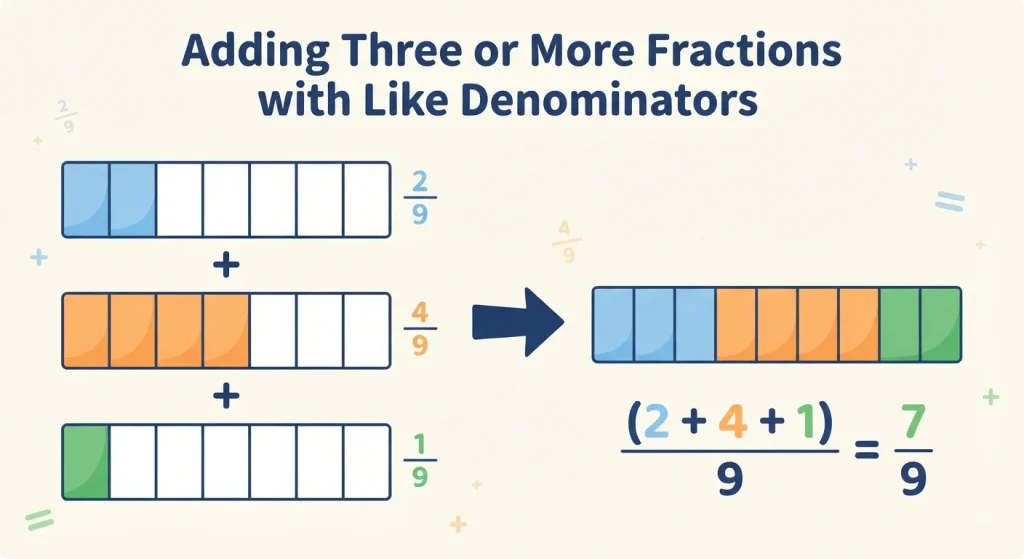
2/9 + 4/9 + 1/9. Numerators: 2 + 4 + 1 = 7.
Answer: 7/9, already in simplest.
3/10 + 4/10 + 5/10 + 2/10.
The numerators total 14, giving 14/10. Simplify by dividing by 2 to get 7/5, then 7 ÷ 5 = 1 remainder 2.
Answer: 1 and 2/5.
Converting first and simplifying afterward gives the same result, as long as you do both.
Common mistake here: children add the first two, write an answer, add the third to that, and change the denominator somewhere along the way. Have them write all the numerators in one line, as (2 + 4 + 1)/9, so the denominator is physically written only once.
Adding Mixed Numbers with Like Denominators
A mixed number such as 2 and 3/7 is a whole number plus a fraction. Two methods work, and children should meet both.
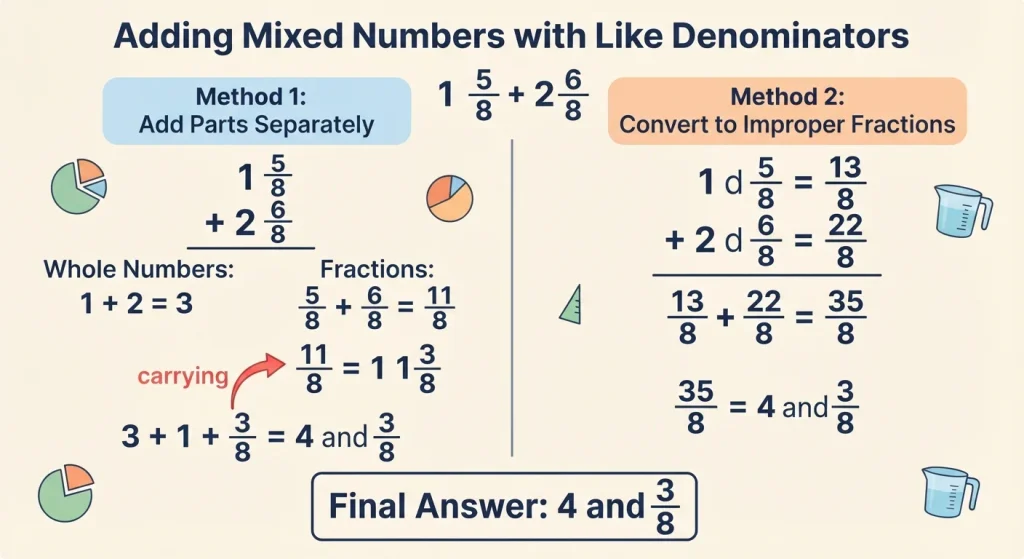
Method 1: add the parts separately.
For 2 and 3/7 + 1 and 2/7, add the wholes (2 + 1 = 3) and the fractions (3/7 + 2/7 = 5/7). Answer: 3 and 5/7.
Method 1 with regrouping.
For 1 and 5/8 + 2 and 6/8, the wholes give 3 and the fractions give 11/8, which is improper. Convert it: 11 ÷ 8 = 1 remainder 3, so 1 and 3/8. Carry that whole across: 3 + 1 = 4, with 3/8 left.
Answer: 4 and 3/8. This carry is where most errors happen, so name the link to the carrying children already do in column addition.
Method 2: convert to improper fractions first.
For the same sum, 1 and 5/8 becomes (1 × 8) + 5 = 13/8, and 2 and 6/8 becomes (2 × 8) + 6 = 22/8. Add: 35/8. Convert back: 35 ÷ 8 = 4 remainder 3.
Answer: 4 and 3/8, which is a satisfying thing for a child to discover.
Method 2 uses bigger numbers but never needs regrouping, so it suits children who find carrying fiddly. Let them choose after trying both.
The Most Common Mistake and How to Fix It
Wrong: 1/5 + 2/5 = 3/10. Right: 1/5 + 2/5 = 3/5.
This is not carelessness, it is pattern transfer. For four years addition has meant “add the numbers you see.” A fraction looks like two numbers, so the child applies the only rule they have.
The counter-example that fixes it.
Everyone knows half a roti plus half a roti is one whole roti. Apply the wrong method and 1/2 + 1/2 becomes 2/4, which is one half, so eating a second half left you with half a roti and one half simply vanished. Say it in exactly those terms. The correct method gives 2/2, which is 1.
Keep this on hand. When the error returns, do not re-explain the rule. Ask: “Try your way on half plus half. What do you get?”
Other errors, stage by stage
- Not simplifying. 6/8 is not wrong, but it is incomplete at Class 5 and 6. Add a final question to every sum: can this be reduced?
- Leaving an improper fraction when the question says “simplest form,” which asks for both simplification and conversion.
- Dividing only the numerator while simplifying. Write the division on both lines, one above the other.
- Flipping the conversion. Converting 11/8 to 1 and 8/3. The remainder becomes the numerator, the denominator never moves.
- Dropping the whole number. In 2 and 1/4 + 1 and 1/4, a hurried child writes 2/4 and loses the 3. Circle the whole numbers first.
- Using this method on unlike fractions. 1/3 + 1/4 is not 2/7. Make the denominator check step one, every time.
Real-Life Word Problems
Sharing food.
A pizza is cut into 8 slices. Riya eats 3, Arjun eats 2. Together: 3/8 + 2/8 = 5/8 of the pizza.
Measuring cloth.
A tailor uses 3/4 metre for one sleeve and 3/4 for the other. 3/4 + 3/4 = 6/4 = 1 and 1/2 metres.
Combining time.
Meera studies 2/3 of an hour in the morning and 2/3 in the evening. 2/3 + 2/3 = 4/3 = 1 hour and 20 minutes.
Spending money.
Aarav spends 2/5 of his 100 rupees on a notebook and 1/5 on pens. 2/5 + 1/5 = 3/5, which is 60 rupees.
Filling a container.
A drum is filled 5/12 in the morning and 4/12 in the afternoon. 5/12 + 4/12 = 9/12 = 3/4 full, leaving 1/4 empty.
Teach children to underline the denominators first. If they all match, the like-fraction method applies immediately. For problems that hide the operation inside longer wording, the approach in how to solve math word problems works alongside this.
Fraction Addition in Olympiad Problems
Olympiad questions rarely say “add 3/8 and 2/8.” They hide the addition inside a structure, and the student who understands the fixed denominator spots it fast.
Pattern sums.
1/12 + 2/12 + 3/12 + 4/12 + 5/12. The numerators are 1 to 5, totalling 15, so the answer is 15/12 = 1 and 1/4. One move instead of five.
Completing the whole.
Two friends take 2/9 and 4/9 of a cake. What is left? You recognise the whole as 9/9, add to get 6/9, subtract. Pure like-denominator thinking.
Missing numerator.
If 3/11 + ?/11 = 9/11, the fixed denominator collapses this to 3 + ? = 9. A child who still suspects the denominator might change cannot make that collapse.
Comparing sums.
is 4/15 + 6/15 greater than 3/15 + 8/15? Shared denominator, so comparing 10 with 11 settles it with no calculation.
The habit worth building: when the denominators match, the problem is a whole-number problem in costume. More of this pattern work sits in how to solve math olympiad problems and the sample sets in math olympiad questions.
From Like Denominators to Unlike Denominators
The next topic is adding fractions like 1/3 + 1/4. It looks new. It is not.
The whole method for unlike denominators is: make the denominators like, then use the method on this page. For 1/3 + 1/4 you find a common denominator of 12, rewrite them as 4/12 and 3/12, and you are back on familiar ground: 7/12.
This is why rushing past like denominators costs so much later.
The conversion is preparation, the addition never changes. A child who understands that only same-sized pieces can be counted together already understands why the LCM step exists. A child who memorised “add the tops” has no idea why anyone bothers.
One check before moving on: ask why we cannot add 1/3 and 1/4 straight away. If the answer mentions different piece sizes, they are ready. The same idea carries into related work like converting decimals to fractions.
8 Activities and Games
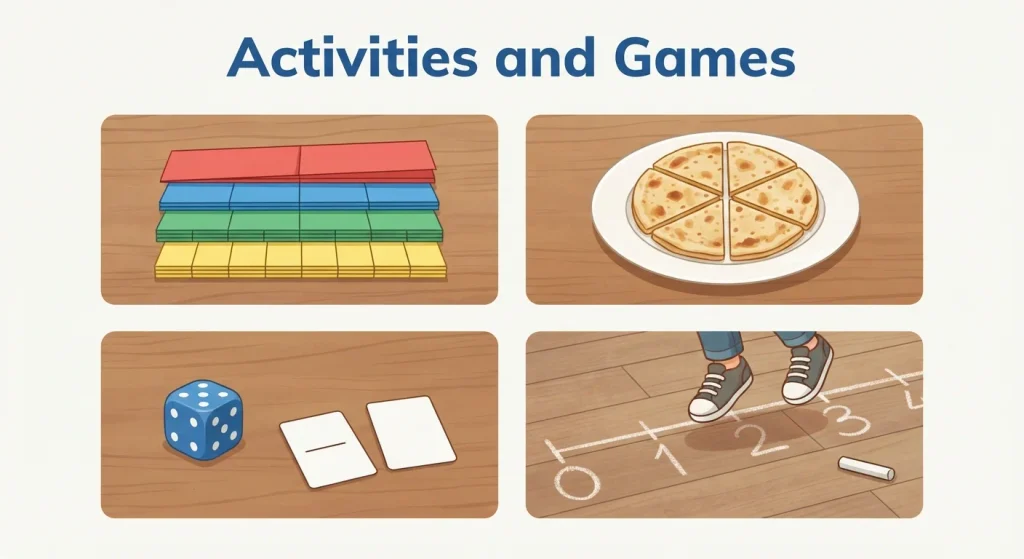
- Paper strip bars. Cut equal-length strips, fold into halves, quarters, sixths and eighths, label the parts. Children place 2/8 beside 3/8 and count 5 eighths.
- The roti plate. Cut a chapati into equal parts at mealtime and narrate in fractions. “You’ve had 2 of 6, I’ve had 1. Together?”
- Fraction dice. Fix a denominator for the round, say 8. Each player rolls twice, forms two fractions, adds them. Closest to 1 without going over wins. Improper results appear constantly.
- Number line hopscotch. Chalk 0 to 2 in tenths. Call out 4/10 + 7/10 and have the child hop it. Landing past 1 makes improper fractions physical.
- Spot the error. Give five completed sums, three correct and two with added denominators. The child marks them. Explaining a wrong answer is harder and more useful than producing a right one.
- Fraction snap. Sums on one set of cards, answers on another, matched in snap. Keep each round inside one denominator family.
- Measuring cup challenge. With a 1/4 cup measure and some rice, make 3/4 of a cup, then 5/4. Building more than a full cup from quarter scoops is the clearest improper fraction there is.
- Build the whole. Set a target such as 10/10. Children take turns writing like fractions that add to it, no repeats. This builds the complement thinking Olympiad problems lean on.
For younger siblings, the earlier versions of these work with fractions for Class 1.
Tips for Parents and Teachers
At home.
Insist on the spoken form, “three eighths,” never “three over eight.” Start with a picture, not a rule. When the error appears, do not restate the rule, ask the child to test their method on 1/2 + 1/2 and let the contradiction teach.
Train them to notice when an answer comes out smaller than what went in, which catches the denominator error every time. Keep one running example, the same chapati or the same box of laddoos, for weeks rather than switching contexts. And separate the two skills: if answers are right but unsimplified, the addition is fine and only simplification needs practice.
In class.
Spend a full lesson on the denominator question before writing any algorithm, which then takes ten minutes. Keep every example in the same denominator for a whole session so the pattern is visible.
Teach all three models deliberately, since children lock onto different ones. Put the wrong answer on the board yourself and let the class demolish it, because children who have argued against an error rarely repeat it.
Add a “simplest form” column so nobody treats it as optional. Reach three addends in the first week, so nobody thinks this is a two-fraction rule. And assess by explanation: ask “why is the denominator still 8?”
The answers tell you who memorised and who understood. The approach in teaching fractions to younger students feeds straight into this.
Practice Questions with Answers
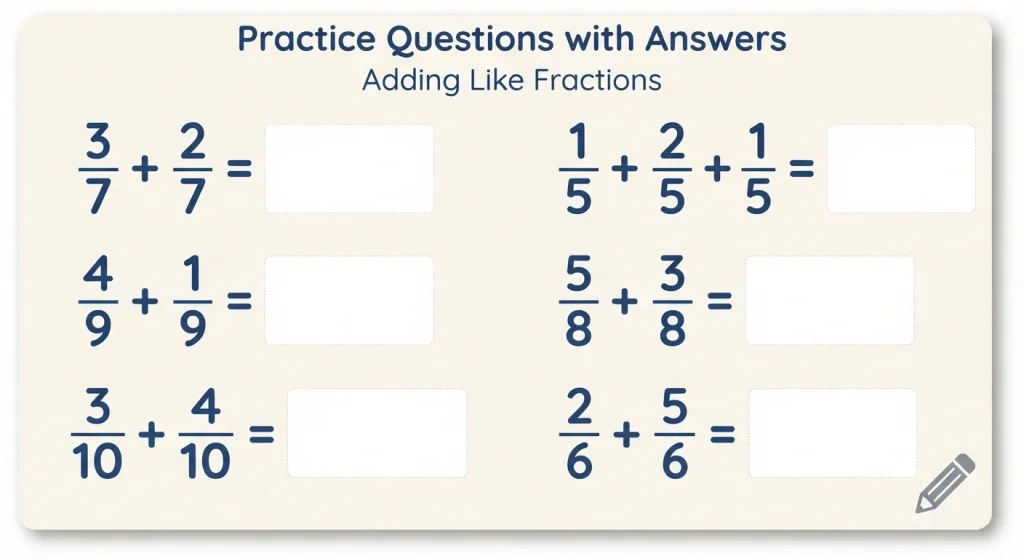
Section A: simple addition
- 2/9 + 4/9 2. 1/6 + 3/6 3. 5/11 + 3/11 4. 2/7 + 2/7
Section B: Simplify
5. 3/8 + 1/8 6. 4/15 + 6/15 7. 7/18 + 5/18 8. 2/10 + 6/10
Section C: improper results
9. 7/9 + 5/9 10. 3/4 + 3/4 11. 8/5 + 4/5 12. 9/12 + 7/12
Section D: three or more
13. 1/8 + 2/8 + 3/8 14. 2/5 + 1/5 + 4/5 15. 3/10 + 3/10 + 3/10 + 1/10
Section E: mixed numbers
16. 1 and 2/5 + 2 and 1/5 17. 3 and 5/9 + 1 and 7/9 18. 2 and 3/6 + 1 and 5/6
Section F: Word problems
19. A 1-litre jug gets 3/8 litre of juice and then 4/8 litre of water. How full is it, and how much space is left? 20. Vikram walks 5/6 km to school and 5/6 km back. How far in total?
Answers:
1. 2/3
2. 2/3
3. 8/11
4. 4/7
5. 1/2
6. 2/3
7. 2/3
8. 4/5
9. 1 and 1/3
10. 1 and 1/2
11. 2 and 2/5
12. 1 and 1/3
13. 3/4
14. 1 and 2/5
15. 1
16. 3 and 3/5
17. 5 and 1/3
18. 4 and 1/3
19. 7/8 full, 1/8 litre of space left
20. 1 and 2/3 km
Make Preparing for Math Olympiad Simple!


What does adding fractions with like denominators mean?
Adding two or more fractions that have the same bottom number. You add the numerators and keep the denominator unchanged, so 2/7 + 3/7 = 5/7.
Why does the denominator stay the same when adding fractions?
Because the denominator names the size of each piece rather than counting pieces. When both fractions are made of sevenths, the answer is still measured in sevenths. Only the number of pieces changes, and that is the numerator.
What happens if you add the denominators too?
You get an answer that is usually smaller than what you started with. Test it on 1/2 + 1/2. Adding both parts gives 2/4, which is one half, so the second half disappeared. The correct answer is 2/2, which is one whole.
Do I always have to simplify the answer?
At Class 5 and 6, yes. Answers are expected in simplest form. Divide the numerator and denominator by their HCF.
What do I do if the answer is bigger than 1?
You have an improper fraction. Divide the numerator by the denominator. The quotient is the whole number, the remainder is the new numerator, and the denominator stays the same. So 12/8 becomes 1 and 4/8, which simplifies to 1 and 1/2.
Can I add three or more fractions with the same denominator at once?
Yes. Add all the numerators in one step and keep the shared denominator. For 2/9 + 4/9 + 1/9, add 2 + 4 + 1 = 7 to get 7/9.
How do I add mixed numbers with like denominators?
Either add the whole numbers and fraction parts separately, regrouping if the fraction part becomes improper, or convert both to improper fractions, add, and convert back. Both give the same answer.
Which class learns adding fractions with like denominators?
It begins visually in Class 4, becomes a written method with simplification in Class 5, and extends in Class 6 to three or more fractions, mixed numbers, and then unlike denominators.
What is the difference between like and unlike fractions?
Like fractions share a denominator, such as 3/8 and 5/8, so their pieces are the same size and can be added directly. Unlike fractions, such as 1/3 and 1/4, must be rewritten with a common denominator first.
My child gets the method right but still makes mistakes. What should I check?
Find the failing stage. Unsimplified answers point to HCF practice. Lost whole numbers point to regrouping. A changed denominator points back to the core concept, so return to fraction bars for a few days.
Bringing It Together
One idea carries this whole chapter: same-sized pieces can be counted together. The count is the numerator, the piece size is the denominator, and counting does not change the size of anything.
Once a child holds that, the rest follows. Simplifying is tidying up, improper fractions just mean more than one whole, three addends are no harder than two, mixed numbers are wholes plus leftovers, and unlike denominators are only a preparation step before the same old addition.
Keep the picture nearby, keep saying “three eighths” aloud, and let the half-plus-half test do the correcting whenever the old habit returns.

Mikha Piregu is a Content Writer with experience spanning educational content, including math and math olympiad topics, as well as advocacy writing, research-based articles, and SEO-driven web content. He creates high-quality blog content, web copy, and feature articles that support brand visibility, audience engagement, and long-term organic growth through data-informed storytelling. Skilled in WordPress, WooCommerce, and modern digital tools, Mikha adapts content across various platforms, including blogs, websites, campaigns, and advocacy initiatives, with clarity and purpose.


There are no comments posted here yet.
Sign in to leave a comment