


A line of symmetry is an imaginary straight line that cuts a 2D shape into two matching halves, each the mirror image of the other.
- The Fold Test: Where Symmetry Begins
- What Is a Line of Symmetry?
- How to Test Whether a Line Is a Line of Symmetry
- How Many Lines of Symmetry Does a Rectangle Have?
- How Many Lines of Symmetry Does a Square Have?
- How Many Lines of Symmetry Does a Shape Have?
- How Many Lines of Symmetry Does a Circle Have?
- Lines of Symmetry in Letters of the Alphabet
- Lines of Symmetry in Numbers 0 to 9
- Symmetry Examples in Real Life
- Reflective Symmetry vs Rotational Symmetry
- Common Mistakes Children Make About Lines of Symmetry
- Hands-On Symmetry Activities for Kids
- Tips for Parents Teaching Symmetry at Home
- Tips for Teachers Delivering a Symmetry Lesson
- Symmetry in Olympiad Geometry Problems
- Where Symmetry Appears in the CBSE and NCERT Syllabus
- Practice Questions With Answers
- Conclusion
Fold the shape along it and the halves land exactly on top of each other. It is also called the mirror line or the axis of symmetry. A rectangle has 2, a square has 4, an equilateral triangle has 3, and a circle has infinitely many.
That is the answer. The harder part is helping a child see why, and that starts with a fold, not a definition. Fold a paper butterfly down the middle and the wings land on each other exactly. That crease is the whole idea, explained without one difficult word.
This guide covers the fold-and-mirror intuition, the formal definition, a three-step test, and every common shape with its exact count and the reasoning behind it. Then letters, numbers, real-life examples, rotational symmetry, the mistakes children make most often, and activities you can run at home with paper and a pencil.
The Fold Test: Where Symmetry Begins
Before any definition, give your child a pair of scissors and a sheet of paper.
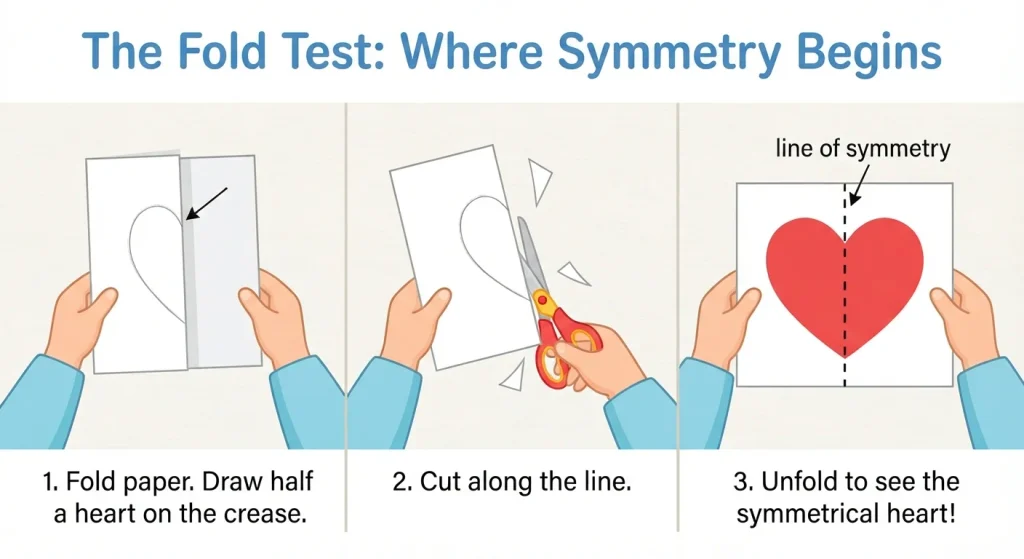
Fold the sheet once. Cut a shape along the fold, any shape at all, a wavy hill or a half heart or a half tree. Open it out. Whatever comes out is symmetrical, and the crease running down the middle is the line of symmetry. The child made it without being told a rule.
Now reverse the activity. Hand over a shape already drawn on paper, cut it out, and ask the child to find a fold that makes the two halves land exactly on top of each other. For a square they will find four. For a rectangle they will find two and then get stuck trying for a third. For an ordinary scalene triangle they will find none at all, which is an important discovery rather than a failure.
The second intuition is the mirror. Stand a small mirror upright along the crease of the folded shape. If the reflection in the mirror looks exactly like the half that is hidden behind it, the crease is a line of symmetry. This is why the line is sometimes called a mirror line.
Both tests say the same thing. One uses folding, the other uses reflection. Children who have done both are far less likely to guess later on, because they have a physical action to fall back on when a shape looks confusing on paper.
What Is a Line of Symmetry?
A line of symmetry is a straight line that divides a shape into two halves that are exact mirror images. Fold the shape along that line and the two halves cover each other perfectly, with nothing sticking out and no gap left over.
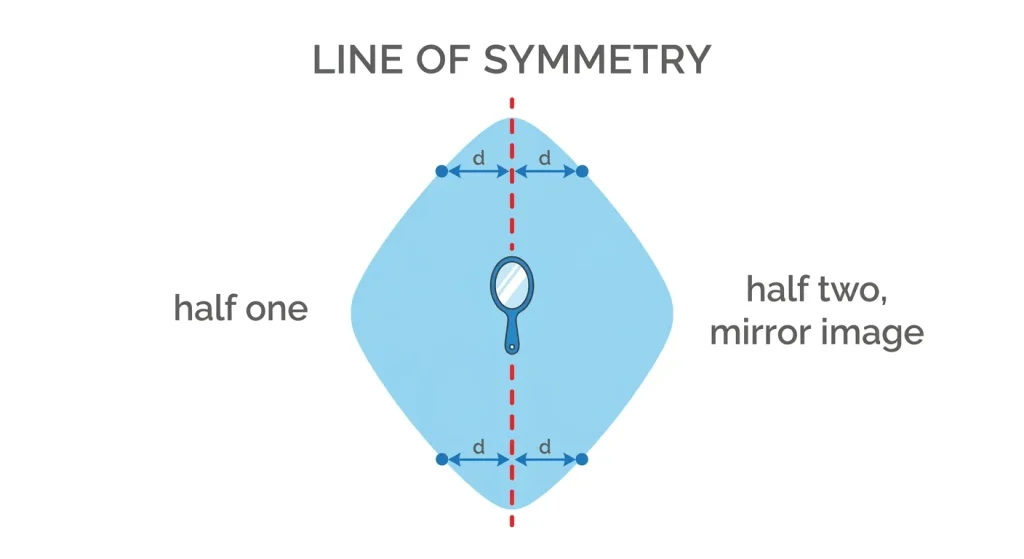
It is also called the axis of symmetry or the mirror line. NCERT textbooks use “line of symmetry”, so that is the term your child will see in class.
Two things decide whether a line qualifies:
It must be straight. A curved fold never counts, however neatly it separates the shape.
The halves must be mirror images, not just equal in size. A diagonal across a rectangle makes two triangles of the same area, but they are not mirror images, so it fails. Think of your hands: same size, same shape, yet a left hand laid on a right hand does not match.
A shape with at least one line of symmetry is symmetrical. A shape with none is asymmetrical, like a cloud or your own handwriting.
From one line to many. A shape can have zero, one, several, or infinitely many lines of symmetry, and counting them is most of what Class 4 to Class 6 geometry asks for. They run in three directions:
- Vertical, top to bottom. The letter A has one, and so does a butterfly with its wings spread.
- Horizontal, left to right. The letter B has one.
- Diagonal, at a slant. A square has two, corner to corner. A rhombus has only these two.
One rule ties the whole topic together: the more regular a shape is, the more lines of symmetry it has. Equal sides and equal angles mean more ways to fold. That is why a square beats a rectangle, an equilateral triangle beats an isosceles one, and a circle beats everything.
How to Test Whether a Line Is a Line of Symmetry
When a shape is printed on paper and folding is not an option, children need a reliable method. Teach these three steps in order and ask for all three every time.
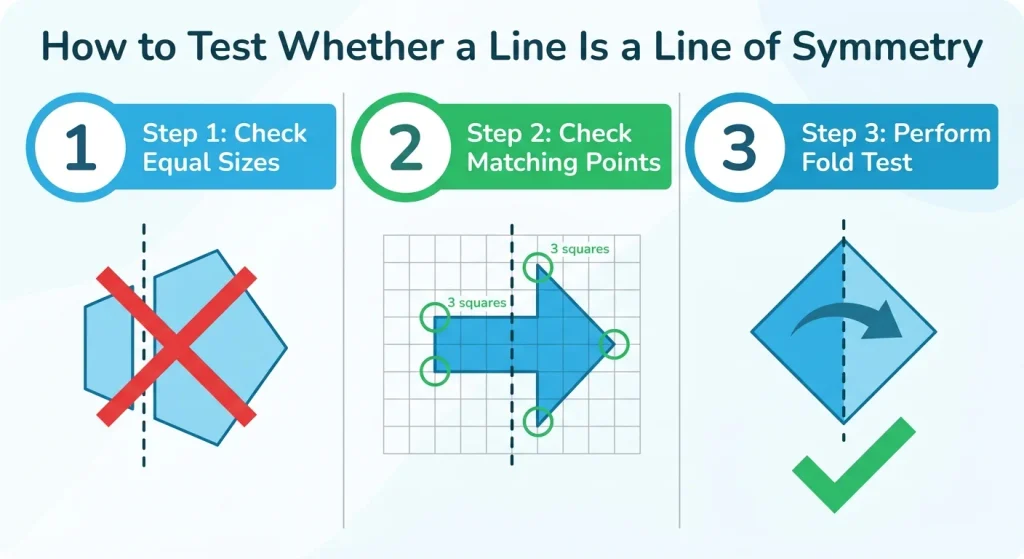
Step 1: Check that the two sides are the same size. Look at the two parts the line creates. If one is visibly bigger than the other, stop. The line fails immediately. This step catches the easiest errors.
Step 2: Check matching points. Pick a corner on one side of the line. Measure how far it sits from the line, straight across at a right angle. Now look at the same position on the other side. There must be a matching corner the same distance away, directly opposite. Repeat for every corner. If even one point has no partner, the line is not a line of symmetry.
Step 3: Do the mental fold. Imagine the paper folding along the line. Does every edge land on an edge? Does every corner land on a corner? If anything overlaps wrongly or sticks out, the line fails.
For a shape drawn on squared paper this becomes very easy, because children can count squares instead of measuring. Three squares left of the line must be matched by three squares right of the line, at exactly the same height.
If your child is still unsure, there is always the physical check: trace the shape onto tracing paper, fold the tracing along the proposed line, and hold it up to the light. Tracing paper is cheap and it settles arguments.
How Many Lines of Symmetry Does a Rectangle Have?
A rectangle has exactly 2 lines of symmetry. One runs horizontally through the middle, from the midpoint of the left side to the midpoint of the right side.
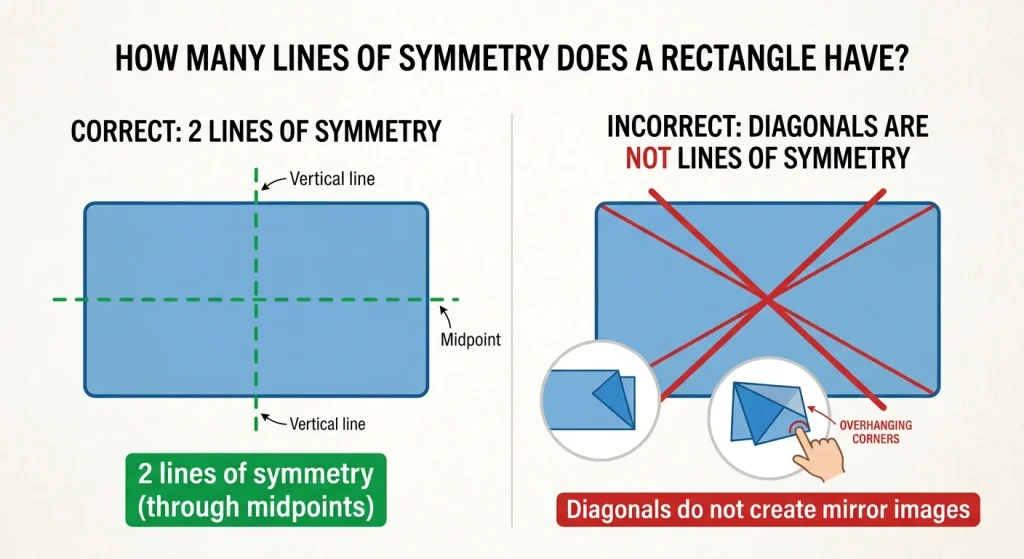
The other runs vertically through the middle, from the midpoint of the top side to the midpoint of the bottom side.
Picture a rectangle lying flat, wider than it is tall. Fold the top edge down onto the bottom edge: the two halves match, so the horizontal middle line works. Now fold the left edge across onto the right edge: again the halves match, so the vertical middle line works.
Those are the only two. This holds for every rectangle that is not a square, whether it is a doorway, a page of a notebook, or a blackboard.
Why the Diagonals of a Rectangle Are Not Lines of Symmetry
This is the single most common error children make in this chapter, and it deserves a careful answer rather than a flat “no.”
Draw a rectangle on paper, cut it out, and draw a diagonal from the top left corner to the bottom right corner. Now fold along that diagonal.
The two triangles do not match. One of them is long and lean pointing one way, the other is long and lean pointing the other way. The corners stick out past each other. Your child can see this in two seconds with a real piece of paper, and seeing it beats being told.
Here is the reason behind what they just saw. Folding along the diagonal tries to land the short side of the rectangle on top of the long side. A 10 cm side cannot cover a 6 cm side, and a 6 cm side cannot cover a 10 cm side. The fold is being asked to match two edges of different lengths, so it fails.
Children often reply that the diagonal still splits the rectangle into two equal triangles. They are right, and this is where the real teaching happens: equal area is not the same as mirror image. The diagonal creates two triangles of the same size, but they are rotations of each other, not reflections. You can spin one triangle around to land on the other, but you cannot fold one onto the other.
Put a mirror along the diagonal and the point becomes obvious. The reflection shows a kite shape or a thin sliver, never the original rectangle. A line of symmetry is a line where the mirror shows the shape unchanged.
How Many Lines of Symmetry Does a Square Have?
A square has exactly 4 lines of symmetry. They are:
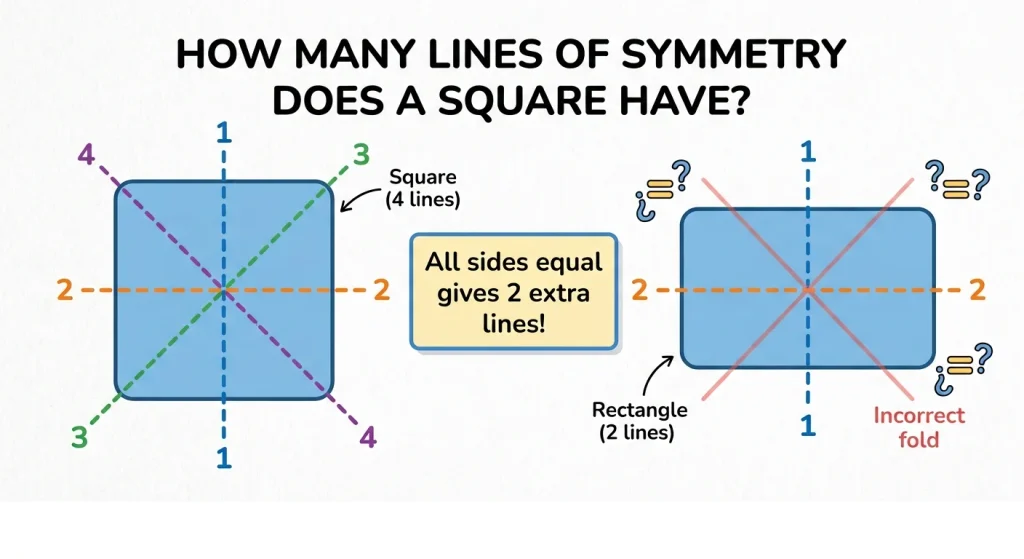
- The vertical line through the midpoints of the top and bottom sides.
- The horizontal line through the midpoints of the left and right sides.
- The diagonal from the top left corner to the bottom right corner.
- The diagonal from the top right corner to the bottom left corner.
Fold along any one of these four and the two halves land on each other exactly. Cut a square from paper and let your child find all four folds. Most find the first two quickly, then pause, then discover the diagonals with real satisfaction.
Why a Square Has 4 Lines and a Rectangle Has Only 2
Both shapes have four right angles. Both have opposite sides equal. The square has one extra property, and that one property doubles its symmetry: all four of its sides are the same length.
Go back to why the rectangle’s diagonal fold failed. It failed because the fold asked a short side to cover a long side. In a square there is no short side and no long side. Every side is the same length, so when you fold along a diagonal, each side lands neatly on its neighbour. Nothing sticks out, nothing is left over.
This is worth framing as a rule your child can carry forward: a square is a rectangle whose extra equal sides buy it two extra lines of symmetry. It is the same relationship you will see again between an isosceles triangle and an equilateral triangle. More equal sides, more symmetry.
How Many Lines of Symmetry Does a Shape Have?
Every Common Shape Counted
Here is the complete reference, with the reasoning attached to each count rather than just the number.
How Many Lines of Symmetry Does a Triangle Have?
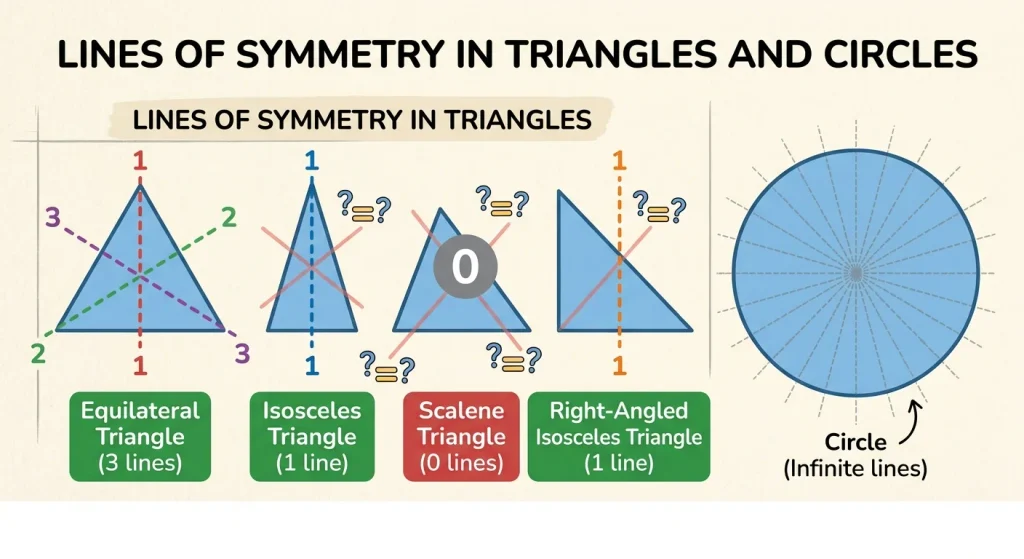
The answer depends entirely on which triangle you mean, and this is the clearest example in the whole topic of equal sides buying symmetry.
Equilateral triangle: 3 lines of symmetry. All three sides are equal and all three angles measure 60 degrees. Each line runs from one vertex down to the midpoint of the opposite side. Three vertices means three lines.
Isosceles triangle: 1 line of symmetry. Two sides are equal and one is different. The single line runs from the vertex between the two equal sides down to the midpoint of the third side. Fold along it and the two equal sides land on each other.
Scalene triangle: 0 lines of symmetry. All three sides have different lengths, so no fold can make any two of them match.
Right-angled triangle: usually 0 lines of symmetry. The exception is a right-angled isosceles triangle, the kind you get by cutting a square along one diagonal, which has 1 line of symmetry running from the right angle to the midpoint of the longest side.
How Many Lines of Symmetry Does a Circle Have?
A circle has infinite lines of symmetry. Every straight line that passes through the centre of a circle is a line of symmetry. Since you can draw endlessly many lines through a single point, the count has no end.
The reason is that every point on the edge of a circle sits exactly the same distance from the centre. There is no long side and no short side, no corner and no flat edge, nothing that could ever fail to match. A circle is the most symmetrical flat shape there is.
Try this with your child: draw a circle, cut it out, and fold it any way you like as long as the crease passes through the centre. It always works. Fold it in a way that misses the centre and it never works. That one experiment explains the whole answer.
Lines of Symmetry in Regular Polygons
A regular polygon is a shape whose sides are all equal and whose angles are all equal. For these shapes there is one clean rule that replaces memorisation:
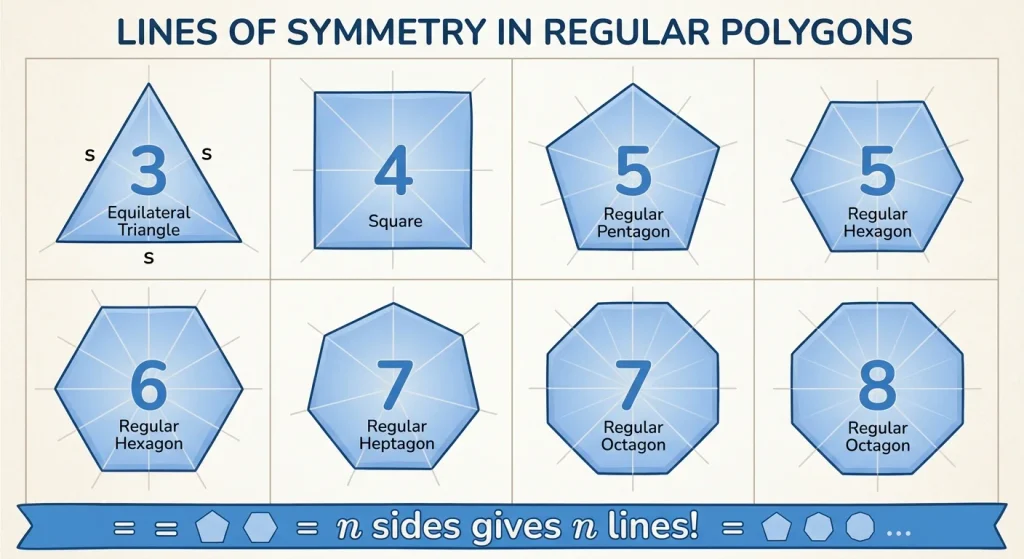
A regular polygon with n sides has exactly n lines of symmetry.
| Regular polygon | Number of sides | Lines of symmetry |
|---|---|---|
| Equilateral triangle | 3 | 3 |
| Square | 4 | 4 |
| Regular pentagon | 5 | 5 |
| Regular hexagon | 6 | 6 |
| Regular heptagon | 7 | 7 |
| Regular octagon | 8 | 8 |
| Regular decagon | 10 | 10 |
| Circle (think of it as having endless sides) | infinite | infinite |
There is a smaller pattern hiding inside this rule, and bright students enjoy spotting it. When the number of sides is odd, every line of symmetry runs from a vertex to the midpoint of the opposite side. A regular pentagon has 5 such lines. When the number of sides is even, half the lines run corner to corner and half run from the midpoint of one side to the midpoint of the opposite side. A regular hexagon has 3 of each, which is why it ends up with 6.
Lines of Symmetry in Other Quadrilaterals
| Shape | Lines of symmetry | Where they are |
|---|---|---|
| Square | 4 | 2 through midpoints of sides, 2 diagonals |
| Rectangle | 2 | 1 horizontal, 1 vertical, both through midpoints |
| Rhombus | 2 | Both diagonals only |
| Parallelogram | 0 | None at all |
| Kite | 1 | The diagonal joining the two unequal angles |
| Isosceles trapezium | 1 | The vertical line through the midpoints of the parallel sides |
| Ordinary trapezium | 0 | None |
The parallelogram is worth a pause. It looks balanced, which is exactly why children insist it must have a line of symmetry. It does not. Cut one out and try every fold, including both diagonals, and nothing matches.
A parallelogram is a leaning shape, and leaning shapes cannot be folded onto themselves. It does have rotational symmetry, which is covered further down, and that is usually the source of the confusion.
The rhombus is the opposite surprise. It has no horizontal or vertical line of symmetry at all, only its two diagonals. Children who hunt only for upright and sideways folds will report zero and be wrong.
Irregular Shapes
Most shapes in the real world have no lines of symmetry whatsoever. A scribble, a torn piece of paper, a map of Maharashtra, a jigsaw piece. If the sides and angles are not matched in pairs, no fold will work.
An irregular shape can still have one line of symmetry without being regular. An arrow, a heart, a kite and the letter A are all irregular shapes with exactly one line each. Regularity gives many lines; irregularity does not automatically mean zero.
Lines of Symmetry in Letters of the Alphabet
Capital letters are the best practice material available, and they cost nothing, which is why alphabet pattern work pairs so naturally with this topic. Write the alphabet in plain block capitals and sort each letter into one of four groups.
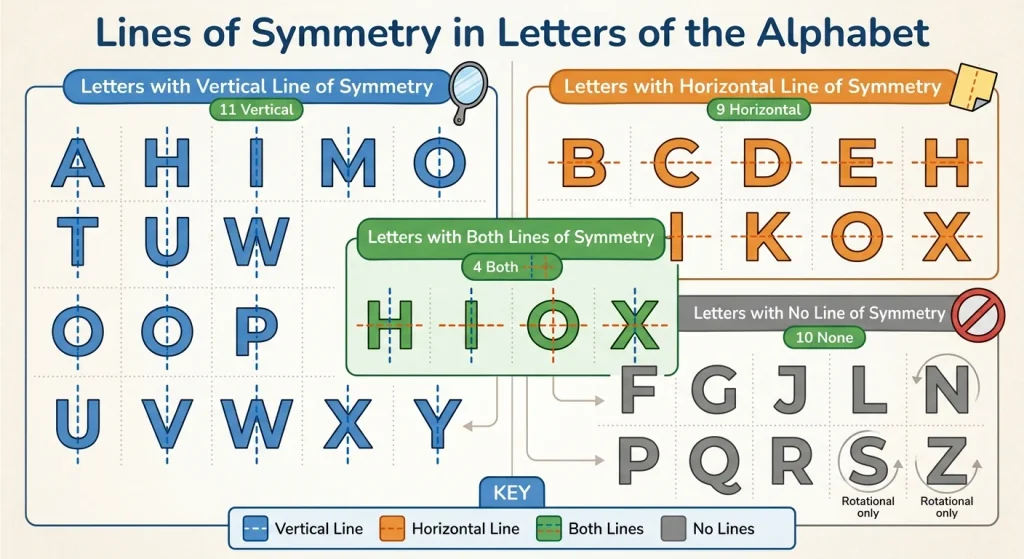
Letters with a vertical line of symmetry (11): A, H, I, M, O, T, U, V, W, X, Y
Fold these down the middle from top to bottom and the halves match.
Letters with a horizontal line of symmetry (9): B, C, D, E, H, I, K, O, X
Fold these across the middle from left to right and the halves match.
Letters with both a vertical and a horizontal line (4): H, I, O, X
These four appear in both lists above. They are the most symmetrical letters in the alphabet.
Letters with no line of symmetry (10): F, G, J, L, N, P, Q, R, S, Z
Make the point that this depends on how the letter is written. These answers hold for plain block capitals. Write a fancy curly A and the symmetry disappears. Write the letter O as a perfect circle and it suddenly has infinite lines. Ask your child to test each letter themselves rather than memorise the lists, because the testing is the actual skill.
A good follow-up question: can you find a word that has a vertical line of symmetry when written vertically down the page? MOM, TOOT, and HAH all work.
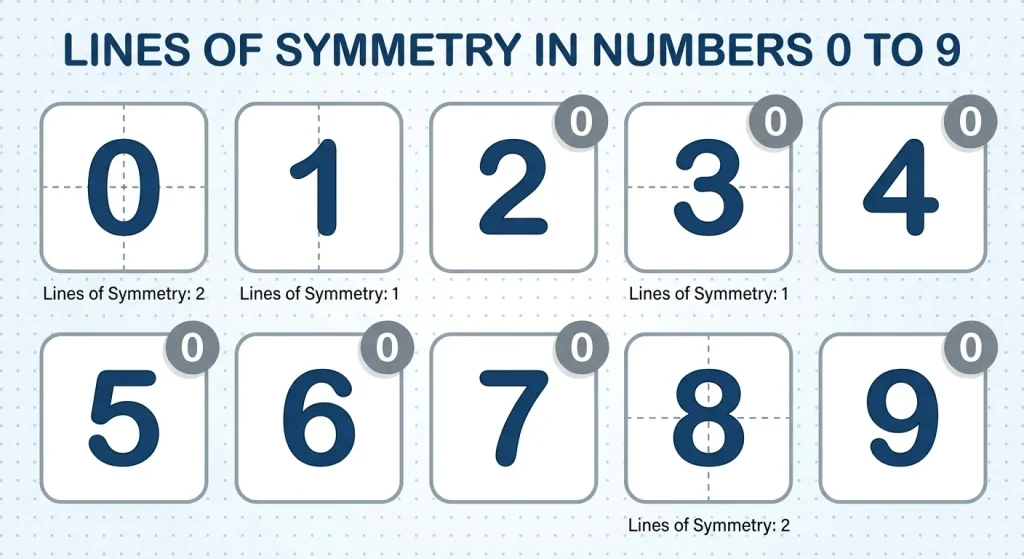
Lines of Symmetry in Numbers 0 to 9
Digits work the same way, with the same warning about handwriting.
| Digit | Lines of symmetry | Type |
|---|---|---|
| 0 | 2 | Vertical and horizontal |
| 1 | 1 | Vertical, if written as a plain stroke |
| 2 | 0 | None |
| 3 | 1 | Horizontal |
| 4 | 0 | None |
| 5 | 0 | None |
| 6 | 0 | None |
| 7 | 0 | None |
| 8 | 2 | Vertical and horizontal |
| 9 | 0 | None |
Eight and zero are the stars here. They are the only digits that survive both a vertical fold and a horizontal fold, which makes them worth pointing out. The digit 3 is the one children usually get wrong, because they try a vertical fold, fail, and declare it has none. Turn the page sideways and the horizontal line appears.
Ask your child to write the digits in a digital clock style, with straight segments. Several answers change, which is a useful reminder that symmetry belongs to the shape in front of you, not to the idea of the number.
Symmetry Examples in Real Life
Symmetry is not a classroom invention. Once a child starts looking, it is everywhere, and this is the part of the topic that tends to stick, because it builds spatial understanding rather than recall.
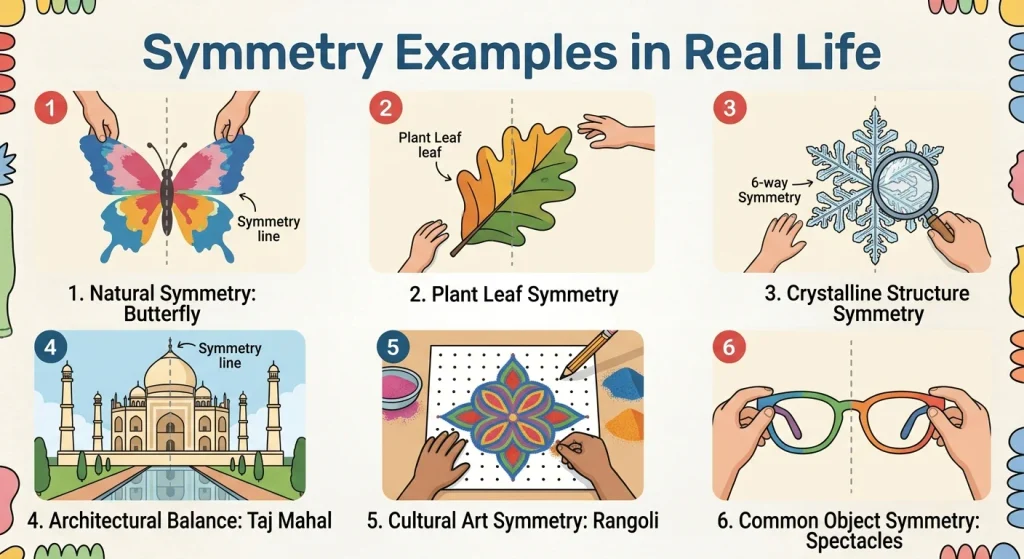
In nature. A butterfly with wings open has one vertical line of symmetry. Most leaves have one line running along the central vein, although real leaves are rarely perfect. A snowflake has six lines of symmetry, the same as a regular hexagon, because of the way water molecules lock together as they freeze. A starfish has five. The human face is roughly symmetrical about a vertical line, though never exactly.
In architecture. Walk past almost any important building in India and you will see a vertical line of symmetry through the main entrance. The Taj Mahal is the famous example, with its matching minarets and mirrored facade reflected again in the water channel in front of it. Temple gateways, the arches of Mughal monuments, and ordinary house fronts with a door in the middle and a window on each side all use the same idea. Bridges are built symmetrically about their centre partly because balanced loads are easier to support.
In everyday objects. A pair of spectacles, a kite, a cricket bat seen face on, the dial of a clock, a chessboard, a plate, a tiffin box, a scissors blade pair, the Ashoka Chakra on the national flag with its 24 spokes. Rangoli and kolam patterns are deliberate symmetry exercises, drawn freehand, usually with several lines of symmetry at once.
In letters and design. Logos are frequently symmetrical because symmetrical shapes read as stable and trustworthy. Ask your child to check the logos on their school bag and water bottle.
Set a challenge at the dinner table: find five symmetrical objects in the room and say how many lines each one has. It takes two minutes and it converts the whole topic from an exercise into a habit of looking.
Reflective Symmetry vs Rotational Symmetry
Everything so far has been reflective symmetry, also called line symmetry or mirror symmetry. There is a second kind, and keeping the two apart prevents a lot of confusion.
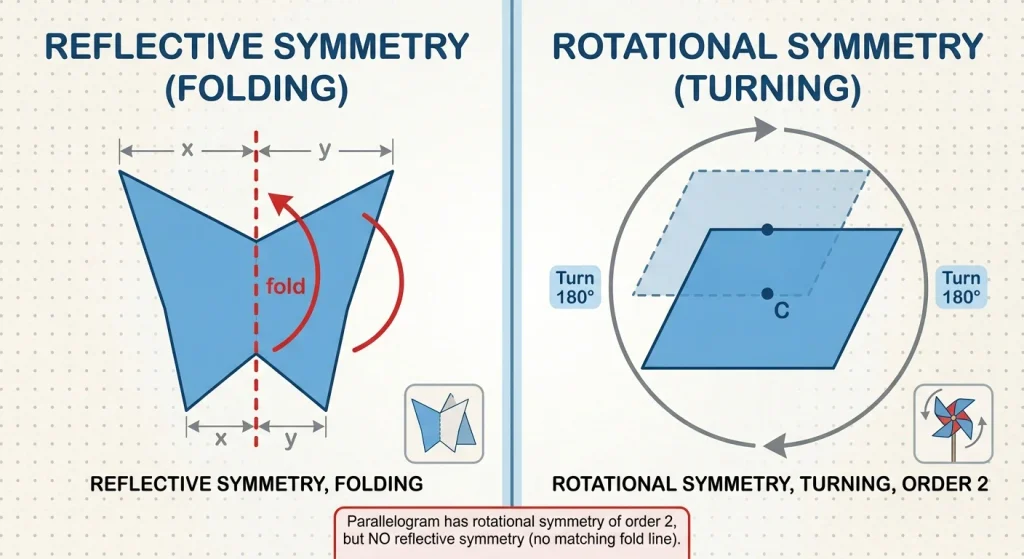
Reflective symmetry is about folding. A shape has reflective symmetry if you can fold it along a line so the halves match.
Rotational symmetry is about turning. A shape has rotational symmetry if you can spin it around its centre by less than a full turn and it looks exactly the same as when you started.
The number of positions in which a shape looks unchanged during one full turn is called its order of rotational symmetry. A square looks the same four times as you rotate it through a complete turn, so it has rotational symmetry of order 4. An equilateral triangle has order 3. A rectangle has order 2, because it looks the same after a half turn.
Here is the example that makes the distinction land. A parallelogram has no lines of symmetry at all, but it has rotational symmetry of order 2. Turn it halfway around and it looks identical. Fold it any way you like and it never matches. That one shape proves the two kinds of symmetry are genuinely different properties, not two names for the same thing.
For Class 4 and Class 5 the fold test is enough. Rotational symmetry is formally introduced in Class 6 and extended in Class 7, so an early, casual demonstration with a cut-out square and a pencil pushed through its centre is plenty of preparation.
Common Mistakes Children Make About Lines of Symmetry
Drawing diagonals on a rectangle. The big one, covered in detail above. Fix it with a paper rectangle and an actual fold, not with a correction in red pen.
Assuming every shape has at least one line. Scalene triangles and parallelograms have none, and children find zero an uncomfortable answer. Make zero a respectable result by asking for it deliberately: “find me three shapes with no lines of symmetry.”
Confusing equal halves with mirror halves. Any line through the centre of a parallelogram cuts it into two equal areas. Almost none of them are lines of symmetry. Keep repeating that the test is folding, not splitting.
Missing diagonal lines of symmetry. Children search vertically and horizontally, then stop. They under-count squares at 2 and rhombuses at 0. Teach the habit of rotating the paper and searching again.
Being thrown by orientation. A square balanced on one corner looks like a diamond, and children report different answers for the same shape. It still has 4 lines. Turning the page is allowed and should be encouraged, and regular visual reasoning practice makes this far less likely to trip a child up.
Treating a near-miss as symmetry. A real leaf, a hand-drawn heart, a photograph of a face: all roughly symmetrical, none exactly. Introduce the phrase “almost symmetrical” so children have an honest label for these instead of forcing them into a yes or a no.
Confusing rotational symmetry with line symmetry. Covered above. The parallelogram is the cure.
8 Hands-On Symmetry Activities for Kids
All of these use materials you already have at home or in a classroom.
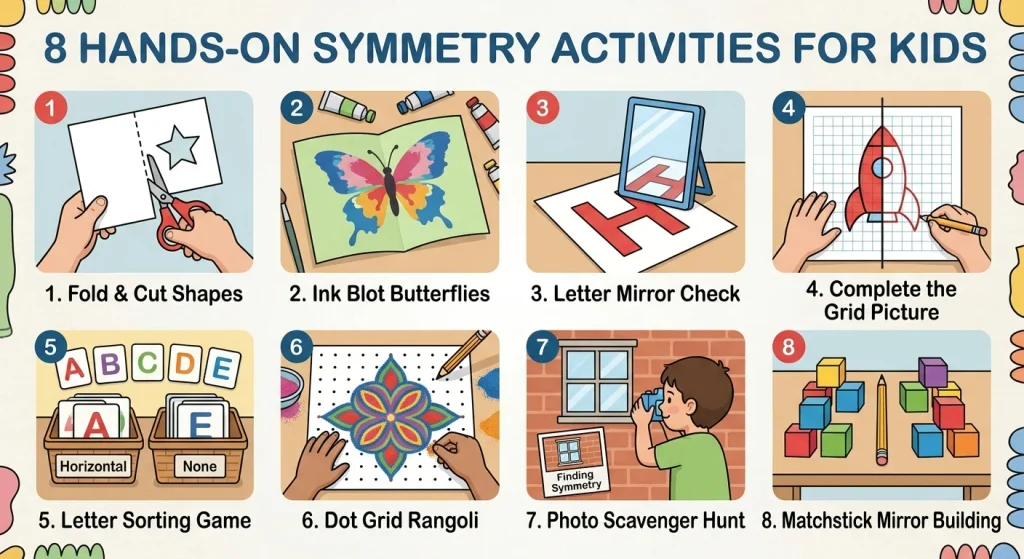
1. Fold and cut. Fold a paper in half, cut any shape along the fold, open it out. Every result is symmetrical. Ask the child to predict what will appear before unfolding. This is the single best first activity.
2. Ink blot butterflies. Put a drop of paint or ink on one half of a folded sheet, press the halves together, open it out. The crease is a perfect line of symmetry and the result usually looks like a butterfly or a moth. Messy and memorable.
3. Mirror hunting. Give the child a small flat mirror. Place it on half of a picture or a shape and look at the reflection. If the reflection completes the picture correctly, the mirror is standing on a line of symmetry. Works beautifully on printed letters.
4. Half-picture completion. Draw half a shape or half a face on squared paper with a clear mirror line drawn in. The child completes the other half by counting squares. This directly matches the questions that appear in exams.
5. Alphabet sorting. Write the 26 capital letters on slips of paper. Sort them into four piles: vertical line, horizontal line, both, none. Checks the whole concept in about ten minutes.
6. Rangoli and kolam patterns. Draw a grid of dots and build a pattern that has 2 lines of symmetry, then try for 4. This connects the topic to something many families already do at festival time, and it is harder than it looks.
7. Symmetry walk. Walk around the house or the school building and photograph or list ten symmetrical things. Record how many lines each one has. Good homework that does not feel like homework.
8. Build it with blocks or matchsticks. Lay a line of symmetry down on the table with a ruler or a pencil. One player places three blocks on one side; the other player must mirror them exactly. Then swap. Builds the matching-points idea from the three-step test without any paper at all.
A ninth for older children: take a shape with 1 line of symmetry and ask what the smallest change is that would give it 2. For an isosceles triangle, the answer is making the third side equal to the other two, which turns 1 line into 3.
Tips for Parents Teaching Symmetry at Home
Let the paper do the arguing. If your child insists a rectangle has 4 lines of symmetry, do not correct them with words. Hand over scissors and let the fold settle it. Self-correction sticks far better than being told.
Ask for reasons, not numbers. “How many lines does a hexagon have?” gets a guess. “Show me where they are and fold to prove it” gets understanding.
Accept zero as a correct answer and say so clearly, otherwise children will invent lines rather than report none.
Use objects before diagrams. Shapes drawn on a page are harder than shapes you can hold, and nearly every child who struggles with this topic is struggling with the picture rather than the idea.
Keep sessions short. Ten minutes of folding beats an hour of worksheets, especially in Class 4 and Class 5.
Connect it to what is already in the house: rangoli, chessboards, windows, jewellery, floor tiles. The concept is at its strongest when it stops being a school topic.
Tips for Teachers Delivering a Symmetry Lesson
Start the lesson with the fold-and-cut activity before writing any definition on the board. Children who have already produced a symmetrical shape with their hands receive the definition as a label for something they have done, which is far easier than receiving it cold.
Keep a set of pre-cut card shapes ready: square, rectangle, equilateral triangle, isosceles triangle, scalene triangle, rhombus, parallelogram, kite, regular pentagon, regular hexagon, circle. One set per pair of students. Folding card is faster than drawing and removes the drawing errors that otherwise dominate the lesson. If students are drawing their own shapes, make sure they are confident using a protractor first.
Plan a deliberate detour into the rectangle diagonal. Do not wait for it to come up as a mistake; raise it yourself, let the class vote, then test it with card. A predicted misconception that the class resolves itself is remembered; the same point made as a correction is forgotten.
Present shapes in varied orientations from the very first exercise. A square on its corner, a triangle upside down, a pentagon tipped to one side. Symmetry questions in exams and olympiads are rarely presented neatly.
Give tracing paper to students who cannot visualise the fold. It is not a crutch, it is the same method in a different medium, and most children stop needing it within a week.
Finish with the regular polygon rule rather than starting with it. The n sides gives n lines pattern is far more powerful when students discover it from a filled-in table than when they are handed it as a formula.
Symmetry in Olympiad Geometry Problems
Symmetry is one of the highest value ideas in competition mathematics, and the version taught in Class 4 to Class 6 is the first step towards it. It is also one of the first genuine problem solving techniques a young student can apply on their own.
At the junior olympiad level symmetry shows up in a few recognisable ways:
Counting problems. How many lines of symmetry does a figure made of several joined squares have? These reward a systematic search rather than a quick glance.
Paper folding and punching. A square sheet is folded twice, a hole is punched, and students must predict the arrangement of holes when the paper is opened out. This is reflective symmetry applied twice in a row, and it appears regularly in olympiad and aptitude papers.
Mirror and water images. Figures are reflected in a vertical or horizontal line and students pick the correct image from options. Children who understand matching points handle these quickly; children who memorised shape counts do not.
Shading and pattern completion. A grid is partly shaded and students must shade more cells to achieve a required number of lines of symmetry. Asking for exactly 2 lines rather than at least 1 is what makes these hard.
Symmetry as a solving shortcut. At higher levels, spotting that a figure or an equation is symmetrical often collapses a long calculation into a short one. If a diagram is symmetrical about a line, two angles or two lengths on opposite sides must be equal, and that equality is frequently the key step in a geometry proof.
The habit worth building early is simple: before starting any geometry problem, look for a line of symmetry. If the figure has one, half the work is usually already done. You can see this habit in action across typical math olympiad questions, and it is worth introducing early if your child is working towards a junior math olympiad.
Where Symmetry Appears in the CBSE and NCERT Syllabus
Symmetry is not a one-year topic. It returns across several classes, each time with a little more precision.
In the early primary classes, symmetry appears informally through pattern work, folding and cutting activities, and shape recognition rather than as a named chapter, alongside the rest of early geometry.
By Class 5, children work with shapes that look the same after folding or turning, which brings reflective and rotational ideas together for the first time in an exploratory way.
Class 6 is where symmetry becomes a full chapter. Students identify lines of symmetry in two-dimensional shapes, work with figures that have more than one line, complete figures across a given mirror line, and meet rotational symmetry formally alongside reflection.
Class 7 extends the same ideas, with closer attention to lines of symmetry in regular polygons and to order of rotational symmetry.
Beyond that, symmetry reappears inside coordinate geometry, where it sits next to tools like the distance formula, as the axis of symmetry of a curve, and inside algebra as symmetry in expressions and equations. The vocabulary changes; the underlying idea does not.
If you are supporting a child at home, the practical takeaway is that time spent on folding in Class 4 and Class 5 is not revision for one test. It is the foundation for a concept that keeps returning for the next eight years.
Practice Questions With Answers
Let your child attempt all fifteen before checking anything.
- How many lines of symmetry does a rectangle have?
- How many lines of symmetry does a square have?
- How many lines of symmetry does an equilateral triangle have?
- How many lines of symmetry does a scalene triangle have?
- How many lines of symmetry does a circle have?
- How many lines of symmetry does a regular octagon have?
- How many lines of symmetry does a parallelogram have?
- How many lines of symmetry does a rhombus have, and where are they?
- Which capital letters have both a vertical and a horizontal line of symmetry?
- Which digits from 0 to 9 have exactly two lines of symmetry?
- A regular polygon has 12 sides. How many lines of symmetry does it have?
- True or false: a diagonal of a rectangle is a line of symmetry.
- A triangle has exactly one line of symmetry. What type of triangle is it?
- Name a shape that has no lines of symmetry but does have rotational symmetry.
- A shape has 5 lines of symmetry. How many sides does it have, if it is a regular polygon?
Answers
- Two, one horizontal and one vertical, both through the midpoints of opposite sides.
- Four, two through the midpoints of the sides and two along the diagonals.
- Three, each running from a vertex to the midpoint of the opposite side.
- Zero, because all three sides have different lengths.
- Infinite, because every line through the centre works.
- Eight, following the rule that a regular polygon with n sides has n lines of symmetry.
- Zero.
- Two, and they are its two diagonals. A rhombus has no horizontal or vertical line of symmetry.
- H, I, O and X.
- Zero and eight.
- Twelve.
- False. The two triangles are equal in area but are not mirror images across the diagonal.
- An isosceles triangle.
- A parallelogram, which has rotational symmetry of order 2.
- Five, so it is a regular pentagon.
Make Preparing for Math Olympiad Simple!


What is a line of symmetry in simple words?
A line of symmetry is a line that cuts a shape into two halves that are exact mirror images. If you fold the shape along that line, the two halves land perfectly on top of each other.
How many lines of symmetry does a rectangle have?
A rectangle has 2 lines of symmetry: one horizontal and one vertical, each passing through the midpoints of opposite sides. The diagonals are not lines of symmetry.
Why are the diagonals of a rectangle not lines of symmetry?
Folding along a diagonal asks the short side of the rectangle to land on top of the long side, and sides of different lengths cannot cover each other. The two triangles are equal in area but they are not mirror images across the diagonal.
How many lines of symmetry does a square have?
A square has 4 lines of symmetry: two through the midpoints of opposite sides and two along its diagonals. It has more than a rectangle because all four of its sides are equal.
How many lines of symmetry does a triangle have?
It depends on the triangle. An equilateral triangle has 3, an isosceles triangle has 1, and a scalene triangle has none.
How many lines of symmetry does a circle have?
Infinite. Every straight line that passes through the centre of a circle divides it into two identical halves.
Can a shape have no line of symmetry?
Yes. A scalene triangle, a parallelogram and most irregular shapes have none. Zero is a perfectly correct answer.
What is the difference between a line of symmetry and an axis of symmetry?
Nothing. They are two names for the same line, along with mirror line. NCERT textbooks mostly use line of symmetry.
How many lines of symmetry does a regular polygon have?
The same number as its sides. A regular pentagon has 5, a regular hexagon has 6, and a regular polygon with n sides has n lines of symmetry.
Is a line of symmetry the same as rotational symmetry?
No. A line of symmetry is about folding. Rotational symmetry is about turning a shape around its centre and having it look the same. A parallelogram has rotational symmetry but no line of symmetry.
Which letters of the alphabet have a line of symmetry?
In block capitals, A, H, I, M, O, T, U, V, W, X and Y have a vertical line; B, C, D, E, H, I, K, O and X have a horizontal line; H, I, O and X have both.
At what age do children learn lines of symmetry?
Children meet symmetry informally in the early primary years through folding and pattern activities, and study it as a full chapter in Class 6, with further work in Class 7.
Conclusion
Lines of symmetry look like a counting exercise, but what children are really learning is how to see balance in a shape and then prove that it is there.
Start with the fold. Move to the mirror. Insist on reasons rather than remembered numbers. Spend the extra five minutes on the rectangle’s diagonal, because that one misconception, properly dismantled with a piece of paper, carries more weight than any list of counts.
Once the fold test is automatic, every other answer in this guide follows from it, including the ones your child will meet years from now in competitive papers.

Mikha Piregu is a Content Writer with experience spanning educational content, including math and math olympiad topics, as well as advocacy writing, research-based articles, and SEO-driven web content. He creates high-quality blog content, web copy, and feature articles that support brand visibility, audience engagement, and long-term organic growth through data-informed storytelling. Skilled in WordPress, WooCommerce, and modern digital tools, Mikha adapts content across various platforms, including blogs, websites, campaigns, and advocacy initiatives, with clarity and purpose.

There are no comments posted here yet.
Sign in to leave a comment